

SIST EN 17160:2019
(Main)Product category rules for ceramic tiles
General Information
- Abstract
This document defines Product Category Rules (PCR) providing guidelines and rules for developing a type III environmental declaration (EPD) for ceramic tiles produced by extrusion and dry-pressing techniques, mainly used for internal and/or external floorings and walls coverings and façade cladding.
These PCR specify the calculation rules in accordance with EN 15804:2012+A1:2013 for the Life Cycle Assessment (LCA) of ceramic tiles for developing an EPD, as well as the requirements on the background of the LCA.
These PCR:
- define the parameters to be declared and the way in which they are collated and reported;
- describe which stages of ceramic tiles’s life cycle are considered in the EPD and which processes are to be included in the life cycle stages;
- defines rule for the development of scenarios;
- include the rules for calculating the Life Cycle Inventory and the Life Cycle Impact Assessment underlying the EPD, including the specification of the data quality to be applied;
- include the rules for reporting predetermined, environmental and health information, that is not covered by LCA for a ceramic tile, construction process and construction service where necessary;
- define the conditions under which ceramic tiles can be compared based on the information provided by EPD.
The EPD developed using these PCR will contain data from the product stages (A1 to A3). Optionally, the manufacturer can include all modules of the product’s life cycle stages (construction process, use, and end of life) (A4 to C4), using the scenarios described in 7.3 when primary data are not available. The results of these stages shall be shown individually (without being added together).
Therefore, these PCR cover:
- EPD cradle-to-gate (only the product stage is considered);
- EPD cradle-to-grave (the whole life cycle of ceramic tiles is considered). In these type of EPD module D may be included.
After verification an EPD is valid for a 5 year period from the date of issue, after which it shall be reviewed and verified.
- Status
- Withdrawn
- Public Enquiry End Date
- 19-Oct-2017
- Publication Date
- 07-Apr-2019
- Withdrawal Date
- 13-May-2026
- Technical Committee
- IKER - Ceramics
- Current Stage
- 9900 - Withdrawal (Adopted Project)
- Start Date
- 13-May-2026
- Due Date
- 05-Jun-2026
- Completion Date
- 14-May-2026

Overview
EN 17160:2019 - Product category rules for ceramic tiles (CEN) defines the Product Category Rules (PCR) for developing Type III Environmental Product Declarations (EPD) for ceramic tiles manufactured by extrusion and dry-pressing. The standard sets the Life Cycle Assessment (LCA) and reporting rules in alignment with EN 15804:2012+A1:2013, specifying which life cycle stages to include, how to calculate the Life Cycle Inventory (LCI) and Life Cycle Impact Assessment (LCIA), and the data quality and scenario requirements. EPDs created under EN 17160:2019 can be either cradle-to-gate (A1–A3) or cradle-to-grave (A1–C4), with optional Module D. An issued EPD is valid for five years from verification.
Key Topics and Requirements
- Scope and product definition: Ceramic tiles for internal/external flooring, wall coverings and façade cladding produced by extrusion or dry-pressing.
- LCA alignment: Calculation rules follow EN 15804:2012+A1:2013 core product category rules.
- Mandatory modules: Product stage A1–A3 must be reported; A4–C4 are optional and shown individually (not aggregated) when included.
- Scenarios & data: Rules for developing scenarios when primary data are missing; specification of data quality and background data.
- LCI / LCIA rules: Procedures for compiling inventories, allocation, and impact assessment parameters.
- Predetermined information: Requirements to report additional environmental and health parameters not covered by LCA (e.g., emissions, hazardous substances).
- Comparability: Conditions and criteria under which EPDs for ceramic tiles can be compared meaningfully.
- Verification & validity: EPD verification requirements and a five-year validity period.
Applications and Who Uses This Standard
EN 17160:2019 is essential for:
- Ceramic tile manufacturers preparing verified EPDs for product transparency and market access.
- LCA practitioners and EPD program operators implementing PCR-compliant calculations and documentation.
- Third‑party verifiers assessing EPDs against EN 17160 requirements.
- Architects, specifiers and sustainability consultants using EPD data for building LCA, green procurement and environmental performance claims.
- Procurement teams and certification bodies assessing product environmental impacts for sustainable building schemes.
Practical uses include creating cradle-to-gate or cradle-to-grave EPDs for export/market claims, comparing tile products when comparability rules are met, and aggregating product data for building-level environmental assessments.
Related Standards
- EN 15804:2012+A1:2013 (core PCR for construction products)
- EN ISO 14025:2010 (Type III environmental declarations)
- EN ISO 14044:2006 (LCA requirements)
- EN 14411:2016 (ceramic tiles definition/classification)
- CEN/TR 15941 and EN 15942 (EPD data selection and communication)
- ISO 15686 series (reference service life guidance)
Keywords: EN 17160:2019, PCR, EPD, ceramic tiles, LCA, EN 15804, cradle-to-gate, cradle-to-grave, extrusion, dry-pressing.
Relations
- Effective Date
- 09-Feb-2026
- Effective Date
- 28-Jan-2026
- Effective Date
- 28-Jan-2026
- Effective Date
- 28-Jan-2026
- Effective Date
- 28-Jan-2026
- Effective Date
- 28-Jan-2026
- Effective Date
- 28-Jan-2026
- Effective Date
- 28-Jan-2026
- Effective Date
- 28-Jan-2026
- Effective Date
- 22-Nov-2023
Get Certified
Connect with accredited certification bodies for this standard

DIBt (Deutsches Institut für Bautechnik)
German Institute for Building Technology.
DIN CERTCO
DIN Group product certification.

Aboma Certification B.V.
Specialized in construction, metal, and transport sectors.
Sponsored listings
Frequently Asked Questions
SIST EN 17160:2019 is a standard published by the Slovenian Institute for Standardization (SIST). Its full title is "Product category rules for ceramic tiles". This standard covers: This document defines Product Category Rules (PCR) providing guidelines and rules for developing a type III environmental declaration (EPD) for ceramic tiles produced by extrusion and dry-pressing techniques, mainly used for internal and/or external floorings and walls coverings and façade cladding. These PCR specify the calculation rules in accordance with EN 15804:2012+A1:2013 for the Life Cycle Assessment (LCA) of ceramic tiles for developing an EPD, as well as the requirements on the background of the LCA. These PCR: - define the parameters to be declared and the way in which they are collated and reported; - describe which stages of ceramic tiles’s life cycle are considered in the EPD and which processes are to be included in the life cycle stages; - defines rule for the development of scenarios; - include the rules for calculating the Life Cycle Inventory and the Life Cycle Impact Assessment underlying the EPD, including the specification of the data quality to be applied; - include the rules for reporting predetermined, environmental and health information, that is not covered by LCA for a ceramic tile, construction process and construction service where necessary; - define the conditions under which ceramic tiles can be compared based on the information provided by EPD. The EPD developed using these PCR will contain data from the product stages (A1 to A3). Optionally, the manufacturer can include all modules of the product’s life cycle stages (construction process, use, and end of life) (A4 to C4), using the scenarios described in 7.3 when primary data are not available. The results of these stages shall be shown individually (without being added together). Therefore, these PCR cover: - EPD cradle-to-gate (only the product stage is considered); - EPD cradle-to-grave (the whole life cycle of ceramic tiles is considered). In these type of EPD module D may be included. After verification an EPD is valid for a 5 year period from the date of issue, after which it shall be reviewed and verified.
This document defines Product Category Rules (PCR) providing guidelines and rules for developing a type III environmental declaration (EPD) for ceramic tiles produced by extrusion and dry-pressing techniques, mainly used for internal and/or external floorings and walls coverings and façade cladding. These PCR specify the calculation rules in accordance with EN 15804:2012+A1:2013 for the Life Cycle Assessment (LCA) of ceramic tiles for developing an EPD, as well as the requirements on the background of the LCA. These PCR: - define the parameters to be declared and the way in which they are collated and reported; - describe which stages of ceramic tiles’s life cycle are considered in the EPD and which processes are to be included in the life cycle stages; - defines rule for the development of scenarios; - include the rules for calculating the Life Cycle Inventory and the Life Cycle Impact Assessment underlying the EPD, including the specification of the data quality to be applied; - include the rules for reporting predetermined, environmental and health information, that is not covered by LCA for a ceramic tile, construction process and construction service where necessary; - define the conditions under which ceramic tiles can be compared based on the information provided by EPD. The EPD developed using these PCR will contain data from the product stages (A1 to A3). Optionally, the manufacturer can include all modules of the product’s life cycle stages (construction process, use, and end of life) (A4 to C4), using the scenarios described in 7.3 when primary data are not available. The results of these stages shall be shown individually (without being added together). Therefore, these PCR cover: - EPD cradle-to-gate (only the product stage is considered); - EPD cradle-to-grave (the whole life cycle of ceramic tiles is considered). In these type of EPD module D may be included. After verification an EPD is valid for a 5 year period from the date of issue, after which it shall be reviewed and verified.
SIST EN 17160:2019 is classified under the following ICS (International Classification for Standards) categories: 91.100.23 - Ceramic tiles. The ICS classification helps identify the subject area and facilitates finding related standards.
SIST EN 17160:2019 has the following relationships with other standards: It is inter standard links to SIST ISO 15686-2:2014, SIST EN ISO 14025:2010, SIST EN ISO 20184-1:2019, SIST EN ISO 14044:2006, SIST-TP CEN/TR 16788:2015, SIST EN 15942:2022, SIST EN 15941:2024, SIST EN 14411:2016, SIST EN 15804:2012+A1:2013, SIST EN 17160:2026. Understanding these relationships helps ensure you are using the most current and applicable version of the standard.
SIST EN 17160:2019 is available in PDF format for immediate download after purchase. The document can be added to your cart and obtained through the secure checkout process. Digital delivery ensures instant access to the complete standard document.
Standards Content (Sample)
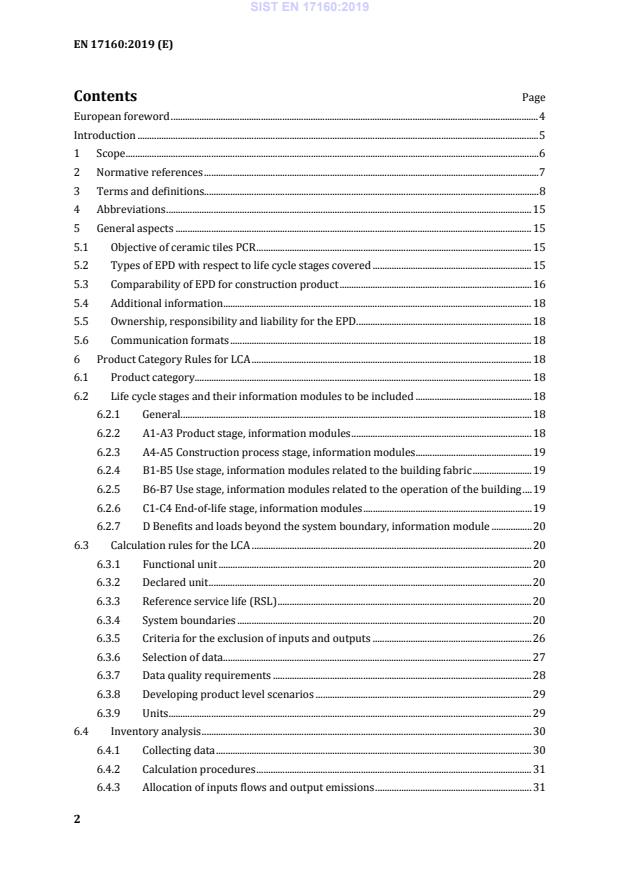
2003-01.Slovenski inštitut za standardizacijo. Razmnoževanje celote ali delov tega standarda ni dovoljeno.Produktkategorieregeln für keramische Fliesen und PlattenRègles de définition des catégories de produits pour les carreaux céramiquesProduct category rules for ceramic tiles91.100.23Ceramic tilesICS:Ta slovenski standard je istoveten z:EN 17160:2019SIST EN 17160:2019en,fr,de01-maj-2019SIST EN 17160:2019SLOVENSKI
STANDARD
EUROPEAN STANDARD NORME EUROPÉENNE EUROPÄISCHE NORM
EN 17160
February
t r s { ICS
{ sä s r rä t u English Version
Product category rules for ceramic tiles Règles de définition des catégories de produits pour les carreaux céramiques
Produktkategorieregeln für keramische Fliesen und Platten This European Standard was approved by CEN on
t u December
t r s zä
egulations which stipulate the conditions for giving this European Standard the status of a national standard without any alterationä Upætoædate lists and bibliographical references concerning such national standards may be obtained on application to the CENæCENELEC Management Centre or to any CEN memberä
translation under the responsibility of a CEN member into its own language and notified to the CENæCENELEC Management Centre has the same status as the official versionsä
CEN members are the national standards bodies of Austriaá Belgiumá Bulgariaá Croatiaá Cyprusá Czech Republicá Denmarká Estoniaá Finlandá Former Yugoslav Republic of Macedoniaá Franceá Germanyá Greeceá Hungaryá Icelandá Irelandá Italyá Latviaá Lithuaniaá Luxembourgá Maltaá Netherlandsá Norwayá Polandá Portugalá Romaniaá Serbiaá Slovakiaá Sloveniaá Spainá Swedená Switzerlandá Turkey and United Kingdomä
EUROPEAN COMMITTEE FOR STANDARDIZATION COMITÉ EUROPÉEN DE NORMALISATION EUROPÄISCHES KOMITEE FÜR NORMUNG
CEN-CENELEC Management Centre:
Rue de la Science 23,
B-1040 Brussels
t r s { CEN All rights of exploitation in any form and by any means reserved worldwide for CEN national Membersä Refä Noä EN
s y s x rã t r s { ESIST EN 17160:2019
y 3 Terms and definitions. 8 4 Abbreviations . 15 5 General aspects . 15 5.1 Objective of ceramic tiles PCR . 15 5.2 Types of EPD with respect to life cycle stages covered . 15 5.3 Comparability of EPD for construction product . 16 5.4 Additional information . 18 5.5 Ownership, responsibility and liability for the EPD . 18 5.6 Communication formats . 18 6 Product Category Rules for LCA . 18 6.1 Product category . 18 6.2 Life cycle stages and their information modules to be included . 18 6.2.1 General. 18 6.2.2 A1-A3 Product stage, information modules . 18 6.2.3 A4-A5 Construction process stage, information modules . 19 6.2.4 B1-B5 Use stage, information modules related to the building fabric . 19 6.2.5 B6-B y Use stageá information modules related to the operation of the building . 19 6.2.6 C1-C4 End-of-life stage, information modules . 19
xä tä y D Benefits and loads beyond the system boundary, information module . 20 6.3 Calculation rules for the LCA . 20 6.3.1 Functional unit . 20 6.3.2 Declared unit . 20 6.3.3 Reference service life (RSL) . 20 6.3.4 System boundaries . 20 6.3.5 Criteria for the exclusion of inputs and outputs . 26 6.3.6 Selection of data .
t y
xä uä y Data quality requirements . 28 6.3.8 Developing product level scenarios . 29 6.3.9 Units . 29 6.4 Inventory analysis . 30 6.4.1 Collecting data . 30 6.4.2 Calculation procedures . 31 6.4.3 Allocation of inputs flows and output emissions . 31 SIST EN 17160:2019
y Content of the EPD . 34
yä s Declaration of general information . 34
yä t Declaration of environmental parameters derived from LCA . 35
yä t.1 General. 35
yä tä t Rules for declaring LCA information per module . 35
yä tä u Parameters describing environmental impacts . 35
yä tä v Parameters describing resource use . 36
yä tä w Other environmental information describing different waste categories and outputs flows
u y
yä u Scenarios and additional technical information . 38
yä uä s General. 38
yä uä t Construction process stage . 39
yä uä u B1-B y use stage . 42
yä uä v End-of-life . 44
yä v Additional information on release of dangerous substances to indoor air, soil and water during the use stage . 45
yä vä s Indoor air . 45
yä vä t Soil and water . 45
yä w Aggregation of information modules . 46 8 Project report . 46 8.1 General . 46 8.2 LCA-related elements of the project report . 46 8.3 Documentation on additional information . 48 8.4 Data availability for verification . 48 9 Verification and validity of an EPD . 49 Annex A (normative)
Requirements and guidance on the reference service life . 50 Annex B (informative)
Waste . 54 B.1 End-of-waste . 54 B.2 Properties of hazardous waste for Table 5 . 54 Annex C (normative)
Characterization factors for GWP, ODP, AP, EP, POCP and ADP . 55 Bibliography . 69
s y s x r:2019) has been prepared by Technical Committee CEN/TC
x y “Ceramic tiles”, the secretariat of which is held by UNI. This European Standard shall be given the status of a national standard, either by publication of an identical text or by endorsement, at the latest by August 2019, and conflicting national standards shall be withdrawn at the latest by August 2019. Attention is drawn to the possibility that some of the elements of this document may be the subject of patent rights. CEN shall not be held responsible for identifying any or all such patent rights. According to the CEN-CENELEC Internal Regulations, the national standards organisations of the following countries are bound to implement this European Standard: Austria, Belgium, Bulgaria, Croatia, Cyprus, Czech Republic, Denmark, Estonia, Finland, Former Yugoslav Republic of Macedonia, France, Germany, Greece, Hungary, Iceland, Ireland, Italy, Latvia, Lithuania, Luxembourg, Malta, Netherlands, Norway, Poland, Portugal, Romania, Serbia, Slovakia, Slovenia, Spain, Sweden, Switzerland, Turkey and the United Kingdom. SIST EN 17160:2019
s w { y z, Sustainability of construction works – Assessment of environmental performance of buildings – Calculation method; — EN 15804:2012+A1:2013, Sustainability of construction works – Environmental product declaration – Core rules for the product category of construction products; — CEN/TR 15941, Sustainability of construction works – Environmental product declarations – Methodology for selection and use of generic data; — EN 15942, Sustainability of construction works – Environmental product declarations – Communication format business-to-business. SIST EN 17160:2019
yä u when primary data are not available. The results of these stages shall be shown individually (without being added together). Therefore, these PCR cover:
EPD cradle-to-gate (only the product stage is considered);
EPD cradle-to-grave (the whole life cycle of ceramic tiles is considered). In these type of EPD module D may be included. After verification an EPD is valid for a 5 year period from the date of issue, after which it shall be reviewed and verified. SIST EN 17160:2019
ISO and IEC maintain terminological databases for use in standardization at the following addresses:
http://www.electropedia.org/
ne browsing platform: available at http://www.iso.org/obp 3.1 additional technical information information that forms part of the EPD by providing a basis for the development of scenarios [SOURCE: EN 15804:2012+A1:2013] 3.2 allocation partitioning the input or output flows of a process or a product system between the product system under study and one or more other product systems [SOURCE: EN ISO 14040:2006] 3.3 ancillary material input material or product that is used by the unit process producing the product, but which does not constitute part of the product Note 1 to entry: Example of ancillary material oil used in the press, batteries, lime used into purification systems. [SOURCE: EN ISO 14040:2006] 3.4 average data data representative of a product, product group or construction service, provided by more than one supplier Note 1 to entry: The product group or construction service can contain similar products or construction services. [SOURCE: EN 15804:2012+A1:2013] 3.5 by-product production material that is not waste and process characteristics that make it ready for further use in the market place without any further processing Note 1 to entry: Example of by-product fired and unfired production solid discharge materials. [SOURCE: ISO 14021:2016] SIST EN 17160:2019
x y r y-1:2004 according to the recommendation of ISO/TC 59/AHG Terminology. [SOURCE: EN 15643-1:2010, 3.11] 3.10 construction service activity that supports the construction process or subsequent maintenance [SOURCE: EN 15804:2012+A1:2013] 3.11 co-product any of two or more marketable materials, products or fuels from the same unit process, but which is not the object of the assessment Note 1 to entry: Co-product, by-product and product have the same status and are used for identification of several distinguished flows of products from the same unit process. From co-product, by-product and product, waste is the only output to be distinguished as a non-product. Note 2 to entry: Example of by-product spry dry powder sold to a third company. [SOURCE: EN 15804:2012+A1:2013] SIST EN 17160:2019
y cm [SOURCE: EN 14411:2016] 3.25 non-renewable energy energy from sources which are not defined as renewable energy sources [SOURCE: EN 15804:2012+A1:2013] SIST EN 17160:2019
“Parties involved” are usually supplier “first party” and purchaser “second party” interests. [SOURCE: EN ISO 14024:2000] 3.40 type III environmental declaration environmental declaration providing quantified environmental data using predetermined parameters and, where relevant, additional environmental information Note 1 to entry: The calculation of predetermined parameters is based on the ISO 14040 series of standards, which is made up of ISO 14040, and ISO 14044. The selection of the predetermined parameters is based on ISO 21930 adapted from ISO 14025. [SOURCE: EN 15804:2012+A1:2013] 3.41 upstream process process that precedes a given life cycle stage [SOURCE: EN 15804:2012+A1:2013, modified] 3.42 downstream process process that follows a given life cycle stage [SOURCE: EN 15804:2012+A1:2013, modified] 3.43 waste substance or object which the holder discards or intends or is required to discard [SOURCE: Directive 2008/98/EC, Art. 3, 1.] 3.44 unit process smallest element considered in the life cycle inventory analysis for which input and ouput data are quantified [SOURCE: EN ISO 14040:2006] SIST EN 17160:2019
best available techniques reference document
EPD
environmental product declaration PCR product category rules LCA
life cycle assessment LCI
life cycle inventory analysis LCIA
life cycle impact assessment RSL
reference service life EOL
end of life ESL
estimated service life ELCD
European life cycle database EPBD
energy performance of buildings directive 5 General aspects 5.1 Objective of ceramic tiles PCR The objective of the PCR for ceramic tiles is to ensure: — the provision of verifiable and consistent data for an EPD, based on the LCA; — the provision of verifiable and consistent ceramic tiles related technical data or scenarios for the assessment of the environmental performance of buildings; — the provision of verifiable and consistent ceramic tiles related technical data or scenarios potentially related to the health of users for the assessment of the performance of buildings; — that comparisons between construction products are carried out in the context of their application in the building; — the communication of the environmental information of construction products from business to business; — the basis, subject to additional requirements, for the communication of the environmental information of ceramic tiles to consumers. Declarations based on this standard are not comparative assertions. 5.2 Types of EPD with respect to life cycle stages covered The EPD shall at least include the product stage (A1 to A3) of ceramic tiles (see Figure 1). If the entire life cycle of the product is considered, this shall be subdivided into the following stages: — Product: corresponds to the manufacture of the ceramic tiles, including all the upstream processes of the product stage (raw materials supply and/or recycled materials, raw materials’ transport, energy supply, etc.). It comprises modules A1, A2, and A3 of EN 15804:2012+A1:2013; SIST EN 17160:2019
Figure 1 — Types of EPD with respect to life cycle stages covered and life cycle stages and modules for the building assessment. (EN 15804:2012+A1:2013) NOTE
Cradle to gate with option EPDs are not applicable for this PCR. SIST EN 17160:2019
yä u; — additional information on emissions to indoor air, soil and water during the use stage, describing release of dangerous substances into indoor air, soil and water which are not covered by LCIA. This additional information is required. See
yä v. 5.5 Ownership, responsibility and liability for the EPD A manufacturer or a group of manufacturers are the sole owners and have liability and responsibility for an EPD. 5.6 Communication formats The communication format of the EPD shall be in accordance with EN 15942. 6 Product Category Rules for LCA 6.1 Product category The product category referred to in these PCR includes all ceramic tiles coverings for flooring and/or wall and façade cladding, both indoors and outdoors, including mosaics and decorative pieces. 6.2 Life cycle stages and their information modules to be included 6.2.1 General The environmental information of an EPD covering all life cycle stages (“cradle to grave”) shall be subdivided into the information module groups A1 to A3, A4-A5, B1 to B5, B6-B yá C s to C v and module D. Only the declaration of the product stage modules, A1 to A3, is required for compliance with these PCR. Information modules within any of the life cycle stages are communicated depending on the types of EPD as specified in 5.2. They include impacts and aspects related to losses in the module in which the losses occur (i.e. production, transport, and waste processing and disposal of the lost waste products and materials). 6.2.2 A1-A3 Product stage, information modules The product stage includes: A1: raw material extraction and processing, processing of secondary material input (e.g. recycling processes, recovered glass and sludge); A2: transport of raw materials to the manufacturer; A3: manufacturing of ceramic tiles; including provision of all materials, products and energy, as well as waste processing up to the end-of waste state (6.3.4.5) or disposal of final residues during the product stage. SIST EN 17160:2019
Figure 2 — Example of a cradle-to-gate ceramic tile process flow diagram 6.3.4.2 Product stage The product stage is an information module required to be included in the EPD. As illustrated in Figure 1 it includes the information modules A1 to A3. The system boundary with nature is set to include those processes that provide the material and energy inputs into the system and the following manufacturing, and transport processes up to the factory gate as well as the processing of any waste arising from those processes. In the case of input of secondary materials or energy recovered from secondary fuels, the system boundary between the system under study and the previous system (providing the secondary materials) is set where outputs of the previous system, e.g. materials, products, building elements or energy, reach the end-of-waste state (see 6.3.4.5 and Annex B). SIST EN 17160:2019
The product stage, which includes the production of ceramic tiles and other materials, such as packaging materials, shall be included in the EPD and comprises the following modules and processes: A1: Extraction and processing of raw materials (e.g. mining processes (clay, kaolin, feldspar, etc.)). Purchased products, such as frits, spray dry powder or glazes should be included in A1 phase; A1: Reuse of products of materials from a previous product syste
...