

SIST EN 17092-5:2020
(Main)Protective garments for motorcycle riders - Part 5: Class B garments - Requirements
General Information
- Abstract
This European Standard specifies general requirements for motorcyclists’ protective garments of Class B: protective garments, which are intended to provide limited protection to the wearer against abrasion injury. It applies to protective garments for motorcycle on-road use.
- Status
- Published
- Public Enquiry End Date
- 19-Apr-2017
- Publication Date
- 29-Mar-2020
- Technical Committee
- OVP - Personal protecting equipment
- Current Stage
- 6060 - National Implementation/Publication (Adopted Project)
- Start Date
- 05-Mar-2020
- Due Date
- 10-May-2020
- Completion Date
- 30-Mar-2020
- Directive
- 2016/425 - Regulation (EU) 2016/425 of the European Parliament and of the Council of 9 March 2016 on personal protective equipment and repealing Council Directive 89/686/EECOJ Ref: L 077, L 77 OJ Date: 05-Mar-2021


Overview
SIST EN 17092-5:2020 is a European Standard developed by CEN that specifies the general requirements for Class B protective garments for motorcycle riders. These garments are designed to provide limited protection against abrasion injuries during on-road motorcycle use. Unlike higher classes, Class B garments offer abrasion resistance but do not include integrated impact protectors, making them suitable for modular use in combination with standalone impact protection.
This standard supports manufacturers, safety professionals, retailers, and regulators in ensuring motorcycle protective clothing meets essential requirements for abrasion safety without compromising comfort or mobility.
Key Topics
Scope of Protection:
Class B garments are focused on abrasion resistance, using materials and construction that match the abrasion protection of Class A garments (EN 17092-4), but omit integrated impact protectors.Garment Types Covered:
- Jackets
- Trousers (including salopettes)
- One-piece suits
- Two-piece suits
- Other modular protective clothing for on-road motorcyclists
Design and Performance Requirements:
- Materials and seams must provide defined levels of abrasion, tear, and seam strength based on the risk zones of the garment.
- Zone-based risk assessment: Garment areas are classified into zones (Zone 1: high risk, Zone 2: moderate risk, Zone 3: low risk), each having specific performance criteria.
- Requirements for dimensional stability, fit, and garment restraint (e.g., sleeve or waist fastening) to ensure the garment stays in place during an incident.
- Additional construction rules for vents, pockets, closures, and non-abrasive or retroreflective materials if included.
Marking and Information:
Garments must be clearly labeled per EN ISO 13688 and include user instructions to ensure correct use and maintenance.
Applications
Motorcycle Clothing Manufacturers:
Reference SIST EN 17092-5:2020 to design and test modular garments (e.g., mesh jackets, riding jeans) that provide abrasion protection for riders preferring to select their own impact protectors.Retailers and Distributors:
Use this standard to communicate product compliance and support consumer education on the modular approach to motorcycle safety gear.Riders:
Tailor personal protection by combining Class B garments with certified impact protectors (e.g., EN 1621-1/2 pads) in high-impact zones for complete minimum protection.Certification Bodies and Market Surveillance:
Assess garments’ conformity to European PPE Regulation (EU) 2016/425 through standardized performance and marking requirements.
Related Standards
For a comprehensive approach to motorcycle protective clothing, consider the suite of related EN 17092 standards:
- EN 17092-1:2020: Test methods for motorcycle protective garments
- EN 17092-2:2020: Requirements for Class AAA garments (highest protection)
- EN 17092-3:2020: Requirements for Class AA garments (advanced protection)
- EN 17092-4:2020: Requirements for Class A garments (basic protection, with impact protectors)
- EN 17092-6:2020: Requirements for Class C garments (impact protector ensemble garments)
- EN 1621 Series: Test standards for integrated impact protectors (shoulder, elbow, back, chest, inflatable)
- EN 13594 / EN 13634: Standards for protective gloves and footwear for motorcycle riders
SIST EN 17092-5:2020 ensures that motorcycle riders have access to independently tested and standardized Class B protective garments, supporting safety, modularity, and product transparency across the European market.
Relations
- Effective Date
- 01-May-2020
- Effective Date
- 01-May-2020
- Effective Date
- 01-May-2020
- Effective Date
- 01-May-2020
- Effective Date
- 28-Jan-2026
- Effective Date
- 28-Jan-2026
- Effective Date
- 28-Jan-2026
- Effective Date
- 28-Jan-2026
- Effective Date
- 28-Jan-2026
- Effective Date
- 28-Jan-2026
- Effective Date
- 28-Jan-2026
- Effective Date
- 28-Jan-2026
- Effective Date
- 28-Jan-2026
- Effective Date
- 28-Jan-2026
- Effective Date
- 28-Jan-2026
Get Certified
Connect with accredited certification bodies for this standard

TÜV Rheinland
TÜV Rheinland is a leading international provider of technical services.

TÜV SÜD
TÜV SÜD is a trusted partner of choice for safety, security and sustainability solutions.

DEKRA Certification Inc.
DEKRA US certification services.
Sponsored listings
Frequently Asked Questions
SIST EN 17092-5:2020 is a standard published by the Slovenian Institute for Standardization (SIST). Its full title is "Protective garments for motorcycle riders - Part 5: Class B garments - Requirements". This standard covers: This European Standard specifies general requirements for motorcyclists’ protective garments of Class B: protective garments, which are intended to provide limited protection to the wearer against abrasion injury. It applies to protective garments for motorcycle on-road use.
This European Standard specifies general requirements for motorcyclists’ protective garments of Class B: protective garments, which are intended to provide limited protection to the wearer against abrasion injury. It applies to protective garments for motorcycle on-road use.
SIST EN 17092-5:2020 is classified under the following ICS (International Classification for Standards) categories: 13.340.10 - Protective clothing; 43.140 - Motorcycles and mopeds. The ICS classification helps identify the subject area and facilitates finding related standards.
SIST EN 17092-5:2020 has the following relationships with other standards: It is inter standard links to SIST EN 13595-2:2003, SIST EN 13595-1:2002, SIST EN 13595-3:2002, SIST EN 13595-4:2002, SIST EN 17092-1:2020, SIST EN 13594:2015, SIST EN 1621-3:2019, SIST EN ISO 5077:2009, SIST EN 1150:1999, SIST EN 1621-4:2013, SIST EN ISO 4674-1:2017, SIST EN ISO 3377-1:2012, SIST EN ISO 13688:2013, SIST EN 1621-2:2014, SIST EN 1621-1:2013. Understanding these relationships helps ensure you are using the most current and applicable version of the standard.
SIST EN 17092-5:2020 is associated with the following European legislation: EU Directives/Regulations: 2016/425, 89/686/EEC; Standardization Mandates: M/031, M/571. When a standard is cited in the Official Journal of the European Union, products manufactured in conformity with it benefit from a presumption of conformity with the essential requirements of the corresponding EU directive or regulation.
SIST EN 17092-5:2020 is available in PDF format for immediate download after purchase. The document can be added to your cart and obtained through the secure checkout process. Digital delivery ensures instant access to the complete standard document.
Standards Content (Sample)
SLOVENSKI STANDARD
01-maj-2020
Nadomešča:
SIST EN 13595-1:2002
SIST EN 13595-2:2003
SIST EN 13595-3:2002
SIST EN 13595-4:2002
Varovalna obleka za voznike motornih koles - 5. del: Oblačila razreda B - Zahteve
Protective garments for motorcycle riders - Part 5: Class B garments - Requirements
Motorradfahrerschutzkleidung - Teil 5: Kleidungsstücke der Klasse B - Anforderungen
Vêtements de protection pour les motocyclistes - Partie 5 : Vêtements de classe B -
Exigences
Ta slovenski standard je istoveten z: EN 17092-5:2020
ICS:
13.340.10 Varovalna obleka Protective clothing
43.140 Motorna kolesa in mopedi Motorcycles and mopeds
2003-01.Slovenski inštitut za standardizacijo. Razmnoževanje celote ali delov tega standarda ni dovoljeno.
EN 17092-5
EUROPEAN STANDARD
NORME EUROPÉENNE
February 2020
EUROPÄISCHE NORM
ICS 13.340.10 Supersedes EN 13595-1:2002, EN 13595-2:2002, EN
13595-3:2002, EN 13595-4:2002
English Version
Protective garments for motorcycle riders - Part 5: Class B
garments - Requirements
Vêtements de protection pour les motocyclistes - Partie Motorradfahrerschutzkleidung - Teil 5:
5 : Vêtements de classe B - Exigences Kleidungsstücke der Klasse B - Anforderungen
This European Standard was approved by CEN on 25 November 2019.
CEN members are bound to comply with the CEN/CENELEC Internal Regulations which stipulate the conditions for giving this
European Standard the status of a national standard without any alteration. Up-to-date lists and bibliographical references
concerning such national standards may be obtained on application to the CEN-CENELEC Management Centre or to any CEN
member.
This European Standard exists in three official versions (English, French, German). A version in any other language made by
translation under the responsibility of a CEN member into its own language and notified to the CEN-CENELEC Management
Centre has the same status as the official versions.
CEN members are the national standards bodies of Austria, Belgium, Bulgaria, Croatia, Cyprus, Czech Republic, Denmark, Estonia,
Finland, France, Germany, Greece, Hungary, Iceland, Ireland, Italy, Latvia, Lithuania, Luxembourg, Malta, Netherlands, Norway,
Poland, Portugal, Republic of North Macedonia, Romania, Serbia, Slovakia, Slovenia, Spain, Sweden, Switzerland, Turkey and
United Kingdom.
EUROPEAN COMMITTEE FOR STANDARDIZATION
COMITÉ EUROPÉEN DE NORMALISATION
EUROPÄISCHES KOMITEE FÜR NORMUNG
CEN-CENELEC Management Centre: Rue de la Science 23, B-1040 Brussels
© 2020 CEN All rights of exploitation in any form and by any means reserved Ref. No. EN 17092-5:2020 E
worldwide for CEN national Members.
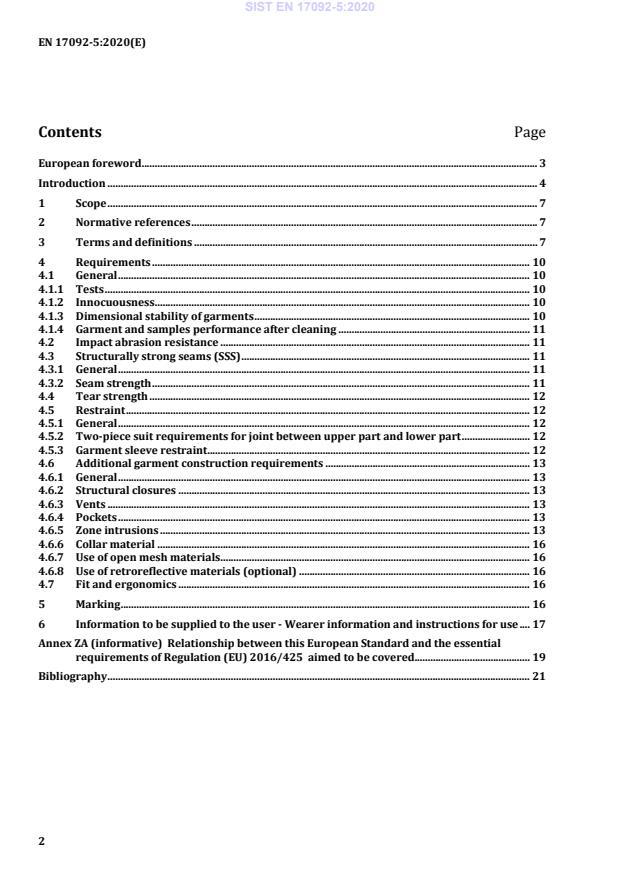
Contents Page
European foreword . 3
Introduction . 4
1 Scope . 7
2 Normative references . 7
3 Terms and definitions . 7
4 Requirements . 10
4.1 General . 10
4.1.1 Tests . 10
4.1.2 Innocuousness . 10
4.1.3 Dimensional stability of garments . 10
4.1.4 Garment and samples performance after cleaning . 11
4.2 Impact abrasion resistance . 11
4.3 Structurally strong seams (SSS) . 11
4.3.1 General . 11
4.3.2 Seam strength . 11
4.4 Tear strength . 12
4.5 Restraint . 12
4.5.1 General . 12
4.5.2 Two-piece suit requirements for joint between upper part and lower part . 12
4.5.3 Garment sleeve restraint . 12
4.6 Additional garment construction requirements . 13
4.6.1 General . 13
4.6.2 Structural closures . 13
4.6.3 Vents . 13
4.6.4 Pockets . 13
4.6.5 Zone intrusions . 13
4.6.6 Collar material . 16
4.6.7 Use of open mesh materials. 16
4.6.8 Use of retroreflective materials (optional) . 16
4.7 Fit and ergonomics . 16
5 Marking . 16
6 Information to be supplied to the user - Wearer information and instructions for use . 17
Annex ZA (informative) Relationship between this European Standard and the essential
requirements of Regulation (EU) 2016/425 aimed to be covered . 19
Bibliography . 21
European foreword
This document (EN 17092-5:2020) has been prepared by Technical Committee CEN/TC 162 “Protective
clothing including hand and arm protection and lifejackets”, the secretariat of which is held by DIN.
This European Standard shall be given the status of a national standard, either by publication of an
identical text or by endorsement, at the latest by August 2020, and conflicting national standards shall
be withdrawn at the latest by February 2023.
Attention is drawn to the possibility that some of the elements of this document may be the subject of
patent rights. CEN shall not be held responsible for identifying any or all such patent rights.
This document, together with EN 17092-1:2020, EN 17092-2:2020, EN 17092-3:2020, 17092-4:2020
and EN 17092-6:2020, supersedes EN 13595-1:2002, EN 13595-2:2002, EN 13595-3:2002,
EN 13595-4:2002.
This document has been prepared under a standardization request given to CEN by the European
Commission and the European Free Trade Association, and supports essential requirements of
Regulation (EU) 2016/425.
For relationship with EU Regulation, see informative Annex ZA, which is an integral part of this
document.
This standard is part of a series of standards specifying test methods and requirements for
motorcyclists’ protective garments. EN 17092 is comprised of multiple parts:
— Part 1: Test methods
— Part 2: Class AAA garments — Requirements
— Part 3: Class AA garments — Requirements
— Part 4: Class A garments — Requirements
— Part 5: Class B garments — Requirements
— Part 6: Class C garments — Requirements
According to the CEN-CENELEC Internal Regulations, the national standards organisations of the
following countries are bound to implement this European Standard: Austria, Belgium, Bulgaria,
Croatia, Cyprus, Czech Republic, Denmark, Estonia, Finland, France, Germany, Greece, Hungary, Iceland,
Ireland, Italy, Latvia, Lithuania, Luxembourg, Malta, Netherlands, Norway, Poland, Portugal, Republic of
North Macedonia, Romania, Serbia, Slovakia, Slovenia, Spain, Sweden, Switzerland, Turkey and the
United Kingdom.
Introduction
Motorcyclists’ protective jackets, trousers, one-piece suits, two-piece suits, impact protector ensemble
garments and other protective garments (hereinafter: “garments”) are intended to give some amount of
protection to riders without significantly reducing the ability of the rider to control the motorcycle. In
addition, they are designed to provide adequate protection against the risks against which they are
intended to protect, such as a fall from a motorcycle or another accident. Additional, particular, hazards
encountered during a motorcycle accident may include: impact with and abrasion from the riding
surface, impacts with the rider’s motorcycle, conflicting vehicles, and other objects. Motorcyclists’
protective garments are not intended to and cannot prevent traumas caused by high-energy impacts,
traumas caused by severe forces of bending, twisting, torsion, flexion, or crushing as the result of
striking an object, traumas caused by extreme abrasion, traumas caused by extreme movements, or
traumas caused by massive penetrations. No protective garments can offer complete protection against
all injuries. The principle of this standard is to define the basic performance requirements considered
essential for motorcyclists’ protective garments, in order for them to offer useful, classes of protection
to riders according to the risks they may encounter, in the situations described above, during various
riding activities and in various riding environments. This standard does not cover risks caused by
extreme weather conditions. Where additional protective features are claimed (e.g. high visibility), the
assessment of said protective features will be done with reference to the appropriate additional
standards.
Motorcycling encompasses a diverse range of riders participating in a diverse range of activities. While
all motorcyclists face similar fundamental risks when involved in an accident or a fall from a
motorcycle, the type and degree of risk or hazard that a motorcyclist will encounter and the class of
protection that they will need is closely linked to the riding activity, the riding environment, and the
nature of the accident. In addition, because each motorcyclist participates in their chosen riding activity
in different ways, within specific riding activities motorcyclists are also exposed to varying levels of risk
and, therefore, require varying classes of protection. The elements that are a part of the fundamental
design and functionality of a particular type of motorcyclists’ protective garment, while appropriate and
minimally constraining or limiting when used in a specific environment for a specific riding activity,
may, on the other hand, present unacceptable constraints and liabilities in other riding environments
and for other riding activities, such as increased penalties of weight, decreased range of motion and/or
heat stress, and therefore, may not be acceptable for use by all riders during all motorcycle activities.
This series of standards has been developed to encompass a large range of motorcycle disciplines and
motorcyclists’ activities, each with their own particular risks and appropriate classes of protection, to
ensure that the best possible protection of an appropriate type is available for riders during their riding
activities.
This standard is a part of a series of standards including also EN 17092-2, EN 17092-3, EN 17092-4 and
EN 17092-6 which together describe the requirements for motorcyclists’ garments, according to the
various classes of protection offered and EN 17092-1, which specifies the test methods to assess the
conformity of said garments to the requirements of the applicable product standard of the EN 17092
series.
Classes of motorcycle protective garments and the principle of risk category zoning
Classes of Protection
Garments designed to provide protection for motorcycle riders are tested according to the class of
protection they afford. The performance requirements for the classes of protection are detailed by
specific standards as follows:
— EN 17092 - 2— Class AAA garments
offer protection from impact and abrasion, using materials and construction that meet higher
requirements than for garments covered by parts 3, and 4 of this standard series.
Class AAA garments may have limiting ergonomic, weight and thermal penalties for some riding
activities.
Some common examples are: one-piece or two-piece suits.
— EN 17092-3 — Class AA garments.
offer protection from impact and abrasion, using materials and construction that meet higher
requirements than for garments covered by part 4 of this standard series and lower requirements than
for garments covered by part 2 of this standard series.
Class AA garments generally offer protection, against the risks of the greatest diversity of riding
activities, and they may have lower ergonomic and weight penalties than Class AAA garments.
Some common examples are: garments designed to be worn by themselves or to be worn over other
clothing.
— EN 17092-4 — Class A garments.
Offer a minimum necessary degree of protection from impact and abrasion, using materials and
construction that meet lower requirements than for parts 2 and 3 of this standard series.
Class A garments are expected to have the least ergonomic and weight penalties.
Some common examples are: garments, designed to be worn by themselves or to be worn over other
clothing by riders in warm environments.
— EN 17092-5 — Class B garments.
This class is for specialized garments, designed to provide the equivalent abrasion protection of Class A
garments but without the inclusion of impact protectors.
Class B garments do not offer impact protection and it is recommended that they be worn with, at least,
EN 1621-1 shoulder and elbow impact protectors, in the case of a jacket, or EN 1621-1 knee impact
protectors, in the case of trousers, in order to offer complete minimum protection.
Some common examples are: modular garments suitable to be combined with other garments providing
impact protection.
— EN 17092-6 — Class C garments.
This class is for specialized non-shell, impact protector ensemble garments, designed only to hold one
or more impact protectors in place, either as an undergarment or as an overgarment.
Class C garments are designed to provide impact protection for areas covered by the impact
protector(s) only and they do not offer complete minimum abrasion protection and may not offer
complete minimum impact protection.
Class C garments are designed to offer supplemental impact protection only. It is intended that Class C
garments be worn in combination with Class AAA, AA, A or B garments to enhance the protection Class
AAA, AA, A or B garments offer.
Some common examples are: modular garments suitable to be combined with other garments providing
impact and abrasion protection or only abrasion protection.
This standard contains the requirements for Class B garments.
Risk category zoning
The performance requirements of the various aforementioned standards for motorcyclists’ protective
garments are, in turn, based on specific performance requirements for the garments’ “risk category
zones”. Risk category zones are defined according to the likelihood that the area of the garment
included in the zone will be subject to mechanical stress, in the event of an accident. There are three
zones, as follows:
— Zone 1 – the areas of motorcyclists’ protective garments that have a high risk of damage e.g. impact,
abrasion, and tearing.
— Zone 2 – the areas of motorcyclists’ protective garments that have a moderate risk of damage e.g.
abrasion and tearing.
— Zone 3 – the areas of motorcyclists’ protective garments that have a low risk of damage e.g.
abrasion and tearing.
1 Scope
This European Standard specifies general requirements for motorcyclists’ protective garments of
Class B: protective garments, which are intended to provide limited protection to the wearer against
abrasion injury. It applies to protective garments for motorcycle on-road use.
2 Normative references
The following documents are referred to in the text in such a way that some or all of their content
constitutes requirements of this document. For dated references, only the edition cited applies. For
undated references, the latest edition of the referenced document (including any amendments) applies.
EN 1150:1999, Protective Clothing - Visibility clothing for non-professional use – Test methods and
requirements
EN 1621-1:2012, Motorcyclists' protective clothing against mechanical impact - Part 1: Motorcyclists'
limb joint impact protectors - Requirements and test methods
EN 1621-2:2014, Motorcyclists' protective clothing against mechanical impact - Part 2: Motorcyclists'
back protectors - Requirements and test methods
EN 1621-3:2018, Motorcyclists' protective clothing against mechanical impact — Part 3: Motorcyclists'
chest protectors - Requirements and test methods
EN 1621-4:2013, Motorcyclists' protective clothing against mechanical impact - Part 4: Motorcyclists'
inflatable protectors - Requirements and test methods
EN 13356:2001, Visibility accessories for non-professional use — Test methods and requirements
EN 13594:2015, Protective gloves for motorcycle riders - Requirements and test methods
EN 13634:2017, Protective footwear for motorcycle riders - Requirements and test methods
EN ISO 3377-1:2011, Leather - Physical and mechanical tests - Determination of tear load - Part 1: Single
edge tear (ISO 3377-1:2011)
EN ISO 13688:2013, Protective clothing - General requirements (ISO 13688:2013)
EN ISO 4674-1:2016, Rubber- or plastics-coated fabrics - Determination of tear resistance - Part 1:
Constant rate of tear methods (ISO 4674-1:2016)
EN ISO 5077:2008, Textiles - Determination of dimensional change in washing and drying (ISO
5077:2007)
EN 17092-1:2020, Protective garments for motorcycle riders — Part 1: Test methods
3 Terms and definitions
For the purposes of this document, the following terms and definitions apply.
3.1
garment
jackets or trouser separate, one-piece or two-piece suit, impact protector ensemble clothing, and other
protective motorcycle rider clothing types excluding protective motorcycle rider clothing for the head,
neck, hands, or feet
3.1.1
class B garment
clothing designed to provide the equivalent abrasion protection of EN 17092-4 clothing but without the
inclusion of impact protectors.
3.1.2
jacket
garment constructed to provide protective coverage for the upper part of the body generally from the
neck to the waistline or below, including the arms
Note 1 to entry: A system to link the jacket to trousers may be present.
Note 2 to entry: For two-piece suits, jackets are the part of the suit that provide protective coverage for the
upper part of the body, generally from the neck to the waistline or below, including the arms.
3.1.3
trousers (including salopettes)
garment constructed to provide protective coverage from the area of the ankles up until the top of the
hips or above
Note 1 to entry: A system to link the trousers to jackets may be present.
Note 2 to entry: For two-piece suits, trousers are the part of the suit that provide protective coverage generally
from the ankles up until the top of the hips or above, including the area of the pelvis and buttocks.
3.1.4
one-piece suit
single garment constructed to provide protective coverage generally from the ankles to the neck,
including the arms
3.1.5
two-piece suit
garment constructed in two pieces: an upper part, providing protective coverage for the upper part of
the body including the arms and a lower part, providing protective coverage for the lower part of the
body generally to the ankles, with a system that joins the two pieces thereby, creating a single garment,
which essentially provides the protective coverage of a one-piece suit
3.1.6
impact protector ensemble garment
garment, which holds one or more impact protectors in place and is designed for use as an under or
over-garment and may take the general form of a jacket, trousers, one-piece suit, two-piece suit, or
other forms
3.2
impact protector
arrangement of energy absorbing and or impact spreading materials designed to offer some impact
protection to a specific area
Note 1 to entry: Impact protectors may be permanent in a garment or removable.
...