

SIST EN 4678:2011
(Main)Aerospace series - Weldments and brazements for aerospace structures - Joints of metallic materials by laser beam welding - Quality of weldments
General Information
- Abstract
This standard defines the rules to be observed to ensure the quality of aerospace structures in metallic materials by (solid code 521 and gas code 522 and diode laser Semi-conductor 523 according to EN ISO 4063:2009) laser beam welding, implemented automatically, semi-automatically or manually.
It is applicable without any restriction for the manufacturing of new parts or repair parts, these operations being under the responsibility of an approved Design Authority or repairer.
- Status
- Published
- Publication Date
- 24-Oct-2011
- Technical Committee
- I13 - Imaginarni 13
- Current Stage
- 6060 - National Implementation/Publication (Adopted Project)
- Start Date
- 14-Oct-2011
- Due Date
- 19-Dec-2011
- Completion Date
- 25-Oct-2011

Overview
EN 4678:2011 (CEN) - "Aerospace series – Weldments and brazements for aerospace structures – Joints of metallic materials by laser beam welding – Quality of weldments" - specifies rules to ensure the quality of metallic aerospace structures joined by laser beam welding. The standard covers laser types defined in EN ISO 4063 (solid 521, gas 522, diode/semiconductor 523) and applies to automatic, semi‑automatic and manual laser welding for both new manufacture and repair under an approved design authority.
Key topics and technical requirements
- Scope and applicability: Quality rules for laser beam welding of metallic aerospace parts; applicable without restriction to new parts and repairs when overseen by an approved design authority or repairer.
- Welding parameters and terminology: Defines important parameters such as run‑on/run‑off plates, beam shift, firing distance, focusing level, beam power, welding speed and specific welding energy - all used to control penetration and weld consistency.
- Process control and qualification: Requirements for welding procedure specification (WPS), qualification test specimens, welding campaigns, and stabilized manufacturing. References EN ISO 15609‑4 for laser WPS.
- Personnel and responsibilities: Roles and competence for welding coordinators, setters, welders and operators; links to EN ISO 14731 for welding coordination and EN 4179 for NDT personnel qualification.
- Inspection and testing: Destructive and non‑destructive inspection requirements and references (e.g., EN 1435 radiographic, ISO 17636, EN ISO 17640 ultrasonic, macro/micro examination and hardness tests).
- Manufacturing and repair controls: Technical requirements for manufacturing new parts and repair processes (including tack welding, pre‑heating, pool support and smoothing passes), plus traceability (batches, heat treatment, tooling).
- Quality assurance: Definitions of acceptance criteria, inspection levels, and documentation needed to demonstrate conformance.
Practical applications and users
EN 4678:2011 is intended for:
- Aerospace OEMs and Tier suppliers specifying and validating laser welding for metallic structures.
- Approved repair stations and design authorities managing repair procedures and return‑to‑service inspections.
- Welding coordinators, process engineers, setters and welders who develop and implement laser welding procedures.
- Quality, NDT and certification personnel responsible for inspection, testing and documentation.
Typical uses include qualification of laser welding procedures, production control of fuselage, engine and structural components, repair method approval, and supplier audits.
Related standards (selected)
- EN ISO 4063 (process codes 521/522/523)
- EN ISO 15609‑4 (laser WPS)
- EN 1011‑6 (laser beam welding recommendations)
- EN 1435 / ISO 17636 (radiographic testing)
- EN ISO 17640 (ultrasonic testing)
- EN ISO 14731 (welding coordination)
- EN 4179 (NDT personnel qualification)
EN 4678:2011 provides a structured framework for specifying, qualifying and controlling laser beam weld quality in aerospace metallic assemblies - essential for manufacturers and repairers seeking consistent, traceable, and auditable laser welding practices.
Relations
- Effective Date
- 29-Jul-2026
- Effective Date
- 09-Feb-2026
- Effective Date
- 09-Feb-2026
- Effective Date
- 28-Jan-2026
- Effective Date
- 28-Jan-2026
- Effective Date
- 28-Jan-2026
- Effective Date
- 28-Jan-2026
- Effective Date
- 28-Jan-2026
- Effective Date
- 28-Jan-2026
- Effective Date
- 28-Jan-2026
- Effective Date
- 28-Jan-2026
- Effective Date
- 28-Jan-2026
- Effective Date
- 28-Jan-2026
- Effective Date
- 28-Jan-2026
- Effective Date
- 28-Jan-2026
Get Certified
Connect with accredited certification bodies for this standard

BUREAU VERITAS Certification Germany
Bureau Veritas certification in Germany.

Element Materials Technology
Materials testing and product certification.

AQMS Ltd.
AQMS provides ISO certification to SMEs across the UK.
Sponsored listings
Frequently Asked Questions
SIST EN 4678:2011 is a standard published by the Slovenian Institute for Standardization (SIST). Its full title is "Aerospace series - Weldments and brazements for aerospace structures - Joints of metallic materials by laser beam welding - Quality of weldments". This standard covers: This standard defines the rules to be observed to ensure the quality of aerospace structures in metallic materials by (solid code 521 and gas code 522 and diode laser Semi-conductor 523 according to EN ISO 4063:2009) laser beam welding, implemented automatically, semi-automatically or manually. It is applicable without any restriction for the manufacturing of new parts or repair parts, these operations being under the responsibility of an approved Design Authority or repairer.
This standard defines the rules to be observed to ensure the quality of aerospace structures in metallic materials by (solid code 521 and gas code 522 and diode laser Semi-conductor 523 according to EN ISO 4063:2009) laser beam welding, implemented automatically, semi-automatically or manually. It is applicable without any restriction for the manufacturing of new parts or repair parts, these operations being under the responsibility of an approved Design Authority or repairer.
SIST EN 4678:2011 is classified under the following ICS (International Classification for Standards) categories: 49.025.05 - Ferrous alloys in general. The ICS classification helps identify the subject area and facilitates finding related standards.
SIST EN 4678:2011 has the following relationships with other standards: It is inter standard links to SIST EN ISO 11145:2026, SIST ISO 24394:2017, SIST EN 4179:2026, SIST EN ISO 4136:2022, SIST EN ISO 17640:2019, SIST EN 4632-005:2010, SIST EN ISO 15609-4:2010, SIST EN ISO 17636-2:2023, SIST EN ISO 22827-1:2006, SIST EN ISO 17636-1:2023, SIST EN ISO 6520-1:2008, SIST EN 4179:2022, SIST EN 4632-001:2008, SIST EN 1539:2010, SIST EN 4632-003:2010. Understanding these relationships helps ensure you are using the most current and applicable version of the standard.
SIST EN 4678:2011 is available in PDF format for immediate download after purchase. The document can be added to your cart and obtained through the secure checkout process. Digital delivery ensures instant access to the complete standard document.
Standards Content (Sample)
2003-01.Slovenski inštitut za standardizacijo. Razmnoževanje celote ali delov tega standarda ni dovoljeno.Aeronavtika - Varjeni in trdo spajkani sestavi za konstrukcije v aeronavtiki - Spoji kovinskih materialov pri varjenju z laserskim snopom - Kakovost varjenih sestavovLuft- und Raumfahrt - Schweiß- und Lötverbindungen für die Luft- und Raumfahrt - Lasers strahlschweißen - Qualität der SchweißverbindungenSérie aérospatiale - Assemblages soudés et brasés pour constructions aérospatiales - Assemblages de matériaux métalliques soudés par faisceaux laser - Qualité des assemblages soudésAerospace series - Weldments and brazements for aerospace structures - Joints of metallic materials by laser beam welding - Quality of weldments49.025.05Železove zlitine na splošnoFerrous alloys in generalICS:Ta slovenski standard je istoveten z:EN 4678:2011SIST EN 4678:2011en01-december-2011SIST EN 4678:2011SLOVENSKI
STANDARD
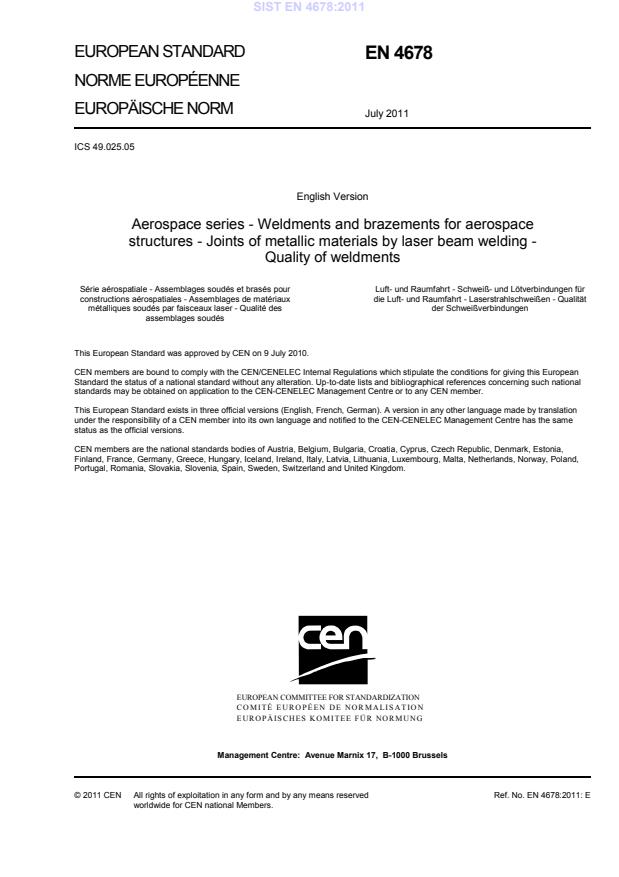
EUROPEAN STANDARD NORME EUROPÉENNE EUROPÄISCHE NORM
EN 4678
July 2011 ICS 49.025.05 English Version
Aerospace series - Weldments and brazements for aerospace structures - Joints of metallic materials by laser beam welding - Quality of weldments
Série aérospatiale - Assemblages soudés et brasés pour constructions aérospatiales - Assemblages de matériaux métalliques soudés par faisceaux laser - Qualité des assemblages soudés
Luft- und Raumfahrt - Schweiß- und Lötverbindungen für die Luft- und Raumfahrt - Laserstrahlschweißen - Qualität der Schweißverbindungen This European Standard was approved by CEN on 9 July 2010.
CEN members are bound to comply with the CEN/CENELEC Internal Regulations which stipulate the conditions for giving this European Standard the status of a national standard without any alteration. Up-to-date lists and bibliographical references concerning such national standards may be obtained on application to the CEN-CENELEC Management Centre or to any CEN member.
This European Standard exists in three official versions (English, French, German). A version in any other language made by translation under the responsibility of a CEN member into its own language and notified to the CEN-CENELEC Management Centre has the same status as the official versions.
CEN members are the national standards bodies of Austria, Belgium, Bulgaria, Croatia, Cyprus, Czech Republic, Denmark, Estonia, Finland, France, Germany, Greece, Hungary, Iceland, Ireland, Italy, Latvia, Lithuania, Luxembourg, Malta, Netherlands, Norway, Poland, Portugal, Romania, Slovakia, Slovenia, Spain, Sweden, Switzerland and United Kingdom.
EUROPEAN COMMITTEE FOR STANDARDIZATION
COMITÉ EUROPÉEN DE NORMALISATION EUROPÄISCHES KOMITEE FÜR NORMUNG
Management Centre:
Avenue Marnix 17,
B-1000 Brussels © 2011 CEN All rights of exploitation in any form and by any means reserved worldwide for CEN national Members. Ref. No. EN 4678:2011: ESIST EN 4678:2011
1) Published as ASD-STAN Prestandard at the date of publication of this standard by Aerospace and Defense Industries Association of Europe-Standardization (ASD-STAN), (www.asd-stan.org).
Non-destructive testing of welds - Ultrasonic testing - Techniques, testing levels, and assessment (ISO 17640:2010) ISO 22826, Destructive tests on welds in metallic materials — Hardness testing of narrow joints welded by laser and electron beam (Vickers and Knoop hardness tests) EN ISO 22827-1, Acceptance tests for Nd:YAG laser beam welding machines — Machines with optical fibre delivery — Part 1: Laser assembly (ISO 22827-1:2005) EN ISO 22827-2, Acceptance tests for Nd:YAG laser beam welding machines — Machines with optical fibre delivery — Part 2: Moving mechanism (ISO 22827-2:2005) ISO 24394, Welding for aerospace applications — Qualification test for welders and welding operators — Fusion welding of metallic components ISO/TR 25901, Welding and related processes — Vocabulary NAS 410, Certification and qualification of non-destructive test personnel 2)
2) Published by: National Standards Association, Inc., 1200 Quince Orchard Blvd, Gaithersburg, MD 20878, United States. SIST EN 4678:2011
3.2.1.3 Firing distance Distance between the impact point of the beam on detail parts and a reference surface linked to the machine EXAMPLE End of nozzle. 3.2.1.4 Specific welding energy Ratio between the beam power over the welding speed, multiplied by 60. Paverage (W) is measured at nozzle exit side.
J/cm)(k(cm/min)000160)(averageaverageVWPE××= SIST EN 4678:2011
Figure 1 3.2.1.6 Slope (or ramp) up Controlled increase of the beam power at the beginning of the welding 3.2.1.7 Clearance before welding Distance measured on a straight section of the joint between the sides to weld. NOTE The clearance depends on the design of the welded joint (for circular axial welds or circular welds see EN 1011-6). 3.2.1.8 Focusing level Distance between the beam impact point on the detail parts and the focusing point. NOTE Conventionally, this distance is negative when the focusing point is within the detail parts, see Figure 2. SIST EN 4678:2011
Key 1 Positive focusing level (+ 1 mm) 2 Focusing level 0 3 Negative focusing level (− 1 mm) 4 Firing distance 5 Detail part Figure 2 3.2.1.9 Beam power The laser beam power is measured with a calorimeter which absorbs all or part of the beam
3.2.1.10 Welding speed Length of the weld on beam impact side produced per time unit. 3.2.2 Other technical terms 3.2.2.1 Welding campaign Series of welding operations on identical parts, executed on the same machine, without any changes to adjustments, without performing other welds on the machine, without interrupting manufacturing for more than a week (working days). 3.2.2.2 Tacking pass Pre-assembling of elementary detail parts using the same process as the one used for welding, consisting of making slightly penetrating, narrow weld, continuous or discontinuous along the joint plane. The purpose is to maintain detail parts in position. SIST EN 4678:2011
Pre-assembly of detail parts by welding consisting of a set of tacks (by laser or an alternative process, for example TIG) along the joint plane, intended to hold the detail parts in position. SIST EN 4678:2011
Key 1 Pool support Figure 3 3.2.2.19 Heat treatment Treatment intended to provide the base material and the welded zone with the required characteristics and structural state 3.3 General terms 3.3.1 Customer
Individual or company placing a contract or order and who may or may not be the design authority. SIST EN 4678:2011
Person who makes, or manufactures and assembles the elements or subassemblies into assemblies.
3.3.3 Supplier Individual or company holding a contract or order that it has accepted, binding to the design authority of one company or to the final customer to perform the services defined therein. 3.3.4 Design authority The organisation responsible for the design of the welded assembly and for defining the performance and inspection requirements. 3.3.5 Welding coordinator Person responsible and competent to perform welding coordination according to EN ISO 14731. 3.3.6 Welder Person who is able to manipulate by hand the laser system and to manage the filler metal in the fusion pool and to develop the welding parameters. 3.3.7 Reinforced visual inspection Visual inspection of a surface with a magnifying glass, endoscope or other tests (dye penetrant or magnetoscopy, etc.). 3.3.8 Operator Person who operates adaptive control, automatic, mechanized, or robotic welding equipment. 3.3.9 Qualification Action recognizing that a welder, product, etc. is capable of fulfilling the role for which they are intended. 3.3.10 Repair Act consisting in making acceptable a part that was felt to be beyond the acceptance criteria after its normal manufacturing and inspection cycle NOTE Bringing into conformity of a part which had been damaged during operation 3.3.11 Setter Person in charge of the complete programming of the machine, beam analysis and finalization of welding procedure parameters and, if necessary, of performing welding operations using a mechanized or automated process.
3.3.12 Repairer Supplier in the repair activity domain. 3.3.13 Competent department Specialist service within a company with specific tasks. EXAMPLE Design office, quality service, laboratory, methods office. 3.3.14 Official supervisory body Approved government authorities or organizations responsible for checking the conformity of materials and welds with the definition file. SIST EN 4678:2011
P Welding power E Welding energy V Welding speed WPS Welding Procedure Specification 5 Weldability 5.1 Concept of weldability It is considered that a metallic material is weldable to a given degree, by a given process or for a given application type when, it can be used to produce a weld provided that precautions corresponding to this degree are taken, and if the characteristics and the consequences of the presence of the weld satisfy the required properties chosen as the basis for a judgement. 5.2 Weldability degrees Weldability of materials is assessed according to the following four degrees (see EN 4632-001): degree 1: material with very good weldability, for which no special precautions are necessary. To be used in preference. degree 2: material with good weldability but which may require special welding precautions (for example, preheating, low welding speed). degree 3: material with poor weldability, requiring specific development for each part type and which may involve manufacturing uncertainties. Not to be recommended. degree 4: material with very poor weldability. To be avoided. SIST EN 4678:2011
Weld classification is the responsibility of the design authority. 6.1.1 Manufacturing new parts
The design authority, at the time of part design, shall allocate a weld class to each joint: 1, 2 or 3 according to a decremental functional severity order. The requirements are listed in Table 1. A higher severity weld class may be allocated to meet specific problems such as manufacturing complexity or interpretation of inspection operations, etc.
Table 1 — Weld class allocation requirements Part with function Assembly weld rupture can alter normal operation of the part without significant consequences Safety critical 1 2 Other 2 3
A given part may have several different weld classes. Each weld class is associated with one of the following conditions: implementation before manufacturing; follow up during manufacturing; inspection on welded assembly; acceptance criteria. For weld classes 1 and 2, the design authority verifies with the quality department that the inspection operation makes it possible to guarantee compliance of the welds to the requirements of these classes. For class 1 welds, designs of lap welds, on raised edge or square-edged joint plane are not recommended (see sketch in Table 4). For classes 2 and 3 welds, overlapping welds on raised edges, on square-edged joint plane and with partial penetration joint are to be addressed in particular specifications. 6.1.2 Salvage The repairer shall comply with the recommendations of the design authority. However, if the acceptance criteria of this standard are selected due to the requirements of Clause 6, the repairer may propose a weld class. He shall then ask for the approval from the design authority or from the official supervisory body involved. SIST EN 4678:2011
finalization of parameters and production of the necessary documents. SIST EN 4678:2011
The training concerns: complete programming of the machine; analysis of beam quality according to EN ISO 15616-1. For instance, use of a beam analysis device which enables to obtain the position, diameter of focal point and space distribution of energy; finalization of parameters and production of the necessary documents; The setter shall prepare a welding procedure in order to validate his training. 6.3.2 Qualification 6.3.2.1 Operator and welder qualification
The examination on physical fitness (eyesight) of the operator and the welder will be realized in accordance with the test and requirements of the Table 2 hereafter or a test judged equivalent by the design authority.
Table 2 — Operator and welder qualification requirements Test Requirement Near vision Visual acuity (eyesight) shall be examined for near vision. Welder and Welding operators shall have vision acuity of 20/30 or better in each eye, and shall be able to read the Jaeger No. 2 eye chart at 400 mm or to pass an equivalent test as specified by an optometrist. Corrective vision may be used to fulfil eye test requirements Colour perception Be capable of distinguishing and differentiating colours used in the process involved. Where it is not possible to devise a suitable test, Ishihara test may be used.
Vision shall be tested to these requirements at least every two years. Operator and welder qualification shall comprise technical training on the process and production of a manufacturing test specimen, according to a given parameter welding procedure and have correctly produced at least one welded part. Guidance on operator and welder qualification is given in ISO 24394. Production of the manufacturing test specimen according to a given parameter welding procedure shall be renewed each time the operator has not welded for more than six months. Technical training on the process shall be repeated at least once every two years according to ISO 24394. Operator and welder qualification shall be the subject of a welding work quality follow up made by quality audit, based on conformance and periodic inspection operations carried out on standard production welds. SIST EN 4678:2011
Welders implementing the laser process by hand shall be able to manage filler metal in a fusion bath and to develop welding parameters. 6.3.2.3 Setter qualification The procedure defined during training 6.3.2.1. shall involve the production of welded parts by the setter or an operator and assessed as being in compliance by the competent department.
Setter qualification shall be awarded by the competent department of the manufacturer which shall justify the training course followed.
If the setter performs production operations, he shall be qualified according to 6.3.2.1. This qualification shall be officially recorded in an internal document. 6.4 Responsibilities The choice and the execution of "non-destructive" control, which would not be required by this standard, are under the responsibility of the competent department of manufacturer or supplier with prior agreement of the design authority. Machine acceptance and qualification is under the responsibility of the manufacturer who shall, in addition, designate a competent person in charge of the application of this standard in each workshop.
If the requirements of this standard are not observed, the competent departments of the manufacturer, supplier or repairer may request the manufacturer to stop production. SIST EN 4678:2011
...