


SIST EN ISO 12866:2000/AC:2000
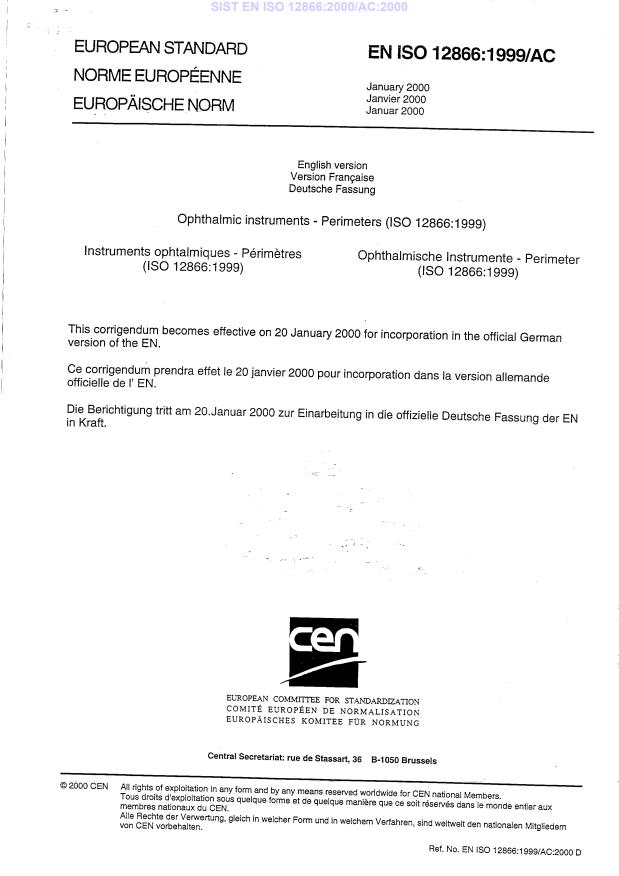
(Amendment)Ophthalmic instruments - Perimeters (ISO 12866:1999)
Ophthalmic instruments - Perimeters (ISO 12866:1999)
ISO - Mistakes in the English version with an effect on the German version
Ophthalmische Instrumente - Perimeter (ISO 12866:1999)
Instruments ophtalmiques - Périmetres (ISO 12866:1999)
Oftalmični instrumenti- Perimetri (ISO 12866:1999)
General Information
Relations
Standards Content (Sample)
2003-01.Slovenski inštitut za standardizacijo. Razmnoževanje celote ali delov tega standarda ni dovoljeno.Ophthalmische Instrumente - Perimeter (ISO 12866:1999)Instruments ophtalmiques - Périmetres (ISO 12866:1999)Ophthalmic instruments - Perimeters (ISO 12866:1999)11.040.70Oftalmološk
...
This May Also Interest You
This document specifies the reference method for the testing of spectacle frames, ready-to-wear near-vision spectacles, sunglasses and spectacle frames used for eye and face protection for nickel release.
The reference method supports the demonstration of conformity with the limit value for nickel release of 0,5 µg·cm−2·week−1 set forth by European Regulation.
The reference method involves the procedural steps shown in Figure 1 and described in Clause 4.
This document applies to those parts of metal spectacle frames and those metal parts of combination spectacle frames that are intended to come into direct and prolonged contact with the skin of the wearer. This document also applies to those relevant metal parts of ready-to-wear near-vision spectacles, sunglasses and spectacle frames used for eye and face protection.
NOTE The reference method for articles apart from spectacle frames, ready-to-wear near-vision spectacles, sunglasses and spectacle frames used for eye and face protection is specified in EN 1811.
- Standard49 pagesEnglish languagesale 10% offe-Library read for×1 day
This document defines requirements with regards to safety for the intended performance, design attributes, preclinical and clinical evaluation, sterilization, product packaging, product labelling, and the information supplied by the manufacturer.
This document applies to ophthalmic irrigating solutions (OIS), used during ophthalmic surgery. These solutions do not provide any primary immunological, pharmacological, or metabolic function.
- Standard34 pagesEnglish languagesale 10% offe-Library read for×1 day
This document specifies fundamental requirements and their test methods for unglazed spectacle frames designed for use with prescription lenses. It is applicable to spectacle frames at the point of sale by the manufacturer or supplier to the retailer.
This document is applicable to:
— all mass-produced spectacle frame types, including rimless mounts, semi-rimless mounts and folding spectacle frames;
— spectacle frames made with additive manufacturing, for example, 3D printing;
— spectacle frames made from natural organic materials;
— the frame or mount of clip-ons designed specifically for attachment to particular models of spectacle frame, but not to their lenses or filters to which ISO 16034 or ISO 12312-1 apply;
— prescription inserts designed for attachment to particular models of, for example, eye protector, sunglass or diving mask.
Parts of this document are applicable to custom-made frames – see 3.1.3 and Table 1.
NOTE See Annex A for recommendations on the design of spectacle frames and terms to be used when describing metal frames.
This document is not applicable to spectacle frames used in eye protection, where ISO 16321-1 applies, or to sunglasses with afocal filters, where ISO 12312-1 applies.
- Standard50 pagesEnglish languagesale 10% offe-Library read for×1 day
- 25-Apr-2022
- 10-Sep-2025
- 11.040.70
- 2017/745
- M/575
- M/575 AMD 2
- VAZ
This document gives requirements and guidelines for the clinical investigation (CI) to establish the safety and performance of contact lenses and contact lens care products.
NOTE 1 This document attempts to align the recognised regulatory requirements for the conduct of a CI to meet the marketing and labelling requirements for contact lenses and contact lens care products around the world. However, national requirements vary greatly. Wherever national practice or regulations dictate some legal requirement, this requirement takes precedence over this document.
NOTE 2 For indications beyond correction of refractive error, additional considerations for safety and performance are to be included in the clinical investigation plan (CIP).
- Standard39 pagesEnglish languagesale 10% offe-Library read for×1 day
This document specifies fundamental requirements for uncut finished spectacle lenses. This document is not applicable to protective spectacle lenses.
This document takes precedence over the corresponding requirements of other standards, if differences exist.
- Standard21 pagesEnglish languagesale 10% offe-Library read for×1 day
- 12-Dec-2023
- 18-Jun-2025
- 11.040.70
- 2017/745
- M/575
- M/575 AMD 2
- VAZ
This document specifies fundamental requirements for optical radiation safety for ophthalmic instruments and is applicable to all ophthalmic instruments that direct optical radiation into or at the eye. It is also applicable to all new and emerging ophthalmic instruments that direct optical radiation into or at the eye, as well as to those portions of therapeutic or surgical systems that direct optical radiation into or at the eye for diagnostic, illumination, measurement, imaging or alignment purposes.
NOTE For the purpose of this document, optical radiation relates to the wavelength range of 250 nm to 2 500 nm.
This document does not apply to therapeutic radiation. However, in the case of the treatment beams of therapeutic devices, when conducting risk assessments for non-target tissues, the limits given in this document may be applied to those parts of the treatment beam that strike non-target tissue.
Where vertical (instrument-specific) International Standards contain specific light hazard requirements different from those given in ISO 15004-2, then those in the vertical International Standard take precedence.
This document classifies ophthalmic instruments into either Group 1 or Group 2 to distinguish instruments that are non-hazardous from those that are potentially hazardous.
- Standard65 pagesEnglish languagesale 10% offe-Library read for×1 day
This document specifies reference wavelengths to be used for the characterization of optical materials, optical systems and instruments, and ophthalmic lenses. It defines the associated principal refractive indices and principal dispersions, as well as the Abbe numbers with regard to these reference wavelengths and principal dispersions.
- Standard11 pagesEnglish languagesale 10% offe-Library read for×1 day
This document specifies requirements and test methods for certain optical properties of intraocular lenses (IOLs) with monofocal, toric, simultaneous vision, and/or accommodative optics. The generic descriptor ‘IOL’ used throughout this document also includes phakic intraocular lenses (PIOL).
- Standard30 pagesEnglish languagesale 10% offe-Library read for×1 day
This document applies to printed, projected, and electronic displays of high-contrast text that are designed for assessment and measurement of near reading acuity under photopic conditions.
The definitions and requirements of this document apply to the Latin alphabet.
- Standard16 pagesEnglish languagesale 10% offe-Library read for×1 day
This document specifies the particular requirements for the clinical investigations of intraocular lenses that are implanted in the eye in order to correct aphakia.
- Standard59 pagesEnglish languagesale 10% offe-Library read for×1 day
Questions, Comments and Discussion
Ask us and Technical Secretary will try to provide an answer. You can facilitate discussion about the standard in here.
Loading comments...