


SIST EN 14625:2012
(Main)Ambient air - Standard method for the measurement of the concentration of ozone by ultraviolet photometry
Ambient air - Standard method for the measurement of the concentration of ozone by ultraviolet photometry
This European Standard specifies a continuous measurement method for the determination of the concentrations of ozone present in ambient air based on the ultraviolet photometric measuring principle. This standard describes the performance characteristics and sets the relevant minimum criteria required to select an appropriate ultraviolet photometric analyser by means of type approval tests. It also includes the evaluation of the suitability of an analyser for use in a specific fixed site so as to meet the data quality requirements as specified in Annex I of Directive 2008/50/EC [1] and requirements during sampling, calibration and quality assurance for use.
The method is applicable to the determination of the con¬centration of ozone present in ambient air up to 500 µg/m3. This concentration range represents the certification range for ozone for the type approval test.
NOTE 1 Other ranges may be used depending on the levels present in ambient air.
NOTE 2 When the standard is used for other purposes than for measurements required by Directive 2008/50/EC, the ranges and uncertainty requirements may not apply.
The method covers the determination of ambient air concentrations of ozone in areas classified as rural, urban and urban-background areas.
The results are expressed in µg/m3 (at 20 C and 101,3 kPa).
NOTE 3 500 µg/m3 of O3 corresponds to 250 nmol/mol of O3 at 20 C and 101,3 kPa.
This standard contains information for different groups of users.
Clauses 5 to 7 and Annexes B and C contain general information about the principles of ozone measurement by ultraviolet photometric analyser and sampling equipment.
Clause 8 and Annex E are specifically directed towards test houses and laboratories that perform type-approval testing of ozone analysers. These sections contain information about:
- Type-approval test conditions, test procedures and test requirements;
- Analyser performance requirements;
- Evaluation of the type-approval test results;
- Evaluation of the uncertainty of the measurement results of the ozone analyser based on the type-approval test results.
Clauses 9 to 11 and Annexes F and G are directed towards monitoring networks performing the practical measurements of ozone in ambient air. These sections contain information about:
- Initial installation of the analyser in the monitoring network and acceptance testing;
- Ongoing quality assurance/quality control;
- Calculation and reporting of measurement results;
- Evaluation of the uncertainty of measurement results under practical monitoring conditions.
Luftqualität - Messverfahren zur Bestimmung der Konzentration von Ozon mit Ultraviolett-Photometrie
Diese Europäische Norm legt ein kontinuierliches ultraviolettphotometrisches Messverfahren zur Bestimmung der Konzentration von Ozon in Luft fest. Es nennt die Leistungs¬kenngrößen und legt die Mindest¬anforde-rungen für die Eignungsprüfung von photometrischen Messgeräten fest. Es beinhaltet auch die Bewertung der Eignung eines Messgeräts für den Einsatz an einem bestimmten ortsfesten Messstandort bezüglich der Anforderungen an die Datenqualität nach Anhang I der Richtlinie 2008/50/EG [1] und bezüglich der Anforderungen für Probennahme, Kalibrierung und Qualitätssicherung.
Das Verfahren ist anwendbar zur Bestimmung der Massenkonzentration von Ozon in Luft im Bereich bis 500 µg/m3. Dieser Konzentrationsbereich entspricht dem Zertifizierungsbereich für die Eignungsprüfung.
ANMERKUNG 1 Für ländliche Standorte zur Überwachung von Ökosystemen können auch andere Bereiche gewählt werden.
ANMERKUNG 2 Wird diese Norm für andere Zwecke als für Messungen nach Richtlinie 2008/50/EG eingesetzt, dann brauchen die Anforderungen hinsichtlich Anwendungsbereich und Unsicherheit nicht zur Geltung kommen.
Das Verfahren umfasst die Bestimmung der Konzentration von Ozon an Standorten, die als ländlich, städtisch und städtischer Hintergrund klassifiziert sind.
Die Ergebnisse werden in µg/m3 (bei 20 °C und 101,3 kPa) angegeben.
ANMERKUNG 3 500 µg/m3 Ozon entsprechen 250 nmol/mol Ozon bei 20 °C und 101,3 kPa.
Dieses Dokument enthält Informationen für verschiedene Nutzergruppen.
Die Abschnitte 5 bis 7 und die Anhänge B und C enthalten allgemeine Informationen über die Grundlagen der Ozon-Messung mit einem Ultraviolett-Photometer sowie über die Probennahmeeinrichtung.
Abschnitt 8 und Anhang E richten sich speziell an Prüfinstitute und -laboratorien, die Eignungsprüfungen von Ozon-Messgeräten durchführen. Diese Abschnitte enthalten Informationen über
- Prüfbedingungen, -verfahren und -anforderungen bei der Eignungsprüfung;
- Anforderungen an die Leistungsfähigkeit des Messgeräts;
- die Bewertung der Ergebnisse der Eignungsprüfung;
- die Bewertung der Unsicherheit der Messergebnisse des Ozon-Messgeräts anhand der Eignungs¬prüfungs-ergebnisse.
Die Abschnitte 9 bis 11 und die Anhänge F und G richten sich an die Betreiber von Messnetzen, mit denen Ozon-Messungen in Luft durchgeführt werden. Diese Abschnitte enthalten Informationen über
- die Erstinstallation des Messgeräts im Messnetz und Eignungsbewertung;
- die laufende Qualitätssicherung und -kontrolle;
- die Berechnung und Übermittlung der Messergebnisse;
- die Bewertung der Unsicherheit der Messergebnisse unter Messbedingungen.
Air ambiant - Méthode normalisée de mesurage de la concentration en ozone par photométrie U.V.
La présente Norme européenne spécifie une méthode de mesurage en continu pour la détermination de la concentration en ozone dans l’air ambiant, selon le principe de mesure par photométrie U.V. La présente norme décrit les caractéristiques de performance et fixe les critères minimaux requis pour sélectionner un analyseur par photométrie U.V. à l’aide d’essais d’approbation de type. Elle présente également l’évaluation de l’aptitude à l’emploi d’un analyseur sur un site fixe spécifique de manière à répondre aux exigences de qualité des données telles que spécifiées dans l’Annexe I de la Directive 2008/50/CE [1] ainsi qu’aux exigences à observer au cours du prélèvement, de l’étalonnage et de l’assurance qualité.
La méthode s’applique à la détermination de la concentration en ozone présent dans l’air ambiant jusqu’à 500 µg/m3. Cette plage de concentration représente l’étendue de mesure certifiée de l’ozone pour l’essai d’approbation de type.
NOTE 1 D’autres plages peuvent être utilisées pour les systèmes de mesure appliqués aux zones rurales contrôlant des écosystèmes.
NOTE 2 Lorsque la norme est utilisée à d’autres fins que la Directive 2008/50/CE, les exigences relatives aux plages et à l’incertitude peuvent ne pas être appliquées.
La méthode s’applique à la détermination des concentrations en ozone présent dans l’air ambiant dans les zones classées comme zones rurales, urbaines et périurbaines.
Les résultats sont exprimés en µg/m3 (à 20 °C et 101,3 kPa).
NOTE 3 500 µg/m3 d’O3 correspondent à 250 nmol/mol d’O3 à 20 °C et 101,3 kPa.
La présente norme contient des informations pour différents groupes d’utilisateurs.
Les Articles 5 à 7 et les Annexes B et C contiennent des informations générales relatives aux principes de mesure de l’ozone à l’aide d’un analyseur par photométrie U.V. et d’un équipement de prélèvement.
L’Article 8 et l’Annexe E concernent tout particulièrement les organismes et les laboratoires d’essai qui effectuent des essais d’approbation de type des analyseurs d’ozone. Ces sections contiennent des informations concernant :
- les conditions de l’essai d’approbation de type, les modes opératoires d’essai et les exigences d’essai ;
- les exigences de performance de l’analyseur ;
- l’évaluation des résultats de l’essai d’approbation de type ;
- l’évaluation de l’incertitude des résultats de mesurage de l’analyseur d’ozone d’après les résultats de l’essai d’approbation de type.
Les Articles 9 à 11 et les Annexes F et G concernent les réseaux de surveillance effectuant les mesurages pratiques de l’ozone dans l’air ambiant. Ces sections contiennent des informations concernant :
- l’installation initiale de l’analyseur dans le réseau de surveillance et l’essai de réception ;
- l’assurance qualité/le contrôle qualité en continu ;
- le calcul et le compte-rendu des résultats de mesurage ;
- l’évaluation de l’incertitude des résultats de mesurage sous des conditions de surveillance pratiques.
Zunanji zrak - Standardna metoda za določevanje koncentracije ozona z ultravijolično fotometrijo
Ta evropski standard določa metodo stalnega merjenja za določitev koncentracij ozona v zunanjem zraku na podlagi ultravijoličnega fotometričnega merilnega principa. Ta standard opisuje lastnosti delovanja in vzpostavlja ustrezna minimalna merila, potrebna za izbor ustreznega ultravijoličnega fotometričnega analizatorja s homologacijskimi preizkusi. Vključuje tudi oceno ustreznosti analizatorja za uporabo na specifičnem fiksnem mestu, da se izpolnijo zahteve o kakovosti podatkov, kot je opredeljeno v Prilogi I Direktive 2008/50/ES, ter zahteve med vzorčenjem, kalibriranjem in zagotavljanjem kakovosti za uporabo. Ta metoda velja za določitev koncentracije ozona v zunanjem zraku do vrednosti 500 μg/m3. Ta razpon koncentracij predstavlja razpon certificiranja za ozon za homologacijski preizkus. Ta metoda pokriva določitev koncentracij ozona v zunanjem zraku na področjih, ki so uvrščena med podeželska območja, mestna območja in območja v urbanem okolju. Rezultati so izraženi v μg/m3 (pri 20 °C in 101,3 kPa). Ta standard vsebuje informacije za različne skupine uporabnikov. Določbe od 5 do 7 ter dodatka B in C vsebujejo splošne informacije o načelih merjenja ozona z ultravijoličnimi fotometričnimi analizatorji in opremo za vzorčenje. Osrednji predmet obravnave določbe 8 in dodatka E so laboratoriji, ki izvajajo homologacijsko preizkušanje ozonskih analizatorjev. Ti razdelki vsebujejo informacije o naslednjem: – pogoji homologacijskih preizkusov, preizkusni postopki in zahteve; – zahteve glede učinkovitosti analizatorja; ocena rezultatov homologacijskih preizkusov; ocena negotovosti rezultatov merjenja ozonskega analizatorja na podlagi rezultatov homologacijskih preizkusov. Osrednji predmet obravnave določb od 9 do 11 ter dodatkov F in G so omrežja za spremljanje stanja, ki izvajajo praktične meritve ozona v zunanjem zraku. Ti razdelki vsebujejo informacije o naslednjem: – začetna namestitev analizatorja v omrežju za spremljanje stanja in preizkušanje ustreznosti; – tekoče zagotavljanje kakovosti/nadzor kakovosti; izračun in poročanje rezultatov merjenja; ocena negotovosti rezultatov merjenja pod pogoji praktičnega spremljanja.
General Information
- Status
- Withdrawn
- Public Enquiry End Date
- 19-May-2010
- Publication Date
- 13-Nov-2012
- Withdrawal Date
- 03-Mar-2025
- Technical Committee
- KAZ - Air quality
- Current Stage
- 9900 - Withdrawal (Adopted Project)
- Start Date
- 10-Feb-2025
- Due Date
- 05-Mar-2025
- Completion Date
- 04-Mar-2025
Relations
- Effective Date
- 01-Dec-2012
- Effective Date
- 01-Apr-2025



Frequently Asked Questions
SIST EN 14625:2012 is a standard published by the Slovenian Institute for Standardization (SIST). Its full title is "Ambient air - Standard method for the measurement of the concentration of ozone by ultraviolet photometry". This standard covers: This European Standard specifies a continuous measurement method for the determination of the concentrations of ozone present in ambient air based on the ultraviolet photometric measuring principle. This standard describes the performance characteristics and sets the relevant minimum criteria required to select an appropriate ultraviolet photometric analyser by means of type approval tests. It also includes the evaluation of the suitability of an analyser for use in a specific fixed site so as to meet the data quality requirements as specified in Annex I of Directive 2008/50/EC [1] and requirements during sampling, calibration and quality assurance for use. The method is applicable to the determination of the con¬centration of ozone present in ambient air up to 500 µg/m3. This concentration range represents the certification range for ozone for the type approval test. NOTE 1 Other ranges may be used depending on the levels present in ambient air. NOTE 2 When the standard is used for other purposes than for measurements required by Directive 2008/50/EC, the ranges and uncertainty requirements may not apply. The method covers the determination of ambient air concentrations of ozone in areas classified as rural, urban and urban-background areas. The results are expressed in µg/m3 (at 20 C and 101,3 kPa). NOTE 3 500 µg/m3 of O3 corresponds to 250 nmol/mol of O3 at 20 C and 101,3 kPa. This standard contains information for different groups of users. Clauses 5 to 7 and Annexes B and C contain general information about the principles of ozone measurement by ultraviolet photometric analyser and sampling equipment. Clause 8 and Annex E are specifically directed towards test houses and laboratories that perform type-approval testing of ozone analysers. These sections contain information about: - Type-approval test conditions, test procedures and test requirements; - Analyser performance requirements; - Evaluation of the type-approval test results; - Evaluation of the uncertainty of the measurement results of the ozone analyser based on the type-approval test results. Clauses 9 to 11 and Annexes F and G are directed towards monitoring networks performing the practical measurements of ozone in ambient air. These sections contain information about: - Initial installation of the analyser in the monitoring network and acceptance testing; - Ongoing quality assurance/quality control; - Calculation and reporting of measurement results; - Evaluation of the uncertainty of measurement results under practical monitoring conditions.
This European Standard specifies a continuous measurement method for the determination of the concentrations of ozone present in ambient air based on the ultraviolet photometric measuring principle. This standard describes the performance characteristics and sets the relevant minimum criteria required to select an appropriate ultraviolet photometric analyser by means of type approval tests. It also includes the evaluation of the suitability of an analyser for use in a specific fixed site so as to meet the data quality requirements as specified in Annex I of Directive 2008/50/EC [1] and requirements during sampling, calibration and quality assurance for use. The method is applicable to the determination of the con¬centration of ozone present in ambient air up to 500 µg/m3. This concentration range represents the certification range for ozone for the type approval test. NOTE 1 Other ranges may be used depending on the levels present in ambient air. NOTE 2 When the standard is used for other purposes than for measurements required by Directive 2008/50/EC, the ranges and uncertainty requirements may not apply. The method covers the determination of ambient air concentrations of ozone in areas classified as rural, urban and urban-background areas. The results are expressed in µg/m3 (at 20 C and 101,3 kPa). NOTE 3 500 µg/m3 of O3 corresponds to 250 nmol/mol of O3 at 20 C and 101,3 kPa. This standard contains information for different groups of users. Clauses 5 to 7 and Annexes B and C contain general information about the principles of ozone measurement by ultraviolet photometric analyser and sampling equipment. Clause 8 and Annex E are specifically directed towards test houses and laboratories that perform type-approval testing of ozone analysers. These sections contain information about: - Type-approval test conditions, test procedures and test requirements; - Analyser performance requirements; - Evaluation of the type-approval test results; - Evaluation of the uncertainty of the measurement results of the ozone analyser based on the type-approval test results. Clauses 9 to 11 and Annexes F and G are directed towards monitoring networks performing the practical measurements of ozone in ambient air. These sections contain information about: - Initial installation of the analyser in the monitoring network and acceptance testing; - Ongoing quality assurance/quality control; - Calculation and reporting of measurement results; - Evaluation of the uncertainty of measurement results under practical monitoring conditions.
SIST EN 14625:2012 is classified under the following ICS (International Classification for Standards) categories: 13.040.20 - Ambient atmospheres. The ICS classification helps identify the subject area and facilitates finding related standards.
SIST EN 14625:2012 has the following relationships with other standards: It is inter standard links to SIST EN 14625:2005, SIST EN 14625:2025. Understanding these relationships helps ensure you are using the most current and applicable version of the standard.
SIST EN 14625:2012 is associated with the following European legislation: EU Directives/Regulations: 2002/3/EC. When a standard is cited in the Official Journal of the European Union, products manufactured in conformity with it benefit from a presumption of conformity with the essential requirements of the corresponding EU directive or regulation.
You can purchase SIST EN 14625:2012 directly from iTeh Standards. The document is available in PDF format and is delivered instantly after payment. Add the standard to your cart and complete the secure checkout process. iTeh Standards is an authorized distributor of SIST standards.
Standards Content (Sample)
2003-01.Slovenski inštitut za standardizacijo. Razmnoževanje celote ali delov tega standarda ni dovoljeno.Luftqualität - Messverfahren zur Bestimmung der Konzentration von Ozon mit Ultraviolett-PhotometrieAir ambiant - Méthode normalisée de mesurage de la concentration en ozone par photométrie U.V.Ambient air - Standard method for the measurement of the concentration of ozone by ultraviolet photometry13.040.20Kakovost okoljskega zrakaAmbient atmospheresICS:Ta slovenski standard je istoveten z:EN 14625:2012SIST EN 14625:2012en,fr,de01-december-2012SIST EN 14625:2012SLOVENSKI
STANDARDSIST EN 14625:20051DGRPHãþD
EUROPEAN STANDARD NORME EUROPÉENNE EUROPÄISCHE NORM
EN 14625
August 2012 ICS 13.040.20 Supersedes EN 14625:2005English Version
Ambient air - Standard method for the measurement of the concentration of ozone by ultraviolet photometry
Air ambiant - Méthode normalisée de mesurage de la concentration en ozone par photométrie U.V.
Luftqualität - Messverfahren zur Bestimmung der Konzentration von Ozon mit Ultraviolett-Photometrie This European Standard was approved by CEN on 10 May 2012.
CEN members are bound to comply with the CEN/CENELEC Internal Regulations which stipulate the conditions for giving this European Standard the status of a national standard without any alteration. Up-to-date lists and bibliographical references concerning such national standards may be obtained on application to the CEN-CENELEC Management Centre or to any CEN member.
This European Standard exists in three official versions (English, French, German). A version in any other language made by translation under the responsibility of a CEN member into its own language and notified to the CEN-CENELEC Management Centre has the same status as the official versions.
CEN members are the national standards bodies of Austria, Belgium, Bulgaria, Croatia, Cyprus, Czech Republic, Denmark, Estonia, Finland, Former Yugoslav Republic of Macedonia, France, Germany, Greece, Hungary, Iceland, Ireland, Italy, Latvia, Lithuania, Luxembourg, Malta, Netherlands, Norway, Poland, Portugal, Romania, Slovakia, Slovenia, Spain, Sweden, Switzerland, Turkey and United Kingdom.
EUROPEAN COMMITTEE FOR STANDARDIZATION
COMITÉ EUROPÉEN DE NORMALISATION EUROPÄISCHES KOMITEE FÜR NORMUNG
Management Centre:
Avenue Marnix 17,
B-1000 Brussels © 2012 CEN All rights of exploitation in any form and by any means reserved worldwide for CEN national Members. Ref. No. EN 14625:2012: ESIST EN 14625:2012
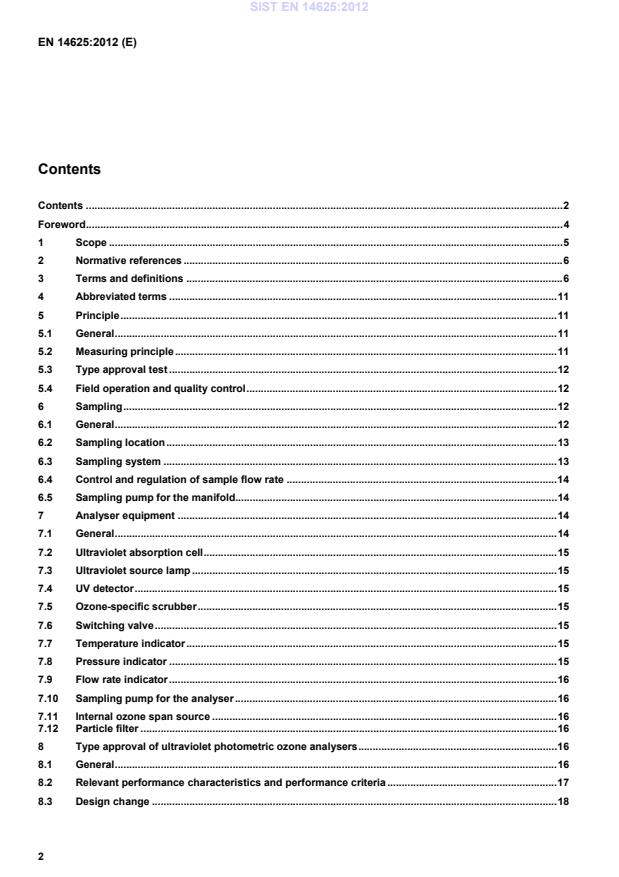
Contents Contents . 2Foreword . 41Scope . 52Normative references . 63Terms and definitions . 64Abbreviated terms . 115Principle . 115.1General . 115.2Measuring principle . 115.3Type approval test . 125.4Field operation and quality control . 126Sampling . 126.1General . 126.2Sampling location . 136.3Sampling system . 136.4Control and regulation of sample flow rate . 146.5Sampling pump for the manifold . 147Analyser equipment . 147.1General . 147.2Ultraviolet absorption cell . 157.3Ultraviolet source lamp . 157.4UV detector . 157.5Ozone-specific scrubber . 157.6Switching valve . 157.7Temperature indicator . 157.8Pressure indicator . 157.9Flow rate indicator . 167.10Sampling pump for the analyser . 167.11Internal ozone span source . 167.12Particle filter . 168Type approval of ultraviolet photometric ozone analysers . 168.1General . 168.2Relevant performance characteristics and performance criteria . 178.3Design change . 18SIST EN 14625:2012
Test of lack of fit . 48Annex B (informative)
Sampling equipment. 50Annex C (informative)
Ultraviolet photometric analyser . 52Annex D (informative)
Manifold testing equipment . 54Annex E (normative)
Type approval . 56Annex F (informative)
Calculation of uncertainty in field operation at the hourly alert threshold value . 75Annex G (informative)
Calculation of uncertainty in field operation at the 8-hour target value . 83Annex H (informative)
Significant technical changes . 93Bibliography . 94 SIST EN 14625:2012
According to the CEN/CENELEC Internal Regulations, the national standards organisations of the following countries are bound to implement this European Standard: Austria, Belgium, Bulgaria, Croatia, Cyprus, Czech Republic, Denmark, Estonia, Finland, Former Yugoslav Republic of Macedonia, France, Germany, Greece, Hungary, Iceland, Ireland, Italy, Latvia, Lithuania, Luxembourg, Malta, Netherlands, Norway, Poland, Portugal, Romania, Slovakia, Slovenia, Spain, Sweden, Switzerland, Turkey and the United Kingdom. SIST EN 14625:2012
The results are expressed in µg/m3 (at 20 °C and 101,3 kPa). NOTE 3 500 µg/m3 of O3 corresponds to 250 nmol/mol of O3 at 20 °C and 101,3 kPa. This standard contains information for different groups of users. Clauses 5 to 7 and Annexes B and C contain general information about the principles of ozone measurement by ultraviolet photometric analyser and sampling equipment. Clause 8 and Annex E are specifically directed towards test houses and laboratories that perform type-approval testing of ozone analysers. These sections contain information about: type-approval test conditions, test procedures and test requirements; analyser performance requirements; evaluation of the type-approval test results; evaluation of the uncertainty of the measurement results of the ozone analyser based on the type-approval test results. Clauses 9 to 11 and Annexes F and G are directed towards monitoring networks performing the practical measurements of ozone in ambient air. These sections contain information about: initial installation of the analyser in the monitoring network and acceptance testing; ongoing quality assurance/quality control; calculation and reporting of measurement results; evaluation of the uncertainty of measurement results under practical monitoring conditions.
(ISO/IEC 17025) ENV 13005:1999, Guide to the expression of uncertainty in measurement ISO 13964:1998, Air quality — Determination of ozone in ambient air — Ultraviolet photometric method 3 Terms and definitions For the purposes of this document, the following terms and definitions apply. 3.1 adjustment set of operations carried out on a measuring system so that it provides prescribed indications corresponding to given values of a quantity to be measured
Note 1 to entry
Types of adjustment of a measuring system include zero adjustment of a measuring system, offset adjustment, and span adjustment (sometimes called gain adjustment). Note 2 to entry
Adjustment of a measuring system should not be confused with calibration, which is a prerequisite for adjustment. [SOURCE: JCGM 200:2012 (VIM) [2]] Note 3 to entry
In the context of this standard, adjustment is performed on measurement data rather than on the analyser. 3.2 alert threshold level beyond which there is a risk to human health from brief exposure for the population as a whole and at which immediate steps are to be taken by the Member States [SOURCE: 2008/50/EC [1]] 3.3 ambient air outdoor air in the troposphere, excluding workplaces as defined by Directive 89/654/EEC, where provisions concerning health and safety at work apply and to which members of the public do not have regular access [SOURCE: 2008/50/EC [1]] SIST EN 14625:2012
3.6 calibration operation that, under specified conditions, in a first step, establishes a relation between the quantity values with measurement uncertainties provided by measurement standards and corresponding indications with associated measurement uncertainties and, in a second step, uses this information to establish a relation for obtaining a measurement result from an indication
Note 1 to entry: A calibration may be expressed by a statement, calibration function, calibration diagram, calibration curve, or calibration table. In some cases, it may consist of an additive or multiplicative correction of the indication with associated measurement uncertainty. Note 2 to entry:
Calibration should not be confused with adjustment of a measuring system, often mistakenly called “self-calibration”, nor with verification of a calibration. Note 3 to entry: Often, the first step alone in the above definition is perceived as being calibration. [SOURCE: JCGM 200:2008 (VIM) [2]] Note 4 to entry: In the context of this standard, calibration is a comparison of the analyser response to a known gas concentration with a known uncertainty when the information obtained from the comparison is used for the successive adjustment (if needed) of the analyser. 3.7 certification range concentration range for which the analyser is type-approved 3.8 check verification that the analyser is still operating within specified performance limits
3.9 combined standard uncertainty standard uncertainty of the result of a measurement when that result is obtained from the values of a number of other quantities, equal to the positive square root of a sum of terms, the terms being the variances or co-variances of these other quantities weighted according to how the measurement result varies with changes in these quantities [SOURCE: ENV 13005:1999] 3.10 coverage factor numerical factor used as a multiplier of the combined standard uncertainty in order to obtain an expanded uncertainty [SOURCE: ENV 13005:1999] 3.11 designated body body which has been designated for a specific task (type approval tests and/or QA/QC activities in the field) by the competent authority in the Member States
The fraction may be viewed as the coverage probability or level of confidence of the interval. Note 2 to entry:
To associate a specific level of confidence with the interval defined by the expanded uncertainty requires explicit or implicit assumptions regarding the probability distribution characterised by the measurement result and its combined standard uncertainty. The level of confidence that may be attributed to this interval can be known only to the extent to which such assumptions may be justified. [SOURCE: ENV 13005:1999] Note 3 to entry: For the purpose of this European Standard, the expanded uncertainty is the combined standard uncertainty multiplied by a coverage factor k=2 resulting in an interval with a level of confidence of 95 %. 3.14 fall time difference between the response time (fall) and the lag time (fall) 3.15 independent measurement individual measurement that is not influenced by a previous individual measurement by separating two individual measurements by at least four response times Note 1 to entry: The largest value of response time (rise) and response time (fall) are intended. 3.16 individual measurement measurement averaged over a time period equal to the response time of the analyser Note 1 to entry: The largest value of response time (rise) and response time (fall) are intended. Note 2 to entry: This definition differs from the meaning of the concept “individual measurement” in Directive 2008/50/EC [1]. 3.17 influence quantity quantity that is not the measurand but that affects the result of the measurement
[SOURCE: ENV 13005:1999] 3.18 interferent component of the air sample, excluding the measured constituent, that affects the output signal 3.19 lack of fit maximum deviation from the linear regression line of the average of a series of measurement results at the same concentration
3.23 parallel measurements measurements from different analysers, sampling from one and the same sampling manifold, starting at the same time and ending at the same time 3.24 performance characteristic one of the parameters assigned to equipment in order to define its performance 3.25 performance criterion limiting quantitative numerical value assigned to a performance characteristic, to which conformance is tested 3.26 period of unattended operation time period over which the drift is within the performance criterion for long term drift 3.27 repeatability (of results of measurement) closeness of the agreement between the results of successive individual measurements of ozone carried out under the same conditions of measurement Note 1 to entry: These conditions are called laboratory repeatability conditions and include: a) the same measurement procedure; b)
the same observer; c)
the same analyser, used under the same conditions; d) at the same location; e) repetition over a short period of time. 3.28 reproducibility under field conditions closeness of the agreement between the results of simultaneous measurements with two analysers in ambient air carried out under the same conditions of measurement Note 1 to entry: These conditions are called field reproducibility conditions and include: a) the same measurement procedure; b)
two identical analysers, used under the same conditions; c) at the same monitoring station; d) the period of unattended operation. 3.29 residence time inside the analyser time period for the sampled air to be transported from the inlet of the analyser to the UV absorption cell SIST EN 14625:2012
Note 1 to entry: The term ‘gas’ may refer to a test gas used in type-approval testing or to ambient air transferred to the analyser.
3.34 sampling system the assembly of components needed to transfer ambient air to the analyser 3.35 short-term drift difference between zero or span readings at the beginning and end of a 12 h period 3.36 standard uncertainty uncertainty of the result of a measurement expressed as a standard deviation
[SOURCE: ENV 13005:1999] 3.37 surrounding temperature temperature of the air directly surrounding the analyser 3.38 target value level fixed with the aim of avoiding, preventing or reducing harmful effects on human health and/or the environment as a whole, to be attained where possible over a given period [SOURCE: 2008/50/EC [1]] 3.39 total residence time sum of the residence time in the sampling system and the residence time inside the analyser 3.40 type approval decision taken by a designated body that the pattern of an analyser conforms to specified requirements 3.41 type approval test examination of two or more analysers of the same pattern which are submitted by a manufacturer to a designated body including the tests necessary for approval of the pattern SIST EN 14625:2012
FEP
perfluoro-ethylene-propylene; MFC mass flow controller; PFA
perfluoroalkoxy (polymer resin); PTFE polytetrafluoroethylene. 5 Principle 5.1 General This standard describes the method for measurement of the concentrations of ozone in ambient air by means of ultraviolet photometry. The requirements, the specific components of the ultraviolet photometric analyser and its sampling system are described. A number of performance characteristics with associated minimum performance criteria are given for the analyser. The actual values of these performance characteristics for a specific type of analyser shall be determined in a so-called type approval test for which procedures have been described. The type approval test comprises a laboratory test and a field test. The selection of a type-approved analyser for a specific measuring task in the field is based on the calculation of the expanded uncertainty of the measurement method. In this expanded uncertainty calculation, the actual values of various performance characteristics of a type-approved analyser and the site-specific conditions at the monitoring station are taken into account (see 9.6). The expanded uncertainty of the method shall not exceed 15 % for fixed measurements or 30% for indicative measurements, as specified in Directive 2008/50/EC [1]. Requirements and recommendations for quality assurance and quality control are given for the measurements in the field (see 9.4). 5.2 Measuring principle Sampled air is drawn continuously through an optical absorption cell where it is irradiated by monochromatic radiation, centred on 253,7 nm, from a stabilised low-pressure mercury (Hg) discharge lamp. The UV radiation, which passes through the absorption cell, is measured by a sensitive photodiode or photomultiplier detector and converted to a measurable electrical signal. Absorption of this radiation by the sampled air within the absorption cell is a measure of the ozone concentration in the ambient air. Two different systems for the measurement of the ultraviolet absorption by ozone are usually employed. In one system, the ultraviolet absorption by ozone is determined by means of the difference in ultraviolet absorption between a sample cell and a reference cell (dual-cell type). In the other system, only a single sample cell is employed. The ultraviolet absorption of ozone is determined by alternately supplying sampled air containing ozone to the absorption cell and ozone-free sampled air. Ozone-free sampled air is obtained by passing the sampled air through an ozone catalytic converter in which the ozone is destroyed. Most modern commercial ozone analysers measure the temperature and pressure of the sampled air in the absorption cell. Using these data, an internal microprocessor automatically calculates the measured ozone concentration relative to some chosen reference conditions. For analysers without this automated pressure and temperature compensation, the concentrations need to be corrected manually to the chosen reference conditions. SIST EN 14625:2012
6.1 General Depending on the installation of the ultraviolet photometric analyser at a monitoring station, a single sampling line for the analyser may be chosen. Alternatively, sampling can take place from a sampling system consisting of a common sampling inlet with a sampling manifold to which other analysers and equipment may be attached. Conditions and layout of the sampling system will contribute to the uncertainty of the measurement; to minimise this contribution to the expanded uncertainty, requirements for the sampling equipment are given in the following subclauses. NOTE In Annex B, different arrangements of the sampling equipment are schematically presented. The following factors may, through decrease or increase in the concentration of ozone, contribute to the uncertainty of the measurement when considering the sampling as an integral part of the measurement: — loss of ozone in the sampling system; SIST EN 14625:2012
The material of the sample inlet as well as the sampling line or manifold can influence the composition of the sample. In practice, the best materials, such as polytetrafluoroethylene (PTFE), perfluoro-ethylene-propylene (FEP), borosilicate glass or stainless steel shall be used. The influence of the material of the sampling inlet and line or manifold on the measured concentrations of ozone due to losses shall be < 2,0 %.
NOTE This value may be achieved when the quality assurance and quality control requirements (see Clause 9) are followed.
The sampling line or manifold may be moderately heated to avoid condensation. Condensation may occur in the case of high ambient temperature and/or humidity. The influence of the pressure drop along the sampling inlet and line or manifold and the particle filter on the measured concentrations shall be ≤ 1,0 %. 6.3.2 Particle filter A particle filter shall be placed between the sampling line or manifold and the inlet of the analyser. The filter shall retain all particles likely to alter the performance of the analyser. It shall be made of PTFE. The material of the filter housing shall be chemically inert to ozone.
NOTE 1 The filter may be internal to the analyser (see 7.12) or external. In case the analyser contains a built-in filter, an external filter is not necessary. NOTE 2 A pore size of the filter of 5 µm usually fulfils this requirement. SIST EN 14625:2012
The particle filter shall be conditioned before used in measurements. The filter shall be changed periodically depending on the dust loading at the sampling site (as indicated in 9.7). The filter housing shall be cleaned at least every six months. Overloading of the filter may cause loss of ozone by reaction with the particle matter and may increase the pressure drop in the sampling line. 6.3.3 Loss of ozone As NO is generally present in the sampled air, a change in concentration of ozone will occur due to the reaction of NO with O3 in the sampling inlet and line or manifold, and in the analyser. In practice a significant change in the concentrations of ozone may be avoided when the residence time in the sampling system is ≤ 3 s. The requirement for the residence time in the analyser is ≤ 3 s (see Table 1). Consequently, the total residence time in the sampling system plus analyser shall comply with the performance criterion in Table 1. Depending on the location of the particle filter, the sampling system can be contaminated by deposition of dust. This can induce losses of ozone. The sampling system shall be cleaned (as stated in 9.4.1) with a frequency which is dependent on the site-specific conditions. 6.3.4 Conditioning The sampling system and the particle filter shall be conditioned (at initial installation and after each cleaning) to avoid temporary decreases in the measured ozone concentrations by sampling ambient air or ozonated air for a period of at least 30 min at the nominal sample flow rate.
These conditioning periods shall not be included in the calculation of the availability of the analyser during the type approval test (8.5.7). Conditioning may also be done in the laboratory before installing. NOTE Conditioning during field operation is considered a part of normal maintenance. Consequently, the concentrations measured during conditioning need not be included in the calculation of data capture, and hourly and 8-hourly averages. 6.4 Control and regulation of sample flow rate The sample flow rate into the analyser shall be maintained within the specifications of the manufacturer of the analyser.
NOTE The flow rate into the ultraviolet photometric analyser is usually controlled by means of restrictors. 6.5 Sampling pump for the manifold When a sampling manifold is used, a pump (or similar device, e.g. a blower) is necessary for sampling ambient air and suction of the ambient air through the sampling manifold. The inlet of the sampling pump for the sampling manifold shall be located at the end of the sampling manifold (see Annex B). The sampling pump or fan shall have sufficient rating to ensure that all analysers connected to the manifold are supplied with the required amount of air and to ensure that the residence time fulfils the requirement given in 6.3.3. To verify the functioning of this pump, it is recommended to install a flow alarm system. An example of a sampling manifold is given in Annex B.
The influence of the pressure drop induced by the manifold sampling pump on the measured concentration shall be ≤ 1,0 %. 7 Analyser equipment 7.1 General In Annex C, schematic diagrams are given of two types of ultraviolet photometric ozone analysers. The ultraviolet photometric analyser consists of the principal components that are described in 7.2 to 7.11. SIST EN 14625:2012
NOTE Vacuum photodiodes with caesium telluride sensitisation meet this requirement at 253,7 nm and have a negligible sensitivity at other mercury emission wavelengths. Other detectors, such as photomultiplier tubes also satisfy this purpose. 7.5 Ozone-specific scrubber The ozone-specific scrubber shall contain a material that selectively catalyses the destruction of ozone in the sampled air. NOTE 1 Manganese dioxide on a metal substrate has been found to do this satisfactorily. Even though this particular compound does not remove any of the other more common pollutant it has been found to partly remove some organic compounds which may be present in the ambient air. Annex A of ISO 13964:1998 lists such interfering chemical compounds.
NOTE 2 A significant decrease in response to ambient ozone may be an indication of scrubber failure. Normally, manufacturers give an average lifetime of such scrubbers; however, the actual lifetime will depend on the sampling location. For example: high pollutant concentrations at an urban-background station may deactivate the scrubber prematurely. 7.6 Switching valve A switching valve is used to direct the sampled air alternately either through or around the ozone-specific scrubber is required. It shall be made of a material that is inert to ozone, such as a fluorocarbon polymer. 7.7 Temperature indicator A temperature-measuring device capable of measuring the sampled air in the ultraviolet absorption cell with a repeatability of max 2 K (as expanded uncertainty) is required. 7.8 Pressure indicator A pressure-measuring device capable of measuring the pressure of the sampled air in the ultraviolet absorption cell with measurement repeatability of 2 kPa (as expanded uncertainty) is required.
...
Questions, Comments and Discussion
Ask us and Technical Secretary will try to provide an answer. You can facilitate discussion about the standard in here.
Loading comments...