

SIST EN 4621:2010
(Main)Aerospace series - Inserts, MJ threads, self-locking, self-broaching keys - Technical specification
General Information
- Abstract
This standard specifies the characteristics, qualification and acceptance requirements for self-locking inserts, self-broaching keys with MJ threads, for aerospace applications.
It is applicable whenever referenced.
- Status
- Published
- Publication Date
- 08-Apr-2010
- Technical Committee
- I13 - Imaginarni 13
- Current Stage
- 6060 - National Implementation/Publication (Adopted Project)
- Start Date
- 22-Mar-2010
- Due Date
- 27-May-2010
- Completion Date
- 09-Apr-2010

Overview
EN 4621:2010 - "Aerospace series - Inserts, MJ threads, self-locking, self-broaching keys - Technical specification" (CEN) defines the characteristics, qualification and acceptance requirements for self-locking inserts with MJ threads and self-broaching keys used in aerospace applications. The standard is applicable whenever referenced and provides the inspection, test and documentation framework manufacturers and users must follow to ensure safe, consistent performance.
Key Topics
- Scope and applicability: Requirements for finished inserts (material, dimensions, coatings, heat treatment) and the conditions under which EN 4621 applies.
- Quality assurance: Qualification and acceptance programs, including sampling plans and test reporting. Qualification typically requires 39 inserts selected from a single batch by simple random sampling.
- Mechanical and functional tests:
- Installation requirement: Inserts must be freely hand-screwable and show no buckling or thread damage after installation (installation procedure referenced to EN 4619).
- Rotational resistance test: Verifies that installed inserts resist prescribed torques without rotation (Annex B).
- Axial tensile/strength test: Confirms axial load resistance to values given in Annex C or the definition document; checks for axial movement, cracks or thread tearing.
- Reusability test: Assesses seating/unseating and self-locking torques through repeated assembly cycles (Annex D).
- Dimensional inspection: Thread and key position checks using a "GO" gauge (Annex E); thread form and surface roughness requirements (ISO 4288).
- Manufacturing controls: Acceptable thread production methods (machining or forming), heat treatment controls, surface coatings and inspection for surface discontinuities.
- Documentation: Test and inspection reports, material certificates and conformity evidence as required by the purchase order.
Applications
- Use wherever MJ-threaded, self-locking, self-broaching key inserts are specified for aerospace structures and assemblies.
- Typical users:
- Aerospace OEMs and suppliers specifying or producing standard parts
- Quality engineers and inspection laboratories performing qualification and acceptance tests
- Procurement and design engineers referencing standardized insert performance and test methods
- Common practical applications include structural repairs, threaded insert installations in aluminium, titanium and stainless test blocks, and aerospace component assemblies requiring reliable locking under vibration and load.
Related Standards
- EN 4619 - Installation and removal procedure for MJ inserts
- EN 4620 - Design standard for MJ threaded inserts
- EN 9133 - Qualification procedure for aerospace standard parts
- ISO 5855-1 / ISO 5855-2 - MJ thread general requirements and limit dimensions
- ISO 4288, ISO 3452, ASTM E112 - referenced inspection and test methods
Keywords: EN 4621, MJ threads, self-locking inserts, self-broaching keys, aerospace standard, qualification, acceptance testing, rotational resistance, axial tensile, GO gauge.
Relations
- Effective Date
- 25-Aug-2026
- Effective Date
- 25-Aug-2026
- Effective Date
- 28-Jan-2026
- Effective Date
- 28-Jan-2026
- Effective Date
- 28-Jan-2026
- Effective Date
- 28-Jan-2026
- Effective Date
- 28-Jan-2026
- Effective Date
- 28-Jan-2026
- Effective Date
- 28-Jan-2026
- Effective Date
- 28-Jan-2026
- Effective Date
- 28-Jan-2026
- Effective Date
- 28-Jan-2026
Get Certified
Connect with accredited certification bodies for this standard

BUREAU VERITAS Certification Germany
Bureau Veritas certification in Germany.

Element Materials Technology
Materials testing and product certification.

AQMS Ltd.
AQMS provides ISO certification to SMEs across the UK.
Sponsored listings
Frequently Asked Questions
SIST EN 4621:2010 is a standard published by the Slovenian Institute for Standardization (SIST). Its full title is "Aerospace series - Inserts, MJ threads, self-locking, self-broaching keys - Technical specification". This standard covers: This standard specifies the characteristics, qualification and acceptance requirements for self-locking inserts, self-broaching keys with MJ threads, for aerospace applications. It is applicable whenever referenced.
This standard specifies the characteristics, qualification and acceptance requirements for self-locking inserts, self-broaching keys with MJ threads, for aerospace applications. It is applicable whenever referenced.
SIST EN 4621:2010 is classified under the following ICS (International Classification for Standards) categories: 49.030.30 - Nuts. The ICS classification helps identify the subject area and facilitates finding related standards.
SIST EN 4621:2010 has the following relationships with other standards: It is inter standard links to SIST ISO 2859-1:2003, SIST ISO 4288:2001, SIST EN 9133:2018, SIST EN 4620:2010, SIST EN 13848-1:2004+A1:2008, SIST EN 4619:2010, SIST EN 840-6:2004+A1:2008, SIST EN 196-1:1995, SIST EN 14458:2004, SIST EN 4623:2010, SIST EN 4624:2010, SIST EN 4622:2010. Understanding these relationships helps ensure you are using the most current and applicable version of the standard.
SIST EN 4621:2010 is available in PDF format for immediate download after purchase. The document can be added to your cart and obtained through the secure checkout process. Digital delivery ensures instant access to the complete standard document.
Standards Content (Sample)
2003-01.Slovenski inštitut za standardizacijo. Razmnoževanje celote ali delov tega standarda ni dovoljeno.VSHFLILNDFLMDLuft- und Raumfahrt - Gewindeeinsätze, MJ-Gewinden, selbstsicherndmit selbsträumenden Stiften - Technische LieferbedingungenSérie aérospatiale - Douilles filetées, à filetages MJ, à freinage interne à clavettes autobrochantes - Spécification techniqueAerospace series - Inserts, MJ threads, self-locking, self-broaching keys - Technical specification49.030.30MaticeNutsICS:Ta slovenski standard je istoveten z:EN 4621:2010SIST EN 4621:2010en01-maj-2010SIST EN 4621:2010SLOVENSKI
STANDARD
EUROPEAN STANDARD NORME EUROPÉENNE EUROPÄISCHE NORM
EN 4621
March 2010 ICS 49.030.30 English Version
Aerospace series - Inserts, MJ threads, self-locking, self-broaching keys - Technical specification
Série aérospatiale - Douilles filetées, à filetages MJ, à freinage interne à clavettes auto-brochantes - Spécification technique
Luft- und Raumfahrt - Gewindeeinsätze, MJ-Gewinden, selbstsicherndmit selbsträumenden Stiften - Technische Lieferbedingungen This European Standard was approved by CEN on 9 January 2010.
CEN members are bound to comply with the CEN/CENELEC Internal Regulations which stipulate the conditions for giving this European Standard the status of a national standard without any alteration. Up-to-date lists and bibliographical references concerning such national standards may be obtained on application to the CEN Management Centre or to any CEN member.
This European Standard exists in three official versions (English, French, German). A version in any other language made by translation under the responsibility of a CEN member into its own language and notified to the CEN Management Centre has the same status as the official versions.
CEN members are the national standards bodies of Austria, Belgium, Bulgaria, Croatia, Cyprus, Czech Republic, Denmark, Estonia, Finland, France, Germany, Greece, Hungary, Iceland, Ireland, Italy, Latvia, Lithuania, Luxembourg, Malta, Netherlands, Norway, Poland, Portugal, Romania, Slovakia, Slovenia, Spain, Sweden, Switzerland and United Kingdom.
EUROPEAN COMMITTEE FOR STANDARDIZATION
COMITÉ EUROPÉEN DE NORMALISATION EUROPÄISCHES KOMITEE FÜR NORMUNG
Management Centre:
Avenue Marnix 17,
B-1000 Brussels © 2010 CEN All rights of exploitation in any form and by any means reserved worldwide for CEN national Members. Ref. No. EN 4621:2010: ESIST EN 4621:2010
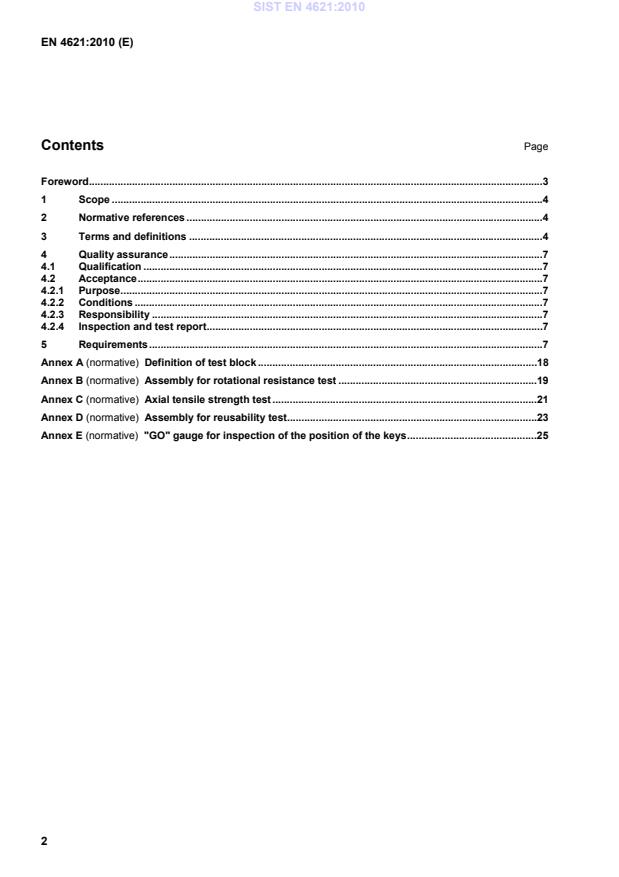
Definition of test block .18Annex B (normative)
Assembly for rotational resistance test .19Annex C (normative)
Axial tensile strength test .21Annex D (normative)
Assembly for reusability test .23Annex E (normative)
"GO" gauge for inspection of the position of the keys .25 SIST EN 4621:2010
With coarse peripheral grain control 1) EN 4619, Aerospace series — Inserts, MJ threads, self-locking, with self-broaching keys — Installation and removal procedure
EN 4620, Aerospace series — Inserts, MJ threads, self-locking, with self-broaching keys — Design standard
EN 9133, Aerospace series — Quality management systems — Qualification procedure for aerospace standard parts ISO 2859-1:1999, Sampling procedures for inspection by attributes — Part 1: Sampling schemes indexed by acceptance quality limit (AQL) for lot-by-Iot inspection ISO 3452:1984, Non-destructive testing — Penetrant inspection — General principles ISO 4288, Geometrical Product Specifications (GPS) — Surface texture: Profile method — Rules and procedures for the assessment of surface texture ISO 5855-1, Aerospace — MJ threads — Part 1: General requirements ISO 5855-2, Aerospace — MJ threads — Part 2: Limit dimensions for bolts and nuts ASTM E 112-96, Standard Test Methods for Determining Average Grain Size 2) 3 Terms and definitions For the purposes of this document, the following terms and definitions apply. 3.1 batch quantity of finished parts, of the same type and same diameter, produced from the same material obtained from the same melt, manufactured in the course of the same production cycle, following the same manufacturing route and having undergone all the relevant heat treatments and surface treatments
1) Published as ASD Prestandard at the date of publication of this standard. 2) Published by: American Society for Testing and Materials (ASTM), 1916, Race Street, Philadelphia, PA 19103, USA. SIST EN 4621:2010
NOTE These particles may be isolated or arranged in strings. 3.2.5 test temperature ambient temperature, unless otherwise specified 3.2.6 simple random sampling taking of n items from a population of N items in such a way that all possible combinations of n items have the same probability of being chosen 3.2.7 critical defect defect that, according to judgement and experience, is likely to result in hazardous or unsafe conditions for individuals using, maintaining, or depending upon the considered product, or that is likely to prevent performance of the function of a major end item 3.2.8 major defect defect other than critical, that is likely to result in a failure or to reduce materially the usability of the considered product for its intended purpose 3.2.9 minor defect defect that is not likely to reduce materially the usability of the considered product for its intended purpose, or that is a departure from established specification having little bearing on the effective use or operation of this product 3.2.10 sampling plan plan according to which one or more samples are taken in order to obtain information and possibly to reach a decision SIST EN 4621:2010
LQ10 in a sampling plan, quality limit which corresponds to a specified 10 % probability of acceptance NOTE 1 It is the limiting lot quality characteristic that the consumer is willing to accept with a low probability that a lot of this quality would occur. NOTE 2 For the purposes of this standard, the limiting quality quoted in Table 4 corresponds to a probability of acceptance of 10 %. 3.2.12 acceptance quality limit
AQL quality limit which in a sampling plan corresponds to a specified but relatively high probability of acceptance NOTE It is the maximum percent defective (or the maximum number of defects per hundred units) that, for purposes of sampling inspection, can be considered satisfactory as a process average. 3.2.13 finished insert insert ready for use, inclusive of any possible treatments and/or surface coatings, as specified in the definition document 3.2.14 definition document document specifying all the requirements for finished inserts 3.2.15 self-locking torque ttorque to be applied to the associated bolt to maintain movement of rotation in relation to the part, the assembly being under no axial load and the insert locking zone being completely engaged with the bolt (minimum protrusion of two pitches, including the end chamfer) 3.2.16 seating torque tightening torque to be applied to the insert or bolt to introduce or to increase the axial load in the assembly 3.2.17 unseating torque untightening torque to be applied to the insert or bolt to reduce or remove the axial load in the assembly 3.2.18 breakaway torque torque required to start unscrewing the insert or the bolt from the associated part, with the insert locking device still fully engaged on the bolt, but after the axial load in the assembly has been removed by unscrewing half a turn followed by a halt in rotational movement SIST EN 4621:2010
Material In accordance with the definition document Chemical analysis or certificate of conformity issued by the manufacturer of the semi-finished product Q
5.2
Dimensions, tolerances and tolerances of form and position In accordance with the definition document. A "GO" inspection gauge is to be fitted on the insert keys. On completion of this inspection, the keys shall neither be bent nor moved. Standard gauging See Annex E. Q 39
A Tables 3 and 4 5.3
Manufacturing
5.3.1
Process Insert threads may be produced by machining or forming. Manufacturing method shall be indicated on test report.
5.3.2
Heat treatment The heat treatment medium or atmosphere shall not cause any surface contamination. Calibration of the heat treatment equipment shall be confirmed.
Any scale which will not be removed by subsequent machining shall be removed by abrasive blasting with an appropriate equipment. Visual examination
The material shall be heat treated in accordance with the material specification defined in the definition document. Examination of the heat treatment specification 5.3.3
Thread deformation (form out-of round) Threads in the locking zone may be deformed in any manner provided that the insert meets the requirements of this standard. The finished inserts shall allow the "GO" thread plug gauge to enter a minimum of three turns, when gauged from the installation side before engagement in the locking zone. Standard gauging Q 39
A Tables 3 and 4 5.3.4
Surface roughness In accordance with the definition document ISO 4288 Q 3
A Tables 3 and 4 5.3.5
Surface coating In accordance with the definition document See applicable coating standard. Q 36
A Tables 3 and 4
A Table 6 (continued) SIST EN 4621:2010
Mechanical properties
5.4.1
Installation requirement The screwing of insert shall be possible freely by hand. After testing, the inserts shall show no signs of:
– buckling and/or incomplete fitting of the keys; – deformation of the internal thread of the insert caused by keys installation. Inserts shall be ins
...