


SIST EN 13232-9:2006+A1:2012
(Main)Railway applications - Track - Switches and crossings - Part 9: Layouts
Railway applications - Track - Switches and crossings - Part 9: Layouts
The scope of this part is:
- to describe the design process of switches and crossings, and the use of the other parts of this standard;
- to define the main criteria to be taken into account during the design of the layout, including the safety and functional dimensions as well as geometrical and material aspects;
- to define the main criteria to be verified during the design approval;
- to define the geometrical and non-geometrical acceptance criteria for inspection of layouts assembled both in the fabrication plant and at track site in case of layouts that are delivered non or partially assembled or in a "kit" form;
- to determine the limits of supply;
- to define the minimum requirements for traceability.
This European Standard applies only to layouts that are assembled in the manufacturing plant or that are assembled for the first time at trackside.
Other aspects such as installation and maintenance also influence performance; these are not considered as part of this European Standard.
Bahnanwendungen - Oberbau - Weichen und Kreuzungen - Teil 9: Weichenanlagen
Der vorliegende Teil umfasst folgende Bereiche:
- den Konstruktionsablauf für Weichen und Kreuzungen sowie die Anwendung auf die anderen Teilbereiche dieser Normung zu beschreiben;
- die wesentlichen Kriterien zu definieren, die für die Konstruktion der Weichenanlagen zu berücksichtigen sind, einschließlich der Maße für Sicherheit und Funktion, sowohl unter geometrischen Gesichtspunkten als auch hinsichtlich der Werkstoffe;
- die wesentlichen Kriterien zu definieren, die im Genehmigungsverfahren für die Konstruktion zu überprüfen sind;
- die geometrischen und nicht geometrischen Abnahmekriterien für die Inspektion der Weichenanlagen zu definieren, sowohl für den Fall, dass die Weichenanlagen im Lieferwerk und auf der Baustelle montiert werden, als auch dafür, dass sie nur teilweise montiert oder als Bausatz geliefert werden;
- den Lieferumfang festzulegen;
- ein Minimum an Erfordernissen für die Rückverfolgbarkeit zu definieren.
Diese Europäische Norm gilt nur für Weichenanlagen, die im Lieferwerk oder auf der Baustelle zum ersten Mal montiert werden.
Andere Gesichtspunkte, wie Einbau und Unterhaltung, die ebenfalls die Leistungsfähigkeit beeinflussen, sind nicht Teil dieser Europäischen Norm.
Applications ferroviaires - Voie - Appareils de voie - Partie 9: Ensemble de l'appareil
La présente partie de la Norme européenne a pour but :
- de décrire le processus de conception des appareils de voie, ainsi que l’utilisation des autres parties de cette norme ;
- de définir les principaux critères à prendre en compte lors de la conception de l’ensemble de l’appareil, y compris les dimensions fonctionnelles et sécuritaires ainsi que les aspects géométriques et matériels ;
- de définir les principaux critères à contrôler lors de l’approbation de la conception ;
- de définir les critères de conformité géométrique et non-géométrique pour l’inspection des ensembles assemblés en usine et sur le site en cas d’ensembles livrés non-assemblés ou partiellement assemblés ou sous forme de «kit» ;
- de déterminer les limites de fourniture ;
- de définir les exigences minimales en terme de traçabilité.
La présente Norme européenne s’applique uniquement aux ensembles d’appareils assemblés en usine ou assemblés pour la première fois sur le site (aire de montage).
D’autres aspects, tels que l’installation et la maintenance, influent également sur les performances, mais ne sont pas pris en compte dans la présente Norme européenne.
Železniške naprave - Zgornji ustroj - Kretnice in križišča - 9. del: Kretniški sklopi
Namen tega dela je:
- opisati postopek projektiranja kretnic in krožišč ter uporabo drugih delov tega standarda;
- opredeliti glavna merila, ki se morajo upoštevati pri projektiranju kretniških sklopov, vključno z varnostjo in funkcionalnimi merami ter vidiki geometrije in materiala;
- opredeliti glavna merila, ki jih je treba preveriti med projektno odobritvijo;
- opredeliti geometrijska in negeometrijska merila sprejemljivosti za nadzor kretniških sklopov, sestavljenih v proizvodnem obratu in na samem mestu zgornjega ustroja, v primeru kretniških sklopov, dobavljenih v nesestavljeni ali delno sestavljeni obliki ali obliki »kompleta«;
- določiti meje napajanja;
- opredeliti minimalne zahteve za sledljivost.
Ta evropski standard velja samo za kretniške sklope, sestavljene v proizvodnem obratu, ali kretniške sklope, prvič sestavljene na tirnicah.
Drugi vidiki, kot so vgradnja in vzdrževanje, prav tako vplivajo na delovanje, vendar niso del tega evropskega standarda.
General Information
- Status
- Withdrawn
- Publication Date
- 22-Nov-2011
- Withdrawal Date
- 05-Nov-2023
- Technical Committee
- IŽNP - Reilway applications
- Current Stage
- 9900 - Withdrawal (Adopted Project)
- Start Date
- 06-Nov-2023
- Due Date
- 29-Nov-2023
- Completion Date
- 06-Nov-2023
Relations
- Consolidates
SIST EN 13232-9:2006 - Railway applications - Track - Switches and crossings - Part 9: Layouts - Effective Date
- 01-Jan-2012
- Effective Date
- 18-Jan-2023
- Effective Date
- 18-Jan-2023
- Effective Date
- 31-Oct-2018
- Effective Date
- 01-Jul-2014

Frequently Asked Questions
SIST EN 13232-9:2006+A1:2012 is a standard published by the Slovenian Institute for Standardization (SIST). Its full title is "Railway applications - Track - Switches and crossings - Part 9: Layouts". This standard covers: The scope of this part is: - to describe the design process of switches and crossings, and the use of the other parts of this standard; - to define the main criteria to be taken into account during the design of the layout, including the safety and functional dimensions as well as geometrical and material aspects; - to define the main criteria to be verified during the design approval; - to define the geometrical and non-geometrical acceptance criteria for inspection of layouts assembled both in the fabrication plant and at track site in case of layouts that are delivered non or partially assembled or in a "kit" form; - to determine the limits of supply; - to define the minimum requirements for traceability. This European Standard applies only to layouts that are assembled in the manufacturing plant or that are assembled for the first time at trackside. Other aspects such as installation and maintenance also influence performance; these are not considered as part of this European Standard.
The scope of this part is: - to describe the design process of switches and crossings, and the use of the other parts of this standard; - to define the main criteria to be taken into account during the design of the layout, including the safety and functional dimensions as well as geometrical and material aspects; - to define the main criteria to be verified during the design approval; - to define the geometrical and non-geometrical acceptance criteria for inspection of layouts assembled both in the fabrication plant and at track site in case of layouts that are delivered non or partially assembled or in a "kit" form; - to determine the limits of supply; - to define the minimum requirements for traceability. This European Standard applies only to layouts that are assembled in the manufacturing plant or that are assembled for the first time at trackside. Other aspects such as installation and maintenance also influence performance; these are not considered as part of this European Standard.
SIST EN 13232-9:2006+A1:2012 is classified under the following ICS (International Classification for Standards) categories: 45.080 - Rails and railway components. The ICS classification helps identify the subject area and facilitates finding related standards.
SIST EN 13232-9:2006+A1:2012 has the following relationships with other standards: It is inter standard links to SIST EN 13232-9:2006, oSIST prEN 13232-9:2014, SIST EN 13232-9:2023, SIST EN 13232-9:2023, oSIST prEN 13232-9:2014. Understanding these relationships helps ensure you are using the most current and applicable version of the standard.
SIST EN 13232-9:2006+A1:2012 is associated with the following European legislation: EU Directives/Regulations: 2008/57/EC, 2016/797/EU; Standardization Mandates: M/024, M/483. When a standard is cited in the Official Journal of the European Union, products manufactured in conformity with it benefit from a presumption of conformity with the essential requirements of the corresponding EU directive or regulation.
You can purchase SIST EN 13232-9:2006+A1:2012 directly from iTeh Standards. The document is available in PDF format and is delivered instantly after payment. Add the standard to your cart and complete the secure checkout process. iTeh Standards is an authorized distributor of SIST standards.
Standards Content (Sample)
2003-01.Slovenski inštitut za standardizacijo. Razmnoževanje celote ali delov tega standarda ni dovoljeno.Bahnanwendungen - Oberbau - Weichen und Kreuzungen - Teil 9: WeichenanlagenApplications ferroviaires - Voie - Appareils de voie - Partie 9: Ensemble de l'appareilRailway applications - Track - Switches and crossings - Part 9: Layouts45.080Rails and railway componentsICS:Ta slovenski standard je istoveten z:EN 13232-9:2006+A1:2011SIST EN 13232-9:2006+A1:2012en,fr,de01-januar-2012SIST EN 13232-9:2006+A1:2012SLOVENSKI
STANDARD
EUROPEAN STANDARD NORME EUROPÉENNE EUROPÄISCHE NORM
EN 13232-9:2006+A1
October 2011 ICS 93.100 Supersedes EN 13232-9:2006English Version
Railway applications - Track - Switches and crossings - Part 9: Layouts
Applications ferroviaires - Voie - Appareils de voie - Partie 9: Ensemble de l'appareil
Bahnanwendungen - Oberbau - Weichen und Kreuzungen -Teil 9: Weichenanlagen This European Standard was approved by CEN on 13 February 2006 and includes Amendment 1 approved by CEN on 13 September 2011.
CEN members are bound to comply with the CEN/CENELEC Internal Regulations which stipulate the conditions for giving this European Standard the status of a national standard without any alteration. Up-to-date lists and bibliographical references concerning such national standards may be obtained on application to the CEN-CENELEC Management Centre or to any CEN member.
This European Standard exists in three official versions (English, French, German). A version in any other language made by translation under the responsibility of a CEN member into its own language and notified to the CEN-CENELEC Management Centre has the same status as the official versions.
CEN members are the national standards bodies of Austria, Belgium, Bulgaria, Croatia, Cyprus, Czech Republic, Denmark, Estonia, Finland, France, Germany, Greece, Hungary, Iceland, Ireland, Italy, Latvia, Lithuania, Luxembourg, Malta, Netherlands, Norway, Poland, Portugal, Romania, Slovakia, Slovenia, Spain, Sweden, Switzerland and United Kingdom.
EUROPEAN COMMITTEE FOR STANDARDIZATION
COMITÉ EUROPÉEN DE NORMALISATION EUROPÄISCHES KOMITEE FÜR NORMUNG
Management Centre:
Avenue Marnix 17,
B-1000 Brussels © 2011 CEN All rights of exploitation in any form and by any means reserved worldwide for CEN national Members. Ref. No. EN 13232-9:2006+A1:2011: ESIST EN 13232-9:2006+A1:2012
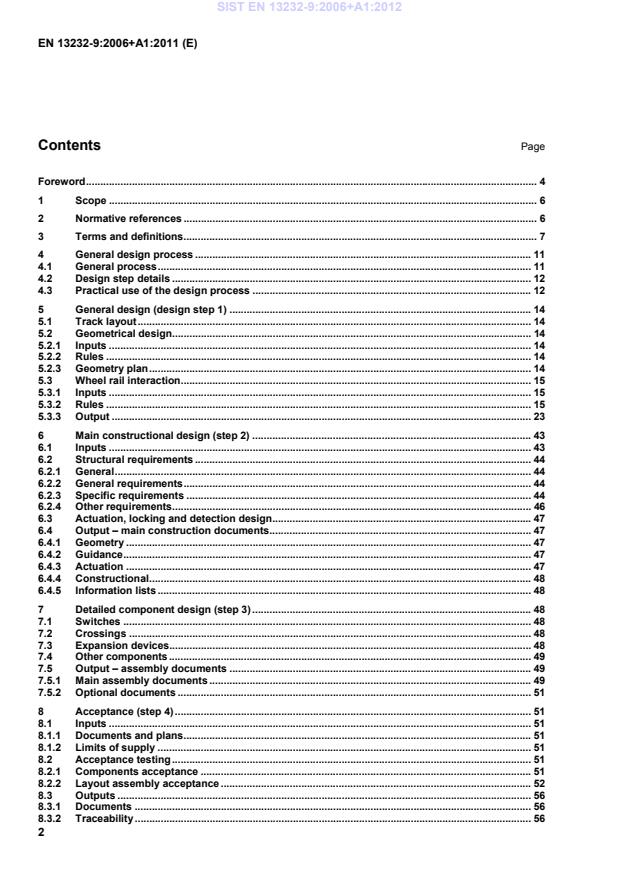
Design criteria . 57A.1Geometry design . 57A.2Wheel rail interaction . 59A.3Actuation, locking and detection conformity . 61A.4Switch design . 63A.5Crossing design (with fixed parts) . 65A.6Crossing design (with moveable parts) . 67A.7Expansion devices . 69Annex B (informative)
Layout acceptance form. 70B.1Justification . 70B.2Example of layout acceptance form . 71Annex C (informative)
Functional and safety dimensions, practically used by different European Networks . 73Annex D (normative)
Maximum angle of attack in obtuse crossings . 74Annex ZA (informative)
!Relationship between this European Standard and the Essential Requirements of EU Directive 2008/57/EC" . 76Bibliography . 79 SIST EN 13232-9:2006+A1:2012
1 Scope The scope of this part is: to describe the design process of switches and crossings, and the use of the other parts of this standard; to define the main criteria to be taken into account during the design of the layout, including the safety and functional dimensions as well as geometrical and material aspects; to define the main criteria to be verified during the design approval; to define the geometrical and non-geometrical acceptance criteria for inspection of layouts assembled both in the fabrication plant and at track site in case of layouts that are delivered non or partially assembled or in a “kit” form; to determine the limits of supply; to define the minimum requirements for traceability. This European Standard applies only to layouts that are assembled in the manufacturing plant or that are assembled for the first time at trackside. Other aspects such as installation and maintenance also influence performance; these are not considered as part of this European Standard. 2 Normative references The following referenced documents are indispensable for the application of this European Standard. For dated references, only the edition cited applies. For undated references, the latest edition of the referenced document (including any amendments) applies. EN 13145, Railway applications — Track — Wood sleepers and bearers EN 13230-4, Railway applications — Track — Concrete sleepers and bearers — Part 4: Prestressed bearers for switches and crossings EN 13232-2, Railway applications — Track — Switches and crossings — Part 2: Requirements for geometric design EN 13232-3, Railway applications — Track — Switches and crossings — Part 3: Requirements for wheel/rail interaction EN 13232-4, Railway applications — Track – Switches and crossings — Part 4: Actuation, locking and detection EN 13232-5, Railway applications — Track — Switches and crossings — Part 5: Switches EN 13232-6, Railway applications — Track — Switches and crossings — Part 6: Fixed common and obtuse crossings EN 13232-7, Railway applications — Track — Switches and crossings — Part 7: Crossings with moveable parts prEN 13232-8, Railway applications — Track — Switches and crossings — Part 8: Expansion devices EN 13481 (all parts), Railway applications — Track — Performance requirements for fastening systems SIST EN 13232-9:2006+A1:2012
Key γA contact angle A contact point Figure 1 — Contact angle This contact angle determines the contact danger zone on the wheel, as defined in EN 13232-3 3.4 friction coefficient µµµµ friction coefficient encountered at the contact point where the contact angle is determined 3.5 flange sharpness qR parameter which characterises the sharpness of the wheel flange. The measurement is taken in accordance with UIC 510-2 at the active side of the flange as defined in Figure 2. It is the distance, parallel to the wheel axis, between the following two points: reference point on the profile, at a distance from wheel axis of 10 mm more than the wheel radius; reference point located at a distance 2 mm from the flange tip towards the wheel axis SIST EN 13232-9:2006+A1:2012
Key a
wheel back to back qR
flange sharpness b
flange width R
wheel radius hfl
flange depth
Figure 2 — Wheel parameters 3.6 flange depth hfl see EN 13232-3 3.7 wheel back-to-back a see EN 13232-2. The symbol “a” is used throughout this standard. An index max or min is given to this symbol according respectively to the maximum and minimum values that can occur during operation 3.8 flange width b see EN 13232-2. The symbol "b" is used throughout this standard. An index max or min is given to this symbol according respectively to the maximum and minimum values that can occur during operation 3.9 switch point retraction E distance, measured at the reference plane, between the reference line of switch and stock rail at the actual switch toe SIST EN 13232-9:2006+A1:2012
Key E point retraction Z1 switch rail machining reference plane (see EN 13232-5) Z2 stock rail machining reference plane (see EN 13232-5) Figure 3 — Switch point retraction 3.10 point retraction in fixed common crossing reference line in a fixed common crossing which can deviate from the theoretical geometry line. From a certain distance to the crossing point, the reference line of the vee can, depending on the design, be removed from this theoretical line away from the wheel flange in order to avoid contact between both elements. This situation is described in Figure 4. SIST EN 13232-9:2006+A1:2012
Key 1 theoretical reference line 2 actual reference line 3 point retraction 4 mathematical point (MP) 5 actual point (RP) Figure 4 — Point retraction in fixed common crossing The value of the point retraction is measured at the actual point (RP) 3.11 lead of turnout distance between reference points of the different components of the S&C, e.g. the distance between theoretical points of crossing and switch in a standard layout. The lead is measured parallel to the reference line, except when stated otherwise 4 General design process 4.1 General process The design process of switches and crossings is complex due to the many requirements that apply and the different situations that may occur. Figure 5 gives a schematic representation of the general design process. It separates the whole process into 4 main steps: step 1 contains the general design of the S&C. It permits the definition of the fundamental aspects of the S&C, respecting the main design requirements, as defined in parts 2 to 4; step 2 is the main constructional design process, which specifies the main construction of the S&C; step 3 consists of the detailed design of the individual components; step 4 is the product acceptance. SIST EN 13232-9:2006+A1:2012
Key 1 step 1: General design 2 step 2: Main constructional design 3 step 3: Detailed component design 4 step 4: Acceptance Figure 5 — General design process Step 1 consists of the geometrical design, the design of the wheel-rail interaction and the design requirements for compliance with the actuation, locking and detection system. Step 2 is based on the technology used by the supplier and is not dealt with in detail by any standard. It is mainly based on the suppliers’ experience and expertise. Step 3 is dealt with in different standards. The design of the main components shall respect the requirements laid down in parts 5 to 8. Other components, such as fastenings, bearers, etc, are dealt with in respective EN’s. 4.2 Design step details a) Every design step requires sufficient input data to enable the design to be completed. b) These input data are dealt with by the supplier through the design rules. The rules are defined in EN 13232, parts 2 to 8. c) The result of the different design steps are outputs. All these aspects are schematically represented for each design step in Figure 6, with a reference to the different parts and clauses where these aspects are dealt with in detail. 4.3 Practical use of the design process The previous scheme deals with the complete design process of the S&C. The use of the standard is not limited to this case only. The customer may choose to instruct the supplier to perform the whole design process and therefore the customer would provide all the necessary input data to permit the supplier to perform the design The customer may also opt to instruct the supplier to perform only parts of the design process. In this case the customer shall deliver all inputs of the design steps he has requested the supplier to perform. This means that he has to deliver all outputs of the previous design steps. EXAMPLE 1 The customer may instruct the supplier to perform the detailed design of an S&C layout based on the geometry of an existing design for use on a main railway line. In this case the customer shall provide the supplier with the outputs from geometrical requirements (the geometry plan) as well as the requirements for wheel-rail interaction, specified by the functional and safety dimensions. Based on this information and the inputs for both conformity for actuation, locking and detection (ALD) and general requirements, he performs the general and detailed component design. SIST EN 13232-9:2006+A1:2012
" NOTE Subclause references in Figure 6 relate to this European Standard. Figure 6 — Design process SIST EN 13232-9:2006+A1:2012
It contains the following information: gauge throughout the S&C; cant throughout the S&C; origin of switch curve; real switch toe; theoretical intersection (crossing); centreline radii; tangent offset; limits of supply; etc. SIST EN 13232-9:2006+A1:2012
(1) or, in another form: ()µγarctanarctan+=QYA
(2) From this law an admissible contact angle is given, by determining an acceptable Y/Q ratio and an assumed friction coefficient µ. This admissible contact angle determines the contact danger zone on the wheel, where no contact with track components may take place to eliminate the risk of wheel climbing. According to experiments (see ERRI C70 RP1) the contact angle γA shall be no smaller than 40°. This corresponds to a friction coefficient of 0,3 and Y/Q of 0,4. 5.3.2.3 Wheels in operation 5.3.2.3.1 Wheel profiles and wear As stated in EN 13232-3, the profiles of both new and worn wheels shall be considered. A typical new wheel profile, according to EN 13715 is given in Figure 7 for information. SIST EN 13232-9:2006+A1:2012
Key R wheel radius Figure 7 — Typical new wheel profile Dimensions in millimetres
Key R wheel radius Figure 8 — Typical worn wheel profile For operation on switches and crossings, no sharp edges or burrs may be tolerated in the transition zone between the active part of the wheel and the flange tip. SIST EN 13232-9:2006+A1:2012
Key Ψ1 skew due to clearances present in axle boxes Ψ2 skew due to clearance of the wheel axles in the track Ψ3 angle formed by a curved track and the parallel wheel axles of car or a bogie Figure 9 — Angle of attack 5.3.2.3.3 Apparent wheel profiles The contact point between rail and wheel can be determined by projection of the wheel onto a plane, perpendicular to the running plane. The projection of the wheel on this plane is called the apparent wheel profile. SIST EN 13232-9:2006+A1:2012
Key 1 Contact danger zone .
Angle of dangerous zone Figure 10 — Wheel with angle of attack = 0º
Key 1 Contact danger zone Figure 11 — Wheel with angle of attack ≠≠≠≠ 0º Due to the non-zero angle of attack (≠ 0º), the apparent wheel profile changes as well as the contact position between wheel and rail (see Figure 11). The derailment risk is at its greatest when the contact takes place in front of the wheel as friction forces lift the wheel out of the track. 5.3.2.3.4 Tangent and secant contact Tangent contact appears when the wheel follows a track element (rail) with a continuous profile. Secant contact appears when the wheel encounters an object on its route. Typical situations are: switch toe not protected by its stock rail; fixed crossing nose in case of insufficient protection by check rail; switch rail with damaged upper surface (tip). 5.3.2.4 Common derailment-critical situations 5.3.2.4.1 Tangent contact The contact is similar to plain line contact. The worst case appears when a new profile with maximum angle of attack encounters the rail. In this case the contact angle γA will be maximum. See Figure 12. SIST EN 13232-9:2006+A1:2012
Key A contact point A contact angle Figure 12 — Tangent contact 5.3.2.4.2 Secant contact at partially open switch tip or crossing nose The worst case is encountered when the worn wheel hits the switch tip with a positive angle of attack and when the wheel is in contact with the corresponding stock rail (see Figure 13). There are two contact points: SIST EN 13232-9:2006+A1:2012
Key 1 PC1 with the switch tip at contact point 1 2 PC0 with the stock rail at contact point 2 Figure 13 — Secant contact The contact angle in contact point PC1 is to be compared with the limiting value of γA. The contact point should stay out of the danger zone of the wheel. In Figures 14 and 15 the danger zone is indicated. Figure14 represents a safe situation. Figure 15 represents a situation that is potentially dangerous. SIST EN 13232-9:2006+A1:2012
Key 1 ellipse γA 2 contact danger zone . angle of dangerous zone Figure 14 — Safe secant contact SIST EN 13232-9:2006+A1:2012
Key 1 ellipse γA 2 contact danger zone . angle of dangerous zone Figure 15 — Dangerous secant contact 5.3.2.4.3 Secant contact at damaged switch tip (for information only) This situation has been studied in UIC 716. The worst case appears when a new wheel profile, lifted by 2 mm, encounters the tongue with a maximum angle of attack (including entry angle). This situation is illustrated in Figure 16 and 17. SIST EN 13232-9:2006+A1:2012
(3)
Key amin
minimum value of wheel back-to-back bmin
minimum flange width FWPS
free wheel passage in switches Z
stock rail machining reference plane Figure 18 — Free wheel passage in switches In order to be able to respect this value during operation the design value shall be agreed between customer and supplier, taking into account tolerances for: lateral wear on switch rail; vertical wear on stock rail; gap between switch rail and associated stock rail; workshop tolerances; gauge widening; geometrical aspects such as inclined switch back machining; etc. 5.3.3.1.1.2 Entry angle Important entry angles occur when gauge widening is applied to the branch line, i.e. in case of tight curves (see Figure 19). A similar situation may occur when switch rails are shortened (see Figure 20). SIST EN 13232-9:2006+A1:2012
Key G gauge G1 gauge widening MP mathematical point of switch RP real point of switch θ switch entry angle Figure 19 — Tight curve design
Key G gauge MP mathematical point of switch RP real point of switch θ switch entry angle
Figure 20 — Shortened switch design Both situations may lead to a greater angle of attack, also depending on the track characteristics in front of the switch. The limiting angle of attack shall be determined by the customer. For UIC-wheels corresponding to UIC 510-2, the limits given in the first column of Table 1 apply, depending on the maximum speed of the branch line. For tracks, designed in accordance to prEN 13803-2, this leads to the limits given in the second column. Table 1 — Maximum angle of attack for UIC-wheels Speed Maximum angle of attack Maximum entry angle (prEN 13803-2) ≤ 40 km/h 2º 1º ≤ 100 km/h 1,41(6)º 0,41(6)º > 100 km/h Reserved Reserved The actual chosen value shall be agreed between customer and supplier taking into account: requested comfort level; worst situation that may occur in the adjacent track; available turnout length; maintenance tolerance (i.e. grinding limits of the switch rail); acceptable mechanical resistance; etc. 5.3.3.1.1.3 Switch point relief A2 The switch point relief at the switch tip shall be determined such that no contact occurs in the wheel danger zone. The worst case occurs with new wheel flanges and the switch opened at its limit dgap (accepted by the detection system). A 2 mm wheel lift will be taken into account. See also Figure 21. SIST EN 13232-9:2006+A1:2012
Key A2
switch point relief dgap
switch rail opening Figure 21 — Switch point relief For wheels according EN 13715, the maximum switch point relief shall be no bigger than 25 mm. The actual value shall be determined taking into account: workshop tolerances; lateral stock rail wear; detection system; etc. SIST EN 13232-9:2006+A1:2012
Key 1 stock rail 2 switch rail L length of side relief machining E point retraction MP pathematical point of switch RP real point of switch R branch line radius Figure 22 — Lateral point retraction In order to prohibit the wheel pushing the switch toe aside, the switch toe shall be sufficiently protected by its corresponding stock rail. This will lead to a lateral point retraction, as shown if Figure 22 (see also 5.3.2.4.). The worst situation will appear with worn wheels (small flange sharpness qR) with high angle of attack. The length L and the value of the retraction E shall be agreed between customer and supplier, taking into account: the workshop tolerances; the lateral stock rail wear; the detection system used (maximum gap at switch point dtoe – see EN 13232-4); maintenance prescriptions; etc. For vehicles in accordance to UIC 510-2, the point retraction E shall be at least 3 mm for turnouts, designed for 100 km/h or more in branch line. This point retraction length L shall be at least 200 mm. SIST EN 13232-9:2006+A1:2012
5.3.3.1.1.5 Lateral point machining Dimensions in millimetres
Key 1 switch rail running face 2 flange running face γ flange angle qR flange sharpness Figure 23 — Lateral point machining The lateral point machining shall be chosen such that the wheel can’t climb up the switch tip. The sharp wheel flange shall be considered for the worst situation. For wheels in accordance with UIC 510-2, the minimum flange sharpness qR is 6,5 mm which corresponds to an angle γ = 14º. This corresponds to the maximum angle to which the switch toe may be machined laterally. The actual value shall be determined between customer and supplier, taking into account: workshop tolerances; maintenance prescriptions; etc. SIST EN 13232-9:2006+A1:2012
Key A1
leading axle P1
distance between axle 1 and 2 A2
middle axle P2
distance between axle 2 and 3 A3
trailing axle φ
entry angle 1
virtual trajectory of axle 2 2
clearance of middle axle A11
contact axle 1/ A22
virtual contact axle 2/ A32
contact axle 3/ R
branch line radius Figure 24 — Vehicle with three axles inscription In order to permit three axle vehicles or bogies to run through the branch line, gauge widening may be required. The leading axle of a three axle vehicle or bogie enters the branch line with the leading axle in contact to the outside rail, the trailing axle being in contact with the inside rail. This situation is given in Figure 24, representing the axles only by the wheel flanges, without wheel back to back (see Figure 25). The middle axle normally has a larger track clearance than the outer axles, either because of smaller flange widths or larger lateral axle clearances in the suspensions. In order to guarantee free passage, the track clearance shall be large enough for this middle axle to permit its passage without forcing the vehicle to move laterally. SIST EN 13232-9:2006+A1:2012
Key a wheel back-to-back b flange width G track gauge Figure 25 — Schematic axle representation 5.3.3.1.2 Closure panel No special requirements are to be applied. 5.3.3.1.3 Common crossing panel 5.3.3.1.3.1 Fixed nose protection Npcf The wheel shall be kept away from the crossing nose by the check rail, when running through the crossing panel. This situation is represented in Figure 26. The following equation can be derived: Npcf ≥ amax + bmax
(4)
Key amax
maximum value of wheel back-to-back bmax
maximum flange width Npcf
nose protection in crossing Z
gauge reference plane Figure 26 — Nose protection in fixed common crossing SIST EN 13232-9:2006+A1:2012
(5)
Key amin
minimum value of wheel back-to-back Fwpcf
free wheel passage Z
gauge reference plane Figure 27 — Free wheel passage in fixed common crossing This dimension is taken between the active check rail side and the wing rail at the running edge. The nominal design value for Fwpcf shall be agreed between customer and supplier, taking into account the tolerances on check rail position after installation. 5.3.3.1.3.3 Free wheel passage at check rail entry Fwpcre The check rail shall only become active after the check rail entry point. This situation is represented in Figure 28. Following equation can be derived: Fwpcre < amin + bmin
(6) SIST EN 13232-9:2006+A1:2012
Key amin
minimum value of wheel back-to-back bmin
minimum flange width Fwpcre free wheel passage in check rail entry Z
gauge reference plane Figure 28 — Free wheel passage at check rail entry This dimension is taken between the active side of the check rail and the running edge of the opposite rail. The nominal value shall be agreed between customer and supplier taking into account: workshop tolerances; maximum values for lateral rail wear; installation tolerances for check rail position; gauge widening; etc. SIST EN 13232-9:2006+A1:2012
(7)
Key amin
minimum value of wheel back-to-back bmin
minimum flange width Fwpwre free wheel passage at wing rail entry Z
gauge reference plane Figure 29 — Free wheel passage at wing rail entry This dimension is taken between the active side of the wing rail and the running edge of the opposite rail. The nominal value shall be agreed between customer and supplier taking into account: workshop tolerances; maximum values for lateral rail wear; crossing production tolerances; etc. SIST EN 13232-9:2006+A1:2012
EN 1
...
Questions, Comments and Discussion
Ask us and Technical Secretary will try to provide an answer. You can facilitate discussion about the standard in here.
Loading comments...