

SIST EN ISO 22248:2026
(Main)Lasers and laser-related equipment - Test methods for laser-induced damage threshold - Classification of medical beam delivery systems (ISO 22248:2020)
- Abstract
This document specifies a method of testing the laser-induced ignition and damage of medical beam delivery systems to allow checking of suitable products according to the classification system.
NOTE 1 Take care when interpreting these results, since the direct applicability of the results of this test method to the clinical situation has not been fully established.
NOTE 2 Users of products tested by this method are cautioned that the laser will be wavelength sensitive and tested at the wavelength for which it is intended to be used. If tested using other wavelengths, the power settings and modes of beam delivery need to be explicitly stated.
CAUTION — This test method can involve hazardous materials, operations and equipment. This document provides advice on minimizing some of the risks associated with its use but does not purport to address all such risks. It is the responsibility of the user of this document to establish appropriate safety and health practices and to determine the applicability of regulatory limitations prior to use.
- Status
- Published
- Public Enquiry End Date
- 29-Apr-2024
- Publication Date
- 13-Jul-2026
- Technical Committee
- VAZ - Healthcare
- Current Stage
- 6060 - National Implementation/Publication (Adopted Project)
- Start Date
- 09-Jul-2026
- Due Date
- 13-Sep-2026
- Completion Date
- 14-Jul-2026

SIST EN ISO 22248:2026 specifies a test method for laser-induced ignition and damage of medical beam delivery systems, together with a classification system for judging whether a product is suitable for that use. It is a CEN European Standard based on ISO 22248:2020, and it is written for manufacturers, test laboratories, and users who need to compare laser resistance under defined test conditions.
What does SIST EN ISO 22248:2026 specify?
SIST EN ISO 22248:2026 specifies how to test medical beam delivery systems for laser-induced ignition and damage so they can be checked against the document’s classification system. The test is aimed at products such as articulated arms, hollow waveguides, optical fibres, and related applicators used to carry a medical laser beam to the treatment site.
The scope also gives two practical cautions. First, the results have not been fully established as directly applicable to clinical situations. Second, the laser response is wavelength-sensitive, so the test wavelength and beam-delivery mode need to match the intended use, and any test at another wavelength has to be stated clearly.
The document is organized into Clauses 1 to 12:
- Scope
- Normative references
- Terms and definitions
- Principle
- Significance and use
- Apparatus
- Reagents and materials
- Preparation of test specimens
- Preparation of apparatus
- Test methods
- Classification
- Test report
What are the key requirements of SIST EN ISO 22248:2026?
SIST EN ISO 22248:2026 is built around a worst-case fire-risk test in oxygen-enriched conditions, with separate methods for irradiation and transmission. In practice, the standard asks you to control the test setup closely, use the manufacturer’s instructions, and report results in a way that allows comparison between products.
Test conditions and apparatus
- Clause 4 sets the principle: expose the material to laser power with known characteristics in an environment that can reach 98 % ± 2 % oxygen. This matters because the standard is trying to reproduce severe ignition conditions rather than everyday handling.
- Clause 6 requires a draught-resistant ventilated containment box, specimen holder, laser source, power meter, gas supply, and smoke evacuation. The box has to be non-reflective inside, allow observation, and be able to flood rapidly with nitrogen or another inert gas.
- The laser beam must have the same optical quality as in surgical use, and beam diameter is measured in accordance with ISO 13694. The power meter uncertainty has to be less than 5 %, and transmitted power has to be verified to within ±10 %. In practice, that means the test setup must be controlled well enough that the results are meaningful.
Specimens and test sequence
- Clause 5 says the specimen preparation follows the manufacturer’s instructions for use, and the test is performed in ambient air and in oxygen-enriched atmospheres of 60 % ± 2 % and 98 % ± 2 %. This matters because the same product may behave very differently as oxygen concentration rises.
- Clause 8 requires five specimens. Single-use products are taken from their selling package, while reusable products are tested new and again after reprocessing up to the maximum allowed number of uses. Specimens must be free from extraneous material and conditioned for 24 h at 20 °C ± 3 °C and 20 % ± 2 % relative humidity.
- Clause 10.2 and 10.3 start testing at 10 % of the manufacturer’s maximum specified power, for 1 s to 10 s, then increase power in reasonable steps until ignition or damage occurs. A new specimen is needed for each new power level. In practice, this builds a threshold curve rather than a single yes/no result.
Classification and reporting
- Clause 11 assigns class symbols for the results: I for irradiation ignition, T for transmission ignition, and D for transmission destruction. The oxygen concentration is shown by a subscript, so the report makes clear whether the result came from ambient air, 60 % oxygen, or 98 % oxygen.
- The class system distinguishes no ignition, ignition that self-extinguishes, and ignition that continues after the laser is stopped. For destruction, the document separates simple destruction from destruction with loss of parts. For a buyer or quality manager, this tells you not just whether the product burns, but how it fails.
- The five-specimen rule in Clause 11 determines the product class: if all specimens fall in one class, that is the product class; if two or more move to a higher, less safe class, that higher class is assigned; if only one specimen moves higher, a second series of five specimens is required.
- Clause 12 requires a report that identifies the product, laser type and wavelength, exposure time, maximum power, environment, specimen condition, observed burning behaviour, afterflame and afterglow times, damage length, and a graph of power versus exposure duration. This is the evidence trail needed for comparison, audit, or product documentation.
What terms does SIST EN ISO 22248:2026 define?
SIST EN ISO 22248:2026 defines the terms used to describe ignition, damage, and the device under test. The most important ones are:
- Medical beam delivery system - a product intended to transmit the laser beam from the source to the treatment site, directly or with additional applicators.
- Applicator - an attachment at the treatment site, such as a focussing handpiece, scanner, endoscope, tip, or lens.
- Ignition - combustion created by delivery of laser power.
- Irradiation ignition - ignition caused by laser irradiation from outside the specimen.
- Transmission ignition - ignition caused when the laser beam passes through the specimen.
- Destruction - damage during laser transmission caused by absorption, such as crumbling, melting, disconnecting, or breaking, with or without loss of parts.
- Laser resistance - the ability of a material to withstand laser power without ignition or damage.
Who uses SIST EN ISO 22248:2026?
SIST EN ISO 22248:2026 is used by manufacturers, test laboratories, and technical teams that evaluate medical beam delivery systems for surgical laser applications. It is relevant to products such as articulated arms, hollow waveguides, optical fibres, bare fibres, shaped fibres, connected end pieces, handpieces, scanners, endoscopes, and laser tips.
Quality, regulatory, and purchasing teams use it to compare products under the same test conditions and to document the class assigned to a product. It is also relevant when a reusable product is reprocessed, because the document asks for testing at the point where the rating changes.
What changed in SIST EN ISO 22248:2026 from the previous edition?
SIST EN ISO 22248:2026 is the CEN adoption of ISO 22248:2020 without technical modification. The European foreword states that the ISO text was approved as SIST EN ISO 22248:2026 without any change.
Which standards are used with SIST EN ISO 22248:2026?
SIST EN ISO 22248:2026 cites two normative references:
- ISO 13694 - used for measuring beam power or energy density distribution, which supports the beam diameter requirement in the test setup.
- ISO/IEC Guide 99 - supplies the metrology vocabulary used in the definitions and measurement context.
The document also draws terms from ISO 11810:2015 and ISO 11145:2018, and its bibliography points to related laser safety and medical laser standards such as IEC 60601-2-22 and IEC 60825-1.
What does the SIST EN ISO 22248:2026 document contain?
SIST EN ISO 22248:2026 contains apparatus drawings, procedure flowcharts, classification tables, and a test report checklist. Figures 1 and 2 show the irradiation and transmission test arrangements, and Figures 3 and 4 show the flowcharts for the ignition and destruction procedures.
Tables 1 to 3 set out the I, T, and D classification systems. Clause 12 then lists the report items, including the test environment, laser settings, specimen description, burning behaviour, and the graph of power against exposure duration.
The document also describes the containment box, gas supply, oxygen analysis, smoke evacuation, specimen conditioning, and the testing sequence used to compare products under ambient and oxygen-enriched conditions.
Relations
- Effective Date
- 15-Jul-2026
Frequently Asked Questions
SIST EN ISO 22248:2026 is a standard published by the Slovenian Institute for Standardization (SIST). Its full title is "Lasers and laser-related equipment - Test methods for laser-induced damage threshold - Classification of medical beam delivery systems (ISO 22248:2020)". This standard covers: This document specifies a method of testing the laser-induced ignition and damage of medical beam delivery systems to allow checking of suitable products according to the classification system. NOTE 1 Take care when interpreting these results, since the direct applicability of the results of this test method to the clinical situation has not been fully established. NOTE 2 Users of products tested by this method are cautioned that the laser will be wavelength sensitive and tested at the wavelength for which it is intended to be used. If tested using other wavelengths, the power settings and modes of beam delivery need to be explicitly stated. CAUTION — This test method can involve hazardous materials, operations and equipment. This document provides advice on minimizing some of the risks associated with its use but does not purport to address all such risks. It is the responsibility of the user of this document to establish appropriate safety and health practices and to determine the applicability of regulatory limitations prior to use.
This document specifies a method of testing the laser-induced ignition and damage of medical beam delivery systems to allow checking of suitable products according to the classification system. NOTE 1 Take care when interpreting these results, since the direct applicability of the results of this test method to the clinical situation has not been fully established. NOTE 2 Users of products tested by this method are cautioned that the laser will be wavelength sensitive and tested at the wavelength for which it is intended to be used. If tested using other wavelengths, the power settings and modes of beam delivery need to be explicitly stated. CAUTION — This test method can involve hazardous materials, operations and equipment. This document provides advice on minimizing some of the risks associated with its use but does not purport to address all such risks. It is the responsibility of the user of this document to establish appropriate safety and health practices and to determine the applicability of regulatory limitations prior to use.
SIST EN ISO 22248:2026 is classified under the following ICS (International Classification for Standards) categories: 31.260 - Optoelectronics. Laser equipment. The ICS classification helps identify the subject area and facilitates finding related standards.
SIST EN ISO 22248:2026 has the following relationships with other standards: It is inter standard links to SIST-V ISO/IEC Vodilo 99:2012. Understanding these relationships helps ensure you are using the most current and applicable version of the standard.
SIST EN ISO 22248:2026 is associated with the following European legislation: EU Directives/Regulations: 2017/745; Standardization Mandates: M/575, M/575 AMD 2. When a standard is cited in the Official Journal of the European Union, products manufactured in conformity with it benefit from a presumption of conformity with the essential requirements of the corresponding EU directive or regulation.
SIST EN ISO 22248:2026 is available in PDF format for immediate download after purchase. The document can be added to your cart and obtained through the secure checkout process. Digital delivery ensures instant access to the complete standard document.
Standards Content (Sample)
SLOVENSKI STANDARD
01-september-2026
Laserji in laserska oprema - Preskusne metode za ugotavljanje praga poškodbe,
povzročene z laserjem - Razvrstitev sistemov odmerkov medicinskega žarka (ISO
22248:2020)
Lasers and laser-related equipment - Test methods for laser-induced damage threshold -
Classification of medical beam delivery systems (ISO 22248:2020)
Laser und Laseranlagen - Prüfverfahren für die laserinduzierte Zerstörschwelle -
Einteilung von medizinischen Strahlführungssystemen (ISO 22248:2020)
Lasers et équipements associés aux lasers - Méthodes d'essai du seuil
d'endommagement provoqué par laser - Classification des systèmes de transmission de
faisceau médical (ISO 22248:2020)
Ta slovenski standard je istoveten z: EN ISO 22248:2026
ICS:
31.260 Optoelektronika, laserska Optoelectronics. Laser
oprema equipment
2003-01.Slovenski inštitut za standardizacijo. Razmnoževanje celote ali delov tega standarda ni dovoljeno.
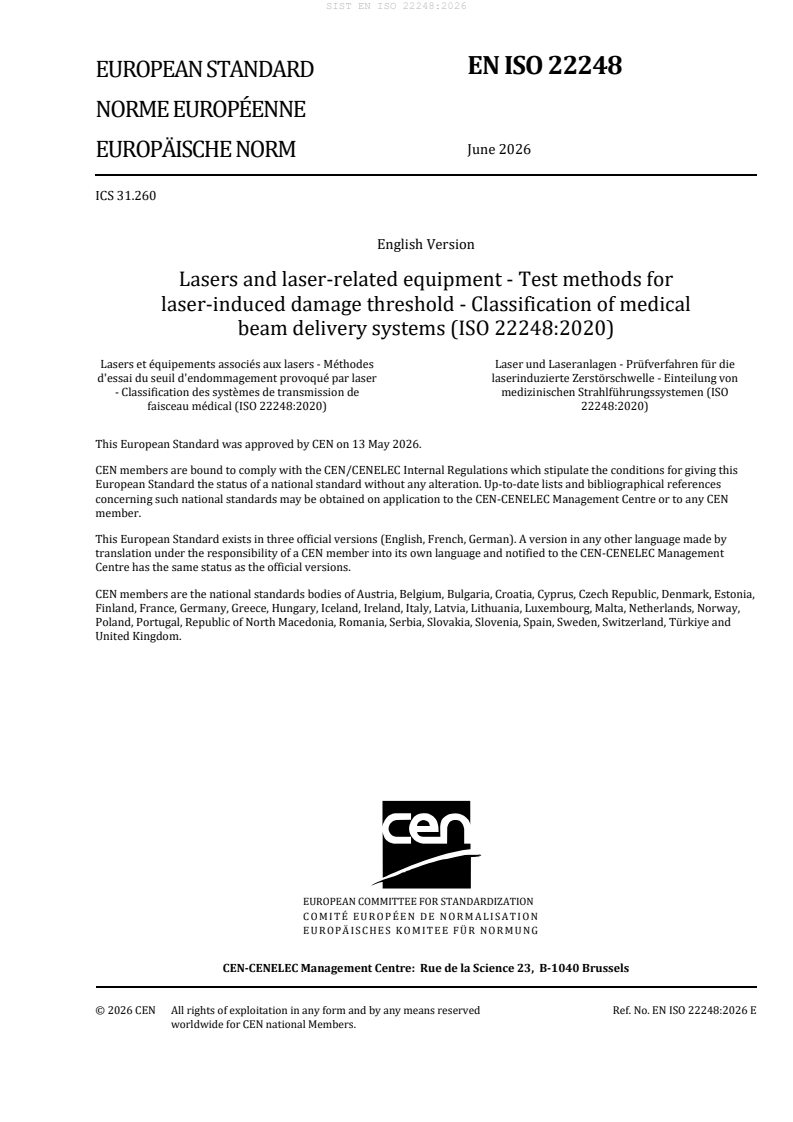
EN ISO 22248
EUROPEAN STANDARD
NORME EUROPÉENNE
June 2026
EUROPÄISCHE NORM
ICS 31.260
English Version
Lasers and laser-related equipment - Test methods for
laser-induced damage threshold - Classification of medical
beam delivery systems (ISO 22248:2020)
Lasers et équipements associés aux lasers - Méthodes Laser und Laseranlagen - Prüfverfahren für die
d'essai du seuil d'endommagement provoqué par laser laserinduzierte Zerstörschwelle - Einteilung von
- Classification des systèmes de transmission de medizinischen Strahlführungssystemen (ISO
faisceau médical (ISO 22248:2020) 22248:2020)
This European Standard was approved by CEN on 13 May 2026.
CEN members are bound to comply with the CEN/CENELEC Internal Regulations which stipulate the conditions for giving this
European Standard the status of a national standard without any alteration. Up-to-date lists and bibliographical references
concerning such national standards may be obtained on application to the CEN-CENELEC Management Centre or to any CEN
member.
This European Standard exists in three official versions (English, French, German). A version in any other language made by
translation under the responsibility of a CEN member into its own language and notified to the CEN-CENELEC Management
Centre has the same status as the official versions.
CEN members are the national standards bodies of Austria, Belgium, Bulgaria, Croatia, Cyprus, Czech Republic, Denmark, Estonia,
Finland, France, Germany, Greece, Hungary, Iceland, Ireland, Italy, Latvia, Lithuania, Luxembourg, Malta, Netherlands, Norway,
Poland, Portugal, Republic of North Macedonia, Romania, Serbia, Slovakia, Slovenia, Spain, Sweden, Switzerland, Türkiye and
United Kingdom.
EUROPEAN COMMITTEE FOR STANDARDIZATION
COMITÉ EUROPÉEN DE NORMALISATION
EUROPÄISCHES KOMITEE FÜR NORMUNG
CEN-CENELEC Management Centre: Rue de la Science 23, B-1040 Brussels
© 2026 CEN All rights of exploitation in any form and by any means reserved Ref. No. EN ISO 22248:2026 E
worldwide for CEN national Members.
Contents Page
European foreword . 3
European foreword
The text of ISO 22248:2020 has been prepared by Technical Committee ISO/TC 172 “Optics and
photonics” of the International Organization for Standardization (ISO) and has been taken over as
which is held by DIN.
This European Standard shall be given the status of a national standard, either by publication of an
identical text or by endorsement, at the latest by December 2026, and conflicting national standards
shall be withdrawn at the latest by December 2026.
Attention is drawn to the possibility that some of the elements of this document may be the subject of
patent rights. CEN shall not be held responsible for identifying any or all such patent rights.
Any feedback and questions on this document should be directed to the users’ national standards body.
A complete listing of these bodies can be found on the CEN website.
According to the CEN-CENELEC Internal Regulations, the national standards organizations of the
following countries are bound to implement this European Standard: Austria, Belgium, Bulgaria,
Croatia, Cyprus, Czech Republic, Denmark, Estonia, Finland, France, Germany, Greece, Hungary, Iceland,
Ireland, Italy, Latvia, Lithuania, Luxembourg, Malta, Netherlands, Norway, Poland, Portugal, Republic of
North Macedonia, Romania, Serbia, Slovakia, Slovenia, Spain, Sweden, Switzerland, Türkiye and the
United Kingdom.
Endorsement notice
The text of ISO 22248:2020 has been approved by CEN as EN ISO 22248:2026 without any modification.
INTERNATIONAL ISO
STANDARD 22248
First edition
2020-11
Lasers and laser-related equipment —
Test methods for laser-induced
damage threshold — Classification of
medical beam delivery systems
Lasers et équipements associés aux lasers — Méthodes d'essai du seuil
d'endommagement provoqué par laser — Classification des systèmes
de transmission de faisceau médical
Reference number
ISO 22248:2020(E)
©
ISO 2020
ISO 22248:2020(E)
© ISO 2020
All rights reserved. Unless otherwise specified, or required in the context of its implementation, no part of this publication may
be reproduced or utilized otherwise in any form or by any means, electronic or mechanical, including photocopying, or posting
on the internet or an intranet, without prior written permission. Permission can be requested from either ISO at the address
below or ISO’s member body in the country of the requester.
ISO copyright office
CP 401 • Ch. de Blandonnet 8
CH-1214 Vernier, Geneva
Phone: +41 22 749 01 11
Email: copyright@iso.org
Website: www.iso.org
Published in Switzerland
ii © ISO 2020 – All rights reserved
ISO 22248:2020(E)
Contents Page
Foreword .iv
Introduction .v
1 Scope . 1
2 Normative references . 1
3 Terms and definitions . 1
4 Principle . 4
5 Significance and use of the test. 4
6 Apparatus . 4
6.1 General . 4
6.2 Containment box . 6
6.3 Specimen holder . 7
6.4 Lasers and beam delivery systems . 7
6.5 Power meter . 7
6.6 Gas supply system . 7
6.7 Environment . 8
6.7.1 Ambient air conditions . 8
6.7.2 Oxygen enriched atmospheres . 8
6.8 Smoke evacuation device . 8
7 Reagents and materials . 8
8 Preparation of test specimens . 9
9 Preparation of apparatus . 9
10 Test methods .10
10.1 General conditions .10
10.2 Testing during laser irradiation .10
10.3 Testing during laser transmission .11
11 Classification .12
11.1 General .12
11.2 Irradiation ignition testing (I) .13
11.3 Transmission ignition and destruction testing (T/D) .13
11.3.1 Transmission ignition testing (T) .13
11.3.2 Transmission destruction testing (D) .14
12 Test report .16
Bibliography .18
ISO 22248:2020(E)
Foreword
ISO (the International Organization for Standardization) is a worldwide federation of national standards
bodies (ISO member bodies). The work of preparing International Standards is normally carried out
through ISO technical committees. Each member body interested in a subject for which a technical
committee has been established has the right to be represented on that committee. International
organizations, governmental and non-governmental, in liaison with ISO, also take part in the work.
ISO collaborates closely with the International Electrotechnical Commission (IEC) on all matters of
electrotechnical standardization.
The procedures used to develop this document and those intended for its further maintenance are
described in the ISO/IEC Directives, Part 1. In particular, the different approval criteria needed for the
different types of ISO documents should be noted. This document was drafted in accordance with the
editorial rules of the ISO/IEC Directives, Part 2 (see www .iso .org/ directives).
Attention is drawn to the possibility that some of the elements of this document may be the subject of
patent rights. ISO shall not be held responsible for identifying any or all such patent rights. Details of
any patent rights identified during the development of the document will be in the Introduction and/or
on the ISO list of patent declarations received (see www .iso .org/ patents).
Any trade name used in this document is information given for the convenience of users and does not
constitute an endorsement.
For an explanation of the voluntary nature of standards, the meaning of ISO specific terms and
expressions related to conformity assessment, as well as information about ISO's adherence to the
World Trade Organization (WTO) principles in the Technical Barriers to Trade (TBT) see www .iso .org/
iso/ foreword .html.
This document was prepared by Technical Committee ISO/TC 172, Optics and photonics, Subcommittee
SC 9, Laser and electro-optical systems.
Any feedback or questions on this document should be directed to the user’s national standards body. A
complete listing of these bodies can be found at www .iso .org/ members .html.
iv © ISO 2020 – All rights reserved
ISO 22248:2020(E)
Introduction
Fire in an operating room is the most dangerous situation for patient and staff. Besides electrosurgical
devices and endoscopic light sources, even surgical lasers can be ignition sources for drapes, gowns
and tracheal tubes. This risk was identified very early and several ISO standards for laser proof
materials have been published. The medical beam delivery system itself, however, was out of focus.
Due to the increasing market on the one hand and necessity for cost reduction in health care on the
other hand fibres have come into the market with a risk of self-ignition of the core or cladding material.
Furthermore with reinvention of fibre-applicator-systems for contact application or integrated diffusor
systems they have an increased risk for self-ignition due to high absorption. This document elaborates
reproducible test parameters for medical beam delivery systems.
INTERNATIONAL STANDARD ISO 22248:2020(E)
Lasers and laser-related equipment — Test methods
for laser-induced damage threshold — Classification of
medical beam delivery systems
1 Scope
This document specifies a method of testing the laser-induced ignition and damage of medical beam
delivery systems to allow checking of suitable products according to the classification system.
NOTE 1 Take care when interpreting these results, since the direct applicability of the results of this test
method to the clinical situation has not been fully established.
NOTE 2 Users of products tested by this method are cautioned that the laser will be wavelength sensitive and
tested at the wavelength for which it is intended to be used. If tested using other wavelengths, the power settings
and modes of beam delivery need to be explicitly stated.
CAUTION — This test method can involve hazardous materials, operations and equipment. This
document provides advice on minimizing some of the risks associated with its use but does not
purport to address all such risks. It is the responsibility of the user of this document to establish
appropriate safety and health practices and to determine the applicability of regulatory
limitations prior to use.
2 Normative references
The following documents are referred to in the text in such a way that some or all of their content
constitutes requirements of this document. For dated references, only the edition cited applies. For
undated references, the latest edition of the referenced document (including any amendments) applies.
ISO 13694, Optics and photonics — Lasers and laser-related equipment — Test methods for laser beam
power (energy) density distribution
ISO/IEC Guide 99, International vocabulary of metrology — Basic and general concepts and associated
terms (VIM)
3 Terms and definitions
For the purposes of this document, the terms and definitions given in ISO/IEC Guide 99 and the
following apply.
ISO and IEC maintain terminological databases for use in standardization at the following addresses:
— ISO Online browsing platform: available at https:// www .iso .org/ obp
— IEC Electropedia: available at http:// www .electropedia .org/
3.1
afterflame
persistence of flaming of a material, under specified test conditions, after the ignition source has
been removed
[SOURCE: ISO 11810:2015, 3.1]
ISO 22248:2020(E)
3.2
afterflame time
length of time for which a material continues to flame, under specified test conditions, after the ignition
source has been removed
[SOURCE: ISO 11810:2015, 3.2]
3.3
afterglow
persistence of glowing of a material, under specified test conditions, after cessation of flaming or, if no
flaming occurs, after the ignition source has been removed
[SOURCE: ISO 11810:2015, 3.3]
3.4
afterglow time
time during which a material continues to glow, under specified test conditions, after cessation of
flaming or, if no flaming occurs, after the ignition source has been removed
[SOURCE: ISO 11810:2015, 3.4]
3.5
beam diameter
d
diameter of a circular aperture in a plane perpendicular to the beam axis that contains 95 % of the total
beam power (energy)
[SOURCE: ISO 11145:2018, 3.3.1, modified — Value of contained total beam power set to 95 % and
Note 1 to entry removed.]
3.6
beam cross-sectional area
A
smallest completely filled area containing 95 % of the total beam power (energy)
[SOURCE: ISO 11145:2018, 3.6.1, modified — Value of contained total beam power set to 95 % and
Note 1 to entry removed.]
3.7
combustion
any continuing burning process that occurs in or on the specimen caused by a chemical process of
oxidation with the liberation of heat
EXAMPLE Flame, smouldering, rapid evolution of smoke.
[SOURCE: ISO 11810:2015, 3.7]
3.8
destruction
damage of the system during laser radiation transmission due to absorption rather than ignition
(crumbling, melting, disconnecting, breaking) with or without loss of parts of the system
3.9
flammable
subject to ignition and flaming combustion
[SOURCE: ISO 11810:2015, 3.9]
2 © ISO 2020 – All rights reserved
ISO 22248:2020(E)
3.10
ignition
creation of combustion induced by the beam delivery of laser power
[SOURCE: ISO 11810:2015, 3.10, modified — "laser" was included before "power"]
3.10.1
irradiation ignition
ignition of a specimen by laser irradiation of the specimen from outside
3.10.2
transmission ignition
ignition of a specimen by a laser beam transmission through the specimen
3.11
laser resistance
measure of the ability of a material to withstand laser power without ignition or damage
[SOURCE: ISO 11810:2015, 3.11]
3.12
medical beam delivery system
product intended to transmit the laser beam from the source to the treatment site directly or by the use
of additional applicators
EXAMPLE Articulated arms, hollow waveguides, optical fibres.
Note 1 to entry: Directly means direct application either with bare fibres, shaped fibres or internal marked fibres.
3.12.1
applicator
attachment to the medical beam delivery system at the treatment site
EXAMPLE Focussing handpiece, micromanipulators, scanners, endoscopes, shaped tips like sapphire tips,
ceramic/metal tips, radial tips, focussing lenses or diffusor tips.
3.13
melting behaviour
softening of a material under the influence of heat (including shrinking, dripping and burning of molten
material, etc.)
[SOURCE: ISO 11810:2015, 3.12]
3.14
thermal resistance
ability of a material to resist conduction of heat
[SOURCE: ISO 11810:2015, 3.20]
3.15
product
finished medical device (samples)
3.16
reusable product
product intended to be prepared and re-sterilized for multiple use
[SOURCE: ISO 11810:2015, 3.16]
ISO 22248:2020(E)
3.17
single use
product intended to be used once and then discarded
[SOURCE: ISO 11810:2015, 3.18]
4 Principle
WARNING — This test method can result in a rocket-like fire. Such a fire can produce intense
heat and light and toxic gases.
To simulate worst-case conditions, the material is exposed to laser power of known characteristics in
an environment up to 98 % ± 2 % oxygen.
5 Significance and use of the test
5.1 A medical beam delivery system is intended to transmit the laser beam from the source to the
treatment area. This can be articulated arms, hollow waveguides or optical fibres. It can deliver the
radiation to the target by connected applicators like focussing handpiece, micromanipulators, scanners
or endoscopes or fix mounted applicators as shaped tips like sapphire tips, ceramic/metal tips, radial
tips, focussing lenses or diffusor tips. Another technical solution is the direct application either with bare
fibres, shaped fibres or internal marked fibres.
5.2 This document describes a uniform and repeatable test method for measuring the laser-induced
ignition, flame spread and damage of medical beam delivery systems. Variables involved in laser ignition
have been fixed in order to establish a basis for comparison. This test method can be used to compare
different types and designs.
5.3 A large number and range of variables are involved in ignition. A change in one variable can affect
the outcome of the test. Caution should be observed, since the direct applicability of the results of this
test method to the clinical situation has not been fully established.
NOTE This method can be applied to study the effect of changing the test conditions, but this is outside the
scope of this document. For example, variation of the breathing-gas flow rate or different breathing-gas mixtures
might affect the laser ignition.
5.4 Since an oxygen-enriched atmosphere is often present in the clinical situation, either intentionally
or unintentionally, the test is performed under ambient air conditions and an environment of 60 % ± 2%
and 98 % ± 2 % oxygen, respectively.
5.5 The preparation of the specimen shall be in accordance with the manufacturer's instructions for use.
6 Apparatus
6.1 General
The test apparatus shall consist of a draught-resistant ventilated containment box, specimen holder,
specimen rack, laser energy source and associated parts (see Figures 1 and 2).
4 © ISO 2020 – All rights reserved
ISO 22248:2020(E)
Key
1 medical beam delivery system 6 flashback arrestor
2 medical beam delivery system support using two clamps 7 oxygen flow meter and controller
3 laser source for irradiation 8 pressure regulator with inlet and outlet
gauges
4 containment box (lateral view) 9 quick-action inert gas valve
5 enclosure cover (may be multi-piece) 10 opening for laser access
11 liquid for cooling/cleaning
Figure 1 — Apparatus for irradiation ignition testing
----------
...