

SIST EN 303 204 V2.1.2:2016
(Main)Network Based Short Range Devices (SRD) - Radio equipment to be used in the 870 MHz to 876 MHz frequency range with power levels ranging up to 500 mW - Harmonised Standard covering the essential requirements of article 3.2 of the Directive 2014/53/EU
General Information
- Abstract
The present document applies to the following radio equipment types:
1) Network Based SRDs which are SRDs intended to operate in association with other SRDs to form network
topologies supporting the intended application.
2) Network Relay Points which are specific Network Based SRDs supporting interconnection of a network of
SRDs with an external network or service.
The present document covers equipment intended for use in a fixed location, equipment normally fixed in a vehicle and
equipment intended to be carried or attached.
The present document contains requirements to demonstrate that radio equipment both effectively uses and supports the
efficient use of radio spectrum in order to avoid harmful interference.
- Status
- Published
- Publication Date
- 12-Oct-2016
- Technical Committee
- MOC - Mobile Communications
- Current Stage
- 6060 - National Implementation/Publication (Adopted Project)
- Start Date
- 26-Sep-2016
- Due Date
- 01-Dec-2016
- Completion Date
- 13-Oct-2016
Buy Documents
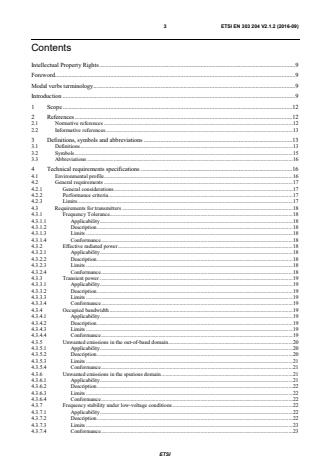
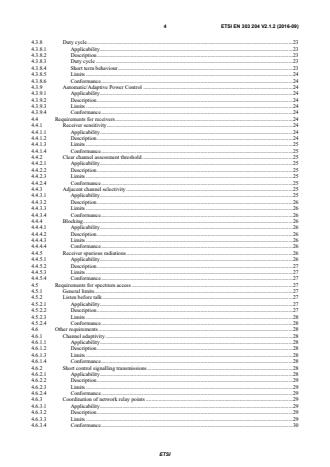
ETSI EN 303 204 V2.1.2 (2016-09) - Network Based Short Range Devices (SRD); Radio equipment to be used in the 870 MHz to 876 MHz frequency range with power levels ranging up to 500 mW; Harmonised Standard covering the essential requirements of article 3.2 of the Directive 2014/53/EU

Overview
SIST EN 303 204 V2.1.2:2016 is a harmonized European standard specifying requirements for network-based Short Range Devices (SRDs) operating in the 870 MHz to 876 MHz frequency range with power levels up to 500 mW. The standard, adopted by SIST (Slovenian Institute for Standardization), aligns with the essential requirements of Article 3.2 of the Radio Equipment Directive 2014/53/EU.
This standard applies to various radio equipment types, including SRDs intended to operate as part of a network, network relay points for interconnecting SRDs to external networks or services, and equipment intended for installation in fixed locations, vehicles, or portable use. Through technical specifications, SIST EN 303 204 V2.1.2:2016 ensures efficient and effective spectrum use, while minimizing the risk of harmful interference with other radio services.
Key Topics
- Scope of Devices:
Covers network-based SRDs and network relay points operating in the specified frequency range. - Spectrum Efficiency:
Requirements ensure optimal use of radio spectrum and avoidance of interference. - Equipment Categories:
Applies to radio equipment in fixed, vehicle-installed, or portable configurations. - Conformance Testing:
Defines test procedures to verify radio equipment meets essential performance and regulatory criteria. - Receiver and Transmitter Requirements:
Outlines technical parameters for frequency tolerance, bandwidth, power output, emissions, and receiver sensitivity. - Adaptive Features:
Sets conditions for adaptive power control, duty cycle limits, and channel access, supporting coexistence and minimizing interference. - Safety and Compatibility:
Aligns with EU directives for electromagnetic compatibility (EMC) and safety.
Applications
SIST EN 303 204 V2.1.2:2016 supports a broad spectrum of professional and industrial applications reliant on short range radio communications:
- Industrial and Building Automation:
Facilitates remote sensor communications and control systems in smart buildings and industrial premises. - Logistics and Asset Tracking:
Enables networked tag readers and location services for warehousing and distribution centers. - Fleet Management:
Used in vehicle-installed systems for real-time data sharing and status monitoring. - Smart Utility Networks:
Applies to interconnected meter devices and infrastructure monitoring. - Home and Consumer Electronics:
Supports wireless alarm systems, security devices, and other home automation products operating in the 870–876 MHz band. - Agricultural and Environmental Monitoring:
Useful in distributed sensor networks for precision agriculture and environmental data collection.
Compliance with this standard is crucial for manufacturers and integrators seeking CE marking and market acceptance within the European Union, as it demonstrates conformity with radio spectrum and interference requirements.
Related Standards
For a comprehensive and compliant product development lifecycle, consider referencing these related standards:
- ETSI EN 303 204:
The underlying European harmonized standard equivalent to SIST EN 303 204 V2.1.2:2016. - EN 301 489 Series:
Standards on electromagnetic compatibility (EMC) for radio equipment. - EN 300 220 Series:
Requirements for short range devices operating in adjacent bands. - EN 61000 Series:
Global standards on electromagnetic compatibility and immunity. - Radio Equipment Directive 2014/53/EU:
EU regulatory framework for placing radio equipment on the market.
By adhering to SIST EN 303 204 V2.1.2:2016, organizations ensure their network-based SRDs operate reliably, coexist with other wireless systems, and fulfill European regulatory obligations for radio devices in the 870 MHz to 876 MHz frequency range. This drives innovation while protecting the integrity and efficiency of the shared radio spectrum.
Buy Documents
ETSI EN 303 204 V2.1.2 (2016-09) - Network Based Short Range Devices (SRD); Radio equipment to be used in the 870 MHz to 876 MHz frequency range with power levels ranging up to 500 mW; Harmonised Standard covering the essential requirements of article 3.2 of the Directive 2014/53/EU
Get Certified
Connect with accredited certification bodies for this standard

ANCE
Mexican certification and testing association.

Intertek Slovenia
Intertek testing, inspection, and certification services in Slovenia.

LNE (Laboratoire National de Métrologie et d'Essais)
French national laboratory for metrology and testing.
Sponsored listings
Frequently Asked Questions
SIST EN 303 204 V2.1.2:2016 is a standard published by the Slovenian Institute for Standardization (SIST). Its full title is "Network Based Short Range Devices (SRD) - Radio equipment to be used in the 870 MHz to 876 MHz frequency range with power levels ranging up to 500 mW - Harmonised Standard covering the essential requirements of article 3.2 of the Directive 2014/53/EU". This standard covers: The present document applies to the following radio equipment types: 1) Network Based SRDs which are SRDs intended to operate in association with other SRDs to form network topologies supporting the intended application. 2) Network Relay Points which are specific Network Based SRDs supporting interconnection of a network of SRDs with an external network or service. The present document covers equipment intended for use in a fixed location, equipment normally fixed in a vehicle and equipment intended to be carried or attached. The present document contains requirements to demonstrate that radio equipment both effectively uses and supports the efficient use of radio spectrum in order to avoid harmful interference.
The present document applies to the following radio equipment types: 1) Network Based SRDs which are SRDs intended to operate in association with other SRDs to form network topologies supporting the intended application. 2) Network Relay Points which are specific Network Based SRDs supporting interconnection of a network of SRDs with an external network or service. The present document covers equipment intended for use in a fixed location, equipment normally fixed in a vehicle and equipment intended to be carried or attached. The present document contains requirements to demonstrate that radio equipment both effectively uses and supports the efficient use of radio spectrum in order to avoid harmful interference.
SIST EN 303 204 V2.1.2:2016 is classified under the following ICS (International Classification for Standards) categories: 33.060.20 - Receiving and transmitting equipment; 33.100.01 - Electromagnetic compatibility in general. The ICS classification helps identify the subject area and facilitates finding related standards.
SIST EN 303 204 V2.1.2:2016 is associated with the following European legislation: EU Directives/Regulations: 1999/5/EC, 2014/53/EU. When a standard is cited in the Official Journal of the European Union, products manufactured in conformity with it benefit from a presumption of conformity with the essential requirements of the corresponding EU directive or regulation.
SIST EN 303 204 V2.1.2:2016 is available in PDF format for immediate download after purchase. The document can be added to your cart and obtained through the secure checkout process. Digital delivery ensures instant access to the complete standard document.
Standards Content (Sample)
HARMONISED EUROPEAN STANDARD
Network Based Short Range Devices (SRD);
Radio equipment to be used in the 870 MHz to 876 MHz
frequency range with power levels ranging up to 500 mW;
Harmonised Standard covering the essential requirements
of article 3.2 of the Directive 2014/53/EU
2 ETSI EN 303 204 V2.1.2 (2016-09)
Reference
REN/ERM-TG28-536
Keywords
harmonised standard, radio, SRD, testing
ETSI
650 Route des Lucioles
F-06921 Sophia Antipolis Cedex - FRANCE
Tel.: +33 4 92 94 42 00 Fax: +33 4 93 65 47 16
Siret N° 348 623 562 00017 - NAF 742 C
Association à but non lucratif enregistrée à la
Sous-Préfecture de Grasse (06) N° 7803/88
Important notice
The present document can be downloaded from:
http://www.etsi.org/standards-search
The present document may be made available in electronic versions and/or in print. The content of any electronic and/or
print versions of the present document shall not be modified without the prior written authorization of ETSI. In case of any
existing or perceived difference in contents between such versions and/or in print, the only prevailing document is the
print of the Portable Document Format (PDF) version kept on a specific network drive within ETSI Secretariat.
Users of the present document should be aware that the document may be subject to revision or change of status.
Information on the current status of this and other ETSI documents is available at
https://portal.etsi.org/TB/ETSIDeliverableStatus.aspx
If you find errors in the present document, please send your comment to one of the following services:
https://portal.etsi.org/People/CommiteeSupportStaff.aspx
Copyright Notification
No part may be reproduced or utilized in any form or by any means, electronic or mechanical, including photocopying
and microfilm except as authorized by written permission of ETSI.
The content of the PDF version shall not be modified without the written authorization of ETSI.
The copyright and the foregoing restriction extend to reproduction in all media.
© European Telecommunications Standards Institute 2016.
All rights reserved.
TM TM TM
DECT , PLUGTESTS , UMTS and the ETSI logo are Trade Marks of ETSI registered for the benefit of its Members.
TM
3GPP and LTE™ are Trade Marks of ETSI registered for the benefit of its Members and
of the 3GPP Organizational Partners.
GSM® and the GSM logo are Trade Marks registered and owned by the GSM Association.
ETSI
3 ETSI EN 303 204 V2.1.2 (2016-09)
Contents
Intellectual Property Rights . 9
Foreword . 9
Modal verbs terminology . 9
Introduction . 9
1 Scope . 12
2 References . 12
2.1 Normative references . 12
2.2 Informative references . 13
3 Definitions, symbols and abbreviations . 13
3.1 Definitions . 13
3.2 Symbols . 15
3.3 Abbreviations . 16
4 Technical requirements specifications . 16
4.1 Environmental profile . 16
4.2 General requirements . 17
4.2.1 General considerations . 17
4.2.2 Performance criteria . 17
4.2.3 Limits . 17
4.3 Requirements for transmitters . 18
4.3.1 Frequency Tolerance. 18
4.3.1.1 Applicability. 18
4.3.1.2 Description . 18
4.3.1.3 Limits . 18
4.3.1.4 Conformance . 18
4.3.2 Effective radiated power . 18
4.3.2.1 Applicability. 18
4.3.2.2 Description . 18
4.3.2.3 Limits . 18
4.3.2.4 Conformance . 18
4.3.3 Transient power . 19
4.3.3.1 Applicability. 19
4.3.3.2 Description . 19
4.3.3.3 Limits . 19
4.3.3.4 Conformance . 19
4.3.4 Occupied bandwidth . 19
4.3.4.1 Applicability. 19
4.3.4.2 Description . 19
4.3.4.3 Limits . 19
4.3.4.4 Conformance . 19
4.3.5 Unwanted emissions in the out-of-band domain . 20
4.3.5.1 Applicability. 20
4.3.5.2 Description . 20
4.3.5.3 Limits . 21
4.3.5.4 Conformance . 21
4.3.6 Unwanted emissions in the spurious domain . 21
4.3.6.1 Applicability. 21
4.3.6.2 Description . 22
4.3.6.3 Limits . 22
4.3.6.4 Conformance . 22
4.3.7 Frequency stability under low-voltage conditions . 22
4.3.7.1 Applicability. 22
4.3.7.2 Description . 22
4.3.7.3 Limits . 23
4.3.7.4 Conformance . 23
ETSI
4 ETSI EN 303 204 V2.1.2 (2016-09)
4.3.8 Duty cycle . 23
4.3.8.1 Applicability. 23
4.3.8.2 Description . 23
4.3.8.3 Duty cycle . 23
4.3.8.4 Short term behaviour . 23
4.3.8.5 Limits . 24
4.3.8.6 Conformance . 24
4.3.9 Automatic/Adaptive Power Control . 24
4.3.9.1 Applicability. 24
4.3.9.2 Description . 24
4.3.9.3 Limits . 24
4.3.9.4 Conformance . 24
4.4 Requirements for receivers . 24
4.4.1 Receiver sensitivity . 24
4.4.1.1 Applicability. 24
4.4.1.2 Description . 24
4.4.1.3 Limits . 25
4.4.1.4 Conformance . 25
4.4.2 Clear channel assessment threshold . 25
4.4.2.1 Applicability. 25
4.4.2.2 Description . 25
4.4.2.3 Limits . 25
4.4.2.4 Conformance . 25
4.4.3 Adjacent channel selectivity . 25
4.4.3.1 Applicability. 25
4.4.3.2 Description . 26
4.4.3.3 Limits . 26
4.4.3.4 Conformance . 26
4.4.4 Blocking . 26
4.4.4.1 Applicability. 26
4.4.4.2 Description . 26
4.4.4.3 Limits . 26
4.4.4.4 Conformance . 26
4.4.5 Receiver spurious radiations . 26
4.4.5.1 Applicability. 26
4.4.5.2 Description . 27
4.4.5.3 Limits . 27
4.4.5.4 Conformance . 27
4.5 Requirements for spectrum access . 27
4.5.1 General limits . 27
4.5.2 Listen before talk . 27
4.5.2.1 Applicability. 27
4.5.2.2 Description . 27
4.5.2.3 Limits . 28
4.5.2.4 Conformance . 28
4.6 Other requirements . 28
4.6.1 Channel adaptivity . 28
4.6.1.1 Applicability. 28
4.6.1.2 Description . 28
4.6.1.3 Limits . 28
4.6.1.4 Conformance . 28
4.6.2 Short control signalling transmissions . 28
4.6.2.1 Applicability. 28
4.6.2.2 Description . 29
4.6.2.3 Limits . 29
4.6.2.4 Conformance . 29
4.6.3 Coordination of network relay points . 29
4.6.3.1 Applicability. 29
4.6.3.2 Description . 29
4.6.3.3 Limits . 29
4.6.3.4 Conformance . 30
ETSI
5 ETSI EN 303 204 V2.1.2 (2016-09)
5 Testing for compliance with technical requirements . 30
5.1 Environmental conditions for testing . 30
5.2 General conditions for testing . 30
5.2.1 General considerations . 30
5.2.2 Provider declared information . 30
5.2.3 Presentation of equipment for testing purposes . 31
5.2.3.1 General Considerations . 31
5.2.3.2 Choice of model for testing . 31
5.2.3.2.1 General considerations . 31
5.2.3.2.2 EUT with an external RF connector . 32
5.2.3.2.3 EUT without an external RF connector . 32
5.2.3.3 Testing of modular equipment . 32
5.2.3.4 Transmitter shut-off facility . 33
5.2.3.5 Battery saving circuit . 33
5.2.3.6 Test power source . 33
5.2.3.6.1 General considerations . 33
5.2.3.6.2 External test power source . 33
5.2.3.6.3 Internal test power source . 33
5.2.4 Normal and extreme test conditions. 33
5.2.4.1 Normal temperature and humidity . 33
5.2.4.2 Extreme temperatures . 34
5.2.4.2.1 Procedure for tests at extreme temperatures . 34
5.2.4.2.2 Procedure for equipment designed for continuous operation . 34
5.2.4.2.3 Procedure for equipment designed for intermittent operation . 34
5.2.4.2.4 Extreme temperature ranges . 34
5.2.4.3 Normal test power source . 35
5.2.4.3.1 Mains voltage . 35
5.2.4.3.2 Regulated lead-acid battery power sources . 35
5.2.4.3.3 Other power sources . 35
5.2.4.4 Extreme test source voltages . 35
5.2.4.4.1 Mains voltage . 35
5.2.4.4.2 Regulated lead-acid battery power sources . 35
5.2.4.4.3 Power sources using other types of batteries . 35
5.2.4.4.4 Other power sources . 36
5.2.5 Conducted measurements . 36
5.2.5.1 Artificial antenna . 36
5.2.5.2 Voltage Standing Wave Ratio (VSWR) . 36
5.2.6 Radiated measurements . 36
5.2.7 Measuring receiver . 36
5.2.7.1 General considerations . 36
5.2.7.2 Reference Bandwidth . 37
5.2.8 Transmitter test signals . 37
5.2.9 Applicable measurement methods . 38
5.2.10 Modes of operation . 39
5.2.10.1 Test mode . 39
5.2.10.2 Transmitter operation . 39
5.2.10.3 Testing of multi-frequency or channel agile equipment . 40
5.2.10.4 Non-uniform maximum transmit power . 40
5.3 Interpretation of the measurement results . 40
5.4 Conformance methods of measurement for transmitters . 41
5.4.1 Frequency tolerance . 41
5.4.1.1 Test conditions . 41
5.4.1.2 Radiated measurement . 41
5.4.1.3 Conducted measurement . 41
5.4.1.4 Alternate conducted measurement . 41
5.4.1.5 Measurement procedure . 42
5.4.2 Effective radiated power . 42
5.4.2.1 Test conditions . 42
5.4.2.2 Radiated measurement procedure . 43
5.4.2.3 Conducted measurement procedure . 43
5.4.3 Transient power . 44
5.4.3.1 Test conditions . 44
ETSI
6 ETSI EN 303 204 V2.1.2 (2016-09)
5.4.3.2 Radiated measurement . 44
5.4.3.3 Conducted measurement . 45
5.4.3.4 Measurement procedure . 45
5.4.4 Occupied bandwidth . 46
5.4.4.1 Test conditions . 46
5.4.4.2 Radiated measurement . 46
5.4.4.3 Conducted measurement . 46
5.4.4.4 Alternate conducted measurement . 46
5.4.4.5 Measurement procedure . 47
5.4.5 Unwanted emissions in the out-of-band domain . 48
5.4.5.1 Test conditions . 48
5.4.5.2 Radiated measurement . 48
5.4.5.3 Conducted measurement . 48
5.4.5.4 Measurement procedure . 48
5.4.6 Unwanted emissions in the spurious domain . 50
5.4.6.1 Test conditions . 50
5.4.6.2 Radiated measurement . 50
5.4.6.3 Alternate Radiated measurement . 50
5.4.6.4 Conducted measurement . 51
5.4.6.5 Measurement procedure . 51
5.4.6.5.1 Conducted measurement. 51
5.4.6.5.2 Radiated measurement . 52
5.4.7 Frequency stability under low-voltage conditions . 53
5.4.7.1 Test conditions . 53
5.4.7.2 Radiated measurement . 53
5.4.7.3 Conducted measurement . 53
5.4.7.4 Alternate conducted measurement . 53
5.4.7.5 Measurement procedure . 53
5.4.8 Duty cycle . 54
5.4.8.1 (Long Term Duty Cycle) . 54
5.4.8.1.1 Measurement procedure . 54
5.4.8.2 (Short Term Duty Cycle) . 54
5.4.8.2.1 Test conditions . 54
5.4.8.2.2 Radiated measurement . 54
5.4.8.2.3 Conducted measurement. 55
5.4.8.2.4 Alternate conducted measurement . 55
5.4.8.2.5 Measurement procedure . 55
5.4.9 Automatic / Adaptive Power Control . 56
5.4.9.1 Test conditions . 56
5.4.9.2 Radiated measurement . 56
5.4.9.3 Conducted measurement . 56
5.4.9.4 Measurement procedure . 56
5.5 Conformance test suites for receivers . 57
5.5.1 Receiver sensitivity . 57
5.5.1.1 Test Conditions . 57
5.5.1.2 Radiated measurement . 58
5.5.1.3 Conducted measurement . 58
5.5.1.4 Measurement procedure . 58
5.5.2 Clear channel assessment threshold . 59
5.5.2.1 Test conditions . 59
5.5.2.2 Radiated measurement . 59
5.5.2.3 Conducted measurement . 59
5.5.2.4 Measurement procedure . 60
5.5.3 Adjacent channel selectivity . 61
5.5.3.1 Test conditions . 61
5.5.3.2 Radiated measurement . 61
5.5.3.3 Conducted measurement . 61
5.5.3.4 Measurement procedure . 62
5.5.4 Blocking . 62
5.5.4.1 Test conditions . 62
5.5.4.2 Radiated measurement . 63
5.5.4.3 Conducted measurement . 63
ETSI
7 ETSI EN 303 204 V2.1.2 (2016-09)
5.5.4.4 Measurement procedure . 63
5.5.5 Receiver spurious radiation. 64
5.5.5.1 Test conditions . 64
5.5.5.2 Radiated measurement . 64
5.5.5.3 Alternate radiated measurement . 65
5.5.5.4 Conducted measurement . 65
5.5.5.5 Measurement procedure . 65
5.5.5.5.1 Conducted measurement. 65
5.5.5.5.2 Radiated measurement . 65
5.6 Conformance test suites for spectrum access . 66
5.6.1 Listen before talk . 66
5.6.1.1 Measurement procedure . 66
5.7 Other test suites . 66
5.7.1 Transmitter test suites . 66
5.7.2 Receiver test suites. 66
5.7.3 Polite spectrum access test suites . 67
5.7.3.1 Channel adaptivity . 67
5.7.3.1.1 Measurement procedure . 67
5.7.3.2 Short control signalling transmissions . 67
5.7.3.2.1 Measurement procedure . 67
5.7.3.3 Coordination of network relay points . 67
5.7.3.3.1 Measurement procedure . 67
Annex A (normative): Relationship between the present document and the essential
requirements of Directive 2014/53/EU . 68
Annex B (normative): Test sites and arrangements for radiated measurement . 70
B.1 General considerations . 70
B.2 Radiation test sites .
...
2003-01.Slovenski inštitut za standardizacijo. Razmnoževanje celote ali delov tega standarda ni dovoljeno.(8Network Based Short Range Devices (SRD) - Radio equipment to be used in the 870 MHz to 876 MHz frequency range with power levels ranging up to 500 mW - Harmonised Standard covering the essential requirements of article 3.2 of the Directive 2014/53/EU33.100.01Elektromagnetna združljivost na splošnoElectromagnetic compatibility in general33.060.20Sprejemna in oddajna opremaReceiving and transmitting equipmentICS:Ta slovenski standard je istoveten z:ETSI EN 303 204 V2.1.2 (2016-09)SIST EN 303 204 V2.1.2:2016en01-november-2016SIST EN 303 204 V2.1.2:2016SLOVENSKI
STANDARD
HARMONISED EUROPEAN STANDARD SIST EN 303 204 V2.1.2:2016
ETSI ETSI EN 303 204 V2.1.2 (2016-09) 2
Reference REN/ERM-TG28-536 Keywords harmonised standard, radio, SRD, testing ETSI 650 Route des Lucioles F-06921 Sophia Antipolis Cedex - FRANCE
Tel.: +33 4 92 94 42 00
Fax: +33 4 93 65 47 16
Siret N° 348 623 562 00017 - NAF 742 C Association à but non lucratif enregistrée à la Sous-Préfecture de Grasse (06) N° 7803/88
Important notice The present document can be downloaded from: http://www.etsi.org/standards-search The present document may be made available in electronic versions and/or in print. The content of any electronic and/or print versions of the present document shall not be modified without the prior written authorization of ETSI. In case of any existing or perceived difference in contents between such versions and/or in print, the only prevailing document is the print of the Portable Document Format (PDF) version kept on a specific network drive within ETSI Secretariat. Users of the present document should be aware that the document may be subject to revision or change of status. Information on the current status of this and other ETSI documents is available at https://portal.etsi.org/TB/ETSIDeliverableStatus.aspx If you find errors in the present document, please send your comment to one of the following services: https://portal.etsi.org/People/CommiteeSupportStaff.aspx Copyright Notification No part may be reproduced or utilized in any form or by any means, electronic or mechanical, including photocopying and microfilm except as authorized by written permission of ETSI. The content of the PDF version shall not be modified without the written authorization of ETSI. The copyright and the foregoing restriction extend to reproduction in all media.
© European Telecommunications Standards Institute 2016. All rights reserved.
DECTTM, PLUGTESTSTM, UMTSTM and the ETSI logo are Trade Marks of ETSI registered for the benefit of its Members. 3GPPTM and LTE™ are Trade Marks of ETSI registered for the benefit of its Members and of the 3GPP Organizational Partners. GSM® and the GSM logo are Trade Marks registered and owned by the GSM Association. SIST EN 303 204 V2.1.2:2016
ETSI ETSI EN 303 204 V2.1.2 (2016-09) 3 Contents Intellectual Property Rights . 9 Foreword . 9 Modal verbs terminology . 9 Introduction . 9 1 Scope . 12 2 References . 12 2.1 Normative references . 12 2.2 Informative references . 13 3 Definitions, symbols and abbreviations . 13 3.1 Definitions . 13 3.2 Symbols . 15 3.3 Abbreviations . 16 4 Technical requirements specifications . 16 4.1 Environmental profile . 16 4.2 General requirements . 17 4.2.1 General considerations . 17 4.2.2 Performance criteria . 17 4.2.3 Limits . 17 4.3 Requirements for transmitters . 18 4.3.1 Frequency Tolerance. 18 4.3.1.1 Applicability. 18 4.3.1.2 Description . 18 4.3.1.3 Limits . 18 4.3.1.4 Conformance . 18 4.3.2 Effective radiated power . 18 4.3.2.1 Applicability. 18 4.3.2.2 Description . 18 4.3.2.3 Limits . 18 4.3.2.4 Conformance . 18 4.3.3 Transient power . 19 4.3.3.1 Applicability. 19 4.3.3.2 Description . 19 4.3.3.3 Limits . 19 4.3.3.4 Conformance . 19 4.3.4 Occupied bandwidth . 19 4.3.4.1 Applicability. 19 4.3.4.2 Description . 19 4.3.4.3 Limits . 19 4.3.4.4 Conformance . 19 4.3.5 Unwanted emissions in the out-of-band domain . 20 4.3.5.1 Applicability. 20 4.3.5.2 Description . 20 4.3.5.3 Limits . 21 4.3.5.4 Conformance . 21 4.3.6 Unwanted emissions in the spurious domain . 21 4.3.6.1 Applicability. 21 4.3.6.2 Description . 22 4.3.6.3 Limits . 22 4.3.6.4 Conformance . 22 4.3.7 Frequency stability under low-voltage conditions . 22 4.3.7.1 Applicability. 22 4.3.7.2 Description . 22 4.3.7.3 Limits . 23 4.3.7.4 Conformance . 23 SIST EN 303 204 V2.1.2:2016
ETSI ETSI EN 303 204 V2.1.2 (2016-09) 4 4.3.8 Duty cycle . 23 4.3.8.1 Applicability. 23 4.3.8.2 Description . 23 4.3.8.3 Duty cycle . 23 4.3.8.4 Short term behaviour . 23 4.3.8.5 Limits . 24 4.3.8.6 Conformance . 24 4.3.9 Automatic/Adaptive Power Control . 24 4.3.9.1 Applicability. 24 4.3.9.2 Description . 24 4.3.9.3 Limits . 24 4.3.9.4 Conformance . 24 4.4 Requirements for receivers . 24 4.4.1 Receiver sensitivity . 24 4.4.1.1 Applicability. 24 4.4.1.2 Description . 24 4.4.1.3 Limits . 25 4.4.1.4 Conformance . 25 4.4.2 Clear channel assessment threshold . 25 4.4.2.1 Applicability. 25 4.4.2.2 Description . 25 4.4.2.3 Limits . 25 4.4.2.4 Conformance . 25 4.4.3 Adjacent channel selectivity . 25 4.4.3.1 Applicability. 25 4.4.3.2 Description . 26 4.4.3.3 Limits . 26 4.4.3.4 Conformance . 26 4.4.4 Blocking . 26 4.4.4.1 Applicability. 26 4.4.4.2 Description . 26 4.4.4.3 Limits . 26 4.4.4.4 Conformance . 26 4.4.5 Receiver spurious radiations . 26 4.4.5.1 Applicability. 26 4.4.5.2 Description . 27 4.4.5.3 Limits . 27 4.4.5.4 Conformance . 27 4.5 Requirements for spectrum access . 27 4.5.1 General limits . 27 4.5.2 Listen before talk . 27 4.5.2.1 Applicability. 27 4.5.2.2 Description . 27 4.5.2.3 Limits . 28 4.5.2.4 Conformance . 28 4.6 Other requirements . 28 4.6.1 Channel adaptivity . 28 4.6.1.1 Applicability. 28 4.6.1.2 Description . 28 4.6.1.3 Limits . 28 4.6.1.4 Conformance . 28 4.6.2 Short control signalling transmissions . 28 4.6.2.1 Applicability. 28 4.6.2.2 Description . 29 4.6.2.3 Limits . 29 4.6.2.4 Conformance . 29 4.6.3 Coordination of network relay points . 29 4.6.3.1 Applicability. 29 4.6.3.2 Description . 29 4.6.3.3 Limits . 29 4.6.3.4 Conformance . 30 SIST EN 303 204 V2.1.2:2016
ETSI ETSI EN 303 204 V2.1.2 (2016-09) 5 5 Testing for compliance with technical requirements . 30 5.1 Environmental conditions for testing . 30 5.2 General conditions for testing . 30 5.2.1 General considerations . 30 5.2.2 Provider declared information . 30 5.2.3 Presentation of equipment for testing purposes . 31 5.2.3.1 General Considerations . 31 5.2.3.2 Choice of model for testing . 31 5.2.3.2.1 General considerations . 31 5.2.3.2.2 EUT with an external RF connector . 32 5.2.3.2.3 EUT without an external RF connector . 32 5.2.3.3 Testing of modular equipment . 32 5.2.3.4 Transmitter shut-off facility . 33 5.2.3.5 Battery saving circuit . 33 5.2.3.6 Test power source . 33 5.2.3.6.1 General considerations . 33 5.2.3.6.2 External test power source . 33 5.2.3.6.3 Internal test power source . 33 5.2.4 Normal and extreme test conditions. 33 5.2.4.1 Normal temperature and humidity . 33 5.2.4.2 Extreme temperatures . 34 5.2.4.2.1 Procedure for tests at extreme temperatures . 34 5.2.4.2.2 Procedure for equipment designed for continuous operation . 34 5.2.4.2.3 Procedure for equipment designed for intermittent operation . 34 5.2.4.2.4 Extreme temperature ranges . 34 5.2.4.3 Normal test power source . 35 5.2.4.3.1 Mains voltage . 35 5.2.4.3.2 Regulated lead-acid battery power sources . 35 5.2.4.3.3 Other power sources . 35 5.2.4.4 Extreme test source voltages . 35 5.2.4.4.1 Mains voltage . 35 5.2.4.4.2 Regulated lead-acid battery power sources . 35 5.2.4.4.3 Power sources using other types of batteries . 35 5.2.4.4.4 Other power sources . 36 5.2.5 Conducted measurements . 36 5.2.5.1 Artificial antenna . 36 5.2.5.2 Voltage Standing Wave Ratio (VSWR) . 36 5.2.6 Radiated measurements . 36 5.2.7 Measuring receiver . 36 5.2.7.1 General considerations . 36 5.2.7.2 Reference Bandwidth . 37 5.2.8 Transmitter test signals . 37 5.2.9 Applicable measurement methods . 38 5.2.10 Modes of operation . 39 5.2.10.1 Test mode . 39 5.2.10.2 Transmitter operation . 39 5.2.10.3 Testing of multi-frequency or channel agile equipment . 40 5.2.10.4 Non-uniform maximum transmit power . 40 5.3 Interpretation of the measurement results . 40 5.4 Conformance methods of measurement for transmitters . 41 5.4.1 Frequency tolerance . 41 5.4.1.1 Test conditions . 41 5.4.1.2 Radiated measurement . 41 5.4.1.3 Conducted measurement . 41 5.4.1.4 Alternate conducted measurement . 41 5.4.1.5 Measurement procedure . 42 5.4.2 Effective radiated power . 42 5.4.2.1 Test conditions . 42 5.4.2.2 Radiated measurement procedure . 43 5.4.2.3 Conducted measurement procedure . 43 5.4.3 Transient power . 44 5.4.3.1 Test conditions . 44 SIST EN 303 204 V2.1.2:2016
ETSI ETSI EN 303 204 V2.1.2 (2016-09) 6 5.4.3.2 Radiated measurement . 44 5.4.3.3 Conducted measurement . 45 5.4.3.4 Measurement procedure . 45 5.4.4 Occupied bandwidth . 46 5.4.4.1 Test conditions . 46 5.4.4.2 Radiated measurement . 46 5.4.4.3 Conducted measurement . 46 5.4.4.4 Alternate conducted measurement . 46 5.4.4.5 Measurement procedure . 47 5.4.5 Unwanted emissions in the out-of-band domain . 48 5.4.5.1 Test conditions . 48 5.4.5.2 Radiated measurement . 48 5.4.5.3 Conducted measurement . 48 5.4.5.4 Measurement procedure . 48 5.4.6 Unwanted emissions in the spurious domain . 50 5.4.6.1 Test conditions . 50 5.4.6.2 Radiated measurement . 50 5.4.6.3 Alternate Radiated measurement . 50 5.4.6.4 Conducted measurement . 51 5.4.6.5 Measurement procedure . 51 5.4.6.5.1 Conducted measurement. 51 5.4.6.5.2 Radiated measurement . 52 5.4.7 Frequency stability under low-voltage conditions . 53 5.4.7.1 Test conditions . 53 5.4.7.2 Radiated measurement . 53 5.4.7.3 Conducted measurement . 53 5.4.7.4 Alternate conducted measurement . 53 5.4.7.5 Measurement procedure . 53 5.4.8 Duty cycle . 54 5.4.8.1 (Long Term Duty Cycle) . 54 5.4.8.1.1 Measurement procedure . 54 5.4.8.2 (Short Term Duty Cycle) . 54 5.4.8.2.1 Test conditions . 54 5.4.8.2.2 Radiated measurement . 54 5.4.8.2.3 Conducted measurement. 55 5.4.8.2.4 Alternate conducted measurement . 55 5.4.8.2.5 Measurement procedure . 55 5.4.9 Automatic / Adaptive Power Control . 56 5.4.9.1 Test conditions . 56 5.4.9.2 Radiated measurement . 56 5.4.9.3 Conducted measurement . 56 5.4.9.4 Measurement procedure . 56 5.5 Conformance test suites for receivers . 57 5.5.1 Receiver sensitivity . 57 5.5.1.1 Test Conditions . 57 5.5.1.2 Radiated measurement . 58 5.5.1.3 Conducted measurement . 58 5.5.1.4 Measurement procedure . 58 5.5.2 Clear channel assessment threshold . 59 5.5.2.1 Test conditions . 59 5.5.2.2 Radiated measurement . 59 5.5.2.3 Conducted measurement . 59 5.5.2.4 Measurement procedure . 60 5.5.3 Adjacent channel selectivity . 61 5.5.3.1 Test conditions . 61 5.5.3.2 Radiated measurement . 61 5.5.3.3 Conducted measurement . 61 5.5.3.4 Measurement procedure . 62 5.5.4 Blocking . 62 5.5.4.1 Test conditions . 62 5.5.4.2 Radiated measurement . 63 5.5.4.3 Conducted measurement . 63 SIST EN 303 204 V2.1.2:2016
ETSI ETSI EN 303 204 V2.1.2 (2016-09) 7 5.5.4.4 Measurement procedure . 63 5.5.5 Receiver spurious radiation. 64 5.5.5.1 Test conditions . 64 5.5.5.2 Radiated measurement . 64 5.5.5.3 Alternate radiated measurement . 65 5.5.5.4 Conducted measurement . 65 5.5.5.5 Measurement procedure . 65 5.5.5.5.1 Conducted measurement. 65 5.5.5.5.2 Radiated measurement . 65 5.6 Conformance test suites for spectrum access . 66 5.6.1 Listen before talk . 66 5.6.1.1 Measurement procedure . 66 5.7 Other test suites . 66 5.7.1 Transmitter test suites . 66 5.7.2 Receiver test suites. 66 5.7.3 Polite spectrum access test suites . 67 5.7.3.1 Channel adaptivity . 67 5.7.3.1.1 Measurement procedure . 67 5.7.3.2 Short control signalling transmissions . 67 5.7.3.2.1 Measurement procedure . 67 5.7.3.3 Coordination of network relay points . 67 5.7.3.3.1 Measurement procedure . 67 Annex A (normative): Relationship between the present document and the essential requirements of Directive 2014/53/EU . 68 Annex B (normative): Test sites and arrangements for radiated measurement . 70 B.1 Gener
...