

SIST EN 61181:2010
Mineral oil-filled electrical equipment - Application of dissolved gas analysis (DGA) to factory tests on electrical equipment (IEC 61181:2007)
- Abstract
Specifies oil-sampling procedures, analysis requirements and procedures, and recommends sensitivity, repeatability and accuracy criteria for the application of dissolved gas analysis (DGA) to factory testing of new power transformers, reactors and instrument transformers filled with mineral insulating oil when DGA testing has been specified. The most effective and useful application of DGA techniques to factory testing is during the performance of long-term tests, typically temperature-rise (heat run) and overloading tests on power transformers and reactors, also impulse tests on instrument transformers. DGA may also be valuable for over-excitation tests run over an extended period of time. Experience with DGA results, before and after short-time dielectric tests, indicates that DGA is normally less sensitive than electrical and acoustic methods for detecting partial discharges. However, DGA will indicate when these partial discharges become harmful to the insulation and may be detected by inspection [2]. This edition includes the following significant technical changes with respect to the previous edition: a) the specific procedures used during factory tests (sampling location, sampling frequency, gas extraction and chromatographic analysis in the laboratory) are described in more detail; b) information is provided in Annex A concerning the residual gas contents recommended before thermal tests on power transformers, typical gas values observed during the tests and cases where gas formation during the tests was followed by problems in the transformers; c) typical values observed during chopped lightning-impulse tests on instrument transformers are indicated in Annex B.
- Status
- Published
- Publication Date
- 08-Jul-2010
- Technical Committee
- TPD - Fluids for electrotechnical applications
- Current Stage
- 6060 - National Implementation/Publication (Adopted Project)
- Start Date
- 22-Jun-2010
- Due Date
- 27-Aug-2010
- Completion Date
- 09-Jul-2010



SIST EN 61181:2010 is the Slovenian adoption of EN 61181:2007 for applying dissolved gas analysis (DGA) to factory tests on mineral oil-filled electrical equipment. It specifies how to take oil samples, extract and analyse dissolved gases, and report the results when DGA testing is used on new power transformers, reactors and instrument transformers.
What does SIST EN 61181:2010 specify?
SIST EN 61181:2010 sets out the DGA procedure for factory testing of mineral oil-filled electrical equipment. It is aimed at tests where gas generation is small and controlled, so sampling and laboratory practice need to be consistent to make the results meaningful.
The scope focuses on new power transformers, reactors and instrument transformers. It highlights long-term tests such as temperature-rise (heat run) and overloading tests on power transformers and reactors, and impulse tests on instrument transformers. It also notes that DGA can help during extended over-excitation tests and can show when partial discharges become harmful.
The document is organized into clauses on caution and safety, oil sampling, factors affecting gassing rate, dissolved gas extraction and analysis, and reporting. Annex A gives informative data for thermal tests on power transformers, and Annex B gives informative data for chopped lightning-impulse tests on instrument transformers.
| Annex | What it covers |
|---|---|
| Annex A | Gas formation rates during thermal tests on power transformers |
| Annex B | Gas formation rates during chopped-lightning impulse tests on instrument transformers |
What are the key requirements of SIST EN 61181:2010?
SIST EN 61181:2010 is mainly a procedure standard: it tells users how to sample, analyse and record DGA results so that factory-test data can be compared reliably. In practice, the document matters most for avoiding contamination, using enough sensitivity, and keeping the test sequence consistent.
Sampling and handling
Clause 4 requires oil sampling to follow IEC 60567, with qualified personnel and duplicate samples. It also specifies suitable containers, representative sampling locations, sample labels, protected storage, and proper waste-oil disposal. For a reader, this means the sample has to represent the bulk oil and stay clean from the moment it is taken.
Timing of samples
For thermal tests on power transformers, clause 4 calls for samples before the test and after the test, with intermediate samples depending on test length and purpose. For chopped lightning-impulse tests on instrument transformers, one sample is taken before the test and another 72 h after it to allow gas diffusion. In practice, the timing affects whether a small gas increase can actually be seen.
Laboratory analysis
Clause 6 requires gas extraction and gas chromatography in accordance with IEC 60567. It recommends using methods that work well at low gas levels, and says samples should be analysed as soon as possible and no later than seven days after sampling. This matters because factory-test gas quantities are small, so the laboratory method has to be sensitive and consistent.
Sensitivity, repeatability and accuracy
Table 1 gives the required detection limits for the main gases and clauses 6 and 7 stress repeatability and accuracy. The same laboratory, trained staff and short analysis intervals are recommended, and the document ties significance to repeatability or accuracy depending on the time between analyses. For users, this means small differences between samples only count when the measurement system can truly distinguish them.
Factors that affect gas formation
Clause 5 explains that gassing rate depends on equipment design, oil-to-cellulose ratio, paper type, oil type, cooling, test duration, temperature and air content. It also notes that some oil may be oxygenated to increase gas formation, and that nitrogen-cushioned transformers may release gases from the oil. This helps users interpret results without confusing design effects with faults.
Reporting
Clause 7 requires the report to identify the laboratory and equipment, state the sampling location, give DGA results for each sample, and show gas-generation rate. That makes the test traceable and lets the factory compare results across tests or units.
What terms does SIST EN 61181:2010 define?
- Dissolved gas analysis (DGA) - a method for measuring gases dissolved in oil to observe gas formation during factory tests.
- Mineral insulating oil - the insulating oil used in the equipment covered by the standard.
- Temperature-rise (heat run) test - a long-term thermal test where DGA is particularly useful.
- Chopped lightning-impulse test - an impulse test on instrument transformers where Annex B gives typical gas increases.
- Stray gassing - gas generation related to the oil itself, mentioned as a factor affecting interpretation.
- Repeatability (r) - the closeness of repeated analyses, which must be good enough for low gas concentrations.
- Partial discharges - insulation discharges that DGA may detect when they become harmful.
Who uses SIST EN 61181:2010?
SIST EN 61181:2010 is used by transformer, reactor and instrument transformer manufacturers, factory test laboratories, and qualified sampling and analysis personnel. Quality managers and buyers use it when DGA is specified in factory tests and when they need a common procedure for agreeing test timing, sample handling and reporting.
It is also relevant to engineers responsible for temperature-rise, overloading, over-excitation and impulse tests, because it explains when DGA is most useful and how to interpret small gas changes during those tests.
What changed in SIST EN 61181:2010 from the previous edition?
SIST EN 61181:2010 supersedes EN 61181:1993. The edition adds more detail on the factory-test procedure, including sampling location, sampling frequency, gas extraction and chromatographic analysis. It also adds Annex A with residual gas content guidance and typical thermal-test values, and Annex B with typical values for chopped lightning-impulse tests on instrument transformers.
Which standards are used with SIST EN 61181:2010?
| Standard | What it contributes |
|---|---|
| IEC 60567 | Sampling of gases and oil for analysis of free and dissolved gases; used for the sampling and extraction methods in clause 4 and clause 6. |
| IEC 60076 | Power transformer context for thermal-test examples in Annex A. |
| IEC 60599 | Interpretation of dissolved and free gas analysis; referenced for typical-value calculation in Annex A. |
| IEC 60044 (all parts) | Instrument transformer context for Annex B. |
| IEEE Standard C57.12.90 | Another cited test code for liquid-immersed transformers used in the Annex A context. |
What does the SIST EN 61181:2010 document contain?
The document includes a general caution section, a detailed oil-sampling procedure, guidance on factors that affect gas generation, and a laboratory section on gas extraction and chromatography. It also includes a reporting clause that tells users what to record after testing.
Annex A and Annex B provide informative tables of observed gas formation values, with notes that these are typical observations rather than acceptance limits. Those annexes are used for factory test evaluation, trend checking, and discussion between manufacturer and purchaser before testing begins.
Relations
- Effective Date
- 06-May-2014
- Effective Date
- 03-Feb-2026
- Effective Date
- 03-Feb-2026
- Referred By
SIST EN IEC 61869-1:2024 - Instrument transformers - Part 1: General requirements (IEC 61869-1:2023) - Effective Date
- 03-Feb-2026
- Effective Date
- 26-Apr-2011
Get Certified
Connect with accredited certification bodies for this standard

IMQ S.p.A. (Certification)
Italian electrical product certification.

SLG Prüf- und Zertifizierungs GmbH
German testing and certification body.

UL Solutions
Global safety science company with testing, inspection and certification.
Sponsored listings
Frequently Asked Questions
SIST EN 61181:2010 is a standard published by the Slovenian Institute for Standardization (SIST). Its full title is "Mineral oil-filled electrical equipment - Application of dissolved gas analysis (DGA) to factory tests on electrical equipment (IEC 61181:2007)". This standard covers: Specifies oil-sampling procedures, analysis requirements and procedures, and recommends sensitivity, repeatability and accuracy criteria for the application of dissolved gas analysis (DGA) to factory testing of new power transformers, reactors and instrument transformers filled with mineral insulating oil when DGA testing has been specified. The most effective and useful application of DGA techniques to factory testing is during the performance of long-term tests, typically temperature-rise (heat run) and overloading tests on power transformers and reactors, also impulse tests on instrument transformers. DGA may also be valuable for over-excitation tests run over an extended period of time. Experience with DGA results, before and after short-time dielectric tests, indicates that DGA is normally less sensitive than electrical and acoustic methods for detecting partial discharges. However, DGA will indicate when these partial discharges become harmful to the insulation and may be detected by inspection [2]. This edition includes the following significant technical changes with respect to the previous edition: a) the specific procedures used during factory tests (sampling location, sampling frequency, gas extraction and chromatographic analysis in the laboratory) are described in more detail; b) information is provided in Annex A concerning the residual gas contents recommended before thermal tests on power transformers, typical gas values observed during the tests and cases where gas formation during the tests was followed by problems in the transformers; c) typical values observed during chopped lightning-impulse tests on instrument transformers are indicated in Annex B.
Specifies oil-sampling procedures, analysis requirements and procedures, and recommends sensitivity, repeatability and accuracy criteria for the application of dissolved gas analysis (DGA) to factory testing of new power transformers, reactors and instrument transformers filled with mineral insulating oil when DGA testing has been specified. The most effective and useful application of DGA techniques to factory testing is during the performance of long-term tests, typically temperature-rise (heat run) and overloading tests on power transformers and reactors, also impulse tests on instrument transformers. DGA may also be valuable for over-excitation tests run over an extended period of time. Experience with DGA results, before and after short-time dielectric tests, indicates that DGA is normally less sensitive than electrical and acoustic methods for detecting partial discharges. However, DGA will indicate when these partial discharges become harmful to the insulation and may be detected by inspection [2]. This edition includes the following significant technical changes with respect to the previous edition: a) the specific procedures used during factory tests (sampling location, sampling frequency, gas extraction and chromatographic analysis in the laboratory) are described in more detail; b) information is provided in Annex A concerning the residual gas contents recommended before thermal tests on power transformers, typical gas values observed during the tests and cases where gas formation during the tests was followed by problems in the transformers; c) typical values observed during chopped lightning-impulse tests on instrument transformers are indicated in Annex B.
SIST EN 61181:2010 is classified under the following ICS (International Classification for Standards) categories: 29.040.01 - Insulating fluids in general. The ICS classification helps identify the subject area and facilitates finding related standards.
SIST EN 61181:2010 has the following relationships with other standards: It is inter standard links to SIST EN 61181:1997, SIST EN 60567:2006, SIST EN 60076-2:2011, SIST EN IEC 61869-1:2024, SIST EN 61181:2010/A1:2012. Understanding these relationships helps ensure you are using the most current and applicable version of the standard.
SIST EN 61181:2010 is available in PDF format for immediate download after purchase. The document can be added to your cart and obtained through the secure checkout process. Digital delivery ensures instant access to the complete standard document.
Standards Content (Sample)
2003-01.Slovenski inštitut za standardizacijo. Razmnoževanje celote ali delov tega standarda ni dovoljeno.Getränkte Isolierstoffe - Verwendung der Gasanalyse für gelöste Gase (DGA) als Werksprüfung für elektrische Betriebsmittel (IEC 61181:2007)Matériels électriques imprégnés d'huile minérale - Application de l'analyse des gaz dissous (AGD) lors d'essais en usine de matériels électriques (CEI 61181:2007)Mineral oil-filled electrical equipment - Application of dissolved gas analysis (DGA) to factory tests on electrical equipment (IEC 61181:2007)29.040.01Izolacijski fluidi na splošnoInsulating fluids in generalICS:Ta slovenski standard je istoveten z:EN 61181:2007SIST EN 61181:2010en01-september-2010SIST EN 61181:2010SLOVENSKI
STANDARDSIST EN 61181:19971DGRPHãþD
EUROPEAN STANDARD EN 61181 NORME EUROPÉENNE
EUROPÄISCHE NORM April 2007
CENELEC European Committee for Electrotechnical Standardization Comité Européen de Normalisation Electrotechnique Europäisches Komitee für Elektrotechnische Normung
Central Secretariat: rue de Stassart 35, B - 1050 Brussels
© 2007 CENELEC -
All rights of exploitation in any form and by any means reserved worldwide for CENELEC members.
Ref. No. EN 61181:2007 E
ICS 29.040.10; 29.180 Supersedes EN 61181:1993
English version
Mineral oil-filled electrical equipment -
Application of dissolved gas analysis (DGA)
to factory tests on electrical equipment (IEC 61181:2007)
Matériels électriques
imprégnés d'huile minérale -
Application de l'analyse des gaz dissous (AGD) lors d'essais en usine
de matériels électriques (CEI 61181:2007)
Getränkte Isolierstoffe -
Verwendung der Gasanalyse
für gelöste Gase (DGA)
als Werksprüfung
für elektrische Betriebsmittel (IEC 61181:2007)
This European Standard was approved by CENELEC on 2007-03-01. CENELEC members are bound to comply with the CEN/CENELEC Internal Regulations which stipulate the conditions for giving this European Standard the status of a national standard without any alteration.
Up-to-date lists and bibliographical references concerning such national standards may be obtained on application to the Central Secretariat or to any CENELEC member.
This European Standard exists in three official versions (English, French, German). A version in any other language made by translation under the responsibility of a CENELEC member into its own language and notified to the Central Secretariat has the same status as the official versions.
CENELEC members are the national electrotechnical committees of Austria, Belgium, Bulgaria, Cyprus, the Czech Republic, Denmark, Estonia, Finland, France, Germany, Greece, Hungary, Iceland, Ireland, Italy, Latvia, Lithuania, Luxembourg, Malta, the Netherlands, Norway, Poland, Portugal, Romania, Slovakia, Slovenia, Spain, Sweden, Switzerland and the United Kingdom.
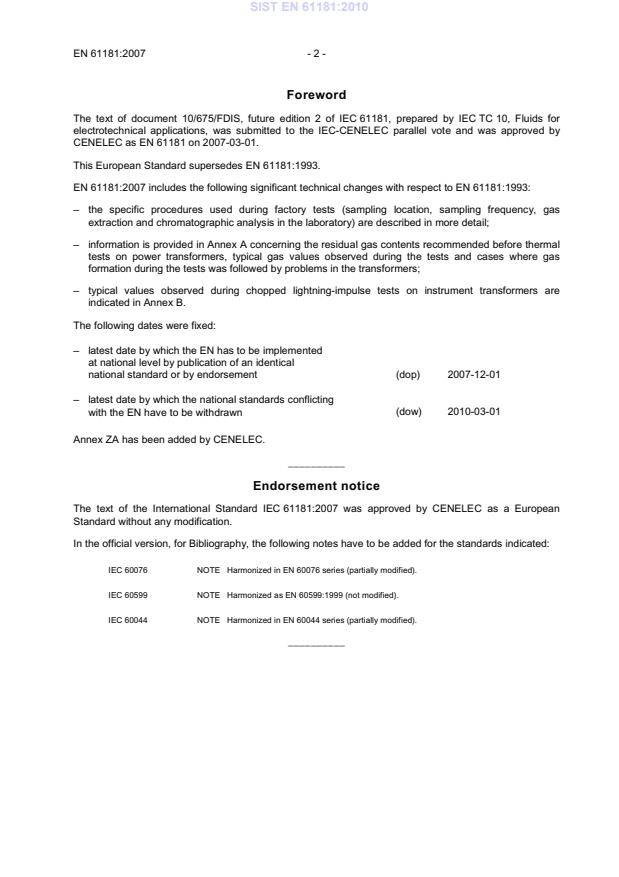
Foreword The text of document 10/675/FDIS, future edition 2 of IEC 61181, prepared by IEC TC 10, Fluids for electrotechnical applications, was submitted to the IEC-CENELEC parallel vote and was approved by CENELEC as EN 61181 on 2007-03-01. This European Standard supersedes EN 61181:1993. EN 61181:2007 includes the following significant technical changes with respect to EN 61181:1993: – the specific procedures used during factory tests (sampling location, sampling frequency, gas extraction and chromatographic analysis in the laboratory) are described in more detail; – information is provided in Annex A concerning the residual gas contents recommended before thermal tests on power transformers, typical gas values observed during the tests and cases where gas formation during the tests was followed by problems in the transformers; – typical values observed during chopped lightning-impulse tests on instrument transformers are indicated in Annex B. The following dates were fixed: – latest date by which the EN has to be implemented
at national level by publication of an identical
national standard or by endorsement
(dop)
2007-12-01 – latest date by which the national standards conflicting
with the EN have to be withdrawn
(dow)
2010-03-01 Annex ZA has been added by CENELEC. __________ Endorsement notice The text of the International Standard IEC 61181:2007 was approved by CENELEC as a European Standard without any modification. In the official version, for Bibliography, the following notes have to be added for the standards indicated: IEC 60076 NOTE
Harmonized in EN 60076 series (partially modified). IEC 60599 NOTE
Harmonized as EN 60599:1999 (not modified). IEC 60044 NOTE
Harmonized in EN 60044 series (partially modified). __________
- 3 - EN 61181:2007 Annex ZA
(normative)
Normative references to international publications with their corresponding European publications
The following referenced documents are indispensable for the application of this document. For dated references, only the edition cited applies. For undated references, the latest edition of the referenced document (including any amendments) applies.
NOTE
When an international publication has been modified by common modifications, indicated by (mod), the relevant EN/HD applies.
Publication Year Title EN/HD Year
IEC 60567 -1) Oil-filled electrical equipment - Sampling of gases and of oil for analysis of free and dissolved gases - Guidance EN 60567 20052)
1) Undated reference. 2) Valid edition at date of issue. SIST EN 61181:2010
NORME INTERNATIONALECEIIEC INTERNATIONAL STANDARD 61181Deuxième éditionSecond edition2007-02 Matériels électriques imprégnés d’huile minérale –Application de l’analyse des gaz dissous (AGD) lors d’essais en usine de matériels électriques
Mineral oil-filled electrical equipment – Application of dissolved gas analysis (DGA)
to factory tests on electrical equipment Pour prix, voir catalogue en vigueur For price, see current catalogue© IEC 2007
Droits de reproduction réservés
⎯
Copyright - all rights reserved Aucune partie de cette publication ne peut être reproduite ni utilisée sous quelque forme que ce soit et par aucun procédé, électronique ou mécanique, y compris la photocopie et les microfilms, sans l'accord écrit de l'éditeur. No part of this publication may be reproduced or utilized in any form or by any means, electronic or mechanical, including photocopying and microfilm, without permission in writing from the publisher. International Electrotechnical Commission,
3, rue de Varembé, PO Box 131, CH-1211 Geneva 20, SwitzerlandTelephone: +41 22 919 02 11 Telefax: +41 22 919 03 00 E-mail: inmail@iec.ch
Web: www.iec.ch CODE PRIX PRICE CODE N Commission Electrotechnique InternationaleInternational Electrotechnical CommissionSIST EN 61181:2010
61181 © IEC:2007 – 3 – CONTENTS FOREWORD.5 INTRODUCTION.9
1 Scope.11 2 Normative references.11 3 General caution, health, safety and environmental protection.11 4 Oil sampling.13 4.1 General.13 4.2 Sample containers.13 4.3 Sampling location.13 4.4 Sampling frequency.13 4.5 Sample labelling.15 4.6 Sample storage.15 4.7 Disposal of waste oil.17 5 Factors affecting gassing rate during thermal tests.17 6 Dissolved gas extraction and analysis.17 7 Report.21
Annex A (informative)
Gas formation rates during thermal tests on power transformers.23 Annex B (informative)
Gas formation rates during chopped-lightning impulse tests
on instrument transformers [6].27
Bibliography.29
Table 1 – Required detection limits for factory tests.17 Table A.1 – Ranges of 90 % typical rates of gas formation in modern,
mineral oil- filled
power transformers during thermal tests, in μl/l/h.23 Table A.2 – Survey of cases followed by problems in core-type, mineral oil- filled power transformers, for various rates of gas formation observed during the thermal tests, (values in μl/l/h).25 Table B.1 – 90 % typical gas concentration increases observed between the beginning and the end of chopped lightning-impulse tests on instrument transformers.27
61181 © IEC:2007 – 5 – INTERNATIONAL ELECTROTECHNICAL COMMISSION ____________
MINERAL OIL-FILLED ELECTRICAL EQUIPMENT – APPLICATION OF DISSOLVED GAS ANALYSIS (DGA) TO FACTORY TESTS ON ELECTRICAL EQUIPMENT
FOREWORD 1) The International Electrotechnical Commission (IEC) is a worldwide organization for standardization comprising all national electrotechnical committees (IEC National Committees). The object of IEC is to promote international co-operation on all questions concerning standardization in the electrical and electronic fields. To this end and in addition to other activities, IEC publishes International Standards, Technical Specifications, Technical Reports, Publicly Available Specifications (PAS) and Guides (hereafter referred to as “IEC Publication(s)”). Their preparation is entrusted to technical committees; any IEC National Committee interested in the subject dealt with may participate in this preparatory work. International, governmental and non-governmental organizations liaising with the IEC also participate in this preparation. IEC collaborates closely with the International Organization for Standardization (ISO) in accordance with conditions determined by agreement between the two organizations. 2) The formal decisions or agreements of IEC on technical matters express, as nearly as possible, an international consensus of opinion on the relevant subjects since each technical committee has representation from all interested IEC National Committees.
3) IEC Publications have the form of recommendations for international use and are accepted by IEC National Committees in that sense. While all reasonable efforts are made to ensure that the technical content of IEC Publications is accurate, IEC cannot be held responsible for the way in which they are used or for any misinterpretation by any end user. 4) In order to promote international uniformity, IEC National Committees undertake to apply IEC Publications transparently to the maximum extent possible in their national and regional publications. Any divergence between any IEC Publication and the corresponding national or regional publication shall be clearly indicated in the latter. 5) IEC provides no marking procedure to indicate its approval and cannot be rendered responsible for any equipment declared to be in conformity with an IEC Publication. 6) All users should ensure that they have the latest edition of this publication. 7) No liability shall attach to IEC or its directors, employees, servants or agents including individual experts and members of its technical committees and IEC National Committees for any personal injury, property damage or other damage of any nature whatsoever, whether direct or indirect, or for costs (including legal fees) and expenses arising out of the publication, use of, or reliance upon, this IEC Publication or any other IEC Publications.
8) Attention is drawn to the Normative references cited in this publication. Use of the referenced publications is indispensable for the correct application of this publication. 9) Attention is drawn to the possibility that some of the elements of this IEC Publication may be the subject of patent rights. IEC shall not be held responsible for identifying any or all such patent rights. International Standard IEC 61181 has been prepared by IEC technical committee 10: Fluids for electrotechnical applications. This second edition cancels and replaces the first edition published in 1993 and constitutes a technical revision.
This edition includes the following significant technical changes with respect to the previous edition: a) the specific procedures used during factory tests (sampling location, sampling frequency, gas extraction and chromatographic analysis in the laboratory) are described in more detail;
b) information is provided in Annex A concerning the residual gas contents recommended before thermal tests on power transformers, typical gas values observed during the tests and cases where gas formation during the tests was followed by problems in the transformers; SIST EN 61181:2010
61181 © IEC:2007 – 7 – c) typical values observed during chopped lightning-impulse tests on instrument transformers are indicated in Annex B. The text of this standard is based on the following documents: FDIS Report on voting 10/675/FDIS 10/688/RVD
Full information on the voting for the approval of this standard can be found in the report on voting indicated in the above table. This publication has been drafted in accordance with the ISO/IEC Directives, Part 2. The committee has decided that the contents of this publication will remain unchanged until the maintenance result date indicated on the IEC web site under "http://webstore.iec.ch" in the data related to the specific publication. At this date, the publication will be
• reconfirmed; • withdrawn; • replaced by a revised edition, or • amended.
61181 © IEC:2007 – 9 – INTRODUCTION IEC technical committee 10, responsible for IEC 61181, has prepared guidelines for performing DGA measurements during factory testing on equipment filled with mineral insulating oil in order to ensure consistency in the industry and improve the confidence with which the results will be used. DGA is used routinely as a standard quality control procedure during and after factory tests on electrical equipment, for example during temperature-rise and chopped lightning-impulse tests, to indicate that a design meets specified requirements. Due to the small quantities of gases generated during factory tests, specific requirements are necessary for the sampling and analysis of oil samples and the interpretation of results. Acceptance criteria are beyond the scope of TC 10. Attention is drawn, however, to the fact that the guidelines issued by CIGRE in 1993-1995 [1]1 do not apply any more to transformers manufactured today, the design of which having been improved. Examples of values actually observed today are indicated in Annexes A and
B. ——————— 1 Figures in square brackets refer to the bibliography. SIST EN 61181:2010
61181 © IEC:2007 – 11 – MINERAL OIL-FILLED ELECTRICAL EQUIPMENT – APPLICATION OF DISSOLVED GAS ANALYSIS (DGA) TO FACTORY TESTS ON ELECTRICAL EQUIPMENT
1 Scope This International Standard specifies oil-sampling procedures, analysis requirements and procedures, and recommends sensitivity, repeatability and accuracy criteria for the application of dissolved gas analysis (DGA) to factory testing of new power transformers, reactors and instrument transformers filled with mineral insulating oil when DGA testing has been specified. The most effective and useful application of DGA techniques to factory testing is during the performance of long-term tests, typically temperature-rise (heat run) and overloading tests on power transformers and reactors, also impulse tests on instrument transformers. DGA may also be valuable for over-excitation tests run over an extended period of time. Experience with DGA results, before and after short-time dielectric tests, indicates that DGA is normally less sens
...