

SIST EN 16659:2016
(Main)Bituminen and Bituminous Binders - Multiple Stress Creep and Recovery Test (MSCRT)
General Information
- Abstract
1.1 This test method covers the determination of percent recovery and non-recoverable creep compliance of bitumen and bituminous binders by means of Multiple Stress Creep and Recovery (MSCR) testing. The MSCR test is conducted using the Dynamic Shear Rheometer (DSR) in creep mode at a specified temperature.
1.2 The percent recovery at multiple stress levels is intended to determine the presence of elastic response and stress dependence of bituminous binders.
1.3 The non-recoverable creep compliance at multiple stress levels is intended as an indicator for the sensitivity to permanent deformation and stress dependence of bituminous binders.
1.4 This European Standard does not purport to address all of the safety concerns, if any, associated with its use. It is the responsibility of the user of this European Standard to establish appropriate safety and health practices and determine the applicability of regulatory limitations prior to use.
- Status
- Withdrawn
- Public Enquiry End Date
- 09-Dec-2013
- Publication Date
- 25-Feb-2016
- Withdrawal Date
- 07-May-2026
- Technical Committee
- VLA - Water proofing
- Current Stage
- 9900 - Withdrawal (Adopted Project)
- Start Date
- 06-May-2026
- Due Date
- 29-May-2026
- Completion Date
- 08-May-2026

Overview
EN 16659:2015 defines the Multiple Stress Creep and Recovery Test (MSCRT) for the characterization of bitumen and bituminous binders. The method uses a Dynamic Shear Rheometer (DSR) in stress-controlled creep mode to determine percent recovery and non‑recoverable creep compliance (Jnr) at multiple stress levels and specified temperatures. These metrics indicate elastic response and sensitivity to permanent deformation - properties directly relevant to pavement rutting resistance and binder performance under repeated traffic loading.
Key Topics and Requirements
- Test objective: Measure percent recovery (%R) and non-recoverable creep compliance (Jnr) to assess elastic behavior and permanent deformation susceptibility.
- Instrumentation: Dynamic Shear Rheometer (DSR) running in stress-controlled mode with temperature control (5 °C–85 °C capability) and data sampling at least every 0.1 s during creep.
- Geometry and gap: 25 mm parallel plate geometry with 1.00 mm gap (±0.01 mm).
- Loading protocol: Ten 1 s creep / 9 s recovery cycles at 0.1 kPa, followed by ten cycles at 3.2 kPa (standard durations and stress levels specified).
- Temperatures: Standard test temperatures include 50 °C, 60 °C, 70 °C or 80 °C; other temperatures may be used for comparison.
- Sample prep & handling: Sampling per EN 58, preparation per EN 12594; strict heating limits, storage delays (min 30 min, max 24 h), and special instructions for polymer-modified and fluxed binders.
- Quality & precision: Includes requirements for rheometer calibration, repeatability and reproducibility assessment (ISO 5725-2 referenced).
- Safety note: Standard does not replace laboratory safety practices - users must manage high-temperature handling risks.
Applications and Users
- Practical uses:
- Quality control and acceptance testing of asphalt binders.
- Screening of polymer-modified binders for elastic response.
- Comparative evaluation of binder sensitivity to permanent deformation (indicator of rutting potential).
- Research and development of binder formulations and performance grading.
- Typical users:
- Materials and pavement testing laboratories
- Bitumen manufacturers and suppliers
- Highway authorities and pavement engineers
- R&D teams working on asphalt binder modifiers and performance specifications
Related Standards
- EN 14770 - DSR determination of complex shear modulus and phase angle
- EN 58 - Sampling of bituminous binders
- EN 12594 - Preparation of test samples
- EN 12597 - Terminology for bitumen
- ISO 5725-2 - Determination of repeatability and reproducibility
This summary helps practitioners quickly understand what EN 16659:2015 (MSCRT) covers, the technical requirements, and how the results support binder selection and pavement performance assessment. Keywords: EN 16659:2015, MSCRT, Multiple Stress Creep and Recovery, bitumen, DSR, percent recovery, Jnr, pavement rutting.
Relations
- Effective Date
- 01-Jun-2026
- Effective Date
- 01-Apr-2026
- Effective Date
- 28-Jan-2026
- Effective Date
- 28-Jan-2026
- Effective Date
- 28-Jan-2026
- Effective Date
- 28-Jan-2026
- Effective Date
- 28-Jan-2026
Get Certified
Connect with accredited certification bodies for this standard

DIBt (Deutsches Institut für Bautechnik)
German Institute for Building Technology.
DIN CERTCO
DIN Group product certification.

Element Materials Technology
Materials testing and product certification.
Sponsored listings
Frequently Asked Questions
SIST EN 16659:2016 is a standard published by the Slovenian Institute for Standardization (SIST). Its full title is "Bituminen and Bituminous Binders - Multiple Stress Creep and Recovery Test (MSCRT)". This standard covers: 1.1 This test method covers the determination of percent recovery and non-recoverable creep compliance of bitumen and bituminous binders by means of Multiple Stress Creep and Recovery (MSCR) testing. The MSCR test is conducted using the Dynamic Shear Rheometer (DSR) in creep mode at a specified temperature. 1.2 The percent recovery at multiple stress levels is intended to determine the presence of elastic response and stress dependence of bituminous binders. 1.3 The non-recoverable creep compliance at multiple stress levels is intended as an indicator for the sensitivity to permanent deformation and stress dependence of bituminous binders. 1.4 This European Standard does not purport to address all of the safety concerns, if any, associated with its use. It is the responsibility of the user of this European Standard to establish appropriate safety and health practices and determine the applicability of regulatory limitations prior to use.
1.1 This test method covers the determination of percent recovery and non-recoverable creep compliance of bitumen and bituminous binders by means of Multiple Stress Creep and Recovery (MSCR) testing. The MSCR test is conducted using the Dynamic Shear Rheometer (DSR) in creep mode at a specified temperature. 1.2 The percent recovery at multiple stress levels is intended to determine the presence of elastic response and stress dependence of bituminous binders. 1.3 The non-recoverable creep compliance at multiple stress levels is intended as an indicator for the sensitivity to permanent deformation and stress dependence of bituminous binders. 1.4 This European Standard does not purport to address all of the safety concerns, if any, associated with its use. It is the responsibility of the user of this European Standard to establish appropriate safety and health practices and determine the applicability of regulatory limitations prior to use.
SIST EN 16659:2016 is classified under the following ICS (International Classification for Standards) categories: 75.140 - Waxes, bituminous materials and other petroleum products; 91.100.50 - Binders. Sealing materials. The ICS classification helps identify the subject area and facilitates finding related standards.
SIST EN 16659:2016 has the following relationships with other standards: It is inter standard links to SIST EN 16659:2026, SIST ISO 5725-2:2003, SIST ENV 14237:2002, SIST EN 12597:2025, SIST EN 14770:2023, SIST EN 12594:2025, SIST EN 58:2012. Understanding these relationships helps ensure you are using the most current and applicable version of the standard.
SIST EN 16659:2016 is available in PDF format for immediate download after purchase. The document can be added to your cart and obtained through the secure checkout process. Digital delivery ensures instant access to the complete standard document.
Standards Content (Sample)
2003-01.Slovenski inštitut za standardizacijo. Razmnoževanje celote ali delov tega standarda ni dovoljeno.Bitumen und bitumenhaltige Bindemittel - MSCR-Prüfung (Multiple Stress Creep and Recovery Test)Bitumes et liants bitumineux- Essai de fluage-recouvrance sous contraintes répétéesBituminen and Bituminous Binders - Multiple Stress Creep and Recovery Test (MSCRT)91.100.50Veziva. Tesnilni materialiBinders. Sealing materials75.140Voski, bitumni in drugi naftni proizvodiWaxes, bituminous materials and other petroleum productsICS:Ta slovenski standard je istoveten z:EN 16659:2015SIST EN 16659:2016en,fr,de01-marec-2016SIST EN 16659:2016SLOVENSKI
STANDARD
EUROPEAN STANDARD NORME EUROPÉENNE EUROPÄISCHE NORM
EN 16659
December
t r s w ICS
y wä s v râ
{ sä s r rä w r English Version
Bitumen and Bituminous Binders æ Multiple Stress Creep Bitumes et liants bitumineuxæ Essai de fluageæ Bitumen und bitumenhaltige Bindemittel æ MSCRæThis European Standard was approved by CEN on
s x November
t r s wä
egulations which stipulate the conditions for giving this European Standard the status of a national standard without any alterationä Upætoædate lists and bibliographical references concerning such national standards may be obtained on application to the CENæCENELEC Management Centre or to any CEN memberä
translation under the responsibility of a CEN member into its own language and notified to the CENæCENELEC Management Centre has the same status as the official versionsä
CEN members are the national standards bodies of Austriaá Belgiumá Bulgariaá Croatiaá Cyprusá Czech Republicá Denmarká Estoniaá Finlandá Former Yugoslav Republic of Macedoniaá Franceá Germanyá Greeceá Hungaryá Icelandá Irelandá Italyá Latviaá Lithuaniaá Luxembourgá Maltaá Netherlandsá Norwayá Polandá Portugalá Romaniaá Slovakiaá Sloveniaá Spainá Swedená Switzerlandá Turkey andUnited Kingdomä
EUROPEAN COMMITTEE FOR STANDARDIZATION COMITÉ EUROPÉEN DE NORMALISATION EUROPÄISCHES KOMITEE FÜR NORMUNG
CEN-CENELEC Management Centre:
Avenue Marnix 17,
B-1000 Brussels
t r s w CEN All rights of exploitation in any form and by any means reserved worldwide for CEN national Membersä Refä Noä EN
s x x w {ã t r s w ESIST EN 16659:2016
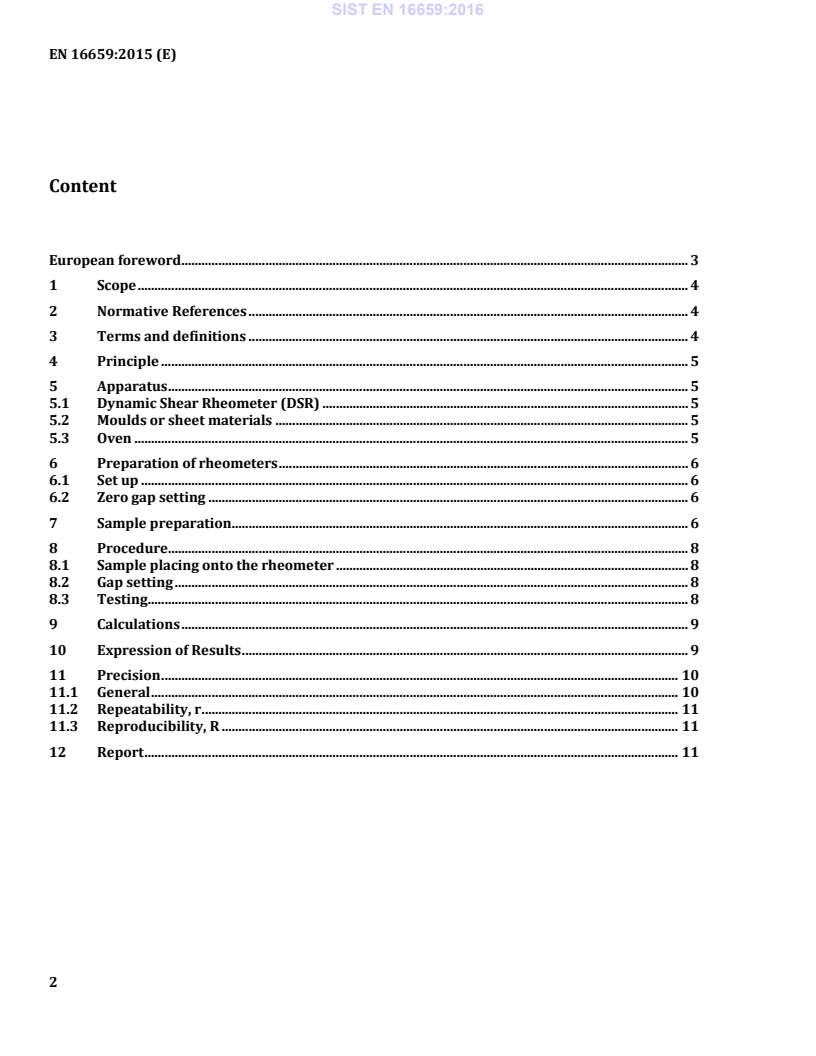
European foreword . 3 1 Scope . 4 2 Normative References . 4 3 Terms and definitions . 4 4 Principle . 5 5 Apparatus . 5 5.1 Dynamic Shear Rheometer (DSR) . 5 5.2 Moulds or sheet materials . 5 5.3 Oven . 5 6 Preparation of rheometers . 6 6.1 Set up . 6 6.2 Zero gap setting . 6 7 Sample preparation . 6 8 Procedure. 8 8.1 Sample placing onto the rheometer . 8 8.2 Gap setting . 8 8.3 Testing . 8 9 Calculations . 9 10 Expression of Results . 9 11 Precision . 10 11.1 General . 10 11.2 Repeatability, r . 11 11.3 Reproducibility, R . 11 12 Report . 11
...