

kSIST-TS FprCEN/TS 16157-10:2026
(Main)Intelligent transport systems - DATEX II data exchange specifications for traffic management and information - Part 10: Energy infrastructure publications
- Abstract
The proposed CEN/TS 16157-10 of the CEN 16157 series will specify publication sub-models within the DATEX II model that support the publication of information about vehicle energy infrastructure, e.g. sites, stations and refill points for electric vehicles as well as petrol, gasoline or gas-based refuelling for vehicles. In terms of dynamic information, the availability of the infrastructure, possible faults and a price indication will be covered. This is specified as a DATEX II "EnergyInfrastructure" namespace, which is part of the DATEX II platform independent model and hence follows the EN 16157-1 methodology and reuse common concepts that are specified in EN 16157-2 (Location referencing), EN 16157-7 (Common data elements) and CEN/TS 16157-12 (Facility related publications).
It will define a UML model with a corresponding data dictionary and XML Schema.
These publications of CEN/TS 16157-10 will contain informational structures, relationships, association ends, attributes and associated data types required for publishing information about facilities within the DATEX II framework.
- Status
- Not Published
- Public Enquiry End Date
- 13-Sep-2026
- Technical Committee
- ITC - Information technology
- Current Stage
- 5520 - Unique Acceptance Procedure (UAP) (Adopted Project)
- Start Date
- 14-Jul-2026
- Due Date
- 01-Dec-2026
- Completion Date
- 20-Aug-2026

SIST publishes kSIST-TS FprCEN/TS 16157-10:2026 as the Slovene adoption of the DATEX II specification for energy infrastructure publications. It specifies how to model and exchange static site data and dynamic status data for vehicle energy supply, including electric charging, petrol, gas and hydrogen, for traffic authorities, infrastructure providers and ITS service providers.
The document defines a UML model and a corresponding XML Schema, and it reuses common DATEX II concepts from EN 16157-1, EN 16157-2, EN 16157-7 and CEN/TS 16157-12. In practice, it is the part of DATEX II you use when you need structured messages about energy sites, stations, refill points, availability and prices.
What does kSIST-TS FprCEN/TS 16157-10:2026 specify?
kSIST-TS FprCEN/TS 16157-10:2026 specifies two DATEX II publication sub-models for vehicle energy infrastructure. One sub-model carries relatively stable information about sites and refill facilities, and the other carries high-frequency status information.
The document is organized into Clauses 1 to 7 and normative Annex A. Clause 7 contains the model structure for the EnergyInfrastructure namespace, while Annex A gives the full data dictionary for the AfirEnergyInfrastructure namespace.
The scope covers:
- vehicle energy infrastructure sites, stations and refill points
- electric vehicle charging as well as petrol, gasoline and gas-based refuelling
- dynamic availability, faults and price indications
- publication structures intended for onward information exchange between traffic authorities, implementers and ITS service providers
What are the key requirements of kSIST-TS FprCEN/TS 16157-10:2026?
The most important requirement is that kSIST-TS FprCEN/TS 16157-10:2026 is a DATEX II platform independent model and corresponds to the level A model defined in EN 16157-1. Conformance requires platform specific models generated from it to follow the UML modelling rules in EN 16157-1.
Publication split: static table data and dynamic status data
Clause 7 separates the model into EnergyInfrastructureTablePublication and EnergyInfrastructureStatusPublication. This matters because site descriptions change slowly, while availability, faults and prices can change often.
EnergyInfrastructureTablePublication carries the static EnergyInfrastructureTable, which contains one or more EnergyInfrastructureSite instances. EnergyInfrastructureStatusPublication carries dynamic status information and can reference the static tables through tableReference.
Core site, station and refill point model
Clause 7.1 defines three central classes: EnergyInfrastructureSite, EnergyInfrastructureStation and RefillPoint. EnergyInfrastructureSite covers the location and general site information, EnergyInfrastructureStation covers the refuelling or charging station at that site, and RefillPoint covers the actual point where energy is transferred to one vehicle at a time.
This structure is practical for operators because it lets them describe a whole site, then each station on that site, then each individual fuel or charging point. The model also inherits facility properties such as versioned identification, operating hours, rates, URLs, owner and operator data from CEN/TS 16157-12.
Energy products, rates and prices
Clause 7.2.5 defines EnergyProduct, EnergyRate, EnergyPrice and related applicability classes. These classes let the publication describe the product name, green energy information, contract-based or ad hoc pricing, price type, currency, tax, and whether a price applies by time or by delivered energy.
For a buyer or integrator, this means the standard can carry both the offer itself and the pricing logic behind it. It is useful when a consumer app or back-office system needs to display tariffs consistently.
Refill point specializations
Clause 7.2.6 specializes RefillPoint into AlternativeFuelsRefillPoint, DieselRefillPoint, PetrolRefillPoint and ElectricChargingPoint. These specializations cover the different data needed for gases, hydrogen, diesel, petrol and electric charging.
ElectricChargingPoint includes connector information, energy source mixes, charging mode, current type, usage type and vehicle-to-grid communication type. That is the part to use when charging compatibility and charging equipment details matter.
Status publication and live information
Clause 7.3 defines the dynamic status model. EnergyInfrastructureSiteStatus, EnergyInfrastructureStationStatus, RefillPointStatus, ElectricChargingPointStatus, PlannedRefillPointStatus, EnergyRateUpdate and DurationValue support live availability, closures, reservations, waiting time and updated rates.
This is the operational part of the standard. It lets systems report whether a station is available, whether a refill point is occupied or faulted, and what price or waiting time applies now or in the future.
Electric charging equipment and parking
Clauses 7.4 and 7.5 add ElectricChargingEquipment and AssociatedParking. These extend the model with charging equipment as a supplemental facility and with parking information linked to the energy infrastructure site.
For users, that means a charging location can be published together with adjacent parking details, which helps route planning and site presentation.
Data types and controlled vocabularies
Clause 7.6 adds the model data types Watt, Volt, Ampere, Units, Bar and KilogramPerDay. Annex A then defines the controlled vocabularies for authentication, connectors, charging modes, fuel types, prices, reservation, service types and statuses.
These fixed data types and enumerations matter because they keep exchanged messages machine-readable and interoperable across systems.
What terms does kSIST-TS FprCEN/TS 16157-10:2026 define?
connector- the type and form of the piece used to connect a charging point to a vehicle or vice versa.electric charging point- technical infrastructure at a specific location that facilitates electric charging of one vehicle at a time.energy infrastructure site- a location and its constructions where vehicles can be refilled and other services may be offered.energy infrastructure station- the part of an energy infrastructure site that offers at least one refilling option.refilling- the process of transferring energy from a refill point to a vehicle, replacing the termsfuellingandcharging.refill point- technical infrastructure at a specific location that facilitates an energy refilling process for at most one vehicle at a time.fault- information about a malfunction relating to a specific piece of equipment or process.
Who uses kSIST-TS FprCEN/TS 16157-10:2026?
kSIST-TS FprCEN/TS 16157-10:2026 is used by road traffic authorities, infrastructure providers, mobility service providers, roaming platforms and ITS service providers. It is also relevant to organisations that implement traffic regulation orders and onward information exchange.
In practice, these users use it to publish:
- static lists of energy sites, stations and refill points
- live availability, faults and closures
- prices, tariffs and rate updates
- connector, payment and authentication details
- parking and reservation-related information
What changed in kSIST-TS FprCEN/TS 16157-10:2026 from the previous edition?
kSIST-TS FprCEN/TS 16157-10:2026 supersedes CEN/TS 16157-10:2022. The foreword states these changes:
- added elements to support COMMISSION IMPLEMENTING REGULATION (EU) 2025/655
- a new
AfirEnergyInfrastructurenamespace (aegi) because of non-backwards compatible model changes - further model improvements
- correction of different bugs
Which standards are used with kSIST-TS FprCEN/TS 16157-10:2026?
| Standard | Contribution |
|---|---|
| EN 16157-1:2018 | Context, framework and UML modelling rules for DATEX II |
| EN 16157-2:2019 | Location referencing used by the energy infrastructure model |
| EN 16157-7:2018 | Common data elements, including PayloadPublication, HeaderInformation and shared types |
| CEN/TS 16157-12 | Facility-related publications and the AfirFacilities namespace reused by this part |
| ISO/IEC 19505-1:2012 | UML notation used in the specification |
| EN IEC 61851-1 | Terminology used for ChargingModeEnum |
| EN ISO 15118 (all parts) | Terminology for vehicle-to-grid communication and over-the-air authentication |
| IEC/TS 61980-2 | Terminology for vehicle-to-grid communication |
| IEC 60309-2 | Connector terminology used by ConnectorTypeEnum |
| IEC 62196 (all parts) | Connector terminology used by ConnectorTypeEnum |
| EN 17186 | Connector identification terminology |
| ISO/TS 21219-25:2017 | Source for the core energy infrastructure concept |
What does the kSIST-TS FprCEN/TS 16157-10:2026 document contain?
kSIST-TS FprCEN/TS 16157-10:2026 contains a UML-based data model, class diagrams and a full Annex A data dictionary. Annex A covers classes, associations, attributes, data types and enumerations for the AfirEnergyInfrastructure namespace, with table-based definitions for site, station, refill point, price and status structures.
It also contains controlled value lists for authentication methods, charging modes, connector types, gas and petrol types, hydrogen refuelling modes, price types, reservation types, service types and status values. Those tables are the part implementers use when building software, XML schemas, validation rules or interface mappings.
Relations
- Effective Date
- 05-Nov-2024
Get Certified
Connect with accredited certification bodies for this standard

BSI Group
BSI (British Standards Institution) is the business standards company that helps organizations make excellence a habit.

NYCE
Mexican standards and certification body.
Sponsored listings
Frequently Asked Questions
kSIST-TS FprCEN/TS 16157-10:2026 is a draft published by the Slovenian Institute for Standardization (SIST). Its full title is "Intelligent transport systems - DATEX II data exchange specifications for traffic management and information - Part 10: Energy infrastructure publications". This standard covers: The proposed CEN/TS 16157-10 of the CEN 16157 series will specify publication sub-models within the DATEX II model that support the publication of information about vehicle energy infrastructure, e.g. sites, stations and refill points for electric vehicles as well as petrol, gasoline or gas-based refuelling for vehicles. In terms of dynamic information, the availability of the infrastructure, possible faults and a price indication will be covered. This is specified as a DATEX II "EnergyInfrastructure" namespace, which is part of the DATEX II platform independent model and hence follows the EN 16157-1 methodology and reuse common concepts that are specified in EN 16157-2 (Location referencing), EN 16157-7 (Common data elements) and CEN/TS 16157-12 (Facility related publications). It will define a UML model with a corresponding data dictionary and XML Schema. These publications of CEN/TS 16157-10 will contain informational structures, relationships, association ends, attributes and associated data types required for publishing information about facilities within the DATEX II framework.
The proposed CEN/TS 16157-10 of the CEN 16157 series will specify publication sub-models within the DATEX II model that support the publication of information about vehicle energy infrastructure, e.g. sites, stations and refill points for electric vehicles as well as petrol, gasoline or gas-based refuelling for vehicles. In terms of dynamic information, the availability of the infrastructure, possible faults and a price indication will be covered. This is specified as a DATEX II "EnergyInfrastructure" namespace, which is part of the DATEX II platform independent model and hence follows the EN 16157-1 methodology and reuse common concepts that are specified in EN 16157-2 (Location referencing), EN 16157-7 (Common data elements) and CEN/TS 16157-12 (Facility related publications). It will define a UML model with a corresponding data dictionary and XML Schema. These publications of CEN/TS 16157-10 will contain informational structures, relationships, association ends, attributes and associated data types required for publishing information about facilities within the DATEX II framework.
kSIST-TS FprCEN/TS 16157-10:2026 is classified under the following ICS (International Classification for Standards) categories: 35.240.60 - IT applications in transport. The ICS classification helps identify the subject area and facilitates finding related standards.
kSIST-TS FprCEN/TS 16157-10:2026 has the following relationships with other standards: It is inter standard links to SIST-TS CEN/TS 16157-10:2022. Understanding these relationships helps ensure you are using the most current and applicable version of the standard.
kSIST-TS FprCEN/TS 16157-10:2026 is associated with the following European legislation: EU Directives/Regulations: 2010/40/EU, 2023/1804, 2023/1804-2. When a standard is cited in the Official Journal of the European Union, products manufactured in conformity with it benefit from a presumption of conformity with the essential requirements of the corresponding EU directive or regulation.
kSIST-TS FprCEN/TS 16157-10:2026 is available in PDF format for immediate download after purchase. The document can be added to your cart and obtained through the secure checkout process. Digital delivery ensures instant access to the complete standard document.
Standards Content (Sample)
SLOVENSKI STANDARD
01-september-2026
Inteligentni transportni sistemi - Specifikacije za izmenjavo podatkov DATEX II pri
upravljanju prometa in informiranju - 10. del: Publikacije o energetski infrastrukturi
Intelligent transport systems - DATEX II data exchange specifications for traffic
management and information - Part 10: Energy infrastructure publications
Intelligente Verkehrssysteme - Datex-II-Datenaustauschspezifikationen für
Verkehrsmanagement und Verkehrsinformationen - Teil 10: Energieinfrastruktur
Publikation
Systèmes de transport intelligents - Spécifications DATEX II d'échange de données pour
la gestion du trafic et l'information routière - Partie 10: Publication de infrastructure
énergétique
Ta slovenski standard je istoveten z: FprCEN/TS 16157-10
ICS:
35.240.60 Uporabniške rešitve IT v IT applications in transport
prometu
2003-01.Slovenski inštitut za standardizacijo. Razmnoževanje celote ali delov tega standarda ni dovoljeno.
FINAL DRAFT
TECHNICAL SPECIFICATION
SPÉCIFICATION TECHNIQUE
TECHNISCHE SPEZIFIKATION
June 2026
ICS
English Version
Intelligent transport systems - DATEX II data exchange
specifications for traffic management and information -
Part 10: Energy infrastructure publications
Systèmes de transport intelligents - Spécifications Intelligente Verkehrssysteme - Datex-II-
DATEX II d'échange de données pour la gestion du Datenaustauschspezifikationen für
trafic et l'information routière - Partie 10: Publication Verkehrsmanagement und Verkehrsinformationen -
de infrastructure énergétique Teil 10: Energieinfrastruktur Publikation
This draft Technical Specification is submitted to CEN members for Vote. It has been drawn up by the Technical Committee
CEN/TC 278.
CEN members are the national standards bodies of Austria, Belgium, Bulgaria, Croatia, Cyprus, Czech Republic, Denmark, Estonia,
Finland, France, Germany, Greece, Hungary, Iceland, Ireland, Italy, Latvia, Lithuania, Luxembourg, Malta, Netherlands, Norway,
Poland, Portugal, Republic of North Macedonia, Romania, Serbia, Slovakia, Slovenia, Spain, Sweden, Switzerland, Türkiye and
United Kingdom.
Recipients of this draft are invited to submit, with their comments, notification of any relevant patent rights of which they are
aware and to provide supporting documentation.
Warning : This document is not a Technical Specification. It is distributed for review and comments. It is subject to change
without notice and shall not be referred to as a Technical Specification.
EUROPEAN COMMITTEE FOR STANDARDIZATION
COMITÉ EUROPÉEN DE NORMALISATION
EUROPÄISCHES KOMITEE FÜR NORMUNG
CEN-CENELEC Management Centre: Rue de la Science 23, B-1040 Brussels
© 2026 CEN All rights of exploitation in any form and by any means reserved Ref. No. FprCEN/TS 16157-10:2026 E
worldwide for CEN national Members.
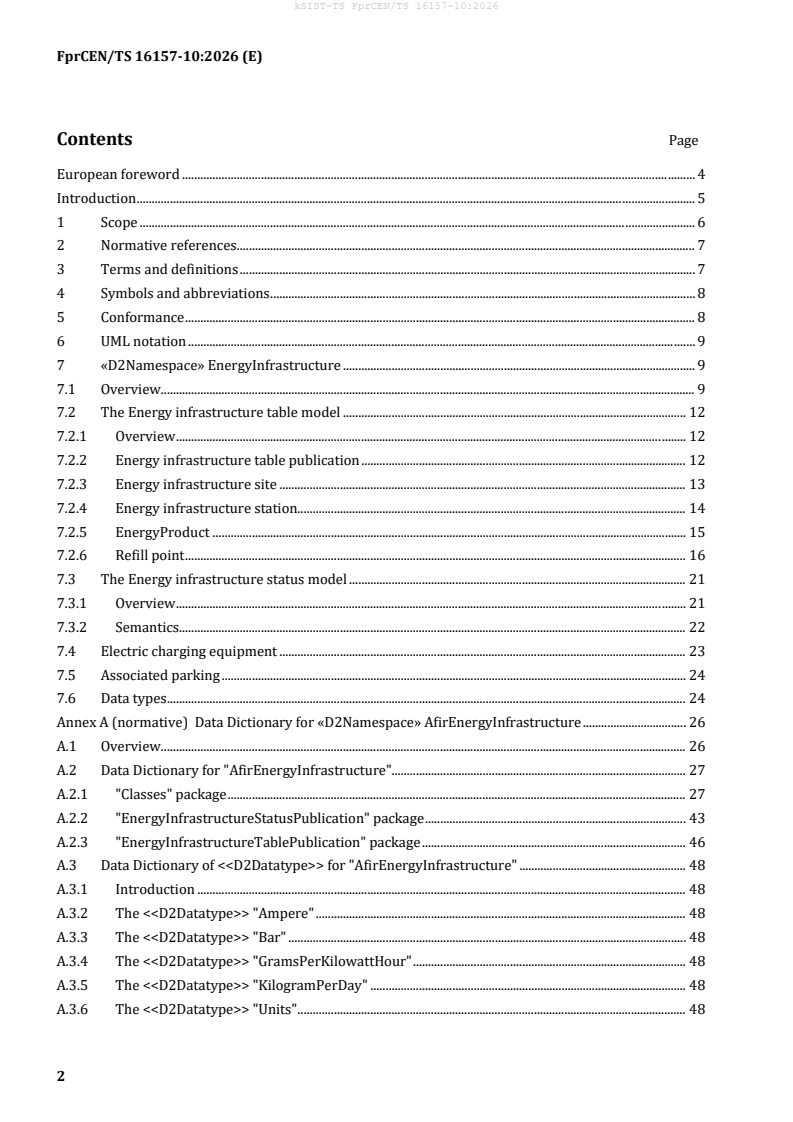
Contents Page
European foreword . 4
Introduction . 5
1 Scope . 6
2 Normative references . 7
3 Terms and definitions . 7
4 Symbols and abbreviations . 8
5 Conformance . 8
6 UML notation . 9
7 «D2Namespace» EnergyInfrastructure . 9
7.1 Overview . 9
7.2 The Energy infrastructure table model . 12
7.2.1 Overview . 12
7.2.2 Energy infrastructure table publication . 12
7.2.3 Energy infrastructure site . 13
7.2.4 Energy infrastructure station. 14
7.2.5 EnergyProduct . 15
7.2.6 Refill point . 16
7.3 The Energy infrastructure status model . 21
7.3.1 Overview . 21
7.3.2 Semantics. 22
7.4 Electric charging equipment . 23
7.5 Associated parking . 24
7.6 Data types . 24
Annex A (normative) Data Dictionary for «D2Namespace» AfirEnergyInfrastructure . 26
A.1 Overview . 26
A.2 Data Dictionary for "AfirEnergyInfrastructure". 27
A.2.1 "Classes" package . 27
A.2.2 "EnergyInfrastructureStatusPublication" package . 43
A.2.3 "EnergyInfrastructureTablePublication" package . 46
A.3 Data Dictionary of <> for "AfirEnergyInfrastructure" . 48
A.3.1 Introduction . 48
A.3.2 The <> "Ampere" . 48
A.3.3 The <> "Bar" . 48
A.3.4 The <> "GramsPerKilowattHour" . 48
A.3.5 The <> "KilogramPerDay" . 48
A.3.6 The <> "Units" . 48
A.3.7 The <> "Volt" . 48
A.3.8 The <> "Watt" . 48
A.4 Data Dictionary of <> for "AfirEnergyInfrastructure" . 48
A.4.1 Introduction . 48
A.4.2 The <> "AuthenticationAndIdentificationEnum" . 48
A.4.3 The <> "BioethanolTypeEnum" . 49
A.4.4 The <> "ChargingModeEnum" . 50
A.4.5 The <> "ChargingPointUsageTypeEnum" . 50
A.4.6 The <> "ConnectorFormatTypeEnum" . 51
A.4.7 The <> "ConnectorTypeEnum" . 51
A.4.8 The <> "CurrentTypeEnum" . 54
A.4.9 The <> "DeliveryUnitEnum" . 54
A.4.10 The <> "DieselVehicleTypeEnum". 54
A.4.11 The <> "ElectricEnergySourceTypeEnum" . 54
A.4.12 The <> "EnergyInfrastructureSiteTypeEnum" . 55
A.4.13 The <> "GasConnectorTypeEnum" . 55
A.4.14 The <> "HydrogenFuellingProcessProtocolEnum" . 56
A.4.15 The <> "HydrogenRefuellingModeEnum" . 56
A.4.16 The <> "OctaneTypeEnum" . 57
A.4.17 The <> "PetrolTypeEnum" . 57
A.4.18 The <> "PriceTypeEnum" . 57
A.4.19 The <> "RatePolicyEnum" . 58
A.4.20 The <> "RefillPointStatusEnum" . 58
A.4.21 The <> "ReservationTypeEnum" . 59
A.4.22 The <> "ServiceTypeEnum" . 59
A.4.23 The <> "SmartRechargingServicesEnum" . 60
A.4.24 The <> "UserTypeEnum" . 60
A.4.25 The <> "VehicleToGridCommunicationTypeEnum" . 61
Bibliography . 63
European foreword
This document (FprCEN/TS 16157-10:2026) has been prepared by Technical Committee CEN/TC 278
“Intelligent transport systems”, the secretariat of which is held by NEN.
This document will supersede CEN/TS 16157-10:2022.
CEN/TS 16157-10:2022:
adding elements to provide support for COMMISSION IMPLEMENTING REGULATION (EU) 2025/655
- Rules for the application of Regulation (EU) 2023/1804 of the European Parliament and of the
Council as regards specifications and procedures relating to the availability and accessibility of data
on alternative fuels infrastructure
introducing the new namespace AfirEnergyInfrastructure (aegi) because of non-backwards
compatible model changes
further model improvements
correction of different bugs.
Introduction
This document defines a common set of data exchange specifications to support the vision of a seamless
interoperable exchange of road traffic and travel information across boundaries, including national,
urban, interurban, road administrations, infrastructure providers and service providers. Standardisation
in this context is a vital constituent to ensure interoperability, reduction of risk, reduction of the cost base,
promotion of open marketplaces and many social, economic and community benefits to be gained from
more informed travellers, network managers and transport operators.
Deploying intelligent transport systems in line with European Sustainable and Smart Mobility Strategy as
issued by the European Commission requires co-ordination of traffic management operation and
development of seamless pan-European information services. These jointly aim at contributing to the
transformation of the European transport system for the objectives of efficient, safe, sustainable, smart
and resilient mobility.
In this context the European Commission has been supporting the development of information exchange
between the actors of road traffic management and related services for several years. In the road sector,
DATEX II has been long in fruition, with the European Commission being fundamental to its development
through an initial contract and subsequent co-funding of the further evolution of the standard and user
support ecosystem. With this standardisation of DATEX II, there is a real basis for common exchange
between the actors of the traffic and travel information sector both in the collaboration between traffic
management organisations and their systems, as well as in coherent information provision to service
providers. DATEX II supports the requirements of the stakeholder organisations involved in the road
traffic and travel domain in compliance with the EU policy and legal frameworks aimed at the sector.
Attention is drawn to the possibility that some of the elements of this document may be the subject of
patent rights. CEN shall not be held responsible for identifying any or all such patent rights.
1 Scope
This document specifies two publication sub-models within the DATEX II framework that support the
publication of information on infrastructure for vehicle energy supply. The provided data model is
separated into two publications for static and dynamic information. The static information regarding the
infrastructure is not subject to frequent changes, whereas the dynamic part offers the ability to provide
highly up-to-date information. The static part covers all relevant information on vehicle energy
infrastructure, e.g. sites, stations and refill points for electric vehicles as well as petrol, gasoline or gas-
based refuelling for vehicles. In terms of dynamic information, the availability of the infrastructure,
possible faults and a price indication are covered.
In normative Annex A, the data dictionary for the «D2Namespace» AfirEnergyInfrastructure is specified.
These publications are intended to support the exchange of informational content from road traffic
authorities issuing traffic regulation orders and organisations implementing these orders to other
organisations providing ITS services or onward information exchange.
2 Normative references
The following documents are referred to in the text in such a way that some or all of their content
constitutes requirements of this document. For dated references, only the edition cited applies. For
undated references, the latest edition of the referenced document (including any amendments) applies.
EN 16157-1:2018, Intelligent transport systems - DATEX II data exchange specifications for traffic
management and information - Part 1: Context and framework
EN 16157-2:2019, Intelligent transport systems - DATEX II data exchange specifications for traffic
management and information - Part 2: Location referencing
EN 16157-7:2018, Intelligent transport systems - DATEX II data exchange specifications for traffic
management and information - Part 7: Common data elements
CEN/TS 16157-12, Intelligent transport systems - DATEX II data exchange specifications for traffic
management and information - Part 12: Facility related publications
ISO/IEC 19505-1:2012, Information technology - Object Management Group Unified Modeling Language
(OMG UML) - Part 1: Infrastructure
3 Terms and definitions
For the purposes of this document, the terms and definitions given in EN 16157-1, EN 16157-2 and EN
16157-7 and the following apply.
ISO and IEC maintain terminological databases for use in standardization at the following addresses:
ISO Online browsing platform: available at https://www.iso.org/obp
IEC Electropedia: available at https://www.electropedia.org/
3.1
connector
type and form of the piece that is used to connect a charging point to a vehicle or vice versa
Note 1 to entry: It requires a matching socket.
3.2
electric charging point
technical infrastructure at a specific location that facilitates electric charging of one vehicle at a time
3.3
energy infrastructure site
location and corresponding constructions where vehicles can be refilled and other services (parking,
shopping, etc.) may be offered
3.4
energy infrastructure station
part of an energy infrastructure site that offers at least one refilling option (e.g. fuel, gas, electricity, .)
Under preparation. Stage at the time of publication: FprCEN/TS 16157-12.
3.5
fault
information about a malfunction relating to a specific piece of equipment or process
3.6
refilling
process of transferring energy from a refill point to a vehicle, regardless of the type of energy; replaces
the terms "fuelling" and "charging"
3.7
refill point
technical infrastructure at a specific location that facilitates an energy refilling process being connected
to max. one vehicle at a time
4 Symbols and abbreviations
AC Alternating Current
DC Direct Current
CEE Commission on the Rules for the Approval of the Electrical Equipment
CCS Combined Charging Solution
CNG Compressed Natural Gas
EV Electric Vehicle
IEC International Electrotechnical Commission
kWh Kilo Watt Hours
LPG Liquefied Petroleum Gas
MCS Megawatt Charging System
NFC Near Field Communication
PLC Powerline Communication
RFID Radio-Frequency Identification
SAE Society of Automotive Engineers
UML Unified Modeling Language
URL Uniform Resource Locator
XML eXtensible Markup Language
5 Conformance
This document specifies DATEX II infrastructure for vehicle energy supply, except for the elements that
relate to location information which are specified in EN 16157-2:2019, the common elements (i.e., shared
between several publications) which are defined in EN 16157-7:2018 and facility information which is
specified in CEN/TS 16157-12
Revision in preparation
The DATEX II platform independent data model, of which this publication sub-model is a part,
corresponds to the level A model as defined in EN 16157-1.
Conformance with this Part shall require platform independent models from which platform specific
models are generated to comply with the UML modelling rules defined in EN 16157-1 and with the
following requirements of the models which are expressed in this part.
6 UML notation
The UML notation used in these Technical Specifications shall be as described in ISO/IEC 19505-1.
NOTE Some introductory guides to UML 2 are provided in the Bibliography of EN 16157-1:2018
7 «D2Namespace» EnergyInfrastructure
7.1 Overview
The namespace "EnergyInfrastructure" shall specify a data model with details of infrastructure for vehicle
energy supply. The approach is to provide all necessary details for all kinds of energy types (fuels, gases,
hydrogen and electricity). The core concept (see Figure 2) was derived from ISO/TS 21219-25 [7].
Three core elements define the model:
«D2Class» "EnergyInfrastructureSite" represents an energy infrastructure site, i.e. a site where
vehicles can refill energy. It is described by a number of properties and parameters like for example
its included energy infrastructure stations, operation hours or its location.
«D2Class» "EnergyInfrastructureStation" represents an energy infrastructure station that is located
on an energy infrastructure site. The station is the location on the site where the refilling can be
carried out. For fuels, it usually offers different kinds of petrol (super, regular) and diesel. For electro
mobility, it may offer different kind of connectors. Furthermore, it may offer options for the client to
pay for the product (energy) they refilled.
«D2Class» "RefillPoint" represents a refill point that is part of an energy infrastructure station. A refill
point is defined by its ability to charge one vehicle at a time by establishing a connection between the
station and the vehicle. In most cases, a refill point is specialised to only be able to provide one kind
of energy.
These three classes shall all be a specialization of the «D2Class» "Facility" from «D2Namespace» Facilities
defined in CEN/TS 16157-12. This implies, that these classes inherit a number of facility properties, like
being versioned identifiable, operating hours, rates, URLs, information about operator and owner and
more.
EXAMPLE: Figure 1 shows the core elements of an energy infrastructure site at the example of electric charging.
Note that ElectricChargingPoint is a specialisation of RefillPoint, and connectors are only available for electric
charging points, not for other types of refill points.
Figure 1 — Core elements of an energy infrastructure site on the example of electric charging
Figure 2 — The core structure of the Energy Infrastructure Publication
The «D2Namespace» "AfirEnergyInfrastructure" shall be immediately subordinate to the
“PayloadPublication” package defined in EN 16157-7 and shall comprise:
the «D2Package» "EnergyInfrastructureTablePublication" (see 7.2);
the «D2Package» "EnergyInfrastructureStatusPublication" (see 7.3);
and, in addition, the classes, data types and enumerations specific for these payload publications.
The prefix of the namespace shall be "aegi".
Some of the packages and individual classes used within the “AfirEnergyInfrastructure” namespace reside
in the namespaces “Common” and "LocationReferencing" defined in EN 16157-7 and EN 16157-2. Some
other elements reside in the «D2Namespace» "AfirFacilities" that is specified in CEN/TS 16157-12.
The classes, attributes, data types and enumerations that are specific to the namespace
"AfirEnergyPublication" are defined in the normative Annex A. The XML schema corresponding to this
document is provided in the normative Annex B.
7.2 The Energy infrastructure table model
7.2.1 Overview
The Energy infrastructure table model shall be located in the «D2Package» "EnergyInfrastructureTable
Publication" and define a model for publishable information on sites where vehicles can be refilled with
energy. The corresponding publication contains information designated for low exchange-rate
communication.
7.2.2 Energy infrastructure table publication
7.2.2.1 Overview
The «D2Class» “EnergyInfrastructureTablePublication” class shall be a specialization of the
“PayloadPublication” class defined in EN 16157-7 (see Figure 3). It shall comprise one or more instances
of «D2VersionedIdentifiable» “EnergyInfrastructureTable”.
Figure 3 — EnergyInfrastructureTablePublication class and associated classes
7.2.2.2 Semantics
7.2.2.2.1 «D2Class» EnergyInfrastructureTablePublication
The “EnergyInfrastructureTablePublication” class is a specific realisable case of a “PayloadPublication”
(defined in EN 16157-7). The “EnergyInfrastructureTablePublication” class is the base class for
containing the published “EnergyInfrastructureTable”.
7.2.2.2.2 «D2Class» HeaderInformation
The “HeaderInformation” class and its components is defined in EN 16157-7.
7.2.2.2.3 «D2VersionedIdentifiable» EnergyInfrastructureTable
Each instance of a “EnergyInfrastructureTable” comprises one or more instances of the
“EnergyInfrastructureSite” class and may have associated metadata contained in an instance of the
“HeaderInformation” class (defined in EN 16157-7), which allows the supplier of the
“EnergyInfrastructureTable” to specify how the recipient should treat the information contained in it.
7.2.3 Energy infrastructure site
7.2.3.1 Overview
The «D2Class» “EnergyInfrastructureSite” is aggregated to the “EnergyInfrastructureTable” class (see
Figure 4) and a specialization of the «D2Class» "Facility" from «D2Namespace» AfirFacilities defined in
CEN/TS 16157-12. It shall comprise any number of instances of «D2Class» “EnergyInfrastructureStation”
and shall have further aggregations to the «D2Class» Location as depicted in Figure 4.
Figure 4 — EnergyInfrastructureSite and -Station and associated classes
7.2.3.2 Semantics
7.2.3.2.1 «D2Class» EnergyInfrastructureSite
The “EnergyInfrastructureSite” class shall provide information about a site which offers refilling of
vehicles. By inheritance of the Facility class, a name or its location (including a physical address) may be
given. General information like operating hours, owner and operator and a link to its website may also be
given. For users, information on supplemental facilities, i.e. services or equipment, may be provided.
7.2.3.2.2 «D2Class» Location
The aggregated Location class is specified in EN 16157-2.
7.2.3.2.3 «D2Class» ServiceType
The “ServiceType” class may be used to give information whether a station operates with full service, self-
service, with physical attendance or is unattended. It may be linked to a specific period valid for this type
of service.
7.2.4 Energy infrastructure station
7.2.4.1 Overview
The «D2Class» “EnergyInfrastructureStation” is aggregated to the “EnergyInfrastructureSite” class and a
specialization of the «D2Class» "Facility" from «D2Namespace» AfirFacilities defined in CEN/TS 16157-
12. It shall comprise any number of instances of «D2Class» “RefillPoint” and shall have further
aggregations to classes as depicted in Figure 4.
7.2.4.2 Semantics
7.2.4.2.1 «D2Class» EnergyInfrastructureStation
The “EnergyInfrastructureStation” class shall provide information on authentication methods and the
number of available refill points. An energy distributor, multiple mobility service providers and multiple
roamingplatforms may be specified, each using the Organisation sub model from «D2Namespace»
AfirFacilities. The type of service may be specified similar as of an Energy Infrastructure Site.
7.2.4.2.2 «D2Class» Hydrogen
The “Hydrogen” class offers specific information for hydrogen stations such as the specific refill solution
for hydrogen and the cumulative capacity per day.
7.2.5 EnergyProduct
7.2.5.1 Overview
The «D2Class» “EnergyProduct” shall be aggregated to the “EnergyInfrastructureSite” class as well as to
“RefillPoint” class (see Figure 5). Each instance shall provide a specific offer of energy, optional specialised
as “ElectricEnergy” which might be described with its electrical mix and its rates.
Figure 5 —EnergyProduct
7.2.5.2 Semantics
7.2.5.2.1 «D2Class» EnergyProduct
This class provides information on the product name, green energy information and further product
information of a specific energy offer. This specification can be applied to all types of energy sources, but
the class might be specialised by class “ElectricEnergy” to allow the specification of a specific electric
energy product.
7.2.5.2.2 «D2Class» ElectricEnergy
This class provides information on the carbon dioxid and the nuclear waste impact of a specific electric
energy offer. The electric energy mix might be specified in detail using the “ElectricEnergySourceRatio”
class.
7.2.5.2.3 «D2Class» EnergyRate
This class provides specific rate information for an energy offer. It can be distinguished between contract
based and adhoc offers. Rates can be specified in relation to a specific given period. Payment methods can
be specified by using the PaymentMethod structure from the «D2Namespace» AfirFacilities.
7.2.5.2.4 «D2Class»EnergyPrice, TimeBasedApplicability and EnergyBasedApplicability
This class provides price information for the given energy rate. Prices can be specified in relation to a
specific given period or time-based (applicable from/to a specific minute of charging) or energy-based
(applicable from/to a specific value of kWh).
7.2.5.2.5 «D2Class» ElectricEnergySourceRatio
For each type of energy source its percentage ratio can be defined.
7.2.6 Refill point
7.2.6.1 Overview
The abstract «D2Class» “RefillPoint” class (see Figure 6) shall be a specialization of the «D2Class»
"Facility" from «D2Namespace» AfirFacilities defined in CEN/TS 16157-12. Its Instance shall be
specialized by one of the objects of the classes “AlternativeFuelsRefillPoint” (see 7.2.6.2.2),
“DieselRefillPoint” (see Figure 7), “PetrolRefillPoint” (see Figure 8) or “ElectricChargingPoint” (see Figure
9).
7.2.6.2 Semantics
7.2.6.2.1 Abstract «D2Class» RefillPoint
The “RefillPoint” class shall give information on what kind of energy can be transferred to a vehicle and
which connector is used. It may specify the delivery unit, a minimum and maximum delivery amount, a
model type and the type of reservation, if applicable.
7.2.6.2.2 «D2Class» AlternativeFuelsRefillPoint
The “AlternativeFuelsRefillPoint” class (see Figure 6) is a specialization of the “RefillPoint” class. It may
be used to provide information on the type of gases or liquids that this refill point provides (e.g. cng, lng,
lpd, hydrogen). It may be used to provide information on the refill solution and the process protocol.
Additionally, information on the ratio of renewable energy used for the hydrogen production may be
given.
Figure 6 — AlternativeFuelsRefillPoint
7.2.6.2.3 «D2Class» DieselRefillPoint
The “DieselRefillPoint” class (see Figure 7) is a specialization of the “RefillPoint” class. It may be used to
provide information on the type of diesel and its cetane value offered at this refill point.
Figure 7 — DieselRefillPoint class
7.2.6.2.4 «D2Class» PetrolRefillPoint
The “PetrolRefillPoint” class (see Figure 8) is a specialization of the “RefillPoint” class. It may be used to
provide information on the type of petrol available, its cetane value and bio ethanol percentage.
Figure 8 — PetrolRefillPoint class
7.2.6.2.5 «D2Class» ElectricChargingPoint
The “ElectricChargingPoint” class (see Figure 9) is a specialization of the “RefillPoint” class. It may be used
to provide information on the connectors, the energy source mixes and limitations for users in terms of
the usage type and the charging solution modes. Specific spaces for vehicles that are adjacent to this
electric charging point may be specified by using the «D2Class» VehicleSpace, which shall be a
specialization of the «D2Class» "Facility" from «D2Namespace» AfirFacilities defined in CEN/TS 16157-
12.
Figure 9 — ElectricChargingPoint class structure
7.2.6.2.6 «D2Class» Connector
The “Connector” class shall be used to provide information on the connector used at an electric charging
point, such as the charging interface and information on the cable (see Figure 9).
Some literals of the following elements make use of termonology from the denoted standards:
ChargingModeEnum – EN IEC 61851-1 [1];
VehicleToGridCommunicationTypeEnum – EN ISO 15118 (all parts) [2], IEC/TS 61980-2 [3];
ConnectorTypeEnum – IEC 60309-2 [4], IEC 62196 (all parts) [5], EN 17186 [6].
7.3 The Energy infrastructure status model
7.3.1 Overview
The Energy infrastructure status model shall be located in the «D2Package» "EnergyInfrastructureStatus
Publication" and comprises a model for defining publishable information on the current status of
locations where vehicles can be refilled with energy – see Figure 10. The corresponding publication shall
exchange information on a high frequency.
Figure 10 — EnergyInfrastructureStatus class model
7.3.2 Semantics
7.3.2.1 «D2Class» EnergyInfrastructureStatusPublication
The “EnergyInfrastructureStatusPublication” class is a specific realisable case of a “PayloadPublication”
(defined in EN 16157-7). The “EnergyInfrastructureStatusPublication” class is the base class for
containing the published “EnergyInfrastructureStatus”.
7.3.2.2 «D2Class» HeaderInformation
The “HeaderInformation” class and its components is defined in EN 16157-7.
7.3.2.3 «D2Class» EnergyInfrastructureSiteStatus
The “EnergyInfrastructureSiteStatus” relates to the EnergyInfrastructureSite class (7.2.3.2.1). It is a
specialization of FacilityStatus from Namespace AfirFacilities, from which it inherits a number of status
properties, such as information about operating hours or closures. The reference to the class
EnergyInfrastructureSite is done on the level of the classes Facility and FacilityStatus by using the
versioned reference mechanism described in EN 16157-1.
The attributes in this class may be used to provide information on the available car and truck parking
spaces.
It is possible to specify the service type for the site (as well for the station), also in combination with
specific periods.
7.3.2.4 «D2Class» EnergyInfrastructureStationStatus
The “EnergyInfrastructureStationStatus” relates to the EnergyInfrastructureStation class (7.2.4.2.1). It is
a specialization of FacilityStatus from Namespace AfirFacilities, from which it inherits a number of status
properties. The reference to the class EnergyInfrastructureStation is done on the level of the classes
Facility and FacilityStatus by using the versioned reference mechanism described in EN 16157-1.
The attribute in this class may be used for each individual station to provide information whether it is
available.
7.3.2.5 «D2Class» RefillPointStatus
The “RefillPointStatus” relates to the RefillPoint class (7.2.6.2.1). It is a specialization of FacilityStatus
from Namespace AfirFacilities, from which it inherits a number of status properties. The reference to the
class RefillPoint is done on the level of the classes Facility and FacilityStatus by using the versioned
reference mechanism described in EN 16157-1.
The “RefillPointStatus” class may be used to provide information for an individual refill point regarding
its status (e.g. available, occupied or faulted), the price per delivery unit or minute (via class Rate) and an
approximated waiting time.
7.3.2.6 «D2Class» ElectricChargingPointStatus
The “ElectricChargingPointStatus” class may be used to provide additional information on the status of
an electric charging point. Due to the longer charging times compared to other refill processes, the
information whether a charging point is occupied at a certain point is much more relevant.
7.3.2.7 «D2Class» PlannedRefillPointStatus
With this class it is possible to define reservations, closures or some other status information of the refill
point in the future due to the aggregation to overallPeriod.
7.3.2.8 «D2Class» EnergyRateUpdate and EnergyPrice
With these classes, energy rates and prices can be updated. The energyRateReference is mandatory to
refer to a defined energy rate of the static model.
7.3.2.9 «D2Class» DurationValue (waitingTime)
With this class, the current waiting time at a specific refill point can be specified.
7.4 Electric charging equipment
The «D2Class» ElectricChargingEquipment (see Figure 11) shall provide an additional option to specify
an electric charging point as an equipment component in terms of a SupplementalFacility as defined in
«D2Namespace» AfirFacilies (CEN/TS 16157-12).
Figure 11 — Electric charging equipment
7.5 Associated parking
The «D2Class» AssociatedParking (see Figure 12) shall form a specialization of the «D2Class»
AssociatedFacility defined in the «D2Namespace» AfirFacilies (CEN/TS 16157-12) to support some basic
parking related information for some parking facility that is associated with this energy infrastructure
facility.
Figure 12 — Associated parking
7.6 Data types
The following data types shall be part of the energy infrastructure model:
Watt;
Volt;
Ampere;
Units – This data type allows to specify amounts in generic terms of a Unit, which can be one of the
elements in DeliveryUnitEnum.
Bar;
KilogramPerDay.
All of them shall be derived from the generic data type "Float" specified in EN 16157-7 – see Figure 13.
Figure 13 — Data types
Annex A
(normative)
Data Dictionary for «D2Namespace» AfirEnergyInfrastructure
A.1 Overview
This data dictionary identifies the definitions and characteristics of the different classes, attributes,
association ends, data types and enumerations appearing in the data model defined in Clause 7. The data
dictionary is specified as a whole, for the whole “AfirEnergyInfrastructure” namespace.
The generic data types which are used throughout all publications are defined in EN 16157-7:2018.
The first part of the data dictionary for each publication is partitioned into subclauses which relate to
each of the UML model packages and each subclause defines the contained classes, their attributes and
any association ends defined for associations between the classes within that package.
The Data Dictionary tables use the following columns:
Column Class name: it provides the symbolic name (upper camel case) given to the corresponding class.
Where a class name is prefixed by another name separated by a dot, the first name identifies the
namespace.
Column Association end: it provides the symbolic name (lower camel case) given to the corresponding
association end.
Column Attribute name: it provides the symbolic name (lower camel case) given to the corresponding
attribute of a class.
Column Enumerated value name: It provides the symbolic name (lower camel case) given to the
corresponding enumerated value.
Column Designation: it provides the corresponding name in natural language of the corresponding class,
attribute, association end or enumeration value.
Column Definition: it provides a comprehensive definition detailing the class, attribute or association
end.
Column Stereotype: it provides a statement of the stereotype that is assigned to the class, if any – see EN
16157-1:2018, 6.2 for further details.
Column Abstract: it provides a statement as to whether the class is abstract (non-instantiable) or
concrete (instantiable).
Column Multiplicity: it provides a statement of the allowed multiplicity for the attribute or association
end.
Column Target: It provides the name of the class which is at the end of the association to which the
association end applies.
A.2 Data Dictionary for "AfirEnergyInfrastructure"
A.2.1 "Classes" package
A.2.1.1 Location of "Classes" package
The location of "Classes" package is:
— D2Payload/PayloadPublication/AfirEnergyInfrastructure/Classes
A.2.1.2 Classes of the "Classes" package
Table A.1— Classes of the "Classes" package
Class name Designation Definition Stereotype Abstract
AlternativeFuelsRefill Alternative fuels refill A refill point for alt
...