

SIST ISO 5447:2000
(Main)Ferrosilicomanganese -- Specification and conditions of delivery
General Information
- Abstract
Refers to ferrosilicomanganese usually supplied for steelmaking and foundry use. Specifies definition, information for ordering, requirements, testing, despatch and storage.
- Status
- Published
- Publication Date
- 31-Mar-2000
- Technical Committee
- IFEK - Ferrous metals
- Current Stage
- 6060 - National Implementation/Publication (Adopted Project)
- Start Date
- 01-Apr-2000
- Due Date
- 01-Apr-2000
- Completion Date
- 01-Apr-2000
Buy Documents





ISO 5447:1980 - Ferrosilicomanganese — Specification and conditions of delivery Released:12/1/1980

ISO 5447:1980 - Ferro-silico-manganese — Spécifications et conditions de livraison Released:12/1/1980


ISO 5447:1980 - Ferro-silico-manganese — Spécifications et conditions de livraison Released:12/1/1980
Overview - ISO 5447:1980 ferrosilicomanganese specification
ISO 5447:1980 defines the specification and conditions of delivery for ferrosilicomanganese, a ferroalloy typically used in steelmaking and foundry applications. The standard covers the product definition, ordering information, chemical and physical requirements, sampling and testing protocols, and rules for despatch, packing and storage. It is intended for suppliers, purchasers and quality laboratories involved in the production, trade and use of ferrosilicomanganese.
Key topics and technical requirements
- Product definition: Ferrosilicomanganese is described as a master alloy of iron, manganese (≈60.0–75.0% mass) and silicon (≈10.0–35.0% mass) obtained by reduction.
- Ordering information: Orders should specify quantity, consignment constitution (tapped, graded or blended lot), chemical designation and particle size class.
- Consignment methods:
- Tapped lot: single melt or part of a continuous tap.
- Graded lot: several melts/parts of taps of the same designation (constituent melts must not differ by more than 3% absolute).
- Blended lot: crushed and homogenized material from several melts.
- Chemical composition: Table 1 (in the standard) lists designations (e.g., FeMnSi12, FeMnSi22HP, FeMnSi30LP) and specified limits for Mn, Si and impurities (C, P, S, Fe). Compositions are subject to analytical and sampling precision.
- Particle size and tolerances: Particle classes 1–6 and associated undersize/oversize limits are given (see Table 2). Sizes are referenced to screening on steel sieves per ISO 565.
- Sampling & testing:
- Sampling recommended per ISO 3713 (general rules); arbitration sampling and analysis procedures are described.
- Chemical analysis preferably by methods in ISO 4139, ISO 4158 and ISO 4159 (Si, Al, Mn methods referenced). Suppliers must provide an analysis certificate and, on request, a representative sample.
- Despatch, packing and storage: Material must be free from extraneous contamination and transported, packed and stored according to applicable international regulations (examples: RID, IMDG Code).
Applications - who uses ISO 5447
- Steel producers and foundries specifying alloy feedstock for deoxidation and alloying.
- Ferroalloy manufacturers and traders preparing materials and certificates for sale.
- Quality control and testing laboratories responsible for sampling and chemical analysis.
- Logistics and procurement teams ensuring compliant packing, storage and delivery.
Related standards
- ISO 565 (test sieves)
- ISO 3713 (sampling of ferroalloys)
- ISO 4139, ISO 4158, ISO 4159 (chemical analysis methods)
- ISO 4551 and ISO 4555 (sieve and sampling methods under development/referenced)
Keywords: ISO 5447:1980, ferrosilicomanganese, ferroalloys, steelmaking, foundry, chemical composition, particle size, sampling, testing, delivery conditions.
Buy Documents
ISO 5447:1980 - Ferrosilicomanganese — Specification and conditions of delivery Released:12/1/1980
ISO 5447:1980 - Ferro-silico-manganese — Spécifications et conditions de livraison Released:12/1/1980
ISO 5447:1980 - Ferro-silico-manganese — Spécifications et conditions de livraison Released:12/1/1980
Get Certified
Connect with accredited certification bodies for this standard

Element Materials Technology
Materials testing and product certification.

Inštitut za kovinske materiale in tehnologije
Institute of Metals and Technology. Materials testing, metallurgical analysis, NDT.
Sponsored listings
Frequently Asked Questions
SIST ISO 5447:2000 is a standard published by the Slovenian Institute for Standardization (SIST). Its full title is "Ferrosilicomanganese -- Specification and conditions of delivery". This standard covers: Refers to ferrosilicomanganese usually supplied for steelmaking and foundry use. Specifies definition, information for ordering, requirements, testing, despatch and storage.
Refers to ferrosilicomanganese usually supplied for steelmaking and foundry use. Specifies definition, information for ordering, requirements, testing, despatch and storage.
SIST ISO 5447:2000 is classified under the following ICS (International Classification for Standards) categories: 77.100 - Ferroalloys. The ICS classification helps identify the subject area and facilitates finding related standards.
SIST ISO 5447:2000 is available in PDF format for immediate download after purchase. The document can be added to your cart and obtained through the secure checkout process. Digital delivery ensures instant access to the complete standard document.
Standards Content (Sample)
SLOVENSKI STANDARD
01-april-2000
Ferosilikomangan - Specifikacija in dobavni pogoji
Ferrosilicomanganese -- Specification and conditions of delivery
Ferro-silico-manganèse -- Spécifications et conditions de livraison
Ta slovenski standard je istoveten z: ISO 5447:1980
ICS:
77.100 Železove zlitine Ferroalloys
2003-01.Slovenski inštitut za standardizacijo. Razmnoževanje celote ali delov tega standarda ni dovoljeno.
International Standard
INTERNATIONAL ORGANIZATION FOR STANDARDIZATION.ME)IC(1YHAPOJJHAfl OPI-AHM3ALWlfl l-IO CTAHAAPTbl3A~MM~RGANISATION INTERNATIONALE DE NORMALISATION
Specification and conditions of
Ferrosilicomanganese -
delivery
Spkcifica tions et conditions de livraison
Ferro-silico-manganhe -
First edition - 1980-12-15
Ref. No. ISO 5447-1980 (E)
UDC 669.15’74’782-198
w
-
delivery, quality control, grain size.
Descriptors : ferroalloys, ferrosilicon, materials specifications, Chemical composition,
Price based on 3 pages
v)
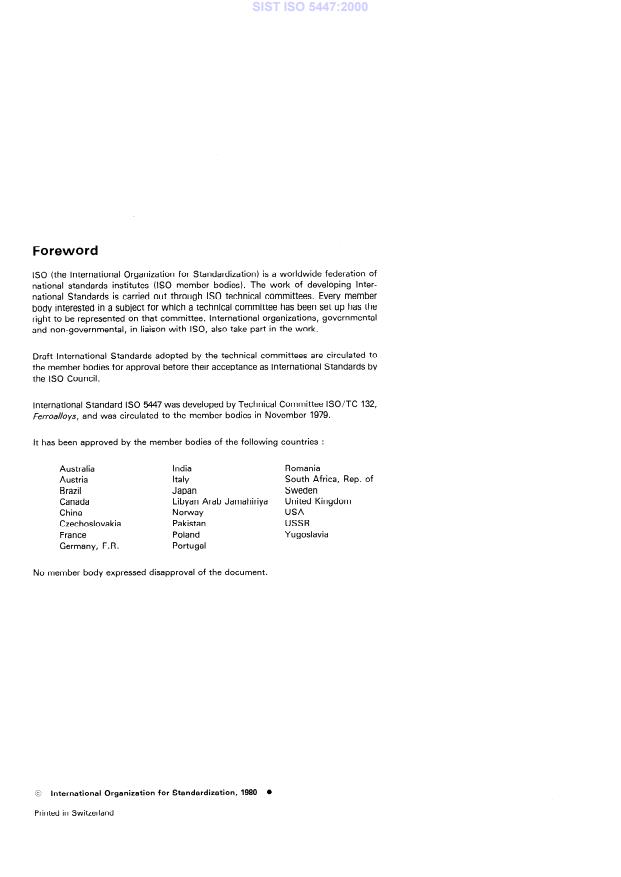
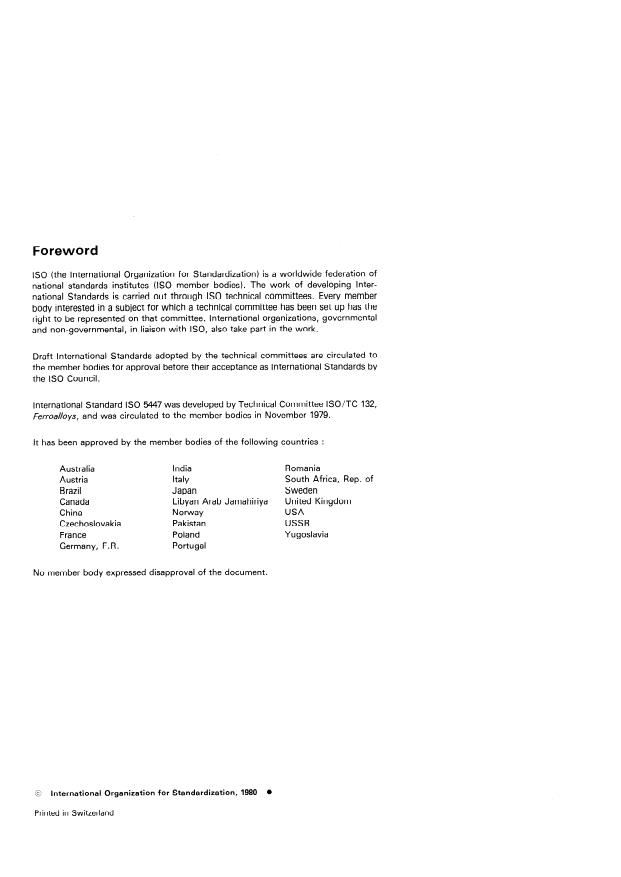
Foreword
ISO (the International Organization for Standardization) is a worldwide federation of
national Standards institutes (ISO member bodies). The work of developing Inter-
national Standards is carried out through ISO technical committees. Every member
body interested in a subject for which a technical committee has been set up has the
right to be represented on that committee. International organizations, governmental
and non-governmental, in liaison with ISO, also take part in the work.
Qraft International Standards adopted by the technical committees are circulated to
the member bodies for approval before their acceptance as International Standards by
the ISO Council.
International Standard ISO 5447 was developed by Technical Committee ISO/TC 132,
Ferroa//oys, and was circulated to the member bodies in November 1979.
lt has been approved by the member bodies of the following countries :
Australia India Romania
Austria Italy South Africa, Rep. of
Brazil Japan Sweden
Canada Libyan Arab Jamahiriya United Kingdom
China Norway USA
Czechoslovakia Pakistan USSR
France Poland Y ugoslavia
Germany, F. R. Portugal
No member body expressed disapproval of the document.
0 international Organkation for Standardkation, 1980
Printed in Switzerland
ISO 5447-1980 (EI
INTERNATIONAL STANDARD
Ferrosilicomanganese - Specification and conditions
of delivery
1 Scope and field of application d) Particle size ranges in accordance with the classes
given in table 2.
This International Standard specifies requirements and con-
ditions of delivery for ferrosilicomanganese usually supplied for e) Necessary requirements for analysis reports, packing,
steelmaking and foundry use. etc., as appropriate.
2 References
5 Requirements
ISO 565, Testsieves - Woven me tal wire clo th and perfora ted
plate - Nominal sizes of apertures.
5.1 Constitution of consignment
ISO 3713, Ferroalloys - Samplingandpreparationofsamples -
Ferrosilicomanganese shall be delivered in consignments con-
General rules. 1)
stituted by one of the following methods.
ISO 4139, Ferrosilicon - Determination of aluminium content
-
Flame a tomic absorp tion spec trome tric me thod.
5.1.1 Tapped lot method
I S 0 4 158, Ferrosilicon, ferrosilicomanganese and ferro-
A consignment constituted by the tapped lot method consists
silico chromium - Determination of Silicon con ten t -
of a ferrosilicomanganese mass of one melt (or one part of a
Gra vime tric me thod.
continuous tap).
I SO 4159, Ferromanganese and ferrosilicomanganese - Deter-
mination of manganese content - Potentiometric method.
5.1.2 Graded lot method
A consignment constituted by the graded lot method consists
3 Definition
of a number of melts (or Parts of continuous taps) of one
ferrosilicomanganese designation.
3.1 ferrosilicomanganese : A master alloy of iron,
manganese and Silicon with manganese contents in the range
The manganese and the Silicon content of the melts (or Parts of
from 60,O to 75,0 % by mass and Silicon contents in the range
continuous taps) constituting the consignment shall not differ
from 10,O to 35,0 % by mass, obtained by reduction.
from each other by more than 3 % absolute.
5.1.3 Blended lot method
4 Information for ordering
A consignment constituted by the blended lot method consists
Orders for ferrosilicomanganese shall include the following in-
formation. of a number of melts (or Parts of continuous taps) of one
ferrosilicomanganese designation, which have been crushed to
a particle size less than x mm2) and thoroughly mixed.
a) Quantity.
The content of the main constituent of the melts (or Parts of
b) Constitution of consignment.
continuous taps) constituting the consignment may vary
c) Chemical composition in accordance with the designa- between the minimum and maximum limits specified for the
tions given in table 1. appropriate ferrosilicomanganese designation.
1) At present at the Stage of draft.
2) To be defined after further investigation.
1s0 5447-1980 (El
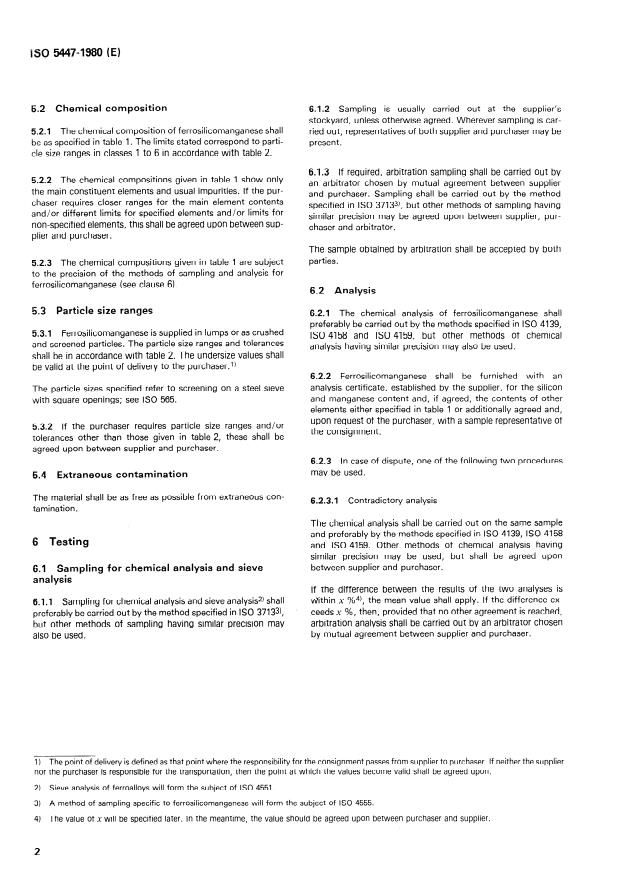
5.2 Chemical composition 6.1.2 Sampling is usually carried out at the supplier’s
Stockyard, unless otherwise agreed. Wherever sampling is car-
5.21 The Chemical composition of ferrosilicomanganese shall ried out, representatives of both supplier and purchaser may be
be as specified in table 1. The limits stated corr
...
International Standard
INTERNATIONAL ORGANIZATION FOR STANDARDIZATION.ME)IC(1YHAPOJJHAfl OPI-AHM3ALWlfl l-IO CTAHAAPTbl3A~MM~RGANISATION INTERNATIONALE DE NORMALISATION
Specification and conditions of
Ferrosilicomanganese -
delivery
Spkcifica tions et conditions de livraison
Ferro-silico-manganhe -
First edition - 1980-12-15
Ref. No. ISO 5447-1980 (E)
UDC 669.15’74’782-198
w
-
delivery, quality control, grain size.
Descriptors : ferroalloys, ferrosilicon, materials specifications, Chemical composition,
Price based on 3 pages
v)
Foreword
ISO (the International Organization for Standardization) is a worldwide federation of
national Standards institutes (ISO member bodies). The work of developing Inter-
national Standards is carried out through ISO technical committees. Every member
body interested in a subject for which a technical committee has been set up has the
right to be represented on that committee. International organizations, governmental
and non-governmental, in liaison with ISO, also take part in the work.
Qraft International Standards adopted by the technical committees are circulated to
the member bodies for approval before their acceptance as International Standards by
the ISO Council.
International Standard ISO 5447 was developed by Technical Committee ISO/TC 132,
Ferroa//oys, and was circulated to the member bodies in November 1979.
lt has been approved by the member bodies of the following countries :
Australia India Romania
Austria Italy South Africa, Rep. of
Brazil Japan Sweden
Canada Libyan Arab Jamahiriya United Kingdom
China Norway USA
Czechoslovakia Pakistan USSR
France Poland Y ugoslavia
Germany, F. R. Portugal
No member body expressed disapproval of the document.
0 international Organkation for Standardkation, 1980
Printed in Switzerland
ISO 5447-1980 (EI
INTERNATIONAL STANDARD
Ferrosilicomanganese - Specification and conditions
of delivery
1 Scope and field of application d) Particle size ranges in accordance with the classes
given in table 2.
This International Standard specifies requirements and con-
ditions of delivery for ferrosilicomanganese usually supplied for e) Necessary requirements for analysis reports, packing,
steelmaking and foundry use. etc., as appropriate.
2 References
5 Requirements
ISO 565, Testsieves - Woven me tal wire clo th and perfora ted
plate - Nominal sizes of apertures.
5.1 Constitution of consignment
ISO 3713, Ferroalloys - Samplingandpreparationofsamples -
Ferrosilicomanganese shall be delivered in consignments con-
General rules. 1)
stituted by one of the following methods.
ISO 4139, Ferrosilicon - Determination of aluminium content
-
Flame a tomic absorp tion spec trome tric me thod.
5.1.1 Tapped lot method
I S 0 4 158, Ferrosilicon, ferrosilicomanganese and ferro-
A consignment constituted by the tapped lot method consists
silico chromium - Determination of Silicon con ten t -
of a ferrosilicomanganese mass of one melt (or one part of a
Gra vime tric me thod.
continuous tap).
I SO 4159, Ferromanganese and ferrosilicomanganese - Deter-
mination of manganese content - Potentiometric method.
5.1.2 Graded lot method
A consignment constituted by the graded lot method consists
3 Definition
of a number of melts (or Parts of continuous taps) of one
ferrosilicomanganese designation.
3.1 ferrosilicomanganese : A master alloy of iron,
manganese and Silicon with manganese contents in the range
The manganese and the Silicon content of the melts (or Parts of
from 60,O to 75,0 % by mass and Silicon contents in the range
continuous taps) constituting the consignment shall not differ
from 10,O to 35,0 % by mass, obtained by reduction.
from each other by more than 3 % absolute.
5.1.3 Blended lot method
4 Information for ordering
A consignment constituted by the blended lot method consists
Orders for ferrosilicomanganese shall include the following in-
formation. of a number of melts (or Parts of continuous taps) of one
ferrosilicomanganese designation, which have been crushed to
a particle size less than x mm2) and thoroughly mixed.
a) Quantity.
The content of the main constituent of the melts (or Parts of
b) Constitution of consignment.
continuous taps) constituting the consignment may vary
c) Chemical composition in accordance with the designa- between the minimum and maximum limits specified for the
tions given in table 1. appropriate ferrosilicomanganese designation.
1) At present at the Stage of draft.
2) To be defined after further investigation.
1s0 5447-1980 (El
5.2 Chemical composition 6.1.2 Sampling is usually carried out at the supplier’s
Stockyard, unless otherwise agreed. Wherever sampling is car-
5.21 The Chemical composition of ferrosilicomanganese shall ried out, representatives of both supplier and purchaser may be
be as specified in table 1. The limits stated correspond to parti-
present.
cle size ranges in classes 1 to 6 in accordance with table 2.
6.1.3 If required, arbitration sampling shall be carried out by
52.2 The Chemical compositions given in table 1 show only
an arbitrator Chosen by mutual agreement between supplier
the main constituent elements and usual impurities. If the pur-
and purchaser. Sampling shall be carried out by the method
chaser requires closer ranges for the main element contents
specifie
...
Norme internationale
INTERNATIONAL ORGANIZATION FOR STANDARDIZATION.ME~YHAPO,QHAR OPl-AHMJAl.&lR il0 CTAH~APTM3A~MM.ORGANISATION INTERNATIONALE DE NORMALISATION
Ferro-silice-manganèse - Spécifications et conditions de
livraison
Ferrosilicomanganese - Specifica tion and conditions of delivery
Première édition - 1980-12-15
CDU 669.15’74782-198 Réf. no : ISO 5447-1980 (F)
Descripteurs : ferro-alliage, ferro-silicium, spécification de matiére, composition chimique, livraison, contrôle de qualité, granulométrie.
Prix basé sur 3 pages
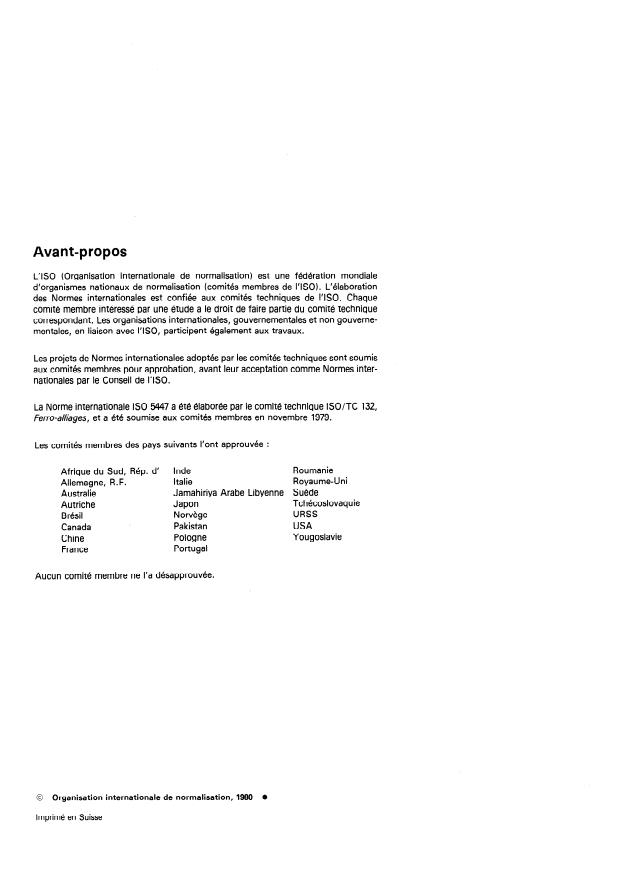
Avant-propos
L’ISO (Organisation internationale de normalisation) est une fédération mondiale
d’organismes nationaux de normalisation (comités membres de I’ISO). L’élaboration
des Normes internationales est confiée aux comités techniques de I’ISO. Chaque
comité membre intéressé par une étude a le droit de faire partie du comité technique
correspondant. Les organisations internationales, gouvernementales et non gouverne-
mentales, en liaison avec I’ISO, participent également aux travaux.
Les projets de Normes internationales adoptés par les comités techniques sont soumis
aux comités membres pour approbation, avant leur acceptation comme Normes inter-
nationales par le Conseil de I’ISO.
La Norme internationale ISO 5447 a été élaborée par le comité technique ISO/TC 132,
Ferra-adiages, et a été soumise aux comités membres en novembre 1979.
Les comités membres des pays suivants l’ont approuvée :
Inde Roumanie
Afrique du Sud, Rép. d’
Allemagne, R. F. Italie Royaume-Uni
Jamahiriya Arabe Libyenne Suède
Australie
Japon Tchécoslovaquie
Autriche
Brésil Norvège URSS
Pakistan USA
Canada
Pologne Yougoslavie
Chine
France Portugal
Aucun comité membre ne l’a désapprouvée.
0 Organisation internationale de normalisation, 1980 0
Imprimé en Suisse
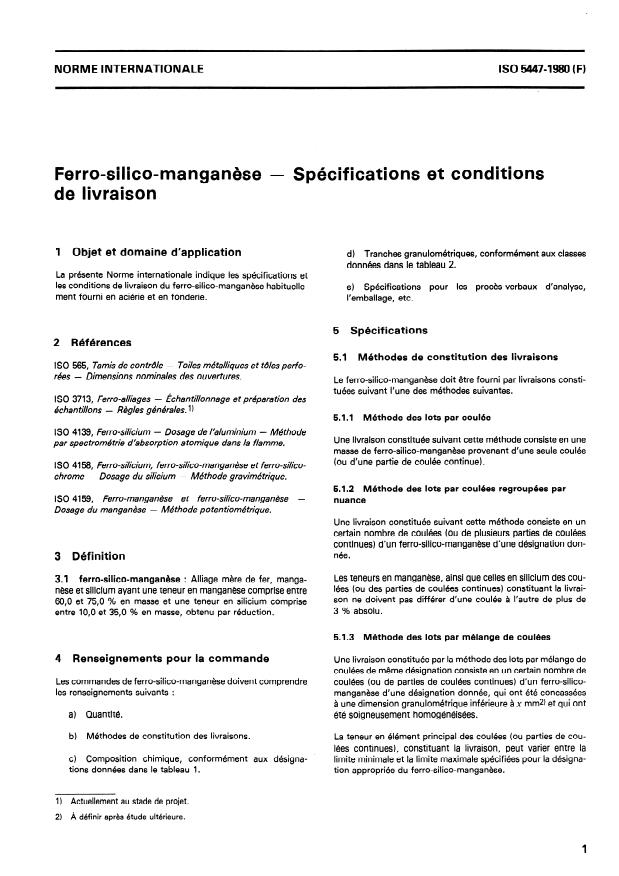
NORME INTERNATIONALE ISO 5447-1980 (F)
Ferro-silice-manganèse - Spécifications et conditions
de livraison
1 Objet et domaine d’application
d) Tranches granulométriques, conformément aux classes
données dans le tableau 2.
La présente Norme internationale indique les spécifications et
les conditions de livraison du ferro-silice-manganèse habituelle-
e) Spécifications pour les procès-verbaux d’analyse,
ment fourni en aciérie et en fonderie.
l’emballage, etc.
5 Spécifications
2 Références
5.1 Méthodes de constitution des livraisons
ISO 565, Tamis de contrôle - Toiles me talliques et toles perfo-
des - Dimensions nominales des ouvertures.
Le ferro-silice-manganése doit être fourni par livraisons consti-
tuees suivant l’une des méthodes suivantes.
ISO 3713, Ferro-alliages - Échantillonnage et préparation des
échantillons - Règles générales. 1)
5.1.1 Méthode des lots par coulée
ISO 4139, Ferra-silicium - Dosage de l’aluminium - Méthode
Une livraison constituée suivant cette méthode consiste en une
par spectrométrie d’absorption atomique dans la flamme,
masse de ferro-silice-manganése provenant d’une seule coulée
(ou d’une partie de coulée continue).
I SO 4158, Ferro-silicium, ferro-silice-manganèse et ferro-silico-
chrome - Dosage du silicium - Méthode gravimétrique.
5.1.2 Méthode des lots par coulées regroupées par
ISO 4159, Ferro-manganèse et ferro-silice-manganèse -
nuance
Dosage du manganèse - Me thode po ten tiomé trique.
Une livraison constituée suivant cette méthode consiste en un
certain nombre de coulées (ou de plusieurs parties de coulées
continues) d’un ferro-silice-manganése d’une désignation don-
née.
3 Définition
Les teneurs en manganése, ainsi que celles en silicium des cou-
3.1 ferro-silice-manganbe : Alliage mére de fer, manga-
lées (ou des parties de coulées continues) constituant la livrai-
nese et silicium ayant une teneur en manganèse comprise entre
son ne doivent pas différer d’une coulée à l’autre de plus de
60,O et 75,0 % en masse et une teneur en silicium comprise
3 % absolu.
entre 10,O et 35,0 % en masse, obtenu par réduction.
5.1.3 Méthode des lots par melange de coubes
4 Renseignements pour la commande
Une livraison constituée par la méthode des lots par mélange de
coulées de même désignation consiste en un certain nombre de
Les commandes de ferro-silice-manganèse doivent comprendre coulées (ou de parties de coulées continues) d’un ferro-silico-
les renseignements suivants :
manganèse d’une désignation donnée, qui ont été concassées
à une dimension granulométrique inférieure à x mm2) et qui ont
a) Quantité.
été soigneusement homogénéisées.
b) Méthodes de constitution des livraisons. La teneur en élément principal des coulées (ou parties de COU-
Iées continues), constituant la livraison, peut varier entre la
c) Composition chimique, conformément aux désigna-
limite minimale et la limite maximale spécifiées pour la désigna-
tions données dans le tableau 1.
tion appropriée du ferro-silice-manganèse.
1) Actuellement au stade de projet.
2) À définir aprés étude ultérieure.
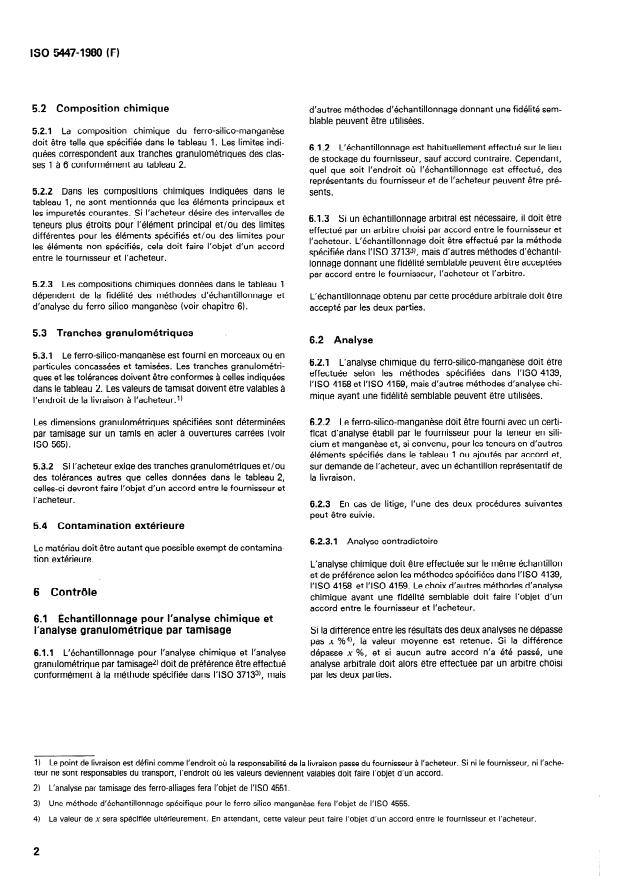
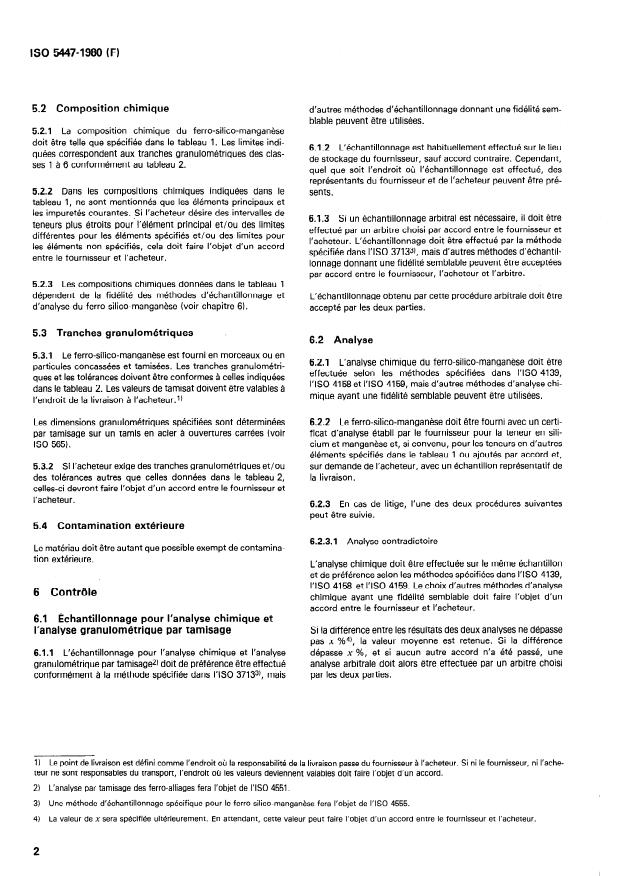
ISO 54474980 (FI
5.2 Composition chimique d’autres méthodes d’échantillonnage donnant une fidélité sem-
blable peuvent être utilisées.
5.2.1 La composition chimique du ferro-silice-manganèse
doit être telle que spécifiée dans le tableau 1. Les limites indi-
6.1.2 L’échantillonnage est habituellement effectué sur le lieu
quées correspondent aux tranches granulométriques des clas-
de stockage du fournisseur, sauf accord contraire. Cependant,
ses 1 à 6 conformément au tableau 2.
quel que soit l’endroit où l’échantillonnage est effectué, des
représentants du fournisseur et de l’acheteur peuvent être pré-
5.2.2 Dans les compositions chimiques indiquées dans le
sents.
tableau 1, ne sont mentionnés que les éléments principaux et
les impuretés courantes. Si l’acheteur désire des intervalles de
6.1.3 Si un échantillonnage arbitral est nécessaire, il doit être
teneurs plus étroits pour l’élément principal et
...
Norme internationale
INTERNATIONAL ORGANIZATION FOR STANDARDIZATION.ME~YHAPO,QHAR OPl-AHMJAl.&lR il0 CTAH~APTM3A~MM.ORGANISATION INTERNATIONALE DE NORMALISATION
Ferro-silice-manganèse - Spécifications et conditions de
livraison
Ferrosilicomanganese - Specifica tion and conditions of delivery
Première édition - 1980-12-15
CDU 669.15’74782-198 Réf. no : ISO 5447-1980 (F)
Descripteurs : ferro-alliage, ferro-silicium, spécification de matiére, composition chimique, livraison, contrôle de qualité, granulométrie.
Prix basé sur 3 pages
Avant-propos
L’ISO (Organisation internationale de normalisation) est une fédération mondiale
d’organismes nationaux de normalisation (comités membres de I’ISO). L’élaboration
des Normes internationales est confiée aux comités techniques de I’ISO. Chaque
comité membre intéressé par une étude a le droit de faire partie du comité technique
correspondant. Les organisations internationales, gouvernementales et non gouverne-
mentales, en liaison avec I’ISO, participent également aux travaux.
Les projets de Normes internationales adoptés par les comités techniques sont soumis
aux comités membres pour approbation, avant leur acceptation comme Normes inter-
nationales par le Conseil de I’ISO.
La Norme internationale ISO 5447 a été élaborée par le comité technique ISO/TC 132,
Ferra-adiages, et a été soumise aux comités membres en novembre 1979.
Les comités membres des pays suivants l’ont approuvée :
Inde Roumanie
Afrique du Sud, Rép. d’
Allemagne, R. F. Italie Royaume-Uni
Jamahiriya Arabe Libyenne Suède
Australie
Japon Tchécoslovaquie
Autriche
Brésil Norvège URSS
Pakistan USA
Canada
Pologne Yougoslavie
Chine
France Portugal
Aucun comité membre ne l’a désapprouvée.
0 Organisation internationale de normalisation, 1980 0
Imprimé en Suisse
NORME INTERNATIONALE ISO 5447-1980 (F)
Ferro-silice-manganèse - Spécifications et conditions
de livraison
1 Objet et domaine d’application
d) Tranches granulométriques, conformément aux classes
données dans le tableau 2.
La présente Norme internationale indique les spécifications et
les conditions de livraison du ferro-silice-manganèse habituelle-
e) Spécifications pour les procès-verbaux d’analyse,
ment fourni en aciérie et en fonderie.
l’emballage, etc.
5 Spécifications
2 Références
5.1 Méthodes de constitution des livraisons
ISO 565, Tamis de contrôle - Toiles me talliques et toles perfo-
des - Dimensions nominales des ouvertures.
Le ferro-silice-manganése doit être fourni par livraisons consti-
tuees suivant l’une des méthodes suivantes.
ISO 3713, Ferro-alliages - Échantillonnage et préparation des
échantillons - Règles générales. 1)
5.1.1 Méthode des lots par coulée
ISO 4139, Ferra-silicium - Dosage de l’aluminium - Méthode
Une livraison constituée suivant cette méthode consiste en une
par spectrométrie d’absorption atomique dans la flamme,
masse de ferro-silice-manganése provenant d’une seule coulée
(ou d’une partie de coulée continue).
I SO 4158, Ferro-silicium, ferro-silice-manganèse et ferro-silico-
chrome - Dosage du silicium - Méthode gravimétrique.
5.1.2 Méthode des lots par coulées regroupées par
ISO 4159, Ferro-manganèse et ferro-silice-manganèse -
nuance
Dosage du manganèse - Me thode po ten tiomé trique.
Une livraison constituée suivant cette méthode consiste en un
certain nombre de coulées (ou de plusieurs parties de coulées
continues) d’un ferro-silice-manganése d’une désignation don-
née.
3 Définition
Les teneurs en manganése, ainsi que celles en silicium des cou-
3.1 ferro-silice-manganbe : Alliage mére de fer, manga-
lées (ou des parties de coulées continues) constituant la livrai-
nese et silicium ayant une teneur en manganèse comprise entre
son ne doivent pas différer d’une coulée à l’autre de plus de
60,O et 75,0 % en masse et une teneur en silicium comprise
3 % absolu.
entre 10,O et 35,0 % en masse, obtenu par réduction.
5.1.3 Méthode des lots par melange de coubes
4 Renseignements pour la commande
Une livraison constituée par la méthode des lots par mélange de
coulées de même désignation consiste en un certain nombre de
Les commandes de ferro-silice-manganèse doivent comprendre coulées (ou de parties de coulées continues) d’un ferro-silico-
les renseignements suivants :
manganèse d’une désignation donnée, qui ont été concassées
à une dimension granulométrique inférieure à x mm2) et qui ont
a) Quantité.
été soigneusement homogénéisées.
b) Méthodes de constitution des livraisons. La teneur en élément principal des coulées (ou parties de COU-
Iées continues), constituant la livraison, peut varier entre la
c) Composition chimique, conformément aux désigna-
limite minimale et la limite maximale spécifiées pour la désigna-
tions données dans le tableau 1.
tion appropriée du ferro-silice-manganèse.
1) Actuellement au stade de projet.
2) À définir aprés étude ultérieure.
ISO 54474980 (FI
5.2 Composition chimique d’autres méthodes d’échantillonnage donnant une fidélité sem-
blable peuvent être utilisées.
5.2.1 La composition chimique du ferro-silice-manganèse
doit être telle que spécifiée dans le tableau 1. Les limites indi-
6.1.2 L’échantillonnage est habituellement effectué sur le lieu
quées correspondent aux tranches granulométriques des clas-
de stockage du fournisseur, sauf accord contraire. Cependant,
ses 1 à 6 conformément au tableau 2.
quel que soit l’endroit où l’échantillonnage est effectué, des
représentants du fournisseur et de l’acheteur peuvent être pré-
5.2.2 Dans les compositions chimiques indiquées dans le
sents.
tableau 1, ne sont mentionnés que les éléments principaux et
les impuretés courantes. Si l’acheteur désire des intervalles de
6.1.3 Si un échantillonnage arbitral est nécessaire, il doit être
teneurs plus étroits pour l’élément principal et
...