

oSIST prEN 13631-7:2021
(Main)Explosives for civil uses - High explosives - Part 7: Determination of safety and reliability at extreme temperatures
General Information
- Abstract
This European Standard specifies the special conditions and procedures permitting the extension to wider ranges of applicability of the following test methods:
- determination of resistance to hydrostatic pressure;
- verification of the means of initiation;
- determination of transmission of detonation.
Standardised test methods at extreme temperatures for the following purposes are not given:
- determination of sensitiveness to friction;
- determination of sensitiveness to impact;
- determination of resistance to water;
- determination of the initiating capability of boosters;
- determination of velocity of detonation.
NOTE In these cases, the manufacturer of the explosive should provide a suitable test method and, in cases where the results should be checked by an independent institution or authority, the manufacturer and the institution or authority should agree upon a suitable test method.
- Status
- Not Published
- Public Enquiry End Date
- 02-May-2021
- Technical Committee
- IEKS - Explosives
- Current Stage
- 98 - Abandoned project (Adopted Project)
- Start Date
- 10-May-2024
- Due Date
- 15-May-2024
- Completion Date
- 10-May-2024

Overview
oSIST prEN 13631-7:2021 is a draft European Standard developed by SIST that establishes procedures for testing the safety and reliability of explosives for civil uses at extreme temperatures. This standard is part of the EN 13631 series, focusing on high explosives used in civil engineering, mining, quarrying, and construction. It details specific test methods to evaluate how explosives perform under challenging thermal conditions, ensuring compliance with essential safety requirements set out in Directive 2014/28/EU.
Key Topics
- Extreme Temperature Conditions: The standard applies to explosive testing at temperatures below -40°C and above +80°C, ensuring reliability and safety outside typical climatic environments.
- Test Methods: Defined procedures cover:
- Resistance to Hydrostatic Pressure: How explosives maintain integrity under pressure at varying temperatures.
- Verification of Means of Initiation: Ensuring initiation systems operate reliably after thermal exposure.
- Transmission of Detonation: Confirming that detonation can propagate fully through the explosive material even under extreme temperatures.
- Scope Exclusions: The standard does NOT cover thermal testing for:
- Friction or impact sensitiveness,
- Water resistance,
- Initiating capability of boosters,
- Velocity of detonation. In these cases, manufacturers must supply suitable test methods, subject to agreement with relevant authorities.
Applications
oSIST prEN 13631-7:2021 delivers practical value for companies in sectors such as mining, tunneling, and demolition, where high explosives are subjected to variable and sometimes harsh environmental temperatures. Key applications include:
- Product Development and Quality Assurance: Manufacturers use these procedures to validate that their explosives maintain safety and functionality across a broad range of temperatures.
- Regulatory Compliance: Following this standard supports compliance with EU regulations regarding the storage, handling, and deployment of civil explosives, especially in regions prone to temperature extremes.
- Market Access: Testing as per oSIST prEN 13631-7:2021 helps demonstrate conformity with Directive 2014/28/EU, facilitating smoother approval and distribution in the European market.
- Risk Management: End-users, including contractors and engineers, can specify products tested per this standard for projects in Arctic, desert, or other temperature-challenging environments, reducing operational risk.
Related Standards
For comprehensive assessment and certification, oSIST prEN 13631-7:2021 should be considered alongside other standards in the EN 13631 series, including:
- EN 13631-1: General requirements for explosives for civil uses.
- EN 13631-6: Determination of resistance to hydrostatic pressure.
- EN 13631-10: Method for verification of initiation systems.
- EN 13631-11: Determination of transmission of detonation.
- prEN 13857-1: Terminology for explosives for civil uses.
- EN ISO/IEC 17025: General competence requirements for testing and calibration laboratories.
Following the correct standard ensures confidence in the safety, effectiveness, and regulatory compliance of high explosives used in civil applications, particularly under extreme temperature conditions.
Relations
- Effective Date
- 18-Jan-2023
- Effective Date
- 01-Apr-2021
Get Certified
Connect with accredited certification bodies for this standard

ECOCERT
Organic and sustainability certification.

Eurofins Food Testing Global
Global leader in food, environment, and pharmaceutical product testing.

Intertek Bangladesh
Intertek certification and testing services in Bangladesh.
Sponsored listings
Frequently Asked Questions
oSIST prEN 13631-7:2021 is a draft published by the Slovenian Institute for Standardization (SIST). Its full title is "Explosives for civil uses - High explosives - Part 7: Determination of safety and reliability at extreme temperatures". This standard covers: This European Standard specifies the special conditions and procedures permitting the extension to wider ranges of applicability of the following test methods: - determination of resistance to hydrostatic pressure; - verification of the means of initiation; - determination of transmission of detonation. Standardised test methods at extreme temperatures for the following purposes are not given: - determination of sensitiveness to friction; - determination of sensitiveness to impact; - determination of resistance to water; - determination of the initiating capability of boosters; - determination of velocity of detonation. NOTE In these cases, the manufacturer of the explosive should provide a suitable test method and, in cases where the results should be checked by an independent institution or authority, the manufacturer and the institution or authority should agree upon a suitable test method.
This European Standard specifies the special conditions and procedures permitting the extension to wider ranges of applicability of the following test methods: - determination of resistance to hydrostatic pressure; - verification of the means of initiation; - determination of transmission of detonation. Standardised test methods at extreme temperatures for the following purposes are not given: - determination of sensitiveness to friction; - determination of sensitiveness to impact; - determination of resistance to water; - determination of the initiating capability of boosters; - determination of velocity of detonation. NOTE In these cases, the manufacturer of the explosive should provide a suitable test method and, in cases where the results should be checked by an independent institution or authority, the manufacturer and the institution or authority should agree upon a suitable test method.
oSIST prEN 13631-7:2021 is classified under the following ICS (International Classification for Standards) categories: 71.100.30 - Explosives. Pyrotechnics and fireworks. The ICS classification helps identify the subject area and facilitates finding related standards.
oSIST prEN 13631-7:2021 has the following relationships with other standards: It is inter standard links to SIST EN 13631-7:2004, SIST EN 13631-7:2004. Understanding these relationships helps ensure you are using the most current and applicable version of the standard.
oSIST prEN 13631-7:2021 is associated with the following European legislation: EU Directives/Regulations: 2014/28/EU; Standardization Mandates: M/055, M/562. When a standard is cited in the Official Journal of the European Union, products manufactured in conformity with it benefit from a presumption of conformity with the essential requirements of the corresponding EU directive or regulation.
oSIST prEN 13631-7:2021 is available in PDF format for immediate download after purchase. The document can be added to your cart and obtained through the secure checkout process. Digital delivery ensures instant access to the complete standard document.
Standards Content (Sample)
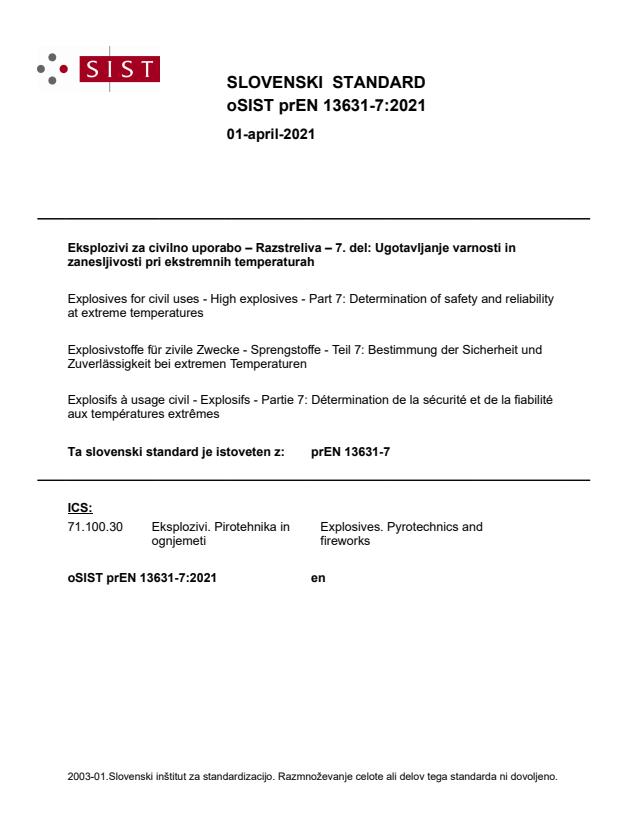
SLOVENSKI STANDARD
01-april-2021
Eksplozivi za civilno uporabo – Razstreliva – 7. del: Ugotavljanje varnosti in
zanesljivosti pri ekstremnih temperaturah
Explosives for civil uses - High explosives - Part 7: Determination of safety and reliability
at extreme temperatures
Explosivstoffe für zivile Zwecke - Sprengstoffe - Teil 7: Bestimmung der Sicherheit und
Zuverlässigkeit bei extremen Temperaturen
Explosifs à usage civil - Explosifs - Partie 7: Détermination de la sécurité et de la fiabilité
aux températures extrêmes
Ta slovenski standard je istoveten z: prEN 13631-7
ICS:
71.100.30 Eksplozivi. Pirotehnika in Explosives. Pyrotechnics and
ognjemeti fireworks
2003-01.Slovenski inštitut za standardizacijo. Razmnoževanje celote ali delov tega standarda ni dovoljeno.
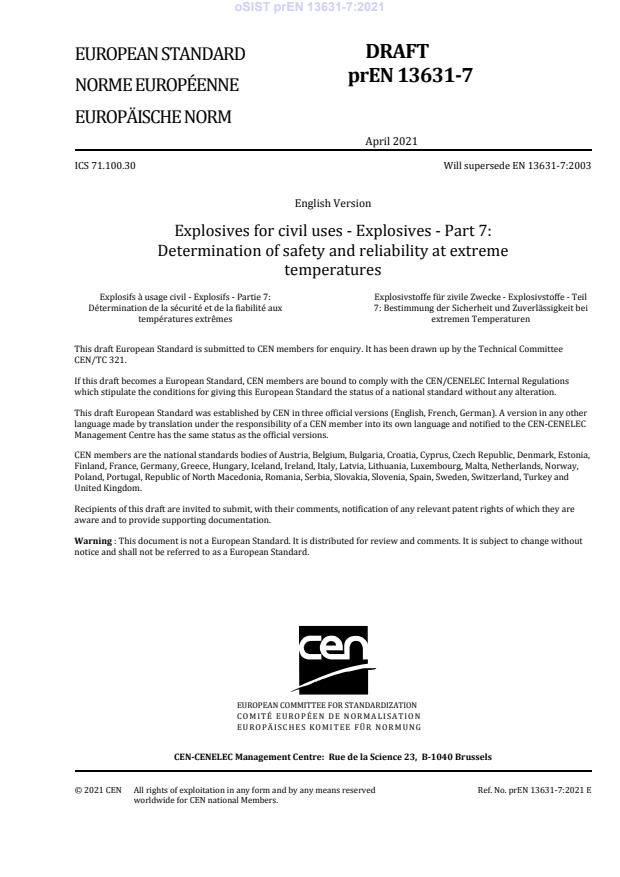
DRAFT
EUROPEAN STANDARD
NORME EUROPÉENNE
EUROPÄISCHE NORM
April 2021
ICS 71.100.30 Will supersede EN 13631-7:2003
English Version
Explosives for civil uses - Explosives - Part 7:
Determination of safety and reliability at extreme
temperatures
Explosifs à usage civil - Explosifs - Partie 7: Explosivstoffe für zivile Zwecke - Explosivstoffe - Teil
Détermination de la sécurité et de la fiabilité aux 7: Bestimmung der Sicherheit und Zuverlässigkeit bei
températures extrêmes extremen Temperaturen
This draft European Standard is submitted to CEN members for enquiry. It has been drawn up by the Technical Committee
CEN/TC 321.
If this draft becomes a European Standard, CEN members are bound to comply with the CEN/CENELEC Internal Regulations
which stipulate the conditions for giving this European Standard the status of a national standard without any alteration.
This draft European Standard was established by CEN in three official versions (English, French, German). A version in any other
language made by translation under the responsibility of a CEN member into its own language and notified to the CEN-CENELEC
Management Centre has the same status as the official versions.
CEN members are the national standards bodies of Austria, Belgium, Bulgaria, Croatia, Cyprus, Czech Republic, Denmark, Estonia,
Finland, France, Germany, Greece, Hungary, Iceland, Ireland, Italy, Latvia, Lithuania, Luxembourg, Malta, Netherlands, Norway,
Poland, Portugal, Republic of North Macedonia, Romania, Serbia, Slovakia, Slovenia, Spain, Sweden, Switzerland, Turkey and
United Kingdom.
Recipients of this draft are invited to submit, with their comments, notification of any relevant patent rights of which they are
aware and to provide supporting documentation.
Warning : This document is not a European Standard. It is distributed for review and comments. It is subject to change without
notice and shall not be referred to as a European Standard.
EUROPEAN COMMITTEE FOR STANDARDIZATION
COMITÉ EUROPÉEN DE NORMALISATION
EUROPÄISCHES KOMITEE FÜR NORMUNG
CEN-CENELEC Management Centre: Rue de la Science 23, B-1040 Brussels
© 2021 CEN All rights of exploitation in any form and by any means reserved Ref. No. prEN 13631-7:2021 E
worldwide for CEN national Members.
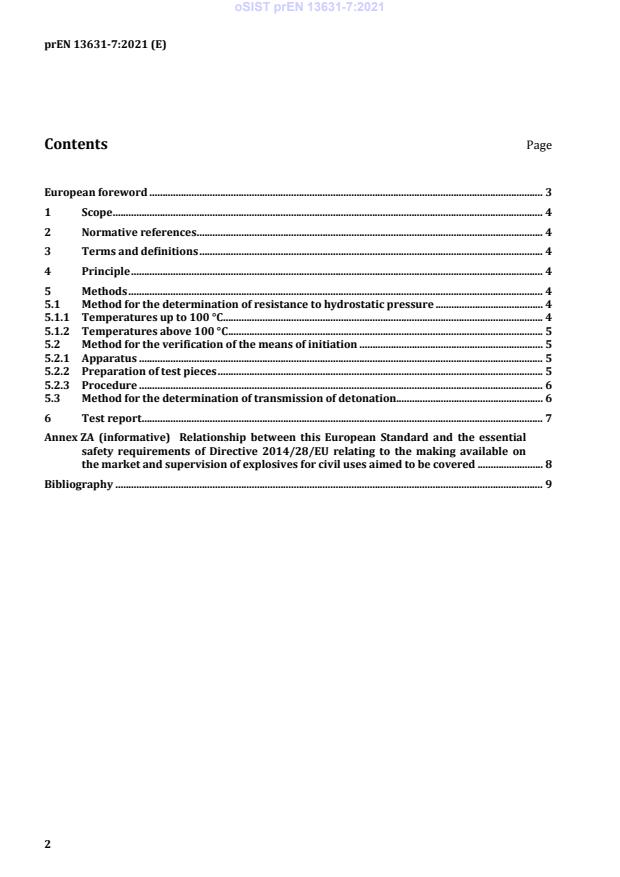
Contents Page
European foreword . 3
1 Scope . 4
2 Normative references . 4
3 Terms and definitions . 4
4 Principle . 4
5 Methods . 4
5.1 Method for the determination of resistance to hydrostatic pressure . 4
5.1.1 Temperatures up to 100 °C. 4
5.1.2 Temperatures above 100 °C . 5
5.2 Method for the verification of the means of initiation . 5
5.2.1 Apparatus . 5
5.2.2 Preparation of test pieces . 5
5.2.3 Procedure . 6
5.3 Method for the determination of transmission of detonation. 6
6 Test report . 7
Annex ZA (informative) Relationship between this European Standard and the essential
safety requirements of Directive 2014/28/EU relating to the making available on
the market and supervision of explosives for civil uses aimed to be covered . 8
Bibliography . 9
European foreword
This document (prEN 13631-7:2021) has been prepared by Technical Committee CEN/TC 321
“Explosives for civil uses”, the secretariat of which is held by UNE.
This document is currently submitted for the CEN Enquiry.
This document will supersede EN 13631-7:2003.
In comparison with the previous edition, the following technical modifications have been made:
a) the main element of the document’s title has been changed from “High explosives” to “Explosives”;
b) the normative references have been updated;
c) Clause 4, Principle, has been added;
d) Annex ZA has been updated.
This document has been prepared under a Standardization Request (M/562) annexed to the
Commission Implementing Decision C(2019)6634 final as regards Explosives for civil uses given to CEN
by the European Commission and the European Free Trade Association, and supports Essential Safety
requirements of Directive 2014/28/EU.
For relationship with Directive 2014/28/EU, see informative Annex ZA, which is an integral part of this
document.
EN 13631, Explosives for civil uses — Explosives, is currently composed with the following parts:
— Part 1: Requirements
— Part 2: Determination of thermal stability of explosives
— Part 3: Determination of sensitiveness to friction of explosives
— Part 4: Determination of sensitiveness to impact of explosives
— Part 5: Determination of resistance of explosives to water
— Part 6: Determination of resistance of explosives to hydrostatic pressure
— Part 7: Determination of safety and reliability of explosives at extreme temperatures
— Part 10: Method for the verification of the means of initiation of explosives
— Part 11: Determination of transmission of detonation of explosives
— Part 13: Determination of density of explosives
— Part 14: Determination of velocity of detonation of explosives
1 Scope
This document specifies a method for determining safety and reliability of explosives for civil uses,
excluding black powder, at extreme temperatures.
NOTE Extreme temperatures are considered to be below −40°C or above + 80 °C.
2 Normative references
The following documents are referred to in the text in such a way that some or all of their content
constitutes requirements of this document. For dated references, only the edition cited applies. For
undated references, the latest edition of the referenced document (including any amendments) applies.
prEN 13631-6:2021, Explosives for civil uses — Explosives — Part 6: Determination of resistance to
hydrostatic pressure
prEN 13631-10:2021, Explosives for civil uses — Explosives — Part 10: Method for the verification of the
means of initiation
prEN 13631-11:2021, Explosives for civil uses — Explosives — Part 11: Determination of transmission of
detonation
prEN 13857-1:2021, Explosives for civil uses — Part 1: Terminology
...