

SIST-TP CEN/TR 16396:2020
(Main)Playground equipment for children - Replies to requests for interpretation of EN 1176 and its parts.
General Information
- Abstract
The purpose of this document is to publish replies to requests for interpretations, to all parts of EN 1176 series, which have been drafted by the interpretation panel and confirmed by CEN/TC 136/S C1 "Playground equipment for children".
- Status
- Published
- Public Enquiry End Date
- 19-Oct-2019
- Publication Date
- 16-Feb-2020
- Technical Committee
- SPO - Sports
- Current Stage
- 6060 - National Implementation/Publication (Adopted Project)
- Start Date
- 30-Jan-2020
- Due Date
- 05-Apr-2020
- Completion Date
- 17-Feb-2020



Overview
SIST-TP CEN/TR 16396:2020 - Playground equipment for children: Replies to requests for interpretation of EN 1176 and its parts is a CEN Technical Report that collects formal replies and “no-action” decisions on interpretation requests submitted against the EN 1176 series (2008 edition and related parts). Prepared by CEN/TC 136/SC1 and confirmed by the interpretation panel, this TR documents clarifications developed between 2009 and 2017 and supersedes the 2012 edition. It is a guidance document to help users apply the EN 1176 playground equipment safety requirements and associated test methods consistently across Europe.
Key topics and technical focus
This Technical Report does not introduce new normative requirements but provides authoritative clarifications on how specific clauses in the EN 1176 series should be understood and applied. Key technical topics covered include:
- General safety requirements and test methods (EN 1176-1) - multiple interpretation requests addressing scope, free space, clusters, and other clause-level questions (e.g., clauses 4.2.x, 4.2.7.2, 4.2.8.1).
- Specific equipment types - clarifications for swings (EN 1176-2), slides (EN 1176-3), cableways (EN 1176-4), rocking equipment (EN 1176-6), fully enclosed play equipment (EN 1176-10), and spatial networks (EN 1176-11).
- Test method application and rationale - guidance on how to interpret test procedures, signage, surfacing considerations, and when no amendment to the standard is required.
- Process and scope of interpretations - explanation of the interpretation protocol, submission routes (via national bodies), and the difference between an interpretation, an amendment proposal, or future revision.
The TR cites numerous clause-specific interpretation requests (for example 2009‑01 through 2017‑09) and provides the official responses drafted by the interpretation panel.
Practical applications - who uses this document
SIST-TP CEN/TR 16396:2020 is a practical reference for:
- Playground equipment manufacturers and designers seeking consistent application of EN 1176 requirements.
- Testing and certification laboratories that need authoritative clarifications for test methods and clause interpretation.
- Safety inspectors, playground owners and municipal authorities applying standards for acceptance, maintenance and risk assessments.
- Standards committees and national bodies that manage interpretation requests or prepare amendments to EN 1176.
Using this TR can reduce ambiguity, support compliance decisions, and help avoid inconsistent interpretations of playground safety clauses.
Related standards
- EN 1176 series (Parts 1–11 and other specific parts) - the primary European standards for playground equipment safety and test methods.
- SIST adoption note: this TR is the Slovenian adoption of CEN/TR 16396:2020.
Keywords: CEN/TR 16396:2020, EN 1176, playground equipment safety, interpretation, test methods, CEN/TC 136, playground standards.
Relations
- Effective Date
- 01-Mar-2020
Frequently Asked Questions
SIST-TP CEN/TR 16396:2020 is a technical report published by the Slovenian Institute for Standardization (SIST). Its full title is "Playground equipment for children - Replies to requests for interpretation of EN 1176 and its parts.". This standard covers: The purpose of this document is to publish replies to requests for interpretations, to all parts of EN 1176 series, which have been drafted by the interpretation panel and confirmed by CEN/TC 136/S C1 "Playground equipment for children".
The purpose of this document is to publish replies to requests for interpretations, to all parts of EN 1176 series, which have been drafted by the interpretation panel and confirmed by CEN/TC 136/S C1 "Playground equipment for children".
SIST-TP CEN/TR 16396:2020 is classified under the following ICS (International Classification for Standards) categories: 97.200.40 - Playgrounds. The ICS classification helps identify the subject area and facilitates finding related standards.
SIST-TP CEN/TR 16396:2020 has the following relationships with other standards: It is inter standard links to SIST-TP CEN/TR 16396:2013. Understanding these relationships helps ensure you are using the most current and applicable version of the standard.
SIST-TP CEN/TR 16396:2020 is available in PDF format for immediate download after purchase. The document can be added to your cart and obtained through the secure checkout process. Digital delivery ensures instant access to the complete standard document.
Standards Content (Sample)
SLOVENSKI STANDARD
01-marec-2020
Nadomešča:
SIST-TP CEN/TR 16396:2013
Oprema otroških igrišč - Odgovori na zahteve za razlago EN 1176 in njegovih delov
Playground equipment for children - Replies to requests for interpretation of EN 1176
and its parts.
Spielplatzgeräte für Kinder - Antworten auf Interpretationsanfragen zu EN 1176 und
dazugehörigen Teilen
Ta slovenski standard je istoveten z: CEN/TR 16396:2020
ICS:
97.200.40 Igrišča Playgrounds
2003-01.Slovenski inštitut za standardizacijo. Razmnoževanje celote ali delov tega standarda ni dovoljeno.
CEN/TR 16396
TECHNICAL REPORT
RAPPORT TECHNIQUE
January 2020
TECHNISCHER BERICHT
ICS 97.200.40 Supersedes CEN/TR 16396:2012
English Version
Playground equipment for children - Replies to requests
for interpretation of EN 1176 and its parts.
Spielplatzgeräte für Kinder - Antworten auf
Interpretationsanfragen zu EN 1176 und
dazugehörigen Teilen
This European Standard was corrected and reissued by the CEN-CENELEC Management Centre on 19 February 2020.
This Technical Report was approved by CEN on 25 November 2019. It has been drawn up by the Technical Committee CEN/TC
136.
CEN members are the national standards bodies of Austria, Belgium, Bulgaria, Croatia, Cyprus, Czech Republic, Denmark, Estonia,
Finland, France, Germany, Greece, Hungary, Iceland, Ireland, Italy, Latvia, Lithuania, Luxembourg, Malta, Netherlands, Norway,
Poland, Portugal, Republic of North Macedonia, Romania, Serbia, Slovakia, Slovenia, Spain, Sweden, Switzerland, Turkey and
United Kingdom.
EUROPEAN COMMITTEE FOR STANDARDIZATION
COMITÉ EUROPÉEN DE NORMALISATIO N
EUROPÄISCHES KOMITEE FÜR NORMUN G
CEN-CENELEC Management Centre: Rue de la Science 23, B-1040 Brussels
© 2020 CEN All rights of exploitation in any form and by any means reserved Ref. No. CEN/TR 16396:2020 E
worldwide for CEN national Members.
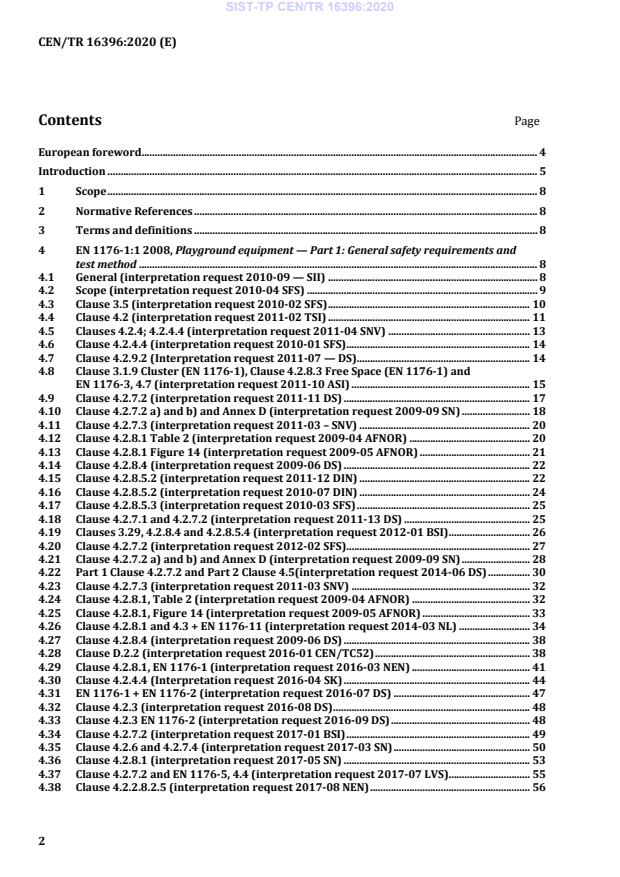
Contents Page
European foreword . 4
Introduction . 5
1 Scope . 8
2 Normative References . 8
3 Terms and definitions . 8
4 EN 1176-1:1 2008, Playground equipment — Part 1: General safety requirements and
test method . 8
4.1 General (interpretation request 2010-09 — SII) . 8
4.2 Scope (interpretation request 2010-04 SFS) . 9
4.3 Clause 3.5 (interpretation request 2010-02 SFS) . 10
4.4 Clause 4.2 (interpretation request 2011-02 TSI) . 11
4.5 Clauses 4.2.4; 4.2.4.4 (interpretation request 2011-04 SNV) . 13
4.6 Clause 4.2.4.4 (interpretation request 2010-01 SFS) . 14
4.7 Clause 4.2.9.2 (Interpretation request 2011-07 — DS) . 14
4.8 Clause 3.1.9 Cluster (EN 1176-1), Clause 4.2.8.3 Free Space (EN 1176-1) and
EN 1176-3, 4.7 (interpretation request 2011-10 ASI) . 15
4.9 Clause 4.2.7.2 (interpretation request 2011-11 DS) . 17
4.10 Clause 4.2.7.2 a) and b) and Annex D (interpretation request 2009-09 SN) . 18
4.11 Clause 4.2.7.3 (interpretation request 2011-03 – SNV) . 20
4.12 Clause 4.2.8.1 Table 2 (interpretation request 2009-04 AFNOR) . 20
4.13 Clause 4.2.8.1 Figure 14 (interpretation request 2009-05 AFNOR) . 21
4.14 Clause 4.2.8.4 (interpretation request 2009-06 DS) . 22
4.15 Clause 4.2.8.5.2 (interpretation request 2011-12 DIN) . 22
4.16 Clause 4.2.8.5.2 (interpretation request 2010-07 DIN) . 24
4.17 Clause 4.2.8.5.3 (interpretation request 2010-03 SFS) . 25
4.18 Clause 4.2.7.1 and 4.2.7.2 (interpretation request 2011-13 DS) . 25
4.19 Clauses 3.29, 4.2.8.4 and 4.2.8.5.4 (interpretation request 2012-01 BSI) . 26
4.20 Clause 4.2.7.2 (interpretation request 2012-02 SFS) . 27
4.21 Clause 4.2.7.2 a) and b) and Annex D (interpretation request 2009-09 SN) . 28
4.22 Part 1 Clause 4.2.7.2 and Part 2 Clause 4.5(interpretation request 2014-06 DS) . 30
4.23 Clause 4.2.7.3 (interpretation request 2011-03 SNV) . 32
4.24 Clause 4.2.8.1, Table 2 (interpretation request 2009-04 AFNOR) . 32
4.25 Clause 4.2.8.1, Figure 14 (interpretation request 2009-05 AFNOR) . 33
4.26 Clause 4.2.8.1 and 4.3 + EN 1176-11 (interpretation request 2014-03 NL) . 34
4.27 Clause 4.2.8.4 (interpretation request 2009-06 DS) . 38
4.28 Clause D.2.2 (interpretation request 2016-01 CEN/TC52) . 38
4.29 Clause 4.2.8.1, EN 1176-1 (interpretation request 2016-03 NEN) . 41
4.30 Clause 4.2.4.4 (Interpretation request 2016-04 SK) . 44
4.31 EN 1176-1 + EN 1176-2 (interpretation request 2016-07 DS) . 47
4.32 Clause 4.2.3 (interpretation request 2016-08 DS) . 48
4.33 Clause 4.2.3 EN 1176-2 (interpretation request 2016-09 DS) . 48
4.34 Clause 4.2.7.2 (interpretation request 2017-01 BSI) . 49
4.35 Clause 4.2.6 and 4.2.7.4 (interpretation request 2017-03 SN) . 50
4.36 Clause 4.2.8.1 (interpretation request 2017-05 SN) . 53
4.37 Clause 4.2.7.2 and EN 1176-5, 4.4 (interpretation request 2017-07 LVS). 55
4.38 Clause 4.2.2.8.2.5 (interpretation request 2017-08 NEN) . 56
4.39 Clause 4.2.3 s (interpretation request 2017-09 NEN) . 57
5 EN 1176-2:2008, Playground equipment and surfacing — Part 2: Additional specific
safety requirements and test methods for swings . 58
5.1 Clause 4.2 (interpretation request 2010-06 DS) . 58
5.2 Clause 4.9 Framework (interpretation request 2011-08 DS) . 59
5.3 Clause 4.10.1 (interpretation request 2010-05 DS) . 60
5.4 Clause 4.10.2.1 (interpretation request 2011-09 DS) . 60
5.5 Clause 4.10.2 (interpretation request 2017-02 BSI) . 61
5.6 Clause 3.9 and Figure 6 (interpretation request 2017-06 CEN/TC/SC 1/TG 1
“Rationales Group”) . 62
5.7 Annex B (interpretation request 2011-06 DS) . 63
6 EN 1176-3:2008, Playground equipment — Part 3: Additional specific safety
requirements and test methods for slides . 64
6.1 Clause 4.2 (interpretation request 2011-05 SIS) . 64
6.2 Clause 4.2 and 4.3.4, Figure 1 (interpretation request 2014-04 SIST) . 65
6.3 Clause 4.9.2 (interpretation request 2016-10 DS) . 66
7 EN 1176-4:2008, Playground equipment — Part 4: Additional specific safety
requirements and test methods for cableways . 68
7.1 Clause 4.5 (interpretation request 2009-01 DS) . 68
8 EN 1176-6:2008, Playground equipment — Part 6: Additional specific safety
requirements and test methods for rocking equipment . 68
8.1 Clause 4.9 (interpretation request 2014-05 NBN) . 68
8.2 Clause 4.10 (interpretation request 2016-02 NEN) . 69
8.3 Clause 4.6 (interpretation request 2009-07 DS) . 70
8.4 Clause 4.10 (interpretation request 2009-08 DS) . 71
8.5 Table 1 (interpretation request 2010-08 CEN/TC 136/SC 1/TG 1 “Rationales Group”) . 71
9 EN 1176-10:2008, Playground equipment — Part 10: Additional specific safety
requirements and test methods for fully enclosed play equipment . 71
9.1 Clause 4.3.7 (interpretation request 2009-02 DS) . 71
9.2 Clause 4.3.7 (interpretation request 2014-01 NL) . 72
9.3 Clause 4.4.2.4 (interpretation request 2009-03 DS) . 73
9.4 Clause 7 + EN 1176-1 (interpretation request 2014-02 NL) . 74
9.5 Clause 4.2.7.6 (interpretation request 2016-05 CYS) . 75
10 EN 1176-11:2008, Playground equipment and surfacing — Part 11: Additional
specific safety requirements and test methods for spatial network . 76
10.1 Scope, signage (interpretation request 2011-01 ASI) . 76
European foreword
This document (CEN/TR 16396:2020) has been prepared by Technical Committee CEN/TC 136 “Sports,
playground and other recreational facilities and equipment”, the secretariat of which is held by DIN.
Attention is drawn to the possibility that some of the elements of this document may be the subject of
patent rights. CEN shall not be held responsible for identifying any or all such patent rights.
This document supersedes CEN/TR 16396:2012.
Introduction
Interpretations and no-action decisions
This document contains all interpretation of TR 16396 to the end of 2017. It should bring a close to all
interpretations made to the 2008 version of EN 1176 and all of its specific parts that were also revised
in 2017. It contains replies to requests for interpretations concerning the understanding of clauses in
the 2008 edition of EN 1176 series. The replies concern those requests that have resulted in an
interpretation or a decision that no action is required as the standard is sufficiently clear.
An interpretation does not have the same status as the text of the standard. However, following an
interpretation gives assurance that the relevant clause of the standard has been correctly applied. An
interpretation is a clarification of the meaning of the standard. This TR covers requests from 2011 to
the end of 2017.
Disclaimer
The interpretations have been prepared by the interpretation panel of CEN/TC 136/SC1 committee
according to agreed process and finally confirmed by the whole SC1 committee prior to responding
back to the enquiring National Standard Body. The information contained herein should always be
considered in association with the original2008 edition of EN 1176 series published text.
Requests for interpretations may be submitted by a CEN member body through its national committee
or by a CEN/TC 136 liaison (but not directly by an individual or a company) – in accordance with the
interpretation protocols agreed by CEN/TC 136/SC 1. The requests are then channelled to the
CEN/TC 136/SC 1interpretation panel, which will then deal with the request.
A request for an interpretation may lead to:
a) an interpretation of the standard with no action to the standard (no revision and no amendment)
This should reflect a reasonable interpretation of how the standard should be used, taking into
account:
1) the wording of the standard;
2) the rationale of the standard;
3) the history of the standard.
This is also applicable when it is agreed that the standard appropriately specifies how playground
equipment shall be assessed.
b) a proposal for an amendment of the standard
This is applicable when it is agreed that the standard is deficient in some way.
NOTE Interpretation and no-action decisions are published in CEN/TR 16396 which will be updated on a
regular basis. Proposals for amendments will be progressed as new work item proposals in accordance with
CEN rules.
c) a future revision
It is not within the interpretation protocol to carry out new work that was not previously covered
within the published EN 1176 series parts and clauses. Future work requests should always be
raised by National Standard Bodies using the “Future work request template” to ensure full
consideration is given to the necessity and possible consequences, before starting any new work on
EN 1176 series.
Answers to requests for interpretations
Since requests for interpretations are submitted through a CEN member body, it is assumed that the
member body will keep itself informed about decisions concerning the request and its progress and will
itself inform the originator of the request as appropriate.
The following information requests have been included in this Technical Report:
2009-01 DS — Part 4 — 4.5
2009-02 DS — Part 10 — 4.3.7
2009-03 DS — Part 10 — 4.4.2.4
2009-04 AFNOR — Part 1 — 4.2.8.1 Table 2
2009-05 AFNOR — Part 1 — 4.2.8.1 Figure 14
2009-06 DS — Part 1 — 4.2.8.4
2009-07 DS — Part 6 — 4.6
2009-08 DS — Part 6 — 4.10
2009-09 SN — Part 1 — 4.2.7.2 a) and b) and Annex D
2010-01 SFS — Part 1 — 4.2.4.4
2010-02 SFS — Part 1 — 3.5
2010-03 SFS —Part 1 — 4.2.8.5.3
2010-04 SFS — Part 1 — Scope
2010-05 DS — Part 2 — 4.10.1
2010-06 DS — Part 2 — 4.2
2010-07 DIN — Part 1 — 4.2.8.5.2
2010-08 CEN/TC 136/SC 1/TG 1 “Rationales group” — Part 6 — Table 1
2010-09 SII — Part 1 — General
2011-01 ASI— Part 11 — Scope Signage
2011-02 TSI — Part 1 — 4.2
2011-03 SNV— Part 1 — 4.2.7.3
2011-04 SNV— Part 1 — 4.2.4 and 4.2.4.4
2011-05 SIS — Part 3 — 4.2
2011-06 DS — Part 2 — Annex B
2011-07 DS — Part 1 — 4.2.9.2
2011-08 DS — Part 2 — 4.9
2011-09 DS — Part 1 — 4.10.2.1
2011-10 ASI —Part 1 — 3.19, 4.2.8.3 + Part 3 Clause 4.7
2011-11 DS — Part 1 — 4.2.7.2
2011-12 DIN —Part 1 — 4.2.8.5.2
2011-13 DS — Part 1 — 4.2.7.1, 4.2.7.2
2012-01 GB — Part 1 — 3.29, 4.2.8.4, 4.2.8.5.4
2012-02 SFS — Part 1 — 4.2.7.2
2014-02 — NEN — Part 1 7.1 + Part 10 Clause 7
2014-03 — NEN — Part 1-4.2.8.1 and Part 11 Clause 4.3
2014-04 — SIST — Part 3 −4.2, 4.3.4 Figure 1
2014-05 — NBN — Part 6, 4.9
2014-06 — DS — Part 1- 4.2.7.2 + Part 2 — 4.5
2016-01 — CEN/TC52
2016-02 — NEN — Part 6
2016-03 — NEN — Part 1 and Part 3
2016-04 — SK — Part 1
2016-05 — CYS — Part 10
2016-06 — was cancelled and updated as 2016-09
2016-07 — DS — Part 1and Part 2
2016-08 — DS — Part 1
2016-09 — DS — Part 1 and Part 2
2016-10 — DS Part 3
2017-01 GB — Part 1
2017-02 GB — Part 2
2017-03 SN — Part 1
2017-04 SN — Part 1
2017-05 SN — Part 1
2017-06 CEN/TC 136/SC 1/ TG 1 “Rationales group” — Part 2
2017-07 LVS — Part 1
2017-08 NEN — Part 1
2017-09 NEN — Part 1
NOTE ASI - Austria, DS - Denmark, SFS - Finland, AFNOR - France, DIN - Germany, SII - Israel, LVS - Latvia,
NBN - Belgium, NEN - Netherlands, SN - Norway, SIS - Sweden, SIST - Slovenia, SN - Switzerland, TSI - Turkey, GB -
United Kingdom.
1 Scope
The purpose of this document is to publish replies to requests for interpretations, to all parts of
EN 1176 series, which have been drafted by the interpretation panel and confirmed by
CEN/TC 136/S C1 “Playground equipment for children”.
2 Normative References
There are no normative references in this document.
3 Terms and definitions
No terms and definitions are listed in this document.
ISO and IEC maintain terminological databases for use in standardization at the following addresses:
— IEC Electropedia: available at http://www.electropedia.org/
— ISO Online browsing platform: available at http://www.iso.org/obp
4 EN 1176-1:2008, Playground equipment and surfacing — Part 1: General safety
requirements and test method
4.1 General (interpretation request 2010-09 — SII)
Question
1. We would appreciate a formal answer from the TC 136/WG in relation to how to test the “rope
carousel” and to provide an explanation for the rationale for testing them only according to
EN 1176-1 and not according to EN 1176-5?
2. During that period our WG discussed the EN 1176-1:2008 standard and now have a few questions:
a) We need to obtain the position regarding the criteria for fire resistance of playground
equipment placed mainly in open areas.
b) We need to obtain an explanation as to why the instructions for tests of playground equipment
in accordance with EN 1021 series have been deleted.
c) Why are there no clear instructions besides the regulations of the countries as to where the
equipment is assembled?
3. We are also involved with musical playground equipment (see attached photographs). Would the
requirements of EN 1176-1 be applicable to some of them? Which types would be covered by
EN 1176-1 and which would not? Is there any restriction to placing them in an area together with
other playground equipment?
Reply
No action/interpretation
1. A picture of the specific product would be required to make a formal judgement.
EN 1176-1, 4.2.1 confirms; “Equipment where the primary play function is augmented by a
secondary motion, e.g. rocking and/or rotating, shall conform to the additional parts of EN 1176
relating to both play functions, as appropriate, unless the equipment is specifically covered in just
one of the additional parts of EN 1176.”
EN 1176-5, scope confirms; “This document is not applicable to equipment where the main play
function in not rotating”.
2. Contained Playground Equipment has the greatest risk and these requirements are now covered in
the new EN 1176-10. Other than this the greatest risk is from materials that produce a surface flash
effect and would not give time for users to leave the area.
a) EN 1021 series was no longer thought to be necessary as a general requirement but is still
referred to in EN 1176-10.
b) All countries have different National Regulations, from which no universal requirements could
be identified.
3. There are no specific requirements in EN 1176 series for “Musical” Playground Equipment.
However, EN 1176-1 provides a basis for assessing all types of Playground Equipment. The
judgement of when and how much of this specification to apply not only relates to the type of
product, but also to where it is provided. In an unsupervised/free access situation, together with
other Playground Equipment items, then some assessment to EN 1176 series may be helpful.
Comments:
Question 1: Future work required to determine what is relevant for this specific type of product. This
would need to be determined by risk assessment.
Questions 2 and 3: No further action required.
4.2 Scope (interpretation request 2010-04 SFS)
Question
Question 1: How high should the fence be, if it is used as the sole means of separating the playground
from the exercise area?
Question 2: If distance alone is used as means of separating the playground from the exercise area, how
long should this distance be?
Question 3: Can you give any other example of what other means of separating these areas there could
be?
Reply
No action/interpretation
The interpretation panel recommend work is started, as a priority, for exercise equipment of this type
as it is now being specified in most European countries, in association with children’s playground
equipment.
The panel advises that when products of this type are installed in association with children’s
playground equipment it will get used by children, whether intentional or not, because segregating by
fencing, for example, does not work as a solution. Therefore, this type of equipment should be designed
and provided without unacceptable risks to these children, and comply with relevant requirements in
EN 1176 series, e.g. according to test protocols from accredited test houses, until a new standard is
developed.
4.3 Clause 3.5 (interpretation request 2010-02 SFS)
Question
3.5 explains that forced movement is “e.g. sliding, swinging, rocking”. Different rocking equipment
provides different types of movement. This is expressed in the table below:
Type 1 and 6 Type 2–4 Type
Product example
Slow and short Rotation with vertical
Movement type Up-down
horizontal movement movement
Length of movement 60 cm - 130 cm 20 cm - 40 cm infinite
Free fall down is
Movement speed Slow Potentially fast
possible
It is obvious that there is a distinction between different “rocking” movements.
Question 1: Are types 2–4 rocking equipment intended to require free space like in 3.5?
4.2.8.2.5, third paragraph: “In most cases there may be overlapping of falling spaces including impact
areas. Unless specified in other parts of this standard, overlapping of the falling space where forced
movement exists should not occur.”
Question 2: Are types 2–4 rocking equipment intended to be installed without overlapping falling
space as in 4.2.8.2.5?
Reply
No action/interpretation
Answer to the question 1:
The definition for Free Space in EN 1176-1:2008 point 3.5 refers to “Rocking Equipment”.
In addition, in 4.2.8.5.2, first paragraph, there is a clear reference to rocking equipment as having forced
movement (thus free space).
As no exceptions are given in EN 1176-6 it applies to all types of rocking items.
Additionally during the 2008 revision, changes were made to the requirements for a tested surface to
be provided. Part of these discussions assumed that small rocking items, such as type 2a, had a forced
movement/free space to ensure they were required to have an impact attenuating surface in
accordance with EN 1176-1.
Answer to the question 2:
Yes, types 2 – 4 rocking equipment are intended to be installed without overlapping falling space
according to EN 1176-1, 4.2.8.2.5, third paragraph, as there is no exception in Part 6.
However, please also see EN 1176-6, 4.10; This allows the Falling Space for rocking equipment types 1,
2, 3 and 4, to be reduced to a minimum of 1m, from the general requirements in EN 1176-1.
Comments:
Risks associated with a closer separation/proximity of single-user rockers, such as type 2a, are much
less than for multiuser types as that single user has a far higher level of control. A closer separation
distance for Rocking Equipment, of this type, could be considered, as an exemption, as future work. This
would need to be carefully considered to the existing requirements of EN 1176-1, 4.2.8.2.
We would recommend that specific types of Rocking Equipment complying with EN 1176-6 should be
exempt from the restriction in EN 1176-1, not to overlap Falling Spaces (should be confirmed by risk
assessment). This would still enforce that they include some forced movement, but acknowledges it to
be of a small, lower risk, amplitude.
4.4 Clause 4.2 (interpretation request 2011-02 TSI)
Question
Is the product seen in the photos suitable for 4.2 of EN 1176-1?
a)
b)
Figure 1
Reply
No action/interpretation
EN 1176-2 does not contain any specific requirements for the stiffness of swing seats.
EN 1176-1, 4.2.1 requires that: “The dimensions and degree of difficulty… is apparent and foreseeable
by the child”. Some of these judgements will be subjective and it is not possible for this committee to
comment on specific products and circumstances.
However, the panel is aware that “belt seats” are common in some markets, for use on swings,
and we are not aware of any reason why this type of seat should not be accepted in principle.
4.5 Clauses 4.2.4; 4.2.4.4 (interpretation request 2011-04 SNV)
Question
How are the requirements for protection against falling on easily accessible suspension bridges?
Figure 2
Reply
Future Revision
There are no specific requirements for protection against falling on easily accessible suspension bridges
(see comments below).
Suspension bridges offer much higher levels of challenge than rigid platforms. The movement of the
walkway and the construction of the side elements will provide encouragement to users to hold on. This
is different to a “platform”, which is defined in EN 1176-1, 3.20, where barriers or guardrails are
required.
In the case of suspension bridges, which include handhold supports to the side, the free height of fall
should be measured from the walkway.
EN 1176-1, 4.2.1, states that “the dimensions and degree of difficulty of the equipment should be
suitable for the intended user group”. In the case of access, this would include an assessment to ensure
any access provided is not “easily accessible” to those users who may not be able to cope with the
expected risk factors.
Comment:
The proposal to introduce new requirements including protection against falling and limiting the height
of “easily accessible” suspension bridges may be helpful to allow better supervision of less able users.
We recommend that this is considered as future work.
4.6 Clause 4.2.4.4 (interpretation request 2010-01 SFS)
Question
It is not clear how the width of the opening should be measured. Text speaks about “clear opening” and
even Figure 10a indicates that opening is measured from narrowest point. Still some clarifying
information in text would be nice as well a figure showing how the width of the opening should be
measured.
Reply
No action/interpretation
Agreed this could be clarified:
Propose to amend 4.2.4.3, second Paragraph, second sentence;
“The width of entrance and exit opening in guardrails, with exception of stairs, ramps and bridges, shall
have a maximum clear opening of 500 mm, when measured horizontally at a position, with a height
between 600 mm to 850 mm from the platform.”
Propose to amend 4.2.4.4, second sentence:
“The width of entrance and exit opening in barriers shall have a clear opening of 500 mm maximum,
when measured horizontally at any point, unless a guardrail is provided across the opening …”
4.7 Clause 4.2.9.2 (Interpretation request 2011-07 — DS)
Question
Can a barrier be replaced by a guardrail up to a height of 1 m and then continue with a barrier for the
rest of the stairway above 1 m?
Please clarify the text!
Interpretation panel Reply
PROPOSED TRACK: Amendment x
Comments/proposal for an answer:
If the platform that the stairs are leading to is more than 1m in height, it is possible to combine a
guardrail and barrier, but the barrier section shall start from the first step above 600 mm.
EN 1176-1, Clause 4.2.9.2 has a general requirement for falling protection to be in accordance with
Clause 4.2.4.
EN 1176-1, Clause 4.2.4 refers to Figure 8 as showing the appropriate type of protection with different
heights of equipment. For equipment easily accessible to all age,s Figure 8 shows barriers being
provided from a height of 600 mm above the playing surface. This is also consistent with Clause 4.2.4.4.
There is a specific exemption in Clause 4.2.9.2 for stairs leading to platforms up to 1 m in height that a
guardrail may replace the barrier. However, stairs leading to platforms more than 1 m in height should
comply to the general requirement and be provided from a height of 600 mm above the playing surface.
To remove a contradiction in the current text between the second and third sentences of Clause 4.2.9.2.
Platform height < 600 mm
a)
Platform height < 600 mm to
1000 mm
b)
Platform height 1000 mm
c)
Figure 3
Propose to amend third sentence EN 1176-1, 4.2.9.2;
Guardrails and/or barriers, when required by Clause 4.2.4, shall to be provided from the first step and
shall confirm to the requirements of grasp (4.2.4.7)
4.8 Clause 3.19 Cluster (EN 1176-1), Clause 4.2.8.3 Free Space (EN 1176-1) and 4.7
(EN 1176-3)(interpretation request 2011-10 ASI)
Question 1:
A ladder is installed in the free space of a slide. Example shown in the following pictures.
View from the side: View from the top
b) c)
a)
Figure 4
Applicable requirements:
EN 1176-3:2008, 4.7, Free space:
The free space starts at the beginning of the starting section and finishes at the end of the run-out
section (see Figure 8). Certain slide features, e.g. crossbar, hoods or similar, may be present in the free
space as they provide additional safety. If present, any such features shall conform to the relevant
requirements of EN 1176-1, e.g. entrapment.
EN 1176-1:2008, 4.2.8.3, Protection against injuries in the free space for users undergoing a movement
that is forced by the equipment:
Unless stated otherwise, there shall be no overlapping of adjacent free spaces, or of free space and
falling space.
NOTE 1 This requirement does not apply to the common space between pieces of equipment in a cluster.
EN 1176-1:2008, 3.19, cluster:
Two or more separate pieces of equipment designed to be installed in close proximity to each other to
provide continuity in a sequence that is needed for the play activity, e.g. trail of stepping stones.
According to EN 1176-3:2008, 4.7:
For the equipment shown in the pictures the ladder is no slide feature. Therefore the ladder shall not be
in the free space of the slide.
According to EN 1176-1:2008, 4.2.8.3:
For the equipment shown in the pictures adjacent free space of the slide and the falling space of the
ladder are overlapping. Therefore the arrangement is not allowed.
But according to Note 1 it needs to be evaluated if the ladder and the slide are parts of a cluster
arrangement. Could this be the case and thus the arrangement is according to the standard?
Question 2:
If this arrangement is considered a cluster, we have to amend the requirements for free space as well as
the definition of a cluster.
MB PROPOSAL:
Question 1:
In our view the arrangement shown in the pictures is no cluster since there is no need for the proximity
of the slide and the ladder to provide continuity in a sequence that is needed for the play activity.
Children should not even be encouraged to climb or jump from the ladder to the slide.
The arrangement of the slide and the ladder is not according to the standard.
Question 2:
If this arrangement is considered a cluster, we have to amend the requirements for free space as well as
the definition of a cluster.
PROPOSED TRACK: No action x
Comments/proposal for an answer:
Question 1:
We agree with the MB proposal that the arrangement shown is not an example of a cluster.
Question 2:
No answer required.
4.9 Clause 4.2.7.2 (interpretation request 2011-11 DS)
MB QUESTION:
By the latest revision of EN 1176-1, 4.2.7.2 “Entrapment of the head and neck” was changed to the effect
that the requirement regarding rigid circular openings between 130 mm and 230 mm was deleted.
In the current version of 2008 a new probe E (small head) with a diameter of 130 mm was introduced.
Following the deletion of the requirement for rigid, circular openings and the introduction of a new
probe E, we need to ask for clarification as follows:
1. What is the status and purpose of probe E in comparison with probe C – (“Probes C or E shall not
pass through …”)?
2. Is probe E intended only for rigid circular openings?
3. If probe E is to be used, please state in which occasions the probe is to be used!
In the previous standard (EN 1176-1:1998/A2:2003) the following requirement was given:
“Replace sentence in 4.2.7.2 b) 'Rigid circular . 230 mm' by
'For equipment accessible to children of 0–36 months, rigid openings more than 600 mm above the
ground or standing surface shall not allow a probe of diameter 130 mm shaped as probe D (see
Figure D.1) to pass through unless the opening also allows passage of the large head probe D'.”
PROPOSED TRACK: No action x
Comments/proposal for an answer:
1. Probe E (small head) and Probe C (torso) have equal status. They are checking for different body
orientation entrapment situations; through which the user may pass either head first or feet first.
2. Probe E is intended for “Accessible completely bound openings with a lower edge more than
600 mm above ground …” As defined in EN 1176-1, Clause 4.2.7.2.
3. According to Clause 4.2.7.2; Equipment shall be constructed so that any openings do not create
head and neck entrapment hazards either by head first or feet first passage. Therefore both probes
should be used in all cases defined in Clause 4.2.7.2.
The standard was changed in 2008 to correct the assertion that rigid circular openings are a special
case and to clarify they shall not be treated separately.
It was recognized that there are many different shapes of openings in playground equipment and these
should all be treated equally.
In the 2008 Clause 4.2.7.2 a global approach was made: a user may slide through a completely rigid
opening feet first or head first.
4.10 Clause 4.2.7.2 a) and b) and Annex D (interpretation request 2009-09 SN)
Is this part of the equipment, defined as a “completely bound opening”, supposed to comply with the
requirements in 4.2.7.2 a) and to be tested in accordance with Annex D, D.2.1, probe a), b) and c)? Or, is
this a V-shaped opening which is supposed to comply with 4.2.7.2 b) partially bound and V-shaped
openings, to be tested in accordance to D.2.2 and the use of the test template for V-shaped openings?
a)
b)
d)
c)
e)
f) g) h)
Figure 5
Reply
No action/interpretation
1. Yes, this entrapment situation is defined as a completely bound opening and so shall comply with
the requirements in EN 1176-1, 4.2.7.2 a)
2. Yes, this large completely bound opening also includes a ‘V’ shaped opening and so shall comply
with the requirements in EN 1176-1, 4.2.7.2 b)
4.11 Clause 4.2.7.3 (interpretation request 2011-03 – SNV)
Question
Does it make sense to test the climbing knobs by the toggle test?
Figure 6
Reply
No action/interpretation
The current test requirements in EN 1176-1, 4.2.7.3 ‘entrapment of clothing/hair’ are restricted to
Slides, Sliding Pole and Roofs. These were viewed to be the highest priority for this type of risk based on
accident data that was reviewed at the time of the standards publication. In all of these cases, the user is
subject to ‘forced movement’ on equipment items, where no hand or foot support elements are
provided.
The current standard does not view climbing as a ‘forced movement’ activity.
A climbing wall presents a different risk case, as there will generally be a number of hand and foot holds
within reach of the user, at any one time, which gives them greater opportunities to control their
movements.
Should new accident data become available that suggests climbing walls are higher risk situations that
require a new standard requirement and method of test, then this should be presented to the
committee for review as ‘future work’
4.12 Clause 4.2.8.1 Table 2 (interpretation request 2009-04 AFNOR)
Question
In the case of a hanging position whereupon the user cannot lift himself up to the hand support (please
see example below), what is the free height of fall to be taken into account?
Table 2 — Free height of fall for different types of use
Hanging From hand support height to surface below
(When full body support is provided by the
hands only and the whole body can be lifted up
to the hand support, see Figure 14b)
Example:
Figure 7
Reply
No action/interpretation
The standard is clear.
For hanging use, the free height of fall is measured from the hand support position.
It is not always clear whether a user can lift themselves up, so it is the hand support that is referred to
in Table 2 for Hanging use.
4.13 Clause 4.2.8.1 Figure 14 (interpretation request 2009-05 AFNOR)
Question
How do we measure the free height of fall of the following:
Figure 8
Reply
No action/interpretation
For the left-hand example, the Free Height of Fall (h) is measured from the top, as access is encouraged
to this position.
For the right-hand example the Free Height of Fall (h) is measured from the top of the climbing
panel/horizontal curved support, as it appears access is encouraged to this position.
If there are no support points for feet (climbing hold, rope, mesh, …) between the highest hands
position and this height minus 1 m, we consider playground equipment free height of fall as being
the highest hands position minus 1 m.
If there are support points for feet (climbing hold, rope, mesh, …) between the highest hands
position and this height minus 1 m, we consider playground equipment free height of fall as being
from the highest hands position.
The Panel does recognize that climbing use offers the best security to the user and the measurement of
Free Height of Fall should be reviewed by SC 1.
4.14 Clause 4.2.8.4 (interpretation request 2009-06 DS)
Question
It is stated in 4.2.8.4 that adjacent parts of play structures with a difference in free height of fall of less
than 600 mm may be in the falling space. This leads us to ask the following questions:
— From where and to where is the 600 mm measured?
— What is the definition of “adjacent parts”?
In addition, we would welcome illustrations of acceptable parts of equipment or play structures in the
falling space.
Reply
No action/interpretation
1) The difference in height between adjacent parts is measured from the Free Height of Fall position of
the upper structure to the top of the structure below. (From where the user can fall to where the
user can fall on).
2) An adjacent part means a part of the same play equipment that is adjoining/near by, within the
Falling Space.
4.15 Clause 4.2.8.5.2 (interpretation request 2011-12 DIN)
MB QUESTION:
Is it permissible to install embankment slides on a stone surface (without a fall height to the ground)?
Are round timbers or stones in the impact area on the right and left side of the slide allowed?
According to 4.8 in EN 1176-3, the surface around the run-out section shall have critical fall height of at
least 1 m.
Figure 9
MB PROPOSAL:
The sentence “The critical fall height of the surfacing shall be equal to or greater than the free height of
fall of the equipment.” should be deleted in 4.2.8.5.2, since it is contradictory to the first paragraph in
this clause.
Thus stone or wood would be allowed for embankment slides (flush floor).
PROPOSED TRACK Future Revision x
Comments/proposal for an answer:
Please see answer to previous interpretation 2010-07.
EN 1176-3, 4.8; states the surface around the run-out section shall have a critical fall height of at least
1 000 mm. This is the highest risk area, as a slide designed to EN 1176-3 will “contain and guide” the user
until they reach this section of the slide. (There are no specific requirements given for the sliding or
starting section of the slide).
When tested in accordance with EN 1177 a zero mm Fall Height onto any type of surface will produce a
zero HIC value. Therefore an Impact Area for a zero Fall Height will by implication will have no test
requirements, but it shall still comply with the requirements for the Falling Space given in EN 1176-1,
4.2.8.4.
The example given in picture 1 follows the continuous contours of the ground. Although there is forced
movement there would be a zero fall height.
The examples given in the second and third pictures do not follow the continuous contours of the
ground su
...