

SIST EN 12270:2013
(Main)Mountaineering equipment - Chocks - Safety requirements and test methods
General Information
- Abstract
This European Standard specifies safety requirements and test methods for chocks for use in mountaineering including climbing.
- Status
- Published
- Public Enquiry End Date
- 14-Nov-2011
- Publication Date
- 17-Nov-2013
- Technical Committee
- SPO - Sports
- Current Stage
- 6060 - National Implementation/Publication (Adopted Project)
- Start Date
- 15-Nov-2013
- Due Date
- 20-Jan-2014
- Completion Date
- 18-Nov-2013
- Directive
- 2016/425 - Regulation (EU) 2016/425 of the European Parliament and of the Council of 9 March 2016 on personal protective equipment and repealing Council Directive 89/686/EECOJ Ref: C 113 OJ Date: 27-Mar-2018
89/686/EEC - Personal protective equipment (PPE)OJ Ref: C 110 OJ Date: 11-Apr-2014 Conflicting Date: 31-May-2014

Overview
EN 12270:2013 - Mountaineering equipment - Chocks - Safety requirements and test methods is a CEN European Standard that specifies safety, design and testing requirements for chocks used in mountaineering and climbing. Published in 2013 (superseding EN 12270:1998), the standard defines how chocks and their means of attachment must be designed, marked and tested to demonstrate a minimum holding capability and safe use. It also includes informative annexes on the protection provided by chocks and related mountaineering standards.
Key topics and technical requirements
- Scope and definitions: Covers non‑adjustable chock bodies intended to be wedged into rock cracks and cavities, and defines terms such as means of attachment and holding force.
- Design requirements:
- Chocks may be supplied with or without an attachment; if not supplied, they must allow attachment of tape (EN 565), accessory cord (EN 564) or suitable rope (EN 892 / EN 1891).
- Textile stitching that affects strength must be visually contrasting.
- Attachment points must accept a pin of 15 ± 0.1 mm diameter.
- All edges that can contact fingers or mating components must be free from burrs.
- Strength requirement: The measured holding force must be at least the value marked by the manufacturer and not less than 2.0 kN when tested.
- Test methods and apparatus:
- Specific layouts for supporting jaws and loading bars are defined (e.g., jaw radii 65 ± 2 mm or 25 ± 1 mm, loading bar 10 ± 0.1 mm).
- Conditioning of textile attachments follows EN ISO 139; tests carried out at (23 ± 5) °C.
- Loading rates depend on whether textile elements are stressed (ranges specified in the standard).
- Cam‑type chocks have dedicated test arrangements.
- Marking and manufacturer information: Chocks must be durably marked with manufacturer ID, minimum holding force (whole kN), a read‑instructions symbol (ISO 7000), and year of manufacture if load‑bearing non‑metallic parts are present. Detailed user information (selection, use, lifespan, effects of wet/ice/chemicals) must be supplied.
Applications and users
- Who benefits: chock manufacturers, product testers, independent certification bodies, procurement officers for mountain rescue and guiding organizations, and technical buyers in outdoor equipment retail.
- Practical uses: Ensures consistent safety and interchangeability of chocks across Europe; helps manufacturers demonstrate compliance; aids climbers and guides in selecting appropriately rated protection; supports risk assessment and training for placing passive protection.
Related standards
- EN 564 (Accessory cord), EN 565 (Tape), EN 892 (Dynamic ropes), EN 1891 (Low stretch ropes), EN ISO 139 (Conditioning), ISO 7000 (graphical symbols). These are normatively referenced in EN 12270:2013 and are relevant when choosing or testing chock attachments.
Keywords: EN 12270:2013, chocks, mountaineering equipment, safety requirements, test methods, holding force, cam-type chocks, CEN.
Relations
- Replaces
SIST EN 12270:2000 - Mountaineering equipment - Chocks - Safety requirements and test methods - Effective Date
- 01-Dec-2013
- Effective Date
- 09-Feb-2026
- Effective Date
- 28-Jan-2026
- Refers
SIST EN ISO 139:2005 - Textiles - Standard atmospheres for conditioning and testing (ISO 139:2005) - Effective Date
- 28-Jan-2026
- Refers
SIST EN 564:2023 - Mountaineering equipment - Accessory cords - Safety requirements and test methods - Effective Date
- 28-Jan-2026
- Effective Date
- 28-Jan-2026
- Effective Date
- 28-Jan-2026
- Effective Date
- 28-Jan-2026
Frequently Asked Questions
SIST EN 12270:2013 is a standard published by the Slovenian Institute for Standardization (SIST). Its full title is "Mountaineering equipment - Chocks - Safety requirements and test methods". This standard covers: This European Standard specifies safety requirements and test methods for chocks for use in mountaineering including climbing.
This European Standard specifies safety requirements and test methods for chocks for use in mountaineering including climbing.
SIST EN 12270:2013 is classified under the following ICS (International Classification for Standards) categories: 97.220.40 - Outdoor and water sports equipment. The ICS classification helps identify the subject area and facilitates finding related standards.
SIST EN 12270:2013 has the following relationships with other standards: It is inter standard links to SIST EN 12270:2000, SIST ISO 7000:2012, SIST EN 1891:1999, SIST EN ISO 139:2005, SIST EN 564:2023, SIST EN 565:2017, SIST EN 892:2012+A3:2023, SIST EN ISO 8362-7:2011. Understanding these relationships helps ensure you are using the most current and applicable version of the standard.
SIST EN 12270:2013 is associated with the following European legislation: EU Directives/Regulations: 2016/425, 89/686/EEC, EUR-PUB; Standardization Mandates: M/031. When a standard is cited in the Official Journal of the European Union, products manufactured in conformity with it benefit from a presumption of conformity with the essential requirements of the corresponding EU directive or regulation.
SIST EN 12270:2013 is available in PDF format for immediate download after purchase. The document can be added to your cart and obtained through the secure checkout process. Digital delivery ensures instant access to the complete standard document.
Standards Content (Sample)
2003-01.Slovenski inštitut za standardizacijo. Razmnoževanje celote ali delov tega standarda ni dovoljeno.Bergsteigerausrüstung - Klemmkeile - Sicherheitstechnische Anforderungen und PrüfverfahrenEquipement d'alpinisme et d'escalade - Coinceurs - Exigences de sécurité et méthodes d'essaiMountaineering equipment - Chocks - Safety requirements and test methods97.220.40Oprema za športe na prostem in vodne športeOutdoor and water sports equipmentICS:Ta slovenski standard je istoveten z:EN 12270:2013SIST EN 12270:2013en,fr,de01-december-2013SIST EN 12270:2013SLOVENSKI
STANDARD
EUROPEAN STANDARD NORME EUROPÉENNE EUROPÄISCHE NORM
EN 12270
November 2013 ICS 97.220.40 Supersedes EN 12270:1998English Version
Mountaineering equipment - Chocks - Safety requirements and test methods
Équipement d'alpinisme et d'escalade - Coinceurs - Exigences de sécurité et méthodes d'essai
Bergsteigerausrüstung - Klemmkeile - Sicherheitstechnische Anforderungen und Prüfverfahren This European Standard was approved by CEN on 28 September 2013.
CEN members are bound to comply with the CEN/CENELEC Internal Regulations which stipulate the conditions for giving this European Standard the status of a national standard without any alteration. Up-to-date lists and bibliographical references concerning such national standards may be obtained on application to the CEN-CENELEC Management Centre or to any CEN member.
This European Standard exists in three official versions (English, French, German). A version in any other language made by translation under the responsibility of a CEN member into its own language and notified to the CEN-CENELEC Management Centre has the same status as the official versions.
CEN members are the national standards bodies of Austria, Belgium, Bulgaria, Croatia, Cyprus, Czech Republic, Denmark, Estonia, Finland, Former Yugoslav Republic of Macedonia, France, Germany, Greece, Hungary, Iceland, Ireland, Italy, Latvia, Lithuania, Luxembourg, Malta, Netherlands, Norway, Poland, Portugal, Romania, Slovakia, Slovenia, Spain, Sweden, Switzerland, Turkey and United Kingdom.
EUROPEAN COMMITTEE FOR STANDARDIZATION
COMITÉ EUROPÉEN DE NORMALISATION EUROPÄISCHES KOMITEE FÜR NORMUNG
CEN-CENELEC Management Centre:
Avenue Marnix 17,
B-1000 Brussels © 2013 CEN All rights of exploitation in any form and by any means reserved worldwide for CEN national Members. Ref. No. EN 12270:2013 ESIST EN 12270:2013
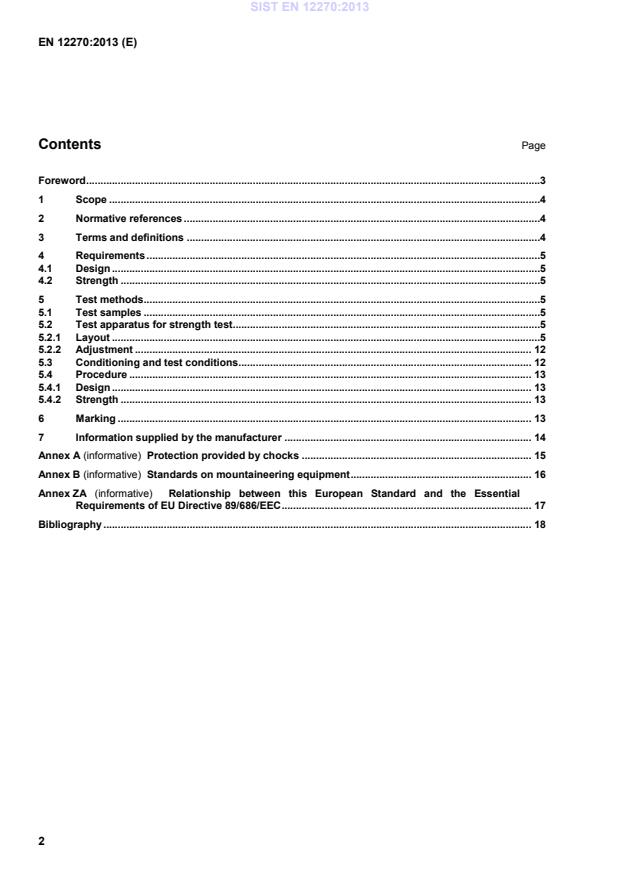
Protection provided by chocks . 15 Annex B (informative)
Standards on mountaineering equipment . 16 Annex ZA (informative)
Relationship between this European Standard and the Essential Requirements of EU Directive 89/686/EEC . 17 Bibliography . 18
The supporting jaws shall not rotate during the test. When testing chocks fitted with textile slings, the surface of the steel bar shall have an arithmetical mean deviation of the profile of Ra = 0,8 Rmax = 6,3 surface roughness requirements when testing chocks with a means of attachment made of other than textile material. For chocks with a horizontal non-parallel cross-section according to Figure 3, the supporting jaws shall have a groove adapted to the cross-section of the chock. SIST EN 12270:2013
...