

kSIST FprEN 1993-1-10:2024
(Main)Eurocode 3: Design of steel structures - Part 1-10: Material toughness and through-thickness properties
General Information
- Abstract
1.1 Scope of EN 1993-1-10
(1) EN 1993-1-10 specifies rules for the selection of steel grades and qualities related to fracture toughness to avoid brittle fracture.
NOTE Steel quality is also known as (Charpy) subgrade.
(2) EN 1993-1-10 specifies rules to specify through thickness properties for welded elements to reduce the risk of lamellar tearing.
(3) EN 1993-1-10 specifies additional toughness requirements for specific cases to ensure upper shelf toughness in relation to design ultimate resistance in tension and seismic design.
(4) EN 1993-1-10 specifies rules for structural steels as listed in EN 1993-1-1. This document applies to steel grades S235 to S700.
(5) EN 1993-1-10 specifies rules that apply to the selection of parent material only.
(6) EN 1993-1-10 specifies rules that apply to steel materials covered by EN 1993-1-1:2022, 5.1(3), provided that each individual piece of steel is tested in accordance with the requirements of EN 1993 1 1:2022, 5.2.1 and EN 1090-2:2018+A1:2024, 5.1.
(7) This document does not apply to material salvaged from existing steelwork subjected to fatigue or fire.
1.2 Assumptions
(1) Unless specifically stated, EN 1990, EN 1991 (all parts) and the other relevant parts of EN 1993-1 (all parts) apply.
(2) The design methods given in EN 1993-1-10 are applicable if:
- the execution quality is as specified in EN 1090-2 or EN 1090-4, and
- the construction materials and products used are as specified in the relevant parts of EN 1993 (all parts), or in the relevant material and product specifications.
- Status
- Not Published
- Public Enquiry End Date
- 07-Jun-2023
- Technical Committee
- KON - Structures
- Current Stage
- 5020 - Formal vote (FV) (Adopted Project)
- Start Date
- 11-Nov-2024
- Due Date
- 30-Dec-2024
- Completion Date
- 01-Aug-2025

Overview
EN 1993-1-10:2025 - part of Eurocode 3 - sets out rules for selecting steel grades and specifying through-thickness properties to control material toughness and reduce the risk of brittle fracture and lamellar tearing in welded steel structures. The standard applies to structural steels S235 to S700, addresses parent material selection only, and is intended to be used alongside EN 1990, EN 1991 and other EN 1993 parts.
Key topics and requirements
- Selection of steel grades for fracture toughness
- Rules to avoid brittle fracture by specifying minimum toughness qualities (Charpy subgrades).
- Reference to the Charpy V‑notch test (KV-value) as a measure of impact energy at a given test temperature.
- Through‑thickness properties for welded elements
- Procedures to specify through‑thickness (thickness-direction) properties to reduce lamellar tearing risk in welded components.
- Additional toughness requirements
- Special requirements to ensure upper‑shelf toughness related to design ultimate tensile resistance and seismic design cases.
- Scope limits
- Applies only to parent material (not to salvaged steels previously exposed to fatigue or fire).
- Applies where execution quality meets EN 1090-2 or EN 1090-4 and materials/products conform to relevant EN 1993 provisions.
- Testing and conformity
- Applies when individual pieces of steel are tested in accordance with EN 1993-1-1 and EN 1090-2 requirements.
- National choices
- The standard allows Nationally Determined Parameters (NDPs) and National Annexes where specified.
Practical applications
Who uses EN 1993-1-10:
- Structural engineers and steelwork designers specifying steels for buildings, bridges and civil engineering works.
- Fabricators and welding engineers defining material acceptance criteria for welded assemblies.
- Specification writers and procurement teams selecting steel grades and Charpy subgrades.
- Authorities, certifiers and software developers implementing Eurocode-based design checks.
How it’s used in practice:
- Selecting appropriate steel grade (S235–S700) and minimum Charpy KV values for project temperature and loading conditions.
- Specifying through-thickness testing or material classes for welded gusset plates, heavy sections and critical welded zones to avoid lamellar tearing.
- Applying extra toughness rules for high‑demand tension components and seismic-resistant designs.
Related standards
- EN 1990 - Basis of structural design
- EN 1991 (all parts) - Actions on structures
- EN 1993-1-1 - General rules for steel design
- EN 1090-2 / EN 1090-4 - Execution requirements for steel structures
Keywords: EN 1993-1-10, Eurocode 3, material toughness, fracture toughness, through-thickness properties, lamellar tearing, Charpy KV, steel grades S235–S700.
Relations
- Effective Date
- 12-Mar-2025
- Effective Date
- 17-Sep-2026
- Effective Date
- 25-Mar-2026
- Refers
kSIST FprEN 1993-1-11:2025 - Eurocode 3 - Design of steel structures - Part 1-11: Tension components - Effective Date
- 25-Mar-2026
- Refers
kSIST FprEN 1991-1-6:2025 - Eurocode 1 - Actions on structures - Part 1-6: Actions during execution - Effective Date
- 25-Mar-2026
- Effective Date
- 25-Mar-2026
- Effective Date
- 25-Mar-2026
- Effective Date
- 25-Mar-2026
- Effective Date
- 25-Mar-2026
- Effective Date
- 25-Mar-2026
- Effective Date
- 25-Mar-2026
- Effective Date
- 25-Mar-2026
- Effective Date
- 25-Mar-2026
- Effective Date
- 28-Jan-2026
- Effective Date
- 28-Jan-2026
Get Certified
Connect with accredited certification bodies for this standard

DIBt (Deutsches Institut für Bautechnik)
German Institute for Building Technology.
DIN CERTCO
DIN Group product certification.

Aboma Certification B.V.
Specialized in construction, metal, and transport sectors.
Sponsored listings
Frequently Asked Questions
kSIST FprEN 1993-1-10:2024 is a draft published by the Slovenian Institute for Standardization (SIST). Its full title is "Eurocode 3: Design of steel structures - Part 1-10: Material toughness and through-thickness properties". This standard covers: 1.1 Scope of EN 1993-1-10 (1) EN 1993-1-10 specifies rules for the selection of steel grades and qualities related to fracture toughness to avoid brittle fracture. NOTE Steel quality is also known as (Charpy) subgrade. (2) EN 1993-1-10 specifies rules to specify through thickness properties for welded elements to reduce the risk of lamellar tearing. (3) EN 1993-1-10 specifies additional toughness requirements for specific cases to ensure upper shelf toughness in relation to design ultimate resistance in tension and seismic design. (4) EN 1993-1-10 specifies rules for structural steels as listed in EN 1993-1-1. This document applies to steel grades S235 to S700. (5) EN 1993-1-10 specifies rules that apply to the selection of parent material only. (6) EN 1993-1-10 specifies rules that apply to steel materials covered by EN 1993-1-1:2022, 5.1(3), provided that each individual piece of steel is tested in accordance with the requirements of EN 1993 1 1:2022, 5.2.1 and EN 1090-2:2018+A1:2024, 5.1. (7) This document does not apply to material salvaged from existing steelwork subjected to fatigue or fire. 1.2 Assumptions (1) Unless specifically stated, EN 1990, EN 1991 (all parts) and the other relevant parts of EN 1993-1 (all parts) apply. (2) The design methods given in EN 1993-1-10 are applicable if: - the execution quality is as specified in EN 1090-2 or EN 1090-4, and - the construction materials and products used are as specified in the relevant parts of EN 1993 (all parts), or in the relevant material and product specifications.
1.1 Scope of EN 1993-1-10 (1) EN 1993-1-10 specifies rules for the selection of steel grades and qualities related to fracture toughness to avoid brittle fracture. NOTE Steel quality is also known as (Charpy) subgrade. (2) EN 1993-1-10 specifies rules to specify through thickness properties for welded elements to reduce the risk of lamellar tearing. (3) EN 1993-1-10 specifies additional toughness requirements for specific cases to ensure upper shelf toughness in relation to design ultimate resistance in tension and seismic design. (4) EN 1993-1-10 specifies rules for structural steels as listed in EN 1993-1-1. This document applies to steel grades S235 to S700. (5) EN 1993-1-10 specifies rules that apply to the selection of parent material only. (6) EN 1993-1-10 specifies rules that apply to steel materials covered by EN 1993-1-1:2022, 5.1(3), provided that each individual piece of steel is tested in accordance with the requirements of EN 1993 1 1:2022, 5.2.1 and EN 1090-2:2018+A1:2024, 5.1. (7) This document does not apply to material salvaged from existing steelwork subjected to fatigue or fire. 1.2 Assumptions (1) Unless specifically stated, EN 1990, EN 1991 (all parts) and the other relevant parts of EN 1993-1 (all parts) apply. (2) The design methods given in EN 1993-1-10 are applicable if: - the execution quality is as specified in EN 1090-2 or EN 1090-4, and - the construction materials and products used are as specified in the relevant parts of EN 1993 (all parts), or in the relevant material and product specifications.
kSIST FprEN 1993-1-10:2024 is classified under the following ICS (International Classification for Standards) categories: 91.010.30 - Technical aspects; 91.080.13 - Steel structures. The ICS classification helps identify the subject area and facilitates finding related standards.
kSIST FprEN 1993-1-10:2024 has the following relationships with other standards: It is inter standard links to SIST EN 1993-1-10:2005/AC:2006, kSIST FprEN 1993-7:2026, kSIST FprEN 1993-2:2025, kSIST FprEN 1993-1-11:2025, kSIST FprEN 1991-1-6:2025, kSIST FprEN 1993-4-2:2025, kSIST FprEN 1991-1-4:2025, kSIST FprEN 1993-6:2025, kSIST FprEN 1991-1-8:2025, kSIST FprEN 1993-3:2025, kSIST FprEN 1991-4:2025, kSIST FprEN 1993-4-1:2025, kSIST FprEN 1991-3:2025, kSIST FprEN 1991-1-9:2024, SIST EN 1993-4-1:2007/A1:2017. Understanding these relationships helps ensure you are using the most current and applicable version of the standard.
kSIST FprEN 1993-1-10:2024 is associated with the following European legislation: EU Directives/Regulations: 305/2011; Standardization Mandates: M/515. When a standard is cited in the Official Journal of the European Union, products manufactured in conformity with it benefit from a presumption of conformity with the essential requirements of the corresponding EU directive or regulation.
kSIST FprEN 1993-1-10:2024 is available in PDF format for immediate download after purchase. The document can be added to your cart and obtained through the secure checkout process. Digital delivery ensures instant access to the complete standard document.
Standards Content (Sample)
SLOVENSKI STANDARD
oSIST prEN 1993-1-10:2023
01-maj-2023
Evrokod 3: Projektiranje jeklenih konstrukcij - 1-10. del: Izbira kakovosti jekla
glede na žilavost in lamelarni lom
Eurocode 3: Design of steel structures - Part 1-10: Material toughness and through-
thickness properties
Eurocode 3: Bemessung und Konstruktion von Stahlbauten - Teil 1-10:
Stahlsortenauswahl im Hinblick auf Bruchzähigkeit und Eigenschaften in Dickenrichtung
Eurocode 3 - Calcul des structures en acier - Partie 1-10 : Ténacité du matériau et
propriétés dans le sens de l'épaisseur
Ta slovenski standard je istoveten z: prEN 1993-1-10
ICS:
91.010.30 Tehnični vidiki Technical aspects
91.080.13 Jeklene konstrukcije Steel structures
oSIST prEN 1993-1-10:2023 en,fr,de
2003-01.Slovenski inštitut za standardizacijo. Razmnoževanje celote ali delov tega standarda ni dovoljeno.
oSIST prEN 1993-1-10:2023
oSIST prEN 1993-1-10:2023
DRAFT
EUROPEAN STANDARD
prEN 1993-1-10
NORME EUROPÉENNE
EUROPÄISCHE NORM
March 2023
ICS Will supersede EN 1993-1-10:2005
English Version
Eurocode 3: Design of steel structures - Part 1-10: Material
toughness and through-thickness properties
Eurocode 3 - Calcul des structures en acier - Partie 1- Eurocode 3: Bemessung und Konstruktion von
10 : Choix des qualités d'acier Stahlbauten - Teil 1-10: Stahlsortenauswahl im
Hinblick auf Bruchzähigkeit und Eigenschaften in
Dickenrichtung
This draft European Standard is submitted to CEN members for enquiry. It has been drawn up by the Technical Committee
CEN/TC 250.
If this draft becomes a European Standard, CEN members are bound to comply with the CEN/CENELEC Internal Regulations
which stipulate the conditions for giving this European Standard the status of a national standard without any alteration.
This draft European Standard was established by CEN in three official versions (English, French, German). A version in any other
language made by translation under the responsibility of a CEN member into its own language and notified to the CEN-CENELEC
Management Centre has the same status as the official versions.
CEN members are the national standards bodies of Austria, Belgium, Bulgaria, Croatia, Cyprus, Czech Republic, Denmark, Estonia,
Finland, France, Germany, Greece, Hungary, Iceland, Ireland, Italy, Latvia, Lithuania, Luxembourg, Malta, Netherlands, Norway,
Poland, Portugal, Republic of North Macedonia, Romania, Serbia, Slovakia, Slovenia, Spain, Sweden, Switzerland, Türkiye and
United Kingdom.
Recipients of this draft are invited to submit, with their comments, notification of any relevant patent rights of which they are
aware and to provide supporting documentation.
Warning : This document is not a European Standard. It is distributed for review and comments. It is subject to change without
notice and shall not be referred to as a European Standard.
EUROPEAN COMMITTEE FOR STANDARDIZATION
COMITÉ EUROPÉEN DE NORMALISATION
EUROPÄISCHES KOMITEE FÜR NORMUNG
CEN-CENELEC Management Centre: Rue de la Science 23, B-1040 Brussels
© 2023 CEN All rights of exploitation in any form and by any means reserved Ref. No. prEN 1993-1-10:2023 E
worldwide for CEN national Members.
oSIST prEN 1993-1-10:2023
prEN 1993-1-10:2022 (E)
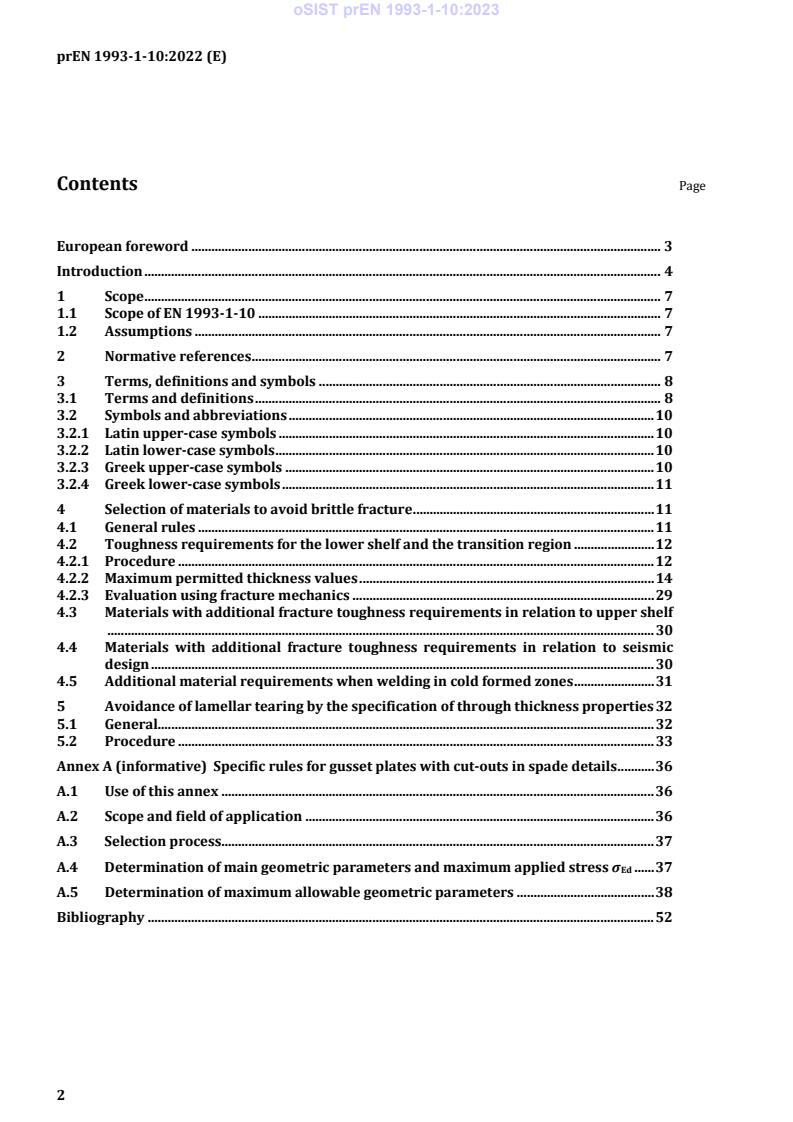
Contents Page
European foreword . 3
Introduction . 4
1 Scope . 7
1.1 Scope of EN 1993-1-10 . 7
1.2 Assumptions . 7
2 Normative references . 7
3 Terms, definitions and symbols . 8
3.1 Terms and definitions . 8
3.2 Symbols and abbreviations . 10
3.2.1 Latin upper-case symbols . 10
3.2.2 Latin lower-case symbols . 10
3.2.3 Greek upper-case symbols . 10
3.2.4 Greek lower-case symbols . 11
4 Selection of materials to avoid brittle fracture . 11
4.1 General rules . 11
4.2 Toughness requirements for the lower shelf and the transition region . 12
4.2.1 Procedure . 12
4.2.2 Maximum permitted thickness values . 14
4.2.3 Evaluation using fracture mechanics . 29
4.3 Materials with additional fracture toughness requirements in relation to upper shelf
................................................................................................................................................................... 30
4.4 Materials with additional fracture toughness requirements in relation to seismic
design . 30
4.5 Additional material requirements when welding in cold formed zones . 31
5 Avoidance of lamellar tearing by the specification of through thickness properties 32
5.1 General. 32
5.2 Procedure . 33
Annex A (informative) Specific rules for gusset plates with cut-outs in spade details . 36
A.1 Use of this annex . 36
A.2 Scope and field of application . 36
A.3 Selection process. 37
A.4 Determination of main geometric parameters and maximum applied stress σ . 37
Ed
A.5 Determination of maximum allowable geometric parameters . 38
Bibliography . 52
oSIST prEN 1993-1-10:2023
prEN 1993-1-10:2022 (E)
European foreword
This document (prEN 1993-1-10:2022) has been prepared by Technical Committee CEN/TC 250
“Structural Codes”, the secretariat of which is held by BSI. CEN/TC 250 is responsible for all Structural
Eurocodes and has been assigned responsibility for structural and geotechnical design matters by CEN.
This document is currently submitted to the CEN Enquiry.
This document will supersede EN 1993-1-10:2005 and EN 1993-1-10:2005/AC:2009.
The first generation of EN Eurocodes was published between 2002 and 2007. This document forms part
of the second generation of the Eurocodes, which have been prepared under Mandate M/515 issued to
CEN by the European Commission and the European Free Trade Association.
The Eurocodes have been drafted to be used in conjunction with relevant execution, material, product
and test standards, and to identify requirements for execution, materials, products and testing that are
relied upon by the Eurocodes.
The Eurocodes recognize the responsibility of each Member State and have safeguarded their right to
determine values related to regulatory safety matters at national level through the use of National
Annexes.
oSIST prEN 1993-1-10:2023
prEN 1993-1-10:2022 (E)
Introduction
0.1 Introduction to the Eurocodes
The Structural Eurocodes comprise the following standards generally consisting of a number of Parts:
— EN 1990 Eurocode: Basis of structural and geotechnical design
— EN 1991 Eurocode 1: Actions on structures
— EN 1992 Eurocode 2: Design of concrete structures
— EN 1993 Eurocode 3: Design of steel structures
— EN 1994 Eurocode 4: Design of composite steel and concrete structures
— EN 1995 Eurocode 5: Design of timber structures
— EN 1996 Eurocode 6: Design of masonry structures
— EN 1997 Eurocode 7: Geotechnical design
— EN 1998 Eurocode 8: Design of structures for earthquake resistance
— EN 1999 Eurocode 9: Design of aluminium structures
— New parts are under development, e.g. Eurocode for design of structural glass
The Eurocodes are intended for use by designers, clients, manufacturers, constructors, relevant
authorities (in exercising their duties in accordance with national or international regulations),
educators, software developers, and committees drafting standards for related product, testing and
execution standards.
NOTE Some aspects of design are most appropriately specified by relevant authorities or, where not specified,
can be agreed on a project-specific basis between relevant parties such as designers and clients. The Eurocodes
identify such aspects making explicit reference to relevant authorities and relevant parties.
0.2 Introduction to EN 1993
EN 1993 (all parts) applies to the design of buildings and civil engineering works in steel. It complies with
the principles and requirements for the safety and serviceability of structures, the basis of their design
and verification that are given in EN 1990 – Basis of structural and geotechnical design.
EN 1993 (all parts) is concerned only with requirements for resistance, serviceability, durability and fire
resistance of steel structures. Other requirements, e.g. concerning thermal or sound insulation, are not
covered.
EN 1993 is subdivided in various parts:
EN 1993-1, Design of Steel Structures — Part 1: General rules and rules for buildings;
EN 1993-2, Design of Steel Structures — Part 2: Steel bridges;
EN 1993-3, Design of Steel Structures — Part 3: Towers, masts and chimneys;
EN 1993-4, Design of Steel Structures — Part 4: Silos and tanks;
EN 1993-5, Design of Steel Structures — Part 5: Piling;
EN 1993-6, Design of Steel Structures — Part 6: Crane supporting structures;
oSIST prEN 1993-1-10:2023
prEN 1993-1-10:2022 (E)
EN 1993-7, Design of steel structures — Part 7: Design of sandwich panels.
EN 1993-1 in itself does not exist as a physical document, but comprises the following 14 separate parts,
the basic part being EN 1993-1-1:
EN 1993-1-1, Design of Steel Structures — Part 1-1: General rules and rules for buildings;
EN 1993-1-2, Design of Steel Structures — Part 1-2: Structural fire design;
EN 1993-1-3, Design of Steel Structures — Part 1-3: Cold-formed members and sheeting;
NOTE Cold-formed hollow sections supplied according to EN 10219 (all parts) are covered in EN 1993-1-1.
EN 1993-1-4, Design of Steel Structures — Part 1-4: Stainless steels;
EN 1993-1-5, Design of Steel Structures — Part 1-5: Plated structural elements;
EN 1993-1-6, Design of Steel Structures — Part 1-6: Strength and stability of shell structures;
EN 1993-1-7, Design of Steel Structures — Part 1-7: Strength and stability of planar plated structures
transversely loaded;
EN 1993-1-8, Design of Steel Structures — Part 1-8: Design of joints;
EN 1993-1-9, Design of Steel Structures — Part 1-9: Fatigue strength of steel structures;
EN 1993-1-10, Design of Steel Structures — Part 1-10: Selection of steel for fracture toughness and through-
thickness properties;
EN 1993-1-11, Design of Steel Structures — Part 1-11: Design of structures with tension components made
of steel;
EN 1993-1-12, Design of Steel Structures — Part 1-12: Additional rules for steel grades up to S960;
EN 1993-1-13, Design of Steel Structures — Part 1-13: Beams with large web openings;
EN 1993-1-14, Design of Steel Structures — Part 1-14: Design assisted by finite element analysis.
All parts numbered EN 1993-1-2 to EN 1993-1-14 treat general topics that are independent from the
structural type such as structural fire design, cold-formed members and sheeting, stainless steels, plated
structural elements, etc.
All parts numbered EN 1993-2 to EN 1993-7 treat topics relevant for a specific structural type such as
steel bridges, towers, masts and chimneys, silos and tanks, piling, crane supporting structures, etc.
EN 1993-2 to EN 1993-7 refer to the generic rules in EN 1993-1 and supplement, modify or supersede
them.
0.3 Introduction to EN 1993-1-10
EN 1993-1-10 gives general design rules for the selection of steel qualities to avoid brittle fracture by
specifying toughness properties and to avoid lamellar tearing by specifying through-thickness properties.
0.4 Verbal forms used in the Eurocodes
The verb “shall” expresses a requirement strictly to be followed and from which no deviation is permitted
in order to comply with the Eurocodes.
The verb “should” expresses a highly recommended choice or course of action. Subject to national
regulation and/or any relevant contractual provisions, alternative approaches could be used/adopted
where technically justified.
The verb “may” expresses a course of action permissible within the limits of the Eurocodes.
The verb “can” expresses possibility and capability; it is used for statements of fact and clarification of
concepts.
oSIST prEN 1993-1-10:2023
prEN 1993-1-10:2022 (E)
0.5 National annex for EN 1993-1-10
National choice is allowed in this standard where explicitly stated within notes. National choice includes
the selection of values for Nationally Determined Parameters (NDPs).
The national standard implementing EN 1993-1-10 can have a National annex containing all national
choices to be used for the design of buildings and civil engineering works to be constructed in the relevant
country.
When no national choice is given, the default choice given in this standard is to be used.
When no national choice is made and no default is given in this standard, the choice can be specified by a
relevant authority or, where not specified, agreed for a specific project by appropriate parties.
National choice is allowed in EN 1993-1-10 through notes to the following:
4.2.1 (4) 4.2.2.3 (1) 4.2.3 (5) 4.3 (3)
4.4 (3) 5.1 (2) A1 (1)
National choice is allowed in EN 1993-1-10 on the application of the following informative annexes:
Annex A
The National Annex can contain, directly or by reference, non-contradictory complementary information
for ease of implementation, provided it does not alter any provisions of the Eurocodes.
oSIST prEN 1993-1-10:2023
prEN 1993-1-10:2022 (E)
1 Scope
1.1 Scope of EN 1993-1-10
(1) EN 1993-1-10 provides rules for the selection of steel grades and qualities related to fracture
toughness to avoid brittle fracture.
NOTE Steel toughness quality is also known as subgrade.
(2) EN 1993-1-10 provides rules to specify through thickness properties for welded elements to
reduce the risk of lamellar tearing.
(3) EN 1993-1-10 contains additional toughness requirements for specific cases to ensure upper
shelf toughness in relation to design ultimate resistance in tension and seismic design.
(4) This document provides rules for structural steels as listed in FprEN 1993-1-1:2022. This
document applies to steel grades S235 to S700.
(5) This document provides rules that apply to the selection of parent material only.
(6) This document provides rules that apply to steel materials covered by FprEN 1993-1-1:2022, 5.1
(3), provided that each individual piece of steel is tested in accordance with the requirements of
FprEN 1993-1-1:2022, 5.1 (3), and EN 1090-2:2018, 5.1.
(7) This document does not apply to material salvaged from existing steelwork subjected to fatigue or
fire.
1.2 Assumptions
(1) Unless specifically stated, EN 1990, EN 1991 (all parts) and the other relevant parts of EN 1993-1
(all parts) apply.
(2) The design methods given in EN 1993-1-10 are applicable if:
— the execution quality is as specified in EN 1090-2 or EN 1090-4, and
— the construction materials and products used are as specified in the relevant parts of EN 1993 (all
parts), or in the relevant material and product specifications.
2 Normative references
The following documents are referred to in the text in such a way that some or all of their content
constitutes requirements of this document. For dated references, only the edition cited applies. For
undated references, the latest edition of the referenced document (including any amendments) applies.
NOTE See the Bibliography for a list of other documents cited that are not normative references, including
those referenced as recommendations (i.e. through ‘should’ clauses) and permissions (i.e. through ‘may’ clauses).
EN 1090-2, Execution of steel structures and aluminium structures - Part 2: Technical requirements for steel
structures
EN 1090-4, Execution of steel structures and aluminium structures - Part 4: Technical requirements for cold-
formed structural steel elements and cold-formed structures for roof, ceiling, floor and wall applications
EN 1990, Eurocode - Basis of structural design
EN 1991 (all parts), Eurocode 1 — Actions on structures
EN 1993 (all parts), Eurocode 3 — Design of steel structures
oSIST prEN 1993-1-10:2023
prEN 1993-1-10:2022 (E)
FprEN 1993-1-1:2022, Eurocode 3 —Design of steel structures — Part 1-1: General rules: General rules and
rules for buildings
3 Terms, definitions and symbols
3.1 Terms and definitions
For the purposes of this document, the following terms and definitions apply:
3.1.1
KV-value
Charpy V-notch value
impact energy in Joules [J] required to fracture a Charpy V-notch specimen at a given test temperature T
(i.e. T )
KV
3.1.2
transition region
region of the toughness-temperature diagram showing the relationship KV(T) in which the material
toughness decreases with the decrease in temperature and the failure mode changes from ductile to
brittle
Note 1 to entry See region 2 on Figure 3.1.
3.1.3
lower shelf region
region of the impact energy-temperature diagram in which the Charpy V-notch test specimen exhibits
cleavage (brittle) modes of failure, See region 1 on Figure 3.1
3.1.4
upper shelf region
region of the toughness-temperature diagram in which the Charpy V-notch test specimen exhibits ductile
modes of failure
Note 1 to entry: See region 3 on Figure 3.1
oSIST prEN 1993-1-10:2023
prEN 1993-1-10:2022 (E)
Key
1 lower shelf region
2 transition region
3 upper shelf region
NOTE Charpy transition temperature can also be T or T – corresponding to Charpy energy values of 30J
30J 40J
or 40J. For an explanation of T and T see the list of symbols.
27J US
Figure 3.1 — Example of relationship between temperature and Charpy V-notch impact energy
3.1.5
charpy transition temperature
minimum temperature in the transition region, at which the material behaviour changes from ductile to
brittle
3.1.6
Z-value
transverse reduction of area of a specimen in a tensile test in through-thickness direction (see EN
ISO 6892-1 and EN 10164) to indicate the through-thickness ductility of a specimen, measured as a
percentage
3.1.7
degree of cold forming
permanent strain from cold forming measured as a percentage
3.1.8
reference temperature
value of the lowest service steel temperature modified by temperature shifts to account for the crack
geometry, the construction detail, the reliability, the strain rates and cold forming as required
oSIST prEN 1993-1-10:2023
prEN 1993-1-10:2022 (E)
3.2 Symbols and abbreviations
3.2.1 Latin upper-case symbols
CTOD crack tip opening displacement
J elastic plastic fracture toughness value (J-integral value) in N/mm determined as a line or
surface integral that encloses the crack front from one crack surface to the other
3/2
K stress intensity factor in N/mm
3/2
K plane strain fracture toughness for linear elastic behaviour measured in N/mm
Ic
KV(T) impact energy in Joule [J] in a test at temperature T with Charpy V notch specimen
KV
KV impact energy in Joule [J] in a test at temperature T with Charpy V notch specimen
US US
T temperature [°C]
T reference temperature (see 4.2.1)
Ed
T transition temperature at which an energy KV should not be less than 27J according to the
27J
relevant product standard in a Charpy V-notch impact test
T transition temperature at which an energy KV should not be less than 30J according to the
30J
relevant product standard in a Charpy V-notch impact test
T transition temperature at which an energy KV should not be less than 40J according to the
40J
relevant product standard in a Charpy V-notch impact test
T impact test temperature for a minimum specified impact energy KV in Joule [J] in a Charpy V-
KV
notch test [°C]
T minimum steel temperature [°C] of a member in service with a return period of 50 years for
N,min
air temperature recommended depending on the type of structure and including a radiation
loss
T lowest temperature [°C] at which the shear fracture appearance is 100 % in a Charpy V-notch
US
impact test, taken as the starting point of upper shelf region (see 4.3)
Z Z-quality class [%] differentiated by increasing levels of Z-value (see 5.2)
Z required design Z-value resulting from the magnitude of strains from restrained metal
Ed
shrinkage under the weld beads
Z available design Z-value depending on through thickness properties of the material
Rd
3.2.2 Latin lower-case symbols
yield strength
f
y
nominal yield strength
f
y,nom
t thickness
t maximum permissible element thickness
max
3.2.3 Greek upper-case symbols
ΔT safety allowance [K], if required, to reflect different reliability levels for different
R
applications
ΔT temperature shift [K] considering a strain rate other than the reference strain rate ε
ε 0
oSIST prEN 1993-1-10:2023
prEN 1993-1-10:2022 (E)
temperature shift [K] considering the degree of cold forming ε or ε
cf eff
ΔT
ε
cf
ΔTσ temperature shift [K] considering stress and yield strength of material, crack imperfection
and member shape and dimensions, see 4.2.3 (3)
3.2.4 Greek lower-case symbols
ε degree of cold forming (DCF) in percent
cf
ε strain rate [1/s]
reference strain rate [1/s]
ε
ε effective strain is the average value of plastic strain in the net section
eff
ε plastic strain to be used for cold bends in hollow sections
pnom
σ stresses accompanying the reference temperature T
Ed Ed
4 Selection of materials to avoid brittle fracture
4.1 General rules
(1) To avoid brittle fracture, the selection of materials shall be in accordance with the general rules
given in EN 1990 and EN 1991 (all parts) and the specific design provisions for steel structures given in
the other relevant parts of EN 1993-1 (all parts).
(2) The execution shall be in accordance with the requirements in EN 1090-2 or EN 1090-4.
(3) The rules in Clause 4 are applicable to elements and details subject to tensile stresses obtained using
combination in Formula (4).1).
(4) The rules in Clause 4 may be applied for elements not subject to tension stresses because the rules
are conservative in this situation. For elements under compression stress a minimum toughness property
may be determined for a nominal stress of σ = 0,25 f (t).
Ed y
(5) Steel product standards specify that test specimens shall not fail at an impact energy lower than a
specified energy KV at a specific test temperature T .
KV
(6) The rules should be applied to the minimum impact energy KV for the specified grade listed in
the relevant steel product standard. New material of a less onerous quality (sub-grades) should not be
used even though test results show equivalent or better values of impact energy.
(7) The rules contained in 4.1 refer to lower shelf toughness and the transition region, see 4.2.
Additional rules for upper shelf toughness in relation to design ultimate resistance in tension and seismic
design are given in 4.3 and 4.4 respectively.
(8) The selection of a design procedure for brittle fracture assessment shall be made as shown in
Figure 4.1.
NOTE The selection is based on temperature (see Formula (4).2)), stress (see Formula (4).1)) and execution classes
as defined in FprEN 1993-1-1:2022, Annex A.
(9) For fatigue loaded elements in EXC 2, a reduction factor of 0,5 according to Table 4.5 should be
applied to the thickness values of Table 4.3.
(10) For welded elements in EXC 3 not covered by detailed tables related to nominal stress methods
in EN 1993-1-9, and which are statically loaded, 4.2.2.3 should be applied.
(11) For details subjected to neutron radiation embrittlement, e.g. structures of nuclear power plants,
their toughness should be determined using fracture mechanics according to 4.2.3.
oSIST prEN 1993-1-10:2023
prEN 1993-1-10:2022 (E)
NOTE Table 4.2 for EXC3 and EXC4 was developed mainly for fatigue loaded elements and Table 4.3 for EXC1
and EXC2 was developed mainly for static loaded elements.
Figure 4.1 — Flowchart of material selection procedures for brittle fracture assessment
4.2 Toughness requirements for the lower shelf and the transition region
4.2.1 Procedure
(1) The steel quality should be selected taking account of the following:
(i) steel material properties:
• yield strength depending on the material thickness fy(t)
• toughness quality expressed in terms of T T or T
27J, 30J 40J
(ii) member characteristics:
• member shape and detail
• stress concentrations according to the details geometry and loaded element thickness (t)
• appropriate assumptions for fabrication flaws (e.g. as through-depth cracks or as semi-
elliptical surface cracks)
oSIST prEN 1993-1-10:2023
prEN 1993-1-10:2022 (E)
(iii) design situations:
• design value of minimum steel temperature
• maximum applied stresses from permanent and variable actions derived from the design
condition described in (4) below
• residual stress
• assumptions for crack growth from fatigue loading during an inspection interval (if relevant)
• strain rate ε from accidental actions (if relevant)
• degree of cold forming (ε and ε ) (if relevant)
cf eff
(iv) Execution Class according to FprEN 1993-1-1:2022, Annex A.
(2) The maximum permissible thickness of steel elements for fracture should be obtained from Table 4.2
and Table 4.3.
(3) The following design condition should be used:
(i) The maximum nominal applied stress σ should be obtained according to the combination of
Ed
actions in Formula (4).1):
Ed = E { A[TEd] “+” ∑GK “+” ψ1 QK1 “+” ∑ψ2,i QKi } (4.1)
where:
A is the leading action represented by the reference temperature T that influences the toughness
Ed
of material of the member considered and might also lead to stress from restraint of movement,
∑G are the permanent actions,
K
ψ Q is the frequent value of the variable load and
1 K1
ψ Q are the quasi-permanent values of the accompanying variable loads, that govern the level
2i Ki
of stresses on the material.
(ii) The combination factors ψ and ψ should be in accordance with EN 1990.
1 2
(iii) The maximum applied stress σ should be the maximum nominal design tensile stress at the
Ed
location of the potential fracture initiation. The applied stress σ shall be determined by elastic
Ed
analyses. Second order effects should be considered where relevant.
NOTE 1 The combination in Formula (4).1) is considered to be equivalent to an accidental combination, because
of the assumption of simultaneous occurrence of lowest temperature, flaw size, location of flaw and material
property.
NOTE 2 σ can include stresses from restraint of movement from temperature change.
Ed
NOTE 3 As the leading action is the reference temperature T , the maximum applied stress σ generally will not
Ed Ed
exceed 75 % of the yield strength.
oSIST prEN 1993-1-10:2023
prEN 1993-1-10:2022 (E)
(4) The reference temperature T at the potential fracture location should be determined using
Ed
Formula (4).2):
T = T + Δ T + Δ T + ΔT + ΔT (4.2)
Ed N,min σ R
ε ε
cf
where
T is the minimum uniform steel temperature with a specified return period for external
N,min
components; see EN 1991-1-5. For the extreme value of the minimum air temperature a return
period of 50 years should be applied depending on the type of structure.
ΔT
The method employed to calculate the temperature shift due to cold forming is based on non-fine
ε
cf
grain steels and is conservative for fine grain steels. If available, other appropriate rules may be used to
consider cold forming effects.
NOTE 1 A maximum value for the difference of 40 K is (TKV ≤ TN,min + 40 K). The National annex can give the
maximum value by which the minimum steel temperature of the steel T can be below the impact test
N,min
temperature T .
KV
ΔT is the adjustment for stress and yield strength of material, crack imperfection and member shape
σ
and dimensions,
NOTE 2 ΔTσ is equal to 0 K for the calculation of TEd according to Formula (4).2), when determining the maximum
permitted thickness values according to 4.2.2.2. This is because in preparing the tabulated values in 4.2.2 a standard
curve has been used for the temperature shift ΔT that envelopes the design values of the stress intensity factor
σ
function K from applied stresses σEd and residual stresses and includes the Wallin-Sanz-correlation between the
stress intensity factor function [K] and the temperature T.
NOTE 3 The National annex can limit the range of σ to which the validity of values for permissible thicknesses
Ed,
in Table 4.2 and Table 4.3 can be restricted.
ΔT is a safety allowance, if required, to reflect different reliability levels for different applications
R
NOTE 4 When using the tabulated values according to 4.2.2 the safety element ΔTR is equal to 0 K unless the
National annex gives a different value to adjust T to other reliability requirements. When using material values
Ed
obtained from testing, the safety element ΔT is equal to −38 K unless the National annex gives a different value.
R
ΔT is the adjustment for a strain rate other than the reference strain rate ε , see Formula (4).5)
ε 0
ΔT is the adjustment for the degree of cold forming ε , see Formula (4).6)
cf
ε
cf
NOTE 5 Alternative methods can be used to determine the toughness requirements. Further information is given
in 4.2.3.
4.2.2 Maximum permitted thickness values
4.2.2.1 General
(1) For Execution Class 3 and 4 the maximum permissible thickness may be selected from Table 4.2. For
Execution Class 1 and 2 the maximum permissible thickness may be selected from Table 4.3 or Table 4.2
if appropriate. The Execution Class may be determined according to FprEN 1993-1-1:2022, Table A1.
NOTE 1 The procedure as illustrated in the flow chart shown in Figure 4.1 applies.
NOTE 2 Table 4.2 and Table 4.3 give the maximum permissible element thickness tmax appropriate to a steel grade,
its toughness quality in terms of KV-value, the applied stress level [σEd] and the reference temperature [TEd].
oSIST prEN 1993-1-10:2023
prEN 1993-1-10:2022 (E)
NOTE 3 The values in Tables 4.2 and 4.3 are based on the following assumptions:
• The values satisfy the reliability requirements of EN 1990;
−4
• A strain rate ε = 4×10 /s has been used which covers the dynamic action effects for most transient and
persistent design situations;
• Non-cold-formed material with ε = 0 %;
cf
• The nominal notch toughness values in terms of T27J are based on the following product standards:
EN 10025 (all parts), EN 10210-1, EN 10210-2, EN 10219-1, EN 10219-2 and EN 10149-2. For other values the
following correlations have been used
TT= +°10 C
[ ]
40J 27J
(4.3)
TT= +°0 C
[ ]
30J 27J
(4.4)
NOTE 4 For members subject to fatigue all detail categories for nominal stresses in EN 1993-1-9 are covered.
NOTE 5 For structures with predominate static loading, a simplified method to account for complex geometries is
given in 4.2.2.3.
In determining Table 4.2, fatigue has been considered by applying a fatigue load to a detail with an
assumed initial flaw. The damage assumed in these members is one quarter of the full fatigue damage
obtained from nominal stress approach according to EN 1993-1-9. This assumption permits a minimum
number of periods between in-service inspections when inspections should be specified for damage
tolerance according to EN 1993-1-9. An inspection at the end-of-life is only required for life extension.
Fatigue loaded members designed according to EN 1993-1-9 using the safe life concept as well as
statically loaded members according to Table 4.3 do not require any in-service inspection in relation to
brittle fracture, provided they are executed according to the requirements of EN 1090-2.
−4
(2) For high strain rates > 4 × 10 /s (e.g. for impact loads) the tabulated values in Table 4.2 and
ε
by given by Formula (4).5):
Table 4.3 may be used by reducing TEd ΔT
ε
1,5
1 440− ft
()
ε
y
ΔTK= − × ln
[ ]
ε ˙
ε
(4.5)
with
−4
ε =10 / s as the reference strain rate.
(3) To allow for cold forming of non-ageing steels, the tabulated values in Table 4.2 and Table 4.3 may
be used by adjusting T by adding ΔT given by Formula (4).6):
Ed
ε
cf
ΔTK=−3×ε
[ ]
ε cf
cf
(4.6)
with 0 K ≥ ΔT ≥ −45 K
ε
cf
where ε is the value of the plastic strain due to cold forming.
cf
oSIST prEN 1993-1-10:2023
prEN 1993-1-10:2022 (E)
(4) For circular cold-formed hollow sections according to EN 10219-1 and EN 10219-2 and other
cold-formed sections to EN 1993-1-3, the adjustment in Formula (4).7) may be used due to cold forming
effects:
ΔT
=-3 εeff [K] for εeff > 2 % (4.7)
ε
cf
where ε is the average value of plastic strain in the net section.
eff
NOTE 1 The value of εeff depends on the wall thickness and the inner radius ri.
NOTE 2 Table 4.1 gives the relationship between the radius of the cold bend and the maximum value of plastic strain
as well the value ε for different wall thickness t.
εpnom eff
oSIST prEN 1993-1-10:2023
prEN 1993-1-10:2022 (E)
Table 4.1 — Definition of ε and ε for radius r of cold bend
pnom eff i
t
ε =
pnom
2rt+
i
Determination of effective strain ε
eff
t ε distribution ε
pnom eff
ε 1−
pnom
t
≥ 20
ε
20− t
t ( )
pnom
+
2 20 20t
< 20
≥ 10
ε
t
pnom
2 10
< 10
(5) For r /t > 15 cold forming effects due to production may be neglected. For r /t ≤ 15, the maximum
i i
value for ΔT may be taken as ΔT = −20 K.
ε ε
cf cf
NOTE For rectangular hollow sections delivered according to EN 10219, the adjustment ΔT reads:
ε
cf
ΔT = −35 [K] for t ≤ 16 mm
ε
cf
oSIST prEN 1993-1-10:2023
prEN 1993-1-10:2022 (E)
ΔT = −45 [K] for t > 16 mm
ε
cf
unless otherwise determined by tests.
4.2.2.2 Determination of maximum permissible values of element thickness
(1) For Execution Class 3 and 4 the maximum permissible thickness may be selected from Table 4.2. For
Execution Class 1 and 2 the maximum permissible thickness may be selected from Table 4.3 or Table 4.2
if appropriate. The Execution Class may be determined according to FprEN 1993-1-1:2022, Table A1.
(2) The thicknesses are presented in terms of three stress levels expressed as proportions of the nominal
yield strength:
a) σ = 0,75 f (t) [N/mm ]
Ed y
b) σ = 0,50 f (t) [N/mm ]
Ed y
c) σ = 0,25 f (t) [N/mm ]
Ed y
(3) The value of the nominal yield strength f (t) may be determined either from Formula (4).8) or may be
y
taken as R -values from the relevant product standards.
eH
t
ft f − 0,25 N / mm
()
y y,nom
t
(4.8)
where
t is the thickness of the plate in mm
t = 1 mm
NOTE The tabulated values are given in terms of a choice of seven reference temperatures: +10, 0, −10, −20,
−30, −40, −50, −80 and −120°C.
(4) Any extrapolations beyond the extreme values of the stresses indicated in Table 4.2 and Table 4.3
should not be done.
=
oSIST prEN 1993-1-10:2023
prEN 1993-1-10:2022 (E)
Table 4.2 — Maximum permissible values of element thickness t in mm for Execution Classes EXC3 and EXC4
KV Reference Temperature T [°C]
Ed
Steel
Qualit - - -
grad 10 0 -10 -20 -30 -40 -50 -80 10 0 -10 -20 -30 -40 -50 -80 10 0 -10 -20 -30 -40 -50 -80
y 120 120 120
T [°C] Jmin
e
σEd = 0,75·fy(t) σEd = 0,5·fy(t) σEd = 0,25·fy(t)
JR 20 27 60 50 40 35 30 25 20 10 5 90 75 65 55 45 40 35 20 15 135 115 100 85 75 65 60 40 30
S235 J0 0 27 90 75 60 50 40 35 30 15 10 125 105 90 75 65 55 45 30 15 175 155 135 115 100 85 75 50 35
J2 −20 27 125 105 90 75 60 50 40 25 10 170 145 125 105 90 75 65 40 20 200 200 175 155 135 115 100 65 40
JR 20 27 55 45 35 30 25 20 15 10 5 80 70 55 50 40 35 30 20 10 125 110 95 80 70 60 55 40 25
J0 0 27 75 65 55 45 35 30 25 15 5 115 95 80 70 55 50 40 25 15 165 145 125 110 95 80 70 45 30
J2 −20 27 110 95 75 65 55 45 35 20 10 155 130 115 95 80 70 55 35 20 200 190 165 145 125 110 95 60 40
S275
K2,M, 25 10
−20 40 135 110 95 75 65 55 45 180 155 130 115 95 80 70 200 200 190 165 145 125 110
N 40 20 70 40
ML,NL −50 27 185 160 135 110 95 75 65 35 15 200 200 180 155 130 115 95 55 30 200 200 200 200 190 165 145 95 55
JR 20 27 40 35 25 20 15 15 10 5 5 65 55 45 40 30 25 25 15 10 110 95 80 70 60 55 45 30 20
J0 0 27 60 50 40 35 25 20 15 10 5 95 80 65 55 45 40 30 20 10 150 130 110 95 80 70 60 40 25
J2 −20 27 90 75 60 50 40 35 25 15 5 135 110 95 80 65 55 45 25 15 200 175 150 130 110 95 80 55 30
J4 −40 27 130 110 90 75 60 50 40 20 10 180 155 135 110 95 80 65 40 20 200 200 195 170 150 130 110 70 40
S355
K2,M, 20 5
−20 40 110 90 75 60 50 40 35 155 135 110 95 80 65 55 30 15 200 200 175 150 130 110 95 60 35
N
J5,ML, 25 10
−50 27 155 130 110 90 75 60 50 200 180 155 135 110 95 80 45 25 210 200 200 200 175 150 130 80 45
NL
JR 20 27 35 30 20 20 15 10 10 5 - 60 50 40 35 25 20 20 10 5 100 85 75 65 55 45 40 30 20
J0 0 27 55 45 35 30 20 20 15 5 - 85 70 60 50 40 35 25 15 10 140 120 100 85 75 65 55 35 20
S420
J2 −20 27 80 65 55 45 35 30 20 10 5 120 100 85 70 60 50 40 20 10 185 160 140 120 100 85 75 45 30
J4 −40 27 115 95 80 65 55 45 35 20 5 165 140 120 100 85 70 60 35 15 200 200 185 160 140 120 100 65 35
oSIST prEN 1993-1-10:2023
prEN 1993-1-10:2022 (E)
K2,M, 15 5
−20 40 95 80 65 55 45 35 30 140 120 100 85 70 60 50 25 15 200 185 160 140 120 100 85 55 30
N
J5,ML, 20 10
−50 27 135 115 95 80 65 55 45 190 165 140 120 100 85 70 40 20 200 200 200 185 160 140 120 75 40
NL
JR 20 27 30 25 20 15 10 10 5 5 - 55 45 35 30 25 20 15 10 5 95 80 70 60 50 45 40 25 15
J0 0 27 50 40 30 25 20 15 10 5 - 80 65 55 45 35 30 25 15 5 130 115 95 80 70 60 50 35 20
J2 −20 27 75 60 50 40 30 25 20 10 5 110 95 80 65 55 45 35 20 10 175 150 130 115 95 80 70 45 25
J4 −40 27 105 90 75 60 50 40 30 15 5 155 130 110 95 80 65 55 30 15 200 200 175 150 130 115 95 60 35
K2,M, 90 75 60 50 40 30 25 10 5 130 110 95 80 65 55 45 25 10 200 175 150 130 115 95 80 50 30
−20 40
S460
N
J5,ML, 125 105 90 75 60 50 40 20 5 180 155 130 110 95 80 65 35 15 200 200 200 175 150 130 115 70 40
−50 27
NL
Q −20 30 75 60 50 40 30 25 20 10 5 110 95 80 65 55 45 35 20 10 175 150 130 115 95 80 70 45 25
QL −40 30 105 90 75 60 50 40 30 15 5 155 130 110 95 80 65 55 30 15 200 200 175 150 130 115 95 60 35
QL1 −60 30 150 125 105 90 75 60 50 25 10 200 180 155 130 110 95 80 45 20 200 200 200 200 175 150 130 80 45
J0 0 27 45 35 30 20 20 15 10 5 - 70 60 50 40 35 25 20 10 5 125 105 90 80 65 55 50 30 20
K2,M,
−20 40
N 80 65 55 45 35 30 20 10 5 125 105 85 70 60 50 40 20 10 195 170 145 125 105 90 80 50 25
ML,NL −50 27 120 100 80 65 55 45 35 20 5 170 145 125 105 85 70 60 35 15 250 220 195 170 145 125 105 65 35
Q 0 40 55 45 35 30 20 20 15 5 - 85 70 60 50 40 35 25 15 5 145 125 105 90 80 65 55 35 20
S500
Q −20 30 65 55 45 35 30 20 20 10 5 105 85 70 60 50 40 35 20 10 170 145 125 105 90 80 65 40 25
QL −20 40 80 65 55 45 35 30 20 10 5 125 105 85 70 60 50 40 20 10 195 170 145 125 105 90 80 50 25
QL −40 30 100 80 65 55 45 35 30 15 5 145 125 105 85 70 60 50 25 10 220 195 170 145 125 105 90 55 30
QL1 −40 40 120 100 80 65 55 45 35 20 5 170 145 125 105 85 70 60 35 15 250 220 195 170 145 125 105 65 35
QL1 −60 30 140 120 100 80 65 55 45 20 10 195 170 145 125 105 85 70 40 20 250 250 220 195 170 145 125 80 40
oSIST prEN 1993-1-10:2023
prEN 1993-1-10:2022 (E)
KV Reference Temperature TEd [°C]
Steel
Qualit - - -
grad 10 0 -10 -20 -30 -40 -50 -80 10 0 -10 -20 -30 -40 -50 -80 10 0 -10 -20 -30 -40 -50 -80
y 120 120 120
T [°C] Jmin
e
σEd = 0,75·fy(t) σEd = 0,5·fy(t) σEd = 0,25·fy(t)
MC −20 40 75 60 50 40 30 25 20 10 5 115 95 80 65 55 45 35 20 10 185 160 140 120 100 85 75 45 25
Q 0 40 50 40 30 25 20 15 10 5 - 80 65 55 45 35 30 25 15 5 140 120 100 85 75 60 55 35 20
Q −20 30 60 50 40 30 25 20 15 5 - 95 80 65 55 45 35 30 15 5 160 140 120 100 85 75 60 40 20
S550 QL −20 40 75 60 50 40 30 25 20 10 5 115 95 80 65 55 45 35 20 10 185 160 140 120 100 85 75 45 25
QL −40 30 90 75 60 50 40 30 25 10 5 135 115 95 80 65 55 45 25 10 210 185 160 140 120 100 85 55 30
QL1 −40 40 110 90 75 60 50 40 30 15 5 160 135 115 95 80 65 55 30 15 240 210 185 160 140 120 100 60 35
QL1 −60 30 130 110 90 75 60 50 40 20 5 185 160 135 115 95 80 65 35 15 250 240 210 185 160 140 120 75 40
S600 MC −20 40 70 55 45 35 30 20 15 5 - 105 90 75 60 50 40 35 20 5 175 155 130 110 95 80 70 40 20
Q 0 40 45 35 25 20 15 15 10 5 - 70 60 50 40 30 25 20 10 5 130 110 95 80 65 55 50 30 15
Q −20 30 55 45 35 25 20 15 15 5 - 85 70 60 50 40 30 25 15 5 150 130 110 95 80 65 55 35 20
QL −20 40 65 55 45 35 25 20 15 5 - 105 85 70 60 50 40 30 15 5 175 150 130 110 95 80 65 40 20
S620
QL −40 30 80 65 55 45 35 25 20 10 5 125 105 85 70 60 50 40 20 10 200 175 150 130 110 95 80 50 25
QL1 −40 40 100 80 65 55 45 35 25 15 5 145 125 105 85 70 60 50 25 10 230 200 175 150 130 110 95 55 30
QL1 −60 30 120 100 80 65 55 45 35 15 5 170 145 125 105 85 70 60 30 15 250 230 200 175 150 130 110 65 35
oSIST prEN 1993-1-10:2023
prEN 1993-1-10:2022 (E)
KV Reference Temperature TEd [°C]
Steel
Qualit - - -
grad 10 0 -10
...