

SIST EN 14278-3:2004
(Main)Textiles - Determination of cotton fibre stickiness - Part 3: Method using an automatic thermodetection rotating drum device
- Abstract
This European Standard describes an automatic technique to simulate the tendency of "contaminated" cotton fibres to stick to working surfaces of textile machines (e.g. card clothing, drafting rollers, crush rolls).
Test specimens can be raw cotton fibre (fibre sampled, e.g. from a bale), or opened fibre, slivers.
- Status
- Published
- Publication Date
- 30-Jun-2004
- Technical Committee
- ITEK - Textile and textile products
- Current Stage
- 6060 - National Implementation/Publication (Adopted Project)
- Start Date
- 01-Jul-2004
- Due Date
- 01-Jul-2004
- Completion Date
- 01-Jul-2004



SIST EN 14278-3:2004 is the Slovenian adoption of EN 14278-3:2004, published by SIST. It specifies an automatic thermodetection rotating drum method for estimating the stickiness potential of cotton fibres by simulating how contaminated fibres adhere to textile machine working surfaces. The method is intended for raw cotton fibre, opened fibre and slivers used in textile processing and testing.
What does SIST EN 14278-3:2004 specify?
SIST EN 14278-3:2004 covers an automatic technique for simulating the tendency of contaminated cotton fibres to stick to working surfaces such as card clothing, drafting rollers and crush rolls. The document applies to raw cotton fibre, opened fibre and slivers.
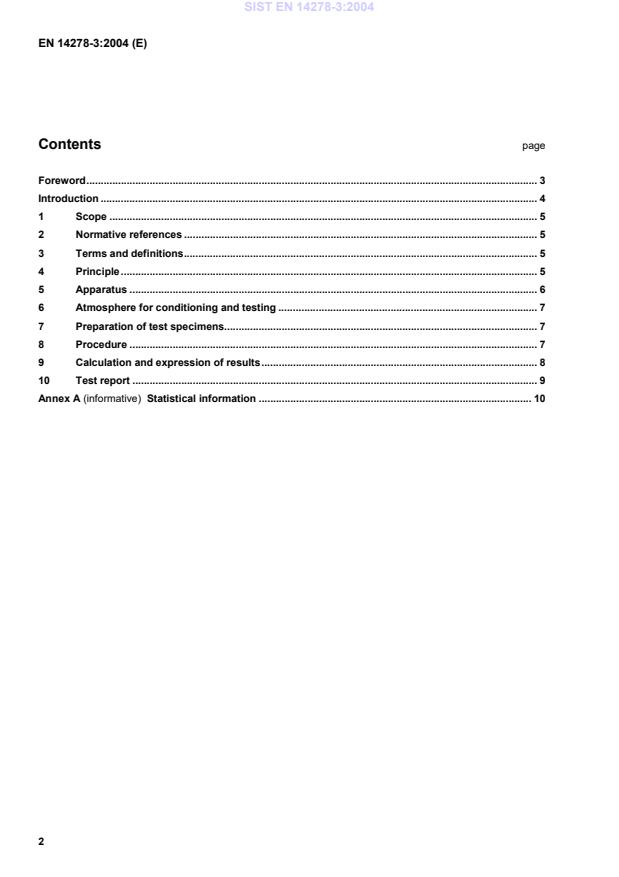
The standard is organized into 10 clauses plus informative Annex A. The clauses cover the scope, normative references, terms and definitions, principle, apparatus, conditioning atmosphere, specimen preparation, procedure, calculation and expression of results, and test report. Annex A adds statistical information that helps users interpret the counting data.
What are the key requirements of SIST EN 14278-3:2004?
Test principle and measurement approach
Clause 4 states that SIST EN 14278-3:2004 uses a weighed cotton specimen that is formed into a sliver, opened into a web, pressed between heated rotating drums, and then examined for sticky points with a laser-based optical system. In practice, the method is looking for fibre deposits that remain attached to the drums after the loose fibre has been removed.
This matters because the result is not a general cleanliness score - it is a measure of how much sticky contamination is likely to interfere with textile machine surfaces during processing.
Apparatus requirements
Clause 5 specifies an automatic system with a conveyor, micro-card device, rotating drum device, heating and cleaning device, web removal device, and sticky point detection and analysis device. The micro-card is set up to produce a cotton web with a mass per unit area of 4.0 ± 0.2 g/m².
The rotating drums run at 100 ± 10 min-1 and their working surfaces are kept at 35 ± 4 °C. The cleaning system uses rotating brushes, scraper blades, vacuum slots and a pressure controller so that the drums are cleared before each measurement. For the reader, this means the instrument must be able to prepare the web, heat the contact surfaces, remove loose fibre, and count the remaining sticky points without re-detecting the same deposit.
Conditioning and specimen preparation
Clause 6 requires the standard atmosphere for conditioning and testing given in EN 20139. Clause 7 requires the cotton fibre sample to be conditioned for at least 24 h, then each test specimen to be weighed at 3.5 ± 0.2 g and formed into a sliver about 30 ± 3 cm long and about 4 cm in diameter.
In practice, sample handling is part of the test result. A poorly conditioned or uneven specimen can change the stickiness reading, so the method depends on consistent preparation before the specimen enters the instrument.
Procedure and repeat testing
Clause 8 requires the operator to follow the supplier’s recommendations for cleaning, stabilisation, calibration and software use, then run the specimen through the automatic sequence. The test is repeated with two other specimens.
That means the result is based on three test runs, not a single pass, which gives a more stable view of the sample.
Results and reporting
Clause 9 states that the result is the number of sticky points per gram for each specimen, followed by the arithmetic mean for the three specimens. The note also indicates that sticky points can be classified into 5 size categories, from the smallest to the largest.
Clause 10 requires the report to identify the standard used, identify the sample and sampling procedure if needed, note any deviation from the method, and give the sticky point count for each specimen plus the mean value. For buyers, labs and mills, this is the information needed to compare lots or document a test run.
What terms does SIST EN 14278-3:2004 define?
- Stickiness level - the number of sticky points used to express the severity of cotton fibre stickiness.
- Sticky point - an entanglement of fibres, or individual fibres, attached to a working surface because of sticky contamination.
- Thermodetection - the action of revealing sticky points by applying heat and pressure together.
- Cotton web - a thin, homogeneous cotton fibre web formed by the micro-card opening device.
- Remover - a device that takes away non-sticking fibres and the cotton web from the rotating drum.
Who uses SIST EN 14278-3:2004?
SIST EN 14278-3:2004 is used by textile laboratories, spinning mills, and quality teams that need to assess cotton fibre stickiness before or during spinning. It is also relevant to equipment suppliers and technical staff who set up or maintain automatic thermodetection devices.
In practice, users apply it to raw cotton fibre from bales, opened fibre, or slivers when they need a repeatable indication of how the material may behave on card clothing, drafting rollers and similar machine surfaces.
Which standards are used with SIST EN 14278-3:2004?
- EN 20139 - provides the standard atmosphere for conditioning and testing.
- Part 1 of EN 14278 - gives the manual thermodetection device method for cotton fibre stickiness.
- Part 2 of EN 14278 - gives the automatic thermodetection plate device method for cotton fibre stickiness.
Together, these references show that Part 3 belongs to a three-part series on cotton fibre stickiness, with different devices for different testing setups.
What does the SIST EN 14278-3:2004 document contain?
SIST EN 14278-3:2004 contains the test principle, apparatus description, specimen conditioning, preparation and handling instructions, the step-by-step operating procedure, the calculation of sticky points per gram, and the test report content. It also includes detailed descriptions of the micro-card, rotating drums, cleaning system, and laser detection system.
Annex A provides statistical guidance on the data, including the observation that sticky point counts are not normally distributed and may be treated with variance-stabilising or log-linear methods. That annex is useful when laboratories compare results or plan repeatability and reproducibility studies.
Relations
- Refers
SIST EN ISO 139:2005 - Textiles - Standard atmospheres for conditioning and testing (ISO 139:2005) - Effective Date
- 28-Jan-2026
Get Certified
Connect with accredited certification bodies for this standard

Control Union Certifications
Global certification for agriculture and sustainability.

Hohenstein Institut
Textile testing and certification.

Bureau Veritas Bangladesh
Bureau Veritas certification services in Bangladesh.
Sponsored listings
Frequently Asked Questions
SIST EN 14278-3:2004 is a standard published by the Slovenian Institute for Standardization (SIST). Its full title is "Textiles - Determination of cotton fibre stickiness - Part 3: Method using an automatic thermodetection rotating drum device". This standard covers: This European Standard describes an automatic technique to simulate the tendency of "contaminated" cotton fibres to stick to working surfaces of textile machines (e.g. card clothing, drafting rollers, crush rolls). Test specimens can be raw cotton fibre (fibre sampled, e.g. from a bale), or opened fibre, slivers.
This European Standard describes an automatic technique to simulate the tendency of "contaminated" cotton fibres to stick to working surfaces of textile machines (e.g. card clothing, drafting rollers, crush rolls). Test specimens can be raw cotton fibre (fibre sampled, e.g. from a bale), or opened fibre, slivers.
SIST EN 14278-3:2004 is classified under the following ICS (International Classification for Standards) categories: 59.060.10 - Natural fibres. The ICS classification helps identify the subject area and facilitates finding related standards.
SIST EN 14278-3:2004 has the following relationships with other standards: It is inter standard links to SIST EN ISO 139:2005. Understanding these relationships helps ensure you are using the most current and applicable version of the standard.
SIST EN 14278-3:2004 is available in PDF format for immediate download after purchase. The document can be added to your cart and obtained through the secure checkout process. Digital delivery ensures instant access to the complete standard document.
Standards Content (Sample)
2003-01.Slovenski inštitut za standardizacijo. Razmnoževanje celote ali delov tega standarda ni dovoljeno.Textilien - Bewertung der Klebrigkeit von Baumwolle - Teil 3: Verfahren mit dem automatischen Rotations-ThermodetektionsgerätTextiles - Détermination du collage des fibres de coton - Partie 3: Méthode utilisant un dispositif automatique de thermodétection a tambour rotatifTextiles - Determination of cotton fibre stickiness - Part 3: Method using an automatic thermodetection rotating drum device59.060.10Naravna vlaknaNatural fibresICS:Ta slovenski standard je istoveten z:EN 14278-3:2004SIST EN 14278-3:2004en01-julij-2004SIST EN 14278-3:2004SLOVENSKI
STANDARD
EUROPEAN STANDARDNORME EUROPÉENNEEUROPÄISCHE NORMEN 14278-3March 2004ICS 59.060.10English versionTextiles - Determination of cotton fibre stickiness - Part 3:Method using an automatic thermodetection rotating drumdeviceTextiles - Détermination du collage des fibres de coton -Partie 3: Méthode utilisant un dispositif automatique dethermodétection à tambour rotatifTextilien - Bewertung der Klebrigkeit von Baumwolle - Teil3: Verfahren mit dem automatischen Rotations-ThermodetektionsgerätThis European Standard was approved by CEN on 24 December 2003.CEN members are bound to comply with the CEN/CENELEC Internal Regulations which stipulate the conditions for giving this EuropeanStandard the status of a national standard without any alteration. Up-to-date lists and bibliographical references concerning such nationalstandards may be obtained on application to the Central Secretariat or to any CEN member.This European Standard exists in three official versions (English, French, German). A version in any other language made by translationunder the responsibility of a CEN member into its own language and notified to the Central Secretariat has the same status as the officialversions.CEN members are the national standards bodies of Austria, Belgium, Cyprus, Czech Republic, Denmark, Estonia, Finland, France,Germany, Greece, Hungary, Iceland, Ireland, Italy, Latvia, Lithuania, Luxembourg, Malta, Netherlands, Norway, Poland, Portugal, Slovakia,Slovenia, Spain, Sweden, Switzerland and United Kingdom.EUROPEAN COMMITTEE FOR STANDARDIZATIONCOMITÉ EUROPÉEN DE NORMALISATIONEUROPÄISCHES KOMITEE FÜR NORMUNGManagement Centre: rue de Stassart, 36
B-1050 Brussels© 2004 CENAll rights of exploitation in any form and by any means reservedworldwide for CEN national Members.Ref. No. EN 14278-3:2004: ESIST EN 14278-3:2004
Statistical information.10SIST EN 14278-3:2004
(fibre sampled, e.g. from a bale), or opened fibre, slivers.2 Normative referencesThis European Standard incorporates by dated or undated reference, provisions from other publications.These normative references are cited at the appropriate places in the text, and the publications are listedhereafter. For dated references, subsequent amendments to or revisions of any of these publications apply tothis European Standard only when incorporated in it by amendment or revision. For undated references thelatest edition of the publication referred to applies (including amendments).EN 20139Textiles - Standard atmospheres for conditioning and testing (ISO 139:1973).3 Terms and definitionsFor the purposes of this European Standard, the following terms and definitions apply.3.1stickiness levelnumber of sticky points indicating the severity of cotton fibre stickiness3.2sticky pointsentanglement of fibres or individual fibres that are attached to a working surface as a result of contaminationof the cotton by sticky substance3.3thermodetectionaction of revealing sticky points through the combined application of heat and pressure3.4cotton webthin homogeneous cotton fibre web formed by a special micro-card opening device3.5removerdevice to take away the non sticking fibres and the cotton web from the rotating drum4 PrincipleA weighed specimen of cotton fibres is formed by hand into a short sliver and delivered by a conveyer to amicro card, where it is opened into a fine web and fed and pressed between two rotating drums maintained ata defined temperature. The web is aspir
...