


oSIST prEN IEC 61375-2-5:2026
(Main)Electronic railway equipment - Train communication network (TCN) - Part 2-5: Ethernet train backbone
Electronic railway equipment - Train communication network (TCN) - Part 2-5: Ethernet train backbone
Elektronische Betriebsmittel für Bahnen - Zug-Kommunikations-Netzwerk (TCN) - Teil 2-5: Ethernet Train Backbone
Matériel électronique ferroviaire - Réseau embarqué de train (TCN) - Partie 2-5: Réseau central de train Ethernet
Železniške elektronske naprave - Komunikacijsko omrežje vlaka (TCN) - 2-5. del: Ethernetno vlakovno vodilo
General Information
- Status
- Not Published
- Public Enquiry End Date
- 28-Feb-2026
- Technical Committee
- ŽEN - Electrical applications for railways
- Current Stage
- 4020 - Public enquire (PE) (Adopted Project)
- Start Date
- 24-Dec-2025
- Due Date
- 13-May-2026
Relations
- Effective Date
- 09-Jul-2024


Frequently Asked Questions
oSIST prEN IEC 61375-2-5:2026 is a draft published by the Slovenian Institute for Standardization (SIST). Its full title is "Electronic railway equipment - Train communication network (TCN) - Part 2-5: Ethernet train backbone". This standard covers: Electronic railway equipment - Train communication network (TCN) - Part 2-5: Ethernet train backbone
Electronic railway equipment - Train communication network (TCN) - Part 2-5: Ethernet train backbone
oSIST prEN IEC 61375-2-5:2026 is classified under the following ICS (International Classification for Standards) categories: 35.240.60 - IT applications in transport; 45.060.01 - Railway rolling stock in general. The ICS classification helps identify the subject area and facilitates finding related standards.
oSIST prEN IEC 61375-2-5:2026 has the following relationships with other standards: It is inter standard links to SIST EN 61375-2-5:2015. Understanding these relationships helps ensure you are using the most current and applicable version of the standard.
oSIST prEN IEC 61375-2-5:2026 is associated with the following European legislation: Standardization Mandates: M/483. When a standard is cited in the Official Journal of the European Union, products manufactured in conformity with it benefit from a presumption of conformity with the essential requirements of the corresponding EU directive or regulation.
oSIST prEN IEC 61375-2-5:2026 is available in PDF format for immediate download after purchase. The document can be added to your cart and obtained through the secure checkout process. Digital delivery ensures instant access to the complete standard document.
Standards Content (Sample)
SLOVENSKI STANDARD
01-februar-2026
Železniške elektronske naprave - Komunikacijsko omrežje vlaka (TCN) - 2-5. del:
Ethernetno vlakovno vodilo
Electronic railway equipment - Train communication network (TCN) - Part 2-5: Ethernet
train backbone
Elektronische Betriebsmittel für Bahnen - Zug-Kommunikations-Netzwerk (TCN) - Teil 2-
5: Ethernet Train Backbone
Matériel électronique ferroviaire - Réseau embarqué de train (TCN) - Partie 2-5: Réseau
central de train Ethernet
Ta slovenski standard je istoveten z: prEN IEC 61375-2-5:2025
ICS:
35.240.60 Uporabniške rešitve IT v IT applications in transport
prometu
45.060.01 Železniška vozila na splošno Railway rolling stock in
general
2003-01.Slovenski inštitut za standardizacijo. Razmnoževanje celote ali delov tega standarda ni dovoljeno.
9/3291/CDV
COMMITTEE DRAFT FOR VOTE (CDV)
PROJECT NUMBER:
IEC 61375-2-5 ED2
DATE OF CIRCULATION: CLOSING DATE FOR VOTING:
2025-12-26 2026-03-20
SUPERSEDES DOCUMENTS:
9/3147/CD, 9/3285/CC
IEC TC 9 : ELECTRICAL EQUIPMENT AND SYSTEMS FOR RAILWAYS
SECRETARIAT: SECRETARY:
France Mr Denis MIGLIANICO
OF INTEREST TO THE FOLLOWING COMMITTEES: HORIZONTAL FUNCTION(S):
SC 65C
ASPECTS CONCERNED:
SUBMITTED FOR CENELEC PARALLEL VOTING NOT SUBMITTED FOR CENELEC PARALLEL VOTING
Attention IEC-CENELEC parallel voting
The attention of IEC National Committees, members of
CENELEC, is drawn to the fact that this Committee Draft
for Vote (CDV) is submitted for parallel voting.
The CENELEC members are invited to vote through the
CENELEC online voting system.
This document is still under study and subject to change. It should not be used for reference purposes.
Recipients of this document are invited to submit, with their comments, notification of any relevant patent rights of
which they are aware and to provide supporting documentation.
Recipients of this document are invited to submit, with their comments, notification of any relevant “In Some Countries”
clauses to be included should this proposal proceed. Recipients are reminded that the CDV stage is the final stage for
submitting ISC clauses. (SEE ac/22/2007 OR new guidance doc).
TITLE:
Electronic railway equipment - Train communication network (TCN) - Part 2-5: Ethernet train
backbone
PROPOSED STABILITY DATE: 2028
NOTE FROM TC/SC OFFICERS:
electronic file, to make a copy and to print out the content for the sole purpose of preparing National Committee positions.
You may not copy or "mirror" the file or printed version of the document, or any part of it, for any other purpose without
permission in writing from IEC.
IEC CDV 61375-2-5 © IEC 2025
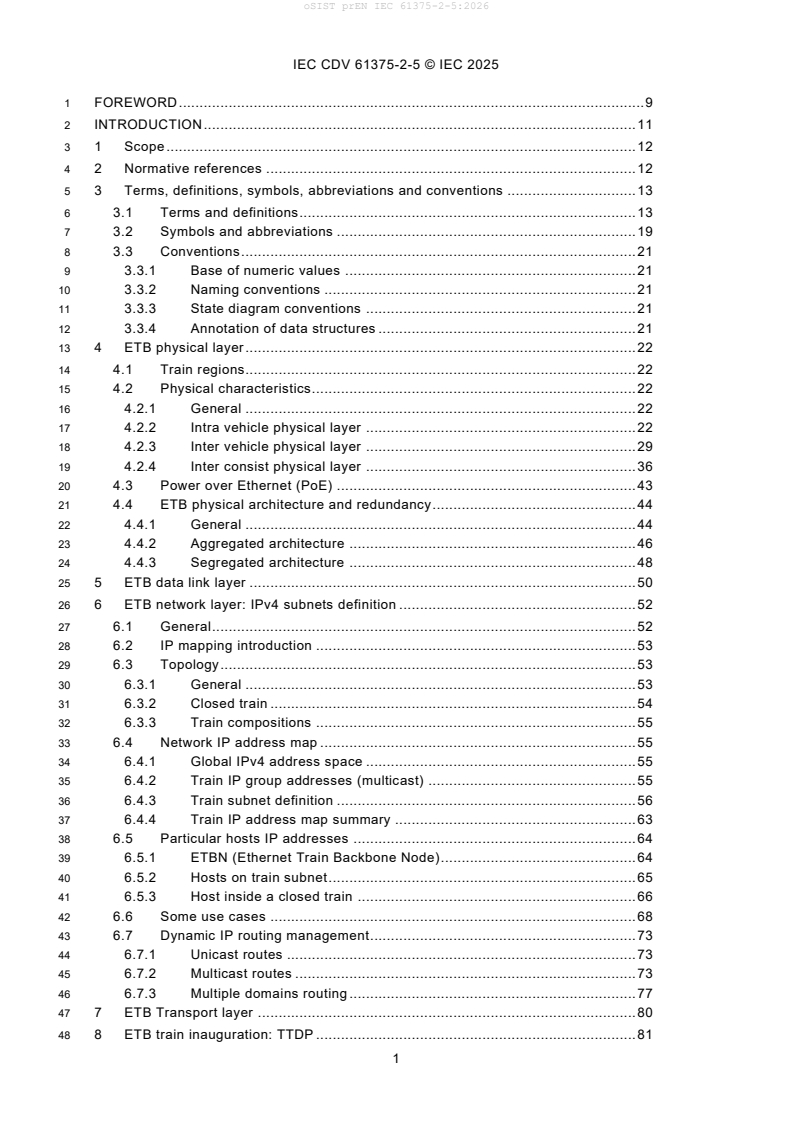
1 FOREWORD . 9
2 INTRODUCTION . 11
3 1 Scope . 12
4 2 Normative references . 12
5 3 Terms, definitions, symbols, abbreviations and conventions . 13
6 3.1 Terms and definitions . 13
7 3.2 Symbols and abbreviations . 19
8 3.3 Conventions . 21
9 3.3.1 Base of numeric values . 21
10 3.3.2 Naming conventions . 21
11 3.3.3 State diagram conventions . 21
12 3.3.4 Annotation of data structures . 21
13 4 ETB physical layer . 22
14 4.1 Train regions. 22
15 4.2 Physical characteristics. 22
16 4.2.1 General . 22
17 4.2.2 Intra vehicle physical layer . 22
18 4.2.3 Inter vehicle physical layer . 29
19 4.2.4 Inter consist physical layer . 36
20 4.3 Power over Ethernet (PoE) . 43
21 4.4 ETB physical architecture and redundancy. 44
22 4.4.1 General . 44
23 4.4.2 Aggregated architecture . 46
24 4.4.3 Segregated architecture . 48
25 5 ETB data link layer . 50
26 6 ETB network layer: IPv4 subnets definition . 52
27 6.1 General . 52
28 6.2 IP mapping introduction . 53
29 6.3 Topology . 53
30 6.3.1 General . 53
31 6.3.2 Closed train . 54
32 6.3.3 Train compositions . 55
33 6.4 Network IP address map . 55
34 6.4.1 Global IPv4 address space . 55
35 6.4.2 Train IP group addresses (multicast) . 55
36 6.4.3 Train subnet definition . 56
37 6.4.4 Train IP address map summary . 63
38 6.5 Particular hosts IP addresses . 64
39 6.5.1 ETBN (Ethernet Train Backbone Node) . 64
40 6.5.2 Hosts on train subnet . 65
41 6.5.3 Host inside a closed train . 66
42 6.6 Some use cases . 68
43 6.7 Dynamic IP routing management. 73
44 6.7.1 Unicast routes . 73
45 6.7.2 Multicast routes . 73
46 6.7.3 Multiple domains routing . 77
47 7 ETB Transport layer . 80
48 8 ETB train inauguration: TTDP . 81
IEC CDV 61375-2-5 © IEC 2025
49 8.1 Contents of this clause. 81
50 8.2 Objectives and assumptions . 81
51 8.2.1 Goals . 81
52 8.2.2 Out of scope . 82
53 8.2.3 Assumptions . 82
54 8.3 ETBN settings . 83
55 8.3.1 ETB switch port states . 83
56 8.3.2 Node settings . 83
57 8.4 General behaviour . 85
58 8.4.1 Train inauguration process . 85
59 8.4.2 TTDP HELLO . 87
60 8.4.3 TTDP TOPOLOGY . 88
61 8.4.4 TTDP HELLO Relay . 88
62 8.4.5 VLAN Reconfiguration . 92
63 8.5 ETBN Inauguration state diagram . 94
64 8.5.1 General . 94
65 8.5.2 Actions . 95
66 8.5.3 Transitions . 97
67 8.5.4 TTDP HELLO Relay state diagram . 98
68 8.5.5 VLAN Reconfiguration state diagram . 103
69 8.6 ETBN peers discovery . 109
70 8.6.1 Internal peers detection . 109
71 8.6.2 External peers detection . 110
72 8.6.3 Switch port states handling . 110
73 8.6.4 ETB lines statuses . 113
74 8.7 TTDP messages description . 116
75 8.7.1 General . 116
76 8.7.2 Convention . 116
77 8.7.3 TTDP frame tagging . 117
78 8.7.4 Transport and addressing . 117
79 8.7.5 TTDP HELLO and IH frame. 117
80 8.7.6 TTDP TOPOLOGY frame . 124
81 8.7.7 TTDP SELECTIVE frame (option) . 130
82 8.8 TTDP data structures . 130
83 8.8.1 Connectivity Vector . 130
84 8.8.2 ETBN Vector. 131
85 8.8.3 Connectivity Table . 131
86 8.8.4 Connectivity Table CRC . 132
87 8.8.5 Train network directory . 133
88 8.8.6 Train network directory CRC (Topology Counter) . 135
89 8.8.7 Corrected topology . 135
90 8.9 TTDP frames timing . 136
91 8.9.1 TTDP HELLO . 136
92 8.9.2 TTDP TOPOLOGY . 139
93 8.9.3 TTDP SELECTIVE . 140
94 8.10 Inauguration Train Application interface . 140
95 8.11 Degraded modes. 141
96 8.11.1 Late insertion ETBN. 141
97 8.11.2 Losing ETBN . 141
IEC CDV 61375-2-5 © IEC 2025
98 8.11.3 End ETBN failure and partial topology counter . 141
99 8.12 Some discovery timing . 142
100 8.12.1 ETBN wakeup . 142
101 8.12.2 ETBN failure . 143
102 8.12.3 Consist coupling . 144
103 9 ETB ETBN redundancy . 144
104 10 ETB physical train naming convention (optional) . 146
105 10.1 General . 146
106 10.2 ETB Train domain . 146
107 10.3 Hostname . 147
108 11 ETB Quality of Service . 148
109 11.1 Contents of this clause. 148
110 11.2 Frame forwarding . 148
111 11.2.1 ETBN switching rate . 148
112 11.2.2 No Head-of-Line blocking . 148
113 11.2.3 Switching priorities . 148
114 11.2.4 Switching queuing scheme . 149
115 11.3 Priority of Inauguration frames . 149
116 11.4 ETB ingress rate limiting . 150
117 11.5 ETB egress rate shaping . 150
118 11.6 ETB data classes . 150
119 11.7 TSN Features for Enhanced QoS . 150
120 11.7.1 Forwarding and Queuing Enhancements - IEEE 802.1Qav . 151
121 11.7.2 Frame Preemption - IEEE 802.1Qbu and 802.3br . 151
122 11.7.3 Per-Stream Filtering and Policing (PSFP) - IEEE 802.1Qci. . 151
123 12 ETB Management and monitoring . 151
124 12.1 Contents of this clause. 151
125 12.2 ETB Management and monitoring via SNMP . 151
126 12.3 ETB Management and monitoring: NetConf . 152
127 13 ETB Application interface . 152
128 13.1 Contents of this clause. 152
129 13.2 Abstract communication model . 153
130 13.3 ETB Process Data and Message Data protocols . 153
131 13.4 ETB protocol transparency . 153
132 13.5 ETBN interfaces . 153
133 13.5.1 Application . 153
134 13.5.2 Maintenance and monitoring . 154
135 14 ETB conformity statement . 155
136 Annex A (normative) Summary of ETB sizing parameters . 156
137 Annex B (normative) Physical topology building algorithm . 157
138 Annex C (normative) TTDP MIB definition . 160
139 Annex D (normative) TTDP YANG Data Model definition . 180
140 Annex E (informative) Application notes on multiple domains routing . 191
141 E.1 General . 191
142 E.2 Application notes at architecture level . 191
143 E.3 Communications considerations and use cases . 192
144 E.4 Multicast Groups, Routing and Gateways . 192
IEC CDV 61375-2-5 © IEC 2025
145 E.5 Unicast Routing and Gateways . 193
146 Annex F (informative) Interoperability Conditions . 195
147 F.1 General . 195
148 F.2 Configuration profiles . 195
149 F.3 Interoperability conditions . 197
150 Annex G (normative) Normal operation and failures recovery of VLAN reconfiguration
151 . 200
152 G.1 General . 200
153 G.2 Introduction . 200
154 G.3 VLAN reconfiguration examples . 201
155 G.3.1 General . 201
156 G.3.2 Normal scenario . 201
157 G.3.3 Single ETB Line Failure . 204
158 G.3.4 Single ETBN device Failure . 206
159 G.3.5 Two ETBN fail at the same time . 208
160 G.3.6 Two ETBN line fail at the same time . 211
161 Bibliography . 213
163 Figure 1 – ETB train regions . 23
164 Figure 2 – ETB Inter vehicle at same potential . 36
165 Figure 3 – ETB Inter vehicle not at the same potential . 37
166 Figure 4 – ETB consist reversing . 43
167 Figure 5 – ETB Inter consist segment . 43
168 Figure 6 – ETBN PSE PoE use case . 44
169 Figure 7 – ETBN PD PoE use case . 44
170 Figure 8 – PoE in inter-consist . 44
171 Figure 9 – PoE PSE alternative A . 45
172 Figure 10 – Redundant train backbone architecture (aggregated architecture) . 45
173 Figure 11 – Redundant train backbone architecture (segregated architecture) . 46
174 Figure 12 – Link aggregation model . 47
175 Figure 13 – Link aggregation group . 48
176 Figure 14 – Conversations over LAG . 49
177 Figure 15 – Train-wide A-Plane/B-Plane definition . 50
178 Figure 16 – Hierarchical consist topology . 55
179 Figure 17 – Closed train . 56
180 Figure 18 – "Consist Id" with single consist network . 59
181 Figure 19 – "Consist Id" with two single consist networks . 59
182 Figure 20 – Multiple consist networks, without fault tolerance . 60
183 Figure 21 – Multiple CNs connected to single ETBN without fault tolerance . 60
184 Figure 22 – Single "Consist Id" with ETBN redundancy in aggregated architecture . 61
185 Figure 23 – Two "Consist Id" with ETBN redundancy in aggregated architecture . 61
186 Figure 24 – "Consist Id" segregated architecture . 62
187 Figure 25 – "Consist Id" aggregated architecture – multiple units w/ ETBN redundancy
188 62
189 Figure 26 – "Consist Id" in multiple units in segregated architecture . 63
IEC CDV 61375-2-5 © IEC 2025
190 Figure 27 – ETBN to ECN connection: Non Overlapping . 64
191 Figure 28 – ETBN to ECN connection: Fully Overlapping . 64
192 Figure 29 – IP train address space summary . 65
193 Figure 30 – Relative addressing example - Direct ETB orientation . 69
194 Figure 31 – Single consist network . 70
195 Figure 32 – Two single consist networks . 70
196 Figure 33 – Single CN with ETBN redundancy, aggregated architecture . 71
197 Figure 34 – Single CN for segregated archicteture for TCMS domain . 72
198 Figure 35 – Two CNs with ETBN redundancy, aggregated architecture . 73
199 Figure 36 –Two CNs for segregated architecture for TCMS domain . 73
200 Figure 37 – Train with two consist networks in single consist . 74
201 Figure 38 – Multiple Domains Solution diagram of reference implementation . 78
202 Figure 39 – Inter Domain Inter consist Communication diagram . 80
203 Figure 40 – Inter Domain Intra consist diagram . 80
204 Figure 41 – Same Domain Inter consist Diagram . 81
205 Figure 42 – ETBN top node reference . 83
206 Figure 43 – ETBN orientation capability . 84
207 Figure 44 – ETB switch in bypass setting . 85
208 Figure 45 – ETB switch in intermediate setting . 85
209 Figure 46 – ETB switch in End Node Setting . 86
210 Figure 47 – Train inauguration process in aggregated architecture . 87
211 Figure 48 – Train inauguration process in segregated architecture . 88
212 Figure 49 – Building up Connectivity Table in aggregated architecture . 88
213 Figure 50 – Consist as a ”black box” in segregated architecture. . 89
214 Figure 51 – Logical connections between ETBNs as in series . 90
215 Figure 52 – Direction mapping of dual ETBs to serial ETB . 91
216 Figure 53 – TTDP HELLO Relay behaviour (in view of ETBN C) . 92
217 Figure 54 – TTDP HELLO Relay behaviour (in view of ETBN B) . 92
218 Figure 55 – A traffic storm on segregated architecture without VLAN reconfiguration . 93
219 Figure 56 – An example of how VLAN reconfiguration manage the loop-free network. 94
220 Figure 57 – Train consist network on Segregated architecture . 94
221 Figure 58 – ETBN Inauguration state diagram . 96
222 Figure 59 – TTDP HELLO Relay state diagram . 100
223 Figure 60 – Decision flow of processing or relaying a HELLO frame. 101
224 Figure 61 – Decision flow of relaying a HELLO frame . 101
225 Figure 62 –VLAN reconfiguration state machine . 104
226 Figure 63 – ActionInspectPrimaryRequest diagram state . 107
227 Figure 64 – ActionCheckPrimaryReply diagram state . 108
228 Figure 65 – actionCheckPrimaryState diagram state . 109
229 Figure 66 – actionMonitorPrimaryState diagram state . 109
230 Figure 67 – actionSelectPrimaryPort diagram state . 110
231 Figure 68 – Switch port state diagram . 112
232 Figure 69 – ETBN physical line state machine . 115
IEC CDV 61375-2-5 © IEC 2025
233 Figure 70 – TTDP HELLO frame LLDPDU structure . 119
234 Figure 71 – LLDP organizationally TLV structure . 119
235 Figure 72 – TTDP HELLO frame frame in ASN.1 . 122
236 Figure 73 – TTDP HELLO frame structure . 124
237 Figure 74 – TTDP specific HELLO TLV structure for aggregated architecture . 124
238 Figure 75 – TTDP specific HELLO TLV structure for segregated architecture . 125
239 Figure 76 –TTDP TOPOLOGY frame in ASN.1 . 127
240 Figure 77 – TTDP TOPOLOGY frame structure . 129
241 Figure 78 – TTDP TOPOLOGY specific ETB TLV structure . 130
242 Figure 79 – TTDP TOPOLOGY specific CN TLV structure . 130
243 Figure 80 – TTDP SELECTIVE frame in ASN.1 . 131
244 Figure 81 – TTDP SELECTIVE frame structure . 131
245 Figure 82 – Train composition for TNDir example . 135
246 Figure 83 – TTDP HELLO normal mode and recovery timing . 138
247 Figure 84 – TTDP HELLO failure timing . 139
248 Figure 85 – TTDP TOPOLOGY frames handling. 140
249 Figure 86 – TTDP ETBNs wake up timing . 143
250 Figure 87 – TTDP ETBN failure timing . 144
251 Figure 88 – TTDP Consist coupling timing . 145
252 Figure 89 – Example: ETBN IP routing table without redundancy . 146
253 Figure 90 – Example: ETBN IP routing table w/ redundancy, aggregated archicture . 146
254 Figure 91 – Example: ETBN IP routing table, segregated architecture (TCMS domain)
255 147
256 Figure 92 – ETB train domain definition . 148
257 Figure 93 – Abstract communication model for ETB communication . 154
258 Figure B.1 – Physical topology building . 158
259 Figure B.2 – computeOrientation(remMAC) . 160
260 Figure B.3 – updateConnTable(remMAC) . 160
261 Figure C.1 – TTDP MIB tree view . 163
262 Figure C.2 – TTDP MIB description in ASN.1 . 180
263 Figure D.1 – TTDP YANG Data Model tree view . 181
264 Figure D.2 – TTDP YANG Data Model . 191
265 Figure E.1 – Example of Domains GW functionality on aggregated archictecture . 192
266 Figure E.2 – Example of Domains GW functionality on segregated archictecture . 192
267 Figure E.3 – Example: IP Addressing scheme for inter consist communication . 194
268 Figure F.1 – Interoperability conditions . 200
269 Figure G.1 – Critical traffic and best effort traffic paths in segregated architecture . 201
270 Figure G.2 – Normal initial scenario – VLAN reconfiguration initial states in each port
271 202
272 Figure G.3 – Normal Initial scenario – Active side send out primary request . 204
273 Figure G.4 – Normal Initial scenario – Passive side accept primary request . 205
274 Figure G.5 – Single ETB line failure diagram . 206
275 Figure G.6 – Single ETB line failure – line is broken . 206
276 Figure G.7 – Single ETB line failure – Line failover is done . 207
IEC CDV 61375-2-5 © IEC 2025
277 Figure G.8 – Single ETBN failure . 208
278 Figure G.9 – Single ETBN Failure – ETBN has failed . 208
279 Figure G.10 – Single ETBN Failure – Failover process done . 209
280 Figure G.11 – Dual ETBNs failure . 210
281 Figure G.12 – Dual ETBNs failure – Second ETBN is failed . 211
282 Figure G.13 – Dual ETBNs failure – After Hello timeout . 211
285 Table 1 – ETB Intra vehicle 100 BASE TX physical layer interface . 24
286 Table 2 – ETB Intra vehicle 1000BASE-T physical layer interface . 26
287 Table 3 – ETB Intra vehicle 10 MBit (10BASE-T1L) physical layer interface . 28
288 Table 4 – ETB Inter vehicle 100 BASE TX physical layer interface . 31
289 Table 5 – ETB Inter vehicle 1000BASE-T physical layer interface . 33
290 Table 6 – ETB Inter vehicle 10 MBit (10BASE-T1L) physical layer interface . 35
291 Table 7 – ETB Inter consist 100 BASE TX physical layer interface . 38
292 Table 8 – ETB Inter consist 1000BASE-T physical layer interface . 40
293 Table 9 – ETB Inter consist 10 MBit (10BASE-T1L) physical layer interface . 42
294 Table 10 – ETB Switch data link layer interface (1 of 2) . 52
295 Table 11 – ETB OSI Network layer . 54
296 Table 12 – Train IP group addresses reserved range . 57
297 Table 13 – Train subnet definition . 57
298 Table 14 – Train subnet decomposition . 58
299 Table 15 – ETBN ETB IP address . 66
300 Table 16 – Hosts IP on train subnet . 67
301 Table 17 – Multicast group decomposition . 75
302 Table 18 – Decomposition of all-train groups . 75
303 Table 19 – Decomposition of ETB-related groups . 75
304 Table 20 – Decomposition of consist-limited groups . 76
305 Table 21 – Domain-aware multicast train ip group address reserved range . 76
306 Table 22 – Multiple Domains reference implementation elements diagram . 78
307 Table 23 – Application ED common interface . 82
308 Table 24 – ETB switch port states . 84
309 Table 25 – TTDP destination MAC addresses . 118
310 Table 26 – Connectivity Vector . 131
311 Table 27 – Connectivity Vector Fields . 132
312 Table 28 – ETBN Vector . 132
313 Table 29 – ETBN Vector Fields . 132
314 Table 30 – Connectivity Table . 133
315 Table 31 – Connectivity Table fields . 133
316 Table 32 – Train network directory . 134
317 Table 33 – Train network directory fields . 134
318 Table 34 – Train network directory (example) . 136
319 Table 35 – DSCP field mapping with 4 priorities . 149
IEC CDV 61375-2-5 © IEC 2025
320 Table 36 – DSCP field mapping with 8 priorities . 150
321 Table 37 – ETB Switching Priorities . 150
322 Table 38 – Data class priorities . 151
323 Table 39 – Yang Models for TSN functionalities . 153
324 Table 40 – Yang Models for non-TSN functionalities . 153
325 Table 41 – Train Topology Discovery Object . 155
326 Table A.1 – ETB sizing parameters (regular train composition) . 157
327 Table A.2 – ETB sizing parameters (extended train composition) . 157
328 Table E.1 – End Devices Routing table for unicast inter domain communication . 193
329 Table E.2 – End Devices Routing table for multicast inter domain communication . 193
330 Table E.3 – End Devices Routing table for inter domain communication . 194
331 Table F.1 – Configuration profiles . 197
IEC CDV 61375-2-5 © IEC 2025
334 INTERNATIONAL ELECTROTECHNICAL COMMISSION
335 ____________
337 ELECTRONIC RAILWAY EQUIPMENT –
338 TRAIN COMMUNICATION NETWORK (TCN) –
340 Part 2-5: Ethernet train backbone
342 FOREWORD
343 1) The International Electrotechnical Commission (IEC) is a worldwide organization for standardization comprising
344 all national electrotechnical committees (IEC National Committees). The object of IEC is to promote international
345 co-operation on all questions concerning standardization in the electrical and electronic fields. To this end and
346 in addition to other activities, IEC publishes International Standards, Technical Specifications, Technical Reports,
347 Publicly Available Specifications (PAS) and Guides (hereafter referred to as “IEC Publication(s)”). Their
348 preparation is entrusted to technical committees; any IEC National Committee interested in the subject dealt with
349 may participate in this preparatory work. International, governmental and non-governmental organizations liaising
350 with the IEC also participate in this preparation. IEC collaborates closely with the International Organization for
351 Standardization (ISO) in accordance with conditions determined by agreement between the two organizations.
352 2) The formal decisions or agreements of IEC on technical matters express, as nearly as possible, an international
353 consensus of opinion on the relevant subjects since each technical committee has representation from all
354 interested IEC National Committees.
355 3) IEC Publications have the form of recommendations for international use and are accepted by IEC National
356 Committees in that sense. While all reasonable efforts are made to ensure that the technical content of IEC
357 Publications is accurate, IEC cannot be held responsible for the way in which they are used or for any
358 misinterpretation by any end user.
359 4) In order to promote international uniformity, IEC National Committees undertake to apply IEC Publications
360 transparently to the maximum extent possible in their national and regional publications. Any divergence between
361 any IEC Publication and the corresponding national or regional publication shall be clearly indicated in the latter.
362 5) IEC itself does not provide any attestation of conformity. Independent certification bodies provide conformity
363 assessment services and, in some areas, access to IEC marks of conformity. IEC is not responsible for any
364 services carried out by independent certification bodies.
365 6) All users should ensure that they have the latest edition of this publication.
366 7) No liability shall attach to IEC or its directors, employees, servants or agents including individual experts and
367 members of its technical committees and IEC National Committees for any personal injury, property damage or
368 other damage of any nature whatsoever, whether direct or indirect, or for costs (including legal fees) and
369 expenses arising out of the publication, use of, or reliance upon, this IEC Publication or any other IEC Publications.
370 8) Attention is drawn to the Normative references cited in this publication. Use of the referenced publications is
371 indispensable for the correct application of this publication.
372 9) Attention is drawn to the possibility that some of the elements of this IEC Publication may be the subject of patent
373 rights. IEC shall not be held responsible for identifying any or all such patent rights.
374 International Standard IEC 61375-2-5 has been prepared by IEC technical committee 9:
375 Electrical equipment and systems for railways.
376 This second edition cancels and replaces the first edition published in 2014. This edition
377 constitutes a technical revision.
378 a) Support of train backbone topologies: aggregated and segregated topology .
379 b) Support for 1000BASE-T (Gigabit Ethernet) and 10BASE-T1L backbone
380 c) Support for extended train composition (e.g. as required for freight trains)
381 d) Extensions for multiple network domains
382 e) Extensions needed for reaching a higher safety level in train inauguration (BEACON
383 proxy function)
384 f) Support for Per-Stream Filtering and Policing (IEEE 802.1Qci) to ensure traffic shaping
385 and protection against misbehaving streams
386 g) Enhanced Quality of Service (QoS) in Ethernet communication through Frame
387 Preemption (IEEE 802.1Qbu)
IEC CDV 61375-2-5 © IEC 2025
388 h) Support for Frame Replication and Elimination for Reliability (IEEE 802.1CB)
389 i) Extension of ETB management and monitoring by using NetConf
390 Furthermore, enhancements in this document are made to improve readability and to lower the
391 risk of misinterpretations by improving clarity.
392 The text of this standard is based on the following documents:
FDIS Report on voting
9/1933/FDIS 9/1961/RVD
394 Full information on the voting for the approval of this standard can be found in the report on
395 voting indicated in the above table.
396 This publication has been drafted in accordance with the ISO/IEC Directives, Part 2.
397 A list of all parts in the IEC 61375 series, published und
...
Questions, Comments and Discussion
Ask us and Technical Secretary will try to provide an answer. You can facilitate discussion about the standard in here.
Loading comments...