


SIST EN 471:2003
(Main)High-visibility warning clothing for professional use - Test methods and requirements
High-visibility warning clothing for professional use - Test methods and requirements
This European Standard specifies requirements for protective clothing capable of signalling the user's presence visually, intended to provide conspicuity of the user in hazardous situations under any light conditions by day and under illumination by vehicle headlights in the dark.
Performance requirements are included for colour and retroreflection as well as for the minimum areas and for the disposition of the materials in protective clothing.
Warnkleidung - Prüfverfahren und Anforderungen
Diese Europäische Norm legt die Anforderungen an Schutzkleidung fest, die die Anwesenheit des Trägers visuell signalisiert, mit der Absicht, ihn in gefährlichen Situationen bei allen möglichen Lichtverhältnissen am Tage sowie beim Anstrahlen mit Fahrzeugscheinwerfern in der Dunkelheit auffällig zu machen.
Es sind Leistungsanforderungen an die Farbe und die Retroreflexion festgelegt, wie auch an die Mindestflächen und die Anordnung der Materialien in der Schutzkleidung.
Vetements de signalisation a haute visibilité pour usage professionnel - Méthodes d'essai et exigences
Le présent document norme spécifie les caractéristiques que doivent avoir les vêtements ayant pour but de signaler visuellement la présence de l'utilisateur, afin de le détecter et de bien le voir dans des situations dangereuses, dans toutes les conditions de luminosité, de jour, et la nuit dans la lumière des phares.
Les exigences de performance sont indiquées pour la couleur et la rétroréflexion ainsi que pour les surfaces minimales et le positionnement des matériaux utilisés.
Dobro vidna opozorilna obleka za poklicno uporabo – Preskusne metode in zahteve
General Information
- Status
- Withdrawn
- Publication Date
- 30-Nov-2003
- Withdrawal Date
- 25-Mar-2008
- Technical Committee
- OVP - Personal protecting equipment
- Current Stage
- 9900 - Withdrawal (Adopted Project)
- Start Date
- 25-Mar-2008
- Due Date
- 17-Apr-2008
- Completion Date
- 26-Mar-2008
Relations
- Effective Date
- 01-Dec-2003
- Consolidated By
SIST EN 471:2003+A1:2008 - High-visibility warning clothing for professional use - Test methods and requirements - Effective Date
- 01-May-2008
- Effective Date
- 22-Dec-2008

Frequently Asked Questions
SIST EN 471:2003 is a standard published by the Slovenian Institute for Standardization (SIST). Its full title is "High-visibility warning clothing for professional use - Test methods and requirements". This standard covers: This European Standard specifies requirements for protective clothing capable of signalling the user's presence visually, intended to provide conspicuity of the user in hazardous situations under any light conditions by day and under illumination by vehicle headlights in the dark. Performance requirements are included for colour and retroreflection as well as for the minimum areas and for the disposition of the materials in protective clothing.
This European Standard specifies requirements for protective clothing capable of signalling the user's presence visually, intended to provide conspicuity of the user in hazardous situations under any light conditions by day and under illumination by vehicle headlights in the dark. Performance requirements are included for colour and retroreflection as well as for the minimum areas and for the disposition of the materials in protective clothing.
SIST EN 471:2003 is classified under the following ICS (International Classification for Standards) categories: 13.340.10 - Protective clothing. The ICS classification helps identify the subject area and facilitates finding related standards.
SIST EN 471:2003 has the following relationships with other standards: It is inter standard links to SIST EN 471:1996, SIST EN 471:2003+A1:2008, SIST EN 471:2003/oprA1:2006. Understanding these relationships helps ensure you are using the most current and applicable version of the standard.
SIST EN 471:2003 is associated with the following European legislation: EU Directives/Regulations: 89/686/EEC, 93/68/EEC, 93/95/EEC, 96/58/EC; Standardization Mandates: M/BC/CEN/88/10. When a standard is cited in the Official Journal of the European Union, products manufactured in conformity with it benefit from a presumption of conformity with the essential requirements of the corresponding EU directive or regulation.
SIST EN 471:2003 is available in PDF format for immediate download after purchase. The document can be added to your cart and obtained through the secure checkout process. Digital delivery ensures instant access to the complete standard document.
Standards Content (Sample)
2003-01.Slovenski inštitut za standardizacijo. Razmnoževanje celote ali delov tega standarda ni dovoljeno.High-visibility warning clothing for professional use - Test methods and requirementsDobro vidna opozorilna obleka za poklicno uporabo – Preskusne metode in zahteveVetements de signalisation a haute visibilité pour usage professionnel - Méthodes d'essai et exigencesWarnkleidung - Prüfverfahren und AnforderungenTa slovenski standard je istoveten z:EN 471:2003SIST EN 471:2003en13.340.10ICS:SIST EN 471:19961DGRPHãþDSLOVENSKI
STANDARDSIST EN 471:200301-december-2003
EUROPEAN STANDARDNORME EUROPÉENNEEUROPÄISCHE NORMEN 471September 2003ICS 13.340.10Supersedes EN 471:1994English versionHigh-visibility warning clothing for professional use - Testmethods and requirementsVêtements de signalisation à haute visibilité - Méthoded'essai et exigencesWarnkleidung - Prüfverfahren und AnforderungenThis European Standard was approved by CEN on 1 August 2003.CEN members are bound to comply with the CEN/CENELEC Internal Regulations which stipulate the conditions for giving this EuropeanStandard the status of a national standard without any alteration. Up-to-date lists and bibliographical references concerning such nationalstandards may be obtained on application to the Management Centre or to any CEN member.This European Standard exists in three official versions (English, French, German). A version in any other language made by translationunder the responsibility of a CEN member into its own language and notified to the Management Centre has the same status as the officialversions.CEN members are the national standards bodies of Austria, Belgium, Czech Republic, Denmark, Finland, France, Germany, Greece,Hungary, Iceland, Ireland, Italy, Luxembourg, Malta, Netherlands, Norway, Portugal, Slovakia, Spain, Sweden, Switzerland and UnitedKingdom.EUROPEAN COMMITTEE FOR STANDARDIZATIONCOMITÉ EUROPÉEN DE NORMALISATIONEUROPÄISCHES KOMITEE FÜR NORMUNGManagement Centre: rue de Stassart, 36
B-1050 Brussels© 2003 CENAll rights of exploitation in any form and by any means reservedworldwide for CEN national Members.Ref. No. EN 471:2003 E
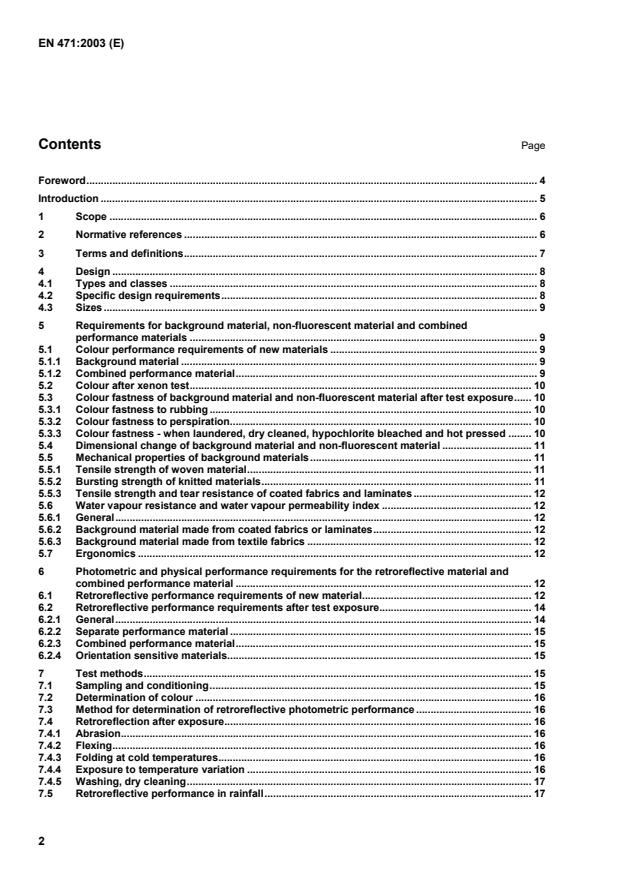
Examples for positioning of bands of retroreflective material.19Annex B (informative)
Recommendations for wearing time.23Annex C (normative) Positioning of bands of retroreflective material on jackets.24Annex D (normative)
Method of measuring wet retroreflective performance.25D.1Principle.25D.2Apparatus.25D.3Procedure.25Annex ZA (informative)
Clauses of this European Standard addressing essential requirements orother provisions of EU Directives.27Bibliography.28
properties - Measurement of thermal and water- vapourresistance under steady-state conditions
(sweating guarded - hotplate test) (ISO
11092:1993)EN ISO 3175-2:1998, Textiles — Dry cleaning and finishing — Part 2: Procedures fo
tetrachloroethene (ISO3175-2:1998)EN ISO 6330:2000, Textiles — Domestic washing and drying procedures for textile testing (ISO 6330:2000)EN ISO 7854:1997, Rubber or plastic coated fabrics — Determination of resistance to damage by flexing (ISO7854:1995)EN ISO 13934-1, Textiles — Tensile properties of
fabrics — Part 1: Determination of
maximum force andelongation at
maximum force using the strip
method (ISO 13934-1:1999)EN ISO 13938-1, Textiles — Bursting properties of
fabrics — Part 1: Hydraulic method for
determination ofbursting strength
and bursting distension (ISO 13938-1:1999)ISO 105-A02, Textiles — Tests for colour fastness — Part A02: Grey Scale for assessing change in colourISO 105-A03, Textiles — Tests for colour fastness — Part A03: Grey Scale for assessing stainingISO 105-B02:1994, Textiles — Tests for colour fastness — Part B02: Colour fastness to artificial light: XenonArc fading lamp testISO 105-C06, Textiles — Tests for colour fastness — Part C06: Colour fastness to domestic and commerciallaunderingISO 105-D01, Textiles — Tests for colour fastness — Part D01: Colour fastness to dry cleaningISO 105-E04, Textiles — Tests for colour fastness — Part E04: Colour fastness to perspirationISO 105-N01, Textiles — Tests for colour fastness — Part N01: Colour fastness to bleaching: HypochloriteISO 105-X11, Textiles — Tests for colour fastness — Part X11: Colour fastness to hot pressingISO 105-X12, Textiles — Tests for colour fastness — Part X12: Colour fastness to rubbing
1 = 0° and 2 = 90°3.2photometric termsNOTEthe photometric terms used in this document are defined in CIE Publication No 17.4:1987 and No 54.2:2001
10 % on the front and backside of thegarment. The garment is to be measured flat on the table including torso, arms and legs.4.2 Specific design requirements4.2.1The background material shall encircle the torso, and, where applicable, the sleeves and trouser legs.4.2.2Bands of retroreflective material shall be not less than 50 mm wide; but for harnesses they shall benot less than 30 mm wide as shown in Figure A.9.4.2.3a) Coveralls shall have two horizontal bands of retroreflective material not less than 50 mm apart encirclingthe torso with a maximum inclination of
20°.b) Jackets, waistcoats, shirts, coats and tabards shall have two bands of retroreflective material with amaximum inclination of
20° not less than 50 mm apart encircling the torso and bands of retroreflectivematerial joining the uppermost torso band from the front to the back over each shoulder.
The bottom ofthe bottom torso band shall be not less than 50 mm above the bottom edge of the jacket, waistcoat,tabard or shirt.Or/alternativelyc) Jackets, waistcoats, shirts, coats and tabards shall have one band of retroreflective material with amaximum inclination of
20° encircling the torso and bands of retroreflective material joining the torsoband from the front to the back over each shoulder. The bottom of the torso band shall be not less than50 mm above the bottom edge of the jacket, waistcoat, tabard or shirt.Or/alternativelyd) Jackets, waistcoats, shirts, coats and tabards shall have two bands of retroreflective material with amaximum inclination of
20° not less than 50 mm apart encircling the torso. The bottom of the bottomtorso band shall be not less than 50 mm above the bottom edge of the jacket, waistcoat, tabard or shirt.
20° not less than 50 mm apart, encircling each leg. The bottom of thelower band shall be not less than 50 mm above the bottom of the trouser leg.4.2.6Bib and brace trousers classes 2 and 3 shall have one band of retroreflective material encircling thetorso with a maximum inclination of
20° from the horizontal.4.2.7Tabards shall be constructed so that a person of the size for which they are designed can wear thetabard so that any gaps at the sides shall be not greater than 50 mm horizontally.4.2.8Any gap (to enable fastening or fixation of seams) in the lengthwise continuit
...
Questions, Comments and Discussion
Ask us and Technical Secretary will try to provide an answer. You can facilitate discussion about the standard in here.
Loading comments...