

SIST EN 1773:1999
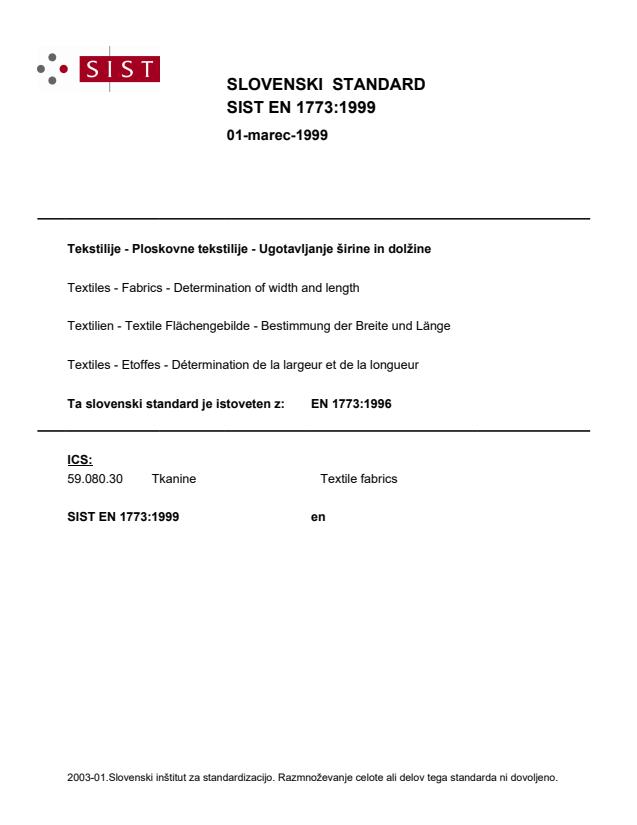
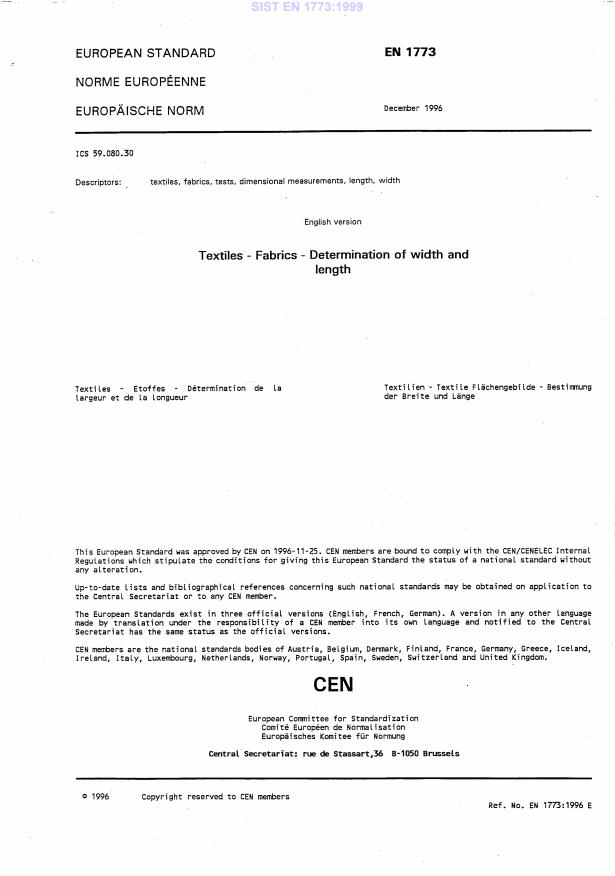
(Main)Textiles - Fabrics - Determination of width and length
General Information
- Abstract
This standard specifies a method for determination of length and width of textile fabrics that are in the state of relaxation obtained by being free from applied tension in the standard atmosphere for textiles. The test is applicable to textile fabrics of full width, folded vertical down the middle, or in tubularform, but no longer than 100m. This standard does not specify a method to determine or describe construction defects or other defects.
- Status
- Published
- Publication Date
- 28-Feb-1999
- Technical Committee
- ITEK - Textile and textile products
- Current Stage
- 6060 - National Implementation/Publication (Adopted Project)
- Start Date
- 01-Mar-1999
- Due Date
- 01-Mar-1999
- Completion Date
- 01-Mar-1999


Overview
SIST EN 1773:1999 is a European standard established by CEN that defines a precise method for determining the width and length of textile fabrics. Specifically, it applies to fabrics that have reached a state of relaxation-meaning the fabrics are free from any applied tension and acclimatized to the standard atmosphere for textiles. This standard is essential for quality control and dimensional assessment in the textile industry, ensuring consistency and accuracy in fabric measurement.
SIST EN 1773:1999 covers textile fabrics in various forms, including:
- Full-width fabrics
- Fabrics folded vertically down the middle
- Tubular fabrics
The maximum fabric length allowed for testing under this standard is 100 meters.
This method does not address the detection or description of construction defects or other types of fabric faults. Its focus remains strictly on dimensional accuracy of textile width and length.
Key Topics
- Fabric Relaxation: The standard emphasizes that measurements must be taken when the textile is fully relaxed and not under tension, reflecting true dimensions.
- Applicable Forms: It covers multiple fabric configurations such as flat fabric, folded fabric, and tubular fabric, providing versatility for measuring different textile products.
- Length Limitation: The method applies to fabric pieces not exceeding 100 meters, which is practical for factory sampling and quality checks.
- Standard Atmosphere: Conditioning of fabrics in standardized environmental conditions before measurement is mandatory to ensure reproducible results.
- Exclusion of Defect Analysis: SIST EN 1773:1999 is solely concerned with dimensional determination and excludes defect detection or fabric construction descriptions.
Applications
SIST EN 1773:1999 serves a critical role across various sectors in the textile industry, including:
- Manufacturing Quality Control: Accurate width and length measurements are vital for cutting, sewing, and finishing processes, minimizing material waste and ensuring product quality.
- Textile Trade and Inspection: Buyers, sellers, and inspectors rely on standardized measurement methods to verify fabric dimensions for contractual compliance.
- Research and Development: Textile engineers and technicians use this method to evaluate fabric dimensional stability and to develop materials that maintain consistent dimensions.
- Textile Testing Laboratories: Accredited labs use this standardized approach to provide reliable test reports that support product certification and international trade.
By implementing SIST EN 1773:1999, companies can streamline production workflows and enhance confidence in material specifications.
Related Standards
- EN ISO 139:2015 - Textiles - Standard atmospheres for conditioning and testing, which complements EN 1773 by defining the environmental conditions for fabric relaxation.
- EN 1474 - Test methods for textile fabrics, covering other physical and mechanical properties that may be checked alongside dimensional measurements.
- ISO 6300 - Textile fabrics - Preparation, conditioning, and testing of textiles, guiding textile sample handling procedures.
- EN 460:1994 - Textiles - Evaluation of defects in woven fabrics, useful for separate assessments of fabric quality beyond dimension.
Adopting SIST EN 1773:1999 ensures consistent, reproducible measurement of fabric width and length, providing essential data to all stakeholders in the textile supply chain. This standard underpins accurate fabric specification, ultimately supporting higher-quality textile products and efficient manufacturing operations.
Relations
- Effective Date
- 28-Jan-2026
- Effective Date
- 28-Jan-2026
- Effective Date
- 28-Jan-2026
- Effective Date
- 28-Jan-2026
- Effective Date
- 28-Jan-2026
- Effective Date
- 28-Jan-2026
- Effective Date
- 28-Jan-2026
- Effective Date
- 28-Jan-2026
- Effective Date
- 28-Jan-2026
- Effective Date
- 28-Jan-2026
- Effective Date
- 28-Jan-2026
Get Certified
Connect with accredited certification bodies for this standard

Control Union Certifications
Global certification for agriculture and sustainability.

Hohenstein Institut
Textile testing and certification.

Bureau Veritas Bangladesh
Bureau Veritas certification services in Bangladesh.
Sponsored listings
Frequently Asked Questions
SIST EN 1773:1999 is a standard published by the Slovenian Institute for Standardization (SIST). Its full title is "Textiles - Fabrics - Determination of width and length". This standard covers: This standard specifies a method for determination of length and width of textile fabrics that are in the state of relaxation obtained by being free from applied tension in the standard atmosphere for textiles. The test is applicable to textile fabrics of full width, folded vertical down the middle, or in tubularform, but no longer than 100m. This standard does not specify a method to determine or describe construction defects or other defects.
This standard specifies a method for determination of length and width of textile fabrics that are in the state of relaxation obtained by being free from applied tension in the standard atmosphere for textiles. The test is applicable to textile fabrics of full width, folded vertical down the middle, or in tubularform, but no longer than 100m. This standard does not specify a method to determine or describe construction defects or other defects.
SIST EN 1773:1999 is classified under the following ICS (International Classification for Standards) categories: 59.080.30 - Textile fabrics. The ICS classification helps identify the subject area and facilitates finding related standards.
SIST EN 1773:1999 has the following relationships with other standards: It is inter standard links to SIST EN ISO 14244:2017, SIST EN 13569:2001, SIST EN ISO 23548:2025, SIST EN 14976:2006, SIST EN 17116-4:2020, SIST EN 14697:2005, SIST EN 16315:2014, SIST EN 4416:2009, SIST EN 4415:2009, SIST EN 17116-3:2020, SIST EN ISO 20042:2021. Understanding these relationships helps ensure you are using the most current and applicable version of the standard.
SIST EN 1773:1999 is available in PDF format for immediate download after purchase. The document can be added to your cart and obtained through the secure checkout process. Digital delivery ensures instant access to the complete standard document.
Standards Content (Sample)
2003-01.Slovenski inštitut za standardizacijo. Razmnoževanje celote ali delov tega standarda ni dovoljeno.Tekstilije - Ploskovne tekstilije - Ugotavljanje širine in dolžineTextilien - Textile Flächengebilde - Bestimmung der Breite und LängeTextiles - Etoffes - Détermination de la largeur et de la longueurTextiles - Fabrics - Determinati
...