

SIST ISO 6882:1996
(Main)Asparagus -- Guide to refrigerated transport
General Information
- Abstract
The guidance describes methods for obtaining optimum conditions for the successful long distance transport of shoots of the species Asparagus officinalis Linnaeus. It is not applicable to transportation over short distance or by air. It includes preparation of the shoots, optimum parameters and means for transport.
- Status
- Published
- Publication Date
- 30-Nov-1996
- Technical Committee
- KŽP - Agricultural food products
- Current Stage
- 6060 - National Implementation/Publication (Adopted Project)
- Start Date
- 01-Dec-1996
- Due Date
- 01-Dec-1996
- Completion Date
- 01-Dec-1996
Buy Documents






ISO 6882:1981 - Asparagus — Guide to refrigerated transport Released:8/1/1981



ISO 6882:1981 - Asperges — Guide pour le transport réfrigéré Released:8/1/1981



ISO 6882:1981 - Asperges — Guide pour le transport réfrigéré Released:8/1/1981
Overview
SIST ISO 6882:1996 is an international standard that provides a comprehensive guide to the refrigerated transport of asparagus shoots (Asparagus officinalis Linnaeus). The guidance focuses on methods to achieve optimal conditions for preserving asparagus quality during long-distance refrigerated transport. It explicitly excludes short-distance or air transport, where refrigeration does not significantly impact product quality. The standard covers essential steps including shoot preparation, handling, optimal temperature and humidity parameters, packaging, and transport logistics.
Key Topics
Harvesting and Preparation
- Asparagus shoots should be harvested at a specific maturity stage to meet quality standards. Shoots must have closed heads and tips, ensuring freshness.
- Cleaning and precooling (to +7°C or below) are critical to extending shelf life. Hydrocooling to around +5°C is recommended before refrigerated storage.
- Precooling should be rapid to reduce spoilage and physiological deterioration such as bacterial rot and toughening.
Packing and Packaging Materials
- Shoots must be free of earth and sand and may be washed if necessary.
- Packaging materials should be new, clean, and safe for human contact, without substances harmful to health.
- Containers-wooden or cardboard boxes lined with perforated parchment paper or plastic film-help maintain high relative humidity (~95%), which is vital to prevent dehydration. Waxed cardboard lined with plastic film is also suitable.
- Bundled shoots may be wrapped in tissue paper or placed in perforated plastic bags to preserve quality and prevent damage. Completely sealed containers or bags should be avoided to prevent carbon dioxide buildup and oxygen depletion that damage produce.
Temperature and Humidity Control
- The optimal transport temperature range is +1°C to +2°C, with relative humidity maintained around 95%. Under these conditions, asparagus can be kept up to three weeks.
- Minor temperature fluctuations between +1°C and +5°C over 2 to 3 days during transit do not compromise quality.
- Continuous refrigeration is mandatory to prevent quality degradation. Precooling and refrigerated storage reduce surface moisture and senescence.
Loading and Transport Logistics
- Boxes should be stacked lengthwise facing forward with gaps closed to prevent movement during transit. Ice-refrigerated railway trucks or refrigerated lorries with reliable ventilation are recommended.
- Vehicles must be free of contaminants, with operational fans and drains to ensure proper air circulation.
- Pre-cooling the loading space and re-icing ice bunkers during transport are necessary to maintain consistent cooling.
- Upon arrival, continuous cooling must be maintained. At the destination, asparagus should be consumed or processed promptly and at normal temperatures for no more than 48 hours.
Applications
- Agricultural Supply Chain
ISO 6882 assists producers, packers, and distributors in maintaining asparagus quality during long-distance transport to regional, national, or international markets. - Cold Chain Management
The standard serves as a reference for cold chain operators to coordinate optimal temperature and humidity control practices from farm to retailer. - Quality Assurance
Food safety and quality management systems benefit from adhering to ISO 6882 recommendations to reduce spoilage, extend shelf life, and preserve nutritional value. - Logistics and Packaging Industry
Packaging suppliers and transportation companies can utilize the guidance to design suitable containers and transport vehicles specifically for perishable asparagus shoots.
Related Standards
- ISO 4186: Asparagus - Guide to Storage
Complements ISO 6882 by detailing conditions for optimal storage, further ensuring asparagus freshness beyond transport. - EEC Product Standards for Asparagus
Provides quality benchmarks and packaging dimensions that align with ISO 6882 recommendations for container size and shoot presentation. - Standards on Refrigerated Transport for Other Perishables
Industry participants may refer to related ISO or regional standards for refrigerated transportation of fruits and vegetables to implement best cold chain practices holistically.
By following the SIST ISO 6882:1996 standard, stakeholders can ensure that asparagus shoots retain their premium quality during long-distance refrigerated transport, reducing losses from spoilage and enhancing consumer satisfaction. This standard remains a critical resource within global agricultural logistics and perishable food transport sectors.
Buy Documents
ISO 6882:1981 - Asparagus — Guide to refrigerated transport Released:8/1/1981
ISO 6882:1981 - Asperges — Guide pour le transport réfrigéré Released:8/1/1981
ISO 6882:1981 - Asperges — Guide pour le transport réfrigéré Released:8/1/1981
Get Certified
Connect with accredited certification bodies for this standard

BSI Group
BSI (British Standards Institution) is the business standards company that helps organizations make excellence a habit.

Bureau Veritas
Bureau Veritas is a world leader in laboratory testing, inspection and certification services.

DNV
DNV is an independent assurance and risk management provider.
Sponsored listings
Frequently Asked Questions
SIST ISO 6882:1996 is a standard published by the Slovenian Institute for Standardization (SIST). Its full title is "Asparagus -- Guide to refrigerated transport". This standard covers: The guidance describes methods for obtaining optimum conditions for the successful long distance transport of shoots of the species Asparagus officinalis Linnaeus. It is not applicable to transportation over short distance or by air. It includes preparation of the shoots, optimum parameters and means for transport.
The guidance describes methods for obtaining optimum conditions for the successful long distance transport of shoots of the species Asparagus officinalis Linnaeus. It is not applicable to transportation over short distance or by air. It includes preparation of the shoots, optimum parameters and means for transport.
SIST ISO 6882:1996 is classified under the following ICS (International Classification for Standards) categories: 67.080.20 - Vegetables and derived products. The ICS classification helps identify the subject area and facilitates finding related standards.
SIST ISO 6882:1996 is available in PDF format for immediate download after purchase. The document can be added to your cart and obtained through the secure checkout process. Digital delivery ensures instant access to the complete standard document.
Standards Content (Sample)
SLOVENSKI STANDARD
01-december-1996
Beluši - Vodilo za hlajen transport
Asparagus -- Guide to refrigerated transport
Asperges -- Guide pour le transport réfrigéré
Ta slovenski standard je istoveten z: ISO 6882:1981
ICS:
67.080.20 Zelenjava in zelenjavni Vegetables and derived
proizvodi products
2003-01.Slovenski inštitut za standardizacijo. Razmnoževanje celote ali delov tega standarda ni dovoljeno.
International Standard 6882
INTERNATIONAL ORGANISATION FOR STANDARDIZATIONOME~YHAPOLZHAFI OPrAHM3A~MR fl0 CTAH~APTM3A~~~~ORGANtsATION INTERfwmoNALE DE NORMAL~SATION
Guide to refrigerated transport
Asparagus -
Asperges - Guide pour Ie transport refrig&
First edition - 1981-08-01
UDC 636.31 : 664.8.037
Ref. No. ISO68824981 (E)
Descriptors : agricultural products, vegetables, asparagus, transportation, refrigerating.
Price based on 2 pages
Foreword
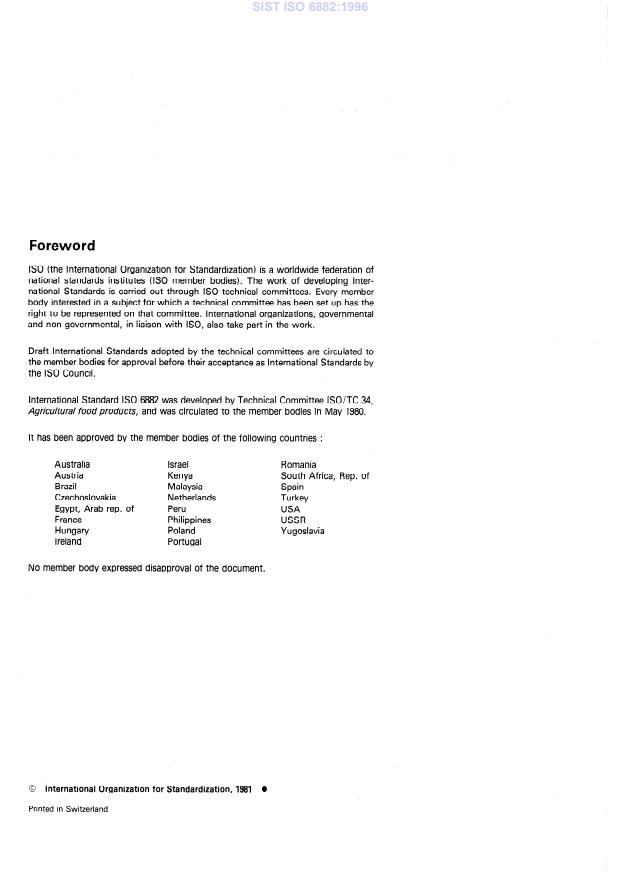
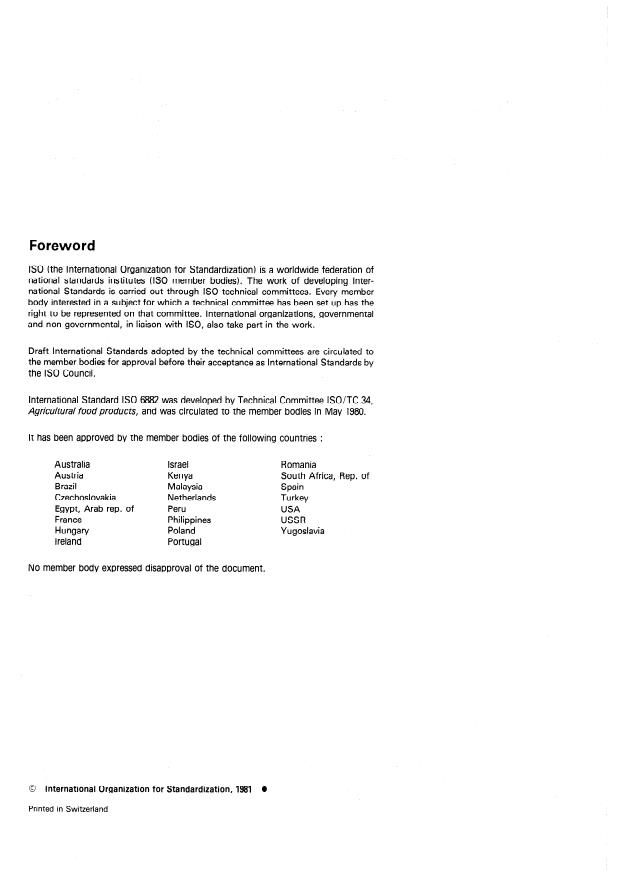
ISO (the International Organization for Standardization) is a worldwide federation of
national Standards institutes (ISO member bodies). The work of developing Inter-
national Standards is carried out through ISO technical committees. Every member
body interested in a subject for which a technical committee has been set up has the
right to be represented on that committee. International organizations, governmental
and non-governmental, in liaison with ISO, also take part in the work.
Draft International Standards adopted by the technical committees are circulated to
the member bodies for approval before their acceptance as International Standards by
the ISO Council.
International Standard ISO 6882 was developed by Technical Committee ISO/TC 34,
Agricultural food products, and was circulated to the member bodies in May 1980.
lt has been approved by the member bodies of the following countries :
Australia Israel Romania
Austria Kenya South Africa, Rep. of
Brazil Malaysia Spain
Czechoslovakia Netherlands Turkey
Egypt, Arab rep. of Peru USA
France Philippines USSR
Hungary Poland Y ugoslavia
Ireland Portugal
No member body expressed disapproval of the document.
0 International Organkation for Standardization, 1981
Printed in Switzerland
ISO 68824981 (EI
INTERNATIONALSTANDARD
Asparagus - Guide to ref rigerated transport
The relative humidity required during transport, i.e. 95 %, tan
1 Scope and field of application
only be maintained if Containers holding the shoots are lined
This International Standard describes methods for obtaining with perforated parchment Paper or plastic film, or if waxed
cardboard Containers lined with plastic film are used. The
conditions for the successful long distance transport of shoots
shoots may be layered either with or without bundling. Com-
of the species Asparagus officinalis Linnaeus, intended either
for direct consumption or for industrial processing. pletely closed Containers or plastic bags preventing Ventilation
should not be used as uncontrolled build up of carbon dioxide
and depletion of Oxygen may Cause darnage to the shoots. The
lt is not applicable to transportation over short distances or by
size of wooden or cardboard boxes should be sufficient for the
air; in these cases, refrigeration does not govern the quality.
shoots in bundles, but should prevent them from moving inside
during transit. (For asparagus shoots packed according to the
EEC product Standard, a nailed wooden box of dimensions
2 Reference
26 cm x 50 cm x 24 cm, fitted with a lid, may be used.)
I SO 4186, Asparagus - Guide to storage.
4 Transport
3 Preparation of the asparagus shoots for
transport
4.1 Optimum conditions for transport
At temperatures of + 1 OC and + 2 OC and at a relative
3.1 Harvesting
humidity of 95 %, the asparagus shoots tan only be kept for a
maximum of three we
...
International Standard 6882
INTERNATIONAL ORGANISATION FOR STANDARDIZATIONOME~YHAPOLZHAFI OPrAHM3A~MR fl0 CTAH~APTM3A~~~~ORGANtsATION INTERfwmoNALE DE NORMAL~SATION
Guide to refrigerated transport
Asparagus -
Asperges - Guide pour Ie transport refrig&
First edition - 1981-08-01
UDC 636.31 : 664.8.037
Ref. No. ISO68824981 (E)
Descriptors : agricultural products, vegetables, asparagus, transportation, refrigerating.
Price based on 2 pages
Foreword
ISO (the International Organization for Standardization) is a worldwide federation of
national Standards institutes (ISO member bodies). The work of developing Inter-
national Standards is carried out through ISO technical committees. Every member
body interested in a subject for which a technical committee has been set up has the
right to be represented on that committee. International organizations, governmental
and non-governmental, in liaison with ISO, also take part in the work.
Draft International Standards adopted by the technical committees are circulated to
the member bodies for approval before their acceptance as International Standards by
the ISO Council.
International Standard ISO 6882 was developed by Technical Committee ISO/TC 34,
Agricultural food products, and was circulated to the member bodies in May 1980.
lt has been approved by the member bodies of the following countries :
Australia Israel Romania
Austria Kenya South Africa, Rep. of
Brazil Malaysia Spain
Czechoslovakia Netherlands Turkey
Egypt, Arab rep. of Peru USA
France Philippines USSR
Hungary Poland Y ugoslavia
Ireland Portugal
No member body expressed disapproval of the document.
0 International Organkation for Standardization, 1981
Printed in Switzerland
ISO 68824981 (EI
INTERNATIONALSTANDARD
Asparagus - Guide to ref rigerated transport
The relative humidity required during transport, i.e. 95 %, tan
1 Scope and field of application
only be maintained if Containers holding the shoots are lined
This International Standard describes methods for obtaining with perforated parchment Paper or plastic film, or if waxed
cardboard Containers lined with plastic film are used. The
conditions for the successful long distance transport of shoots
shoots may be layered either with or without bundling. Com-
of the species Asparagus officinalis Linnaeus, intended either
for direct consumption or for industrial processing. pletely closed Containers or plastic bags preventing Ventilation
should not be used as uncontrolled build up of carbon dioxide
and depletion of Oxygen may Cause darnage to the shoots. The
lt is not applicable to transportation over short distances or by
size of wooden or cardboard boxes should be sufficient for the
air; in these cases, refrigeration does not govern the quality.
shoots in bundles, but should prevent them from moving inside
during transit. (For asparagus shoots packed according to the
EEC product Standard, a nailed wooden box of dimensions
2 Reference
26 cm x 50 cm x 24 cm, fitted with a lid, may be used.)
I SO 4186, Asparagus - Guide to storage.
4 Transport
3 Preparation of the asparagus shoots for
transport
4.1 Optimum conditions for transport
At temperatures of + 1 OC and + 2 OC and at a relative
3.1 Harvesting
humidity of 95 %, the asparagus shoots tan only be kept for a
maximum of three weeks in a condition suitable for consump-
Asparagus should be harvested at a development Stage cor-
tion. During transport therefore, these conditions need to be
responding to the quality requirements specified in the relevant
very carefully controlled, or if this is not possible, the length of
product Sta
...
Norme internationale
INTERNATIONAL ORGANIZATION FOR STANDARDIZATION.ME~YHAPO~HAR OPrAHM3A~MR fl0 CTAH~APTl43AL(Wl~RGANISATION INTERNATIONALE DE NORMALISATION
Guide pour le transport réfrigéré
Asperges -
Asparagus - Guide to refusera ted transport
Première édition - 1981-08-01
CDU 635.31 : 664.8.037
Réf. no : ISO6882-1981 (F)
G-
-
Descripteurs : produit agricole, légume, asperge, transport, réfrigération.
cn
Prix basé sur 2 pages
Avant-propos
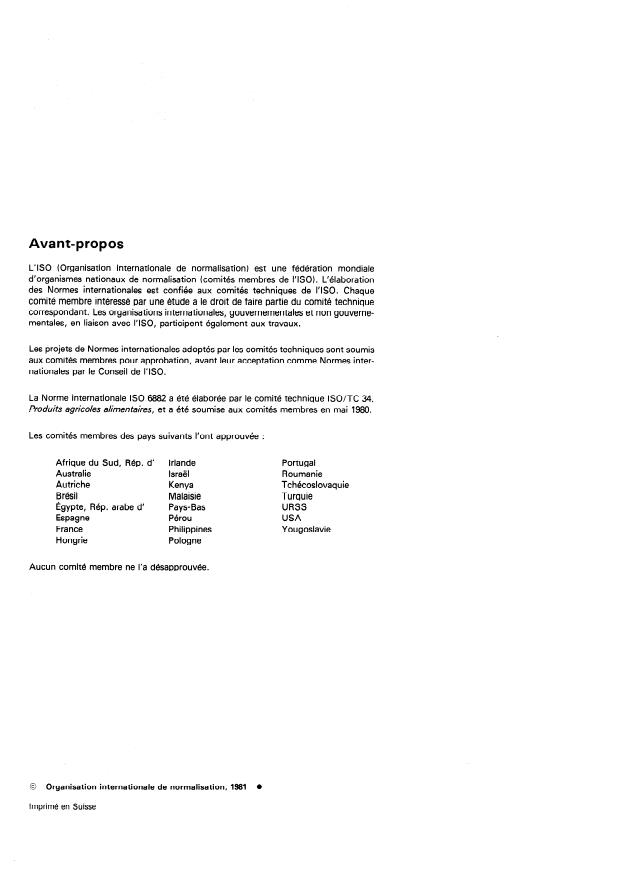
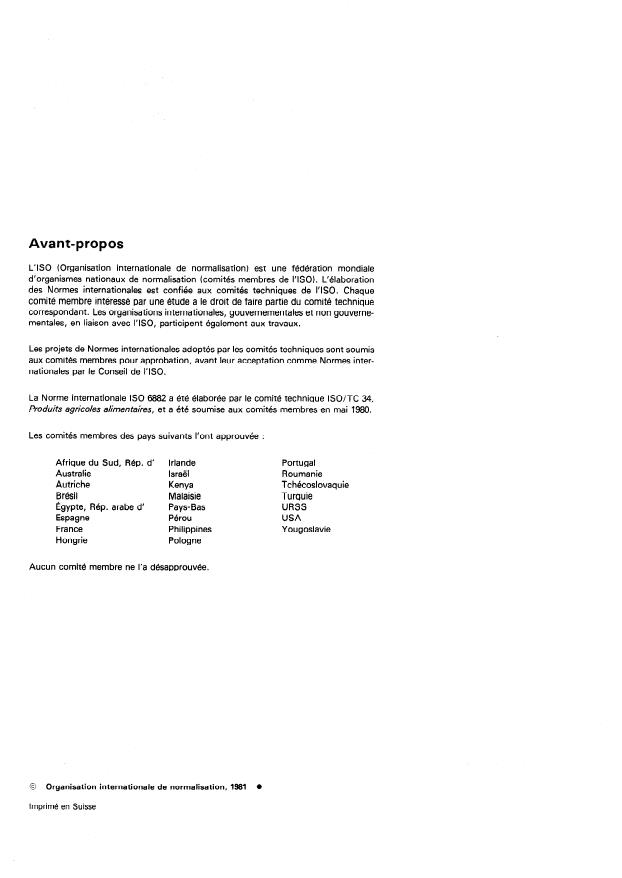
L’ISO (Organisation internationale de normalisation) est une fédération mondiale
d’organismes nationaux de normalisation (comités membres de I’ISO). L’élaboration
des Normes internationales est confiée aux comités techniques de I’ISO. Chaque
comité membre intéressé par une étude a le droit de faire partie du comité technique
correspondant. Les organisations internationales, gouvernementales et non gouverne-
mentales, en liaison avec I’ISO, participent également aux travaux.
Les projets de Normes internationales adoptés par les comités techniques sont soumis
aux comités membres pour approbation, avant leur acceptation comme Normes inter-
nationales par le Conseil de I’ISO.
La Norme internationale ISO 6882 a été élaborée par le comité technique ISO/TC 34,
Produits agrico/es alimentaires, et a été soumise aux comités membres en mai 1980.
Les comités membres des pays suivants l’ont approuvée :
Portugal
Afrique du Sud, Rép. d’ Irlande
Australie Israël Roumanie
Tchécoslovaquie
Autriche Kenya
Turquie
Brésil Malaisie
Pays- Bas URSS
Égypte, Rép. arabe d’
USA
Espagne Pérou
France Philippines Yougoslavie
Hongrie Pologne
Aucun comité membre ne l’a désapprouvée.
0 Organisation internationale de normalisation, 1981
Imprimé en Suisse
ISO 68824981 (F)
NORME INTERNATIONALE
Asperges - Guide pour le transport réfrigéré
lage doit être effectué de manière à conserver la qualité des
1 Objet et domaine d’application
asperges. Les bouts coupés des turions liés en gerbe peuvent
être enveloppés dans du papier de soie ou bien le gerbage
La présente Norme internationale décrit les conditions satisfai-
entier peut être placé dans un sachet en plastique perforé.
santes pour le transport réfrigéré à longue distance des turions
d’asperges de l’espèce Asparagus officinalis Linnaeus, destinés
L’humidité relative pendant le transport doit être de 95 %. Cela
soit à la consomm,ation directe, soit à une transformation
ne peut être maintenu que si l’emballage des turions est doublé
industrielle.
de papier imperméable perforé ou d’un film plastique perforé,
ou si des boîtes en carton paraffinées ou doublées de plastique
Elle n’est pas applicable au transport sur de courtes distances
sont utilisées. Les turions peuvent être mis dans l’emballage en
ou par avion; dans ces cas, la réfrigération n’améliore pas la
gerbes ou en vrac. Des emballages ou des sachets en plastique
qualité.
complètement étanches empêchant la ventilation ne doivent
pas être utilisés, parce que le dioxyde de carbone s’accumule et
que le manque d’oxygène peut endommager le produit. Les
Référence
caisses en bois ou les boîtes en carton doivent avoir des dimen-
sions suffisantes pour les turions liés en gerbe, mais elles doi-
ISO 4186, Asperges - Guide pour l’entreposage.
vent empêcher le déplacement des gerbes pendant le transit.
(Dans le cas de turions d’asperges emballés selon la norme de
3 Préparation des turions d’asperges pour le
produit de la CEE, une caisse en lamelles de bois, de dimen-
transport sions 26 cm x 50 cm x 24 cm, munie d’un couvercle, peut
être utilisée.)
3.1 Récolte
Les asperges doivent être récoltées dans un état de développe-
4 Transport
ment correspondant aux prescriptions de qualité de la norme de
produit les concernant. Les bourgeons terminaux doivent être
4.1 Conditions optimales pour le transport
serrés.
A une température de + 1 OC à + 2 OC et à une humidité rela-
3.2 Nettoyage, refroidissement, emballage
tive de 95 %, les turions d’asperges ne peuvent être entreposés
que pendant une durée maximale de trois semaines, pour rester
Les turions d’asperges doivent être débarrassés de la terre et du
bons
...
Norme internationale
INTERNATIONAL ORGANIZATION FOR STANDARDIZATION.ME~YHAPO~HAR OPrAHM3A~MR fl0 CTAH~APTl43AL(Wl~RGANISATION INTERNATIONALE DE NORMALISATION
Guide pour le transport réfrigéré
Asperges -
Asparagus - Guide to refusera ted transport
Première édition - 1981-08-01
CDU 635.31 : 664.8.037
Réf. no : ISO6882-1981 (F)
G-
-
Descripteurs : produit agricole, légume, asperge, transport, réfrigération.
cn
Prix basé sur 2 pages
Avant-propos
L’ISO (Organisation internationale de normalisation) est une fédération mondiale
d’organismes nationaux de normalisation (comités membres de I’ISO). L’élaboration
des Normes internationales est confiée aux comités techniques de I’ISO. Chaque
comité membre intéressé par une étude a le droit de faire partie du comité technique
correspondant. Les organisations internationales, gouvernementales et non gouverne-
mentales, en liaison avec I’ISO, participent également aux travaux.
Les projets de Normes internationales adoptés par les comités techniques sont soumis
aux comités membres pour approbation, avant leur acceptation comme Normes inter-
nationales par le Conseil de I’ISO.
La Norme internationale ISO 6882 a été élaborée par le comité technique ISO/TC 34,
Produits agrico/es alimentaires, et a été soumise aux comités membres en mai 1980.
Les comités membres des pays suivants l’ont approuvée :
Portugal
Afrique du Sud, Rép. d’ Irlande
Australie Israël Roumanie
Tchécoslovaquie
Autriche Kenya
Turquie
Brésil Malaisie
Pays- Bas URSS
Égypte, Rép. arabe d’
USA
Espagne Pérou
France Philippines Yougoslavie
Hongrie Pologne
Aucun comité membre ne l’a désapprouvée.
0 Organisation internationale de normalisation, 1981
Imprimé en Suisse
ISO 68824981 (F)
NORME INTERNATIONALE
Asperges - Guide pour le transport réfrigéré
lage doit être effectué de manière à conserver la qualité des
1 Objet et domaine d’application
asperges. Les bouts coupés des turions liés en gerbe peuvent
être enveloppés dans du papier de soie ou bien le gerbage
La présente Norme internationale décrit les conditions satisfai-
entier peut être placé dans un sachet en plastique perforé.
santes pour le transport réfrigéré à longue distance des turions
d’asperges de l’espèce Asparagus officinalis Linnaeus, destinés
L’humidité relative pendant le transport doit être de 95 %. Cela
soit à la consomm,ation directe, soit à une transformation
ne peut être maintenu que si l’emballage des turions est doublé
industrielle.
de papier imperméable perforé ou d’un film plastique perforé,
ou si des boîtes en carton paraffinées ou doublées de plastique
Elle n’est pas applicable au transport sur de courtes distances
sont utilisées. Les turions peuvent être mis dans l’emballage en
ou par avion; dans ces cas, la réfrigération n’améliore pas la
gerbes ou en vrac. Des emballages ou des sachets en plastique
qualité.
complètement étanches empêchant la ventilation ne doivent
pas être utilisés, parce que le dioxyde de carbone s’accumule et
que le manque d’oxygène peut endommager le produit. Les
Référence
caisses en bois ou les boîtes en carton doivent avoir des dimen-
sions suffisantes pour les turions liés en gerbe, mais elles doi-
ISO 4186, Asperges - Guide pour l’entreposage.
vent empêcher le déplacement des gerbes pendant le transit.
(Dans le cas de turions d’asperges emballés selon la norme de
3 Préparation des turions d’asperges pour le
produit de la CEE, une caisse en lamelles de bois, de dimen-
transport sions 26 cm x 50 cm x 24 cm, munie d’un couvercle, peut
être utilisée.)
3.1 Récolte
Les asperges doivent être récoltées dans un état de développe-
4 Transport
ment correspondant aux prescriptions de qualité de la norme de
produit les concernant. Les bourgeons terminaux doivent être
4.1 Conditions optimales pour le transport
serrés.
A une température de + 1 OC à + 2 OC et à une humidité rela-
3.2 Nettoyage, refroidissement, emballage
tive de 95 %, les turions d’asperges ne peuvent être entreposés
que pendant une durée maximale de trois semaines, pour rester
Les turions d’asperges doivent être débarrassés de la terre et du
bons
...