


SIST-TP CEN/TR 16598:2014
(Main)Collection of rationales for EN 1176 - Requirements
Collection of rationales for EN 1176 - Requirements
This Technical Report is intended to be read in conjunction with EN 1176.
The rationales given in this Technical Report describe the main reasons behind the requirements given in EN 1176. The requirements in the standard are the tools (e.g. measures, testing methods etc.) by which the objectives are intended to be reached.
Sammlung von grundsätzlichen Überlegungen zur EN 1176 – Anforderungen
Recueil d'exposés des motifs concernant l'EN 1176 - Exigences
Le présent Rapport technique est destiné à être lu conjointement avec l’EN 1176.
Les justifications exposées dans le présent Rapport technique décrivent les principales raisons qui sous tendent les exigences spécifiées dans l’EN 1176. Les exigences de la norme sont les outils (par exemple, dimensions, méthodes d’essai, etc.) par le biais desquels les objectifs sont supposés être atteints.
Zbirka osnovnih utemeljitev za EN 1176 - Zahteve
General Information
- Status
- Withdrawn
- Publication Date
- 12-Mar-2014
- Withdrawal Date
- 04-Mar-2026
- Technical Committee
- SPO - Sports
- Current Stage
- 9900 - Withdrawal (Adopted Project)
- Start Date
- 04-Mar-2026
- Due Date
- 27-Mar-2026
- Completion Date
- 05-Mar-2026
- Directive
- Not Harmonized2001/95/EC - General product safety
Relations
- Effective Date
- 01-Oct-2023
- Effective Date
- 28-Jan-2026
- Effective Date
- 28-Jan-2026
- Effective Date
- 28-Jan-2026
- Effective Date
- 28-Jan-2026
- Effective Date
- 28-Jan-2026
- Effective Date
- 28-Jan-2026
- Effective Date
- 28-Jan-2026
- Effective Date
- 28-Jan-2026
- Effective Date
- 28-Jan-2026
- Effective Date
- 28-Jan-2026
- Effective Date
- 28-Jan-2026
- Effective Date
- 28-Jan-2026



Frequently Asked Questions
SIST-TP CEN/TR 16598:2014 is a technical report published by the Slovenian Institute for Standardization (SIST). Its full title is "Collection of rationales for EN 1176 - Requirements". This standard covers: This Technical Report is intended to be read in conjunction with EN 1176. The rationales given in this Technical Report describe the main reasons behind the requirements given in EN 1176. The requirements in the standard are the tools (e.g. measures, testing methods etc.) by which the objectives are intended to be reached.
This Technical Report is intended to be read in conjunction with EN 1176. The rationales given in this Technical Report describe the main reasons behind the requirements given in EN 1176. The requirements in the standard are the tools (e.g. measures, testing methods etc.) by which the objectives are intended to be reached.
SIST-TP CEN/TR 16598:2014 is classified under the following ICS (International Classification for Standards) categories: 97.200.40 - Playgrounds. The ICS classification helps identify the subject area and facilitates finding related standards.
SIST-TP CEN/TR 16598:2014 has the following relationships with other standards: It is inter standard links to SIST-TP CEN/TR 16598:2023, SIST EN 1176-6:2018, SIST EN 1176-3:2018, SIST EN 1176-2:2018+AC:2019, SIST EN 1176-1:2018+A1:2024, SIST EN 1176-4:2018+AC:2019, SIST EN 1176-7:2020, SIST EN 1176-5:2019, SIST EN 1176-4:2018, SIST EN 1176-2:2018, SIST EN 1176-11:2014, SIST EN 1176-10:2023, SIST EN 1176-6:2018+AC:2019. Understanding these relationships helps ensure you are using the most current and applicable version of the standard.
SIST-TP CEN/TR 16598:2014 is associated with the following European legislation: EU Directives/Regulations: 2001/95/EC. When a standard is cited in the Official Journal of the European Union, products manufactured in conformity with it benefit from a presumption of conformity with the essential requirements of the corresponding EU directive or regulation.
SIST-TP CEN/TR 16598:2014 is available in PDF format for immediate download after purchase. The document can be added to your cart and obtained through the secure checkout process. Digital delivery ensures instant access to the complete standard document.
Standards Content (Sample)
SLOVENSKI STANDARD
01-april-2014
Zbirka osnovnih utemeljitev za EN 1176 - Zahteve
Collection of rationales for EN 1176 - Requirements
Sammlung von grundsätzlichen Überlegungen zur EN 1176 – Anforderungen
Recueil d'exposés des motifs concernant l'EN 1176 - Exigences
Ta slovenski standard je istoveten z: CEN/TR 16598:2014
ICS:
97.200.40 ,JULãþD Playgrounds
2003-01.Slovenski inštitut za standardizacijo. Razmnoževanje celote ali delov tega standarda ni dovoljeno.
TECHNICAL REPORT
CEN/TR 16598
RAPPORT TECHNIQUE
TECHNISCHER BERICHT
February 2014
ICS 97.200.40
English Version
Collection of rationales for EN 1176 - Requirements
Recueil d'exposés des motifs concernant l'EN 1176 - Sammlung von grundsätzlichen Überlegungen zur EN 1176
Exigences - Anforderungen
This Technical Report was approved by CEN on 30 September 2013. It has been drawn up by the Technical Committee CEN/TC 136.
CEN members are the national standards bodies of Austria, Belgium, Bulgaria, Croatia, Cyprus, Czech Republic, Denmark, Estonia,
Finland, Former Yugoslav Republic of Macedonia, France, Germany, Greece, Hungary, Iceland, Ireland, Italy, Latvia, Lithuania,
Luxembourg, Malta, Netherlands, Norway, Poland, Portugal, Romania, Slovakia, Slovenia, Spain, Sweden, Switzerland, Turkey and United
Kingdom.
EUROPEAN COMMITTEE FOR STANDARDIZATION
COMITÉ EUROPÉEN DE NORMALISATION
EUROPÄISCHES KOMITEE FÜR NORMUNG
CEN-CENELEC Management Centre: Avenue Marnix 17, B-1000 Brussels
© 2014 CEN All rights of exploitation in any form and by any means reserved Ref. No. CEN/TR 16598:2014 E
worldwide for CEN national Members.
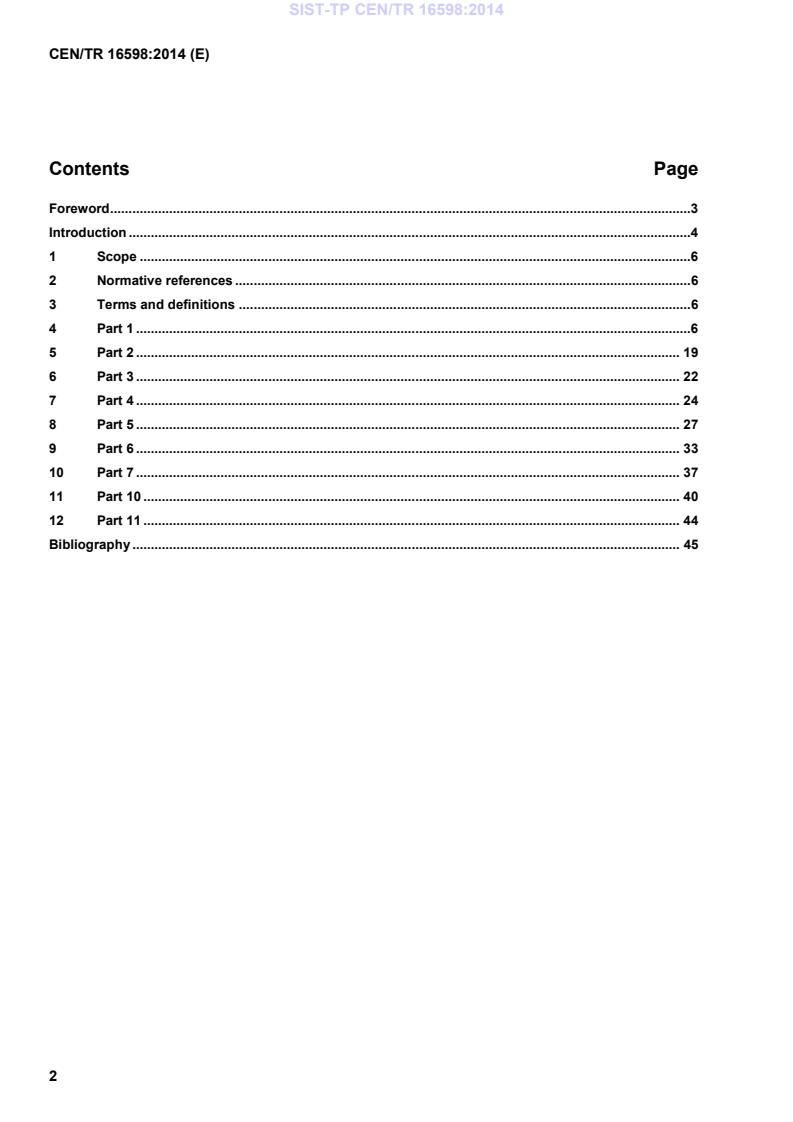
Contents Page
Foreword .3
Introduction .4
1 Scope .6
2 Normative references .6
3 Terms and definitions .6
4 Part 1 .6
5 Part 2 . 19
6 Part 3 . 22
7 Part 4 . 24
8 Part 5 . 27
9 Part 6 . 33
10 Part 7 . 37
11 Part 10 . 40
12 Part 11 . 44
Bibliography . 45
Foreword
This document (CEN/TR 16598:2014) has been prepared by Technical Committee CEN/TC 136 “Sports,
playground and other recreational facilities and equipment”, the secretariat of which is held by DIN.
Attention is drawn to the possibility that some of the elements of this document may be the subject of patent
rights. CEN [and/or CENELEC] shall not be held responsible for identifying any or all such patent rights.
Introduction
The intention of the safety standard for playground equipment was to avoid situations in which a child, due to
his age or ability or stage of development, is unable to comprehend a risk.
It was the intention to eliminate traps and risks from which severe harm could occur for the user.
In consideration of this, the task group choose the form of a report in which the objective mentions repeatedly
that the aim of the standard is always to protect the child from harm.
It has become apparent that users of the standard have sometimes lost sight of this and were just considering
dimensions, functionality or spaces and special equipment parts without regard for the safety aim.
When considering the complexity of an equipment and the efforts to provide safety, these efforts should be
proportionate to the incidents that take place in real life.
Dimensions should not be taken as absolute as juristic and safety treatments are different in relation to the
risk of a deviation from the standard.
A large number of the objectives for the rationales are repeated. This is intentional as it reinforces the safety
aim of the standard and prevents the misunderstanding of a rationale when taken in isolation.
Working on the rationales for the single paragraphs, it became obvious for the task group that there where
parts in the standard which had been discussed very often and deeply (e.g. the damping qualities of surfaces,
HIC) and there were other parts that had no or very little discussions (e.g. hard edges at the end of a falling
space).
Noticing this it was nearly self-evident to have an assessment / evaluation proposal for all requirements:
a) fundamental safety issues:
1) safety installations / regulations have to prevent situations that may cause the death of a user;
2) safety installations / regulations have to prevent situations that may lead to a loss of extremities of a
user;
3) safety installations / regulations have to prevent situations that may cause a lifetime disability
(blindness, paraplegia);
4) safety installations / regulations have to prevent situations in which a user is not able to free himself
out of a trap;
b) basic safety issues:
1) safety installations / regulations should prevent situations which overburden the user according to his
age and prevent accidents like bone fractures, bruises, abrasions although these injuries happen in
everyday life as well and are accepted by society as things that may happen to a human being;
c) standard issues:
1) man-made playground equipment is necessary because the city environments don’t offer natural play
facilities. Therefore, this kind of equipment is meant to advance the development of the child.
As there are very different development levels during childhood it means that the equipment has to be
engineered in such a tricky way that it supports the several stages of development and screens the different
age groups.
At least it should be mentioned that the requirements of the standard are just a concern about the effect of an
equipment on the user. They do not consider the necessity and the social impact of a playground e.g. in areas
where children have no natural resources with which they could play.
The standard cannot account for the behaviour of children. The ideal is that children should use the play
environment as a means of personal development. However, it is accepted that the behaviour of children
cannot be controlled by a technical standard. The best way to deal with this is to adopt a Risk Assessment
process, which will allow the behaviour of children to be considered as part of the inspection of the play
environment.
Risk Assessment has to take into account the competence and ability of the potential users of the equipment
and the foreseeable risks to those users. It is possible to allow greater challenge and opportunity in play
equipment by controlling access to equipment, the control of access has to take in to account the abilities and
skills of the user. The standard lists some ways in which access can be controlled.
It is not possible to control the way in which parents or carers may influence the use of play equipment, in
particular if they allow, encourage or assist children to overcome controls on access imposed by the designer.
The task group did not review the annexes of the different parts of the standard EN 1176; even though these
contain wording that can be considered to be hidden requirements.
Again, it turns out to be true that there is no overlapping with EN 71-8.
1 Scope
This Technical Report is intended to be read in conjunction with EN 1176.
The rationales given in this Technical Report describe the main reasons behind the requirements given in
EN 1176. The requirements in the standard are the tools (e.g. measures, testing methods etc.) by which the
objectives are intended to be reached.
2 Normative references
The following documents, in whole or in part, are normatively referenced in this document and are
indispensable for its application. For dated references, only the edition cited applies. For undated references,
the latest edition of the referenced document (including any amendments) applies.
EN 1176 (all parts), Playground equipment and surfacing
3 Terms and definitions
For the purposes of this document, the following terms and definitions apply.
3.1
objective
what is the intention of the clause in the standard
3.2
risk
what might happen to the user if the objective is not achieved
3.3
rationale
the reason for making this specific requirement
Note 1 to entry: Often you will find rationales in the notes given in the requirements. This is mentioned in the document.
3.4
addendum
additional comments as well as remarks
4 Part 1
4.1 Paragraph in Standard: 4.1.2 Flammability
Objective To avoid burning – particularly from those materials which produce flaming droplets of molten
material which are difficult to extinguish.
Risk
In the event of a flash fire there is insufficient time to intervene and protect the user. The
outcome of a fire may be death or disfigurement.
Rationale The correct selection of materials to ideally prevent this occurring or allow escape from the
equipment.
4.2 Paragraph in Standard: 4.1.3 Timber and associated products
Objective protect the user from harm as a result of unforeseen failure of equipment due to decay of
wooden parts.
a) wood is a natural material and will decay with time, sufficient attention shall be paid to its design;
protection and maintenance to ensure that structures made of wood are safe especially between
maintenance cycles;
b) wood can splinter;
c) hazards from species and treatment of wood.
Risk
a) unforeseen failure of equipment;
b) puncture injuries, eye injuries;
c) allergic reaction, it is considered unlikely that poisoning by ingestion will occur.
Rationale
a) following the requirements of the standard the possibility of failure of the equipment can be controlled
within the maintenance intervals;
b) and c) the selection of the wood type can reduce or eliminate this risk.
Addendum wood as a natural material will crack as part of the drying process; this does not necessarily
present a dangerous situation.
4.3 Paragraph in Standard: 4.1.4 Metals
Objective protect the user from harm as a result of unforeseen failure of equipment due to corrosion of
metal parts.
Risk injury may occur due to unforeseen failure of metal components.
Rationale
a) metals, either as a structural component or as an auxiliary component, can corrode either due to
atmospheric conditions or by electrochemical reaction; sufficient attention shall be paid to its design;
protection and maintenance to ensure that structures made of metal are safe, especially between
maintenance cycles;
b) metals that produce toxic oxidation shall be coated.
4.4 Paragraph in Standard: 4.1.5 Synthetics
Objective protect the user from harm as a result of unrecognized failure of equipment due to aging or
breaking of synthetic materials.
Risk reinforced materials can produce splinters and cuts; static supporting parts may break.
Rationale use of coloured gelcoats to indicate wear and maintenance according to intervals given by the
manufacturer can prevent the risk.
4.5 Paragraph in Standard: 4.1.6 Dangerous substances
Objective protect the user from harm as a result of being exposed to dangerous substances.
Risk poisoning by skin contact; poisoning by mouth contact; chemical burns.
Rationale following the guidelines given in different standards can reduce the risk.
4.6 Paragraph in Standard: 4.2.1 (Design and manufacture) General
Objective protect the user groups from excessive demands.
Risk false estimation of equipment use.
Rationale play always includes risks (see the introduction to the standard). The intended user shall be
able to use the equipment according to his mental and physical stage of development without getting in
trouble caused by the equipment.
Remark the German translation does not completely correspond to the English original text.
4.7 Paragraph in Standard: 4.2.2 Structural integrity
Objective protect the user from harm as a result of breaking down of the used equipment.
Risk severe injuries may occur if a play structure or parts of it collapse during use.
Rationale equipment designed according to the methods described will be structurally suitable.
There may be cases where experience or tradition will ensure the integrity of the equipment.
Calculation has to be done under “worst case scenario”.
More attention shall be given to single post equipment, as these constructions may fail more easily than
equipment based on more than two posts in a line.
Corrosion or rotting can make the single post construction break under use.
4.8 Paragraph in Standard: 4.2.3 Accessibility for adults
Objective children in dangerous, distressed or panic situations should always have the possibility to get
help from grown ups.
Risk children may become trapped or pass out.
Rationale grown ups should be able to help children in dangerous or panic situations. Children should be
able to leave an equipment safely when danger occurs.
In case of fire help from grown ups and escaping should be possible. Leaving the equipment shall always be
possible.
4.9 Paragraph in Standard: 4.2.4.1 (Protection against falling) Types of protection
Objective protect the user from falls in accordance with the competence of the user and the type and
height of the equipment.
Risk injuries from uncontrolled falls off the equipment.
Rationale falls are one of the main sources for severe injuries.
Addendum There are equipment which are accessible for children of all ages (easily accessible - lower risk)
and there are equipment which are difficult to access for young children (not easily accessible – higher risk).
4.10 Paragraph in Standard: 4.2.4.2 Handrails
Objective provide users with the means of maintaining balance while using the equipment.
Risk injuries caused by falling due losing hold caused by losing balance.
Rationale falls are one of the main sources for severe injuries.
Offering a grasp position helps to keep balance.
Addendum the difference between grip and grasp means:
The grip position (closed fist) can support the body even when the user is in a hanging position, the grasp
position (thumb not in contact with the other fingers) is more likely to secure balance.
600 mm comes from the anthropometrical data (centre of gravity).
4.11 Paragraph in Standard: 4.2.4.3 Guardrails
Objective protect users form falling off lower platforms.
Risk injuries caused by falling off the equipment; falling underneath or over a guardrail.
Rationale falls are one of the main sources for severe injuries. Provide a range of dimensions in which
guardrails reduce the risk from falling off not easily accessible lower platforms.
4.12 Paragraph in Standard: 4.2.4.4 Barriers
Objective protect users from falling off higher and/or easily accessible platforms. Protect users from head
entrapment situations.
Risk injuries caused by falling off the equipment or becoming trapped within or underneath the barrier.
Rationale falls are one of the main sources for severe injuries. Head entrapment shall be prevented.
Climbing and/or sitting on barriers shall be prevented.
If there are any gaps in barriers they shall be designed in such a way to prevent these risks.
4.13 Paragraph in Standard: 4.2.4.5 Strength requirements
See 4.2.2.
4.14 Paragraph in Standard: 4.2.4.6 Grip requirements
Objective ensure that where necessary a suitable and safe hold for the users hand is possible.
Risk falling due to an unsafe hold for the hands of the user, losing grip may result in falling off the
equipment.
Rationale a safe hold enables the user to secure himself (during slower movement on the equipment).
E.g. While climbing a 3-dimensional grip provides a better possibility to secure himself.
Addendum the difference between grip and grasp means:
The grip position (closed fist) can support the body even when the user is in a hanging position, the grasp
position (thumb not in contact with the other fingers) is more likely to secure balance.
The measures are taken from the anthropometrical data of children.
4.15 Paragraph in Standard: 4.2.4.7 Grasp requirements
Objective ensure that where necessary a suitable and safe hold for the users hand is possible.
Risk falling due to an unsafe hold for the hands of the user, losing grip may result in falling off the
equipment.
Rationale the possibility of grasping a bar keeps the balance during faster movement on the equipment.
E.g. while running across a bridge a grasp provides enough hold to keep the balance.
Addendum see 4.2.4.6.
4.16 Paragraph in Standard: 4.2.5 Finish of equipment
Objective protect the user from harm as a result of sharp, splintered or spiky parts.
Risk injuries caused by wooden splinters, sharp edges or spiky pieces.
Rationale unintended contact with surfaces or parts of the equipment shall not lead to injuries.
Addendum sharp is not a sufficient criteria to cause harm, it is the combination of sharp and hard that
causes danger.
4.17 Paragraph in Standard: 4.2.6 Moving parts
Objective protect the users body and limbs from getting caught or being pinched / sheared.
Risk moving equipment parts could shear or pinch parts of the users body especially when those parts are
heavy and have high energy (W = m*s).
Rationale The construction shall be done in such a way that the critical body measures are observed as
minimum limits.
400 mm is an agreed measure (not related to anthropometrical data) to allow sufficient space for ground
clearance.
4.18 Paragraph in Standard: 4.2.7.1 (Protection against entrapment) General
Objective protect the user from harm as a result of dimensional changes in equipment during use leading
to traps.
Risk strangulation or entrapment situations in which the user can’t free himself.
Rationale before this paragraph of the standard had been given fatal accidents occurred.
Materials / structures can change shape during use as a result of loading, temperature etc.
This shall be considered during the design process.
4.19 Paragraph in Standard: 4.2.7.2 Entrapment of the head and neck
Objective protect the users head and neck from harm as a result of being trapped by openings within the
equipment.
Risk breaking the neck, strangulation, shearing or crushing of neck or head.
Rationale As a fundamental safety issue the users head and neck shall be protected.
Above 600 mm above ground the risk of head traps shall be prevented because head traps can lead to
strangulation or other significant injuries.
Below 600 mm the user can stand on the ground or platform and can support his body weight.
Shearing and crushing points (regardless of height above the ground) present nearly the same severity of
injury as entrapment to the neck/head and shall be prevented.
Addendum It should be noted that entrapment itself does not necessarily constitutes a dangerous situation.
However movement in entrapped situations creates a potential for injuries.
4.20 Paragraph in Standard: 4.2.7.3 Entrapment of clothing/hair
Objective protect the user from harm as a result of the users clothing or hair being trapped by parts of the
equipment.
Risk fatal or severe injuries and accidents in particular strangulation or scalping.
Rationale A number of fatalities and severe injuries have occurred where children were strangled, pulled
into moving equipment or caught on clothing around their necks. Due to the very short time available for
intervention it is essential that these situations are eliminated.
Children died when the cords of their parkas were caught in the starting section of slides.
Same happened when children fell off a platform with a climbing pole.
4.21 Paragraph in Standard: 4.2.7.4 Entrapment of the whole body
Objective prevent children from being trapped in tunnels or being crushed between or under equipment
parts.
Risk tunnel may cause traps from which children cannot escape and can panic; heavy moving parts may
crush the user.
Rationale children shall be able to leave an equipment without help. But help from adults shall also be
possible.
Injuries caused by heavy moving parts shall be prevented.
Measurements from Table 1 are agreed dimensions and based on experience.
4.22 Paragraph in Standard: 4.2.7.5 Entrapment of the foot or leg
Objective protect users feet and legs from being trapped.
Risk entrapped feet causes falls or fracture of leg or foot.
Rationale Gaps and openings in the running surface or in climbing surfaces shall be designed in such a
way that they cannot entangle the foot.
The 30 mm dimension from Figure 13 is taken in the direction of travel. This is because the foot (ankle) can
rotate into the opening.
4.23 Paragraph in Standard: 4.2.7.6 Entrapment of fingers
Objective protect users fingers from being trapped.
Risk when the user falls from a height of more than 1 m above the standing position or undergoes a
forced movement an entrapped finger may get fractured or amputated. Crushing of fingers may occur
between moving parts.
Rationale accidents have occurred and those openings shall be prevented.
The 8 mm finger probe describes the situation that a finger cannot get into an opening, the 25 mm finger
probe guarantees that a finger can get out under nearly any circumstance, the requirement for 12 mm
clearance between moving parts guarantees that the finger up to the knuckle is not being crushed.
Dimensions are taken from anthropometrical data.
4.24 Paragraph in Standard: 4.2.8.1 (Protection against injuries during movement and falling)
Determination of free height of fall
Objective protect the user from harm as a result of falling off the equipment.
Risk falls are causing most of the injuries from fractures to concussions on playgrounds.
Rationale falls from equipment in order not to be harmful and cause severe injuries shall be controlled.
3 m falling height (3 m food support / 4 m hand support) are agreed maximum falling heights.
4.25 Paragraph in Standard: 4.2.8.2.1 (Determination of spaces and areas) General
No need for rationale.
4.26 Paragraph in Standard: 4.2.8.2.2 Minimum space
Objective this is actual a definition (see 3.8).
Risk not applicable.
Rationale To fulfil the requirements for creating standards this paragraph has been added.
Otherwise there would have been a definition without a requirement.
4.27 Paragraph in Standard: 4.2.8.2.3 Free space
Objective protect the user from harm during a forced movement on the equipment.
Risk while undergoing a forced movement the user could be injured or entrapped by parts that extend into
the space the body of the user passes through.
Rationale The cylinder method allows the easy test of the construction regarding forced movement.
The cylinder method helps to design the free space for a safe use of equipment with forced movement.
The dimension of 350 mm minimum clearance between climbing poles and adjacent platforms is valid only for
the starting platform; elsewhere the cylinder method has to be used.
4.28 Paragraph in Standard: 4.2.8.2.4 Extend of the impact area
Objective protect the user from harm as a result of unintended falls to the ground from the equipment.
Risk severe injuries can occur when falling on not defined surfaces especially when the user gets
additional speed from the equipment.
Rationale when leaving an equipment with additional movement falls on hard ground can be dangerous to
the user.
Therefore, the extent and the quality of the impact area shall be controlled.
4.29 Paragraph in Standard: 4.2.8.2.5 Extend of the falling space
Objective protect the user from harm as a result of unintended falls to the ground from the equipment.
Risk falling off an equipment may cause severe injuries if the ground is not damped.
Rationale falling space minimum measures shall reduce the possibility that the user suffers severe injuries
in case of falling. Falling spaces including impact areas may overlap as the likelihood of two users
unintentionally falling into the same space at the same time is very low.
Falling spaces and frees spaces should not overlap as collisions between users undergoing forced movement
may cause severe injuries.
4.30 Paragraph in Standard: 4.2.8.3 Protection against injuries in the free space for users
undergoing a movement that is forced by the equipment
Objective protect the user from harm as a result of using an equipment with forced movement.
Risk obstacles or equipment parts in the free space may cause severe injuries as the user cannot avoid
collision with these during the movement.
Rationale the user cannot stop the movement. Minimum measures in the operating space shall reduce the
possibility that the user gets injuries during the use of the equipment.
4.31 Paragraph in Standard: 4.2.8.4 Protection against injuries in the falling space
Objective protect the user from harm during a fall from the equipment but before hitting the playground
surface.
Risk obstacles or equipment parts in the falling space may cause severe injuries as the user cannot avoid
collision during the fall – self-protection is not possible.
Rationale the requirements of the falling space shall reduce the possibility that the user gets severe
injuries during a fall off the equipment.
4.32 Paragraph in Standard: 4.2.8.5.1 (Protection against injuries from the surface of the
impact area) General
Objective protect the user from harm as a result of falling onto an impact absorbing surface which is itself
hazardous or from insufficient loose fill surface due to displacement.
Risk obstacles or sharp edged parts in the impact absorbing surface may cause severe injuries as the
user cannot sidestep during the impact.
Traps at the end of the impact absorbing surface may cause falls.
Rationale the impact should be distributed over as large an area as possible and not concentrated on one
point (=spike) or line (=sharp).
Maintenance is important for removing sharp or spiky parts in or on the impact absorbing surface.
Minimum measures for the thickness of the impact absorbing surface shall guarantee that falls of the user
follow defined conditions.
Addendum Maintenance is a fundamental safety issue on playgrounds.
The effect of hard or sharp objects lying on a rubber surface is more severe for the user than on loose fill.
Therefore the maintained interval for rubber should be shorter. This is not to criticize rubber surfaces but to
draw attention to need for specific knowledge relating to maintenance and installation.
4.33 Paragraph in Standard: 4.2.8.5.2 Equipment with a free height of fall greater than
600 mm or with forced movement
Objective protect the user from harm as a result of falling onto an impact area from a platform higher than
600 mm above ground or from equipment with forced movement.
Risk severe injuries caused by falls onto inappropriate impact absorbing surface.
Rationale minimum measures for the thickness and quality of the impact absorbing surface shall guarantee
that falls of the user follow defined conditions.
Remark the examples for forced movement named in brackets includes rocking equipment.
The authors don’t feel well with this.
The typical characteristics of forced movement do not apply to all types (in particular type 2a and 2b) because
the intensity of rocking can be stopped by the user in a very short time.
4.34 Paragraph in Standard: 4.2.8.5.3 Equipment with a free height of fall not exceeding
600 mm and without forced movement
Objective no objective.
Risk not applicable.
Rationale applicable.
4.35 Paragraph in Standard: 4.2.8.5.4 Adjacent platforms
Objective protect the user from harm as a result of falling from a platform higher than 1 m above another
platform.
Risk severe injuries caused by falls on a hard surface.
Rationale demanding the quality of the impact absorbing surface shall guarantee that falls of the user
follow defined conditions.
1 m is an agreed measure.
4.36 Paragraph in Standard: 4.2.8.6 Protection against injuries due to other types of
movement
Objective protect the user from harm as a result of moving in, on or around an equipment.
Risk injuries caused by running against equipment parts or fall onto equipment parts.
Rationale unexpected obstacles shall not be in the moving space of the user.
4.37 Paragraph in Standard: 4.2.9.1 (Means of access) Ladders
Objective protect the user from harm as a result of climbing a ladder.
Risk falls from a ladder causing severe injuries, traps may occur which cause falls with severe injuries.
Rationale head may get entrapped in openings between rungs, loose cross bars or rungs prevent secure
grip which may result in fall, unequal spacings between rungs may cause stumbling and/or falling, little space
behind the rungs may prevent that the foot can hold balance on the rung.
Keep the users balance on a ladder prevents uncontrolled falls from a ladder.
The 90 mm measures the shoe of the user in average and shall be related to the head probe (probe shall not
get in!), the ± 3° is agreed.
4.38 Paragraph in Standard: 4.2.9.2 Stairs
Objective protect the user from harm as a result of using a stair.
Risk falls from a stair causing injuries, traps may occur which cause falls with injuries.
Rationale if the stand on a tread of a stair is not protected by a guardrail or barrier, the user might fall off
the stairs.
If the handrail does not fit the ergonomic measures of the children, keeping balance is more difficult and the
user might fall.
Unequal spacings between the treads may cause stumbling and/or falling, insufficient space behind the rungs
may prevent the foot keeping balance on the rung.
Keep the users balance on a stair prevents falls from a stair.
Measures are agreed (partly taken from other standards and regulations).
Addendum The requirement for at least three treads is a question of defining what is a stair and not a safety
issue.
4.39 Paragraph in Standard: 4.2.9.3 Ramps
Objective protect the user from harm as a result of falling off or onto a ramp.
Risk falls onto or off a ramp may cause injuries.
Rationale ramps inclined more than 38° (agreed measure) cannot be used in an upright bodyposition and
falls may occur.
If ramps were not protected by guardrails or barriers, the user might fall off the ramp. Keep the users balance
on a ramp prevents falls from or onto a ramp.
4.40 Paragraph in Standard: 4.2.9.4 Steep play elements
Objective protect the user from harm as a result of falling through the access opening of a steep element
and to allow openings in barriers / guardrails.
Risk fall through the access opening of the steep play element on the platform.
Rationale the requirement is valid for easily accessible platforms / platform parts combined with steep
elements. Limiting the width of the access opening reduces the risk of falls through the opening.
Limiting the target platform height to 2 m enables grown ups to provide help if needed.
4.41 Paragraph in Standard: 4.2.9.5 Easily accessible playground elements
This clause contains no requirements but gives information and examples about means of easy access.
4.42 Paragraph in Standard: 4.2.10 Connections
Objective protect the user from harm as a result of collapsing equipment parts.
Risk falls or other injuries can occur.
Rationale loosening of connecting parts may cause a collapse of equipment parts or the equipment itself.
Under use this situation could be dangerous for the users. Secured connection parts ensure integrity of the
equipment between maintenance intervals.
4.43 Paragraph in Standard: 4.2.11 Consumable components
Objective protect the user from harm as a result of loosened equipment parts (loosened by user).
Risk falls or other injuries can occur.
Rationale loosened parts may cause a collapse of equipment parts or the equipment itself.
Under use this situation could be dangerous for the users.
Secured connection parts ensure integrity of the equipment between maintenance intervals.
4.44 Paragraph in Standard: 4.2.12.1 (Ropes) Ropes fixed at one end
Objective protect the user from harm as a result of uncontrolled collision with equipment parts, prevent
noose and as a result - strangulation.
Risk uncontrolled collisions; strangulations; uncontrolled dangerous moments.
Rationale as climbing on ropes means the user may rotate and swing with the rope, uncontrolled collisions
with equipment parts may occur.
Strangulation may be possible when ropes are soft (and thin) or fastened too near to adjacent parts of the
equipment.
Interference with swings in the same bay could cause dangerous moments by allowing the user to enter the
path of the swing.
Good grip shall be provided to make climbing easier, minimum clearance between the rope and adjacent parts
prevent the risk of collision.
A stiff rope prevents the risk of making nooses and getting strangulated. Measures are agreed.
The diameters 25 mm and 45 mm are a compromise between grip function and safety issues. (see also
4.2.4.6).
Small rope diameter = small nooses, large rope diameter = large nooses.
4.45 Paragraph in Standard: 4.2.12.2 Ropes fixed at both ends (climbing ropes)
Objective protect the user from harm as a result of uncontrolled collision with equipment parts, prevent
noose and as a result – strangulation.
Risk strangulations.
Rationale strangulation may be possible when ropes connected at both ends are soft and too long.
The same risk occurs when the rope is fixed too near to an adjacent element of the play structure.
Good grip shall be provided to make climbing easier, minimum clearance between the rope and adjacent parts
prevent the risk of strangulation. A stiff rope prevents the risk of making nooses and getting strangulated.
4.46 Paragraph in Standard: 4.2.12.3 Wire ropes
Objective protect the user from harm as a result of corroding and collapsing steel wires and of protruding
single wires as well as of unstable play structures.
Risk dangers from structure failures due to collapsing wire ropes.
Rationale corroding wires may break under the load of the user, protruding single steel wires at the end of
ferrules may penetrate or cut the skin, turnbuckles which can be opened by the user may lead to a unstable
status of the play structure.
Unstable play structures or - under user load - breaking parts of the equipment shall be prevented.
4.47 Paragraph in Standard: 4.2.12.4 Sheathed wire ropes
Objective protect the user from harm as a result of slipping off a coated steel rope.
Risk skin cuts; falls due to loosing grip on a rope.
Rationale monofilament coated steel wires bear the risk that during climbing or slipping off the rope, the
skin is cut by the monofilaments.
If each steel cord is not coated with synthetic or natural fibres, the coating may slip on the steel core and thus
prevent secure grip on the rope; and the coating will wear much faster.
Braided steel ropes prevent the risk of skin cuts.
This clause is not in isolation but should be re-read in conjunction with Clause 4.2.12.3.
4.48 Paragraph in Standard: 4.2.12.5 Fibre ropes (textile type)
Objective protect the user from harm as a result of falling from a breaking textile rope.
Risk falls due to breaking ropes, cuts and abrasions.
Rationale textile ropes can be damaged easily by children. Under the load of a user they may break then.
Monofilament ropes bear the risk that during climbing or slipping off the rope, the skin is cut by the
monofilaments.
Due to the movement on a rope (climbing, slipping) skin cuts shall be avoided and a safe grip has to be
provided.
4.49 Paragraph in Standard: 4.2.13 Chains
Objective protect the user from harm as a result of fingers becoming trapped in chain links.
Risk finger injuries; e.g. breaking, amputation.
Rationale due to the usage of chains in swing structures the users fingers could get trapped in the chain
links when the user jumps off a swing or off another equipment with forced movement.
The openings in chain links shall be big or small enough not to entrap fingers.
The measure of 8,6 mm is related to production methods of chains. 12 mm is an agreed measure.
4.50 Paragraph in Standard: 4.2.14 Foundations
Objective protect the user from harm as a result of fall onto and over the foundation and from breaking
structure.
Risk severe injuries due to fall onto and over foundation and due to breaking structures.
Rationale foundations which stick out of the impact absorbing surface are dangerous for users that might
fall onto or over these foundations.
Wrong foundations may lead to a fast corrosion of the vertical members of the play structure.
The foundations shall be covered either by the construction itself or by a thick enough impact absorbing
surface.
For steel and wooden vertical members (especially one-post-constructions) that stick in concrete foundations
special construction details shall be observed.
4.51 Paragraph in Standard: 4.2.15 Heavy suspended beams
Objective protect the user from harm as a result of being hit or crushed by a suspended heavy beam.
Risk injuries due to become crushed or hit by heavy masses.
Rationale the mass of a suspended heavy beam that swings with users on it may be bigger than the mass
of a child passing the swing way. Therefore the passing child will be pushed away.
If the clearance under such a beam is not sufficient children that fell underneath may get crushed by the
beam.
Rounding the edges of the suspended beam lowers the risk of injuries on passing children.
Underneath the beam a minimum clearance reduces the risk that a fallen child is crushed.
4.52 Paragraph in Standard: 5 Test methods and reports
Rationale Clause 5 gives a guideline for the report of equipment testing.
Addendum protect the user from harm as a result of not producing consistent quality or building equipment
that does not follow the standard.
If the production would not be controlled, a consistency and correspondent safety quality cannot be
maintained, thus resulting in playground installations that may bear risks for the user.
Controlled consistent production according to the standard provides security for the users.
4.53 Paragraph in Standard: 6 Information to be provided by the manufacturer/supplier
Rationale protect the user from harm as a result of not providing necessary information for planning
installation, operation, maintenance and surfacing.
If there is insufficient information from the manufacturer, the operator may make mistakes in planning,
installation, inspecting and maintaining the site which could lead to failure of the equipment.
The manufacturer knows best which critical parts shall be observed, which maintenance intervals should be
followed and which wearing parts should be replaced. So this information shall be provided.
4.54 Paragraph in Standard: 7 Information to be provided by the manufacturer or supplier of
the impact-attenuating surfacing
Rationale protect the user from harm as a result of not providing necessary information on the equipment.
If an equipment had no identifications marks on it, it might be difficult to order the right spare parts or wearing
parts. Wrong parts may rise the risk of improper function or early wear of equipment parts.
Not marking the top of play level could complicate the inspection and maintenance with the risk of having low
thickness of the impact absorbing surfacing, thus creating the risk of dangerous falls off the site.
Inspection and maintenance is responsible for a safe long-term operation of the equipment.
Identifying the site type, manufacturer and date of the applied version of the standard as well as marking the
top of play level is relevant for the correct installation and maintenance according to the manufacturers
information.
5 Part 2
5.1 Paragraph in Standard: 4.2 (Safety requirements) General
Objective to avoid the body being hurt by a swing (with a child sitting on it).
Risk getting crushed by the swing seat (with a child sitting on it).
Rationale as one cannot prevent children (of any age) from being in the swinging area, care has to be
taken that a child being in the swinging direction cannot be rolled or crushed by the swing seat (with a user on
board).
In former times swing seats used to be more heavy than today.
Reducing the measure to 100 mm in case of contact swings is possible due to the repellent character of the
tires in swing direction.
The dimension of 400 mm and 350 mm (for less heavy seats) are agreed measures based on experience.
5.2 Paragraph in Standard: 4.3 Seat clearance for single point swing (Type 3)
Objective to avoid the user being hurt by a swing.
Risk getting crushed by the swing seat.
Rationale owed to the fact that the mass of a one beam
...
Questions, Comments and Discussion
Ask us and Technical Secretary will try to provide an answer. You can facilitate discussion about the standard in here.
Loading comments...