


SIST-TS CEN/TS 17551:2021
(Main)Fixed firefighting systems - Automatic sprinkler systems - Guidance for earthquake bracing
Fixed firefighting systems - Automatic sprinkler systems - Guidance for earthquake bracing
This document specifies requirements for earthquake protection of automatic sprinkler systems in accordance with EN 12845. This document applies only to locations in earthquake zones in accordance to EN 1998-1:2004, 3.2.11 and for area subject to peak ground acceleration above 9 % of g.
This document does not cover all legislative requirements. In certain countries specific national regulations apply and take precedence over this document. Users of this document are advised to inform themselves of the applicability or non-applicability for this document by their national responsible authorities.
Ortsfeste Brandbekämpfungsanlage - Automatische Sprinkleranlagen - Leitfaden für Erdbebensicherungen
Dieses Dokument legt Anforderungen an die Erdbebensicherung von automatischen Sprinkleranlagen nach EN 12845 fest. Dieses Dokument gilt nur für Orte in Erdbebenzonen nach EN 1998 1:2004, 3.2.1 , und für Gebiete mit Spitzenwerten der Bodenbeschleunigung von mehr als 9 % der Erdbeschleunigung.
Dieses Dokument erfasst nicht alle gesetzlichen Anforderungen. In einigen Ländern gelten bestimmte nationale Vorschriften, die Vorrang vor diesem Dokument haben. Den Anwendern dieses Dokumentes wird empfohlen, sich bei den zuständigen Behörden ihres Landes über die Anwendbarkeit oder Nicht-Anwendbarkeit dieses Dokumentes zu informieren.
Installations fixes de lutte contre l'incendie - Systèmes d'extinction automatiques du type sprinkleur - Recommandation pour le contreventement sismique
Le présent document spécifie les exigences relatives à la protection sismique par des systèmes d’extinction automatiques de type sprinkleur conformément à l’EN 12845. Le présent document s’applique uniquement aux lieux situés en zones sismiques conformément à l’EN 1998-1:2004, 3.2.1 1) et pour une surface soumise à une accélération maximale du sol supérieure à 9 % de g.
Le présent document ne couvre pas toutes les exigences législatives. Dans certains pays, des réglementations nationales spécifiques s’appliquent et prévalent sur le présent document. Il est conseillé aux utilisateurs du présent document de s’informer sur l’applicabilité ou non du présent document auprès des autorités nationales responsables.
Vgrajene naprave za gašenje - Avtomatski sprinklerski sistemi - Navodila za zaščito pred potresi
General Information
- Status
- Withdrawn
- Public Enquiry End Date
- 19-Nov-2020
- Publication Date
- 22-Mar-2021
- Withdrawal Date
- 04-Jun-2024
- Technical Committee
- POZ - Požarna varnost
- Current Stage
- 9900 - Withdrawal (Adopted Project)
- Start Date
- 05-Jun-2024
- Due Date
- 28-Jun-2024
- Completion Date
- 05-Jun-2024
Relations
- Effective Date
- 17-Nov-2021



Frequently Asked Questions
SIST-TS CEN/TS 17551:2021 is a technical specification published by the Slovenian Institute for Standardization (SIST). Its full title is "Fixed firefighting systems - Automatic sprinkler systems - Guidance for earthquake bracing". This standard covers: This document specifies requirements for earthquake protection of automatic sprinkler systems in accordance with EN 12845. This document applies only to locations in earthquake zones in accordance to EN 1998-1:2004, 3.2.11 and for area subject to peak ground acceleration above 9 % of g. This document does not cover all legislative requirements. In certain countries specific national regulations apply and take precedence over this document. Users of this document are advised to inform themselves of the applicability or non-applicability for this document by their national responsible authorities.
This document specifies requirements for earthquake protection of automatic sprinkler systems in accordance with EN 12845. This document applies only to locations in earthquake zones in accordance to EN 1998-1:2004, 3.2.11 and for area subject to peak ground acceleration above 9 % of g. This document does not cover all legislative requirements. In certain countries specific national regulations apply and take precedence over this document. Users of this document are advised to inform themselves of the applicability or non-applicability for this document by their national responsible authorities.
SIST-TS CEN/TS 17551:2021 is classified under the following ICS (International Classification for Standards) categories: 13.220.10 - Fire-fighting; 13.220.20 - Fire protection; 91.120.25 - Seismic and vibration protection. The ICS classification helps identify the subject area and facilitates finding related standards.
SIST-TS CEN/TS 17551:2021 has the following relationships with other standards: It is inter standard links to SIST EN 12845-3:2024. Understanding these relationships helps ensure you are using the most current and applicable version of the standard.
You can purchase SIST-TS CEN/TS 17551:2021 directly from iTeh Standards. The document is available in PDF format and is delivered instantly after payment. Add the standard to your cart and complete the secure checkout process. iTeh Standards is an authorized distributor of SIST standards.
Standards Content (Sample)
SLOVENSKI STANDARD
01-april-2021
Vgrajene naprave za gašenje - Avtomatski sprinklerski sistemi - Navodila za
zaščito pred potresi
Fixed firefighting systems - Automatic sprinkler systems - Guidance for earthquake
bracing
Ortsfeste Brandbekämpfungsanlage - Automatische Sprinkleranlagen - Leitfaden für
Erdbebensicherungen
Installations fixes de lutte contre l'incendie - Systèmes d'extinction automatiques du type
sprinkleur - Recommandation pour le contreventement sismique
Ta slovenski standard je istoveten z: CEN/TS 17551:2021
ICS:
13.220.10 Gašenje požara Fire-fighting
91.120.25 Zaščita pred potresi in Seismic and vibration
vibracijami protection
2003-01.Slovenski inštitut za standardizacijo. Razmnoževanje celote ali delov tega standarda ni dovoljeno.
CEN/TS 17551
TECHNICAL SPECIFICATION
SPÉCIFICATION TECHNIQUE
March 2021
TECHNISCHE SPEZIFIKATION
ICS 13.220.20
English Version
Fixed firefighting systems - Automatic sprinkler systems -
Guidance for earthquake bracing
Installations fixes de lutte contre l'incendie - Systèmes Ortsfeste Brandbekämpfungsanlage - Automatische
d'extinction automatiques du type sprinkleur - Sprinkleranlagen - Leitfaden für Erdbebensicherungen
Recommandation pour le contreventement sismique
This Technical Specification (CEN/TS) was approved by CEN on 4 January 2021 for provisional application.
The period of validity of this CEN/TS is limited initially to three years. After two years the members of CEN will be requested to
submit their comments, particularly on the question whether the CEN/TS can be converted into a European Standard.
CEN members are required to announce the existence of this CEN/TS in the same way as for an EN and to make the CEN/TS
available promptly at national level in an appropriate form. It is permissible to keep conflicting national standards in force (in
parallel to the CEN/TS) until the final decision about the possible conversion of the CEN/TS into an EN is reached.
CEN members are the national standards bodies of Austria, Belgium, Bulgaria, Croatia, Cyprus, Czech Republic, Denmark, Estonia,
Finland, France, Germany, Greece, Hungary, Iceland, Ireland, Italy, Latvia, Lithuania, Luxembourg, Malta, Netherlands, Norway,
Poland, Portugal, Republic of North Macedonia, Romania, Serbia, Slovakia, Slovenia, Spain, Sweden, Switzerland, Turkey and
United Kingdom.
EUROPEAN COMMITTEE FOR STANDARDIZATION
COMITÉ EUROPÉEN DE NORMALISATION
EUROPÄISCHES KOMITEE FÜR NORMUNG
CEN-CENELEC Management Centre: Rue de la Science 23, B-1040 Brussels
© 2021 CEN All rights of exploitation in any form and by any means reserved Ref. No. CEN/TS 17551:2021 E
worldwide for CEN national Members.
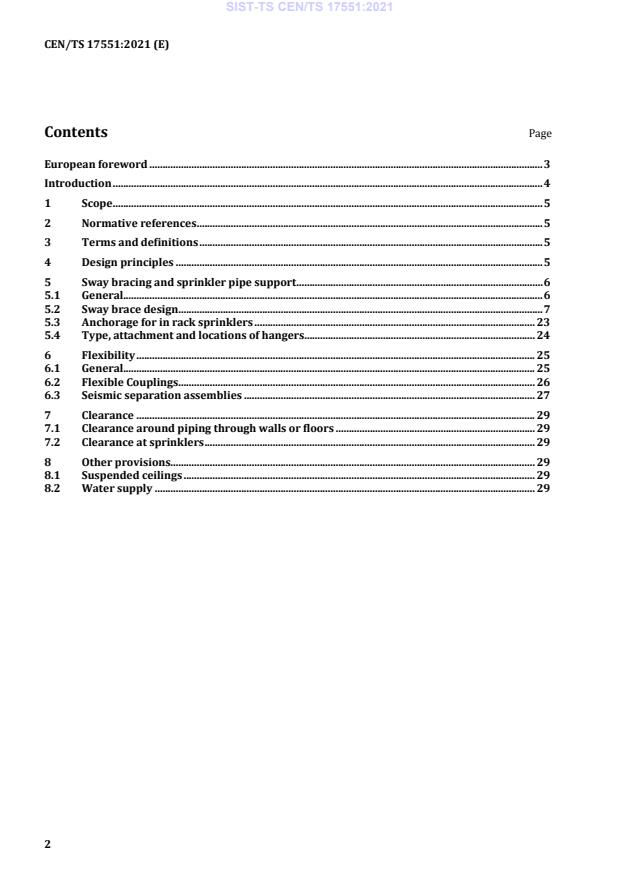
Contents Page
European foreword . 3
Introduction . 4
1 Scope . 5
2 Normative references . 5
3 Terms and definitions . 5
4 Design principles . 5
5 Sway bracing and sprinkler pipe support . 6
5.1 General. 6
5.2 Sway brace design. 7
5.3 Anchorage for in rack sprinklers . 23
5.4 Type, attachment and locations of hangers . 24
6 Flexibility . 25
6.1 General. 25
6.2 Flexible Couplings . 26
6.3 Seismic separation assemblies . 27
7 Clearance . 29
7.1 Clearance around piping through walls or floors . 29
7.2 Clearance at sprinklers . 29
8 Other provisions. 29
8.1 Suspended ceilings . 29
8.2 Water supply . 29
European foreword
This document (CEN/TS 17551:2021) has been prepared by Technical Committee CEN/TC 191 “Fixed
firefighting systems”, the secretariat of which is held by BSI.
Attention is drawn to the possibility that some of the elements of this document may be the subject of
patent rights. CEN shall not be held responsible for identifying any or all such patent rights.
According to the CEN-CENELEC Internal Regulations, the national standards organizations of the
following countries are bound to announce this Technical Specification: Austria, Belgium, Bulgaria,
Croatia, Cyprus, Czech Republic, Denmark, Estonia, Finland, France, Germany, Greece, Hungary, Iceland,
Ireland, Italy, Latvia, Lithuania, Luxembourg, Malta, Netherlands, Norway, Poland, Portugal, Republic of
North Macedonia, Romania, Serbia, Slovakia, Slovenia, Spain, Sweden, Switzerland, Turkey and the United
Kingdom.
Introduction
This document specifies requirements for earthquake protection of automatic sprinkler systems in
accordance with EN 12845 and fire hose piping systems. Requirements made herein are intended to
greatly improve the likelihood that the fire protection systems will remain in working condition during
earthquake and minimize or prevent any potential water damage from fixed firefighting systems leakage
due to an earthquake.
1 Scope
This document specifies requirements for earthquake protection of automatic sprinkler systems in
accordance with EN 12845. This document applies only to locations in earthquake zones in accordance
to EN 1998-1:2004, 3.2.1 and for area subject to peak ground acceleration above 9 % of g.
This document does not cover all legislative requirements. In certain countries specific national
regulations apply and take precedence over this document. Users of this document are advised to inform
themselves of the applicability or non-applicability for this document by their national responsible
authorities.
2 Normative references
The following documents are referred to in the text in such a way that some or all of their content
constitutes requirements of this document. For dated references, only the edition cited applies. For
undated references, the latest edition of the referenced document (including any amendments) applies.
EN 1998-1:2004, Eurocode 8: Design of structures for earthquake resistance - Part 1: General rules, seismic
actions and rules for buildings
EN 12845, Fixed firefighting systems - Automatic sprinkler systems - Design, installation and maintenance
3 Terms and definitions
For the purposes of this document, the terms and definitions given in EN 1998-1:2004 and EN 12845
apply.
ISO and IEC maintain terminological databases for use in standardization at the following addresses:
— IEC Electropedia: available at http://www.electropedia.org/
— ISO Online browsing platform: available at https://www.iso.org/obp
4 Design principles
Requirements given in this document fall into the following seven principles:
— brace sprinkler piping and equipment to minimize uncontrolled differential movement between
these installations and the attached structure; and
— provide flexibility on piping systems and on equipment where differential movement between
portions of those piping systems or equipment is expected; and
— provide clearance between sprinkler piping and structural members, walls, floors or other objects so
that potential damage from impact is minimized; and
— provide anchorage or restraint to minimize potential sliding and/or overturning of equipment such
as the booster pump, jockey pump, tanks, controller, battery package and diesel tank; and
— use types of pipe hangers and sway bracing in accordance to EN 12845 to minimize the potential for
pull-out, properly locate them and attach them to structural members only; and
As impacted by EN 1998-1:2004/AC:2009 and EN 1998-1:2004/A1:2013.
— use types of pipe joining methods in accordance to this document to minimize potential pipe breaks;
and
— provide fire protection system plans and calculations with proper verification of design and proper
verification that the completed installation is in accordance with this document and installed in
accordance with EN 12845.
5 Sway bracing and sprinkler pipe support
5.1 General
Sway bracing for sprinkler systems minimize differential movement between the piping system and the
structure to which it is attached.
Actual design of sway bracing is based on horizontal seismic load. Acceptable sway bracing type,
orientation and attachment methods (to both the sprinkler pipe and the structure) need to
simultaneously provide adequate resistance to both the horizontal seismic load and the net vertical uplift
force component resulting from the horizontal seismic load less any effective offset to that vertical force
component due to sprinkler piping dead weight.
For sprinkler piping within a building, there are two types sway bracing designs two-way and four-way.
Two-way braces are either longitudinal or lateral. Longitudinal and lateral braces resist differential
movement perpendicular and parallel, respectively, to the axis of the pipe, and are used on feed mains,
cross mains, and system range pipes that are DN65 and larger in diameter.
Key
1 two-way brace longitudinal 3 four-way-brace
2 two-way brace lateral
Figure 1 — Sway bracing identification
Four-way sway bracing resists differential movement in all horizontal directions respectively, to the axis
of the pipe, and is typically provided on the above-mentioned items and additionally on risers.
Where lateral and longitudinal sway bracing locations coincide, four-way bracing can be used to satisfy
design requirements for both.
For sway braces to protect the fire sprinkler against damage from earthquakes, their components shall
be shown to have a load capacity greater than the design earthquake load. This requires components to
be cyclical load testing to failure with allowed (design) load rating calculated using a minimum 1,5 safety
factor.
5.2 Sway brace design
5.2.1 Steps in designing sway brace
There are four general steps to properly design sway bracing.
— Step 1: Define sway bracing locations with respect to the sprinkler piping and to the structural
members to which the bracing will be attached.
— Step 2: Calculate the seismic design load requirements for each sway bracing location.
— Step 3: Select the proper sway bracing shape, angle of attachment, size and maximum length based
on the horizontal design load requirement.
— Step 4: Select the proper method to attach the sway bracing to the structure and to the piping.
5.2.2 Step 1, define sway bracing locations
5.2.2.1 Risers
A four-way sway brace shall be provided on all sprinkler risers (whether single or manifolded type)
within 0,6 m of the top of the riser. Brace shall be attached to a structural element for risers located either
on the outside or on the inside of the building. The use of manifolded sway bracing at the top of multiple
adjacent risers requires careful design work and shall be avoided. If used, no more than two risers shall
be used in a manifolded arrangement, and bracing shall be designed to carry the total loads for both risers.
See Figure 2.
Key
1 structural element (given as example- roof 5 0,6 m maximum
could be sloped or flat)
2 roof 6 elbow, flexible joint
3 4-way brace 7 flexible coupling
4 cladding (not structural element)
Figure 2 — Location of 4-ways sway bracing for riser
Intermediate four-way sway bracing shall be provided at an interval (vertical distance) not to exceed
12 m. Where flexible couplings are used, four-way sway bracing shall be provided within 0,6 m of every
other flexible coupling, with no more than two flexible couplings between sway brace locations. See
Figure 3.
Key
1 4-way sway bracing at top of riser and flexible 5 rigid coupling
couplings within 0,6 m (as shown in Figure 1)
2 flexible couplings 6 lateral sway bracing needed if run for horizontal pipe
exceeds 1,8 m, measured from centreline of 2
adjacent pipes
3 0,6 m maximum 7 manifold support
4 0,9 m maximum
Figure 3 — Location of 4-ways sway bracing for riser with manifold
In multi-storey buildings, a four-way brace shall be provided at each floor having a supply pipe.
A two-way lateral sway brace shall be provided within 0,6 m of the end of any horizontal manifold piping
longer than 1,8 m, or when there is one or more flexible coupling(s) on either the horizontal manifold
piping or on the riser stub between the floor and the connection to the horizontal manifold piping.
5.2.2.2 Vertical distribution pipe or main distribution pipe piping
Four-way sway bracing shall be provided at both the top and bottom of the vertical pipe run of 1,8 m or
more. Each brace shall be located within 0,6 m of the respective piping turn. In addition, flexible couplings
shall be provided at the top and bottom. Intermediate four-way sway bracing shall be provided for risers
as recommended in 5.2.2.1.
For vertical pipe runs of less than 1,8 m without bracing, flexible couplings shall not be present within
the vertical pipe run (including the piping turns). If flexible couplings are provided at one or both turns
for vertical pipe runs of less than 1,8 m, then four-way bracing shall be provided within 0,6 m of each turn
equipped with flexible coupling(s).
5.2.2.3 Horizontal changes of direction
Distribution pipe or main distribution piping that has pipe runs of 1,8 m or more adjacent to the change
in direction shall be provided with both lateral and longitudinal sway bracing within 0,6 m the change of
direction. Straight pipe runs after the last change in direction shall be provided with sway bracing as
given in 5.2.2.4, 5.2.2.5 and 5.2.2.6. When the pipe connection at the change in direction is made using a
flexible coupling, then additional sway bracing as given in 5.2.2.5 will be necessary, regardless of the
length of the pipe run adjacent to the change in direction.
5.2.2.4 Ends of main distribution pipes and distribution pipes
Provide lateral bracing within 1,8 m of the end and provide longitudinal bracing within 12 m of the end.
When structural member locations for lateral sway bracing attachment are such that this 1,8 m distance
cannot be met, the distribution pipe or main distribution pipe shall be extended to allow proper location
of the lateral sway bracing. Seismic separation assemblies shall be considered as the end of piping on
both sides of the assembly.
5.2.2.5 Unnecessary flexible couplings
When more flexible couplings than recommended are installed on main distribution pipes and
distribution pipes, regardless of size, or on range pipes or portions of range pipes that are DN65 and
larger and greater than 6 m in length, install additional lateral sway bracing as follows:
— within 0,6 m of every other flexible coupling on straight pipe runs; and
— within 0,6 m of every flexible coupling installed at changes in horizontal pipe direction.
5.2.2.6 Straight pipe runs
5.2.2.6.1 General
After giving credit to any sway bracing installed as given in 5.2.2.1 to 5.2.2.5, sway bracing shall be
provided at a maximum spacing of 12 m for lateral sway bracing and 24 m for longitudinal sway bracing
per the following guidelines.
5.2.2.6.2 Lateral sway bracing
Provide lateral sway bracing on all main distribution pipes and distribution pipes regardless of size, and
on all range pipes and portions of range pipes that are DN 65 and larger and greater than 1,8 m in length.
Space bracing at a maximum of 12 m, recognizing that for main distribution pipes and distribution pipes,
there shall be lateral bracing within 1,8 m of the end of the main(s), as given in 5.2.2.4.
A four-way brace on a vertical pipe (e.g. at the top of a riser) can be counted as the initial lateral brace for
an attached horizontal pipe of the same or smaller diameter when the brace is located within 0,6 m of the
horizontal pipe.
The loads from range pipes or portions of range pipes DN 65 or larger and less than 1,8 m in length shall
be distributed to the longitudinal sway bracing on the distribution pipe as given in 5.2.3.
U-hangers, including wraparound types, shall not be used as lateral sway bracing for main distribution
pipes and distribution pipes. Wraparound U-hangers can be used as lateral sway bracing for range pipes
that require sway bracing if they meet the following criteria:
— have both legs bent out at least 30° from the vertical;
— have the proper diameter and length for the seismic loads involved;
— are properly attached to the building structure as given in 5.2.5; and
— there is no more than 13 mm of space between the top of the range pipes and the wraparound portion
of the U-hanger.
Only for range pipes less than DN 100 m in diameter, lateral sway bracing is not needed on pipes
individually supported by rods that meet the following criteria:
— all rods shall have a length of no more than 150 mm from the supporting member attachment to the
top of the range pipe;
— there shall be no more than 13 mm of space between the top of the range pipes and the bottom of the
support rod.
5.2.2.6.3 Longitudinal sway bracing
Provide longitudinal sway bracing on all main distribution pipes and distribution pipes regardless of size,
and on all range pipes and portions of range pipes that are DN 65 and larger, and greater than 12 m in
length. Space bracing at a maximum of 24 m, recognizing that for main distribution pipes and distribution
pipes, there shall be longitudinal bracing within 12 m of the end of the main(s), as given in 5.2.2.4.
A four-way brace on a vertical pipe (e.g. at the top of a riser) can be counted as the initial longitudinal
brace for an attached horizontal pipe of the same or smaller diameter when the brace is located within
0,6 m of the horizontal pipe.
If a lateral brace is within 0,6 m of a pipe connection to another pipe which is perpendicular and of the
same or lesser pipe size, then the lateral brace can be used to also act as a longitudinal brace for the other
pipe, and the design load for the sway brace will need to include both the lateral and longitudinal loads
as given in 6.2.3.
Using braces on range pipes and riser nipples to brace distribution pipes is not allowed. In general,
bracing to smaller pipes shall not be used as the attachment points to brace larger pipes.
Sway bracing layout locations will usually need to coincide with the structural members to which the
sway braces will be attached.
5.2.2.6.4 Range pipes
Range pipes DN 50 and smaller require restraint from excessive lateral movement and possible damage.
This can be done using sway braces or other alternate method to resist the movement. Restraints do not
require a load path design. At the sprinkler terminal, install a restraint within 0,9 m for DN 25 pipe or
1,2 m for pipe DN 32 thru DN 50 additional restraints are required along the range pipe length at a
recommended spacing of 24 m.
5.2.3 Step 2, calculate seismic design load requirements for each sway bracing location
5.2.3.1 General
The design load requirements shall be calculated following two alternative methods referred respectively
to:
— Eurocode method given in 5.2.3.2, Formula (1); or
— the simplified method according to 5.2.3.3.
Both methods lead to the calculation of F , which is the horizontal force caused by the seismic actions on
a
the pipes. The (F ) for each sway bracing location are based on the weight of the water-filled piping
a
located within the zone of influence for that sway bracing location.
The zone of influence for a sway bracing location includes all piping to be included in the load distribution
calculation for that bracing location, based on the symmetrical layout of all the various bracing locations.
Key
A See 5.2.3.4. D See 5.2.3.5 d).
B See 5.2.3.5 a). E See 5.2.3.6 a).
C See 5.2.3.5 b). F Can be omitted if equally distributed to brace 1 and
brace (see 5.2.3.6 a)).
Figure 4 — Zone of influence and related clauses
The Figure 4 provides examples of typical zone of influence and appropriate bracings as detailed from
5.2.3.4 to 5.2.3.6.
5.2.3.2 Eurocode method in accordance to EN 1998-1:2004
. The original formula (see
This method refers to the calculation procedure proposed in EN 1998-1:2004
EN 1998-1:2004, 4.24 ) applies to non-structural elements as sprinkler pipes are. The following formula
has been adapted to consider the specificity of the sprinkler systems piping.
The effects of the seismic action shall be determined by calculating the horizontal force F which is
a
defined as follows:
SW× × g
( )
a aa
F = (1)
a
q
a
where
F horizontal seismic force, acting at the centre of mass of the water-filled piping in the
a
most unfavourable direction;
W weight of the water-filled piping;
a
S seismic coefficient;
a
g importance factor of the element;
a
q behaviour factor of the element.
a
The importance factor of the element and the behaviour factor of the element can be considered as two
fixed constants with the following values:
— g = 1,5
a
— q = 2
a
In order to determine the Seismic Coefficient S , the following formula (see EN 1998-1:2004, 4.25 ) shall
a
be applied:
Z
3×+1
H
(2)
S=α××S − 0,5
a
T
a
1+ 1−
T
1
where
α referred as peak ground acceleration (PGA) in [g] (see EN 1998-1:2004 );
S soil factor which varies depending on the kind of soil (see EN 1998-1:2004 );
Z height of the piping above the foundation level on the higher point of a rigid base;
H building height measured by the foundation or starting from the highest point of the rigid
base;
T fundamental period of vibration of the non-structural element;
a
T fundamental period of vibration of the building to the considered direction.
NOTE The PGA is typical of the geographical area taken into consideration. Each country can have specific value
for PGA enforced by local authority. In absence of local references, it is possible to refer to the European Seismic
Hazard Map available at www.share-eu.org.
5.2.3.3 Simplified method
As a
...
SIST-TS CEN/TS 17551:2021 표준은 지진 보호를 위한 자동 스프링클러 시스템의 요건을 명확히 규정하고 있습니다. 이 표준은 EN 12845에 따라 지진 지역에서의 설치 및 운영에 대해 구체적인 가이드를 제공하며, 이는 지진 발생 시 자동 스프링클러 시스템의 효율성을 보장하는 데 중요한 역할을 합니다. 이 문서는 특히 EN 1998-1:2004, 3.2.11에 따라 지진 구역에 위치한 시설에 적용되며, 지면 가속도가 9% 이상의 지역에서와 같은 한정된 조건에서도 유효합니다. 이러한 구체적인 범위는 사용자가 지진 영향을 받는 지역에서 스프링클러 시스템을 설치하고 운용할 때 준수해야 할 필수 기준을 마련해줍니다. SIST-TS CEN/TS 17551:2021의 강점은 지진 발생 시 자동 스프링클러 시스템의 구조적 안정성을 보장하는 세부 요건을 제시한다는 점입니다. 이는 건물의 특성과 지진 위험을 반영하여 설계를 최적화할 수 있도록 돕습니다. 또한, 이 표준은 유럽 내에서 지진 안전성에 대한 인식을 높이고, 해외와의 규제 통합을 도모하는 데 기여합니다. 하지만 본 문서는 모든 법적 요구 사항을 포함하지 않으며, 특정 국가에서는 해당 법률이 우선시될 수 있다는 점도 유의해야 합니다. 따라서 이 문서의 적용 가능성에 대해 개인이나 기업은 각국의 관련 책임 당국에 문의하는 것이 권장됩니다. 이러한 점에서 SIST-TS CEN/TS 17551:2021은 지진으로 인한 위험을 관리하고, 사용자에게 구체적인 지침을 제공하는 중요한 표준이라 할 수 있습니다.
SIST-TS CEN/TS 17551:2021は、自動スプリンクラーシステムの地震対策に関する重要なガイドラインを提供する標準文書です。この標準は、EN 12845に基づき、地震の影響を受ける地域における自動スプリンクラーシステムの保護要件を定めています。特に地震動のピーク地盤加速度がgの9%以上を超える区域に適用され、地震ゾーンに位置する施設においてその重要性が増しています。 このドキュメントの強みは、地震防止のための包括的なガイダンスを提供する点にあります。自動スプリンクラーシステムが地震時にどのように機能するべきか、必要な支持構造や設計の考慮点が詳細に記述されています。これにより、施設管理者や設計者は、日本やその他の地震活動が盛んな国々において、適切な対策を講じることができるようになります。 ただし、すべての立法上の要件をカバーしているわけではなく、国によっては特定の国内規制が適用され、この標準よりも優先されることがあります。そのため、この標準を使用する際には、利用者がその国の責任当局に確認することが勧められています。この点は、標準の適用性を理解する上で非常に重要です。 全体として、SIST-TS CEN/TS 17551:2021は、自動スプリンクラーシステムの地震に対する堅牢性を確保するための有効な手段を提供しており、特に地震のリスクが高い地域において、その関連性が高いと言えるでしょう。この標準は、安全な建物の設計と管理に寄与するための基盤を形成しています。
The SIST-TS CEN/TS 17551:2021 standard provides critical guidelines for the earthquake protection of automatic sprinkler systems as outlined under EN 12845. Its primary focus is on ensuring that these systems are adequately braced to withstand seismic events in designated earthquake zones, meeting the specific requirements of EN 1998-1:2004, particularly for areas where peak ground acceleration exceeds 9% of gravitational acceleration. The strength of this standard lies in its detailed guidance tailored for environments at risk of earthquakes. By delineating protective measures, the standard serves as a crucial resource for engineers and designers in planning and implementing automatic sprinkler systems within high-risk zones. This focus on earthquake bracing is vital as it enhances the resilience of essential fire safety systems, thereby contributing to overall safety in buildings and infrastructure. Furthermore, the relevance of the SIST-TS CEN/TS 17551:2021 is underscored by its emphasis on compliance with national regulations. It encourages users to consult local authorities to ensure that installations are not only standardized but also uphold national legislative requirements, which may vary by country. This dual approach of fostering standardization while respecting local regulations makes the standard exceptionally robust and adaptable across different jurisdictions. In summary, the SIST-TS CEN/TS 17551:2021 standard is a key document that provides invaluable guidance for the implementation of earthquake protection measures for automatic sprinkler systems, highlighting its strengths in safety, compliance, and practical applicability in earthquake-prone areas.
Questions, Comments and Discussion
Ask us and Technical Secretary will try to provide an answer. You can facilitate discussion about the standard in here.
Loading comments...