

SIST EN 445:2008
Grout for prestressing tendons - Test methods
General Information
- Abstract
This European Standard describes the test methods for grout specified in EN 447. Testing shall be performed in accordance with the test methods given in this standard (reference test methods). The test methods are applicable to grout for all types of structures including bridges and buildings.
- Status
- Published
- Publication Date
- 03-Feb-2008
- Technical Committee
- BBB - Concrete, reinforced concrete and prestressed concrete
- Current Stage
- 6060 - National Implementation/Publication (Adopted Project)
- Start Date
- 07-Nov-2007
- Due Date
- 12-Jan-2008
- Completion Date
- 04-Feb-2008



Overview
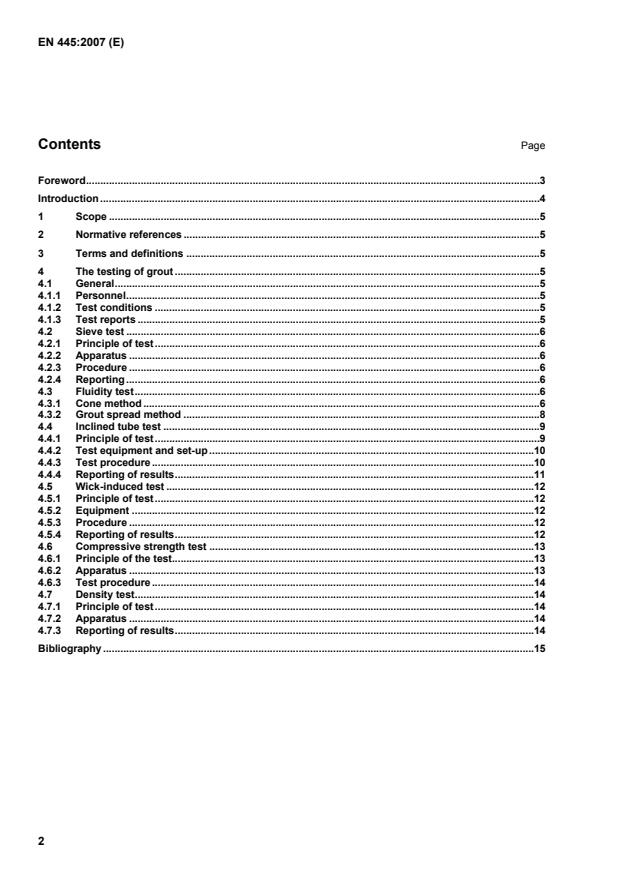
EN 445:2007 - Grout for prestressing tendons: Test methods (CEN) defines the reference test methods to verify grout used for prestressing tendons in post‑tensioned concrete. It specifies how laboratory and on‑site testing shall be carried out to check grout quality and suitability for all types of structures, including bridges and buildings. EN 445:2007 is a CEN standard that replaces EN 445:1996 and is intended to be used with EN 447 (basic requirements) and EN 446 (grouting procedures).
Key topics and requirements
- Scope and purpose: Provides reference test procedures for grout conformity testing as required by EN 447; applicable to initial type testing, suitability testing and production inspection.
- Personnel & conditions: Tests must be carried out by competent personnel and under specified temperature and mixing conditions; use of the same mixer as on site is recommended where relevant.
- Test reporting: Minimum content for test reports is defined (laboratory ID, product ID, mixing and batching details, equipment, individual results, temperatures, signatures).
- Reference test methods included:
- Sieve test - checks for lumps using a ≤2 mm sieve.
- Fluidity tests - two alternatives depending on grout type:
- Cone method (measuring time for 1 L to pass through a cone)
- Grout spread method (measuring spread diameter on a plate, used for thixotropic grouts)
- Inclined tube test - assesses bleed, volume stability and filtering effects of strands at near full scale using long inclined tubes with prestressing strands.
- Wick‑induced test - evaluates bleeding (principle and procedure described).
- Compressive strength and density tests - reference procedures for hardened grout properties (see normative references such as EN 196-1 for cement strength testing).
- Test setup details: Dimensions, apparatus and timing procedures are specified for repeatable measurement (cones, tubes, moulds, thermometers, etc.).
Practical applications and users
EN 445:2007 is used by:
- Structural and geotechnical engineers specifying post‑tensioning and prestressing works.
- Testing laboratories performing quality assurance for grout materials.
- Contractors and specialist prestressing installers conducting suitability testing and on‑site inspection.
- Manufacturers and suppliers of grout materials who need to demonstrate compliance with EU/CEN requirements for bridges, buildings and other prestressed structures.
Using EN 445 helps ensure reliable grout performance-minimizing voids, bleed and segregation-which is critical for corrosion protection and long‑term durability of prestressing tendons.
Related standards
- EN 447 - Grout for prestressing tendons: Basic requirements
- EN 446 - Grout for prestressing tendons: Grouting procedures / suitability testing
- EN 196‑1 - Methods of testing cement (strength)
- prEN 13670 / EN 1992 (Eurocode 2) - Execution and design context for concrete structures
Keywords: EN 445:2007, grout for prestressing tendons, test methods, grouting tests, prestressing grout, fluidity test, inclined tube test, sieve test, CEN.
Relations
- Effective Date
- 01-Mar-2008
- Effective Date
- 28-Jan-2026
- Effective Date
- 28-Jan-2026
- Effective Date
- 28-Jan-2026
- Effective Date
- 28-Jan-2026
- Effective Date
- 28-Jan-2026
- Effective Date
- 28-Jan-2026
- Effective Date
- 28-Jan-2026
- Effective Date
- 28-Jan-2026
- Effective Date
- 28-Jan-2026
- Effective Date
- 28-Jan-2026
Get Certified
Connect with accredited certification bodies for this standard

DIBt (Deutsches Institut für Bautechnik)
German Institute for Building Technology.
DIN CERTCO
DIN Group product certification.

Aboma Certification B.V.
Specialized in construction, metal, and transport sectors.
Sponsored listings
Frequently Asked Questions
SIST EN 445:2008 is a standard published by the Slovenian Institute for Standardization (SIST). Its full title is "Grout for prestressing tendons - Test methods". This standard covers: This European Standard describes the test methods for grout specified in EN 447. Testing shall be performed in accordance with the test methods given in this standard (reference test methods). The test methods are applicable to grout for all types of structures including bridges and buildings.
This European Standard describes the test methods for grout specified in EN 447. Testing shall be performed in accordance with the test methods given in this standard (reference test methods). The test methods are applicable to grout for all types of structures including bridges and buildings.
SIST EN 445:2008 is classified under the following ICS (International Classification for Standards) categories: 91.100.30 - Concrete and concrete products. The ICS classification helps identify the subject area and facilitates finding related standards.
SIST EN 445:2008 has the following relationships with other standards: It is inter standard links to SIST EN 445:1998, SIST EN 196-1:2016, SIST EN 447:2008, SIST EN 17678-1:2023, SIST EN 1504-5:2005, SIST EN 1504-5:2013, SIST EN 14199:2015, SIST EN ISO 11296-9:2023, SIST EN 16506:2015, SIST EN 446:2008, SIST EN 934-4:2009. Understanding these relationships helps ensure you are using the most current and applicable version of the standard.
SIST EN 445:2008 is associated with the following European legislation: Standardization Mandates: M/BC/CEN/87/11. When a standard is cited in the Official Journal of the European Union, products manufactured in conformity with it benefit from a presumption of conformity with the essential requirements of the corresponding EU directive or regulation.
SIST EN 445:2008 is available in PDF format for immediate download after purchase. The document can be added to your cart and obtained through the secure checkout process. Digital delivery ensures instant access to the complete standard document.
Standards Content (Sample)
2003-01.Slovenski inštitut za standardizacijo. Razmnoževanje celote ali delov tega standarda ni dovoljeno.Grout for prestressing tendons - Test methodsInjekcijska masa za prednapete kable - Preskusne metodeCoulis pour câble de précontrainte - Méthode d'essaisEinpressmörtel für Spannglieder - PrüfverfahrenTa slovenski standard je istoveten z:EN 445:2007SIST EN 445:2008en,fr,de91.100.30ICS:SIST EN 445:19981DGRPHãþDSLOVENSKI
STANDARDSIST EN 445:200801-marec-2008
EUROPEAN STANDARDNORME EUROPÉENNEEUROPÄISCHE NORMEN 445October 2007ICS 91.100.30Supersedes EN 445:1996
English VersionGrout for prestressing tendons - Test methodsCoulis pour câble de précontrainte - Méthode d'essaisEinpressmörtel für Spannglieder - PrüfverfahrenThis European Standard was approved by CEN on 21 June 2007.CEN members are bound to comply with the CEN/CENELEC Internal Regulations which stipulate the conditions for giving this EuropeanStandard the status of a national standard without any alteration. Up-to-date lists and bibliographical references concerning such nationalstandards may be obtained on application to the CEN Management Centre or to any CEN member.This European Standard exists in three official versions (English, French, German). A version in any other language made by translationunder the responsibility of a CEN member into its own language and notified to the CEN Management Centre has the same status as theofficial versions.CEN members are the national standards bodies of Austria, Belgium, Bulgaria, Cyprus, Czech Republic, Denmark, Estonia, Finland,France, Germany, Greece, Hungary, Iceland, Ireland, Italy, Latvia, Lithuania, Luxembourg, Malta, Netherlands, Norway, Poland, Portugal,Romania, Slovakia, Slovenia, Spain, Sweden, Switzerland and United Kingdom.EUROPEAN COMMITTEE FOR STANDARDIZATIONCOMITÉ EUROPÉEN DE NORMALISATIONEUROPÄISCHES KOMITEE FÜR NORMUNGManagement Centre: rue de Stassart, 36
B-1050 Brussels© 2007 CENAll rights of exploitation in any form and by any means reservedworldwide for CEN national Members.Ref. No. EN 445:2007: E
System of CEN and EOTA documents as basis for design, execution and materials selection for protective measures of prestressing systems (only main modules). EN 1992 Eurocode 2:Design of concrete structures prEN 13670 Execution of concrete structures ETAG 013 Post-tensioning kits for prestressing
of structuresEN 446 Grout for prestressing tendons Grouting procedures EN 447 Grout for prestressing tendons Basic requirements EN 445 Grout for prestressing tendons Test methods CEN Workshop Agreement CWA 14646 Requirements for the installation of post-tensioning kits for prestressing of structures and qualification of specialist company and its personnel.
3 Terms and definitions For the purposes of this document, the following terms and definitions apply. 3.1
grout homogeneous mixture of cement and water, it may contain admixtures and additions 4 The testing of grout 4.1 General
4.1.1 Personnel The grouts shall be tested by competent personnel experienced in the subject.
4.1.2 Test conditions Testing shall be carried out at specified temperatures. The grout for the tests shall be made from materials specified in EN 447 and mixed in accordance with EN 447. NOTE EN 446 requires suitability testing to be carried out using the same type of mixing equipment as is used for the actual site operations, hence it is preferable to also use the same type of equipment for all testing. 4.1.3 Test reports All test reports shall include the following information as a minimum: a) reference to this European Standard; b) name and address of the testing laboratory; c) identification number of the test report; d) name and address of the organisation or person who ordered the test;
...