

oSIST prEN ISO 17632:2026
(Main)Welding consumables - Tubular cored electrodes for gas shielded and non-gas shielded metal arc welding of non-alloy and fine grain steels - Classification (ISO/DIS 17632:2026)
- Abstract
ISO 17632:2015 specifies requirements for classification of tubular cored electrodes with or without a gas shield for metal arc welding of non-alloy and fine grain steels in the as-welded condition or in the post-weld heat-treated condition with a minimum yield strength of up to 500 MPa or a minimum tensile strength of up to 570 MPa. One tubular cored electrode can be tested and classified with different shielding gases, if any.
This International Standard is a combined specification providing classification utilizing a system based upon the yield strength and the average impact energy of 47 J of all-weld metal or utilizing a system based upon the tensile strength and the average impact energy of 27 J of all-weld metal.
1) Paragraphs and tables which carry the suffix letter "A" are applicable only to tubular cored electrodes classified to the system based upon the yield strength and the average impact energy of 47 J of all-weld metal in accordance with this International Standard.
2) Paragraphs and tables which carry the suffix letter "B" are applicable only to tubular cored electrodes classified to the system based upon the tensile strength and the average impact energy of 27 J of all-weld metal in accordance with this International Standard.
3) Paragraphs and tables which have neither the suffix letter "A" nor the suffix letter "B" are applicable to all tubular cored electrodes classified in accordance with this International Standard.
It is recognized that the operating characteristics of tubular cored electrodes can be modified by the use of pulsed current, but for the purposes of this International Standard, pulsed current is not permitted for determining the electrode classification.
- Status
- Not Published
- Public Enquiry End Date
- 02-Jan-2027
- Technical Committee
- VAR - Welding
- Current Stage
- 4020 - Public enquire (PE) (Adopted Project)
- Start Date
- 03-Nov-2026
- Due Date
- 23-Mar-2027

oSIST prEN ISO 17632:2026 is the SIST publication of the ISO draft classification standard for tubular cored electrodes used in gas shielded and non-gas shielded metal arc welding of non-alloy and fine grain steels. It tells manufacturers, purchasers, and test laboratories how to classify these consumables by mechanical properties, impact performance, chemical composition, shielding gas, welding position, and hydrogen level. The document uses two classification routes, System A and System B, so the same electrode can be designated in the way that best matches the required strength basis.
What does oSIST prEN ISO 17632:2026 specify?
oSIST prEN ISO 17632:2026 specifies how to classify tubular cored electrodes for welding non-alloy and fine grain steels in the as-welded condition or in the post-weld heat-treated condition. The scope covers electrodes for steels with a minimum yield strength up to 500 MPa or a minimum tensile strength up to 570 MPa.
The standard is organized as a combined specification. Clause 4 defines the two classification systems, Clause 5 assigns the designation symbols, Clause 6 sets the mechanical test conditions, Clauses 7 to 10 cover chemical analysis, rounding, retests, and delivery conditions, and Clause 11 gives designation examples.
One electrode can be tested and classified with different shielding gases, if applicable. Pulsed current is recognized as affecting operating characteristics, but it is not used to determine the classification.
| Annex | What it covers |
|---|---|
| Annex A | The two classification systems, ISO 17632-A and ISO 17632-B |
| Annex B | Types of electrode core in the System A classification |
| Annex C | Usability characteristics in the System B classification |
| Annex D | Notes on hydrogen content and why it matters |
What are the key requirements of oSIST prEN ISO 17632:2026?
oSIST prEN ISO 17632:2026 classifies products by one of two routes. System A is based on yield strength and an average impact energy of 47 J, while System B is based on tensile strength and an average impact energy of 27 J. In practice, this means the buyer must choose the system that matches the way the weld metal will be specified and verified.
Classification structure and designation
The designation is built from compulsory symbols and optional symbols. The compulsory part includes the product symbol, strength and elongation, impact properties, chemical composition, core or usability designation, and shielding gas. Optional symbols can add welding position, hydrogen level, and, for System B, the as-welded or post-weld heat-treated condition.
This matters because packages, catalogues, and datasheets must carry the same designation logic. It lets a purchaser compare electrodes on a common basis rather than relying on trade names.
The scope also fixes the electrode sizes used for classification. Gas shielded electrodes are classified on the 1.2 mm size, or the next larger manufactured size if 1.2 mm is not made. Self-shielded electrodes are classified on 2.4 mm, or the largest size if 2.4 mm is not available.
Mechanical properties and impact testing
Clause 5 links the strength symbol to tensile and elongation requirements, and Clause 5.3 links the impact symbol to the test temperature. For System A, three impact test specimens are used, and only one value may fall below 47 J, but not below 32 J. For System B, five specimens are tested, the highest and lowest are discarded, and the average of the remaining three must meet 27 J.
That difference matters in procurement and quality control. System A is stricter on the nominal impact requirement, while System B uses a different statistical treatment and a lower base impact level. When the optional supplemental designator U is used in System B, the deposit must also meet 47 J at the designated test temperature.
For single-run technique, impact testing is not required. Clause 5.2.2 and Table 4 then classify the weld joint strength in the as-welded condition against the parent material used in the test.
Welding procedure, heat input, and heat treatment
Clause 6 controls how the test welds are made. System A uses all-weld metal test assemblies in the as-welded condition, with no preheating required and an interpass temperature limit of 250 °C. System B uses conditions selected from Table 12 and may classify electrodes in the as-welded condition and/or in the post-weld heat-treated condition.
This matters because the classification is tied to a defined welding procedure, not just the electrode wire itself. The standard also limits the pass and layer sequence in Table 13, so test assemblies are welded in a controlled and repeatable way.
For System B post-weld heat treatment, Clause 6.1.6.2 defines a controlled furnace cycle at 620 °C ± 15 °C for at least 1 h, with limits on heating and cooling rates. If a manufacturer claims PWHT classification, the test assembly must follow that heat treatment.
Chemistry, hydrogen, and delivery conditions
Clause 5.4 classifies the chemical composition of the all-weld metal using different symbol sets for System A and System B. If the composition does not fall under a listed symbol, the standard uses Z in System A or G in System B for an agreed composition.
Clause 5.8 uses H5, H10, or H15 to show diffusible hydrogen levels, determined in accordance with ISO 3690. When a hydrogen symbol is included, the manufacturer must state the storage and operating limits needed to keep within that hydrogen level.
Clause 10 requires technical delivery conditions to comply with ISO 544 and ISO 14344. In practice, this links the classification to product marking, dimensions, tolerances, and procurement conditions.
What does oSIST prEN ISO 17632:2026 say about practical use?
oSIST prEN ISO 17632:2026 is intended for the people who classify, specify, buy, and verify tubular cored electrodes for steel welding. Typical users include welding consumable manufacturers, purchasing teams, welding engineers, quality managers, and test laboratories.
They use it to choose the correct designation, set up qualification tests, prepare product data sheets, and check that a supplied consumable matches the claimed classification. It is also useful when comparing electrodes for gas shielded versus non-gas shielded welding, or when a project needs a specific hydrogen level or welding position range.
What changed in oSIST prEN ISO 17632:2026 from the previous edition?
oSIST prEN ISO 17632:2026 cancels and replaces ISO 17632:2015. The foreword states that this edition has been technically revised.
Which standards are used with oSIST prEN ISO 17632:2026?
oSIST prEN ISO 17632:2026 uses several companion standards to define the test and classification framework:
- ISO 544 - technical delivery conditions, including product type, dimensions, tolerances, and markings
- ISO 3690 - determination of hydrogen content in arc weld metal
- ISO 6847 - preparation of a weld metal pad for chemical analysis
- ISO 14175 - designation of shielding gases and gas mixtures
- ISO 14344 - procurement of filler materials and fluxes
- ISO 15792-1:2020 - preparation of all-weld metal test pieces and specimens
- ISO 15792-2:2020 - preparation of single-run and two-run test pieces and specimens
- ISO 80000-1:2022 - rounding rules for test values
- ISO 6947:2019 - welding position symbols used in Table 10
- ISO 13916 - temperature measurement method referenced for preheating and interpass temperature
These references matter because the classification depends on how the test pieces are made, how temperatures are measured, how gas is identified, and how results are rounded and reported.
What does the oSIST prEN ISO 17632:2026 document contain?
The document contains the full classification scheme for tubular cored electrodes, including the symbol tables for strength, impact, chemistry, core type or usability, shielding gas, welding position, hydrogen, and post-weld heat treatment. It also contains the mechanical test methods for multi-run and single-run classifications, with the required specimen preparation and welding conditions.
Clause 7 gives the chemical analysis route, Clause 8 gives the rounding procedure, and Clause 9 gives the retest rules. Clause 11 provides worked designation examples for gas shielded, self-shielded, single-run, and out-of-table chemistry cases.
Annex A gives the structure of the two classification systems in diagram form, while Annexes B and C explain what the System A core types and System B usability designators mean in practical welding terms. Annex D explains why hydrogen content matters, how hydrogen can lead to cold cracking, and why welding conditions influence the achieved hydrogen level.
Relations
- Effective Date
- 01-Dec-2026
Get Certified
Connect with accredited certification bodies for this standard

DVS-ZERT GmbH
German welding certification society.

CARES (UK Certification Authority for Reinforcing Steels)
UK certification for reinforcing steels and construction.

EWF/IIW (European/International Welding Federation)
International welding personnel certification.
Sponsored listings
Frequently Asked Questions
oSIST prEN ISO 17632:2026 is a draft published by the Slovenian Institute for Standardization (SIST). Its full title is "Welding consumables - Tubular cored electrodes for gas shielded and non-gas shielded metal arc welding of non-alloy and fine grain steels - Classification (ISO/DIS 17632:2026)". This standard covers: ISO 17632:2015 specifies requirements for classification of tubular cored electrodes with or without a gas shield for metal arc welding of non-alloy and fine grain steels in the as-welded condition or in the post-weld heat-treated condition with a minimum yield strength of up to 500 MPa or a minimum tensile strength of up to 570 MPa. One tubular cored electrode can be tested and classified with different shielding gases, if any. This International Standard is a combined specification providing classification utilizing a system based upon the yield strength and the average impact energy of 47 J of all-weld metal or utilizing a system based upon the tensile strength and the average impact energy of 27 J of all-weld metal. 1) Paragraphs and tables which carry the suffix letter "A" are applicable only to tubular cored electrodes classified to the system based upon the yield strength and the average impact energy of 47 J of all-weld metal in accordance with this International Standard. 2) Paragraphs and tables which carry the suffix letter "B" are applicable only to tubular cored electrodes classified to the system based upon the tensile strength and the average impact energy of 27 J of all-weld metal in accordance with this International Standard. 3) Paragraphs and tables which have neither the suffix letter "A" nor the suffix letter "B" are applicable to all tubular cored electrodes classified in accordance with this International Standard. It is recognized that the operating characteristics of tubular cored electrodes can be modified by the use of pulsed current, but for the purposes of this International Standard, pulsed current is not permitted for determining the electrode classification.
ISO 17632:2015 specifies requirements for classification of tubular cored electrodes with or without a gas shield for metal arc welding of non-alloy and fine grain steels in the as-welded condition or in the post-weld heat-treated condition with a minimum yield strength of up to 500 MPa or a minimum tensile strength of up to 570 MPa. One tubular cored electrode can be tested and classified with different shielding gases, if any. This International Standard is a combined specification providing classification utilizing a system based upon the yield strength and the average impact energy of 47 J of all-weld metal or utilizing a system based upon the tensile strength and the average impact energy of 27 J of all-weld metal. 1) Paragraphs and tables which carry the suffix letter "A" are applicable only to tubular cored electrodes classified to the system based upon the yield strength and the average impact energy of 47 J of all-weld metal in accordance with this International Standard. 2) Paragraphs and tables which carry the suffix letter "B" are applicable only to tubular cored electrodes classified to the system based upon the tensile strength and the average impact energy of 27 J of all-weld metal in accordance with this International Standard. 3) Paragraphs and tables which have neither the suffix letter "A" nor the suffix letter "B" are applicable to all tubular cored electrodes classified in accordance with this International Standard. It is recognized that the operating characteristics of tubular cored electrodes can be modified by the use of pulsed current, but for the purposes of this International Standard, pulsed current is not permitted for determining the electrode classification.
oSIST prEN ISO 17632:2026 is classified under the following ICS (International Classification for Standards) categories: 25.160.20 - Welding consumables. The ICS classification helps identify the subject area and facilitates finding related standards.
oSIST prEN ISO 17632:2026 has the following relationships with other standards: It is inter standard links to SIST EN ISO 17632:2016. Understanding these relationships helps ensure you are using the most current and applicable version of the standard.
oSIST prEN ISO 17632:2026 is available in PDF format for immediate download after purchase. The document can be added to your cart and obtained through the secure checkout process. Digital delivery ensures instant access to the complete standard document.
Standards Content (Sample)
Contents
- Introduction
- 1 Scope
- 2 Normative references
- 3 Terms and definitions
- 4 Classification
- 4.1 General
- 4.2 Classification systems
- 4.3 Compulsory and optional sections
- 5 Symbols and requirements
- 5.1 Symbol for the product/process
- 5.2 Symbol for tensile properties of all-weld metal or welded joint
- 5.3 Symbol for impact properties of all-weld metal or welded joint
- 5.4 Symbol for chemical composition of all-weld metal
- 5.5 Symbol for type of electrode core or for the usability characteristics of the electrode
- 5.6 Symbol for shielding gas
- 5.7 Symbol for welding position
- 1 PA, PB, PC, PD, PE, PF, PG
- 0 PA, PB
- 2 PA, PB, PC, PD, PE, PF
- 3 PA, PB
- 5 PA, PB, PG
- 5.8 Symbol for hydrogen content of deposited metal
- 5.9 Symbol for condition of postweld heat treatment of all-weld metal
- 6 Mechanical tests
- 6.1 Multi-run technique
- 6.2 Single-run technique
- 7 Chemical analysis
- 8 Rounding procedure
- 9 Retests
- 10 Technical delivery conditions
- 11 Examples of designation
- 11.1 General
- 11.2 Example 1 – System A
- 11.3 Example 2 – System B
- 11.4 Example 3 - System A
- 11.5 Example 4 – System B
- 11.6 Example 5 – System A
- Annex A
- Annex B
- Annex C
- Annex D
- Bibliography
Introduction
This document provides a classification system for tubular cored electrodes in terms of tensile properties, impact properties, chemical composition of the all-weld metal, type of electrode core, shielding gas, and welding position. The ratio of yield to tensile strength of weld metal is generally higher than that of the parent metal. Matching weld metal yield strength to parent metal yield strength will not necessarily ensure that the weld metal tensile strength matches that of the parent metal. Where the application demands matching tensile strengths, selection of consumables is made by reference to Table 3, column 3 or 7, Tensile strength or Table 4, column 3 or 5, Minimum tensile strengths. Of note is that the mechanical properties of all-weld metal test specimens used to classify the tubular cored electrodes will vary from those obtained in production joints because of the differences in welding procedure such as electrode size, width of weave, welding position, and parent metal composition. The classification in accordance with System A is mainly based on EN 758:1997. The classification in accordance with System B is mainly based upon standards used around the Pacific Rim.
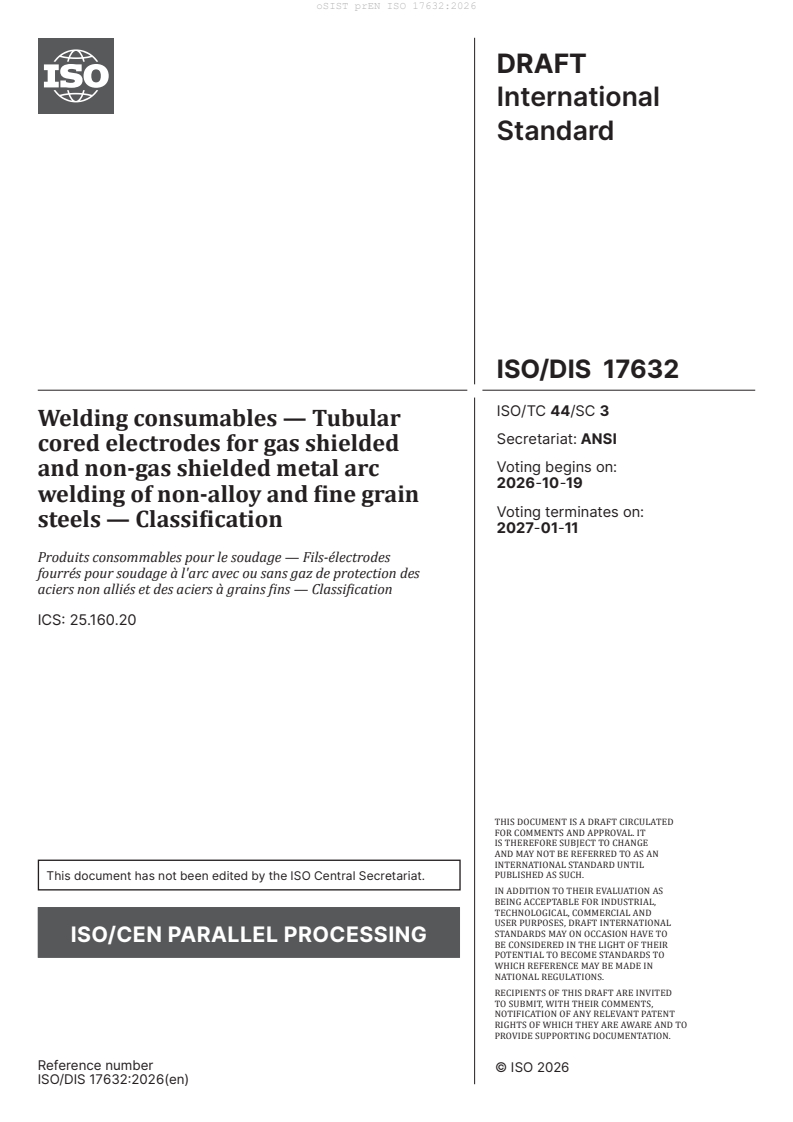
oSIST prEN ISO 17632:2026 DRAFT International Standard ISO/DIS 17632:2026(en) Welding consumables — Tubular cored electrodes for gas shielded and non-gas shielded metal arc welding of non-alloy and fine grain steels — Classification
1 Scope
This document specifies requirements for classification of tubular cored electrodes with or without a gas shield for metal arc welding of non-alloy and fine grain steels in the as-welded condition or in the post-weld heat-treated condition with a minimum yield strength of up to 500 MPa or a minimum tensile strength of up to 570 MPa. One tubular cored electrode can be tested and classified with different shielding gases, if any. This document is a combined specification providing classification utilizing a system based upon the yield strength and the average impact energy of 47 J of all-weld metal or utilizing a system based upon the tensile strength and the average impact energy of 27 J of all-weld metal. a) Clauses, subclauses and tables which carry the suffix “System A” are applicable only to tubular cored electrodes classified to the system based upon the yield strength and the average impact energy of 47 J of all-weld metal in accordance with this document.
b) Clauses, subclauses and tables which carry the suffix “System B” are applicable only to tubular cored electrodes classified to the system based upon the tensile strength and the average impact energy of 27 J of all-weld metal in accordance with this document.
c) Clauses, subclauses and tables which have neither the suffix "System A” nor the suffix "System B” are applicable to all tubular cored electrodes classified in accordance with this document. It is recognized that the operating characteristics of tubular cored electrodes can be modified by the use of pulsed current, but for the purposes of this document Standard, pulsed current is not to be used for determining the electrode classification.
2 Normative references
The following documents are referred to in the text in such a way that some or all of their content constitutes requirements of this document. For dated references, only the edition cited applies. For undated references, the latest edition of the referenced document (including any amendments) applies. ISO 544, Welding consumables — Technical delivery conditions for filler materials and fluxes — Type of product, dimensions, tolerances and markings ISO 3690, Welding and allied processes — Determination of hydrogen content in arc weld metal ISO 6847, Welding consumables — Deposition of a weld metal pad for chemical analysis ISO 14175, Welding consumables — Gases and gas mixtures for fusion welding and allied processes ISO 14344, Welding consumables — Procurement of filler materials and fluxes ISO 15792-1:2020, Welding consumables — Test methods — Part 1: Preparation of all-weld metal test pieces and specimens in steel, nickel and nickel alloys ISO 15792-2:2020, Welding consumables — Test methods — Part 2: Preparation of single-run and two-run technique test pieces and specimens in steel ISO 80000-1:2022, Quantities and units — Part 1: General
oSIST prEN ISO 17632:2026 ISO/DIS 17632:2026(en)
3 Terms and definitions
No terms and definitions are listed in this document.
ISO and IEC maintain terminology databases for use in standardization at the following addresses:
- ISO Online browsing platform: available at https:// www .iso .org/ obp
- IEC Electropedia: available at https:// www .electropedia .org/
4 Classification
4.1 General
Classification designations are based upon two approaches, A and B, to indicate the tensile properties and the impact properties of the all-weld metal obtained with a given electrode. System A is applicable to tubular cored electrodes classified under the system based on the yield strength and an average impact energy of 47 J of the all-weld metal given in this document. System B is applicable to tubular cored electrodes classified under the system based on the tensile strength and an average impact energy of 27 J of the all-weld metal given in this document. The two designation approaches include additional designators for some other classification requirements, but not all as will be clear from the following. In most cases, a given commercial product can be classified in both systems. Then, either or both classification designations can be used for the product (see Annex A). The classification includes all-weld metal properties obtained with a tubular cored electrode and appropriate shielding gas combination as given below. The classification of gas shielded tubular cored electrodes is based on the 1,2 mm electrode size or if this size is not manufactured, the next larger diameter manufactured. The classification of self-shielded tubular cored electrodes is based on the 2,4 mm diameter or the largest diameter manufactured if less than 2,4 mm.
4.2 Classification systems
Each classification system, A and B, is split into parts as given in Table 1. Table 1 — Classification systems Part of Classification system classification System A System B designation 1 Symbol T indicates a tubular cored electrode.
Symbol indicating the yield strength and elongation Symbol indicating the tensile strength and elonof all-weld metal for multi-run technique or the gation of all-weld metal for multi-run technique 2 strength of the parent material used in classification or the strength of the parent material used in for the single-run technique (see Table 3 or Table 4). classification for the single-run technique (see Table 3 or Table 4).
Symbol indicating the impact properties of all-weld Symbol indicating the impact properties of allmetal or welded joint (see Table 5). weld metal (see Table 5). The symbol “U” added as an optional supplemental designator at or near 3 the end of the complete tubular cored electrode designation indicates that the deposit meets an average optional requirement of 47 J at the designated Charpy test temperature. Symbol indicating the chemical composition of Symbol indicating the usability characteristics of
all-weld metal (see Table 6). the electrode (see Table 9).
Symbol indicating the type of electrode core (see Symbol indicating the welding position (see Table 9).
Table 8).
oSIST prEN ISO 17632:2026 ISO/DIS 17632:2026(en) TTabablele 1 1 ((ccoonnttiinnueuedd)) Part of Classification system classification System A System B designation Symbol indicating the shielding gas (see 5.6). Symbol indicating the shielding gas (see 5.6). The 6 letter “S” added to this designator indicates that the electrode is classified for single-pass welding.
Symbol indicating the welding position (see Symbol indicating whether the classification tests Table 10); were conducted in the as-welded (A) or post-weld heat-treated condition (P). If the electrode has been classified in both conditions, the symbol AP
shall be added to the classification. This designator is omitted in the classification for single-pass welding electrodes as these are tested only in the as-welded condition.
Symbol indicating the hydrogen content of depos- Symbol indicating the chemical composition of allited metal (see Table 11). weld metal (see Table 7). The symbol is omitted
for weld deposits conforming to the “No symbol” in Table 7.
Symbol indicating the hydrogen content of deposited metal (see Table 11).
Electrodes can be classified under any number of classifications for either or both the as-welded and post-weld heat-treated condition.
For both Systems A and B, the electrode classification shall include all compulsory sections and can include optional sections as outlined in 4.3.
4.3 Compulsory and optional sections
The compulsory and optional sections are given in Table 2.
The full designation shall comprise the compulsory symbols and can include optional symbols chosen by the manufacturer. The full designation (see Clause 10) shall be used on packages and in the manufacturer’s literature and data sheets.
Table 2 — Compulsory and optional sections Classification system Section System A System B includes the symbols for type of product, strength includes the symbols for type of product, strength and elongation, impact properties, chemical compo- and elongation in the as-welded condition or postsition, type of electrode core, and shielding gas, i.e. weld heat-treated condition, welding positions for Compulsory the symbols defined in 5.1, 5.2, 5.3, 5.4, 5.5, and 5.6. which the electrode is suitable, usability characteristics, shielding gas, impact properties, and chemical composition, i.e. the symbols defined in 5.1, 5.2, 5.3, 5.4, 5.5, 5.6, 5.7, and 5.9.
includes the symbols for the welding positions for includes the symbol “U” to indicate that the weld which the electrode is suitable and the symbol for metal has an average of 47 J impact energy at the Optional hydrogen content, i.e. the symbols defined in 5.7 classification test temperature and the symbol and 5.8. for hydrogen content, i.e. the symbol “U” defined in 5.2 and the symbols defined in 5.8.
5 Symbols and requirements
5.1 Symbol for the product/process
The symbol for the tubular cored electrode used in the metal arc welding process is the letter T.
oSIST prEN ISO 17632:2026 ISO/DIS 17632:2026(en)
5.2 Symbol for tensile properties of all-weld metal or welded joint
5.2.1 Multi-run technique
The symbols in Table 3 indicate:
a) System A – for products suitable for single- and multi-run welding, the symbol in Table 3 indicates yield strength, tensile strength, and elongation of the all-weld metal in the as-welded condition determined in accordance with 6.1.
b) System B – for electrodes suitable for single- and multi-run welding, the symbol in Table 3 indicates yield strength, tensile strength, and elongation of the all-weld metal in the as-welded condition or in the post-weld heat-treated condition determined in accordance with 6.1. Classification of products suitable for both single- and multi-run welding does not require the single-run test of 6.2.
Table 3 — Symbols for tensile properties – multi-run technique System A System B Minimum yield Tensile Minimum Minimum yield Tensile Minimum a b a b strength strength elongation strength strength elongation Symbol Symbol MPa MPa % MPa MPa % 35 355 440 to 570 22 43 330 430 to 600 20 38 380 470 to 600 20 49 390 490 to 670 18 42 420 500 to 640 20 55 460 550 to 740 17 46 460 530 to 680 20 57 490 570 to 770 17 50 500 560 to 720 18 a For yield strength, the lower yield, R , is used when yielding occurs. Otherwise, the 0,2 % proof strength, R , is used. eL p0,2 b Gauge length is equal to five times the test specimen diameter.
5.2.2 Single-run technique
For tubular cored electrodes suitable for single-run welding only, the symbols in Table 4 indicate the strength of the welded joint in the as-welded condition in relation to the parent material used in single-run tests satisfactorily completed in accordance with 6.2.
Table 4 — Symbol for tensile properties by single-run technique System A System B Minimum parent Minimum tensile Minimum tensile strength of the material yield strength of the parent metal and of the welded joint Symbol Symbol strength welded joint MPa MPa MPa 3T 355 470 43 430 4T 420 520 49 490 55 550 5T 500 600 57 570
oSIST prEN ISO 17632:2026 ISO/DIS 17632:2026(en)
5.3 Symbol for impact properties of all-weld metal or welded joint
The symbols in Table 5 indicate the temperature at which a minimum average impact energy of 47 J or 27 J is achieved. The testing conditions for System A and System B are:
a) System A: the conditions given in 6.1 or 6.2 shall be followed. Three test specimens shall be tested. Only one individual value can be lower than 47 J, but not lower than 32 J.
b) System B: testing can be in the as-welded condition or in the post-weld heat-treated condition under the conditions given in 6.1 or 6.2.
Five test specimens shall be tested. The lowest and highest values obtained shall be disregarded. Two of the three remaining values shall be greater than or equal to the specified 27 J level. One of the three can be lower, but shall be no less than 20 J. The average of the three remaining values shall be at least 27 J. Three test specimens shall be tested when the optional supplemental designator “ (see” is used to indicate that the weld deposit will meet a minimum impact energy of 47 J at the test temperature. The impact value shall be determined by the average of the three test specimens. The average of three values shall be 47 J or greater. Only one individual value can be lower than 47 J, but not lower than 32 J. When an all-weld metal has been classified for a certain temperature, it automatically covers any higher temperature listed in Table 5.
NOTE Impact testing is not required to classify electrodes for the single-run technique. Table 5 — Symbol for impact properties of all-weld metal or welded joint a,b c Temperature for minimum average impact energy of 47 J or 27 J Symbol °C a Z No requirements b c A or Y +20 0 0 2 −20 3 −30 4 −40 5 −50 6 −60 7 −70 8 −80 9 −90 10 −100 a Only the symbol Z is used for electrodes for the single-run technique. b Classification by yield strength and 47 J impact energy.
Classification by tensile strength and 27 J impact energy.
5.4 Symbol for chemical composition of all-weld metal
The symbols in Table 6 for System A and Table 7 for System B indicate the chemical composition of all-weld metal determined in accordance with Clause 7.
oSIST prEN ISO 17632:2026 ISO/DIS 17632:2026(en)
Table 6 — System A symbols for chemical composition of all-weld metal a, b Chemical composition (percentage mass fraction) Composition
designation C Mn Si P S Cr Ni Mo V Nb Al Cu No symbol — 2,0 — — — 0,2 0,5 0,2 0,08 0,05 2,0 0,3 Mo — 1,4 — — — 0,2 0,5 0,3 to 0,6 0,08 0,05 2,0 0,3 MnMo — 1,4 to 2,0 — — — 0,2 0,5 0,3 to 0,6 0,08 0,05 2,0 0,3 1Ni — 1,4 0,80 — — 0,2 0,6 to 1,2 0,2 0,08 0,05 2,0 0,3 1,5Ni — 1,6 — — — 0,2 1,2 to 1,8 0,2 0,08 0,05 2,0 0,3 2Ni — 1,4 — — — 0,2 1,8 to 2,6 0,2 0,08 0,05 2,0 0,3 3Ni — 1,4 — — — 0,2 2,6 to 3,8 0,2 0,08 0,05 2,0 0,3 Mn1Ni — 1,4 to 2,0 — — — 0,2 0,6 to 1,2 0,2 0,08 0,05 2,0 0,3 1NiMo — 1,4 — — — 0,2 0,6 to 1,2 0,3 to 0,6 0,08 0,05 2,0 0,3 d Z Any other agreed composition a Single values are maximum values.
b Analysis for boron is required if intentionally added.
Self-shielded electrodes only.
d Consumables for which the chemical composition is not listed shall be symbolized similarly and prefixed by the letter Z. The chemical composition ranges are not specified and therefore it is possible that two electrodes with the same Z classification are not interchangeable.
oSIST prEN ISO 17632:2026 ISO/DIS 17632:2026(en)
Table 7 — System B symbols for chemical composition of all-weld metal a,b Chemical composition (percentage mass fraction) Composition
designation C Mn Si P S Cr Ni Mo Cu V Al d e e e e No symbol 0,18 2,00 0,90 0,030 0,030 0,20 0,50 0,30 — 0,08 2,0 e e e e K 0,20 1,60 1,00 0,030 0,030 0,20 0,50 0,30 — 0,08 — 2M3 0,12 1,50 0,80 0,030 0,030 — — 0,40 to 0,65 — — 1,8 3M2 0,15 1,25 to 2,00 0,80 0,030 0,030 — — 0,25 to 0,55 — — 1,8 N1 0,12 1,75 0,80 0,030 0,030 — 0,30 to 1,00 0,35 — — 1,8 N2 0,12 1,75 0,80 0,030 0,030 — 0,80 to 1,20 0,35 — — 1,8 N3 0,12 1,75 0,80 0,030 0,030 — 1,00 to 2,00 0,35 — — 1,8 N5 0,12 1,75 0,80 0,030 0,030 — 1,75 to 2,75 — — — 1,8 N7 0,12 1,75 0,80 0,030 0,030 — 2,75 to 3,75 — — — 1,8 CC 0,12 0,60 to 1,40 0,20 to 0,80 0,030 0,030 0,30 to 0,60 — — 0,20 to 0,50 — 1,8 NCC 0,12 0,60 to 1,40 0,20 to 0,80 0,030 0,030 0,45 to 0,75 0,10 to 0,45 — 0,30 to 0,75 — 1,8 NCC1 0,12 0,50 to 1,30 0,20 to 0,80 0,030 0,030 0,45 to 0,75 0,30 to 0,80 — 0,30 to 0,75 — 1,8 N1M2 0,15 2,00 0,80 0,030 0,030 0,20 0,40 to 1,00 0,20 to 0,65 — 0,05 1,8 N2M2 0,15 2,00 0,80 0,030 0,030 0,20 0,80 to 1,20 0,20 to 0,65 — 0,05 1,8 N3M2 0,15 2,00 0,80 0,030 0,030 0,20 1,00 to 2,00 0,20 to 0,65 — 0,05 1,8 f G Any other agreed composition a Single values s are maximum values.
b Analysis for boron is required if intentionally added.
Self-shielded electrodes only.
d 0,30 % for self-shielded electrodes.
e The analysis of these elements shall be reported only if added intentionally. f Consumables for which the chemical composition is not listed shall be symbolized by the letter G. The chemical composition ranges are not specified and therefore it is possible that two electrodes with the same G classification are not interchangeable.
oSIST prEN ISO 17632:2026 ISO/DIS 17632:2026(en)
...