

SIST EN ISO 14343:2025
(Main)Welding consumables - Wire electrodes, strip electrodes, wires and rods for arc welding of stainless and heat resisting steels - Classification (ISO 14343:2025)
General Information
- Abstract
This document specifies requirements for classification of wire electrodes, strip electrodes, wires and rods for gas-shielded metal arc welding, gas tungsten arc welding, plasma arc welding, submerged arc welding, electroslag welding and laser beam welding of stainless and heat-resisting steels. The classification of the wire electrodes, strip electrodes, wires and rods is based upon their chemical composition.
This document is a combined specification providing for classification utilizing a system based upon nominal composition (system A), or utilizing a system based upon alloy type (system B).
a) Paragraphs which carry the label “classification according to nominal composition” and the suffix “system A”, or “ISO 14343-A”, are applicable only to products classified according to system A;
b) Paragraphs which carry the label “classification according to alloy type” and the suffix “system B”, or “ISO 14343-B”, are applicable only to products classified according to system B.
c) Paragraphs which carry neither label nor suffix letter are applicable to products that can be classified according to either system A or B or both.
- Status
- Published
- Public Enquiry End Date
- 02-Jul-2024
- Publication Date
- 09-Feb-2025
- Technical Committee
- VAR - Welding
- Current Stage
- 6060 - National Implementation/Publication (Adopted Project)
- Start Date
- 23-Jan-2025
- Due Date
- 30-Mar-2025
- Completion Date
- 10-Feb-2025
Overview
EN ISO 14343:2025 - Welding consumables: Wire electrodes, strip electrodes, wires and rods for arc welding of stainless and heat-resisting steels - Classification - is the revised CEN-adopted version of ISO 14343 (fourth edition). This standard defines how welding consumables for stainless and heat-resisting steels are classified based on chemical composition, and it applies to consumables used for gas‑shielded metal arc welding (GMAW), gas tungsten arc welding (GTAW), plasma arc welding (PAW), submerged arc welding (SAW), electroslag welding (ESW) and laser beam welding (LBW).
Key topics and requirements
- Combined classification system: Two interchangeable approaches are provided
- System A (ISO 14343‑A) - classification by nominal composition using designators that indicate principal alloying elements.
- System B (ISO 14343‑B) - classification by alloy type with three- or four‑digit designations and optional element symbols for modifications.
- Labeling rules: Clauses and symbols are identified with suffixes to show whether they apply to System A, System B, or both.
- Basis of classification: Chemical composition of the consumable (no reliance on product form alone).
- Product forms covered: Wire electrodes, strip electrodes, wires and rods - usable across multiple welding processes.
- Supporting clauses: Properties of all‑weld metal, chemical analysis, rounding procedures, retesting, technical delivery conditions and examples of designation.
- Informative annex: Expected minimum tensile properties of all‑weld metal (Annex A).
Applications and users
EN ISO 14343:2025 is practical for:
- Manufacturers of welding consumables - for product classification, marking and technical data sheets.
- Welding engineers and fabricators - selecting appropriate wire, rod or strip for stainless and heat‑resisting steel welding.
- Procurement and quality teams - specifying consumables in purchase orders and acceptance testing based on standardized classification.
- Welding procedure developers (WPS/PQR) and auditors - ensuring consumable classification matches procedure and regulatory requirements.
- Standards bodies and certification organizations - harmonizing national regulations and technical delivery conditions.
Keywords: EN ISO 14343:2025, welding consumables, wire electrodes, strip electrodes, stainless steels, heat‑resisting steels, classification, system A, system B, GMAW, GTAW, SAW, laser beam welding.
Related standards
- ISO 544 - Technical delivery conditions for filler materials and fluxes
- ISO 14344 - Procurement of filler materials and fluxes
- ISO 80000‑1 - Quantities and units
- Note: EN ISO 14343:2025 supersedes EN ISO 14343:2017 and aligns European practice with the updated ISO classification.
Relations
- Effective Date
- 01-Mar-2025
- Effective Date
- 28-Jan-2026
- Effective Date
- 28-Jan-2026
- Effective Date
- 28-Jan-2026
- Effective Date
- 28-Jan-2026
- Effective Date
- 28-Jan-2026
- Effective Date
- 28-Jan-2026
- Effective Date
- 28-Jan-2026
Get Certified
Connect with accredited certification bodies for this standard

DVS-ZERT GmbH
German welding certification society.
CARES (UK Certification Authority for Reinforcing Steels)
UK certification for reinforcing steels and construction.
EWF/IIW (European/International Welding Federation)
International welding personnel certification.
Sponsored listings
Frequently Asked Questions
SIST EN ISO 14343:2025 is a standard published by the Slovenian Institute for Standardization (SIST). Its full title is "Welding consumables - Wire electrodes, strip electrodes, wires and rods for arc welding of stainless and heat resisting steels - Classification (ISO 14343:2025)". This standard covers: This document specifies requirements for classification of wire electrodes, strip electrodes, wires and rods for gas-shielded metal arc welding, gas tungsten arc welding, plasma arc welding, submerged arc welding, electroslag welding and laser beam welding of stainless and heat-resisting steels. The classification of the wire electrodes, strip electrodes, wires and rods is based upon their chemical composition. This document is a combined specification providing for classification utilizing a system based upon nominal composition (system A), or utilizing a system based upon alloy type (system B). a) Paragraphs which carry the label “classification according to nominal composition” and the suffix “system A”, or “ISO 14343-A”, are applicable only to products classified according to system A; b) Paragraphs which carry the label “classification according to alloy type” and the suffix “system B”, or “ISO 14343-B”, are applicable only to products classified according to system B. c) Paragraphs which carry neither label nor suffix letter are applicable to products that can be classified according to either system A or B or both.
This document specifies requirements for classification of wire electrodes, strip electrodes, wires and rods for gas-shielded metal arc welding, gas tungsten arc welding, plasma arc welding, submerged arc welding, electroslag welding and laser beam welding of stainless and heat-resisting steels. The classification of the wire electrodes, strip electrodes, wires and rods is based upon their chemical composition. This document is a combined specification providing for classification utilizing a system based upon nominal composition (system A), or utilizing a system based upon alloy type (system B). a) Paragraphs which carry the label “classification according to nominal composition” and the suffix “system A”, or “ISO 14343-A”, are applicable only to products classified according to system A; b) Paragraphs which carry the label “classification according to alloy type” and the suffix “system B”, or “ISO 14343-B”, are applicable only to products classified according to system B. c) Paragraphs which carry neither label nor suffix letter are applicable to products that can be classified according to either system A or B or both.
SIST EN ISO 14343:2025 is classified under the following ICS (International Classification for Standards) categories: 25.160.20 - Welding consumables. The ICS classification helps identify the subject area and facilitates finding related standards.
SIST EN ISO 14343:2025 has the following relationships with other standards: It is inter standard links to SIST EN ISO 14343:2017, SIST EN 14825:2022/oprA1:2023, SIST EN 1090-2:2008+A1:2012, SIST EN 1011-3:2001, SIST EN 4632-004:2014, SIST EN 1090-2:2018, SIST EN 1090-2:2018+A1:2024, SIST EN 14532-1:2005. Understanding these relationships helps ensure you are using the most current and applicable version of the standard.
SIST EN ISO 14343:2025 is available in PDF format for immediate download after purchase. The document can be added to your cart and obtained through the secure checkout process. Digital delivery ensures instant access to the complete standard document.
Standards Content (Sample)
SLOVENSKI STANDARD
01-marec-2025
Nadomešča:
SIST EN ISO 14343:2017
Dodajni in pomožni materiali za varjenje - Žične elektrode, tračne elektrode, žice in
palice za obločno varjenje nerjavnih in ognjeodpornih jekel - Razvrstitev (ISO
14343:2025)
Welding consumables - Wire electrodes, strip electrodes, wires and rods for arc welding
of stainless and heat resisting steels - Classification (ISO 14343:2025)
Schweißzusätze - Drahtelektroden, Bandelektroden, Drähte und Stäbe zum
Lichtbogenschweißen von nichtrostenden und hitzebeständigen Stählen - Einteilung
(ISO 14343:2025)
Produits consommables pour le soudage - Fils-électrodes, électrodes en feuillard, fils
d'apport et baguettes de soudage pour le soudage à l'arc des aciers inoxydables et des
aciers résistant aux températures élevées - Classification (ISO 14343:2025)
Ta slovenski standard je istoveten z: EN ISO 14343:2025
ICS:
25.160.20 Potrošni material pri varjenju Welding consumables
2003-01.Slovenski inštitut za standardizacijo. Razmnoževanje celote ali delov tega standarda ni dovoljeno.
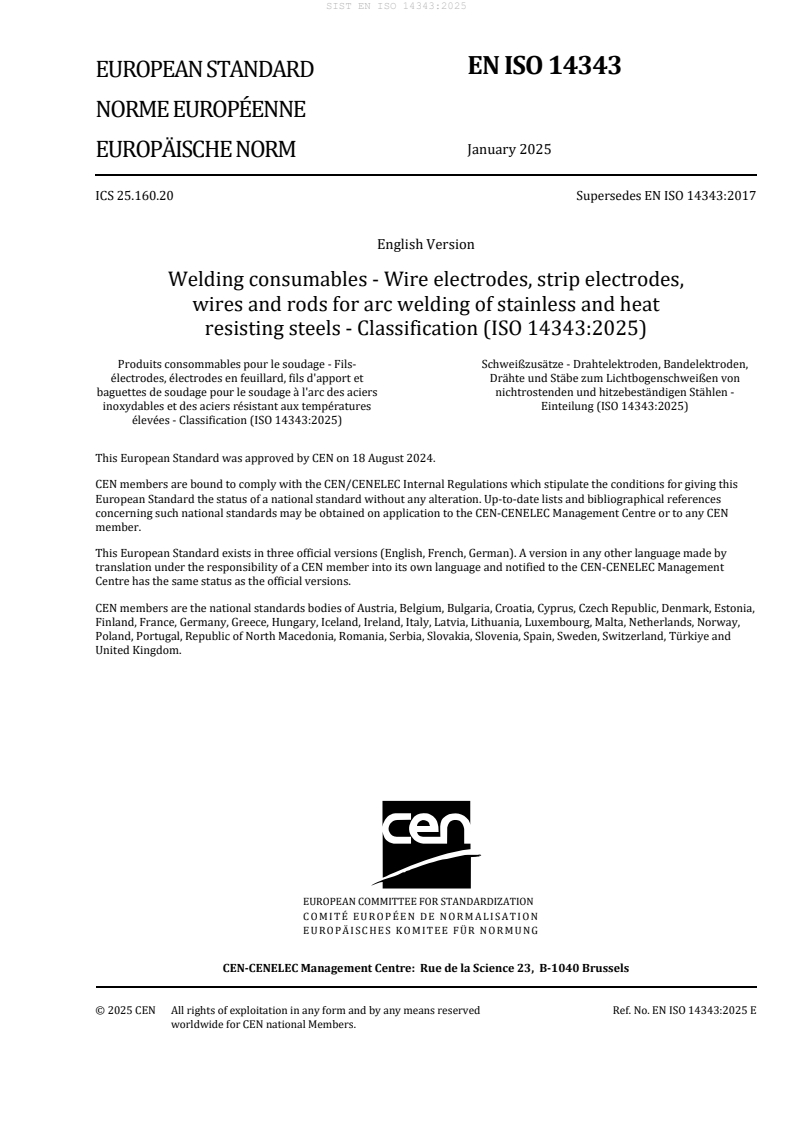
EN ISO 14343
EUROPEAN STANDARD
NORME EUROPÉENNE
January 2025
EUROPÄISCHE NORM
ICS 25.160.20 Supersedes EN ISO 14343:2017
English Version
Welding consumables - Wire electrodes, strip electrodes,
wires and rods for arc welding of stainless and heat
resisting steels - Classification (ISO 14343:2025)
Produits consommables pour le soudage - Fils- Schweißzusätze - Drahtelektroden, Bandelektroden,
électrodes, électrodes en feuillard, fils d'apport et Drähte und Stäbe zum Lichtbogenschweißen von
baguettes de soudage pour le soudage à l'arc des aciers nichtrostenden und hitzebeständigen Stählen -
inoxydables et des aciers résistant aux températures Einteilung (ISO 14343:2025)
élevées - Classification (ISO 14343:2025)
This European Standard was approved by CEN on 18 August 2024.
CEN members are bound to comply with the CEN/CENELEC Internal Regulations which stipulate the conditions for giving this
European Standard the status of a national standard without any alteration. Up-to-date lists and bibliographical references
concerning such national standards may be obtained on application to the CEN-CENELEC Management Centre or to any CEN
member.
This European Standard exists in three official versions (English, French, German). A version in any other language made by
translation under the responsibility of a CEN member into its own language and notified to the CEN-CENELEC Management
Centre has the same status as the official versions.
CEN members are the national standards bodies of Austria, Belgium, Bulgaria, Croatia, Cyprus, Czech Republic, Denmark, Estonia,
Finland, France, Germany, Greece, Hungary, Iceland, Ireland, Italy, Latvia, Lithuania, Luxembourg, Malta, Netherlands, Norway,
Poland, Portugal, Republic of North Macedonia, Romania, Serbia, Slovakia, Slovenia, Spain, Sweden, Switzerland, Türkiye and
United Kingdom.
EUROPEAN COMMITTEE FOR STANDARDIZATION
COMITÉ EUROPÉEN DE NORMALISATION
EUROPÄISCHES KOMITEE FÜR NORMUNG
CEN-CENELEC Management Centre: Rue de la Science 23, B-1040 Brussels
© 2025 CEN All rights of exploitation in any form and by any means reserved Ref. No. EN ISO 14343:2025 E
worldwide for CEN national Members.
Contents Page
European foreword . 3
European foreword
This document (EN ISO 14343:2025) has been prepared by Technical Committee ISO/TC 44 "Welding
and allied processes" in collaboration with Technical Committee CEN/TC 121 “Welding and allied
processes” the secretariat of which is held by AFNOR.
This European Standard shall be given the status of a national standard, either by publication of an
identical text or by endorsement, at the latest by July 2025, and conflicting national standards shall be
withdrawn at the latest by July 2025.
Attention is drawn to the possibility that some of the elements of this document may be the subject of
patent rights. CEN shall not be held responsible for identifying any or all such patent rights.
This document supersedes EN ISO 14343:2017.
Any feedback and questions on this document should be directed to the users’ national standards
body/national committee. A complete listing of these bodies can be found on the CEN website.
According to the CEN-CENELEC Internal Regulations, the national standards organizations of the
following countries are bound to implement this European Standard: Austria, Belgium, Bulgaria,
Croatia, Cyprus, Czech Republic, Denmark, Estonia, Finland, France, Germany, Greece, Hungary, Iceland,
Ireland, Italy, Latvia, Lithuania, Luxembourg, Malta, Netherlands, Norway, Poland, Portugal, Republic of
North Macedonia, Romania, Serbia, Slovakia, Slovenia, Spain, Sweden, Switzerland, Türkiye and the
United Kingdom.
Endorsement notice
The text of ISO 14343:2025 has been approved by CEN as EN ISO 14343:2025 without any modification.
International
Standard
ISO 14343
Fourth edition
Welding consumables — Wire
2025-01
electrodes, strip electrodes,
wires and rods for arc welding of
stainless and heat resisting steels —
Classification
Produits consommables pour le soudage — Fils-électrodes,
électrodes en feuillard, fils d'apport et baguettes de soudage pour
le soudage à l'arc des aciers inoxydables et des aciers résistant
aux températures élevées — Classification
Reference number
ISO 14343:2025(en) © ISO 2025
ISO 14343:2025(en)
© ISO 2025
All rights reserved. Unless otherwise specified, or required in the context of its implementation, no part of this publication may
be reproduced or utilized otherwise in any form or by any means, electronic or mechanical, including photocopying, or posting on
the internet or an intranet, without prior written permission. Permission can be requested from either ISO at the address below
or ISO’s member body in the country of the requester.
ISO copyright office
CP 401 • Ch. de Blandonnet 8
CH-1214 Vernier, Geneva
Phone: +41 22 749 01 11
Email: copyright@iso.org
Website: www.iso.org
Published in Switzerland
ii
ISO 14343:2025(en)
Contents Page
Foreword .iv
Introduction .v
1 Scope . 1
2 Normative references . 1
3 Terms and definitions . 1
4 Classification . 2
4.1 General .2
4.2 Symbols for products/processes .2
4.2.1 Classification by nominal composition – system A.2
4.2.2 Classification by alloy type – system B .2
4.3 Symbols for chemical composition .3
5 Properties of all-weld metal .13
6 Chemical analysis . .13
7 Rounding procedure .13
8 Retesting .13
9 Technical delivery conditions .13
10 Examples of designation .13
Annex A (informative) Expected minimum tensile properties of all-weld metal .16
Bibliography .20
iii
ISO 14343:2025(en)
Foreword
ISO (the International Organization for Standardization) is a worldwide federation of national standards
bodies (ISO member bodies). The work of preparing International Standards is normally carried out through
ISO technical committees. Each member body interested in a subject for which a technical committee
has been established has the right to be represented on that committee. International organizations,
governmental and non-governmental, in liaison with ISO, also take part in the work. ISO collaborates closely
with the International Electrotechnical Commission (IEC) on all matters of electrotechnical standardization.
The procedures used to develop this document and those intended for its further maintenance are described
in the ISO/IEC Directives, Part 1. In particular, the different approval criteria needed for the different types
of ISO document should be noted. This document was drafted in accordance with the editorial rules of the
ISO/IEC Directives, Part 2 (see www.iso.org/directives).
ISO draws attention to the possibility that the implementation of this document may involve the use of (a)
patent(s). ISO takes no position concerning the evidence, validity or applicability of any claimed patent
rights in respect thereof. As of the date of publication of this document, ISO had not received notice of (a)
patent(s) which may be required to implement this document. However, implementers are cautioned that
this may not represent the latest information, which may be obtained from the patent database available at
www.iso.org/patents. ISO shall not be held responsible for identifying any or all such patent rights.
Any trade name used in this document is information given for the convenience of users and does not
constitute an endorsement.
For an explanation of the voluntary nature of standards, the meaning of ISO specific terms and expressions
related to conformity assessment, as well as information about ISO's adherence to the World Trade
Organization (WTO) principles in the Technical Barriers to Trade (TBT), see www.iso.org/iso/foreword.html.
This document was prepared by Technical Committee ISO/TC 44, Welding and allied processes, Subcommittee
SC 3, Welding consumables, in collaboration with the European Committee for Standardization (CEN)
Technical Committee CEN/TC 121, Welding and allied processes, in accordance with the Agreement on
technical cooperation between ISO and CEN (Vienna Agreement).
This fourth edition cancels and replaces the third edition (ISO 14343:2017), which has been technically
revised.
The main changes are as follows:
— addition of 19 L Mo Nb Si Ti, 18 L Ti for the alloy type 439, 27 7 5 N L and 29 8 2 N L in Table 1 and
Table A.1;
— adjustment of chemical compositions in Table 1;
— change of Table 1 footnote c on the symbol classifications in parentheses;
— Addition of G classification in Table 1 for System B and new footnote;
— revision of Clause 10, Example 5.
Any feedback or questions on this document should be directed to the user’s
national standards body. A complete listing of these bodies can be found at
www.iso.org/members.html. Official interpretations of ISO/TC 44 documents, where they exist, are
available from this page: https://committee.iso.org/sites/tc44/home/interpretation.html.
iv
ISO 14343:2025(en)
Introduction
This document provides a classification system for wire electrodes, strip electrodes, wires and rods for arc
welding of stainless and heat resisting steels. It recognizes that there are two somewhat different approaches
in the global market to classifying a given welding consumable, and allows for either or both to be used, to
suit a particular market need. Many, but not all, commercial products addressed by this document can be
classified using both approaches, and suitable products can also be marked.
System A uses the nominal composition approach with designators to indicate the principal alloying
elements at their nominal levels, in a particular sequence, and which is sometimes followed by chemical
element symbols to indicate compositional modifications to the original grade. System B uses the alloy
type approach with three- or four-digit designations for certain grades, sometimes followed by one or
more chemical element symbols indicating compositional modifications of the grade. In both approaches,
classification is based upon the chemical composition of the product. In many cases, a given product can be
classified using both approaches, because the composition ranges, although slightly different, overlap to a
considerable extent between the two.
For stainless steel welding consumables, there is no unique relationship between the product form (wire
electrode, strip electrode, wire or rod) and the welding process used (gas-shielded metal arc welding, gas
tungsten arc welding, plasma arc welding, submerged arc welding, electroslag welding and laser beam
welding). For this reason, the wire electrodes, strip electrodes, wires or rods can be classified on the basis
of any of the above product forms and can be used, as appropriate, for more than one of the above processes.
Classification in accordance with system A, by nominal composition, was based mainly on EN 12072 which
has been withdrawn and replaced by this document. Classification in accordance with system B, by alloy
type, is mainly based upon standards used around the Pacific Rim.
v
International Standard ISO 14343:2025(en)
Welding consumables — Wire electrodes, strip electrodes,
wires and rods for arc welding of stainless and heat resisting
steels — Classification
1 Scope
This document specifies requirements for classification of wire electrodes, strip electrodes, wires and rods
for gas-shielded metal arc welding, gas tungsten arc welding, plasma arc welding, submerged arc welding,
electroslag welding and laser beam welding of stainless and heat-resisting steels. The classification of the
wire electrodes, strip electrodes, wires and rods is based upon their chemical composition.
This document is a combined specification providing for classification utilizing a system based upon nominal
composition (system A), or utilizing a system based upon alloy type (system B).
a) Paragraphs which carry the label “classification according to nominal composition” and the suffix
“system A”, or “ISO 14343-A”, are applicable only to products classified according to system A;
b) Paragraphs which carry the label “classification according to alloy type” and the suffix “system B”, or
“ISO 14343-B”, are applicable only to products classified according to system B.
c) Paragraphs which carry neither label nor suffix letter are applicable to products that can be classified
according to either system A or B or both.
2 Normative references
The following documents, in whole or in part, are normatively referenced in this document and are
indispensable for its application. For dated references, only the edition cited applies. For undated references,
the latest edition of the referenced document (including any amendments) applies.
ISO 544, Welding consumables — Technical delivery conditions for filler materials and fluxes — Type of product,
dimensions, tolerances and markings
ISO 14344, Welding consumables — Procurement of filler materials and fluxes
ISO 80000-1:2022, Quantities and units — Part 1: General
3 Terms and definitions
For the purposes of this document, the following terms and definitions apply.
ISO and IEC maintain terminology databases for use in standardization at the following addresses:
— ISO Online browsing platform: available at https:// www .iso .org/ obp
— IEC Electropedia: available at https:// www .electropedia .org/
3.1
rod
form of welding filler metal, normally packaged in straight lengths, that does not conduct the welding
current, used in gas tungsten arc and plasma arc welding
ISO 14343:2025(en)
3.2
strip electrode
form of welding filler metal, normally packaged as coils, having a rectangular cross-section of width much
greater than thickness, that becomes part of the welding circuit through which current is conducted, and
that terminates at the arc for submerged arc welding, or at the slag bath for electroslag welding
3.3
wire
form of welding filler metal, normally packaged as coils, spools or drums, that does not conduct the welding
current, for gas tungsten arc, plasma arc welding and laser beam welding
3.4
wire electrode
form of welding filler metal, normally packaged as coils, spools or drums, that becomes part of the welding
circuit through which electrical current is conducted, and that terminates at the arc, used in gas-shielded
metal arc and submerged arc welding
4 Classification
4.1 General
A wire electrode, strip electrode, wire or rod shall be classified in accordance with its chemical composition
as given in Table 1.
The classification is divided into two parts:
a) the first gives a symbol indicating the product/process to be identified;
b) the second gives a symbol indicating the chemical composition of the wire electrode, strip electrode,
wire or rod.
4.2 Symbols for products/processes
4.2.1 Classification by nominal composition – system A
The symbol for the wire electrode, strip electrode, wire or rod used in the arc welding process shall be the letter:
— G for gas metal arc welding;
— W for gas tungsten arc welding;
— P for plasma arc welding;
— S for submerged arc welding;
— B for submerged arc welding or electroslag welding with strip electrode; or
— L for laser beam welding, placed at the beginning of the designation.
See Clause 10 for designation examples.
4.2.2 Classification by alloy type – system B
No symbol is used to indicate the welding process.
The symbol for solid stainless and heat-resisting steel wire electrodes, wires and rods for use in all welding
processes shall be the letters “SS”. The initial “S” indicates solid wire as distinguished from covered
electrodes or from tubular cored wires or tubular cored rods. The second “S” indicates that the alloy system
is stainless or heat-resisting steel.
ISO 14343:2025(en)
The symbol for strip electrodes for use in submerged arc welding or electroslag welding shall be the letters
“BS”. “B” indicates a strip electrode, and “S” indicates that the alloy system is stainless or heat-resisting steel.
See Clause 10 for designation examples.
4.3 Symbols for chemical composition
The symbols presented in Table 1 indicate the chemical composition of the wire electrode, strip electrode,
wire or rod determined using the analysis specified in Clause 6.
ISO 14343:2025(en)
Table 1 — Chemical composition requirements
a
Alloy designation Chemical composition, % by mass
Nominal Alloy type
b
composition ISO 14343-B C Si Mn P S Cr Ni Mo N Cu Nb Other
ISO 14343-A
Martensitic/ferritic types
— 409 0,08 0,8 0,8 0,03 0,03 10,5 to 13,5 0,6 0,50 — 0,75 — Ti
10 × C
to 1,5
— 409Nb 0,08 1,0 0,8 0,04 0,03 10,5 to 13,5 0,6 0,50 — 0,75 10 × C —
to 0,75
c
13 (410) 0,15 1,0 1,0 0,03 0,02 12,0 to 15,0 0,5 0,5 — 0,5 — —
c
(13) 410 0,12 0,5 0,6 0,03 0,03 11,5 to 13,5 0,6 0,75 — 0,75 — —
13 L — 0,05 1,0 1,0 0,03 0,02 12,0 to 15,0 0,5 0,5 — 0,5 — —
c
13 4 (410NiMo) 0,05 1,0 1,0 0,03 0,02 11,0 to 14,0 3,0 to 5,0 0,4 to 1,0 — 0,5 — —
c
(13 4) 410NiMo 0,06 0,5 0,6 0,03 0,03 11,0 to 12,5 4,0 to 5,0 0,4 to 0,7 — 0,75 — —
— 420 0,25 to 0,40 0,5 0,6 0,03 0,03 12,0 to 14,0 0,6 0,75 — 0,75 — —
16 5 1 — 0,04 0,2 to 0,7 1,2 to 3,5 0,02 0,01 15,0 to 17,0 4,5 to 6,5 0,9 to 1,5 — 0,5 — —
c
17 (430) 0,12 1,0 1,0 0,03 0,02 16,0 to 19,0 0,5 0,5 — 0,5 — —
c
(17) 430 0,10 0,5 0,6 0,03 0,03 15,5 to 17,0 0,6 0,75 — 0,75 — —
— 430Nb 0,10 0,5 0,6 0,03 0,03 15,5 to 17,0 0,6 0,75 — 0,75 8 × C to 1,2 —
c
(18 L Nb) 430LNb 0,03 0,5 0,6 0,03 0,03 15,5 to 17,0 0,6 0,75 — 0,75 8 × C to 1,2 —
c
18 L Nb (430LNb) 0,03 0,5 0,8 0,03 0,02 17,8 to 18,8 0,5 0,5 0,02 0,5 0,05 + 7(C+N) —
to 0,6
18 L Nb Si — 0,03 0,5 to 1,5 1,0 0,03 0,03 17,5 to 19,5 0,5 0,5 0,02 0,5 0,05 + 7(C+N) —
to 0,6
18 L Nb Ti — 0,03 1,5 1,0 0,03 0,03 17,5 to 19,5 0,5 0,5 0,02 0,5 8 × C Ti 10 × C
to 0,8 to 0,5
a
Single values shown in the table are maximum values. Two values shown indicate minimum and maximum limits for a range.
b
Up to 20 % of the amount of Nb can be replaced by Ta.
c
Alloy designations in parentheses shall not be used as part of a classification. Alloy designations in parentheses [e.g. (308L) or (19 9 L)] indicate a near match in the other designation system, but not an exact match. The
correct designation for a given composition range is the one not in parentheses. A given product, by having a more restricted chemical composition that fulfils both sets of designation requirements, may be assigned both
designations independently.
d
Ni + Cu ≤ 0,5 %.
e
The all-weld metal is in most cases fully austenitic and therefore can be susceptible to microfissuring or hot cracking. The occurrence of fissuring/cracking is reduced by increasing the weld metal manganese level, and in
recognition of this, the manganese range is extended for a number of grades.
f
These compositions are mainly used in low dilution overlay welding such as electroslag strip cladding.
g
Consumables for which the chemical composition is not listed shall be symbolized similarly and prefixed by the letter Z. The chemical composition ranges are not specified, and it is possible that two products with the same
Z classification are not interchangeable.
h
Consumables for which the chemical composition is not listed shall be symbolized by the letter G. The chemical composition ranges are not specified, and it is possible that two products with the same G classification are not
interchangeable.
ISO 14343:2025(en)
Table 1 (continued)
a
Alloy designation Chemical composition, % by mass
Nominal Alloy type
b
composition ISO 14343-B C Si Mn P S Cr Ni Mo N Cu Nb Other
ISO 14343-A
18 L Ti 439 0,04 0,8 0,8 0,03 0,03 17,0 to 19,0 0,6 0,5 — 0,75 — Ti
10 × C to 1,1
19 L Mo Nb Si Ti — 0,03 1,5 1,0 0,03 0,03 18,5 to 20,5 0,5 1,75 to 0,02 0,5 8 × C Ti 6 × C
2,25 to 0,6 to 0,5
d d
— 446LMo 0,015 0,4 0,4 0,02 0,02 25,0 to 27,5 0,75 to 0,015 — —
1,00
Austenitic types
— 209 0,05 0,90 4,0 to 7,0 0,03 0,03 20,5 to 24,0 9,5 to 12,0 1,5 to 3,0 0,10 to 0,30 0,75 — V 0,10 to 0,30
— 218 0,10 3,5 to 4,5 7,0 to 9,0 0,03 0,03 16,0 to 18,0 8,0 to 9,0 0,75 0,08 to 0,18 0,75 — —
— 219 0,05 1,00 8,0 to 10,0 0,03 0,03 19,0 to 21,5 5,5 to 7,0 0,75 0,10 to 0,30 0,75 — —
— 240 0,05 1,00 10,5 to 0,03 0,03 17,0 to 19,0 4,0 to 6,0 0,75 0,10 to 0,30 0,75 — —
13,5
— 308 0,08 0,30 to 1,0 to 2,5 0,03 0,03 19,5 to 22,0 9,0 to 11,0 0,75 — 0,75 — —
0,65
— 308Si 0,08 0,65 to 1,0 to 2,5 0,03 0,03 19,5 to 22,0 9,0 to 11,0 0,75 — 0,75 — —
1,00
c
19 9 L (308L) 0,03 0,65 1,0 to 2,5 0,03 0,02 19,0 to 21,0 9,0 to 11,0 0,5 — 0,5 — —
c
(19 9 L) 308L 0,03 0,30 to 1,0 to 2,5 0,03 0,03 19,5 to 22,0 9,0 to 11,0 0,75 — 0,75 — —
0,65
c
19 9 L Si (308LSi) 0,03 0,65 to 1,2 1,0 to 2,5 0,03 0,02 19,0 to 21,0 9,0 to 11,0 0,5 — 0,5 — —
c
(19 9 L Si) 308LSi 0,03 0,65 to 1,0 to 2,5 0,03 0,03 19,5 to 22,0 9,0 to 11,0 0,75 — 0,75 — —
1,00
— 308N2 0,10 0,90 1,0 to 4,0 0,03 0,03 20,0 to 25,0 7,0 to 11,0 0,75 0,12 to 0,30 0,75 — —
c
19 9 Nb (347) 0,08 0,65 1,0 to 2,5 0,03 0,02 19,0 to 21,0 9,0 to 11,0 0,5 — 0,5 10 × C to 1,0 —
a
Single values shown in the table are maximum values. Two values shown indicate minimum and maximum limits for a range.
b
Up to 20 % of the amount of Nb can be replaced by Ta.
c
Alloy designations in parentheses shall not be used as part of a classification. Alloy designations in parentheses [e.g. (308L) or (19 9 L)] indicate a near match in the other designation system, but not an exact match. The
correct designation for a given composition range is the one not in parentheses. A given product, by having a more restricted chemical composition that fulfils both sets of designation requirements, may be assigned both
designations independently.
d
Ni + Cu ≤ 0,5 %.
e
The all-weld metal is in most cases fully austenitic and therefore can be susceptible to microfissuring or hot cracking. The occurrence of fissuring/cracking is reduced by increasing the weld metal manganese level, and in
recognition of this, the manganese range is extended for a number of grades.
f
These compositions are mainly used in low dilution overlay welding such as electroslag strip cladding.
g
Consumables for which the chemical composition is not listed shall be symbolized similarly and prefixed by the letter Z. The chemical composition ranges are not specified, and it is possible that two products with the same
Z classification are not interchangeable.
h
Consumables for which the chemical composition is not listed shall be symbolized by the letter G. The chemical composition ranges are not specified, and it is possible that two products with the same G classification are not
interchangeable.
ISO 14343:2025(en)
Table 1 (continued)
a
Alloy designation Chemical composition, % by mass
Nominal Alloy type
b
composition ISO 14343-B C Si Mn P S Cr Ni Mo N Cu Nb Other
ISO 14343-A
0,30 to 10 × C to 1,0
c
(19 9 Nb) 347 0,08 1,0 to 2,5 0,03 0,03 19,0 to 21,5 9,0 to 11,0 0,75 — 0,75 —
0,65 0,2 min.
c
19 9 Nb Si (347Si) 0,08 0,65 to 1,2 1,0 to 2,5 0,03 0,02 19,0 to 21,0 9,0 to 11,0 0,5 — 0,5 10 × C to 1,0 —
0,65 to 10 × C to 1,0
c
(19 9 Nb Si) 347Si 0,08 1,0 to 2,5 0,03 0,03 19,0 to 21,5 9,0 to 11,0 0,75 — 0,75 —
1,00 0,2 min.
10 × C to 1,0
— 347L 0,03 0,65 1,0 to 2,5 0,03 0,03 19,0 to 21,5 9,0 to 11,0 0,75 — 0,75 —
0,2 min.
— 347H 0,04 to 0,08 0,65 1,0 to 2,5 0,03 0,03 19,0 to 21,5 9,0 to 11,0 0,75 — 0,75 10 × C to 1,0 —
0,30 to 11,0 to
— 316 0,08 1,0 to 2,5 0,03 0,03 18,0 to 20,0 2,0 to 3,0 — 0,75 — —
0,65 14,0
0,65 to 11,0 to
— 316Si 0,08 1,0 to 2,5 0,03 0,03 18,0 to 20,0 2,0 to 3,0 — 0,75 — —
1,00 14,0
11,0 to
c
19 12 3 L (316L) 0,03 0,65 1,0 to 2,5 0,03 0,02 18,0 to 20,0 2,5 to 3,0 — 0,5 — —
14,0
0,30 to 11,0 to
c
(19 12 3 L) 316L 0,03 1,0 to 2,5 0,03 0,03 18,0 to 20,0 2,0 to 3,0 — 0,75 — —
0,65 14,0
11,0 to
c
19 12 3 L Si (316LSi) 0,03 0,65 to 1,2 1,0 to 2,5 0,03 0,02 18,0 to 20,0 2,5 to 3,0 — 0,5 — —
14,0
0,65 to 11,0 to
c
(19 12 3 L Si) 316LSi 0,03 1,0 to 2,5 0,03 0,03 18,0 to 20,0 2,0 to 3,0 — 0,75 — —
1,00 14,0
11,0 to
— 316LCu 0,03 0,65 1,0 to 2,5 0,03 0,03 18,0 to 20,0 2,0 to 3,0 — 1,0 to 2,5 — —
14,0
11,0 to
c
19 12 3 Nb (318) 0,08 0,65 1,0 to 2,5 0,03 0,02 18,0 to 20,0 2,5 to 3,0 — 0,5 10 × C to 1,0 —
14,0
0,30 to 11,0 to 8 × C to 1,0;
c
(19 12 3 Nb) 318 0,08 1,0 to 2,5 0,03 0,03 18,0 to 20,0 2,0 to 3,0 — 0,75 —
0,65 14,0 0,2 min.
a
Single values shown in the table are maximum values. Two values shown indicate minimum and maximum limits for a range.
b
Up to 20 % of the amount of Nb can be replaced by Ta.
c
Alloy designations in parentheses shall not be used as part of a classification. Alloy designations in parentheses [e.g. (308L) or (19 9 L)] indicate a near match in the other designation system, but not an exact match. The
correct designation for a given composition range is the one not in parentheses. A given product, by having a more restricted chemical composition that fulfils both sets of designation requirements, may be assigned both
designations independently.
d
Ni + Cu ≤ 0,5 %.
e
The all-weld metal is in most cases fully austenitic and therefore can be susceptible to microfissuring or hot cracking. The occurrence of fissuring/cracking is reduced by increasing the weld metal manganese level, and in
recognition of this, the manganese range is extended for a number of grades.
f
These compositions are mainly used in low dilution overlay welding such as electroslag strip cladding.
g
Consumables for which the chemical composition is not listed shall be symbolized similarly and prefixed by the letter Z. The chemical composition ranges are not specified, and it is possible that two products with the same
Z classification are not interchangeable.
h
Consumables for which the chemical composition is not listed shall be symbolized by the letter G. The chemical composition ranges are not specified, and it is possible that two products with the same G classification are not
interchangeable.
ISO 14343:2025(en)
Table 1 (continued)
a
Alloy designation Chemical composition, % by mass
Nominal Alloy type
b
composition ISO 14343-B C Si Mn P S Cr Ni Mo N Cu Nb Other
ISO 14343-A
11,0 to 8 × C to 1,0;
— 318L 0,03 0,65 1,0 to 2,5 0,03 0,03 18,0 to 20,0 2,0 to 3,0 — 0,75 —
14,0 0,2 min.
11,0 to
19 12 3 Nb Si — 0,08 0,65 to 1,2 1,0 to 2,5 0,03 0,02 18,0 to 20,0 2,5 to 3,0 — 0,5 10 × C to 1,0 —
14,0
0,30 to 13,0 to
— 317 0,08 1,0 to 2,5 0,03 0,03 18,5 to 20,5 3,0 to 4,0 — 0,75 — —
0,65 15,0
0,30 to 13,0 to
c
(18 15 3 L) 317L 0,03 1,0 to 2,5 0,03 0,03 18,5 to 20,5 3,0 to 4,0 — 0,75 — —
0,65 15,0
Ti
0,30 to
— 321 0,08 1,0 to 2,5 0,03 0,03 18,5 to 20,5 9,0 to 10,5 0,75 — 0,75 — 9 × C to 1,0;
0,65
0,2 min.
Ferritic-austenitic types (sometimes referred to as austenitic-ferritic types)
c
22 9 3 N L (2209) 0,03 1,0 2,5 0,03 0,02 21,0 to 24,0 7,0 to 10,0 2,5 to 4,0 0,10 to 0,20 0,5 — —
c
(22 9 3
...