

SIST EN 15361:2008
Determination of the influence of the corrosion protection on the anchorage capacity of the transverse anchorage bars
General Information
- Abstract
This document specifies a pull-out test method for the verification of the applicability of the declared outer diameter of the transverse bars with corrosion protection coating tot,g in the calculation of the anchorage capacity of transverse anchorage bars (see A.10.3 in prEN 12602:2006) in prefabricated reinforced components of autoclaved aerated concrete (AAC).
- Status
- Published
- Publication Date
- 05-Oct-2008
- Technical Committee
- BBB - Concrete, reinforced concrete and prestressed concrete
- Current Stage
- 6060 - National Implementation/Publication (Adopted Project)
- Start Date
- 29-Aug-2008
- Due Date
- 03-Nov-2008
- Completion Date
- 06-Oct-2008

Overview
EN 15361:2007 (CEN) specifies a laboratory pull-out test method to determine how a corrosion protection coating affects the anchorage capacity of transverse anchorage bars in prefabricated reinforced components of autoclaved aerated concrete (AAC). The standard verifies whether the declared outer diameter of a coated transverse bar (φtot,g) can be used in design calculations for anchorage capacity by comparing bearing stresses for coated and uncoated conditions.
Key topics and requirements
- Scope: Pull-out testing on prismatic AAC specimens to assess the influence of coatings on transverse bar bearing stress.
- Test specimens: Typical specimen size 200 × 200 × 250 mm with a central longitudinal bar (φ = 7 ± 0.5 mm) and a welded transverse bar (φ = 7 ± 0.5 mm, length L = 60 mm). Three specimen types (A, B, C) are used for bond verification and comparison.
- Measurement of coating diameter: The mean outer diameter of the coated transverse bar (φtot,m) must be measured with calipers at least six locations prior to embedding.
- Conditioning: Specimens are conditioned to a target moisture content (6 ± 2 % by mass) and temperature (20 ± 5 °C) before testing; oven-dry reference masses are required for calculation.
- Loading procedure: Pull-out force is applied to the longitudinal bar at a controlled rate (displacement not exceeding 0.5 mm/min) while recording load–slip curves until at least 5 mm displacement.
- Evaluation: Bearing stress is determined from the mean force at 1 mm slip for each specimen set. The standard defines how to calculate bearing stresses for uncoated and coated bars and the coating’s influence by comparing these results.
- Reporting: The test report must include product identification, test conditions, measured diameters, dry density and compressive strength of AAC (per EN 678 and EN 679), and the calculated bearing stresses.
Applications and users
EN 15361:2007 is practical for:
- AAC prefabrication manufacturers assessing reinforcement detailing and coatings
- Construction material testing laboratories performing pull-out verification
- Structural engineers and designers validating anchorage assumptions in reinforced AAC elements
- Certification bodies and product certifiers validating declared coated-bar diameters and performance
- Standards committees and quality control teams implementing compliance testing
This standard supports safe and reliable use of coated transverse bars in AAC precast components by providing reproducible test methods to confirm anchorage calculations.
Related standards
- EN 678 - Determination of the dry density of autoclaved aerated concrete
- EN 679 - Determination of the compressive strength of autoclaved aerated concrete
- prEN 12602:2006 (reference for anchorage calculation clause A.10.3)
Keywords: EN 15361:2007, autoclaved aerated concrete, AAC, corrosion protection coating, anchorage capacity, pull-out test, transverse anchorage bars, prefabricated reinforced components.
Relations
- Effective Date
- 28-Jan-2026
- Effective Date
- 28-Jan-2026
- Effective Date
- 28-Jan-2026
- Effective Date
- 28-Jan-2026
- Referred By
SIST EN 12602:2008+A1:2013 - Prefabricated reinforced components of autoclaved aerated concrete - Effective Date
- 28-Jan-2026
Get Certified
Connect with accredited certification bodies for this standard

DIBt (Deutsches Institut für Bautechnik)
German Institute for Building Technology.
DIN CERTCO
DIN Group product certification.

Aboma Certification B.V.
Specialized in construction, metal, and transport sectors.
Sponsored listings
Frequently Asked Questions
SIST EN 15361:2008 is a standard published by the Slovenian Institute for Standardization (SIST). Its full title is "Determination of the influence of the corrosion protection on the anchorage capacity of the transverse anchorage bars". This standard covers: This document specifies a pull-out test method for the verification of the applicability of the declared outer diameter of the transverse bars with corrosion protection coating tot,g in the calculation of the anchorage capacity of transverse anchorage bars (see A.10.3 in prEN 12602:2006) in prefabricated reinforced components of autoclaved aerated concrete (AAC).
This document specifies a pull-out test method for the verification of the applicability of the declared outer diameter of the transverse bars with corrosion protection coating tot,g in the calculation of the anchorage capacity of transverse anchorage bars (see A.10.3 in prEN 12602:2006) in prefabricated reinforced components of autoclaved aerated concrete (AAC).
SIST EN 15361:2008 is classified under the following ICS (International Classification for Standards) categories: 91.100.30 - Concrete and concrete products. The ICS classification helps identify the subject area and facilitates finding related standards.
SIST EN 15361:2008 has the following relationships with other standards: It is inter standard links to SIST EN 678:2001, SIST EN 679:2005, SIST EN 12602:2008, SIST EN 12602:2017, SIST EN 12602:2008+A1:2013. Understanding these relationships helps ensure you are using the most current and applicable version of the standard.
SIST EN 15361:2008 is associated with the following European legislation: EU Directives/Regulations: 305/2011, 89/106/EEC. When a standard is cited in the Official Journal of the European Union, products manufactured in conformity with it benefit from a presumption of conformity with the essential requirements of the corresponding EU directive or regulation.
SIST EN 15361:2008 is available in PDF format for immediate download after purchase. The document can be added to your cart and obtained through the secure checkout process. Digital delivery ensures instant access to the complete standard document.
Standards Content (Sample)
2003-01.Slovenski inštitut za standardizacijo. Razmnoževanje celote ali delov tega standarda ni dovoljeno.Bestimmung des Einflusses des Korrosionsschutzüberzugs auf die aufnehmbare Verankerungskraft der zur Verankerung benutzten Querstäbe in vorgefertigten bewehrten Bauteilen aus dampfgehärtetem PorenbetonDétermination de l'influence de la protection contre la corrosion sur la capacité d'ancrage des barres d'ancrage transversales dans les composants préfabriqués en béton cellulaire autoclavé arméDetermination of the influence of the corrosion protection on the anchorage capacity of the transverse anchorage bars91.100.30Beton in betonski izdelkiConcrete and concrete productsICS:Ta slovenski standard je istoveten z:EN 15361:2007SIST EN 15361:2008en,fr,de01-november-2008SIST EN 15361:2008SLOVENSKI
STANDARD
EUROPEAN STANDARDNORME EUROPÉENNEEUROPÄISCHE NORMEN 15361April 2007ICS 91.100.30 English VersionDetermination of the influence of the corrosion protectioncoating on the anchorage capacity of the transverse anchoragebars in prefabricated reinforced components of autoclavedaerated concreteDétermination de l'influence de la protection contre lacorrosion sur la capacité d'ancrage des barres d'ancragetransversales dans les composants préfabriqués en bétoncellulaire autoclavé arméBestimmung des Einflusses des Korrosionsschutzüberzugsauf die aufnehmbare Verankerungskraft der zurVerankerung benutzten Querstäbe in vorgefertigtenbewehrten Bauteilen aus dampfgehärtetem PorenbetonThis European Standard was approved by CEN on 24 February 2007.CEN members are bound to comply with the CEN/CENELEC Internal Regulations which stipulate the conditions for giving this EuropeanStandard the status of a national standard without any alteration. Up-to-date lists and bibliographical references concerning such nationalstandards may be obtained on application to the CEN Management Centre or to any CEN member.This European Standard exists in three official versions (English, French, German). A version in any other language made by translationunder the responsibility of a CEN member into its own language and notified to the CEN Management Centre has the same status as theofficial versions.CEN members are the national standards bodies of Austria, Belgium, Bulgaria, Cyprus, Czech Republic, Denmark, Estonia, Finland,France, Germany, Greece, Hungary, Iceland, Ireland, Italy, Latvia, Lithuania, Luxembourg, Malta, Netherlands, Norway, Poland, Portugal,Romania, Slovakia, Slovenia, Spain, Sweden, Switzerland and United Kingdom.EUROPEAN COMMITTEE FOR STANDARDIZATIONCOMITÉ EUROPÉEN DE NORMALISATIONEUROPÄISCHES KOMITEE FÜR NORMUNGManagement Centre: rue de Stassart, 36
B-1050 Brussels© 2007 CENAll rights of exploitation in any form and by any means reservedworldwide for CEN national Members.Ref. No. EN 15361:2007: ESIST EN 15361:2008
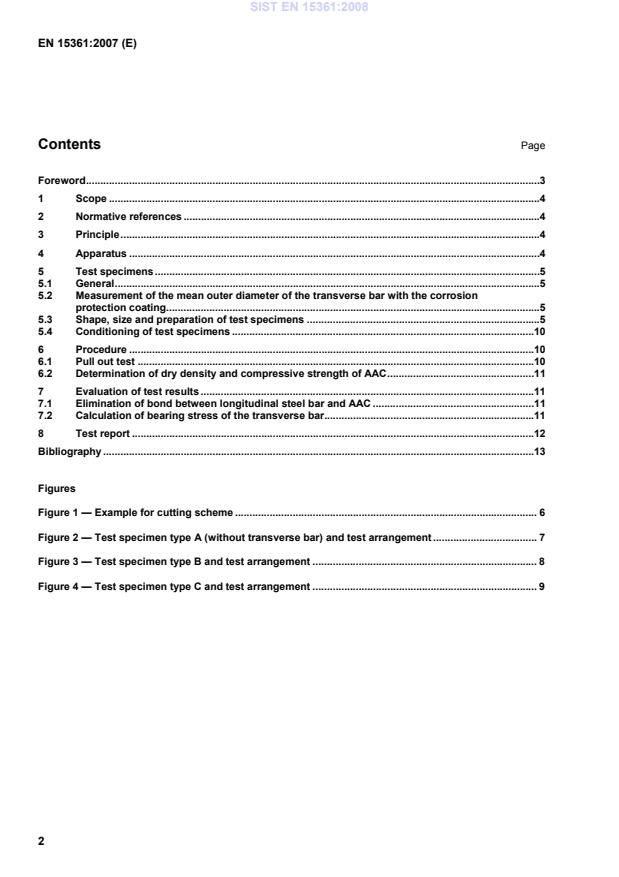
Figures Figure 1 — Example for cutting scheme.6 Figure 2 — Test specimen type A (without transverse bar) and test arrangement.7 Figure 3 — Test specimen type B and test arrangement.8 Figure 4 — Test specimen type C and test arrangement.9
...