


SIST EN 319 132-1 V1.3.1:2024
(Main)Electronic Signatures and Trust Infrastructures (ESI) - XAdES digital signatures - Part 1: Building blocks and XAdES baseline signatures
Electronic Signatures and Trust Infrastructures (ESI) - XAdES digital signatures - Part 1: Building blocks and XAdES baseline signatures
The present document specifies XAdES digital signatures. XAdES signatures build on XML digital signatures [1], by
incorporation of signed and unsigned qualifying properties, which fulfil certain common requirements (such as the long
term validity of digital signatures, for instance) in a number of use cases.
The present document specifies XML Schema definitions for the aforementioned qualifying properties as well as
mechanisms for incorporating them into XAdES signatures.
The present document specifies formats for XAdES baseline signatures, which provide the basic features necessary for
a wide range of business and governmental use cases for electronic procedures and communications to be applicable to
a wide range of communities when there is a clear need for interoperability of digital signatures used in electronic
documents.
The present document defines four levels of XAdES baseline signatures addressing incremental requirements to
maintain the validity of the signatures over the long term, in a way that a certain level always addresses all the
requirements addressed at levels that are below it. Each level requires the presence of certain XAdES qualifying
properties, suitably profiled for reducing the optionality as much as possible.
Procedures for creation, augmentation, and validation of XAdES digital signatures are out of scope and specified in
ETSI EN 319 102-1 [i.6]. Guidance on creation, augmentation and validation of XAdES digital signatures including the
usage of the different properties defined in the present document is provided in ETSI TR 119 100 [i.11].
The present document aims at supporting electronic signatures in different regulatory frameworks.
NOTE: Specifically but not exclusively, XAdES digital signatures specified in the present document aim at
supporting electronic signatures, advanced electronic signatures, qualified electronic signatures,
electronic seals, advanced electronic seals, and qualified electronic seals as per Regulation (EU)
No 910/2014 [i.1].
Elektronski podpisi in infrastrukture zaupanja (ESI) - Digitalni podpisi XAdES - 1. del: Gradniki in izhodiščni podpisi XAdES
Ta dokument določa digitalne podpise XAdES. Podpisi XAdES temeljijo na digitalnih podpisih XML [1] z vključitvijo podpisanih in nepodpisanih kvalificiranih lastnosti, ki izpolnjujejo določene splošne zahteve (kot je dolgoročna veljavnost digitalnih podpisov) v številnih primerih uporabe.
Ta dokument določa definicije sheme XML za zgoraj omenjene kvalificirane lastnosti in tudi mehanizme za njihovo vključevanje v podpise XAdES.
Ta dokument določa specifične formate za izhodiščne podpise XAdES, ki zagotavljajo osnovne funkcije, zaradi katerih se lahko različni poslovni in vladni primeri uporabe za elektronske postopke in komunikacijo uporabijo za širok nabor skupnosti, kadar obstaja jasna potreba po interoperabilnosti digitalnih podpisov, uporabljenih v elektronskih dokumentih.
V tem dokumentu so določene štiri ravni izhodiščnih podpisov XAdES, ki obravnavajo naraščajoče zahteve po dolgoročnem ohranjanju veljavnosti podpisov, pri čemer določena raven vedno obravnava vse zahteve, obravnavane na njenih podravneh. Vsaka raven zahteva prisotnost določenih kvalificiranih lastnosti XAdES,
ki ustrezno zmanjšujejo možnost izbire.
Postopki izdelave, razširitve in potrjevanja digitalnih podpisov XAdES v tem dokumentu niso zajeti, ampak so določeni v standardu ETSI EN 319 102-1 [i.6]. Smernice glede izdelave, razširitve in potrjevanja digitalnih podpisov XAdES, vključno z uporabo različnih lastnosti, določenih v tem dokumentu, so podane v standardu ETSI TR 119 100 [i.11].
Namen tega dokumenta je zagotavljanje podpore za elektronske podpise v različnih regulativnih okvirjih.
OPOMBA: Namen digitalnih podpisov XAdES, določenih v tem dokumentu, je zlasti (vendar ne izključno) zagotavljanje podpore za elektronske podpise, napredne elektronske podpise, kvalificirane elektronske podpise,
elektronske žige, napredne elektronske žige in kvalificirane elektronske žige skladno z Uredbo (EU)
št. 910/2014 [i.1].
General Information
- Status
- Published
- Public Enquiry End Date
- 22-Jul-2024
- Publication Date
- 12-Aug-2024
- Technical Committee
- SPN - Services and Protocols for Networks
- Current Stage
- 6060 - National Implementation/Publication (Adopted Project)
- Start Date
- 05-Aug-2024
- Due Date
- 10-Oct-2024
- Completion Date
- 13-Aug-2024
Buy Documents
ETSI EN 319 132-1 V1.3.0 (2024-04) - Electronic Signatures and Trust Infrastructures (ESI); XAdES digital signatures; Part 1: Building blocks and XAdES baseline signatures
ETSI EN 319 132-1 V1.3.1 (2024-07) - Electronic Signatures and Trust Infrastructures (ESI); XAdES digital signatures; Part 1: Building blocks and XAdES baseline signatures

Overview
SIST EN 319 132-1 V1.3.1:2024 defines the core building blocks and baseline formats for XAdES digital signatures within the ecosystem of electronic signatures and trust infrastructures (ESI). Developed by the Slovenian Institute for Standardization (SIST) and aligned with ETSI EN 319 132-1, this standard enhances XML digital signatures by introducing signed and unsigned qualifying properties, ensuring long-term signature validity, interoperability, and compliance with European Union regulations, including the eIDAS Regulation (EU No 910/2014).
XAdES (XML Advanced Electronic Signatures) signatures extend the capabilities of XML digital signatures, facilitating secure electronic transactions for business, governmental, and cross-border use cases. This standard specifies XML schema definitions for qualifying properties and mechanisms for incorporating these properties into XAdES signatures, enabling uniform and reliable digital signature practices.
Key Topics
- XAdES Building Blocks: Specification of XML schema and mechanisms to enhance XML digital signatures with qualifying properties.
- Baseline XAdES Signatures: Definition of four baseline signature levels, each fulfilling incremental security and validity requirements.
- Qualifying Properties: Structuring signed and unsigned properties (such as signing time, certificate references, and policy identifiers) for enriched legal value and compliance.
- Interoperability: Ensures digital signatures can be validated and trusted across multiple domains, organizations, and jurisdictions.
- Long-Term Validity: Addressing essential requirements for maintaining the validity of digital signatures over extended periods.
Applications
SIST EN 319 132-1 V1.3.1:2024 is highly applicable across a range of digital environments and industries, including:
- Government & Public Sector: Secure electronic communication, document exchange, and legal compliance in e-government solutions.
- Business & Financial Services: Digital contract management, invoicing, and secure record-keeping with long-term legal validity.
- Cross-Border Transactions: Facilitates trust and compliance in international electronic transactions by supporting advanced and qualified electronic signatures and seals as per eIDAS.
- Trust Service Providers: Reference for providers creating or validating XAdES signatures in compliance with EU standards.
- Document Management Systems: Integration of XAdES signatures for proof of origin, integrity, and non-repudiation of electronic records.
Related Standards
The implementation and interoperability of XAdES digital signatures often require alignment with associated standards and guidelines, including:
- ETSI EN 319 102-1: Specifies procedures for the creation and validation of advanced digital signatures.
- ETSI EN 319 132-2: Addresses extended XAdES signatures, adding features beyond the baseline levels.
- ETSI TS 119 172-1: Provides guidance on signature policy documents relevant to signature creation and validation.
- Regulation (EU) No 910/2014 (eIDAS): Legal framework for electronic identification and trust services in Europe.
- W3C XML Signature Syntax and Processing: Underpinning XMLDSIG recommendations for digital signatures.
- ETSI TR 119 100: Offers practical guidance for using signature and validation standards in real-world environments.
Practical Value
- Enhances Security and Trust: By providing a clear framework for qualifying properties, the standard strengthens the legal value and evidentiary weight of digital signatures.
- Supports Interoperability: Allows organizations to confidently exchange signed electronic documents that are recognized and verifiable across the European Union and beyond.
- Future-Proof Compliance: The defined baseline levels ensure organizations can tailor their signature solutions to evolving regulatory or business needs.
- Universality: Applicable to a wide range of platforms, including smart cards, SIM cards, and dedicated signature software.
SIST EN 319 132-1 V1.3.1:2024 is central for organizations aiming to implement secure, interoperable, and regulation-compliant digital signatures in electronic document workflows, supporting both current operational needs and future legal requirements.
Buy Documents
ETSI EN 319 132-1 V1.3.0 (2024-04) - Electronic Signatures and Trust Infrastructures (ESI); XAdES digital signatures; Part 1: Building blocks and XAdES baseline signatures
ETSI EN 319 132-1 V1.3.1 (2024-07) - Electronic Signatures and Trust Infrastructures (ESI); XAdES digital signatures; Part 1: Building blocks and XAdES baseline signatures
Get Certified
Connect with accredited certification bodies for this standard

BSI Group
BSI (British Standards Institution) is the business standards company that helps organizations make excellence a habit.

NYCE
Mexican standards and certification body.
Sponsored listings
Frequently Asked Questions
SIST EN 319 132-1 V1.3.1:2024 is a standard published by the Slovenian Institute for Standardization (SIST). Its full title is "Electronic Signatures and Trust Infrastructures (ESI) - XAdES digital signatures - Part 1: Building blocks and XAdES baseline signatures". This standard covers: The present document specifies XAdES digital signatures. XAdES signatures build on XML digital signatures [1], by incorporation of signed and unsigned qualifying properties, which fulfil certain common requirements (such as the long term validity of digital signatures, for instance) in a number of use cases. The present document specifies XML Schema definitions for the aforementioned qualifying properties as well as mechanisms for incorporating them into XAdES signatures. The present document specifies formats for XAdES baseline signatures, which provide the basic features necessary for a wide range of business and governmental use cases for electronic procedures and communications to be applicable to a wide range of communities when there is a clear need for interoperability of digital signatures used in electronic documents. The present document defines four levels of XAdES baseline signatures addressing incremental requirements to maintain the validity of the signatures over the long term, in a way that a certain level always addresses all the requirements addressed at levels that are below it. Each level requires the presence of certain XAdES qualifying properties, suitably profiled for reducing the optionality as much as possible. Procedures for creation, augmentation, and validation of XAdES digital signatures are out of scope and specified in ETSI EN 319 102-1 [i.6]. Guidance on creation, augmentation and validation of XAdES digital signatures including the usage of the different properties defined in the present document is provided in ETSI TR 119 100 [i.11]. The present document aims at supporting electronic signatures in different regulatory frameworks. NOTE: Specifically but not exclusively, XAdES digital signatures specified in the present document aim at supporting electronic signatures, advanced electronic signatures, qualified electronic signatures, electronic seals, advanced electronic seals, and qualified electronic seals as per Regulation (EU) No 910/2014 [i.1].
The present document specifies XAdES digital signatures. XAdES signatures build on XML digital signatures [1], by incorporation of signed and unsigned qualifying properties, which fulfil certain common requirements (such as the long term validity of digital signatures, for instance) in a number of use cases. The present document specifies XML Schema definitions for the aforementioned qualifying properties as well as mechanisms for incorporating them into XAdES signatures. The present document specifies formats for XAdES baseline signatures, which provide the basic features necessary for a wide range of business and governmental use cases for electronic procedures and communications to be applicable to a wide range of communities when there is a clear need for interoperability of digital signatures used in electronic documents. The present document defines four levels of XAdES baseline signatures addressing incremental requirements to maintain the validity of the signatures over the long term, in a way that a certain level always addresses all the requirements addressed at levels that are below it. Each level requires the presence of certain XAdES qualifying properties, suitably profiled for reducing the optionality as much as possible. Procedures for creation, augmentation, and validation of XAdES digital signatures are out of scope and specified in ETSI EN 319 102-1 [i.6]. Guidance on creation, augmentation and validation of XAdES digital signatures including the usage of the different properties defined in the present document is provided in ETSI TR 119 100 [i.11]. The present document aims at supporting electronic signatures in different regulatory frameworks. NOTE: Specifically but not exclusively, XAdES digital signatures specified in the present document aim at supporting electronic signatures, advanced electronic signatures, qualified electronic signatures, electronic seals, advanced electronic seals, and qualified electronic seals as per Regulation (EU) No 910/2014 [i.1].
SIST EN 319 132-1 V1.3.1:2024 is classified under the following ICS (International Classification for Standards) categories: 35.040.01 - Information coding in general. The ICS classification helps identify the subject area and facilitates finding related standards.
SIST EN 319 132-1 V1.3.1:2024 is available in PDF format for immediate download after purchase. The document can be added to your cart and obtained through the secure checkout process. Digital delivery ensures instant access to the complete standard document.
Standards Content (Sample)
Draft ETSI EN 319 132-1 V1.3.0 (2024-04)
EUROPEAN STANDARD
Electronic Signatures and Trust Infrastructures (ESI);
XAdES digital signatures;
Part 1: Building blocks and XAdES baseline signatures
2 Draft ETSI EN 319 132-1 V1.3.0 (2024-04)
Reference
REN/ESI-0019132-1v131
Keywords
electronic signature, security, XAdES, XML
ETSI
650 Route des Lucioles
F-06921 Sophia Antipolis Cedex - FRANCE
Tel.: +33 4 92 94 42 00 Fax: +33 4 93 65 47 16
Siret N° 348 623 562 00017 - APE 7112B
Association à but non lucratif enregistrée à la
Sous-Préfecture de Grasse (06) N° w061004871
Important notice
The present document can be downloaded from:
https://www.etsi.org/standards-search
The present document may be made available in electronic versions and/or in print. The content of any electronic and/or
print versions of the present document shall not be modified without the prior written authorization of ETSI. In case of any
existing or perceived difference in contents between such versions and/or in print, the prevailing version of an ETSI
deliverable is the one made publicly available in PDF format at www.etsi.org/deliver.
Users of the present document should be aware that the document may be subject to revision or change of status.
Information on the current status of this and other ETSI documents is available at
https://portal.etsi.org/TB/ETSIDeliverableStatus.aspx
If you find errors in the present document, please send your comment to one of the following services:
https://portal.etsi.org/People/CommiteeSupportStaff.aspx
If you find a security vulnerability in the present document, please report it through our
Coordinated Vulnerability Disclosure Program:
https://www.etsi.org/standards/coordinated-vulnerability-disclosure
Notice of disclaimer & limitation of liability
The information provided in the present deliverable is directed solely to professionals who have the appropriate degree of
experience to understand and interpret its content in accordance with generally accepted engineering or
other professional standard and applicable regulations.
No recommendation as to products and services or vendors is made or should be implied.
In no event shall ETSI be held liable for loss of profits or any other incidental or consequential damages.
Any software contained in this deliverable is provided "AS IS" with no warranties, express or implied, including but not
limited to, the warranties of merchantability, fitness for a particular purpose and non-infringement of intellectual property
rights and ETSI shall not be held liable in any event for any damages whatsoever (including, without limitation, damages
for loss of profits, business interruption, loss of information, or any other pecuniary loss) arising out of or related to the use
of or inability to use the software.
Copyright Notification
No part may be reproduced or utilized in any form or by any means, electronic or mechanical, including photocopying and
microfilm except as authorized by written permission of ETSI.
The content of the PDF version shall not be modified without the written authorization of ETSI.
The copyright and the foregoing restriction extend to reproduction in all media.
© ETSI 2024.
All rights reserved.
ETSI
3 Draft ETSI EN 319 132-1 V1.3.0 (2024-04)
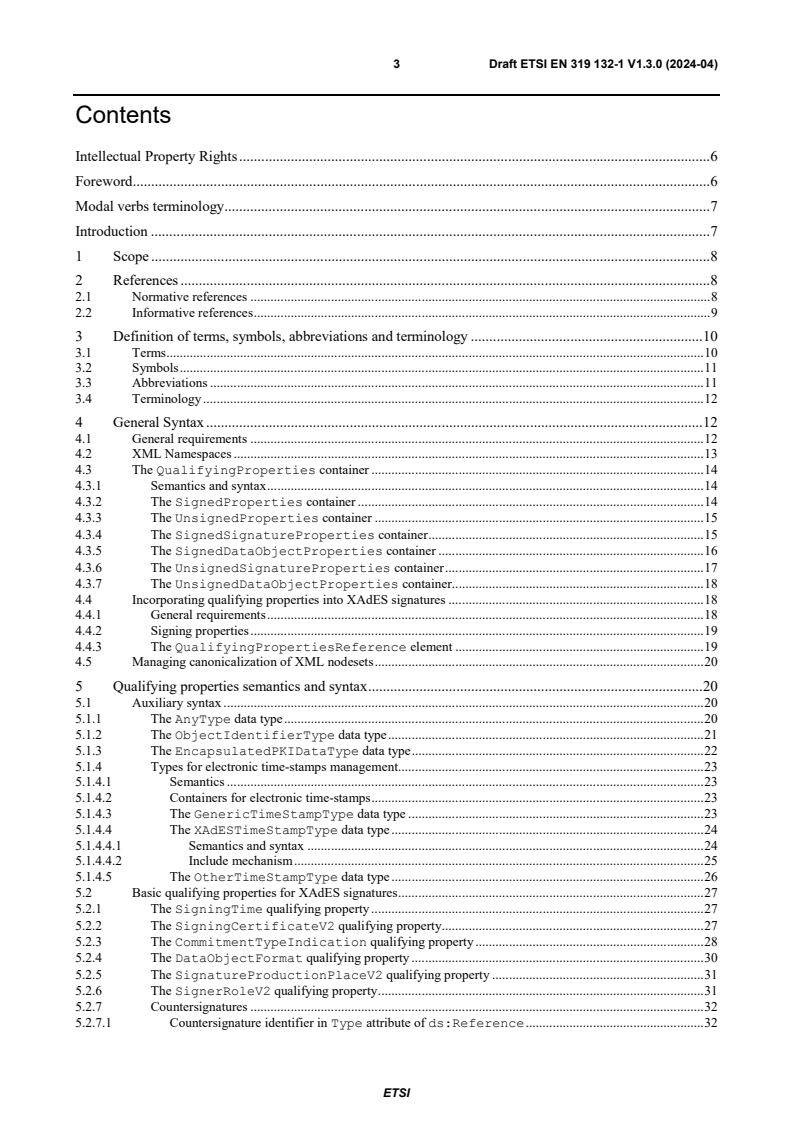
Contents
Intellectual Property Rights . 6
Foreword . 6
Modal verbs terminology . 7
Introduction . 7
1 Scope . 8
2 References . 8
2.1 Normative references . 8
2.2 Informative references . 9
3 Definition of terms, symbols, abbreviations and terminology . 10
3.1 Terms . 10
3.2 Symbols . 11
3.3 Abbreviations . 11
3.4 Terminology . 12
4 General Syntax . 12
4.1 General requirements . 12
4.2 XML Namespaces . 13
4.3 The QualifyingProperties container . 14
4.3.1 Semantics and syntax . 14
4.3.2 The SignedProperties container . 14
4.3.3 The UnsignedProperties container . 15
4.3.4 The SignedSignatureProperties container . 15
4.3.5 The SignedDataObjectProperties container . 16
4.3.6 The UnsignedSignatureProperties container . 17
4.3.7 The UnsignedDataObjectProperties container. 18
4.4 Incorporating qualifying properties into XAdES signatures . 18
4.4.1 General requirements . 18
4.4.2 Signing properties . 19
4.4.3 The QualifyingPropertiesReference element . 19
4.5 Managing canonicalization of XML nodesets . 20
5 Qualifying properties semantics and syntax . 20
5.1 Auxiliary syntax . 20
5.1.1 The AnyType data type . 20
5.1.2 The ObjectIdentifierType data type . 21
5.1.3 The EncapsulatedPKIDataType data type . 22
5.1.4 Types for electronic time-stamps management. 23
5.1.4.1 Semantics . 23
5.1.4.2 Containers for electronic time-stamps . 23
5.1.4.3 The GenericTimeStampType data type . 23
5.1.4.4 The XAdESTimeStampType data type . 24
5.1.4.4.1 Semantics and syntax . 24
5.1.4.4.2 Include mechanism . 25
5.1.4.5 The OtherTimeStampType data type . 26
5.2 Basic qualifying properties for XAdES signatures . 27
5.2.1 The SigningTime qualifying property . 27
5.2.2 The SigningCertificateV2 qualifying property . 27
5.2.3 The CommitmentTypeIndication qualifying property . 28
5.2.4 The DataObjectFormat qualifying property . 30
5.2.5 The SignatureProductionPlaceV2 qualifying property . 31
5.2.6 The SignerRoleV2 qualifying property . 31
5.2.7 Countersignatures . 32
5.2.7.1 Countersignature identifier in Type attribute of ds:Reference . 32
ETSI
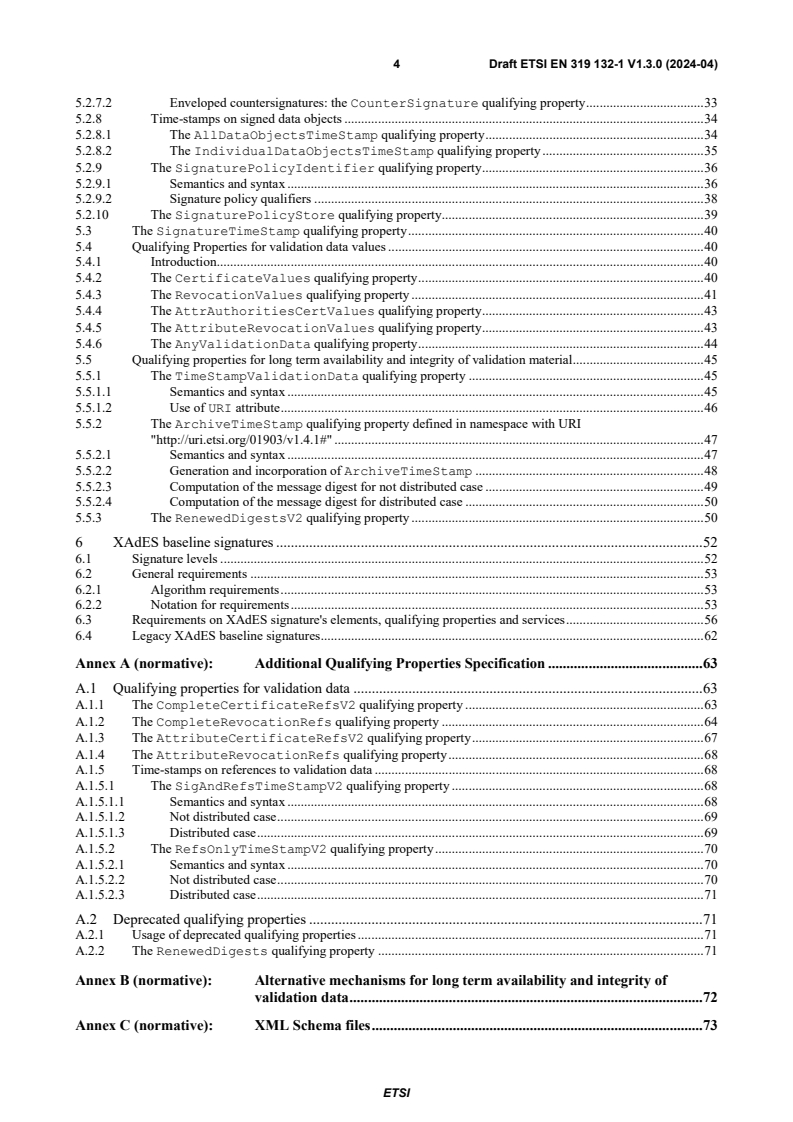
4 Draft ETSI EN 319 132-1 V1.3.0 (2024-04)
5.2.7.2 Enveloped countersignatures: the CounterSignature qualifying property . 33
5.2.8 Time-stamps on signed data objects . 34
5.2.8.1 The AllDataObjectsTimeStamp qualifying property . 34
5.2.8.2 The IndividualDataObjectsTimeStamp qualifying property . 35
5.2.9 The SignaturePolicyIdentifier qualifying property . 36
5.2.9.1 Semantics and syntax . 36
5.2.9.2 Signature policy qualifiers . 38
5.2.10 The SignaturePolicyStore qualifying property . 39
5.3 The SignatureTimeStamp qualifying property . 40
5.4 Qualifying Properties for validation data values . 40
5.4.1 Introduction. 40
5.4.2 The CertificateValues qualifying property . 40
5.4.3 The RevocationValues qualifying property . 41
5.4.4 The AttrAuthoritiesCertValues qualifying property . 43
5.4.5 The AttributeRevocationValues qualifying property . 43
5.4.6 The AnyValidationData qualifying property . 44
5.5 Qualifying properties for long term availability and integrity of validation material . 45
5.5.1 The TimeStampValidationData qualifying property . 45
5.5.1.1 Semantics and syntax . 45
5.5.1.2 Use of URI attribute . 46
5.5.2 The ArchiveTimeStamp qualifying property defined in namespace with URI
"http://uri.etsi.org/01903/v1.4.1#" . 47
5.5.2.1 Semantics and syntax . 47
5.5.2.2 Generation and incorporation of ArchiveTimeStamp . 48
5.5.2.3 Computation of the message digest for not distributed case . 49
5.5.2.4 Computation of the message digest for distributed case . 50
5.5.3 The RenewedDigestsV2 qualifying property . 50
6 XAdES baseline signatures . 52
6.1 Signature levels . 52
6.2 General requirements . 53
6.2.1 Algorithm requirements . 53
6.2.2 Notation for requirements . 53
6.3 Requirements on XAdES signature's elements, qualifying properties and services . 56
6.4 Legacy XAdES baseline signatures . 62
Annex A (normative): Additional Qualifying Properties Specification . 63
A.1 Qualifying properties for validation data . 63
A.1.1 The CompleteCertificateRefsV2 qualifying property . 63
A.1.2 The CompleteRevocationRefs qualifying property . 64
A.1.3 The AttributeCertificateRefsV2 qualifying property . 67
A.1.4 The AttributeRevocationRefs qualifying property . 68
A.1.5 Time-stamps on references to validation data . 68
A.1.5.1 The SigAndRefsTimeStampV2 qualifying property . 68
A.1.5.1.1 Semantics and syntax . 68
A.1.5.1.2 Not distributed case . 69
A.1.5.1.3 Distributed case . 69
A.1.5.2 The RefsOnlyTimeStampV2 qualifying property . 70
A.1.5.2.1 Semantics and syntax . 70
A.1.5.2.2 Not distributed case . 70
A.1.5.2.3 Distributed case . 71
A.2 Deprecated qualifying properties . 71
A.2.1 Usage of deprecated qualifying properties . 71
A.2.2 The RenewedDigests qualifying property . 71
Annex B (normative): Alternative mechanisms for long term availability and integrity of
validation data . 72
Annex C (normative): XML Schema files . . 73
ETSI
5 Draft ETSI EN 319 132-1 V1.3.0 (2024-04)
C.1 XML Schema file location for namespace http://uri.etsi.org/01903/v1.3.2# . 73
C.2 XML Schema file location for namespace http://uri.etsi.org/01903/v1.4.1# . 73
Annex D (normative): Deprecated qualifying properties . 74
Annex E (informative): Change history . 75
History . 77
ETSI
6 Draft ETSI EN 319 132-1 V1.3.0 (2024-04)
Intellectual Property Rights
Essential patents
IPRs essential or potentially essential to normative deliverables may have been declared to ETSI. The declarations
pertaining to these essential IPRs, if any, are publicly available for ETSI members and non-members, and can be
found in ETSI SR 000 314: "Intellectual Property Rights (IPRs); Essential, or potentially Essential, IPRs notified to
ETSI in respect of ETSI standards", which is available from the ETSI Secretariat. Latest updates are available on the
ETSI Web server (https://ipr.etsi.org/).
Pursuant to the ETSI Directives including the ETSI IPR Policy, no investigation regarding the essentiality of IPRs,
including IPR searches, has been carried out by ETSI. No guarantee can be given as to the existence of other IPRs not
referenced in ETSI SR 000 314 (or the updates on the ETSI Web server) which are, or may be, or may become,
essential to the present document.
Trademarks
The present document may include trademarks and/or tradenames which are asserted and/or registered by their owners.
ETSI claims no ownership of these except for any which are indicated as being the property of ETSI, and conveys no
right to use or reproduce any trademark and/or tradename. Mention of those trademarks in the present document does
not constitute an endorsement by ETSI of products, services or organizations associated with those trademarks.
DECT™, PLUGTESTS™, UMTS™ and the ETSI logo are trademarks of ETSI registered for the benefit of its
Members. 3GPP™ and LTE™ are trademarks of ETSI registered for the benefit of its Members and of the 3GPP
Organizational Partners. oneM2M™ logo is a trademark of ETSI registered for the benefit of its Members and of the ®
oneM2M Partners. GSM and the GSM logo are trademarks registered and owned by the GSM Association.
Foreword
This draft European Standard (EN) has been produced by ETSI Technical Committee Electronic Signatures and Trust
Infrastructures (ESI), and is now submitted for the combined Public Enquiry and Vote phase of the ETSI EN Approval
Procedure.
The present document is part 1 of a multi-part deliverable covering XAdES digital signatures, as identified below:
ETSI EN 319 132 -1: "Building blocks and XAdES baseline signatures";
ETSI EN 319 132 -2: "Extended XAdES signatures".
ETSI TS 119 132-3: "Incorporation of Evidence Record Syntax (ERS) mechanisms in XAdES".
Two .xsd files, whose locations are detailed in clauses C.1 and C.2, and which contain XML Schema definitions, are
contained in archive en_31913201v010300a0.zip which accompanies the present document.
Proposed national transposition dates
Date of latest announcement of this EN (doa): 3 months after ETSI publication
Date of latest publication of new National Standard
or endorsement of this EN (dop/e): 6 months after doa
Date of withdrawal of any conflicting National Standard (dow): 36 months after doa
ETSI
7 Draft ETSI EN 319 132-1 V1.3.0 (2024-04)
Modal verbs terminology
In the present document "shall", "shall not", "should", "should not", "may", "need not", "will", "will not", "can" and
"cannot" are to be interpreted as described in clause 3.2 of the ETSI Drafting Rules (Verbal forms for the expression of
provisions).
"must" and "must not" are NOT allowed in ETSI deliverables except when used in direct citation.
Introduction
Electronic commerce has emerged as a frequent way of doing business between companies across local, wide area and
global networks. Trust in this way of doing business is essential for the success and continued development of
electronic commerce. It is therefore important that companies using this electronic means of doing business have
suitable security controls and mechanisms in place to protect their transactions and to ensure trust and confidence with
their business partners. In this respect digital signatures are an important security component that can be used to protect
information and provide trust in electronic business.
The present document is intended to cover digital signatures supported by PKI and public key certificates, and aims to
meet the general requirements of the international community to provide trust and confidence in electronic transactions,
including, amongst other, applicable requirements from Regulation (EU) No 910/2014 [i.1].
The present document can be used for any transaction between an individual and a company, between two companies,
between an individual and a governmental body, etc. The present document is independent of any environment. It can
be applied to any environment e.g. smart cards, SIM cards, special programs for electronic signatures, etc.
The present document is part of a rationalized framework of standards (see ETSI TR 119 000 [i.10]). ETSI
TR 119 100 [i.11] provides guidance on how to use the present document within the aforementioned framework.
ETSI
8 Draft ETSI EN 319 132-1 V1.3.0 (2024-04)
1 Scope
The present document specifies XAdES digital signatures. XAdES signatures build on XML digital signatures [1], by
incorporation of signed and unsigned qualifying properties, which fulfil certain common requirements (such as the long
term validity of digital signatures, for instance) in a number of use cases.
The present document specifies XML Schema definitions for the aforementioned qualifying properties as well as
mechanisms for incorporating them into XAdES signatures.
The present document specifies formats for XAdES baseline signatures, which provide the basic features necessary for
a wide range of business and governmental use cases for electronic procedures and communications to be applicable to
a wide range of communities when there is a clear need for interoperability of digital signatures used in electronic
documents.
The present document defines four levels of XAdES baseline signatures addressing incremental requirements to
maintain the validity of the signatures over the long term, in a way that a certain level always addresses all the
requirements addressed at levels that are below it. Each level requires the presence of certain XAdES qualifying
properties, suitably profiled for reducing the optionality as much as possible.
Procedures for creation, augmentation, and validation of XAdES digital signatures are out of scope and specified in
ETSI EN 319 102-1 [i.6]. Guidance on creation, augmentation and validation of XAdES digital signatures including the
usage of the different properties defined in the present document is provided in ETSI TR 119 100 [i.11].
The present document aims at supporting electronic signatures in different regulatory frameworks.
NOTE: Specifically but not exclusively, XAdES digital signatures specified in the present document aim at
supporting electronic signatures, advanced electronic signatures, qualified electronic signatures,
electronic seals, advanced electronic seals, and qualified electronic seals as per Regulation (EU)
No 910/2014 [i.1].
2 References
2.1 Normative references
References are either specific (identified by date of publication and/or edition number or version number) or
non-specific. For specific references, only the cited version applies. For non-specific references, the latest version of the
referenced document (including any amendments) applies.
Referenced documents which are not found to be publicly available in the expected location might be found at
https://docbox.etsi.org/Reference/.
NOTE: While any hyperlinks included in this clause were valid at the time of publication, ETSI cannot guarantee
their long term validity.
The following referenced documents are necessary for the application of the present document. ®
[1] W3C Recommendation (11 April 2013): "XML Signature Syntax and Processing. Version 1.1". ®
[2] W3C Recommendation Part 1 (28 October 2004): "XML Schema Part 1: Structures
Second Edition". ®
[3] W3C Recommendation Part 2 (28 October 2004): "XML Schema Part 2: Datatypes
Second Edition".
[4] Recommendation ITU-T X.509: "Information technology - Open Systems Interconnection - The
Directory: Public-key and attribute certificate frameworks". ®
[5] W3C Recommendation (26 November 2008): "Extensible Markup Language (XML) 1.0".
[6] IETF RFC 6960: "X.509 Internet Public Key Infrastructure Online Certificate Status Protocol -
OCSP".
ETSI
9 Draft ETSI EN 319 132-1 V1.3.0 (2024-04)
[7] IETF RFC 3161: "Internet X.509 Public Key Infrastructure Time Stamp Protocol (TSP)".
[8] IETF RFC 3061: "A URN Namespace of Object Identifiers". ®
[9] W3C Recommendation (15 March 2001): "Canonical XML Version 1.0". ®
[10] W3C Recommendation (18 July 2002): "Exclusive XML Canonicalization Version 1.0". ®
[11] W3C Recommendation (2 May 2008): "Canonical XML Version 1.1".
[12] IETF RFC 3986: "Uniform Resource Identifier (URI): Generic Syntax". ®
[13] W3C Recommendation (8 November 2002): "XML-Signature XPath Filter 2.0".
[14] ISO/IEC 29500-2:2021: "Information technology -- Document description and processing
languages -- Office Open XML File Formats -- Part 2: Open Packaging Conventions".
[15] IETF RFC 5280: "Internet X.509 Public Key Infrastructure Certificate and Certificate Revocation
List (CRL) Profile".
[16] IETF RFC 5816: "ESSCertIDv2 Update for IETF RFC 3161".
[17] IETF RFC 5035: "Enhanced Security Services (ESS) Update: Adding CertID Algorithm Agility".
[18] IETF RFC 2045: "Multipurpose Internet Mail Extensions (MIME) Part One: Format of Internet
Message Bodies".
2.2 Informative references
References are either specific (identified by date of publication and/or edition number or version number) or
non-specific. For specific references, only the cited version applies. For non-specific references, the latest version of the
referenced document (including any amendments) applies.
NOTE: While any hyperlinks included in this clause were valid at the time of publication, ETSI cannot guarantee
their long term validity.
The following referenced documents are not necessary for the application of the present document but they assist the
user with regard to a particular subject area.
[i.1] Regulation (EU) No 910/2014 of the European Parliament and of the Council on electronic
identification and trust services for electronic transactions in the internal market and repealing
Directive 1999/93/EC. OJ L 257, 28.08.2014, p. 73-114.
[i.2] ETSI TS 101 903 (V1.4.2): "Electronic Signatures and Infrastructures (ESI); XML Advanced
Electronic Signatures (XAdES)".
[i.3] ETSI TS 103 171 (V2.1.1): "Electronic Signatures and Infrastructures (ESI); XAdES Baseline
Profile".
[i.4] ETSI TR 119 001: "Electronic Signatures and Infrastructures (ESI); The framework for
standardization of signatures; Definitions and abbreviations".
[i.5] Commission Decision 2009/767/EC of 16 October 2009 amended by CD 2010/425/EU of 28 July
2010, setting out measures facilitating the use of procedures by electronic means through the
"points of single contact" under Directive 2006/123/EC of the European Parliament and of the
Council on services in the internal market.
[i.6] ETSI EN 319 102-1: "Electronic Signatures and Infrastructures (ESI); Procedures for Creation and
Validation of AdES Digital Signatures; Part 1: Creation and Validation".
[i.7] ETSI TS 119 172-1: "Electronic Signatures and Infrastructures (ESI); Signature Policies; Part 1:
Building blocks and table of contents for human readable signature policy documents".
[i.8] IETF RFC 6931: "Additional XML Security Uniform Resource Identifiers (URIs)".
ETSI
10 Draft ETSI EN 319 132-1 V1.3.0 (2024-04)
[i.9] OASIS Standard: "Assertions and Protocols for the OASIS Security Assertion Markup Language
(SAML) V2.0".
[i.10] ETSI TR 119 000: "Electronic Signatures and Infrastructures (ESI); The framework for
standardization of digital signatures and trust services; Overview".
[i.11] ETSI TR 119 100: "Electronic Signatures and Infrastructures (ESI); Guidance on the use of
standards for signature creation and validation".
[i.12] ETSI TS 119 612: "Electronic Signatures and Infrastructures (ESI); Trusted Lists".
[i.13] ETSI TS 119 511: " Electronic Signatures and Infrastructures (ESI); Policy and security
requirements for trust service providers providing long-term preservation of digital signatures or
general data using digital signature techniques".
[i.14] ETSI TS 119 312: "Electronic Signatures and Infrastructures (ESI); Cryptographic Suites".
[i.15] IETF RFC 4998: "Evidence Record Syntax (ERS)".
[i.16] IETF RFC 6283: "Extensible Markup Language Evidence Record Syntax (XMLERS)".
[i.17] ETSI EN 319 132-2: "Electronic Signatures and Infrastructures (ESI); XAdES digital signatures;
Part 2: Extended XAdES signatures".
[i.18] ETSI TS 119 132-3: "Electronic Signatures and Infrastructures (ESI); XAdES digital signatures;
Part 3: Incorporation of Evidence Record Syntax (ERS) mechanisms in XAdES".
[i.19] ETSI EN 319 132-1 (V1.1.1): "Electronic Signatures and Infrastructures (ESI); XAdES digital
signatures; Part 1: Building blocks and XAdES baseline signatures".
[i.20] ETSI EN 319 132-1 (V1.2.1): "Electronic Signatures and Infrastructures (ESI); XAdES digital
signatures; Part 1: Building blocks and XAdES baseline signatures".
[i.21] ETSI TS 101 903 (V1.3.2): "XML Advanced Electronic Signatures (XAdES)".
[i.22] ETSI TS 101 903 (V1.4.1): "XML Advanced Electronic Signatures (XAdES)".
3 Definition of terms, symbols, abbreviations and
terminology
3.1 Terms
For the purposes of the present document, the terms given in ETSI TR 119 001 [i.4] and the following apply:
attribute certificate: data structure, digitally signed by an attribute authority, that binds some attribute values with
identification information about its holder
certificate revocation list: signed list indicating a set of certificates that are no longer considered valid by the
certificate issuer
data object: actual binary/octet data being operated on (transformed, digested, or signed) by an application
NOTE: This definition of term is part of the definition of this term within XMLDSIG [1].
digital signature: data appended to, or a cryptographic transformation of a data unit that allows a recipient of the data
unit to prove the source and integrity of the data unit and protect against forgery e.g. by the recipient
digital signature value: result of cryptographic transformation of a data unit that allows a recipient of the data unit to
prove the source and integrity of the data unit and protect against forgery e.g. by the recipient
ETSI
11 Draft ETSI EN 319 132-1 V1.3.0 (2024-04)
electronic time-stamp: data in electronic form which binds other electronic data to a particular time establishing
evidence that these data existed at that time
NOTE: In the case of IETF RFC 3161 [7] protocol, updated by IETF RFC 5816 [16], the electronic time-stamp is
referring to the timeStampToken field within the TimeStampResp element (the TSA's response
returned to the requesting client).
legacy XAdES 101 903 signature: digital signature generated according to ETSI TS 101 903 (V1.4.2) [i.2]
legacy XAdES baseline signature: digital signature generated according to ETSI TS 103 171 (V2.1.1) [i.3]
legacy XAdES signature: legacy XAdES 101 903 signature or legacy XAdES baseline signature
message imprint: digest value of the data that is going to be time-stamped
NOTE: In the case of electronic time-stamps compliant with IETF RFC 3161 [7], as updated by IETF
RFC 5816 [16], it corresponds to the digest value incorporated into the hashedMessage field of
MessageImprint type.
signature augmentation policy: set of rules, applicable to one or more digital signatures, that defines the technical and
procedural requirements for their augmentation, in order to meet a particular business need, and under which the digital
signature(s) can be determined to be conformant
NOTE: This covers collection of information and creation of new structures that allows performing, on the long
term, validations of a signature.
signature creation policy: set of rules, applicable to one or more digital signatures, that defines the technical and
procedural requirements for their creation, in order to meet a particular business need, and under which the digital
signature(s) can be determined to be conformant
signature policy: signature creation policy, signature augmentation policy, signature validation policy or any
combination thereof, applicable to the same signature or set of signatures
signature validation policy: set of rules, applicable to one or more digital signatures, that defines the technical and
procedural requirements for their validation, in order to meet a particular business need, and under which the digital
signature(s) can be determined to be valid
trust anchor: entity that is trusted by a relying party and used for validating certificates in certification paths
validation data: data that is used to validate a digital signature
XAdES signature: digital signature that satisfies the requirements specified within the present document or ETSI
EN 319 132-2 [i.17] or ETSI TS 119 132-3 [i.18].
3.2 Symbols
Void.
3.3 Abbreviations
For the purposes of the present document, the following abbreviations apply:
ASN.1 Abstract Syntax Notation 1
BER Basic Encoding Rules
CA Certification Authority
CD european Commission Decision
CER Canonical Encoding Rules
CRL Certificate Revocation List
DER Distinguished Encoding Rules
ERS Evidence Record Syntax
HTTP Hyper Text Transfer Protocol
MD5 Message-Digest Algorithm 5
OCSP Online Certificate Status Protocol
ETSI
12 Draft ETSI EN 319 132-1 V1.3.0 (2024-04)
OID Object IDentifier
PER Packed Encoding Rules
PI Processing Instruction
PKI Public Key Infrastructure
SAML Security Assertion Markup Language
SIM Subscriber Identity Module
SPO Service Provision Option
TSA Time-Stamping Authorities
TSL Trust-service Status List
TSP Trusted Service Providers
TSU Time-Stamping Unit
URI Uniform Resource Identifier
URL Uniform Resource Locator
URN Uniform Resource Name
UTC Coordinated Universal Time
XER XML Encoding Rules
XML eXtensible Markup Language
XMLDSIG eXtensible Markup Language Digital SIGnature
XSLT eXtensible Stylesheet Language Transformations
3.4 Terminology
The present document uses the term "qualifying property" for denoting an XML element that qualifies the signature, the
signed data objects, or the signer.
The present document uses the term "element" exclusively for denoting XML elements.
The present document defines new XML elements that are containers of qualifying properties (for instance
QualifyingProperties, SignedProperties, or UnsignedProperties). The present document uses the
terms "element" or "container" when refers to them.
The present document uses the term "attribute" for denoting either XML attributes of XML elements or for denoting
attributes owned by the signer (as in clause 5.2.6 for instance). Consequently, a qualifying property, being an XML
element, can have (XML) attributes.
The present document uses the term "child element" exclusively in the context of XML content, for denoting an XML
element that is a child element of another XML element.
The present document uses the term "XAdES components" for denoting any XAdES signature's element, and any
XAdES qualifying property incorporated into the XAdES signature.
4 General Syntax
4.1 General requirements
XAdES signatures shall build on XMLDSIG as specified in [1] by incorporation of XML [5] signed and unsigned
qualifying properties. These qualifying properties shall be instances of XML types using the XML Schema syntax and
structures specified in [2] and [3].
The present clause defines the namespaces used in the aforementioned XML schema definitions.
The present clause also defines the types for the containers of the qualifying properties, and specifies the mechanisms
for incorporating them into the XAdES signature.
ETSI
13 Draft ETSI EN 319 132-1 V1.3.0 (2024-04)
4.2 XML Namespaces
The present document uses the URI namespaces listed below:
• http://uri.etsi.org/01903/v1.3.2#
• http://uri.etsi.org/01903/v1.4.1#
• http://www.w3.org/2000/09/xmldsig#
• http://www.w3.org/2001/XMLSchema
ETSI defines two XML Schema files for the present document, namely: "1913201-XAdES01903v132.xsd", and
"1913201-XAdES01903v141.xsd". See annex C for details on their locations.
Table 1 shows two prefixes that refer to the same namespaces in the two XML Schema files. These prefixes are used
throughout the present document to refer to specific elements in the XAdES signature.
Table 1: Namespaces with constant prefixes
XML Namespace URI Prefix
http://www.w3.org/2000/09/xmldsig# ds
http://www.w3.org/2001/XMLSchema xsd
NOTE 1: The present document uses other prefixes in the excerpts of the XML Schema files for referencing XML
elements. The preambles of the corresponding XML Schema files clearly identify the namespace
corresponding to each prefix.
Below follows a copy of the xsd:schema element of the XML Schema file "1913201-XAdES01903v132.xsd",
whose location is detailed in clause C.1, and that defines the namespace whose URI is http://uri.etsi.org/01903/v1.3.2#.
xmlns:ds="http://www.w3.org/2000/09/xmldsig#" xmlns="http://uri.etsi.org/01903/v1.3.2#"
xmlns:xsd="http://www.w3.org/2001/XMLSchema" elementFormDefault="qualified">
NOTE 2: The content of the XML Schema file "1913201-XAdES01903v132.xsd", whose location is detailed in
clause C.1 is identical to the content of the XML Schema file defining types and elements in the
namespace whose URI is http://uri.etsi.org/01903/v1.3.2#, in ETSI EN 319 132-1 (V1.2.1) [i.20].
Below follows a copy of the xsd:schema element of the XML Schema file "1913201-XAdES01903v141.xsd",
whose location is detailed in clause C.2, and that defines the namespace whose URI is http://uri.etsi.org/01903/v1.4.1#.
xmlns:ds="http://www.w3.org/2000/09/xmldsig#" xmlns="http://uri.etsi.org/01903/v1.4.1#"
xmlns:xsd="http://www.w3.org/2001/XMLSchema" xmlns:xades="http://uri.etsi.org/01903/v1.3.2#"
elementFormDefault="qualified">
NOTE 3: The http://uri.etsi.org/01903/v1.3.2# URI was defined by ETSI TS 101 903 (V1.3.2) [i.21]. Most of the
XML elements and types used by XAdES signatures were defined in this namespace. The present
document adds new types and elements to this namespace. Additionally, ETSI TS 101 903 (V1.4.1) [i.22]
defined http://uri.etsi.org/01903/v1.4.1# URI, where new types and elements were defined. The present
document also adds new types and elements to this namespace.
NOTE 4: The content of the XML Schema file "1913201-XAdES01903v141.xsd", whose location is detailed in
clause C.2 is different from the content of the XML Schema file defining types and elements in the
namespace whose URI is http://uri.etsi.org/01903/v1.4.1#, in ETSI EN 319 132-1 (V1.2.1) [i.20].
In case of discrepancies between the xml schema excerpts provided in the present document and the XML Schema files,
the XML Schema files shall take precedence.
ETSI
14 Draft ETSI EN 319 132-1 V1.3.0 (2024-04)
4.3 The QualifyingProperties container
4.3.1 Semantics and syntax
Semantics
The QualifyingProperties element shall act as a container element for all the qualifying information that is
added to an XML signature.
The qualifying properties shall be split into qualifying properties that are cryptographically bound to (i.e. signed by) the
XML signature, and qualifying properties that are not cryptographically bound to (i.e. not signed by) the XML
signature.
Syntax
The QualifyingProperties element shall be defined as in XML Schema file "1913201-XAdES01903v132.xsd",
whose location is detailed in clause C.1, and is copied below for information.
The Target attribute shall refer to the Id attribute of the corresponding ds:Signature.
The value of Target attribute shall be a URI [12] with a b
...
EUROPEAN STANDARD
Electronic Signatures and Trust Infrastructures (ESI);
XAdES digital signatures;
Part 1: Building blocks and XAdES baseline signatures
2 ETSI EN 319 132-1 V1.3.1 (2024-07)
Reference
REN/ESI-0019132-1v131
Keywords
electronic signature, security, XAdES, XML
ETSI
650 Route des Lucioles
F-06921 Sophia Antipolis Cedex - FRANCE
Tel.: +33 4 92 94 42 00 Fax: +33 4 93 65 47 16
Siret N° 348 623 562 00017 - APE 7112B
Association à but non lucratif enregistrée à la
Sous-Préfecture de Grasse (06) N° w061004871
Important notice
The present document can be downloaded from the
ETSI Search & Browse Standards application.
The present document may be made available in electronic versions and/or in print. The content of any electronic and/or
print versions of the present document shall not be modified without the prior written authorization of ETSI. In case of any
existing or perceived difference in contents between such versions and/or in print, the prevailing version of an ETSI
deliverable is the one made publicly available in PDF format on ETSI deliver.
Users should be aware that the present document may be revised or have its status changed,
this information is available in the Milestones listing.
If you find errors in the present document, please send your comments to
the relevant service listed under Committee Support Staff.
If you find a security vulnerability in the present document, please report it through our
Coordinated Vulnerability Disclosure (CVD) program.
Notice of disclaimer & limitation of liability
The information provided in the present deliverable is directed solely to professionals who have the appropriate degree of
experience to understand and interpret its content in accordance with generally accepted engineering or
other professional standard and applicable regulations.
No recommendation as to products and services or vendors is made or should be implied.
In no event shall ETSI be held liable for loss of profits or any other incidental or consequential damages.
Any software contained in this deliverable is provided "AS IS" with no warranties, express or implied, including but not
limited to, the warranties of merchantability, fitness for a particular purpose and non-infringement of intellectual property
rights and ETSI shall not be held liable in any event for any damages whatsoever (including, without limitation, damages
for loss of profits, business interruption, loss of information, or any other pecuniary loss) arising out of or related to the use
of or inability to use the software.
Copyright Notification
No part may be reproduced or utilized in any form or by any means, electronic or mechanical, including photocopying and
microfilm except as authorized by written permission of ETSI.
The content of the PDF version shall not be modified without the written authorization of ETSI.
The copyright and the foregoing restriction extend to reproduction in all media.
© ETSI 2024.
All rights reserved.
ETSI
3 ETSI EN 319 132-1 V1.3.1 (2024-07)
Contents
Intellectual Property Rights . 6
Foreword . 6
Modal verbs terminology . 7
Introduction . 7
1 Scope . 8
2 References . 8
2.1 Normative references . 8
2.2 Informative references . 9
3 Definition of terms, symbols, abbreviations and terminology . 10
3.1 Terms . 10
3.2 Symbols . 11
3.3 Abbreviations . 11
3.4 Terminology . 12
4 General Syntax . 12
4.1 General requirements . 12
4.2 XML Namespaces . 13
4.3 The QualifyingProperties container . 14
4.3.1 Semantics and syntax . 14
4.3.2 The SignedProperties container . 14
4.3.3 The UnsignedProperties container . 15
4.3.4 The SignedSignatureProperties container . 15
4.3.5 The SignedDataObjectProperties container . 16
4.3.6 The UnsignedSignatureProperties container . 17
4.3.7 The UnsignedDataObjectProperties container. 18
4.4 Incorporating qualifying properties into XAdES signatures . 18
4.4.1 General requirements . 18
4.4.2 Signing properties . 19
4.4.3 The QualifyingPropertiesReference element . 19
4.5 Managing canonicalization of XML nodesets . 20
5 Qualifying properties semantics and syntax . 20
5.1 Auxiliary syntax . 20
5.1.1 The AnyType data type . 20
5.1.2 The ObjectIdentifierType data type . 21
5.1.3 The EncapsulatedPKIDataType data type . 22
5.1.4 Types for electronic time-stamps management. 23
5.1.4.1 Semantics . 23
5.1.4.2 Containers for electronic time-stamps . 23
5.1.4.3 The GenericTimeStampType data type . 23
5.1.4.4 The XAdESTimeStampType data type . 24
5.1.4.4.1 Semantics and syntax . 24
5.1.4.4.2 Include mechanism . 25
5.1.4.5 The OtherTimeStampType data type . 26
5.2 Basic qualifying properties for XAdES signatures . 27
5.2.1 The SigningTime qualifying property . 27
5.2.2 The SigningCertificateV2 qualifying property . 27
5.2.3 The CommitmentTypeIndication qualifying property . 28
5.2.4 The DataObjectFormat qualifying property . 30
5.2.5 The SignatureProductionPlaceV2 qualifying property . 31
5.2.6 The SignerRoleV2 qualifying property . 31
5.2.7 Countersignatures . 32
5.2.7.1 Countersignature identifier in Type attribute of ds:Reference . 32
ETSI
4 ETSI EN 319 132-1 V1.3.1 (2024-07)
5.2.7.2 Enveloped countersignatures: the CounterSignature qualifying property . 33
5.2.8 Time-stamps on signed data objects . 34
5.2.8.1 The AllDataObjectsTimeStamp qualifying property . 34
5.2.8.2 The IndividualDataObjectsTimeStamp qualifying property . 35
5.2.9 The SignaturePolicyIdentifier qualifying property . 36
5.2.9.1 Semantics and syntax . 36
5.2.9.2 Signature policy qualifiers . 38
5.2.10 The SignaturePolicyStore qualifying property . 39
5.3 The SignatureTimeStamp qualifying property . 40
5.4 Qualifying Properties for validation data values . 40
5.4.1 Introduction. 40
5.4.2 The CertificateValues qualifying property . 40
5.4.3 The RevocationValues qualifying property . 41
5.4.4 The AttrAuthoritiesCertValues qualifying property . 43
5.4.5 The AttributeRevocationValues qualifying property . 43
5.4.6 The AnyValidationData qualifying property . 44
5.5 Qualifying properties for long term availability and integrity of validation material . 45
5.5.1 The TimeStampValidationData qualifying property . 45
5.5.1.1 Semantics and syntax . 45
5.5.1.2 Use of URI attribute . 46
5.5.2 The ArchiveTimeStamp qualifying property defined in namespace with URI
"http://uri.etsi.org/01903/v1.4.1#" . 47
5.5.2.1 Semantics and syntax . 47
5.5.2.2 Generation and incorporation of ArchiveTimeStamp . 48
5.5.2.3 Computation of the message digest for not distributed case . 49
5.5.2.4 Computation of the message digest for distributed case . 50
5.5.3 The RenewedDigestsV2 qualifying property . 50
6 XAdES baseline signatures . 52
6.1 Signature levels . 52
6.2 General requirements . 53
6.2.1 Algorithm requirements . 53
6.2.2 Notation for requirements . 53
6.3 Requirements on XAdES signature's elements, qualifying properties and services . 56
6.4 Legacy XAdES baseline signatures . 62
Annex A (normative): Additional Qualifying Properties Specification . 63
A.1 Qualifying properties for validation data . 63
A.1.1 The CompleteCertificateRefsV2 qualifying property . 63
A.1.2 The CompleteRevocationRefs qualifying property . 64
A.1.3 The AttributeCertificateRefsV2 qualifying property . 67
A.1.4 The AttributeRevocationRefs qualifying property . 68
A.1.5 Time-stamps on references to validation data . 68
A.1.5.1 The SigAndRefsTimeStampV2 qualifying property . 68
A.1.5.1.1 Semantics and syntax . 68
A.1.5.1.2 Not distributed case . 69
A.1.5.1.3 Distributed case . 69
A.1.5.2 The RefsOnlyTimeStampV2 qualifying property . 70
A.1.5.2.1 Semantics and syntax . 70
A.1.5.2.2 Not distributed case . 70
A.1.5.2.3 Distributed case . 71
A.2 Deprecated qualifying properties . 71
A.2.1 Usage of deprecated qualifying properties . 71
A.2.2 The RenewedDigests qualifying property . 71
Annex B (normative): Alternative mechanisms for long term availability and integrity of
validation data . 72
Annex C (normative): XML Schema files . . 73
ETSI
5 ETSI EN 319 132-1 V1.3.1 (2024-07)
C.1 XML Schema file location for namespace http://uri.etsi.org/01903/v1.3.2# . 73
C.2 XML Schema file location for namespace http://uri.etsi.org/01903/v1.4.1# . 73
Annex D (normative): Deprecated qualifying properties . 74
Annex E (informative): Change history . 75
History . 77
ETSI
6 ETSI EN 319 132-1 V1.3.1 (2024-07)
Intellectual Property Rights
Essential patents
IPRs essential or potentially essential to normative deliverables may have been declared to ETSI. The declarations
pertaining to these essential IPRs, if any, are publicly available for ETSI members and non-members, and can be
found in ETSI SR 000 314: "Intellectual Property Rights (IPRs); Essential, or potentially Essential, IPRs notified to
ETSI in respect of ETSI standards", which is available from the ETSI Secretariat. Latest updates are available on the
ETSI Web server (https://ipr.etsi.org/).
Pursuant to the ETSI Directives including the ETSI IPR Policy, no investigation regarding the essentiality of IPRs,
including IPR searches, has been carried out by ETSI. No guarantee can be given as to the existence of other IPRs not
referenced in ETSI SR 000 314 (or the updates on the ETSI Web server) which are, or may be, or may become,
essential to the present document.
Trademarks
The present document may include trademarks and/or tradenames which are asserted and/or registered by their owners.
ETSI claims no ownership of these except for any which are indicated as being the property of ETSI, and conveys no
right to use or reproduce any trademark and/or tradename. Mention of those trademarks in the present document does
not constitute an endorsement by ETSI of products, services or organizations associated with those trademarks.
DECT™, PLUGTESTS™, UMTS™ and the ETSI logo are trademarks of ETSI registered for the benefit of its
Members. 3GPP™ and LTE™ are trademarks of ETSI registered for the benefit of its Members and of the 3GPP
Organizational Partners. oneM2M™ logo is a trademark of ETSI registered for the benefit of its Members and of the ®
oneM2M Partners. GSM and the GSM logo are trademarks registered and owned by the GSM Association.
Foreword
This European Standard (EN) has been produced by ETSI Technical Committee Electronic Signatures and Trust
Infrastructures (ESI).
The present document is part 1 of a multi-part deliverable covering XAdES digital signatures, as identified below:
ETSI EN 319 132 -1: "Building blocks and XAdES baseline signatures";
ETSI EN 319 132 -2: "Extended XAdES signatures".
ETSI TS 119 132-3: "Incorporation of Evidence Record Syntax (ERS) mechanisms in XAdES".
Two .xsd files, whose locations are detailed in clauses C.1 and C.2, and which contain XML Schema definitions, are
contained in archive en_31913201v010301p0.zip which accompanies the present document.
National transposition dates
Date of adoption of this EN: 23 July 2024
Date of latest announcement of this EN (doa): 31 October 2024
Date of latest publication of new National Standard
or endorsement of this EN (dop/e): 30 April 2025
Date of withdrawal of any conflicting National Standard (dow): 30 April 2025
ETSI
7 ETSI EN 319 132-1 V1.3.1 (2024-07)
Modal verbs terminology
In the present document "shall", "shall not", "should", "should not", "may", "need not", "will", "will not", "can" and
"cannot" are to be interpreted as described in clause 3.2 of the ETSI Drafting Rules (Verbal forms for the expression of
provisions).
"must" and "must not" are NOT allowed in ETSI deliverables except when used in direct citation.
Introduction
Electronic commerce has emerged as a frequent way of doing business between companies across local, wide area and
global networks. Trust in this way of doing business is essential for the success and continued development of
electronic commerce. It is therefore important that companies using this electronic means of doing business have
suitable security controls and mechanisms in place to protect their transactions and to ensure trust and confidence with
their business partners. In this respect digital signatures are an important security component that can be used to protect
information and provide trust in electronic business.
The present document is intended to cover digital signatures supported by PKI and public key certificates, and aims to
meet the general requirements of the international community to provide trust and confidence in electronic transactions,
including, amongst other, applicable requirements from Regulation (EU) No 910/2014 [i.1].
The present document can be used for any transaction between an individual and a company, between two companies,
between an individual and a governmental body, etc. The present document is independent of any environment. It can
be applied to any environment e.g. smart cards, SIM cards, special programs for electronic signatures, etc.
The present document is part of a rationalized framework of standards (see ETSI TR 119 000 [i.10]). ETSI
TR 119 100 [i.11] provides guidance on how to use the present document within the aforementioned framework.
ETSI
8 ETSI EN 319 132-1 V1.3.1 (2024-07)
1 Scope
The present document specifies XAdES digital signatures. XAdES signatures build on XML digital signatures [1], by
incorporation of signed and unsigned qualifying properties, which fulfil certain common requirements (such as the long
term validity of digital signatures, for instance) in a number of use cases.
The present document specifies XML Schema definitions for the aforementioned qualifying properties as well as
mechanisms for incorporating them into XAdES signatures.
The present document specifies formats for XAdES baseline signatures, which provide the basic features necessary for
a wide range of business and governmental use cases for electronic procedures and communications to be applicable to
a wide range of communities when there is a clear need for interoperability of digital signatures used in electronic
documents.
The present document defines four levels of XAdES baseline signatures addressing incremental requirements to
maintain the validity of the signatures over the long term, in a way that a certain level always addresses all the
requirements addressed at levels that are below it. Each level requires the presence of certain XAdES qualifying
properties, suitably profiled for reducing the optionality as much as possible.
Procedures for creation, augmentation, and validation of XAdES digital signatures are out of scope and specified in
ETSI EN 319 102-1 [i.6]. Guidance on creation, augmentation and validation of XAdES digital signatures including the
usage of the different properties defined in the present document is provided in ETSI TR 119 100 [i.11].
The present document aims at supporting electronic signatures in different regulatory frameworks.
NOTE: Specifically but not exclusively, XAdES digital signatures specified in the present document aim at
supporting electronic signatures, advanced electronic signatures, qualified electronic signatures,
electronic seals, advanced electronic seals, and qualified electronic seals as per Regulation (EU)
No 910/2014 [i.1].
2 References
2.1 Normative references
References are either specific (identified by date of publication and/or edition number or version number) or
non-specific. For specific references, only the cited version applies. For non-specific references, the latest version of the
referenced document (including any amendments) applies.
Referenced documents which are not found to be publicly available in the expected location might be found at
https://docbox.etsi.org/Reference/.
NOTE: While any hyperlinks included in this clause were valid at the time of publication, ETSI cannot guarantee
their long term validity.
The following referenced documents are necessary for the application of the present document. ®
[1] W3C Recommendation (11 April 2013): "XML Signature Syntax and Processing. Version 1.1". ®
[2] W3C Recommendation Part 1 (28 October 2004): "XML Schema Part 1: Structures
Second Edition". ®
[3] W3C Recommendation Part 2 (28 October 2004): "XML Schema Part 2: Datatypes
Second Edition".
[4] Recommendation ITU-T X.509: "Information technology - Open Systems Interconnection - The
Directory: Public-key and attribute certificate frameworks". ®
[5] W3C Recommendation (26 November 2008): "Extensible Markup Language (XML) 1.0".
[6] IETF RFC 6960: "X.509 Internet Public Key Infrastructure Online Certificate Status Protocol -
OCSP".
ETSI
9 ETSI EN 319 132-1 V1.3.1 (2024-07)
[7] IETF RFC 3161: "Internet X.509 Public Key Infrastructure Time Stamp Protocol (TSP)".
[8] IETF RFC 3061: "A URN Namespace of Object Identifiers". ®
[9] W3C Recommendation (15 March 2001): "Canonical XML Version 1.0". ®
[10] W3C Recommendation (18 July 2002): "Exclusive XML Canonicalization Version 1.0". ®
[11] W3C Recommendation (2 May 2008): "Canonical XML Version 1.1".
[12] IETF RFC 3986: "Uniform Resource Identifier (URI): Generic Syntax". ®
[13] W3C Recommendation (8 November 2002): "XML-Signature XPath Filter 2.0".
[14] ISO/IEC 29500-2:2021: "Information technology -- Document description and processing
languages -- Office Open XML File Formats -- Part 2: Open Packaging Conventions".
[15] IETF RFC 5280: "Internet X.509 Public Key Infrastructure Certificate and Certificate Revocation
List (CRL) Profile".
[16] IETF RFC 5816: "ESSCertIDv2 Update for IETF RFC 3161".
[17] IETF RFC 5035: "Enhanced Security Services (ESS) Update: Adding CertID Algorithm Agility".
[18] IETF RFC 2045: "Multipurpose Internet Mail Extensions (MIME) Part One: Format of Internet
Message Bodies".
2.2 Informative references
References are either specific (identified by date of publication and/or edition number or version number) or
non-specific. For specific references, only the cited version applies. For non-specific references, the latest version of the
referenced document (including any amendments) applies.
NOTE: While any hyperlinks included in this clause were valid at the time of publication, ETSI cannot guarantee
their long term validity.
The following referenced documents are not necessary for the application of the present document but they assist the
user with regard to a particular subject area.
[i.1] Regulation (EU) No 910/2014 of the European Parliament and of the Council on electronic
identification and trust services for electronic transactions in the internal market and repealing
Directive 1999/93/EC. OJ L 257, 28.08.2014, p. 73-114.
[i.2] ETSI TS 101 903 (V1.4.2): "Electronic Signatures and Infrastructures (ESI); XML Advanced
Electronic Signatures (XAdES)".
[i.3] ETSI TS 103 171 (V2.1.1): "Electronic Signatures and Infrastructures (ESI); XAdES Baseline
Profile".
[i.4] ETSI TR 119 001: "Electronic Signatures and Infrastructures (ESI); The framework for
standardization of signatures; Definitions and abbreviations".
[i.5] Commission Decision 2009/767/EC of 16 October 2009 amended by CD 2010/425/EU of 28 July
2010, setting out measures facilitating the use of procedures by electronic means through the
"points of single contact" under Directive 2006/123/EC of the European Parliament and of the
Council on services in the internal market.
[i.6] ETSI EN 319 102-1: "Electronic Signatures and Infrastructures (ESI); Procedures for Creation and
Validation of AdES Digital Signatures; Part 1: Creation and Validation".
[i.7] ETSI TS 119 172-1: "Electronic Signatures and Infrastructures (ESI); Signature Policies; Part 1:
Building blocks and table of contents for human readable signature policy documents".
[i.8] IETF RFC 6931: "Additional XML Security Uniform Resource Identifiers (URIs)".
ETSI
10 ETSI EN 319 132-1 V1.3.1 (2024-07)
[i.9] OASIS Standard: "Assertions and Protocols for the OASIS Security Assertion Markup Language
(SAML) V2.0".
[i.10] ETSI TR 119 000: "Electronic Signatures and Infrastructures (ESI); The framework for
standardization of digital signatures and trust services; Overview".
[i.11] ETSI TR 119 100: "Electronic Signatures and Infrastructures (ESI); Guidance on the use of
standards for signature creation and validation".
[i.12] ETSI TS 119 612: "Electronic Signatures and Infrastructures (ESI); Trusted Lists".
[i.13] ETSI TS 119 511: " Electronic Signatures and Infrastructures (ESI); Policy and security
requirements for trust service providers providing long-term preservation of digital signatures or
general data using digital signature techniques".
[i.14] ETSI TS 119 312: "Electronic Signatures and Infrastructures (ESI); Cryptographic Suites".
[i.15] IETF RFC 4998: "Evidence Record Syntax (ERS)".
[i.16] IETF RFC 6283: "Extensible Markup Language Evidence Record Syntax (XMLERS)".
[i.17] ETSI EN 319 132-2: "Electronic Signatures and Infrastructures (ESI); XAdES digital signatures;
Part 2: Extended XAdES signatures".
[i.18] ETSI TS 119 132-3: "Electronic Signatures and Infrastructures (ESI); XAdES digital signatures;
Part 3: Incorporation of Evidence Record Syntax (ERS) mechanisms in XAdES".
[i.19] ETSI EN 319 132-1 (V1.1.1): "Electronic Signatures and Infrastructures (ESI); XAdES digital
signatures; Part 1: Building blocks and XAdES baseline signatures".
[i.20] ETSI EN 319 132-1 (V1.2.1): "Electronic Signatures and Infrastructures (ESI); XAdES digital
signatures; Part 1: Building blocks and XAdES baseline signatures".
[i.21] ETSI TS 101 903 (V1.3.2): "XML Advanced Electronic Signatures (XAdES)".
[i.22] ETSI TS 101 903 (V1.4.1): "XML Advanced Electronic Signatures (XAdES)".
3 Definition of terms, symbols, abbreviations and
terminology
3.1 Terms
For the purposes of the present document, the terms given in ETSI TR 119 001 [i.4] and the following apply:
attribute certificate: data structure, digitally signed by an attribute authority, that binds some attribute values with
identification information about its holder
certificate revocation list: signed list indicating a set of certificates that are no longer considered valid by the
certificate issuer
data object: actual binary/octet data being operated on (transformed, digested, or signed) by an application
NOTE: This definition of term is part of the definition of this term within XMLDSIG [1].
digital signature: data appended to, or a cryptographic transformation of a data unit that allows a recipient of the data
unit to prove the source and integrity of the data unit and protect against forgery e.g. by the recipient
digital signature value: result of cryptographic transformation of a data unit that allows a recipient of the data unit to
prove the source and integrity of the data unit and protect against forgery e.g. by the recipient
ETSI
11 ETSI EN 319 132-1 V1.3.1 (2024-07)
electronic time-stamp: data in electronic form which binds other electronic data to a particular time establishing
evidence that these data existed at that time
NOTE: In the case of IETF RFC 3161 [7] protocol, updated by IETF RFC 5816 [16], the electronic time-stamp is
referring to the timeStampToken field within the TimeStampResp element (the TSA's response
returned to the requesting client).
legacy XAdES 101 903 signature: digital signature generated according to ETSI TS 101 903 (V1.4.2) [i.2]
legacy XAdES baseline signature: digital signature generated according to ETSI TS 103 171 (V2.1.1) [i.3]
legacy XAdES signature: legacy XAdES 101 903 signature or legacy XAdES baseline signature
message imprint: digest value of the data that is going to be time-stamped
NOTE: In the case of electronic time-stamps compliant with IETF RFC 3161 [7], as updated by IETF
RFC 5816 [16], it corresponds to the digest value incorporated into the hashedMessage field of
MessageImprint type.
signature augmentation policy: set of rules, applicable to one or more digital signatures, that defines the technical and
procedural requirements for their augmentation, in order to meet a particular business need, and under which the digital
signature(s) can be determined to be conformant
NOTE: This covers collection of information and creation of new structures that allows performing, on the long
term, validations of a signature.
signature creation policy: set of rules, applicable to one or more digital signatures, that defines the technical and
procedural requirements for their creation, in order to meet a particular business need, and under which the digital
signature(s) can be determined to be conformant
signature policy: signature creation policy, signature augmentation policy, signature validation policy or any
combination thereof, applicable to the same signature or set of signatures
signature validation policy: set of rules, applicable to one or more digital signatures, that defines the technical and
procedural requirements for their validation, in order to meet a particular business need, and under which the digital
signature(s) can be determined to be valid
trust anchor: entity that is trusted by a relying party and used for validating certificates in certification paths
validation data: data that is used to validate a digital signature
XAdES signature: digital signature that satisfies the requirements specified within the present document or ETSI
EN 319 132-2 [i.17] or ETSI TS 119 132-3 [i.18].
3.2 Symbols
Void.
3.3 Abbreviations
For the purposes of the present document, the following abbreviations apply:
ASN.1 Abstract Syntax Notation 1
BER Basic Encoding Rules
CA Certification Authority
CD european Commission Decision
CER Canonical Encoding Rules
CRL Certificate Revocation List
DER Distinguished Encoding Rules
ERS Evidence Record Syntax
HTTP Hyper Text Transfer Protocol
MD5 Message-Digest Algorithm 5
MIME Multipurpose Internet Mail Extensions
ETSI
12 ETSI EN 319 132-1 V1.3.1 (2024-07)
OCSP Online Certificate Status Protocol
OID Object IDentifier
PER Packed Encoding Rules
PI Processing Instruction
PKI Public Key Infrastructure
SAML Security Assertion Markup Language
SIM Subscriber Identity Module
SPO Service Provision Option
TSA Time-Stamping Authorities
TSL Trust-service Status List
TSP Trusted Service Providers
TSU Time-Stamping Unit
URI Uniform Resource Identifier
URL Uniform Resource Locator
URN Uniform Resource Name
UTC Coordinated Universal Time
XER XML Encoding Rules
XML eXtensible Markup Language
XMLDSIG eXtensible Markup Language Digital SIGnature
XSLT eXtensible Stylesheet Language Transformations
3.4 Terminology
The present document uses the term "qualifying property" for denoting an XML element that qualifies the signature, the
signed data objects, or the signer.
The present document uses the term "element" exclusively for denoting XML elements.
The present document defines new XML elements that are containers of qualifying properties (for instance
QualifyingProperties, SignedProperties, or UnsignedProperties). The present document uses the
terms "element" or "container" when refers to them.
The present document uses the term "attribute" for denoting either XML attributes of XML elements or for denoting
attributes owned by the signer (as in clause 5.2.6 for instance). Consequently, a qualifying property, being an XML
element, can have (XML) attributes.
The present document uses the term "child element" exclusively in the context of XML content, for denoting an XML
element that is a child element of another XML element.
The present document uses the term "XAdES components" for denoting any XAdES signature's element, and any
XAdES qualifying property incorporated into the XAdES signature.
4 General Syntax
4.1 General requirements
XAdES signatures shall build on XMLDSIG as specified in [1] by incorporation of XML [5] signed and unsigned
qualifying properties. These qualifying properties shall be instances of XML types using the XML Schema syntax and
structures specified in [2] and [3].
The present clause defines the namespaces used in the aforementioned XML schema definitions.
The present clause also defines the types for the containers of the qualifying properties, and specifies the mechanisms
for incorporating them into the XAdES signature.
ETSI
13 ETSI EN 319 132-1 V1.3.1 (2024-07)
4.2 XML Namespaces
The present document uses the URI namespaces listed below:
• http://uri.etsi.org/01903/v1.3.2#
• http://uri.etsi.org/01903/v1.4.1#
• http://www.w3.org/2000/09/xmldsig#
• http://www.w3.org/2001/XMLSchema
ETSI defines two XML Schema files for the present document, namely: "1913201-XAdES01903v132.xsd", and
"1913201-XAdES01903v141.xsd". See annex C for details on their locations.
Table 1 shows two prefixes that refer to the same namespaces in the two XML Schema files. These prefixes are used
throughout the present document to refer to specific elements in the XAdES signature.
Table 1: Namespaces with constant prefixes
XML Namespace URI Prefix
http://www.w3.org/2000/09/xmldsig# ds
http://www.w3.org/2001/XMLSchema xsd
NOTE 1: The present document uses other prefixes in the excerpts of the XML Schema files for referencing XML
elements. The preambles of the corresponding XML Schema files clearly identify the namespace
corresponding to each prefix.
Below follows a copy of the xsd:schema element of the XML Schema file "1913201-XAdES01903v132.xsd",
whose location is detailed in clause C.1, and that defines the namespace whose URI is http://uri.etsi.org/01903/v1.3.2#.
xmlns:ds="http://www.w3.org/2000/09/xmldsig#" xmlns="http://uri.etsi.org/01903/v1.3.2#"
xmlns:xsd="http://www.w3.org/2001/XMLSchema" elementFormDefault="qualified">
NOTE 2: The content of the XML Schema file "1913201-XAdES01903v132.xsd", whose location is detailed in
clause C.1 is identical to the content of the XML Schema file defining types and elements in the
namespace whose URI is http://uri.etsi.org/01903/v1.3.2#, in ETSI EN 319 132-1 (V1.2.1) [i.20].
Below follows a copy of the xsd:schema element of the XML Schema file "1913201-XAdES01903v141.xsd",
whose location is detailed in clause C.2, and that defines the namespace whose URI is http://uri.etsi.org/01903/v1.4.1#.
xmlns:ds="http://www.w3.org/2000/09/xmldsig#" xmlns="http://uri.etsi.org/01903/v1.4.1#"
xmlns:xsd="http://www.w3.org/2001/XMLSchema" xmlns:xades="http://uri.etsi.org/01903/v1.3.2#"
elementFormDefault="qualified">
NOTE 3: The http://uri.etsi.org/01903/v1.3.2# URI was defined by ETSI TS 101 903 (V1.3.2) [i.21]. Most of the
XML elements and types used by XAdES signatures were defined in this namespace. The present
document adds new types and elements to this namespace. Additionally, ETSI TS 101 903 (V1.4.1) [i.22]
defined http://uri.etsi.org/01903/v1.4.1# URI, where new types and elements were defined. The present
document also adds new types and elements to this namespace.
NOTE 4: The content of the XML Schema file "1913201-XAdES01903v141.xsd", whose location is detailed in
clause C.2 is different from the content of the XML Schema file defining types and elements in the
namespace whose URI is http://uri.etsi.org/01903/v1.4.1#, in ETSI EN 319 132-1 (V1.2.1) [i.20].
In case of discrepancies between the xml schema excerpts provided in the present document and the XML Schema files,
the XML Schema files shall take precedence.
ETSI
14 ETSI EN 319 132-1 V1.3.1 (2024-07)
4.3 The QualifyingProperties container
4.3.1 Semantics and syntax
Semantics
The QualifyingProperties element shall act as a container element for all the qualifying information that is
added to an XML signature.
The qualifying properties shall be split into qualifying properties that are cryptographically bound to (i.e. signed by) the
XML signature, and qualifying properties that are not cryptographically bound to (i.e. not signed by) the XML
signature.
Syntax
The QualifyingProperties element shall be defined as in XML Schema file "1913201-XAdES01903v132.xsd",
whose location is detailed in clause C.1, and is copied below for information.
The Target attribute shall refer to the Id attribute of the corresponding ds:Signature.
The value of Target attribute shall be a URI [12] with a bare-name XPointer fragment. If the XAdES signature
envelops the QualifyingProperties element, its not-fragment part shall be empty. Otherwise, its not-fragment
part needs not be empty.
The Id attribute shall be used to reference the QualifyingProperties container.
A XAdES signature shall not incorporate empty Quali
...
SLOVENSKI STANDARD
01-september-2024
Elektronski podpisi in infrastrukture zaupanja (ESI) - Digitalni podpisi XAdES - 1.
del: Gradniki in izhodiščni podpisi XAdES
Electronic Signatures and Trust Infrastructures (ESI) - XAdES digital signatures - Part 1:
Building blocks and XAdES baseline signatures
Ta slovenski standard je istoveten z: ETSI EN 319 132-1 V1.3.1 (2024-07)
ICS:
35.040.01 Kodiranje informacij na Information coding in general
splošno
2003-01.Slovenski inštitut za standardizacijo. Razmnoževanje celote ali delov tega standarda ni dovoljeno.
EUROPEAN STANDARD
Electronic Signatures and Trust Infrastructures (ESI);
XAdES digital signatures;
Part 1: Building blocks and XAdES baseline signatures
2 ETSI EN 319 132-1 V1.3.1 (2024-07)
Reference
REN/ESI-0019132-1v131
Keywords
electronic signature, security, XAdES, XML
ETSI
650 Route des Lucioles
F-06921 Sophia Antipolis Cedex - FRANCE
Tel.: +33 4 92 94 42 00 Fax: +33 4 93 65 47 16
Siret N° 348 623 562 00017 - APE 7112B
Association à but non lucratif enregistrée à la
Sous-Préfecture de Grasse (06) N° w061004871
Important notice
The present document can be downloaded from the
ETSI Search & Browse Standards application.
The present document may be made available in electronic versions and/or in print. The content of any electronic and/or
print versions of the present document shall not be modified without the prior written authorization of ETSI. In case of any
existing or perceived difference in contents between such versions and/or in print, the prevailing version of an ETSI
deliverable is the one made publicly available in PDF format on ETSI deliver.
Users should be aware that the present document may be revised or have its status changed,
this information is available in the Milestones listing.
If you find errors in the present document, please send your comments to
the relevant service listed under Committee Support Staff.
If you find a security vulnerability in the present document, please report it through our
Coordinated Vulnerability Disclosure (CVD) program.
Notice of disclaimer & limitation of liability
The information provided in the present deliverable is directed solely to professionals who have the appropriate degree of
experience to understand and interpret its content in accordance with generally accepted engineering or
other professional standard and applicable regulations.
No recommendation as to products and services or vendors is made or should be implied.
In no event shall ETSI be held liable for loss of profits or any other incidental or consequential damages.
Any software contained in this deliverable is provided "AS IS" with no warranties, express or implied, including but not
limited to, the warranties of merchantability, fitness for a particular purpose and non-infringement of intellectual property
rights and ETSI shall not be held liable in any event for any damages whatsoever (including, without limitation, damages
for loss of profits, business interruption, loss of information, or any other pecuniary loss) arising out of or related to the use
of or inability to use the software.
Copyright Notification
No part may be reproduced or utilized in any form or by any means, electronic or mechanical, including photocopying and
microfilm except as authorized by written permission of ETSI.
The content of the PDF version shall not be modified without the written authorization of ETSI.
The copyright and the foregoing restriction extend to reproduction in all media.
© ETSI 2024.
All rights reserved.
ETSI
3 ETSI EN 319 132-1 V1.3.1 (2024-07)
Contents
Intellectual Property Rights . 6
Foreword . 6
Modal verbs terminology . 7
Introduction . 7
1 Scope . 8
2 References . 8
2.1 Normative references . 8
2.2 Informative references . 9
3 Definition of terms, symbols, abbreviations and terminology . 10
3.1 Terms . 10
3.2 Symbols . 11
3.3 Abbreviations . 11
3.4 Terminology . 12
4 General Syntax . 12
4.1 General requirements . 12
4.2 XML Namespaces . 13
4.3 The QualifyingProperties container . 14
4.3.1 Semantics and syntax . 14
4.3.2 The SignedProperties container . 14
4.3.3 The UnsignedProperties container . 15
4.3.4 The SignedSignatureProperties container . 15
4.3.5 The SignedDataObjectProperties container . 16
4.3.6 The UnsignedSignatureProperties container . 17
4.3.7 The UnsignedDataObjectProperties container. 18
4.4 Incorporating qualifying properties into XAdES signatures . 18
4.4.1 General requirements . 18
4.4.2 Signing properties . 19
4.4.3 The QualifyingPropertiesReference element . 19
4.5 Managing canonicalization of XML nodesets . 20
5 Qualifying properties semantics and syntax . 20
5.1 Auxiliary syntax . 20
5.1.1 The AnyType data type . 20
5.1.2 The ObjectIdentifierType data type . 21
5.1.3 The EncapsulatedPKIDataType data type . 22
5.1.4 Types for electronic time-stamps management. 23
5.1.4.1 Semantics . 23
5.1.4.2 Containers for electronic time-stamps . 23
5.1.4.3 The GenericTimeStampType data type . 23
5.1.4.4 The XAdESTimeStampType data type . 24
5.1.4.4.1 Semantics and syntax . 24
5.1.4.4.2 Include mechanism . 25
5.1.4.5 The OtherTimeStampType data type . 26
5.2 Basic qualifying properties for XAdES signatures . 27
5.2.1 The SigningTime qualifying property . 27
5.2.2 The SigningCertificateV2 qualifying property . 27
5.2.3 The CommitmentTypeIndication qualifying property . 28
5.2.4 The DataObjectFormat qualifying property . 30
5.2.5 The SignatureProductionPlaceV2 qualifying property . 31
5.2.6 The SignerRoleV2 qualifying property . 31
5.2.7 Countersignatures . 32
5.2.7.1 Countersignature identifier in Type attribute of ds:Reference . 32
ETSI
4 ETSI EN 319 132-1 V1.3.1 (2024-07)
5.2.7.2 Enveloped countersignatures: the CounterSignature qualifying property . 33
5.2.8 Time-stamps on signed data objects . 34
5.2.8.1 The AllDataObjectsTimeStamp qualifying property . 34
5.2.8.2 The IndividualDataObjectsTimeStamp qualifying property . 35
5.2.9 The SignaturePolicyIdentifier qualifying property . 36
5.2.9.1 Semantics and syntax . 36
5.2.9.2 Signature policy qualifiers . 38
5.2.10 The SignaturePolicyStore qualifying property . 39
5.3 The SignatureTimeStamp qualifying property . 40
5.4 Qualifying Properties for validation data values . 40
5.4.1 Introduction. 40
5.4.2 The CertificateValues qualifying property . 40
5.4.3 The RevocationValues qualifying property . 41
5.4.4 The AttrAuthoritiesCertValues qualifying property . 43
5.4.5 The AttributeRevocationValues qualifying property . 43
5.4.6 The AnyValidationData qualifying property . 44
5.5 Qualifying properties for long term availability and integrity of validation material . 45
5.5.1 The TimeStampValidationData qualifying property . 45
5.5.1.1 Semantics and syntax . 45
5.5.1.2 Use of URI attribute . 46
5.5.2 The ArchiveTimeStamp qualifying property defined in namespace with URI
"http://uri.etsi.org/01903/v1.4.1#" . 47
5.5.2.1 Semantics and syntax . 47
5.5.2.2 Generation and incorporation of ArchiveTimeStamp . 48
5.5.2.3 Computation of the message digest for not distributed case . 49
5.5.2.4 Computation of the message digest for distributed case . 50
5.5.3 The RenewedDigestsV2 qualifying property . 50
6 XAdES baseline signatures . 52
6.1 Signature levels . 52
6.2 General requirements . 53
6.2.1 Algorithm requirements . 53
6.2.2 Notation for requirements . 53
6.3 Requirements on XAdES signature's elements, qualifying properties and services . 56
6.4 Legacy XAdES baseline signatures . 62
Annex A (normative): Additional Qualifying Properties Specification . 63
A.1 Qualifying properties for validation data . 63
A.1.1 The CompleteCertificateRefsV2 qualifying property . 63
A.1.2 The CompleteRevocationRefs qualifying property . 64
A.1.3 The AttributeCertificateRefsV2 qualifying property . 67
A.1.4 The AttributeRevocationRefs qualifying property . 68
A.1.5 Time-stamps on references to validation data . 68
A.1.5.1 The SigAndRefsTimeStampV2 qualifying property . 68
A.1.5.1.1 Semantics and syntax . 68
A.1.5.1.2 Not distributed case . 69
A.1.5.1.3 Distributed case . 69
A.1.5.2 The RefsOnlyTimeStampV2 qualifying property . 70
A.1.5.2.1 Semantics and syntax . 70
A.1.5.2.2 Not distributed case . 70
A.1.5.2.3 Distributed case . 71
A.2 Deprecated qualifying properties . 71
A.2.1 Usage of deprecated qualifying properties . 71
A.2.2 The RenewedDigests qualifying property . 71
Annex B (normative): Alternative mechanisms for long term availability and integrity of
validation data . 72
Annex C (normative): XML Schema files . . 73
ETSI
5 ETSI EN 319 132-1 V1.3.1 (2024-07)
C.1 XML Schema file location for namespace http://uri.etsi.org/01903/v1.3.2# . 73
C.2 XML Schema file location for namespace http://uri.etsi.org/01903/v1.4.1# . 73
Annex D (normative): Deprecated qualifying properties . 74
Annex E (informative): Change history . 75
History . 77
ETSI
6 ETSI EN 319 132-1 V1.3.1 (2024-07)
Intellectual Property Rights
Essential patents
IPRs essential or potentially essential to normative deliverables may have been declared to ETSI. The declarations
pertaining to these essential IPRs, if any, are publicly available for ETSI members and non-members, and can be
found in ETSI SR 000 314: "Intellectual Property Rights (IPRs); Essential, or potentially Essential, IPRs notified to
ETSI in respect of ETSI standards", which is available from the ETSI Secretariat. Latest updates are available on the
ETSI Web server (https://ipr.etsi.org/).
Pursuant to the ETSI Directives including the ETSI IPR Policy, no investigation regarding the essentiality of IPRs,
including IPR searches, has been carried out by ETSI. No guarantee can be given as to the existence of other IPRs not
referenced in ETSI SR 000 314 (or the updates on the ETSI Web server) which are, or may be, or may become,
essential to the present document.
Trademarks
The present document may include trademarks and/or tradenames which are asserted and/or registered by their owners.
ETSI claims no ownership of these except for any which are indicated as being the property of ETSI, and conveys no
right to use or reproduce any trademark and/or tradename. Mention of those trademarks in the present document does
not constitute an endorsement by ETSI of products, services or organizations associated with those trademarks.
DECT™, PLUGTESTS™, UMTS™ and the ETSI logo are trademarks of ETSI registered for the benefit of its
Members. 3GPP™ and LTE™ are trademarks of ETSI registered for the benefit of its Members and of the 3GPP
Organizational Partners. oneM2M™ logo is a trademark of ETSI registered for the benefit of its Members and of the ®
oneM2M Partners. GSM and the GSM logo are trademarks registered and owned by the GSM Association.
Foreword
This European Standard (EN) has been produced by ETSI Technical Committee Electronic Signatures and Trust
Infrastructures (ESI).
The present document is part 1 of a multi-part deliverable covering XAdES digital signatures, as identified below:
ETSI EN 319 132 -1: "Building blocks and XAdES baseline signatures";
ETSI EN 319 132 -2: "Extended XAdES signatures".
ETSI TS 119 132-3: "Incorporation of Evidence Record Syntax (ERS) mechanisms in XAdES".
Two .xsd files, whose locations are detailed in clauses C.1 and C.2, and which contain XML Schema definitions, are
contained in archive en_31913201v010301p0.zip which accompanies the present document.
National transposition dates
Date of adoption of this EN: 23 July 2024
Date of latest announcement of this EN (doa): 31 October 2024
Date of latest publication of new National Standard
or endorsement of this EN (dop/e): 30 April 2025
Date of withdrawal of any conflicting National Standard (dow): 30 April 2025
ETSI
7 ETSI EN 319 132-1 V1.3.1 (2024-07)
Modal verbs terminology
In the present document "shall", "shall not", "should", "should not", "may", "need not", "will", "will not", "can" and
"cannot" are to be interpreted as described in clause 3.2 of the ETSI Drafting Rules (Verbal forms for the expression of
provisions).
"must" and "must not" are NOT allowed in ETSI deliverables except when used in direct citation.
Introduction
Electronic commerce has emerged as a frequent way of doing business between companies across local, wide area and
global networks. Trust in this way of doing business is essential for the success and continued development of
electronic commerce. It is therefore important that companies using this electronic means of doing business have
suitable security controls and mechanisms in place to protect their transactions and to ensure trust and confidence with
their business partners. In this respect digital signatures are an important security component that can be used to protect
information and provide trust in electronic business.
The present document is intended to cover digital signatures supported by PKI and public key certificates, and aims to
meet the general requirements of the international community to provide trust and confidence in electronic transactions,
including, amongst other, applicable requirements from Regulation (EU) No 910/2014 [i.1].
The present document can be used for any transaction between an individual and a company, between two companies,
between an individual and a governmental body, etc. The present document is independent of any environment. It can
be applied to any environment e.g. smart cards, SIM cards, special programs for electronic signatures, etc.
The present document is part of a rationalized framework of standards (see ETSI TR 119 000 [i.10]). ETSI
TR 119 100 [i.11] provides guidance on how to use the present document within the aforementioned framework.
ETSI
8 ETSI EN 319 132-1 V1.3.1 (2024-07)
1 Scope
The present document specifies XAdES digital signatures. XAdES signatures build on XML digital signatures [1], by
incorporation of signed and unsigned qualifying properties, which fulfil certain common requirements (such as the long
term validity of digital signatures, for instance) in a number of use cases.
The present document specifies XML Schema definitions for the aforementioned qualifying properties as well as
mechanisms for incorporating them into XAdES signatures.
The present document specifies formats for XAdES baseline signatures, which provide the basic features necessary for
a wide range of business and governmental use cases for electronic procedures and communications to be applicable to
a wide range of communities when there is a clear need for interoperability of digital signatures used in electronic
documents.
The present document defines four levels of XAdES baseline signatures addressing incremental requirements to
maintain the validity of the signatures over the long term, in a way that a certain level always addresses all the
requirements addressed at levels that are below it. Each level requires the presence of certain XAdES qualifying
properties, suitably profiled for reducing the optionality as much as possible.
Procedures for creation, augmentation, and validation of XAdES digital signatures are out of scope and specified in
ETSI EN 319 102-1 [i.6]. Guidance on creation, augmentation and validation of XAdES digital signatures including the
usage of the different properties defined in the present document is provided in ETSI TR 119 100 [i.11].
The present document aims at supporting electronic signatures in different regulatory frameworks.
NOTE: Specifically but not exclusively, XAdES digital signatures specified in the present document aim at
supporting electronic signatures, advanced electronic signatures, qualified electronic signatures,
electronic seals, advanced electronic seals, and qualified electronic seals as per Regulation (EU)
No 910/2014 [i.1].
2 References
2.1 Normative references
References are either specific (identified by date of publication and/or edition number or version number) or
non-specific. For specific references, only the cited version applies. For non-specific references, the latest version of the
referenced document (including any amendments) applies.
Referenced documents which are not found to be publicly available in the expected location might be found at
https://docbox.etsi.org/Reference/.
NOTE: While any hyperlinks included in this clause were valid at the time of publication, ETSI cannot guarantee
their long term validity.
The following referenced documents are necessary for the application of the present document. ®
[1] W3C Recommendation (11 April 2013): "XML Signature Syntax and Processing. Version 1.1". ®
[2] W3C Recommendation Part 1 (28 October 2004): "XML Schema Part 1: Structures
Second Edition". ®
[3] W3C Recommendation Part 2 (28 October 2004): "XML Schema Part 2: Datatypes
Second Edition".
[4] Recommendation ITU-T X.509: "Information technology - Open Systems Interconnection - The
Directory: Public-key and attribute certificate frameworks". ®
[5] W3C Recommendation (26 November 2008): "Extensible Markup Language (XML) 1.0".
[6] IETF RFC 6960: "X.509 Internet Public Key Infrastructure Online Certificate Status Protocol -
OCSP".
ETSI
9 ETSI EN 319 132-1 V1.3.1 (2024-07)
[7] IETF RFC 3161: "Internet X.509 Public Key Infrastructure Time Stamp Protocol (TSP)".
[8] IETF RFC 3061: "A URN Namespace of Object Identifiers". ®
[9] W3C Recommendation (15 March 2001): "Canonical XML Version 1.0". ®
[10] W3C Recommendation (18 July 2002): "Exclusive XML Canonicalization Version 1.0". ®
[11] W3C Recommendation (2 May 2008): "Canonical XML Version 1.1".
[12] IETF RFC 3986: "Uniform Resource Identifier (URI): Generic Syntax". ®
[13] W3C Recommendation (8 November 2002): "XML-Signature XPath Filter 2.0".
[14] ISO/IEC 29500-2:2021: "Information technology -- Document description and processing
languages -- Office Open XML File Formats -- Part 2: Open Packaging Conventions".
[15] IETF RFC 5280: "Internet X.509 Public Key Infrastructure Certificate and Certificate Revocation
List (CRL) Profile".
[16] IETF RFC 5816: "ESSCertIDv2 Update for IETF RFC 3161".
[17] IETF RFC 5035: "Enhanced Security Services (ESS) Update: Adding CertID Algorithm Agility".
[18] IETF RFC 2045: "Multipurpose Internet Mail Extensions (MIME) Part One: Format of Internet
Message Bodies".
2.2 Informative references
References are either specific (identified by date of publication and/or edition number or version number) or
non-specific. For specific references, only the cited version applies. For non-specific references, the latest version of the
referenced document (including any amendments) applies.
NOTE: While any hyperlinks included in this clause were valid at the time of publication, ETSI cannot guarantee
their long term validity.
The following referenced documents are not necessary for the application of the present document but they assist the
user with regard to a particular subject area.
[i.1] Regulation (EU) No 910/2014 of the European Parliament and of the Council on electronic
identification and trust services for electronic transactions in the internal market and repealing
Directive 1999/93/EC. OJ L 257, 28.08.2014, p. 73-114.
[i.2] ETSI TS 101 903 (V1.4.2): "Electronic Signatures and Infrastructures (ESI); XML Advanced
Electronic Signatures (XAdES)".
[i.3] ETSI TS 103 171 (V2.1.1): "Electronic Signatures and Infrastructures (ESI); XAdES Baseline
Profile".
[i.4] ETSI TR 119 001: "Electronic Signatures and Infrastructures (ESI); The framework for
standardization of signatures; Definitions and abbreviations".
[i.5] Commission Decision 2009/767/EC of 16 October 2009 amended by CD 2010/425/EU of 28 July
2010, setting out measures facilitating the use of procedures by electronic means through the
"points of single contact" under Directive 2006/123/EC of the European Parliament and of the
Council on services in the internal market.
[i.6] ETSI EN 319 102-1: "Electronic Signatures and Infrastructures (ESI); Procedures for Creation and
Validation of AdES Digital Signatures; Part 1: Creation and Validation".
[i.7] ETSI TS 119 172-1: "Electronic Signatures and Infrastructures (ESI); Signature Policies; Part 1:
Building blocks and table of contents for human readable signature policy documents".
[i.8] IETF RFC 6931: "Additional XML Security Uniform Resource Identifiers (URIs)".
ETSI
10 ETSI EN 319 132-1 V1.3.1 (2024-07)
[i.9] OASIS Standard: "Assertions and Protocols for the OASIS Security Assertion Markup Language
(SAML) V2.0".
[i.10] ETSI TR 119 000: "Electronic Signatures and Infrastructures (ESI); The framework for
standardization of digital signatures and trust services; Overview".
[i.11] ETSI TR 119 100: "Electronic Signatures and Infrastructures (ESI); Guidance on the use of
standards for signature creation and validation".
[i.12] ETSI TS 119 612: "Electronic Signatures and Infrastructures (ESI); Trusted Lists".
[i.13] ETSI TS 119 511: " Electronic Signatures and Infrastructures (ESI); Policy and security
requirements for trust service providers providing long-term preservation of digital signatures or
general data using digital signature techniques".
[i.14] ETSI TS 119 312: "Electronic Signatures and Infrastructures (ESI); Cryptographic Suites".
[i.15] IETF RFC 4998: "Evidence Record Syntax (ERS)".
[i.16] IETF RFC 6283: "Extensible Markup Language Evidence Record Syntax (XMLERS)".
[i.17] ETSI EN 319 132-2: "Electronic Signatures and Infrastructures (ESI); XAdES digital signatures;
Part 2: Extended XAdES signatures".
[i.18] ETSI TS 119 132-3: "Electronic Signatures and Infrastructures (ESI); XAdES digital signatures;
Part 3: Incorporation of Evidence Record Syntax (ERS) mechanisms in XAdES".
[i.19] ETSI EN 319 132-1 (V1.1.1): "Electronic Signatures and Infrastructures (ESI); XAdES digital
signatures; Part 1: Building blocks and XAdES baseline signatures".
[i.20] ETSI EN 319 132-1 (V1.2.1): "Electronic Signatures and Infrastructures (ESI); XAdES digital
signatures; Part 1: Building blocks and XAdES baseline signatures".
[i.21] ETSI TS 101 903 (V1.3.2): "XML Advanced Electronic Signatures (XAdES)".
[i.22] ETSI TS 101 903 (V1.4.1): "XML Advanced Electronic Signatures (XAdES)".
3 Definition of terms, symbols, abbreviations and
terminology
3.1 Terms
For the purposes of the present document, the terms given in ETSI TR 119 001 [i.4] and the following apply:
attribute certificate: data structure, digitally signed by an attribute authority, that binds some attribute values with
identification information about its holder
certificate revocation list: signed list indicating a set of certificates that are no longer considered valid by the
certificate issuer
data object: actual binary/octet data being operated on (transformed, digested, or signed) by an application
NOTE: This definition of term is part of the definition of this term within XMLDSIG [1].
digital signature: data appended to, or a cryptographic transformation of a data unit that allows a recipient of the data
unit to prove the source and integrity of the data unit and protect against forgery e.g. by the recipient
digital signature value: result of cryptographic transformation of a data unit that allows a recipient of the data unit to
prove the source and integrity of the data unit and protect against forgery e.g. by the recipient
ETSI
11 ETSI EN 319 132-1 V1.3.1 (2024-07)
electronic time-stamp: data in electronic form which binds other electronic data to a particular time establishing
evidence that these data existed at that time
NOTE: In the case of IETF RFC 3161 [7] protocol, updated by IETF RFC 5816 [16], the electronic time-stamp is
referring to the timeStampToken field within the TimeStampResp element (the TSA's response
returned to the requesting client).
legacy XAdES 101 903 signature: digital signature generated according to ETSI TS 101 903 (V1.4.2) [i.2]
legacy XAdES baseline signature: digital signature generated according to ETSI TS 103 171 (V2.1.1) [i.3]
legacy XAdES signature: legacy XAdES 101 903 signature or legacy XAdES baseline signature
message imprint: digest value of the data that is going to be time-stamped
NOTE: In the case of electronic time-stamps compliant with IETF RFC 3161 [7], as updated by IETF
RFC 5816 [16], it corresponds to the digest value incorporated into the hashedMessage field of
MessageImprint type.
signature augmentation policy: set of rules, applicable to one or more digital signatures, that defines the technical and
procedural requirements for their augmentation, in order to meet a particular business need, and under which the digital
signature(s) can be determined to be conformant
NOTE: This covers collection of information and creation of new structures that allows performing, on the long
term, validations of a signature.
signature creation policy: set of rules, applicable to one or more digital signatures, that defines the technical and
procedural requirements for their creation, in order to meet a particular business need, and under which the digital
signature(s) can be determined to be conformant
signature policy: signature creation policy, signature augmentation policy, signature validation policy or any
combination thereof, applicable to the same signature or set of signatures
signature validation policy: set of rules, applicable to one or more digital signatures, that defines the technical and
procedural requirements for their validation, in order to meet a particular business need, and under which the digital
signature(s) can be determined to be valid
trust anchor: entity that is trusted by a relying party and used for validating certificates in certification paths
validation data: data that is used to validate a digital signature
XAdES signature: digital signature that satisfies the requirements specified within the present document or ETSI
EN 319 132-2 [i.17] or ETSI TS 119 132-3 [i.18].
3.2 Symbols
Void.
3.3 Abbreviations
For the purposes of the present document, the following abbreviations apply:
ASN.1 Abstract Syntax Notation 1
BER Basic Encoding Rules
CA Certification Authority
CD european Commission Decision
CER Canonical Encoding Rules
CRL Certificate Revocation List
DER Distinguished Encoding Rules
ERS Evidence Record Syntax
HTTP Hyper Text Transfer Protocol
MD5 Message-Digest Algorithm 5
MIME Multipurpose Internet Mail Extensions
ETSI
12 ETSI EN 319 132-1 V1.3.1 (2024-07)
OCSP Online Certificate Status Protocol
OID Object IDentifier
PER Packed Encoding Rules
PI Processing Instruction
PKI Public Key Infrastructure
SAML Security Assertion Markup Language
SIM Subscriber Identity Module
SPO Service Provision Option
TSA Time-Stamping Authorities
TSL Trust-service Status List
TSP Trusted Service Providers
TSU Time-Stamping Unit
URI Uniform Resource Identifier
URL Uniform Resource Locator
URN Uniform Resource Name
UTC Coordinated Universal Time
XER XML Encoding Rules
XML eXtensible Markup Language
XMLDSIG eXtensible Markup Language Digital SIGnature
XSLT eXtensible Stylesheet Language Transformations
3.4 Terminology
The present document uses the term "qualifying property" for denoting an XML element that qualifies the signature, the
signed data objects, or the signer.
The present document uses the term "element" exclusively for denoting XML elements.
The present document defines new XML elements that are containers of qualifying properties (for instance
QualifyingProperties, SignedProperties, or UnsignedProperties). The present document uses the
terms "element" or "container" when refers to them.
The present document uses the term "attribute" for denoting either XML attributes of XML elements or for denoting
attributes owned by the signer (as in clause 5.2.6 for instance). Consequently, a qualifying property, being an XML
element, can have (XML) attributes.
The present document uses the term "child element" exclusively in the context of XML content, for denoting an XML
element that is a child element of another XML element.
The present document uses the term "XAdES components" for denoting any XAdES signature's element, and any
XAdES qualifying property incorporated into the XAdES signature.
4 General Syntax
4.1 General requirements
XAdES signatures shall build on XMLDSIG as specified in [1] by incorporation of XML [5] signed and unsigned
qualifying properties. These qualifying properties shall be instances of XML types using the XML Schema syntax and
structures specified in [2] and [3].
The present clause defines the namespaces used in the aforementioned XML schema definitions.
The present clause also defines the types for the containers of the qualifying properties, and specifies the mechanisms
for incorporating them into the XAdES signature.
ETSI
13 ETSI EN 319 132-1 V1.3.1 (2024-07)
4.2 XML Namespaces
The present document uses the URI namespaces listed below:
• http://uri.etsi.org/01903/v1.3.2#
• http://uri.etsi.org/01903/v1.4.1#
• http://www.w3.org/2000/09/xmldsig#
• http://www.w3.org/2001/XMLSchema
ETSI defines two XML Schema files for the present document, namely: "1913201-XAdES01903v132.xsd", and
"1913201-XAdES01903v141.xsd". See annex C for details on their locations.
Table 1 shows two prefixes that refer to the same namespaces in the two XML Schema files. These prefixes are used
throughout the present document to refer to specific elements in the XAdES signature.
Table 1: Namespaces with constant prefixes
XML Namespace URI Prefix
http://www.w3.org/2000/09/xmldsig# ds
http://www.w3.org/2001/XMLSchema xsd
NOTE 1: The present document uses other prefixes in the excerpts of the XML Schema files for referencing XML
elements. The preambles of the corresponding XML Schema files clearly identify the namespace
corresponding to each prefix.
Below follows a copy of the xsd:schema element of the XML Schema file "1913201-XAdES01903v132.xsd",
whose location is detailed in clause C.1, and that defines the namespace whose URI is http://uri.etsi.org/01903/v1.3.2#.
xmlns:ds="http://www.w3.org/2000/09/xmldsig#" xmlns="http://uri.etsi.org/01903/v1.3.2#"
xmlns:xsd="http://www.w3.org/2001/XMLSchema" elementFormDefault="qualified">
NOTE 2: The content of the XML Schema file "1913201-XAdES01903v132.xsd", whose location is detailed in
clause C.1 is identical to the content of the XML Schema file defining types and elements in the
namespace whose URI is http://uri.etsi.org/01903/v1.3.2#, in ETSI EN 319 132-1 (V1.2.1) [i.20].
Below follows a copy of the xsd:schema element of the XML Schema file "1913201-XAdES01903v141.xsd",
whose location is detailed in clause C.2, and that defines the namespace whose URI is http://uri.etsi.org/01903/v1.4.1#.
xmlns:ds="http://www.w3.org/2000/09/xmldsig#" xmlns="http://uri.etsi.org/01903/v1.4.1#"
xmlns:xsd="http://www.w3.org/2001/XMLSchema" xmlns:xades="http://uri.etsi.org/01903/v1.3.2#"
elementFormDefault="qualified">
NOTE 3: The http://uri.etsi.org/01903/v1.3.2# URI was defined by ETSI TS 101 903 (V1.3.2) [i.21]. Most of the
XML elements and types used by XAdES signatures were defined in this namespace. The present
document adds new types and elements to this namespace. Additionally, ETSI TS 101 903 (V1.4.1) [i.22]
defined http://uri.etsi.org/01903/v1.4.1# URI, where new types and elements were defined. The present
document also adds new types and elements to this namespace.
NOTE 4: The content of the XML Schema file "1913201-XAdES01903v141.xsd", whose location is detailed in
clause C.2 is different from the content of the XML Schema file defining types and elements in the
namespace whose URI is http://uri.etsi.org/01903/v1.4.1#, in ETSI EN 319 132-1 (V1.2.1) [i.20].
In case of discrepancies between the xml schema excerpts provided in the present document and the XML Schema files,
the XML Schema files shall take precedence.
ETSI
14 ETSI EN 319 132-1 V1.3.1 (2024-07)
4.3 The QualifyingProperties container
4.3.1 Semantics and syntax
Semantics
The QualifyingProperties element shall act as a container element for all the qualifying information that is
added to an XML signature.
The qualifying properties shall be split into qualifying properties that are cryptographically bound to (i.e. signed by) the
XML signature, and qualifying properties that are
...