

SIST EN IEC 61158-5-23:2019
(Main)Industrial communication networks - Fieldbus specifications - Part 5-23: Application layer service definition - Type 23 elements (IEC 61158-5-23:2019)
General Information
- Abstract
IEC 61158-5-23:2019 defines the services provided to the FAL user at the boundary between the user and the application layer of the fieldbus reference model, and Systems Management at the boundary between the application layer and Systems Management of the fieldbus reference model. This standard specifies the structure and services of the IEC fieldbus application layer, in conformance with the OSI Basic Reference Model (ISO/IEC 7498-1) and the OSI application layer structure (ISO/IEC 9545).
This second edition cancels and replaces the first edition published in 2014. This edition constitutes a technical revision.
This edition includes the following significant technical changes with respect to the previous edition:•addition of an attribute for Master ID (see 3.2.10, 6.4.3, 6.4.4 and 6.4.5)
- Status
- Withdrawn
- Publication Date
- 08-Oct-2019
- Withdrawal Date
- 17-Mar-2026
- Technical Committee
- MOV - Measuring equipment for electromagnetic quantities
- Current Stage
- 9900 - Withdrawal (Adopted Project)
- Start Date
- 12-Mar-2026
- Due Date
- 04-Apr-2026
- Completion Date
- 18-Mar-2026

Overview
EN IEC 61158-5-23:2019 - “Industrial communication networks - Fieldbus specifications - Part 5-23: Application layer service definition - Type 23 elements” is the 2019 (Edition 2.0) specification that defines application-layer services and Systems Management interfaces for Type 23 fieldbus elements. It specifies the structure and services of the IEC fieldbus application layer (FAL) in conformance with the OSI Basic Reference Model (ISO/IEC 7498-1) and the OSI application layer structure (ISO/IEC 9545). This edition supersedes the 2014 version and includes a technical revision: the addition of an attribute for Master ID.
Key topics and technical requirements
- Application layer service definitions (FAL Type 23): Detailed service definitions at the boundary between the FAL user and the application layer, and between the application layer and Systems Management.
- Data types and ASEs: Definitions of fixed-length types (bitstrings, numeric types) and Abstract Service Elements (ASEs) used by Type 23.
- Communication models: Cyclic models (n:n and 1:n distributed shared memory), transient models (client-server and push), and their service semantics.
- AR/ASE structures: Specification of AR (Application Relation) and ASE structures for both Type C and Type F profiles, including connection/channel control, cyclic and acyclic transmission, and parameter distribution.
- Management and measurement services: Management ASE, synchronization ASE, measurement ASE, vendor commands, node info distribution, statistics, attribute get/set services, and memory access services.
- Service primitives and parameters: Standardized service primitives (Read, Write, Set, Reset, Ld, Run, Stop, etc.) and associated parameter tables and semantics.
- Conformance and interoperability: Conformance rules and references to OSI service conventions to enable interoperable implementations across devices and vendors.
Applications and practical value
- Ensures interoperability of field devices (sensors, actuators, controllers) and systems management tools in industrial automation and process control.
- Guides protocol implementers and firmware developers in implementing application-layer services for Type 23 fieldbus profiles.
- Supports system integration for deterministic cyclic data exchange and reliable acyclic/management operations (configuration, diagnostics, statistics).
- Enables consistent Systems Management interfaces for device configuration, monitoring, and vendor-specific extensions.
Who should use this standard
- Fieldbus protocol designers and implementers
- Device manufacturers and firmware engineers
- Automation system integrators and control engineers
- Test and certification laboratories
- Standards bodies and technical committees
Related standards
- IEC 61158 series (fieldbus parts) and IEC 61158-1 (overview)
- ISO/IEC 7498-1 (OSI Basic Reference Model) and ISO/IEC 9545 (OSI application layer structure)
- IEC 61784 (profile specifications) - referenced for harmonization
Keywords: EN IEC 61158-5-23:2019, fieldbus, application layer, FAL Type 23, industrial communication networks, Master ID, cyclic communication, systems management.
Relations
- Effective Date
- 25-Jun-2019
- Effective Date
- 28-Mar-2023
- Effective Date
- 09-Feb-2026
- Effective Date
- 09-Feb-2026
- Effective Date
- 09-Feb-2026
- Effective Date
- 03-Feb-2026
- Effective Date
- 03-Feb-2026
- Effective Date
- 03-Feb-2026
- Effective Date
- 03-Feb-2026
- Effective Date
- 03-Feb-2026
- Effective Date
- 03-Feb-2026
- Effective Date
- 03-Feb-2026
- Effective Date
- 03-Feb-2026
- Effective Date
- 03-Feb-2026
- Effective Date
- 03-Feb-2026
Get Certified
Connect with accredited certification bodies for this standard

BSI Group
BSI (British Standards Institution) is the business standards company that helps organizations make excellence a habit.

DVS-ZERT GmbH
German welding certification society.
CARES (UK Certification Authority for Reinforcing Steels)
UK certification for reinforcing steels and construction.
Sponsored listings
Frequently Asked Questions
SIST EN IEC 61158-5-23:2019 is a standard published by the Slovenian Institute for Standardization (SIST). Its full title is "Industrial communication networks - Fieldbus specifications - Part 5-23: Application layer service definition - Type 23 elements (IEC 61158-5-23:2019)". This standard covers: IEC 61158-5-23:2019 defines the services provided to the FAL user at the boundary between the user and the application layer of the fieldbus reference model, and Systems Management at the boundary between the application layer and Systems Management of the fieldbus reference model. This standard specifies the structure and services of the IEC fieldbus application layer, in conformance with the OSI Basic Reference Model (ISO/IEC 7498-1) and the OSI application layer structure (ISO/IEC 9545). This second edition cancels and replaces the first edition published in 2014. This edition constitutes a technical revision. This edition includes the following significant technical changes with respect to the previous edition:•addition of an attribute for Master ID (see 3.2.10, 6.4.3, 6.4.4 and 6.4.5)
IEC 61158-5-23:2019 defines the services provided to the FAL user at the boundary between the user and the application layer of the fieldbus reference model, and Systems Management at the boundary between the application layer and Systems Management of the fieldbus reference model. This standard specifies the structure and services of the IEC fieldbus application layer, in conformance with the OSI Basic Reference Model (ISO/IEC 7498-1) and the OSI application layer structure (ISO/IEC 9545). This second edition cancels and replaces the first edition published in 2014. This edition constitutes a technical revision. This edition includes the following significant technical changes with respect to the previous edition:•addition of an attribute for Master ID (see 3.2.10, 6.4.3, 6.4.4 and 6.4.5)
SIST EN IEC 61158-5-23:2019 is classified under the following ICS (International Classification for Standards) categories: 25.040.40 - Industrial process measurement and control; 35.100.70 - Application layer; 35.110 - Networking. The ICS classification helps identify the subject area and facilitates finding related standards.
SIST EN IEC 61158-5-23:2019 has the following relationships with other standards: It is inter standard links to SIST EN 61158-5-23:2015, SIST EN IEC 61158-5-23:2023, SIST EN ISO 13789:2008, SIST-TS CEN ISO/TS 19321:2021, SIST EN 583-5:2001, SIST EN 61158-6-2:2008, SIST EN 61158-6-14:2012, SIST EN 61158-6-23:2015, SIST EN 61158-6-19:2008, SIST EN 61158-6-3:2015, SIST EN 61158-6-2:2015, SIST EN 61158-6-4:2008, SIST EN 61158-6-20:2012, SIST EN 61158-6-15:2012, SIST EN 61158-6-13:2015. Understanding these relationships helps ensure you are using the most current and applicable version of the standard.
SIST EN IEC 61158-5-23:2019 is available in PDF format for immediate download after purchase. The document can be added to your cart and obtained through the secure checkout process. Digital delivery ensures instant access to the complete standard document.
Standards Content (Sample)
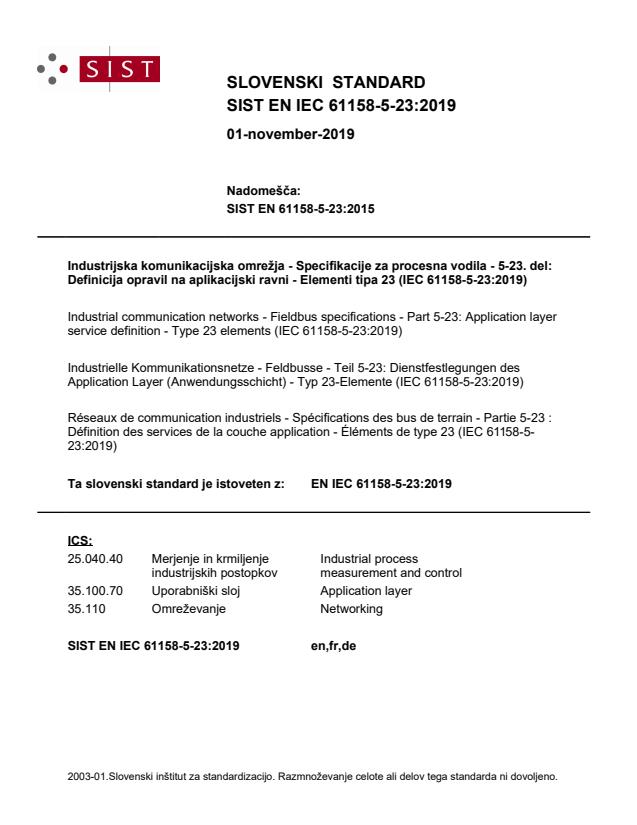
SLOVENSKI STANDARD
01-november-2019
Nadomešča:
SIST EN 61158-5-23:2015
Industrijska komunikacijska omrežja - Specifikacije za procesna vodila - 5-23. del:
Definicija opravil na aplikacijski ravni - Elementi tipa 23 (IEC 61158-5-23:2019)
Industrial communication networks - Fieldbus specifications - Part 5-23: Application layer
service definition - Type 23 elements (IEC 61158-5-23:2019)
Industrielle Kommunikationsnetze - Feldbusse - Teil 5-23: Dienstfestlegungen des
Application Layer (Anwendungsschicht) - Typ 23-Elemente (IEC 61158-5-23:2019)
Réseaux de communication industriels - Spécifications des bus de terrain - Partie 5-23 :
Définition des services de la couche application - Éléments de type 23 (IEC 61158-5-
23:2019)
Ta slovenski standard je istoveten z: EN IEC 61158-5-23:2019
ICS:
25.040.40 Merjenje in krmiljenje Industrial process
industrijskih postopkov measurement and control
35.100.70 Uporabniški sloj Application layer
35.110 Omreževanje Networking
2003-01.Slovenski inštitut za standardizacijo. Razmnoževanje celote ali delov tega standarda ni dovoljeno.
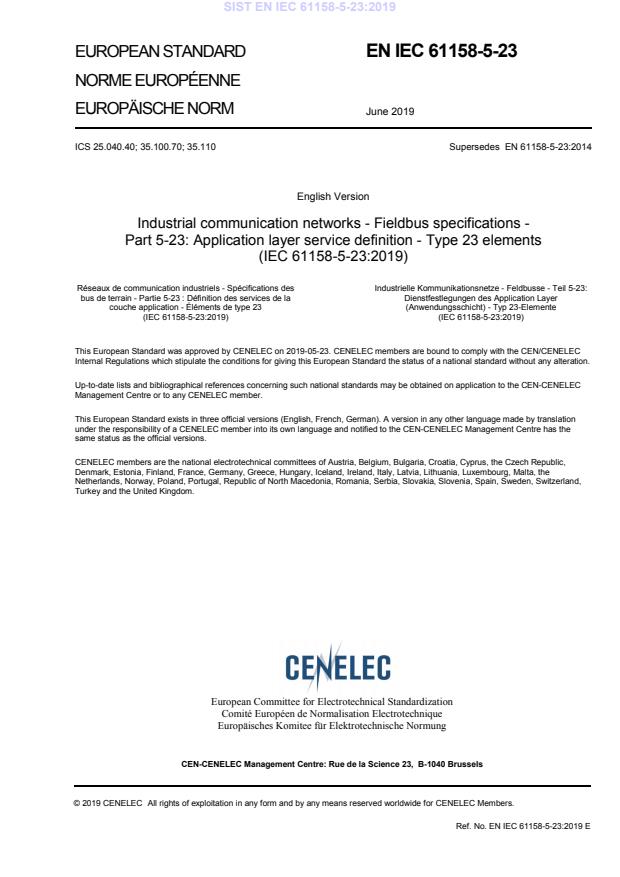
EUROPEAN STANDARD EN IEC 61158-5-23
NORME EUROPÉENNE
EUROPÄISCHE NORM
June 2019
ICS 25.040.40; 35.100.70; 35.110 Supersedes EN 61158-5-23:2014
English Version
Industrial communication networks - Fieldbus specifications -
Part 5-23: Application layer service definition - Type 23 elements
(IEC 61158-5-23:2019)
Réseaux de communication industriels - Spécifications des Industrielle Kommunikationsnetze - Feldbusse - Teil 5-23:
bus de terrain - Partie 5-23 : Définition des services de la Dienstfestlegungen des Application Layer
couche application - Éléments de type 23 (Anwendungsschicht) - Typ 23-Elemente
(IEC 61158-5-23:2019) (IEC 61158-5-23:2019)
This European Standard was approved by CENELEC on 2019-05-23. CENELEC members are bound to comply with the CEN/CENELEC
Internal Regulations which stipulate the conditions for giving this European Standard the status of a national standard without any alteration.
Up-to-date lists and bibliographical references concerning such national standards may be obtained on application to the CEN-CENELEC
Management Centre or to any CENELEC member.
This European Standard exists in three official versions (English, French, German). A version in any other language made by translation
under the responsibility of a CENELEC member into its own language and notified to the CEN-CENELEC Management Centre has the
same status as the official versions.
CENELEC members are the national electrotechnical committees of Austria, Belgium, Bulgaria, Croatia, Cyprus, the Czech Republic,
Denmark, Estonia, Finland, France, Germany, Greece, Hungary, Iceland, Ireland, Italy, Latvia, Lithuania, Luxembourg, Malta, the
Netherlands, Norway, Poland, Portugal, Republic of North Macedonia, Romania, Serbia, Slovakia, Slovenia, Spain, Sweden, Switzerland,
Turkey and the United Kingdom.
European Committee for Electrotechnical Standardization
Comité Européen de Normalisation Electrotechnique
Europäisches Komitee für Elektrotechnische Normung
CEN-CENELEC Management Centre: Rue de la Science 23, B-1040 Brussels
© 2019 CENELEC All rights of exploitation in any form and by any means reserved worldwide for CENELEC Members.
Ref. No. EN IEC 61158-5-23:2019 E
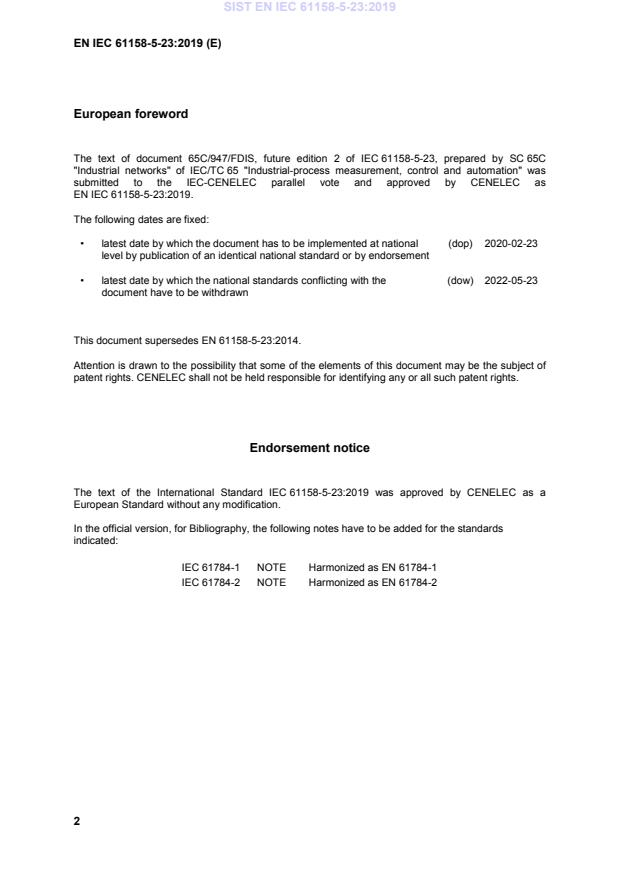
European foreword
The text of document 65C/947/FDIS, future edition 2 of IEC 61158-5-23, prepared by SC 65C
"Industrial networks" of IEC/TC 65 "Industrial-process measurement, control and automation" was
submitted to the IEC-CENELEC parallel vote and approved by CENELEC as
The following dates are fixed:
• latest date by which the document has to be implemented at national (dop) 2020-02-23
level by publication of an identical national standard or by endorsement
• latest date by which the national standards conflicting with the (dow) 2022-05-23
document have to be withdrawn
This document supersedes EN 61158-5-23:2014.
Attention is drawn to the possibility that some of the elements of this document may be the subject of
patent rights. CENELEC shall not be held responsible for identifying any or all such patent rights.
Endorsement notice
The text of the International Standard IEC 61158-5-23:2019 was approved by CENELEC as a
European Standard without any modification.
In the official version, for Bibliography, the following notes have to be added for the standards
indicated:
IEC 61784-1 NOTE Harmonized as EN 61784-1
IEC 61784-2 NOTE Harmonized as EN 61784-2
Annex ZA
(normative)
Normative references to international publications
with their corresponding European publications
The following documents are referred to in the text in such a way that some or all of their content
constitutes requirements of this document. For dated references, only the edition cited applies. For
undated references, the latest edition of the referenced document (including any amendments)
applies.
NOTE 1 Where an International Publication has been modified by common modifications, indicated by (mod), the relevant
EN/HD applies.
NOTE 2 Up-to-date information on the latest versions of the European Standards listed in this annex is available here:
www.cenelec.eu.
Publication Year Title EN/HD Year
IEC 61158-1 2019 Industrial communication networks - EN IEC 61158-1 2019
Fieldbus specifications - Part 1: Overview
and guidance for the IEC 61158 and IEC
61784 series
IEC 61158-6 series Industrial communication networks - EN 61158-6 series
Fieldbus specifications - Part 6-9:
Application layer protocol specification -
Type 9 elements
ISO/IEC 646 - Information technology; ISO 7-bit coded - -
character set for information interchange
ISO/IEC 7498-1 - Information technology - Open Systems - -
Interconnection - Basic reference model:
The basic model
ISO/IEC 8822 - Information technology - Open Systems - -
Interconnection - Presentation service
definition
ISO/IEC 8824-1 - Information technology - Abstract Syntax - -
Notation One (ASN.1): Specification of
basic notation
ISO/IEC 9545 - Information technology - Open Systems - -
Interconnection - Application layer
structure
ISO/IEC 10731 - Information technology - Open Systems - -
Interconnection - Basic Reference Model -
Conventions for the definition of OSI
services
IEC 61158-5-23 ®
Edition 2.0 2019-04
INTERNATIONAL
STANDARD
Industrial communication networks – Fieldbus specifications –
Part 5-23: Application layer service definition – Type 23 elements
INTERNATIONAL
ELECTROTECHNICAL
COMMISSION
ICS 25.040.40; 35.100.70; 35.110 ISBN 978-2-8322-6766-0
– 2 – IEC 61158-5-23:2019 © IEC 2019
CONTENTS
FOREWORD . 5
INTRODUCTION . 7
1 Scope . 8
1.1 General . 8
1.2 Specifications . 9
1.3 Conformance . 9
2 Normative references . 9
3 Terms, definitions, symbols, abbreviated terms and conventions . 10
3.1 Referenced terms and definitions . 10
3.1.1 ISO/IEC 7498-1 terms. 10
3.1.2 ISO/IEC 8822 terms . 10
3.1.3 ISO/IEC 9545 terms . 10
3.1.4 ISO/IEC 8824-1 terms. 11
3.1.5 IEC 61158-1 terms. 11
3.2 Additional Type 23 terms and definitions . 11
3.3 Symbols and abbreviated terms . 13
3.4 Conventions . 14
3.4.1 General conventions . 14
3.4.2 Conventions for class definitions . 15
3.4.3 Conventions for service definitions . 16
4 Concept . 17
5 Data type ASE . 17
5.1 Overview . 17
5.2 Fixed length types . 18
5.2.1 Bitstring types . 18
5.2.2 Numeric types . 19
6 Communication model specification . 23
6.1 Communication model . 23
6.1.1 General . 23
6.1.2 Cyclic model n:n . 23
6.1.3 Cyclic model 1:n . 24
6.1.4 Transient model . 24
6.2 ASE . 25
6.2.1 Overview type C . 25
6.2.2 Overview type F. 25
6.2.3 Cyclic data ASE type C . 25
6.2.4 Cyclic data ASE type F . 32
6.2.5 Acyclic data ASE type C . 37
6.2.6 Acyclic data ASE type F . 43
6.2.7 Management ASE . 56
6.2.8 Synchronization ASE . 59
6.2.9 Measurement ASE . 60
6.3 AR type C . 61
6.3.1 Overview . 61
6.3.2 Connection Control . 62
6.3.3 Cyclic transmission type C . 66
IEC 61158-5-23:2019 © IEC 2019 – 3 –
6.3.4 Acyclic transmission type C . 68
6.3.5 Common parameter dist. 70
6.4 AR type F . 75
6.4.1 Overview . 75
6.4.2 Channel control . 75
6.4.3 Cyclic transmission type F . 82
6.4.4 Acyclic transmission type F . 84
6.4.5 Parameter dist . 87
6.4.6 Synchronous trigger . 90
6.4.7 Measurement transmission . 91
Bibliography . 94
Figure 1 – Cyclic model (n:n type distributed shared memory, unconfirmed push model) . 24
Figure 2 – Cyclic model (1:n type distributed shared memory, unconfirmed push model) . 24
Figure 3 – Transient model (Client server model) . 24
Figure 4 – Transient model (Push model). 25
Figure 5 – Structure of ASE type C of FAL type 23 . 25
Figure 6 – Structure of ASE type F of FAL Type 23 . 25
Figure 7 – Structure of AR type C . 62
Figure 8 – Structure of AR type F. 75
Table 1 – Ld service parameters . 27
Table 2 – Set service parameters . 27
Table 3 – Reset service parameters . 27
Table 4 – Read service parameters. 28
Table 5 – Write service parameters . 28
Table 6 – Ld service parameters . 29
Table 7 – Set service parameters . 30
Table 8 – Reset service parameters . 30
Table 9 – Read service parameters. 31
Table 10 – Write service parameters . 31
Table 11 – Ld service parameters . 33
Table 12 – Set service parameters . 34
Table 13 – Reset service parameters . 34
Table 14 – Read service parameters . 35
Table 15 – Write service parameters . 35
Table 16 – Get memory access info service parameters . 38
Table 17 – Run service parameters. 39
Table 18 – Stop service parameters . 40
Table 19 – Read memory service parameters . 41
Table 20 – Write memory service parameters . 42
Table 21 – Get memory access info service parameters . 44
Table 22 – Run service parameters. 45
Table 23 – Stop service parameters . 46
– 4 – IEC 61158-5-23:2019 © IEC 2019
Table 24 – Read memory service parameters . 47
Table 25 – Write memory service parameters . 48
Table 26 – Vendor command service parameters . 49
Table 27 – Distribute node info service parameters . 50
Table 28 – Get statistics service parameters . 51
Table 29 – Get node info detail service parameters . 53
Table 30 – AC data service parameters . 55
Table 31 – AC data ND service parameters . 56
Table 32 – Get attribute service parameters . 57
Table 33 – Set attribute service parameters . 58
Table 34 – Synchronization trigger service parameters . 59
Table 35 – Start measurement service parameters . 60
Table 36 – Get offset service parameters . 61
Table 37 – Control cyclic service parameters . 66
Table 38 – CT Update service parameters . 67
Table 39 – AC Send service parameters . 68
Table 40 – AC Param send service parameters . 70
Table 41 – CPD Set service parameters . 74
Table 42 – Control cyclic service parameters . 82
Table 43 – CT Update service parameters . 83
Table 44 – AC Send service parameters . 84
Table 45 – AC Send ND service parameters . 86
Table 46 – Synchronous trigger internal service parameters . 90
Table 47 – Measure send service parameters . 91
Table 48 – MeasureAck send service parameters . 92
Table 49 – Offset send service parameters . 92
Table 50 – Update send service parameters . 93
IEC 61158-5-23:2019 © IEC 2019 – 5 –
INTERNATIONAL ELECTROTECHNICAL COMMISSION
____________
INDUSTRIAL COMMUNICATION NETWORKS –
FIELDBUS SPECIFICATIONS –
Part 5-23: Application layer service definition –
Type 23 elements
FOREWORD
1) The International Electrotechnical Commission (IEC) is a worldwide organization for standardization comprising
all national electrotechnical committees (IEC National Committees). The object of IEC is to promote
international co-operation on all questions concerning standardization in the electrical and electronic fields. To
this end and in addition to other activities, IEC publishes International Standards, Technical Specifications,
Technical Reports, Publicly Available Specifications (PAS) and Guides (hereafter referred to as “IEC
Publication(s)”). Their preparation is entrusted to technical committees; any IEC National Committee interested
in the subject dealt with may participate in this preparatory work. International, governmental and non-
governmental organizations liaising with the IEC also participate in this preparation. IEC collaborates closely
with the International Organization for Standardization (ISO) in accordance with conditions determined by
agreement between the two organizations.
2) The formal decisions or agreements of IEC on technical matters express, as nearly as possible, an international
consensus of opinion on the relevant subjects since each technical committee has representation from all
interested IEC National Committees.
3) IEC Publications have the form of recommendations for international use and are accepted by IEC National
Committees in that sense. While all reasonable efforts are made to ensure that the technical content of IEC
Publications is accurate, IEC cannot be held responsible for the way in which they are used or for any
misinterpretation by any end user.
4) In order to promote international uniformity, IEC National Committees undertake to apply IEC Publications
transparently to the maximum extent possible in their national and regional publications. Any divergence
between any IEC Publication and the corresponding national or regional publication shall be clearly indicated in
the latter.
5) IEC provides no marking procedure to indicate its approval and cannot be rendered responsible for any
equipment declared to be in conformity with an IEC Publication.
6) All users should ensure that they have the latest edition of this publication.
7) No liability shall attach to IEC or its directors, employees, servants or agents including individual experts and
members of its technical committees and IEC National Committees for any personal injury, property damage or
other damage of any nature whatsoever, whether direct or indirect, or for costs (including legal fees) and
expenses arising out of the publication, use of, or reliance upon, this IEC Publication or any other IEC
Publications.
8) Attention is drawn to the Normative references cited in this publication. Use of the referenced publications is
indispensable for the correct application of this publication.
9) Attention is drawn to the possibility that some of the elements of this IEC Publication may be the subject of
patent rights. IEC shall not be held responsible for identifying any or all such patent rights.
Attention is drawn to the fact that the use of the associated protocol type is restricted by its
intellectual-property-right holders. In all cases, the commitment to limited release of
intellectual-property-rights made by the holders of those rights permits a layer protocol type to
be used with other layer protocols of the same type, or in other type combinations explicitly
authorized by its intellectual-property-right holders.
NOTE Combinations of protocol types are specified in IEC 61784-1 and IEC 61784-2.
International Standard IEC 61158‑5‑23 has been prepared by subcommittee 65C: Industrial
networks, of IEC technical committee 65: Industrial-process measurement, control and
automation.
This second edition cancels and replaces the first edition published in 2014. This edition
constitutes a technical revision.
– 6 – IEC 61158-5-23:2019 © IEC 2019
This edition includes the following significant technical changes with respect to the previous
edition:
• addition of an attribute for Master ID (see 3.2.10, 6.4.3, 6.4.4 and 6.4.5).
The text of this International Standard is based on the following documents:
FDIS Report on voting
65C/947/FDIS 65C/950/RVD
Full information on the voting for the approval of this International Standard can be found in
the report on voting indicated in the above table.
This publication has been drafted in accordance with ISO/IEC Directives, Part 2.
A list of all the parts of the IEC 61158 series, published under the general title Industrial
communication networks – Fieldbus specifications, can be found on the IEC website.
The committee has decided that the contents of this publication will remain unchanged until
the stability date indicated on the IEC web site under "http://webstore.iec.ch" in the data
related to the specific publication. At this date, the publication will be
• reconfirmed,
• withdrawn,
• replaced by a revised edition, or
• amended.
A bilingual version of this publication may be issued at a later date.
IEC 61158-5-23:2019 © IEC 2019 – 7 –
INTRODUCTION
This document is one of a series produced to facilitate the interconnection of automation
system components. It is related to other standards in the set as defined by the “three-layer”
fieldbus reference model described in IEC 61158-1.
The application service is provided by the application protocol making use of the services
available from the data-link or other immediately lower layer. This document defines the
application service characteristics that fieldbus applications and/or system management may
exploit.
Throughout the set of fieldbus standards, the term “service” refers to the abstract capability
provided by one layer of the OSI Basic Reference Model to the layer immediately above. Thus,
the application layer service defined in this document is a conceptual architectural service,
independent of administrative and implementation divisions.
– 8 – IEC 61158-5-23:2019 © IEC 2019
INDUSTRIAL COMMUNICATION NETWORKS –
FIELDBUS SPECIFICATIONS –
Part 5-23: Application layer service definition –
Type 23 elements
1 Scope
1.1 General
The Fieldbus Application Layer (FAL) provides user programs with a means to access the
fieldbus communication environment. In this respect, the FAL can be viewed as a “window
between corresponding application programs”.
This part of IEC 61158 provides common elements for basic time-critical and non-time-critical
messaging communications between application programs in an automation environment and
material specific to Type 12 fieldbus. The term “time-critical” is used to represent the
presence of a time-window, within which one or more specified actions are required to be
completed with some defined level of certainty. Failure to complete specified actions within
the time window risks failure of the applications requesting the actions, with attendant risk to
equipment, plant and possibly human life.
This International Standard defines in an abstract way the externally visible service provided
by the different Types of the fieldbus Application Layer in terms of
a) an abstract model for defining application resources (objects) capable of being
manipulated by users via the use of the FAL service,
b) the primitive actions and events of the service;
c) the parameters associated with each primitive action and event, and the form which they
take; and
d) the interrelationship between these actions and events, and their valid sequences.
The purpose of this document is to define the services provided to
a) the FAL user at the boundary between the user and the Application Layer of the Fieldbus
Reference Model, and
b) Systems Management at the boundary between the Application Layer and Systems
Management of the Fieldbus Reference Model.
This document specifies the structure and services of the IEC Fieldbus Application Layer, in
conformance with the OSI Basic Reference Model (ISO/IEC 7498-1) and the OSI Application
Layer Structure (ISO/IEC 9545).
FAL services and protocols are provided by FAL application-entities (AE) contained within the
application processes. The FAL AE is composed of a set of object-oriented Application
Service Elements (ASEs) and a Layer Management Entity (LME) that manages the AE. The
ASEs provide communication services that operate on a set of related application process
object (APO) classes. One of the FAL ASEs is a management ASE that provides a common
set of services for the management of the instances of FAL classes.
Although these services specify, from the perspective of applications, how request and
responses are issued and delivered, they do not include a specification of what the requesting
and responding applications are to do with them. That is, the behavioral aspects of the
applications are not specified; only a definition of what requests and responses they can
IEC 61158-5-23:2019 © IEC 2019 – 9 –
send/receive is specified. This permits greater flexibility to the FAL users in standardizing
such object behavior. In addition to these services, some supporting services are also defined
in this document to provide access to the FAL to control certain aspects of its operation.
1.2 Specifications
The principal objective of this document is to specify the characteristics of conceptual
application layer services suitable for time-critical communications, and thus supplement the
OSI Basic Reference Model in guiding the development of application layer protocols for time-
critical communications.
A secondary objective is to provide migration paths from previously-existing industrial
communications protocols. It is this latter objective which gives rise to the diversity of services
standardized as the various Types of IEC 61158, and the corresponding protocols
standardized in subparts of IEC 61158-6.
This specification may be used as the basis for formal Application Programming-Interfaces.
Nevertheless, it is not a formal programming interface, and any such interface will need to
address implementation issues not covered by this specification, including
a) the sizes and octet ordering of various multi-octet service parameters, and
b) the correlation of paired request and confirm, or indication and response, primitives.
1.3 Conformance
This document does not specify individual implementations or products, nor does it constrain
the implementations of application layer entities within industrial automation systems.
There is no conformance of equipment to this application layer service definition standard.
Instead, conformance is achieved through implementation of conforming application layer
protocols that fulfill any given Type of application layer services as defined in this document.
2 Normative references
The following documents are referred to in the text in such a way that some or all of their
content constitutes requirements of this document. For dated references, only the edition
cited applies. For undated references, the latest edition of the referenced document (including
any amendments) applies.
NOTE All parts of the IEC 61158 series, as well as IEC 61784-1 and IEC 61784-2 are maintained simultaneously.
Cross-references to these documents within the text therefore refer to the editions as dated in this list of normative
references.
IEC 61158-1:2019, Industrial communication networks – Fieldbus specifications – Part 1:
Overview and guidance for the IEC 61158 and IEC 61784 series
IEC 61158-6 (all parts), Industrial communication networks – Fieldbus specifications – Part 6:
Application layer protocol specification
ISO/IEC 646, Information technology – ISO 7–bit coded character set for information
interchange
ISO/IEC 7498-1, Information technology – Open Systems Interconnection – Basic Reference
Model: The Basic Model
ISO/IEC 8822, Information technology – Open Systems Interconnection – Presentation
service definition
– 10 – IEC 61158-5-23:2019 © IEC 2019
ISO/IEC 8824-1, Information technology – Abstract Syntax Notation One (ASN.1):
Specification of basic notation
ISO/IEC 9545, Information technology – Open Systems Interconnection – Application Layer
structure
ISO/IEC 10731, Information technology – Open Systems Interconnection – Basic Reference
Model – Conventions for the definition of OSI services
3 Terms, definitions, symbols, abbreviated terms and conventions
For the purposes of this document, the following terms, definitions, symbols, abbreviations
and conventions apply.
ISO and IEC maintain terminological databases for use in standardization at the following
addresses:
• IEC Electropedia: available at http://www.electropedia.org/
• ISO Online browsing platform: available at http://www.iso.org/obp
3.1 Referenced terms and definitions
3.1.1 ISO/IEC 7498-1 terms
For the purposes of this document, the following terms given in ISO/IEC 7498-1 apply:
a) application entity
b) application process
c) application protocol data unit
d) application service element
e) application entity invocation
f) application process invocation
g) application transaction
h) real open system
i) transfer syntax
3.1.2 ISO/IEC 8822 terms
For the purposes of this document, the following terms given in ISO/IEC 8822 apply:
a) abstract syntax
b) presentation context
3.1.3 ISO/IEC 9545 terms
For the purposes of this document, the following terms given in ISO/IEC 9545 apply:
a) application-association
b) application-context
c) application context name
d) application-entity-invocation
e) application-entity-type
f) application-process-invocation
g) application-process-type
IEC 61158-5-23:2019 © IEC 2019 – 11 –
h) application-service-element
i) application control service element
3.1.4 ISO/IEC 8824-1 terms
For the purposes of this document, the following terms given in ISO/IEC 8824-1 apply:
a) object identifier
b) type
3.1.5 IEC 61158-1 terms
For the purposes of this document, the following terms given in IEC 61158-1 apply:
a) DLL mapping protocol machine
b) fieldbus application layer
c) FAL service protocol machine
d) protocol data unit
3.2 Additional Type 23 terms and definitions
For the purposes of this document, the following terms and definitions apply.
3.2.1
cyclic transmission
transmission that is performed periodically used for the link device update
3.2.2
intelligent device station
node capable of performing 1:n bit data and word data cyclic transmission and transient
transmission with the master station, and transient transmission with slave stations, excluding
remote I/O stations and having client functions and server functions during transient
transmission
3.2.3
link bit
link relay bit data that are shared by all the nodes through the cyclic transmission and is used
as one bit unit shared memory of the n:n type
3.2.4
link device
link bit, link word, link x and link y or RX, RY, RWr, and RWw
3.2.5
link word
link register two octet unit data that are shared by all the nodes through the cyclic
transmission and is used as two octet unit shared memory of the n:n type
3.2.6
link x
link input received bit data that are transmitted from each node through the cyclic
transmission and is used as an input shared memory of the 1:n type
3.2.7
link y
link output bit data that are sent to each node through the cyclic transmission and is used as
an output shared memory of the 1:n type
– 12 – IEC 61158-5-23:2019 © IEC 2019
3.2.8
local station
node capable of performing n:n bit data and word data cyclic transmission and transient
transmission with the master station and other local stations, and transient transmission with
slave stations, excluding remote I/O stations and having server functions and client functions
during transient transmission
3.2.9
management node
node in which parameters are set
3.2.10
master ID
ID that represents the node number of the master station
3.2.11
master station
node that has control information (parameters) and manages cyclic transmission
3.2.12
node
element that forms a network and performs data transmission, reception, and transfer
3.2.13
node-to-node test
physical layer test between two nodes
3.2.14
normal node
node other than a management node
3.2.15
remote device station
node capable of performing 1:n bit data and word data cyclic transmission and transient
transmission with the master station, and transient transmission with slave stations, excluding
remote I/O stations and having server functions during transient transmission
3.2.16
remote I/O station
node capable of performing 1:n bit data cyclic transmission with the master station
3.2.17
reserve node
node that is not yet connected, but counted in the total node number of the network not
performing cyclic transmission, but always regarded as normal from applications
3.2.18
RX
remote input as viewed from the master station with bit data that are periodically updated by
cyclic transmission, salve to master, or in local station as viewed from the master station is
RY of the local station
3.2.19
RY
remote output as viewed from the master station with bit data that are periodically updated by
cyclic transmission, master to salve, or in local station as viewed from the master station is
RX of the local station
IEC 61158-5-23:2019 © IEC 2019 – 13 –
3.2.20
RWr
remote register (input) as viewed from the master station with word data that are periodically
updated by cyclic transmission, slave to master, or in local station as viewed from the master
station is RWw of the local station
3.2.21
RWw
remote register (output) as viewed from the master station with word data that are periodically
updated by cyclic transmission, master to slave, or in local station as viewed from the master
station is RWr of the local station
3.2.22
slave station
node other than the master station
3.2.23
station
node of a network
3.2.24
synchronization manager
single node in a master station role per network that manages synchronization, distributing
synchronization timing to other nodes
3.2.25
transient transmission
transmission that is performed upon each request
3.2.26
transient transmission client function
function that issues a transient request
3.2.27
transient transmission server function
function that receives a transient request and issues a response
3.2.28
transmission control manager
single node in a master station role per network that performs token passing management
3.2.29
word
unit representing data, 16 bits in length
3.3 Symbols and abbreviated terms
AE Application Entity
AL Application Layer
AP Application Process
APDU Application Protocol Data Unit
APO Application Process Object
AR Application Relationship
AREP Application Relationship Endpoint
ASE Application Service Element
ASN.1 Abstract Syntax Notation 1
– 14 – IEC 61158-5-23:2019 © IEC 2019
CRC Cyclic Redundancy Check
DLL Data-link Layer
DMPM DLL Mapping Protocol Machine
FAL Fieldbus Application Layer
FSPM FAL Service Protocol Machine
LB Link Bit
LSB Least Significant Bit
LW Link Word
LX Link X
LY Link Y
MSB Most Significant Bit
OSI Open Systems Interconnection
PDU Protocol Data Unit
3.4 Conventions
3.4.1 General conventions
This document uses the descriptive conventions given in ISO/IEC 10731.
The service model, service primitives, and time-sequence diagrams used are entirely abstract
descriptions; they do not represent a specification for implementation.
Service primitives, used to represent service user/service provider interactions (see
ISO/IEC 10731), convey parameters that indicate information available in the user/provider
interaction.
This document uses a tabular format to describe the component parameters of the service
primitives. The parameters that apply to each group of service primitives are set out in tables
throughout the remainder of this document. Each table consists of up to five columns,
containing the name of the service parameter, and a column each for those primitives and
parameter-transfer directions used by the service:
– the request primitive’s input parameters;
– the indication primitive’s output parameters;
– the response primitive’s input parameters; and
– the confirm primitive’s output parameters.
NOTE The request, indication, response and confirm primitives are also known as requestor.submit,
acceptor.deliver, acceptor.submit, and requestor.deliver primitives, respectively (see ISO/IEC 10731).
One parameter (or part of it) is listed in each row of each table. Under the appropriate service
primitive columns, a code is used to specify the type of usage of the parameter on the
primitive and parameter direction specified in the column:
M parameter is mandatory for the primitive.
U parameter is a User option, and may or may not be provided depending on
the dynamic usage of the service-user. When not provided, a default value
for the parameter is assumed.
C parameter is conditional upon other parameters or upon the environment of
the service-user.
(blank) parameter is never present.
IEC 61158-5-23:2019 © IEC 2019 – 15 –
Some entries are further qualified by items in brackets. These may be a parameter-specific
constraint:
(=) indicates that the parameter is semantically equivalent to the parameter in
the service primitive to its immediate left in the table.
In any particular interface, not all parameters need be explicitly stated. Some may be
implicitly associated with the primitive.
In the diagrams which illustrate these interfaces, dashed lines indicate cause-and-effect or
time-sequence relationships, and wavy lines indicate that events are roughly
contemp
...