

SIST ISO 19101-2:2019
(Main)Geographic information -- Reference model -- Part 2: Imagery
General Information
- Abstract
This document defines a reference model for standardization in the field of geographic imagery processing. This reference model identifies the scope of the standardization activity being undertaken and the context in which it takes place. The reference model includes gridded data with an emphasis on imagery. Although structured in the context of information technology and information technology standards, this document is independent of any application development method or technology implementation approach.
- Status
- Published
- Public Enquiry End Date
- 30-May-2017
- Publication Date
- 29-Sep-2019
- Technical Committee
- GIG - Geographic information
- Current Stage
- 6060 - National Implementation/Publication (Adopted Project)
- Start Date
- 16-Sep-2019
- Due Date
- 21-Nov-2019
- Completion Date
- 30-Sep-2019
Buy Documents



ISO 19101-2:2018 - Geographic information -- Reference model
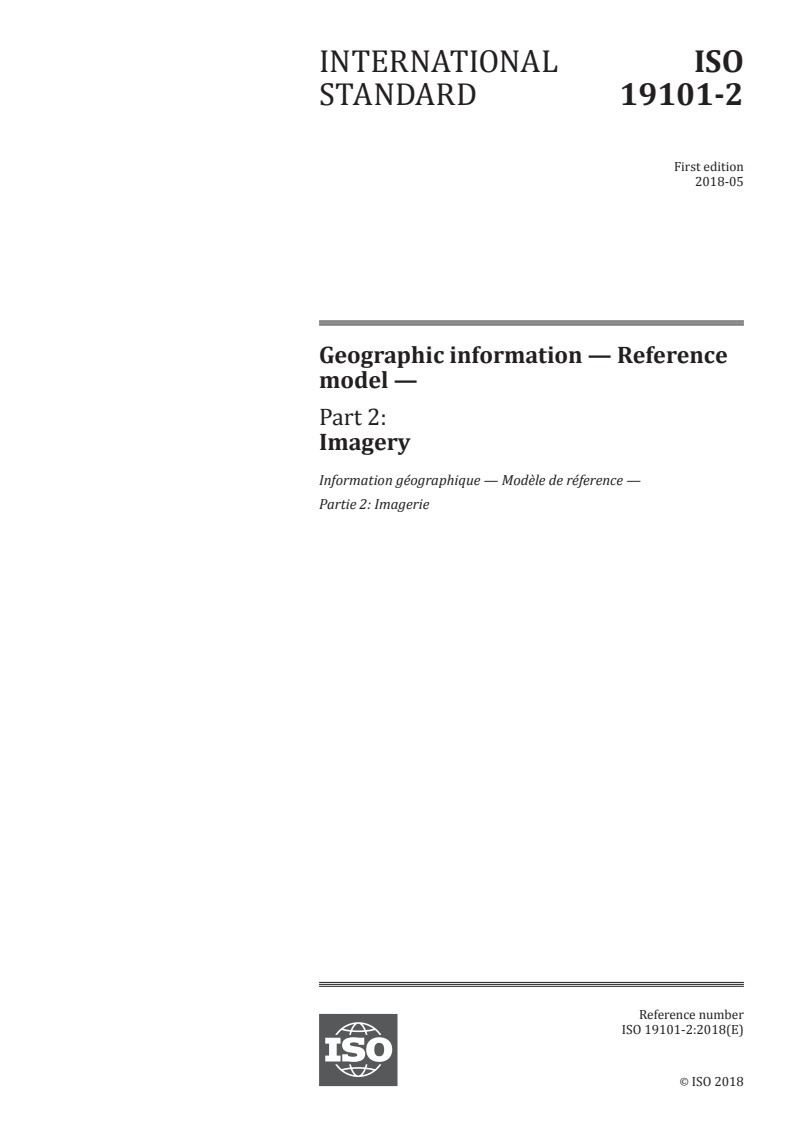

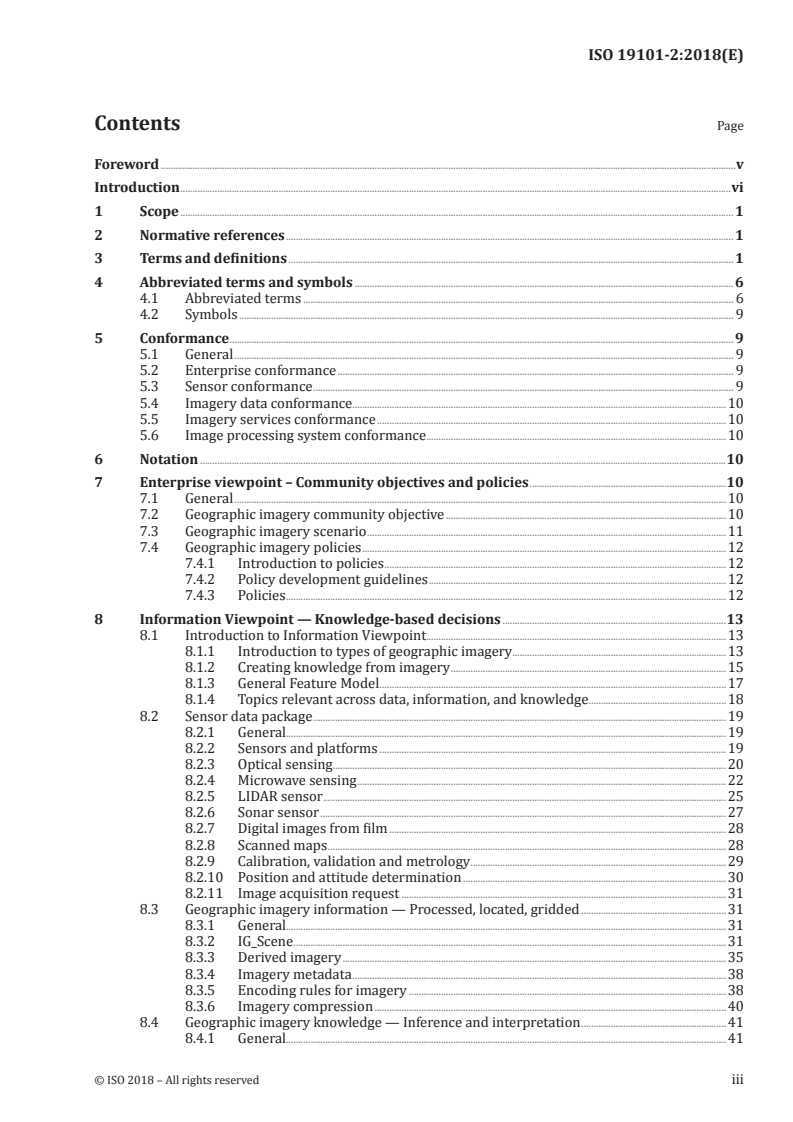
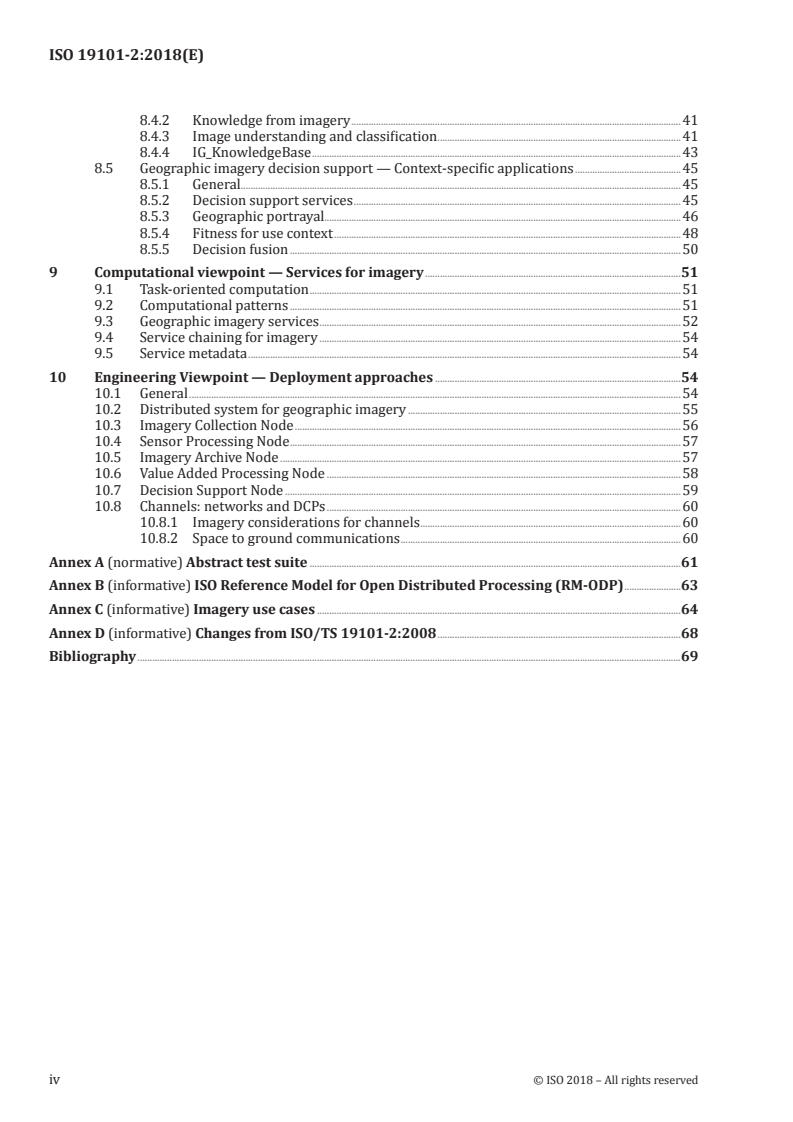
ISO 19101-2:2018 - Geographic information — Reference model — Part 2: Imagery/24/2018

ISO 19101-2:2018 - Information géographique -- Modele de réference

ISO 19101-2:2018 - Information géographique — Modèle de réference — Partie 2: Imagerie/24/2018
Overview
SIST ISO 19101-2:2019 - Geographic information - Reference model - Part 2: Imagery - defines a reference model for standardization of geographic imagery processing. The standard frames the scope and context for imagery-related standardization work, emphasizing gridded data and imagery (optical, microwave, LIDAR, sonar, scanned maps and film-derived digital images). It is technology- and application-method independent, intended to guide interoperable, open distributed processing of geospatial imagery at scale.
Key Topics and Technical Requirements
This part of ISO 19101 organizes imagery standardization around multiple viewpoints and explicit conformance criteria:
- Viewpoints covered: Enterprise (community objectives & policies), Information (data → knowledge → decisions), Computational (services & service chaining), and Engineering (deployment approaches for distributed systems).
- Sensor and data coverage: Sensor data packages for platforms including optical, microwave, LIDAR and sonar; calibration, validation, position & attitude determination; image acquisition requests.
- Imagery data model elements: Processed, located, gridded imagery (e.g., IG_Scene), derived imagery, imagery metadata, encoding and imagery compression rules.
- Knowledge and decision support: Image understanding/classification, IG_KnowledgeBase, decision support services, geographic portrayal, fitness-for-use, and decision fusion.
- Conformance and testing: Clauses for enterprise conformance, sensor conformance, imagery data and services conformance, and image processing system conformance; Annex A provides an abstract test suite.
- Engineering guidance: Deployment nodes such as Imagery Collection, Sensor Processing, Imagery Archive, Value-Added Processing and Decision Support Nodes; channels and communications guidance for space-to-ground links.
- Interoperability: Service metadata, service chaining patterns and distributed system patterns for large-scale imagery archives and workflows.
Practical Applications
SIST ISO 19101-2:2019 is practical for organizations building interoperable geospatial imagery systems and workflows:
- National mapping and cadastral agencies managing multi-petabyte imagery archives
- Satellite and aerial imagery providers defining sensor metadata and calibration workflows
- GIS and remote sensing software vendors implementing imagery services, compression and encoding
- Enterprise architects designing distributed imagery processing, archiving, and decision support systems
- Researchers and solution integrators applying image understanding, classification and decision fusion
Who Should Use This Standard
- Geospatial data managers, systems engineers, remote sensing professionals, imagery analysts, and standards developers who need a consistent reference model for imagery interoperability, metadata, processing chains and conformance testing.
Related Standards
- ISO 19101 series (reference models for geographic information)
- RM-ODP (ISO Reference Model for Open Distributed Processing) - referenced in Annex B
- This edition replaces ISO/TS 19101-2:2009 and aligns with ISO 19101-2:2018.
Keywords: geographic imagery, reference model, imagery processing, geospatial imagery, imagery metadata, remote sensing, LIDAR, image compression, service chaining, distributed imagery systems.
Relations
- Effective Date
- 01-Nov-2019
Buy Documents
ISO 19101-2:2018 - Geographic information -- Reference model
ISO 19101-2:2018 - Geographic information — Reference model — Part 2: Imagery/24/2018
ISO 19101-2:2018 - Information géographique -- Modele de réference
ISO 19101-2:2018 - Information géographique — Modèle de réference — Partie 2: Imagerie/24/2018
Get Certified
Connect with accredited certification bodies for this standard

BSI Group
BSI (British Standards Institution) is the business standards company that helps organizations make excellence a habit.

NYCE
Mexican standards and certification body.
Sponsored listings
Frequently Asked Questions
SIST ISO 19101-2:2019 is a standard published by the Slovenian Institute for Standardization (SIST). Its full title is "Geographic information -- Reference model -- Part 2: Imagery". This standard covers: This document defines a reference model for standardization in the field of geographic imagery processing. This reference model identifies the scope of the standardization activity being undertaken and the context in which it takes place. The reference model includes gridded data with an emphasis on imagery. Although structured in the context of information technology and information technology standards, this document is independent of any application development method or technology implementation approach.
This document defines a reference model for standardization in the field of geographic imagery processing. This reference model identifies the scope of the standardization activity being undertaken and the context in which it takes place. The reference model includes gridded data with an emphasis on imagery. Although structured in the context of information technology and information technology standards, this document is independent of any application development method or technology implementation approach.
SIST ISO 19101-2:2019 is classified under the following ICS (International Classification for Standards) categories: 07.040 - Astronomy. Geodesy. Geography; 35.240.70 - IT applications in science. The ICS classification helps identify the subject area and facilitates finding related standards.
SIST ISO 19101-2:2019 has the following relationships with other standards: It is inter standard links to SIST-TS ISO/TS 19101-2:2009. Understanding these relationships helps ensure you are using the most current and applicable version of the standard.
SIST ISO 19101-2:2019 is available in PDF format for immediate download after purchase. The document can be added to your cart and obtained through the secure checkout process. Digital delivery ensures instant access to the complete standard document.
Standards Content (Sample)
SLOVENSKI STANDARD
01-november-2019
Nadomešča:
SIST-TS ISO/TS 19101-2:2009
Geografske informacije - Referenčni model - 2. del: Podobe
Geographic information -- Reference model -- Part 2: Imagery
Information géographique -- Modèle de réference -- Partie 2: Imagerie
Ta slovenski standard je istoveten z: ISO 19101-2:2018
ICS:
07.040 Astronomija. Geodezija. Astronomy. Geodesy.
Geografija Geography
35.240.70 Uporabniške rešitve IT v IT applications in science
znanosti
2003-01.Slovenski inštitut za standardizacijo. Razmnoževanje celote ali delov tega standarda ni dovoljeno.
INTERNATIONAL ISO
STANDARD 19101-2
First edition
2018-05
Geographic information — Reference
model —
Part 2:
Imagery
Information géographique — Modèle de réference —
Partie 2: Imagerie
Reference number
©
ISO 2018
© ISO 2018
All rights reserved. Unless otherwise specified, or required in the context of its implementation, no part of this publication may
be reproduced or utilized otherwise in any form or by any means, electronic or mechanical, including photocopying, or posting
on the internet or an intranet, without prior written permission. Permission can be requested from either ISO at the address
below or ISO’s member body in the country of the requester.
ISO copyright office
CP 401 • Ch. de Blandonnet 8
CH-1214 Vernier, Geneva
Phone: +41 22 749 01 11
Fax: +41 22 749 09 47
Email: copyright@iso.org
Website: www.iso.org
Published in Switzerland
ii © ISO 2018 – All rights reserved
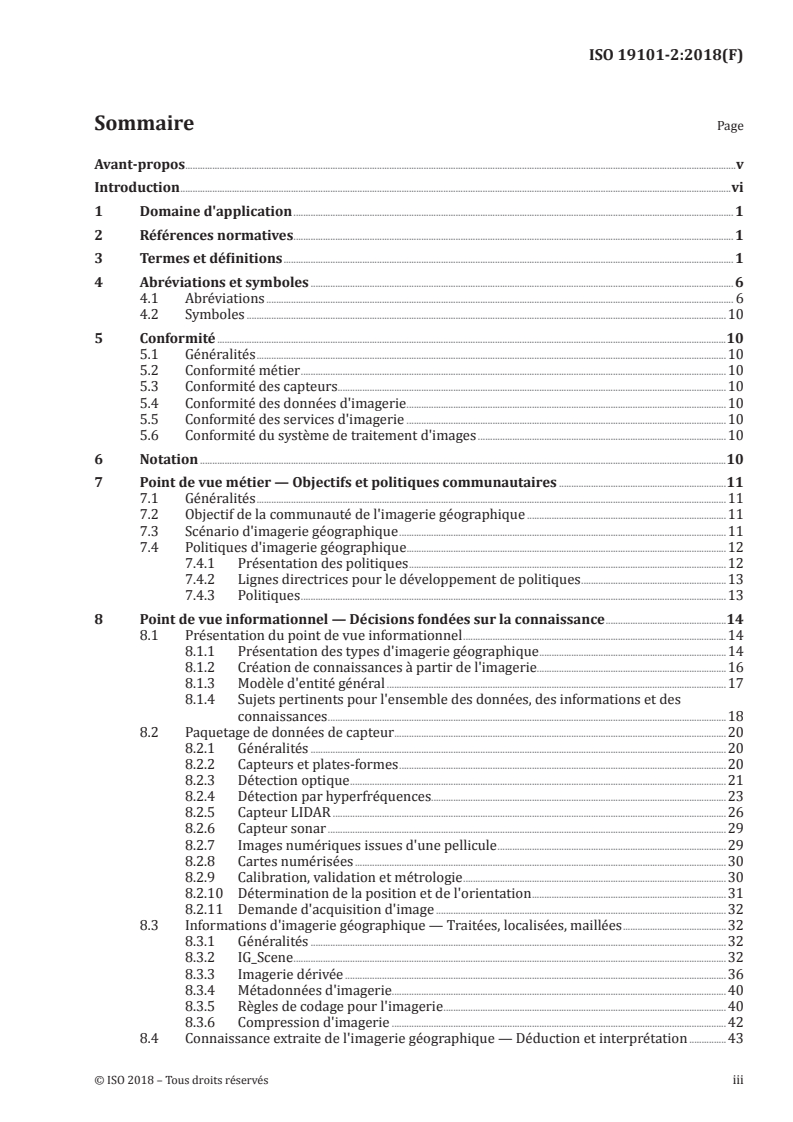
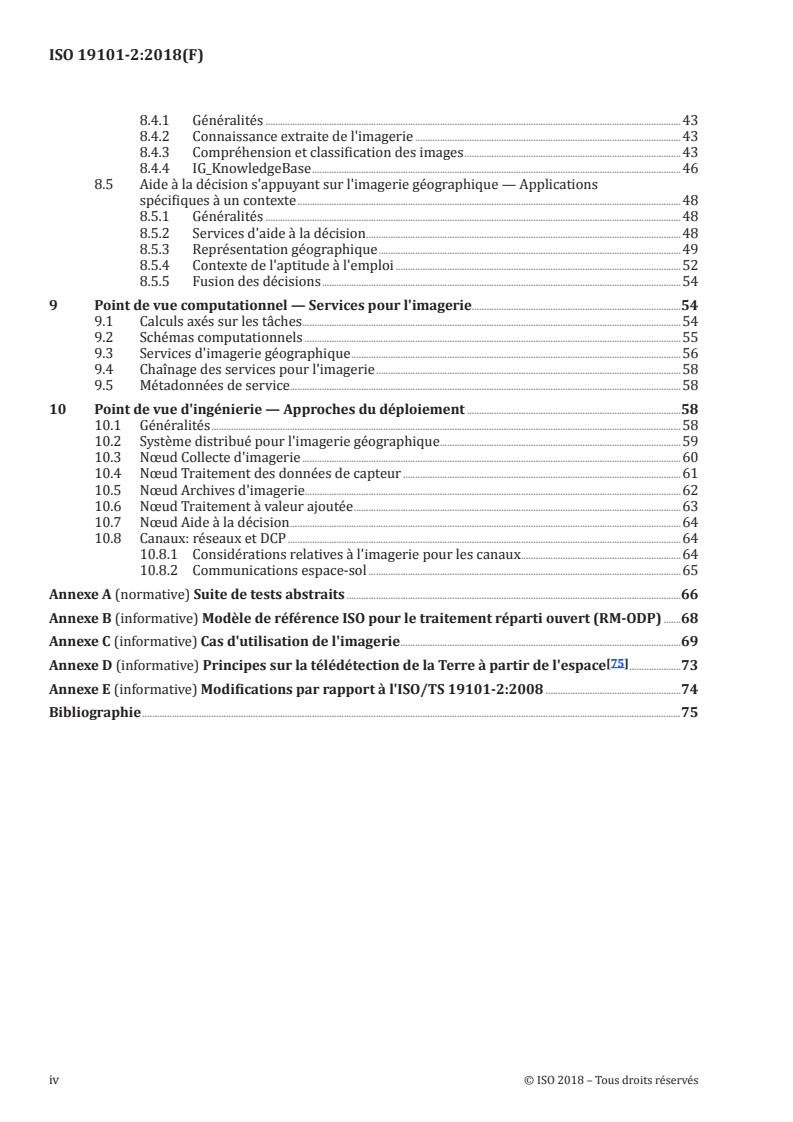
Contents Page
Foreword .v
Introduction .vi
1 Scope . 1
2 Normative references . 1
3 Terms and definitions . 1
4 Abbreviated terms and symbols . 6
4.1 Abbreviated terms . 6
4.2 Symbols . 9
5 Conformance . 9
5.1 General . 9
5.2 Enterprise conformance . 9
5.3 Sensor conformance . 9
5.4 Imagery data conformance .10
5.5 Imagery services conformance .10
5.6 Image processing system conformance .10
6 Notation .10
7 Enterprise viewpoint – Community objectives and policies .10
7.1 General .10
7.2 Geographic imagery community objective .10
7.3 Geographic imagery scenario .11
7.4 Geographic imagery policies .12
7.4.1 Introduction to policies .12
7.4.2 Policy development guidelines .12
7.4.3 Policies .12
8 Information Viewpoint — Knowledge-based decisions .13
8.1 Introduction to Information Viewpoint.13
8.1.1 Introduction to types of geographic imagery . .13
8.1.2 Creating knowledge from imagery .15
8.1.3 General Feature Model .17
8.1.4 Topics relevant across data, information, and knowledge.18
8.2 Sensor data package .19
8.2.1 General.19
8.2.2 Sensors and platforms .19
8.2.3 Optical sensing . . .20
8.2.4 Microwave sensing .22
8.2.5 LIDAR sensor . .25
8.2.6 Sonar sensor .27
8.2.7 Digital images from film .28
8.2.8 Scanned maps .28
8.2.9 Calibration, validation and metrology .29
8.2.10 Position and attitude determination .30
8.2.11 Image acquisition request .31
8.3 Geographic imagery information — Processed, located, gridded .31
8.3.1 General.31
8.3.2 IG_Scene .31
8.3.3 Derived imagery .35
8.3.4 Imagery metadata .38
8.3.5 Encoding rules for imagery .38
8.3.6 Imagery compression .40
8.4 Geographic imagery knowledge — Inference and interpretation .41
8.4.1 General.41
8.4.2 Knowledge from imagery .41
8.4.3 Image understanding and classification .41
8.4.4 IG_KnowledgeBase .43
8.5 Geographic imagery decision support — Context-specific applications .45
8.5.1 General.45
8.5.2 Decision support services .45
8.5.3 Geographic portrayal.46
8.5.4 Fitness for use context .48
8.5.5 Decision fusion .50
9 Computational viewpoint — Services for imagery .51
9.1 Task-oriented computation .51
9.2 Computational patterns .51
9.3 Geographic imagery services .52
9.4 Service chaining for imagery .54
9.5 Service metadata .54
10 Engineering Viewpoint — Deployment approaches .54
10.1 General .54
10.2 Distributed system for geographic imagery .55
10.3 Imagery Collection Node .56
10.4 Sensor Processing Node .57
10.5 Imagery Archive Node .57
10.6 Value Added Processing Node .58
10.7 Decision Support Node .59
10.8 Channels: networks and DCPs .60
10.8.1 Imagery considerations for channels .60
10.8.2 Space to ground communications .60
Annex A (normative) Abstract test suite .61
Annex B (informative) ISO Reference Model for Open Distributed Processing (RM-ODP) .63
Annex C (informative) Imagery use cases .64
Annex D (informative) Changes from ISO/TS 19101-2:2008 .68
Bibliography .69
iv © ISO 2018 – All rights reserved
Foreword
ISO (the International Organization for Standardization) is a worldwide federation of national standards
bodies (ISO member bodies). The work of preparing International Standards is normally carried out
through ISO technical committees. Each member body interested in a subject for which a technical
committee has been established has the right to be represented on that committee. International
organizations, governmental and non-governmental, in liaison with ISO, also take part in the work.
ISO collaborates closely with the International Electrotechnical Commission (IEC) on all matters of
electrotechnical standardization.
The procedures used to develop this document and those intended for its further maintenance are
described in the ISO/IEC Directives, Part 1. In particular the different approval criteria needed for the
different types of ISO documents should be noted. This document was drafted in accordance with the
editorial rules of the ISO/IEC Directives, Part 2 (see www .iso .org/directives).
Attention is drawn to the possibility that some of the elements of this document may be the subject of
patent rights. ISO shall not be held responsible for identifying any or all such patent rights. Details of
any patent rights identified during the development of the document will be in the Introduction and/or
on the ISO list of patent declarations received (see www .iso .org/patents).
Any trade name used in this document is information given for the convenience of users and does not
constitute an endorsement.
For an explanation on the voluntary nature of standards, the meaning of ISO specific terms and
expressions related to conformity assessment, as well as information about ISO's adherence to the
World Trade Organization (WTO) principles in the Technical Barriers to Trade (TBT) see the following
URL: www .iso .org/iso/foreword .html.
This document was prepared by Technical Committee ISO/TC 211, Geographic information/Geomatics.
This edition cancels and replaces the first edition (ISO/TS 19101-2:2008) which has been technically
revised. In order to promote backward compatibility between different versions of standards, the
changes that have been made between this document and the previous version are described in
Annex D.
A list of all parts in the ISO 19101 series can be found on the ISO website.
Introduction
This document provides a reference model for processing of geographic imagery which is frequently done
in open distributed manners. The motivating themes addressed in this reference model are given below.
In terms of volume, imagery is the dominant form of geographic information.
— Stored geographic imagery volume will grow to the order of an exabyte.
— National imagery archives are multiple petabytes in size; ingesting a terabyte per day.
— Individual application data centers are archiving hundreds of terabytes of imagery.
— Tens of thousands of datasets have been catalogued and can be accessible online.
Large volumes of geographic imagery will not be portrayed directly by humans. Human attention is the
scarce resource, and is insufficient to view petabytes of data. Semantic processing will be required: for
example, automatic detection of features; data mining based on geographic concepts.
Information technology allows the sharing of geographic information products through processing
of geographic imagery. Standards are needed to increase creation of products. A number of existing
standards are used for the exchange of geographic imagery.
Examples of technical, legal, and administrative hurdles to moving imagery online include
— technical issues of accessibility – geocoding, geographic access standards,
— maintenance of intellectual property rights,
— maintenance of individual privacy rights as resolution increases, and
— technical issues of compatibility requiring standards.
Governments have been the predominant suppliers of remotely sensed data in the past. This is changing
with the commercialization of remotely sensed data acquisition. Geographic imagery is a key input to
decision support for policy makers.
The ultimate challenge is to enable the geographic imagery collected from different sources to become
an integrated digital representation of the Earth widely accessible for humanity’s critical decisions.
Currently a large number of standards exist that describe imagery data. The processing of imagery
across multiple organizations and information technologies (IT) is hampered by the lack of a common
abstract architecture. The establishment of a common framework will foster convergence at the
framework level. In the future, multiple implementation standards are needed for data format and
service interoperability to carry out the architecture defined in this document.
The objective of this document is the coordinated development of standards that allow the benefits
of distributed geographic image processing to be realized in an environment of heterogeneous IT
resources and multiple organizational domains. An underlying assumption is that uncoordinated
standardization activities made without a plan cannot be united under the necessary framework.
This document provides a reference model for the processing of geographic imagery which is frequently
done in open distributed manners. The basis for defining an information system in this document is the
[42]
Reference Model for Open Distributed Processing (RM-ODP). A brief description of RM-ODP can be
referenced in Annex B. The basis for defining geographic information in this document is the ISO 19100
series of standards.
[42]
The RM-ODP viewpoints are used in the following fashion.
— Typical users and their business activities, and policies to carry out those activities, are addressed
in the Enterprise Viewpoint.
vi © ISO 2018 – All rights reserved
— Data structures and the progressive addition of value to the resulting products are found in the
schemas of the Information Viewpoint.
— Individual processing services and the chaining of services are addressed in the Computational
Viewpoint.
Approaches to deploy the components of the Information and Computational viewpoints to distributed
physical locations are addressed in the Engineering Viewpoint.
INTERNATIONAL STANDARD ISO 19101-2:2018(E)
Geographic information — Reference model —
Part 2:
Imagery
1 Scope
This document defines a reference model for standardization in the field of geographic imagery
processing. This reference model identifies the scope of the standardization activity being undertaken
and the context in which it takes place. The reference model includes gridded data with an emphasis
on imagery. Although structured in the context of information technology and information technology
standards, this document is independent of any application development method or technology
implementation approach.
2 Normative references
The following documents are referred to in the text in such a way that some or all of their content
constitutes requirements of this document. For dated references, only the edition cited applies. For
undated references, the latest edition of the referenced document (including any amendments) applies.
ISO 19115-1:2014, Geographic information — Metadata — Part 1: Fundamentals
ISO 19115-2:2009, Geographic information — Metadata — Part 2: Extensions for imagery and gridded data
ISO 19119:2016, Geographic information — Services
ISO 19123:2005, Geographic information — Schema for coverage geometry and functions
1)
ISO 19130-1:— , Geographic information — Imagery sensor models for geopositioning
3 Terms and definitions
For the purposes of this document, the following terms and definitions apply.
ISO and IEC maintain terminological databases for use in standardization at the following addresses:
— IEC Electropedia: available at http: //www .electropedia .org/
— ISO Online browsing platform: available at http: //www .iso .org/obp
3.1
band
range of wavelengths of electromagnetic radiation that produce a single response by a sensing device
3.2
calibration
process of quantitatively defining a system’s responses to known, controlled signal inputs
[SOURCE: CEOS WGCV]
1) Under preparation. Stage at the time of publication: ISO/DIS 19130-1.
3.3
computational viewpoint
viewpoint (3.42) on an ODP system and its environment that enables distribution through functional
decomposition of the system into objects which interact at interfaces (3.16)
[SOURCE: ISO/IEC 10746-3:2009, 4.1.1.3]
3.4
coverage
feature (3.9) that acts as a function to return values from its range for any direct position within its
spatial, temporal or spatiotemporal domain
[SOURCE: ISO 19123:2005, 4.1.7]
3.5
digital elevation model
dataset of elevation values that are assigned algorithmically to 2-dimensional coordinates
3.6
digital number
DN
integer value representing a measurement (3.20) as detected by a sensor (3.36)
3.7
engineering viewpoint
viewpoint (3.42) on an ODP system and its environment that focuses on the mechanisms and functions
required to support distributed interaction between objects in the system
[SOURCE: ISO/IEC 10746-3:2009, 4.1.1.4]
3.8
enterprise viewpoint
viewpoint (3.42) on an ODP system and its environment that focuses on the purpose, scope and policies
for that system
[SOURCE: ISO/IEC 10746-3:2009, 4.1.1.1]
3.9
feature
abstraction of real world phenomena
[SOURCE: ISO 19101-1:2014, 4.1.11]
3.10
geographic feature
representation of real world phenomenon associated with a location relative to the Earth
[SOURCE: ISO 19125-2:2004, 4.2]
3.11
geographic imagery
imagery (3.14) associated with a location relative to the Earth
3.12
geographic imagery scene
geographic imagery (3.11) whose data consists of measurements (3.20) or simulated measurements of
the natural world produced relative to a specified vantage point and at a specified time
Note 1 to entry: A geographic imagery scene is a representation of an environmental landscape; it may
correspond to a remotely sensed view of the natural world or to a computer-generated virtual scene (3.35)
simulating such a view.
2 © ISO 2018 – All rights reserved
3.13
grid
network composed of two or more sets of curves in which the members of each set intersect the
members of the other sets in an algorithmic way
[SOURCE: ISO 19123:2005, 4.1.23]
3.14
imagery
representation of phenomena as images produced by electronic and/or optical techniques
Note 1 to entry: In this document, it is assumed that the phenomena have been sensed or detected by one or more
devices such as radar, cameras, photometers, and infrared and multispectral scanners.
3.15
information viewpoint
viewpoint (3.42) on an ODP system and its environment that focuses on the semantics of information
and information processing
[SOURCE: ISO/IEC 10746-3:2009, 4.1.1.2]
3.16
interface
named set of operations (3.24) that characterize the behaviour of an entity
[SOURCE: ISO 19119:2016, 4.1.8]
3.17
interoperability
capability to communicate, execute programs, or transfer data among various functional units in a
manner that requires the user to have little or no knowledge of the unique characteristics of those units
[SOURCE: ISO/IEC 2382:2015, 2121317]
3.18
knowledge base
data base of knowledge about a particular subject
Note 1 to entry: The database contains facts, inferences, and procedures needed for problem solution (Webster
Computer).
3.19
measurable quantity
attribute of a phenomenon, body or substance that may be distinguished qualitatively and determined
quantitatively
[SOURCE: VIM: 1993, 1.1]
3.20
measurand
particular quantity subject to measurement (3.20)
EXAMPLE Vapour pressure of a given sample of water at 20 °C.
Note 1 to entry: The specification of a measurand may require statements about quantities such as time,
temperature and pressure.
[SOURCE: VIM: 1993, 2.6]
3.21
measurement
set of operations (3.24) having the object of determining the value of a quantity
[SOURCE: VIM: 1993, 2.1]
3.22
metadata
information about a resource
[SOURCE: ISO 19115-1:2014, 4.10]
3.23
metric traceability
property of the result of a measurement (3.20) or the value of a standard whereby it can be related
to stated references, usually national or international standards, through an unbroken chain of
comparisons all having stated uncertainties
[SOURCE: Derived from VIM]
3.24
operation
specification of a transformation or query that an object may be called to execute
Note 1 to entry: An operation has a name and a list of parameters.
[SOURCE: ISO 19119:2016, 4.1.10]
3.25
orthoimage
image in which by orthogonal projection to a reference surface, displacement of image points due to
sensor (3.36) orientation and terrain relief has been removed
Note 1 to entry: The amount of displacement depends on the resolution and the level of detail of the elevation
information and on the software implementation.
3.26
picture original
representation of a two-dimensional hardcopy or softcopy input image in terms of the colour-space
coordinates (or an approximation thereof)
Note 1 to entry: Picture originals could be obtained from printed maps, printed pictures of a geographic imagery
scene (3.12), or drawings of geographic information, etc.
3.27
picture portrayal
representations of image data in terms of the colour-space coordinates that are appropriate for, and
tightly coupled to, the characteristics of a specified real or virtual output device and viewing
Note 1 to entry: Picture portrayals are geared for visual display whether in hardcopy or softcopy.
3.28
pixel
smallest element of a digital image to which attributes are assigned
Note 1 to entry: This term originated as a contraction of “picture element”.
Note 2 to entry: Related to the concept of a grid (3.13) cell.
4 © ISO 2018 – All rights reserved
3.29
policy
set of rules related to a particular purpose
[SOURCE: ISO/IEC 10746-2]
3.30
radiance
at a point on a surface and in a given direction, the radiant intensity of an element of the surface, divided
by the area of the orthogonal projection of this element on a plane perpendicular to the given direction
[SOURCE: ISO 80000-7:2008, 7-15]
3.31
radiant energy
energy emitted, transferred or received as radiation
[SOURCE: ISO 80000-7:2008, 7-6]
3.32
record
finite, named collection of related items (objects or values)
[SOURCE: ISO 19107:2003, 4.62]
3.33
remote sensing
collection and interpretation of information about an object without being in physical contact with
the object
3.34
resolution (of a sensor)
smallest difference between indications of a sensor (3.36) that can be meaningfully distinguished
Note 1 to entry: For imagery (3.14), resolution refers to radiometric, spectral, spatial and temporal resolutions.
3.35
scene
spectral radiances (3.30) of a view of the natural world as measured from a specified vantage point in
space and at a specified time
Note 1 to entry: A scene may correspond to a remotely sensed view of the natural world or to a computer-
generated virtual scene simulating such a view.
[SOURCE: ISO 22028-1:2016, 3.35]
3.36
sensor
element of a measuring system that is directly affected by a phenomenon, body, or substance carrying a
quantity to be measured
[SOURCE: ISO/IEC GUIDE 99:2007, 3.8]
3.37
sensor model
description of the radiometric and geometric characteristics of a sensor (3.36)
3.38
service
distinct part of the functionality that is provided by an entity through interfaces (3.16)
3.39
technology viewpoint
viewpoint (3.42) on an ODP system and its environment that focuses on the choice of technology in
that system
[SOURCE: ISO/IEC 10746-3:2009, 4.1.1.5]
3.40
uncertainty
parameter, associated with the result of measurement (3.20), that characterizes the dispersion of values
that could reasonably be attributed to the measurand (3.21)
Note 1 to entry: The parameter may be, for example, a standard deviation (or a given multiple of it), or the half-
width of an interval having a stated level of confidence.
Note 2 to entry: Uncertainty of measurement comprises, in general, many components. Some of these
components may be evaluated from the statistical distribution of the results of series of measurements and can
be characterized by experimental standard deviations. The other components, which can also be characterized
by standard deviations, are evaluated from assumed probability distributions based on experience or other
information.
Note 3 to entry: It is understood that the result of the measurement is the best estimate of the value of the
measurand, and that all components of uncertainty, including those arising from systematic effects, such as
components associated with corrections and reference standards, contribute to the dispersion.
[SOURCE: ISO 19116:2004, 4.26, modified — Notes 1-3 to entry have been added.]
3.41
validation
process of assessing, by independent means, the quality of the data products derived from the
system outputs
[SOURCE: CEOS WGCV]
3.42
viewpoint (on a system)
form of abstraction achieved using a selected set of architectural concepts and structuring rules, in
order to focus on particular concerns within a system
[SOURCE: ISO/IEC 10746-2:2009, 3.2.7]
4 Abbreviated terms and symbols
4.1 Abbreviated terms
BeiDou China BeiDou Navigation Satellite System
BIIF Basic Image Interchange Format
CEOS Committee on Earth Observation Satellites
CIE International Commission on Illumination
CMYK Nonlinear Cyan, Magenta, Yellow, Black
CRS Coordinate Reference System
CRT Cathode Ray Tube
CW Continuous Wavelength
6 © ISO 2018 – All rights reserved
DCP Distributed Computing Platform
DEM Digital Elevation Model
DIAL Differential Absorption LIDAR
DM Discrete Multivariate Statistics
DN Digital Number
DSS Decision Support Service
EOS Earth Observation Satellite
EOSDIS Earth Observing System Data and Information System
FIFO First In, First Out
FIR Infrared band
FOV Field of View
G Gravity
Galileo European Union Galileo positioning system
GEO Geosynchronous Earth Orbit
GEOTIFF Tagged Image File Format for Geographic Imagery
GFM General Feature Model
GHz Gigahertz
GIS Geographic Information System
GLONASS Global Navigation Satellite System
GML Geography Markup Language
GMLJP2 GML in JPEG 2000
GPS Global Positioning System
GSD Ground Sample Distance
GSI Ground Sample Interval
HDF Hierarchical Data Format
HSB Hue, Saturation, Brightness
HSV Hue, Saturation, Value
HTTP Hypertext Transfer Protocol
IEC International Electrotechnical Commission
IfSAR Interferometric Synthetic Aperture Radar
IGFOV Instantaneous Geometric Field of View
IHO International Hydrographic Organization
IRNSS Indian Regional Navigation Satellite System
IR-A Infrared IR-A band
IR-B Infrared IR-B band
IR-C IR-C band
ISAR Inverse Synthetic Aperture Radar Infrared
ISR Intelligence, Surveillance, and Reconnaissance
ISPRS International Society for Photogrammetry and Remote Sensing
IT Information Technology
ITU-R International Telecommunication Union Radiocommunication Sector
IUS Image Understanding System
JPEG Joint Photographic Experts Group
KML Keyhole Markup Language
LEO Low Earth Orbit
LIDAR Light Detection And Ranging
LIFO Last In, First Out
MIR Mid-Infrared band
NASA National Aeronautical and Space Administration
NATO North Atlantic Treaty Organization
NCSA National Center for Supercomputing Applications
NEXRAD Next Generation Radar
NIIA NATO ISR Interoperability Architecture
NIR Near-Infrared band
NSIF NATO Secondary Imagery Format
NSILI NATO Standard Image Library Interface
ODP Open Distributed Processing (see RM-ODP)
OGC OpenGeospatial® Consortium
OLAP Online Analytical Processing
OSDDEP Open Skies Digital Data Exchange Profile
QZSS Japanese Quasi-Zenith Satellite System
RCS Radar Cross Section
8 © ISO 2018 – All rights reserved
RGB Red, Green, Blue
RGBI Red, Green, Blue, Intensity
RM-ODP Reference Model for Open Distributed Processing
RMSE Root Mean Squared Error
RNC Raster Nautical Chart
SAR Synthetic Aperture Radar
SI International System
SPCS State Plane Coordinate System
SQL Standard Query Language
STANAG Standardization Agreement
TIFF Tagged Image File Format
UML Unified Modelling Language
UTM Universal Transverse Mercator
VIM International Vocabulary of Basic and General Terms in Metrology
WMO World Meteorological Organization
YCrCb Luminance and Chrominance
4.2 Symbols
λ wavelength
σ° radar backscatter
η volume backscatter coefficient
ν
σ radar target reflective strength
5 Conformance
5.1 General
To conform to this document, all of the conditions specified for at least one of the conformance classes
described below shall be satisfied.
5.2 Enterprise conformance
Any enterprise that claims conformance to this document shall satisfy all of the conditions specified in
the test module in A.1.
5.3 Sensor conformance
Any sensor for which conformance to this document is claimed shall satisfy all of the conditions
specified in the test module in A.2.
5.4 Imagery data conformance
Any enterprise for which conformance to this document is claimed shall satisfy all of the conditions
specified in the test module in A.3.
5.5 Imagery services conformance
Any enterprise for which conformance to this document is claimed shall satisfy all of the conditions
specified in the test module in A.4.
5.6 Image processing system conformance
Any image processing system for which conformance to this document is claimed shall satisfy all of the
conditions specified in the test module in A.5.
6 Notation
The conceptual schema specified in this document is described using the Unified Modelling Language
[28]
(UML), following the guidance of ISO 19103 . Several model elements used in this schema are defined
in other ISO geographic information standards. Names of UML classes, with the exception of basic data
type classes, include a two-letter prefix that identifies the standard and the UML package in which
the class is defined. Table 1 lists the other documents and packages in which UML classes used in this
document have been defined.
Table 1 — Sources of defined UML classes
Prefix Standard Package
CV ISO 19123 Coverages
FC ISO 19110 Feature cataloguing
GF ISO 19109 Rules for Application Schema
IG ISO 19101-2 Reference model — Imagery
LI ISO 19115-1 Metadata
7 Enterprise viewpoint – Community objectives and policies
7.1 General
The enterprise viewpoint on a geographic imagery processing system and its environment focuses on
[42]
the purpose, scope and policies as is done in ODP systems . The purpose is provided as the objective
of the geographic imagery community. The scope is defined through a high-level scenario in 7.3 and
through use cases in Annex C. Policies are discussed in 7.4 through a set of criteria for developing
policies for geographic imagery systems as well as several example international policies relating to
geographic imagery. The enterprise viewpoint provides a context for the development of standards in
the other viewpoints.
7.2 Geographic imagery community objective
The central concept of the enterprise viewpoint is how the geographic imagery community interacts
to enable imagery collected from different sources to become an integrated digital representation of
the Earth widely accessible for humanity’s critical decisions. The enterprise viewpoint provides the
metric traceability between this objective and the system design for distributed geographic imagery
processing systems.
The fundamental goal of the geographic imagery community is to advance and protect interests of
humanity by development of imaging capabilities, and by sustaining and enhancing the geographic
10 © ISO 2018 – All rights reserved
imagery industry. Doing so will also foster economic growth, contribute to environmental stewardship,
assist into natural and manmade disaster management from planning to recovery, and enable scientific
and technological excellence.
7.3 Geographic imagery scenario
Figure 1 provides an example of a geographic imagery scenario. The context is that a customer requests
geographic imagery information to be used with other information, including other geographic
information, in support of a decision. The analyst is key in the role of decision support.
The customer’s request for geographic imagery information is assessed in the planning step. The
customer’s desired information may be readily available from an archive or a model, or may be
processed from information in an archive or available from a model. In this scenario, a model is a
simulation of some portion of the geographic environment able to produce geographic imagery. Some
additional processing may be needed on the archive or model outputs in order to meet the customer’s
request.
The customer’s request for geographic imagery may require collection of new imagery. Tasking
determines the available sensors and platforms and develops an imagery acquisition request. The
sensor is tasked to acquire the raw data and the acquisition is performed. Acquisition of the imagery
data is done in accordance with the acquisition policies.
Whether the customer’s request is to be satisfied from an archive holding, a model output, or a data
acquisition, typically some type of additional processing is needed. This could range from changing
the encoding format of the imagery to creating derived imagery or image knowledge products. The
resulting imagery information may be applied with additional information to form a response that
meets the customer’s needs. Distribution of the imagery information response is done in accordance
with the distribution policies.
Figure 1 — Geographic imagery scenario
7.4 Geographic imagery policies
7.4.1 Introduction to policies
[43]
A policy, as defined in ISO/IEC 10746-2 , is a set of rules related to a particular purpose. A rule can be
expressed as an obligation, a permission or a prohibition. Not every policy is a constraint. Some policies
represent an empowerment.
Some geographic imagery policies promulgated by international organizations are included in 7.4.2 and
7.4.3. They may apply to particular geographic imagery systems.
Organizations involved in imagery work should develop policies consistent with the guidelines in
Table 2.
7.4.2 Policy development guidelines
Guidelines f
...
INTERNATIONAL ISO
STANDARD 19101-2
First edition
2018-05
Geographic information — Reference
model —
Part 2:
Imagery
Information géographique — Modèle de réference —
Partie 2: Imagerie
Reference number
©
ISO 2018
© ISO 2018
All rights reserved. Unless otherwise specified, or required in the context of its implementation, no part of this publication may
be reproduced or utilized otherwise in any form or by any means, electronic or mechanical, including photocopying, or posting
on the internet or an intranet, without prior written permission. Permission can be requested from either ISO at the address
below or ISO’s member body in the country of the requester.
ISO copyright office
CP 401 • Ch. de Blandonnet 8
CH-1214 Vernier, Geneva
Phone: +41 22 749 01 11
Fax: +41 22 749 09 47
Email: copyright@iso.org
Website: www.iso.org
Published in Switzerland
ii © ISO 2018 – All rights reserved
Contents Page
Foreword .v
Introduction .vi
1 Scope . 1
2 Normative references . 1
3 Terms and definitions . 1
4 Abbreviated terms and symbols . 6
4.1 Abbreviated terms . 6
4.2 Symbols . 9
5 Conformance . 9
5.1 General . 9
5.2 Enterprise conformance . 9
5.3 Sensor conformance . 9
5.4 Imagery data conformance .10
5.5 Imagery services conformance .10
5.6 Image processing system conformance .10
6 Notation .10
7 Enterprise viewpoint – Community objectives and policies .10
7.1 General .10
7.2 Geographic imagery community objective .10
7.3 Geographic imagery scenario .11
7.4 Geographic imagery policies .12
7.4.1 Introduction to policies .12
7.4.2 Policy development guidelines .12
7.4.3 Policies .12
8 Information Viewpoint — Knowledge-based decisions .13
8.1 Introduction to Information Viewpoint.13
8.1.1 Introduction to types of geographic imagery . .13
8.1.2 Creating knowledge from imagery .15
8.1.3 General Feature Model .17
8.1.4 Topics relevant across data, information, and knowledge.18
8.2 Sensor data package .19
8.2.1 General.19
8.2.2 Sensors and platforms .19
8.2.3 Optical sensing . . .20
8.2.4 Microwave sensing .22
8.2.5 LIDAR sensor . .25
8.2.6 Sonar sensor .27
8.2.7 Digital images from film .28
8.2.8 Scanned maps .28
8.2.9 Calibration, validation and metrology .29
8.2.10 Position and attitude determination .30
8.2.11 Image acquisition request .31
8.3 Geographic imagery information — Processed, located, gridded .31
8.3.1 General.31
8.3.2 IG_Scene .31
8.3.3 Derived imagery .35
8.3.4 Imagery metadata .38
8.3.5 Encoding rules for imagery .38
8.3.6 Imagery compression .40
8.4 Geographic imagery knowledge — Inference and interpretation .41
8.4.1 General.41
8.4.2 Knowledge from imagery .41
8.4.3 Image understanding and classification .41
8.4.4 IG_KnowledgeBase .43
8.5 Geographic imagery decision support — Context-specific applications .45
8.5.1 General.45
8.5.2 Decision support services .45
8.5.3 Geographic portrayal.46
8.5.4 Fitness for use context .48
8.5.5 Decision fusion .50
9 Computational viewpoint — Services for imagery .51
9.1 Task-oriented computation .51
9.2 Computational patterns .51
9.3 Geographic imagery services .52
9.4 Service chaining for imagery .54
9.5 Service metadata .54
10 Engineering Viewpoint — Deployment approaches .54
10.1 General .54
10.2 Distributed system for geographic imagery .55
10.3 Imagery Collection Node .56
10.4 Sensor Processing Node .57
10.5 Imagery Archive Node .57
10.6 Value Added Processing Node .58
10.7 Decision Support Node .59
10.8 Channels: networks and DCPs .60
10.8.1 Imagery considerations for channels .60
10.8.2 Space to ground communications .60
Annex A (normative) Abstract test suite .61
Annex B (informative) ISO Reference Model for Open Distributed Processing (RM-ODP) .63
Annex C (informative) Imagery use cases .64
Annex D (informative) Changes from ISO/TS 19101-2:2008 .68
Bibliography .69
iv © ISO 2018 – All rights reserved
Foreword
ISO (the International Organization for Standardization) is a worldwide federation of national standards
bodies (ISO member bodies). The work of preparing International Standards is normally carried out
through ISO technical committees. Each member body interested in a subject for which a technical
committee has been established has the right to be represented on that committee. International
organizations, governmental and non-governmental, in liaison with ISO, also take part in the work.
ISO collaborates closely with the International Electrotechnical Commission (IEC) on all matters of
electrotechnical standardization.
The procedures used to develop this document and those intended for its further maintenance are
described in the ISO/IEC Directives, Part 1. In particular the different approval criteria needed for the
different types of ISO documents should be noted. This document was drafted in accordance with the
editorial rules of the ISO/IEC Directives, Part 2 (see www .iso .org/directives).
Attention is drawn to the possibility that some of the elements of this document may be the subject of
patent rights. ISO shall not be held responsible for identifying any or all such patent rights. Details of
any patent rights identified during the development of the document will be in the Introduction and/or
on the ISO list of patent declarations received (see www .iso .org/patents).
Any trade name used in this document is information given for the convenience of users and does not
constitute an endorsement.
For an explanation on the voluntary nature of standards, the meaning of ISO specific terms and
expressions related to conformity assessment, as well as information about ISO's adherence to the
World Trade Organization (WTO) principles in the Technical Barriers to Trade (TBT) see the following
URL: www .iso .org/iso/foreword .html.
This document was prepared by Technical Committee ISO/TC 211, Geographic information/Geomatics.
This edition cancels and replaces the first edition (ISO/TS 19101-2:2008) which has been technically
revised. In order to promote backward compatibility between different versions of standards, the
changes that have been made between this document and the previous version are described in
Annex D.
A list of all parts in the ISO 19101 series can be found on the ISO website.
Introduction
This document provides a reference model for processing of geographic imagery which is frequently done
in open distributed manners. The motivating themes addressed in this reference model are given below.
In terms of volume, imagery is the dominant form of geographic information.
— Stored geographic imagery volume will grow to the order of an exabyte.
— National imagery archives are multiple petabytes in size; ingesting a terabyte per day.
— Individual application data centers are archiving hundreds of terabytes of imagery.
— Tens of thousands of datasets have been catalogued and can be accessible online.
Large volumes of geographic imagery will not be portrayed directly by humans. Human attention is the
scarce resource, and is insufficient to view petabytes of data. Semantic processing will be required: for
example, automatic detection of features; data mining based on geographic concepts.
Information technology allows the sharing of geographic information products through processing
of geographic imagery. Standards are needed to increase creation of products. A number of existing
standards are used for the exchange of geographic imagery.
Examples of technical, legal, and administrative hurdles to moving imagery online include
— technical issues of accessibility – geocoding, geographic access standards,
— maintenance of intellectual property rights,
— maintenance of individual privacy rights as resolution increases, and
— technical issues of compatibility requiring standards.
Governments have been the predominant suppliers of remotely sensed data in the past. This is changing
with the commercialization of remotely sensed data acquisition. Geographic imagery is a key input to
decision support for policy makers.
The ultimate challenge is to enable the geographic imagery collected from different sources to become
an integrated digital representation of the Earth widely accessible for humanity’s critical decisions.
Currently a large number of standards exist that describe imagery data. The processing of imagery
across multiple organizations and information technologies (IT) is hampered by the lack of a common
abstract architecture. The establishment of a common framework will foster convergence at the
framework level. In the future, multiple implementation standards are needed for data format and
service interoperability to carry out the architecture defined in this document.
The objective of this document is the coordinated development of standards that allow the benefits
of distributed geographic image processing to be realized in an environment of heterogeneous IT
resources and multiple organizational domains. An underlying assumption is that uncoordinated
standardization activities made without a plan cannot be united under the necessary framework.
This document provides a reference model for the processing of geographic imagery which is frequently
done in open distributed manners. The basis for defining an information system in this document is the
[42]
Reference Model for Open Distributed Processing (RM-ODP). A brief description of RM-ODP can be
referenced in Annex B. The basis for defining geographic information in this document is the ISO 19100
series of standards.
[42]
The RM-ODP viewpoints are used in the following fashion.
— Typical users and their business activities, and policies to carry out those activities, are addressed
in the Enterprise Viewpoint.
vi © ISO 2018 – All rights reserved
— Data structures and the progressive addition of value to the resulting products are found in the
schemas of the Information Viewpoint.
— Individual processing services and the chaining of services are addressed in the Computational
Viewpoint.
Approaches to deploy the components of the Information and Computational viewpoints to distributed
physical locations are addressed in the Engineering Viewpoint.
INTERNATIONAL STANDARD ISO 19101-2:2018(E)
Geographic information — Reference model —
Part 2:
Imagery
1 Scope
This document defines a reference model for standardization in the field of geographic imagery
processing. This reference model identifies the scope of the standardization activity being undertaken
and the context in which it takes place. The reference model includes gridded data with an emphasis
on imagery. Although structured in the context of information technology and information technology
standards, this document is independent of any application development method or technology
implementation approach.
2 Normative references
The following documents are referred to in the text in such a way that some or all of their content
constitutes requirements of this document. For dated references, only the edition cited applies. For
undated references, the latest edition of the referenced document (including any amendments) applies.
ISO 19115-1:2014, Geographic information — Metadata — Part 1: Fundamentals
ISO 19115-2:2009, Geographic information — Metadata — Part 2: Extensions for imagery and gridded data
ISO 19119:2016, Geographic information — Services
ISO 19123:2005, Geographic information — Schema for coverage geometry and functions
1)
ISO 19130-1:— , Geographic information — Imagery sensor models for geopositioning
3 Terms and definitions
For the purposes of this document, the following terms and definitions apply.
ISO and IEC maintain terminological databases for use in standardization at the following addresses:
— IEC Electropedia: available at http: //www .electropedia .org/
— ISO Online browsing platform: available at http: //www .iso .org/obp
3.1
band
range of wavelengths of electromagnetic radiation that produce a single response by a sensing device
3.2
calibration
process of quantitatively defining a system’s responses to known, controlled signal inputs
[SOURCE: CEOS WGCV]
1) Under preparation. Stage at the time of publication: ISO/DIS 19130-1.
3.3
computational viewpoint
viewpoint (3.42) on an ODP system and its environment that enables distribution through functional
decomposition of the system into objects which interact at interfaces (3.16)
[SOURCE: ISO/IEC 10746-3:2009, 4.1.1.3]
3.4
coverage
feature (3.9) that acts as a function to return values from its range for any direct position within its
spatial, temporal or spatiotemporal domain
[SOURCE: ISO 19123:2005, 4.1.7]
3.5
digital elevation model
dataset of elevation values that are assigned algorithmically to 2-dimensional coordinates
3.6
digital number
DN
integer value representing a measurement (3.20) as detected by a sensor (3.36)
3.7
engineering viewpoint
viewpoint (3.42) on an ODP system and its environment that focuses on the mechanisms and functions
required to support distributed interaction between objects in the system
[SOURCE: ISO/IEC 10746-3:2009, 4.1.1.4]
3.8
enterprise viewpoint
viewpoint (3.42) on an ODP system and its environment that focuses on the purpose, scope and policies
for that system
[SOURCE: ISO/IEC 10746-3:2009, 4.1.1.1]
3.9
feature
abstraction of real world phenomena
[SOURCE: ISO 19101-1:2014, 4.1.11]
3.10
geographic feature
representation of real world phenomenon associated with a location relative to the Earth
[SOURCE: ISO 19125-2:2004, 4.2]
3.11
geographic imagery
imagery (3.14) associated with a location relative to the Earth
3.12
geographic imagery scene
geographic imagery (3.11) whose data consists of measurements (3.20) or simulated measurements of
the natural world produced relative to a specified vantage point and at a specified time
Note 1 to entry: A geographic imagery scene is a representation of an environmental landscape; it may
correspond to a remotely sensed view of the natural world or to a computer-generated virtual scene (3.35)
simulating such a view.
2 © ISO 2018 – All rights reserved
3.13
grid
network composed of two or more sets of curves in which the members of each set intersect the
members of the other sets in an algorithmic way
[SOURCE: ISO 19123:2005, 4.1.23]
3.14
imagery
representation of phenomena as images produced by electronic and/or optical techniques
Note 1 to entry: In this document, it is assumed that the phenomena have been sensed or detected by one or more
devices such as radar, cameras, photometers, and infrared and multispectral scanners.
3.15
information viewpoint
viewpoint (3.42) on an ODP system and its environment that focuses on the semantics of information
and information processing
[SOURCE: ISO/IEC 10746-3:2009, 4.1.1.2]
3.16
interface
named set of operations (3.24) that characterize the behaviour of an entity
[SOURCE: ISO 19119:2016, 4.1.8]
3.17
interoperability
capability to communicate, execute programs, or transfer data among various functional units in a
manner that requires the user to have little or no knowledge of the unique characteristics of those units
[SOURCE: ISO/IEC 2382:2015, 2121317]
3.18
knowledge base
data base of knowledge about a particular subject
Note 1 to entry: The database contains facts, inferences, and procedures needed for problem solution (Webster
Computer).
3.19
measurable quantity
attribute of a phenomenon, body or substance that may be distinguished qualitatively and determined
quantitatively
[SOURCE: VIM: 1993, 1.1]
3.20
measurand
particular quantity subject to measurement (3.20)
EXAMPLE Vapour pressure of a given sample of water at 20 °C.
Note 1 to entry: The specification of a measurand may require statements about quantities such as time,
temperature and pressure.
[SOURCE: VIM: 1993, 2.6]
3.21
measurement
set of operations (3.24) having the object of determining the value of a quantity
[SOURCE: VIM: 1993, 2.1]
3.22
metadata
information about a resource
[SOURCE: ISO 19115-1:2014, 4.10]
3.23
metric traceability
property of the result of a measurement (3.20) or the value of a standard whereby it can be related
to stated references, usually national or international standards, through an unbroken chain of
comparisons all having stated uncertainties
[SOURCE: Derived from VIM]
3.24
operation
specification of a transformation or query that an object may be called to execute
Note 1 to entry: An operation has a name and a list of parameters.
[SOURCE: ISO 19119:2016, 4.1.10]
3.25
orthoimage
image in which by orthogonal projection to a reference surface, displacement of image points due to
sensor (3.36) orientation and terrain relief has been removed
Note 1 to entry: The amount of displacement depends on the resolution and the level of detail of the elevation
information and on the software implementation.
3.26
picture original
representation of a two-dimensional hardcopy or softcopy input image in terms of the colour-space
coordinates (or an approximation thereof)
Note 1 to entry: Picture originals could be obtained from printed maps, printed pictures of a geographic imagery
scene (3.12), or drawings of geographic information, etc.
3.27
picture portrayal
representations of image data in terms of the colour-space coordinates that are appropriate for, and
tightly coupled to, the characteristics of a specified real or virtual output device and viewing
Note 1 to entry: Picture portrayals are geared for visual display whether in hardcopy or softcopy.
3.28
pixel
smallest element of a digital image to which attributes are assigned
Note 1 to entry: This term originated as a contraction of “picture element”.
Note 2 to entry: Related to the concept of a grid (3.13) cell.
4 © ISO 2018 – All rights reserved
3.29
policy
set of rules related to a particular purpose
[SOURCE: ISO/IEC 10746-2]
3.30
radiance
at a point on a surface and in a given direction, the radiant intensity of an element of the surface, divided
by the area of the orthogonal projection of this element on a plane perpendicular to the given direction
[SOURCE: ISO 80000-7:2008, 7-15]
3.31
radiant energy
energy emitted, transferred or received as radiation
[SOURCE: ISO 80000-7:2008, 7-6]
3.32
record
finite, named collection of related items (objects or values)
[SOURCE: ISO 19107:2003, 4.62]
3.33
remote sensing
collection and interpretation of information about an object without being in physical contact with
the object
3.34
resolution (of a sensor)
smallest difference between indications of a sensor (3.36) that can be meaningfully distinguished
Note 1 to entry: For imagery (3.14), resolution refers to radiometric, spectral, spatial and temporal resolutions.
3.35
scene
spectral radiances (3.30) of a view of the natural world as measured from a specified vantage point in
space and at a specified time
Note 1 to entry: A scene may correspond to a remotely sensed view of the natural world or to a computer-
generated virtual scene simulating such a view.
[SOURCE: ISO 22028-1:2016, 3.35]
3.36
sensor
element of a measuring system that is directly affected by a phenomenon, body, or substance carrying a
quantity to be measured
[SOURCE: ISO/IEC GUIDE 99:2007, 3.8]
3.37
sensor model
description of the radiometric and geometric characteristics of a sensor (3.36)
3.38
service
distinct part of the functionality that is provided by an entity through interfaces (3.16)
3.39
technology viewpoint
viewpoint (3.42) on an ODP system and its environment that focuses on the choice of technology in
that system
[SOURCE: ISO/IEC 10746-3:2009, 4.1.1.5]
3.40
uncertainty
parameter, associated with the result of measurement (3.20), that characterizes the dispersion of values
that could reasonably be attributed to the measurand (3.21)
Note 1 to entry: The parameter may be, for example, a standard deviation (or a given multiple of it), or the half-
width of an interval having a stated level of confidence.
Note 2 to entry: Uncertainty of measurement comprises, in general, many components. Some of these
components may be evaluated from the statistical distribution of the results of series of measurements and can
be characterized by experimental standard deviations. The other components, which can also be characterized
by standard deviations, are evaluated from assumed probability distributions based on experience or other
information.
Note 3 to entry: It is understood that the result of the measurement is the best estimate of the value of the
measurand, and that all components of uncertainty, including those arising from systematic effects, such as
components associated with corrections and reference standards, contribute to the dispersion.
[SOURCE: ISO 19116:2004, 4.26, modified — Notes 1-3 to entry have been added.]
3.41
validation
process of assessing, by independent means, the quality of the data products derived from the
system outputs
[SOURCE: CEOS WGCV]
3.42
viewpoint (on a system)
form of abstraction achieved using a selected set of architectural concepts and structuring rules, in
order to focus on particular concerns within a system
[SOURCE: ISO/IEC 10746-2:2009, 3.2.7]
4 Abbreviated terms and symbols
4.1 Abbreviated terms
BeiDou China BeiDou Navigation Satellite System
BIIF Basic Image Interchange Format
CEOS Committee on Earth Observation Satellites
CIE International Commission on Illumination
CMYK Nonlinear Cyan, Magenta, Yellow, Black
CRS Coordinate Reference System
CRT Cathode Ray Tube
CW Continuous Wavelength
6 © ISO 2018 – All rights reserved
DCP Distributed Computing Platform
DEM Digital Elevation Model
DIAL Differential Absorption LIDAR
DM Discrete Multivariate Statistics
DN Digital Number
DSS Decision Support Service
EOS Earth Observation Satellite
EOSDIS Earth Observing System Data and Information System
FIFO First In, First Out
FIR Infrared band
FOV Field of View
G Gravity
Galileo European Union Galileo positioning system
GEO Geosynchronous Earth Orbit
GEOTIFF Tagged Image File Format for Geographic Imagery
GFM General Feature Model
GHz Gigahertz
GIS Geographic Information System
GLONASS Global Navigation Satellite System
GML Geography Markup Language
GMLJP2 GML in JPEG 2000
GPS Global Positioning System
GSD Ground Sample Distance
GSI Ground Sample Interval
HDF Hierarchical Data Format
HSB Hue, Saturation, Brightness
HSV Hue, Saturation, Value
HTTP Hypertext Transfer Protocol
IEC International Electrotechnical Commission
IfSAR Interferometric Synthetic Aperture Radar
IGFOV Instantaneous Geometric Field of View
IHO International Hydrographic Organization
IRNSS Indian Regional Navigation Satellite System
IR-A Infrared IR-A band
IR-B Infrared IR-B band
IR-C IR-C band
ISAR Inverse Synthetic Aperture Radar Infrared
ISR Intelligence, Surveillance, and Reconnaissance
ISPRS International Society for Photogrammetry and Remote Sensing
IT Information Technology
ITU-R International Telecommunication Union Radiocommunication Sector
IUS Image Understanding System
JPEG Joint Photographic Experts Group
KML Keyhole Markup Language
LEO Low Earth Orbit
LIDAR Light Detection And Ranging
LIFO Last In, First Out
MIR Mid-Infrared band
NASA National Aeronautical and Space Administration
NATO North Atlantic Treaty Organization
NCSA National Center for Supercomputing Applications
NEXRAD Next Generation Radar
NIIA NATO ISR Interoperability Architecture
NIR Near-Infrared band
NSIF NATO Secondary Imagery Format
NSILI NATO Standard Image Library Interface
ODP Open Distributed Processing (see RM-ODP)
OGC OpenGeospatial® Consortium
OLAP Online Analytical Processing
OSDDEP Open Skies Digital Data Exchange Profile
QZSS Japanese Quasi-Zenith Satellite System
RCS Radar Cross Section
8 © ISO 2018 – All rights reserved
RGB Red, Green, Blue
RGBI Red, Green, Blue, Intensity
RM-ODP Reference Model for Open Distributed Processing
RMSE Root Mean Squared Error
RNC Raster Nautical Chart
SAR Synthetic Aperture Radar
SI International System
SPCS State Plane Coordinate System
SQL Standard Query Language
STANAG Standardization Agreement
TIFF Tagged Image File Format
UML Unified Modelling Language
UTM Universal Transverse Mercator
VIM International Vocabulary of Basic and General Terms in Metrology
WMO World Meteorological Organization
YCrCb Luminance and Chrominance
4.2 Symbols
λ wavelength
σ° radar backscatter
η volume backscatter coefficient
ν
σ radar target reflective strength
5 Conformance
5.1 General
To conform to this document, all of the conditions specified for at least one of the conformance classes
described below shall be satisfied.
5.2 Enterprise conformance
Any enterprise that claims conformance to this document shall satisfy all of the conditions specified in
the test module in A.1.
5.3 Sensor conformance
Any sensor for which conformance to this document is claimed shall satisfy all of the conditions
specified in the test module in A.2.
5.4 Imagery data conformance
Any enterprise for which conformance to this document is claimed shall satisfy all of the conditions
specified in the test module in A.3.
5.5 Imagery services conformance
Any enterprise for which conformance to this document is claimed shall satisfy all of the conditions
specified in the test module in A.4.
5.6 Image processing system conformance
Any image processing system for which conformance to this document is claimed shall satisfy all of the
conditions specified in the test module in A.5.
6 Notation
The conceptual schema specified in this document is described using the Unified Modelling Language
[28]
(UML), following the guidance of ISO 19103 . Several model elements used in this schema are defined
in other ISO geographic information standards. Names of UML classes, with the exception of basic data
type classes, include a two-letter prefix that identifies the standard and the UML package in which
the class is defined. Table 1 lists the other documents and packages in which UML classes used in this
document have been defined.
Table 1 — Sources of defined UML classes
Prefix Standard Package
CV ISO 19123 Coverages
FC ISO 19110 Feature cataloguing
GF ISO 19109 Rules for Application Schema
IG ISO 19101-2 Reference model — Imagery
LI ISO 19115-1 Metadata
7 Enterprise viewpoint – Community objectives and policies
7.1 General
The enterprise viewpoint on a geographic imagery processing system and its environment focuses on
[42]
the purpose, scope and policies as is done in ODP systems . The purpose is provided as the objective
of the geographic imagery community. The scope is defined through a high-level scenario in 7.3 and
through use cases in Annex C. Policies are discussed in 7.4 through a set of criteria for developing
policies for geographic imagery systems as well as several example international policies relating to
geographic imagery. The enterprise viewpoint provides a context for the development of standards in
the other viewpoints.
7.2 Geographic imagery community objective
The central concept of the enterprise viewpoint is how the geographic imagery community interacts
to enable imagery collected from different sources to become an integrated digital representation of
the Earth widely accessible for humanity’s critical decisions. The enterprise viewpoint provides the
metric traceability between this objective and the system design for distributed geographic imagery
processing systems.
The fundamental goal of the geographic imagery community is to advance and protect interests of
humanity by development of imaging capabilities, and by sustaining and enhancing the geographic
10 © ISO 2018 – All rights reserved
imagery industry. Doing so will also foster economic growth, contribute to environmental stewardship,
assist into natural and manmade disaster management from planning to recovery, and enable scientific
and technological excellence.
7.3 Geographic imagery scenario
Figure 1 provides an example of a geographic imagery scenario. The context is that a customer requests
geographic imagery information to be used with other information, including other geographic
information, in support of a decision. The analyst is key in the role of decision support.
The customer’s request for geographic imagery information is assessed in the planning step. The
customer’s desired information may be readily available from an archive or a model, or may be
processed from information in an archive or available from a model. In this scenario, a model is a
simulation of some portion of the geographic environment able to produce geographic imagery. Some
additional processing may be needed on the archive or model outputs in order to meet the customer’s
request.
The customer’s request for geographic imagery may require collection of new imagery. Tasking
determines the available sensors and platforms and develops an imagery acquisition request. The
sensor is tasked to acquire the raw data and the acquisition is performed. Acquisition of the imagery
data is done in accordance with the acquisition policies.
Whether the customer’s request is to be satisfied from an archive holding, a model output, or a data
acquisition, typically some type of additional processing is needed. This could range from changing
the encoding format of the imagery to creating derived imagery or image knowledge products. The
resulting imagery information may be applied with additional information to form a response that
meets the customer’s needs. Distribution of the imagery information response is done in accordance
with the distribution policies.
Figure 1 — Geographic imagery scenario
7.4 Geographic imagery policies
7.4.1 Introduction to policies
[43]
A policy, as defined in ISO/IEC 10746-2 , is a set of rules related to a particular purpose. A rule can be
expressed as an obligation, a permission or a prohibition. Not every policy is a constraint. Some policies
represent an empowerment.
Some geographic imagery policies promulgated by international organizations are included in 7.4.2 and
7.4.3. They may apply to particular geographic imagery systems.
Organizations involved in imagery work should develop policies consistent with the guidelines in
Table 2.
7.4.2 Policy development guidelines
Guidelines for development of policies for geographic imagery systems are listed in Table 2. In this
document, “policy” refers primarily to issues of ownership i.e. intellectual property, terms and
conditions of use i.e. licensing and charging i.e. for fee or open data for geographic imagery.
Table 2 — Policy development guidelines
Stability Stability of data and services over time is essential so that investment decisions can be
made with a correct understanding of the conditions of the future marketplace.
Specific policies include continuity in data collection, consistency in format, frequency
of observations, and access to comparable data over time.
Simplicity Access to geographic imagery is subject to many interpretations driven by the variety of
people and organizations with informed opinions about the subject. Simple policies that
avoid the pitfalls of becoming too deeply entrenched in implementation are necessary.
Fair treatment Given that much geographic imagery is publicly funded, there is a concern for fair treat-
ment to be applied and to be seen to be applied. This means explicit conditions of access
that do not arbitrarily favour one group or penalize another group.
Growth Growth in the types, extent and volume of geographic imagery is desire
...
INTERNATIONAL ISO
STANDARD 19101-2
First edition
2018-05
Geographic information — Reference
model —
Part 2:
Imagery
Information géographique — Modèle de réference —
Partie 2: Imagerie
Reference number
©
ISO 2018
© ISO 2018
All rights reserved. Unless otherwise specified, or required in the context of its implementation, no part of this publication may
be reproduced or utilized otherwise in any form or by any means, electronic or mechanical, including photocopying, or posting
on the internet or an intranet, without prior written permission. Permission can be requested from either ISO at the address
below or ISO’s member body in the country of the requester.
ISO copyright office
CP 401 • Ch. de Blandonnet 8
CH-1214 Vernier, Geneva
Phone: +41 22 749 01 11
Fax: +41 22 749 09 47
Email: copyright@iso.org
Website: www.iso.org
Published in Switzerland
ii © ISO 2018 – All rights reserved
Contents Page
Foreword .v
Introduction .vi
1 Scope . 1
2 Normative references . 1
3 Terms and definitions . 1
4 Abbreviated terms and symbols . 6
4.1 Abbreviated terms . 6
4.2 Symbols . 9
5 Conformance . 9
5.1 General . 9
5.2 Enterprise conformance . 9
5.3 Sensor conformance . 9
5.4 Imagery data conformance .10
5.5 Imagery services conformance .10
5.6 Image processing system conformance .10
6 Notation .10
7 Enterprise viewpoint – Community objectives and policies .10
7.1 General .10
7.2 Geographic imagery community objective .10
7.3 Geographic imagery scenario .11
7.4 Geographic imagery policies .12
7.4.1 Introduction to policies .12
7.4.2 Policy development guidelines .12
7.4.3 Policies .12
8 Information Viewpoint — Knowledge-based decisions .13
8.1 Introduction to Information Viewpoint.13
8.1.1 Introduction to types of geographic imagery . .13
8.1.2 Creating knowledge from imagery .15
8.1.3 General Feature Model .17
8.1.4 Topics relevant across data, information, and knowledge.18
8.2 Sensor data package .19
8.2.1 General.19
8.2.2 Sensors and platforms .19
8.2.3 Optical sensing . . .20
8.2.4 Microwave sensing .22
8.2.5 LIDAR sensor . .25
8.2.6 Sonar sensor .27
8.2.7 Digital images from film .28
8.2.8 Scanned maps .28
8.2.9 Calibration, validation and metrology .29
8.2.10 Position and attitude determination .30
8.2.11 Image acquisition request .31
8.3 Geographic imagery information — Processed, located, gridded .31
8.3.1 General.31
8.3.2 IG_Scene .31
8.3.3 Derived imagery .35
8.3.4 Imagery metadata .38
8.3.5 Encoding rules for imagery .38
8.3.6 Imagery compression .40
8.4 Geographic imagery knowledge — Inference and interpretation .41
8.4.1 General.41
8.4.2 Knowledge from imagery .41
8.4.3 Image understanding and classification .41
8.4.4 IG_KnowledgeBase .43
8.5 Geographic imagery decision support — Context-specific applications .45
8.5.1 General.45
8.5.2 Decision support services .45
8.5.3 Geographic portrayal.46
8.5.4 Fitness for use context .48
8.5.5 Decision fusion .50
9 Computational viewpoint — Services for imagery .51
9.1 Task-oriented computation .51
9.2 Computational patterns .51
9.3 Geographic imagery services .52
9.4 Service chaining for imagery .54
9.5 Service metadata .54
10 Engineering Viewpoint — Deployment approaches .54
10.1 General .54
10.2 Distributed system for geographic imagery .55
10.3 Imagery Collection Node .56
10.4 Sensor Processing Node .57
10.5 Imagery Archive Node .57
10.6 Value Added Processing Node .58
10.7 Decision Support Node .59
10.8 Channels: networks and DCPs .60
10.8.1 Imagery considerations for channels .60
10.8.2 Space to ground communications .60
Annex A (normative) Abstract test suite .61
Annex B (informative) ISO Reference Model for Open Distributed Processing (RM-ODP) .63
Annex C (informative) Imagery use cases .64
Annex D (informative) Changes from ISO/TS 19101-2:2008 .68
Bibliography .69
iv © ISO 2018 – All rights reserved
Foreword
ISO (the International Organization for Standardization) is a worldwide federation of national standards
bodies (ISO member bodies). The work of preparing International Standards is normally carried out
through ISO technical committees. Each member body interested in a subject for which a technical
committee has been established has the right to be represented on that committee. International
organizations, governmental and non-governmental, in liaison with ISO, also take part in the work.
ISO collaborates closely with the International Electrotechnical Commission (IEC) on all matters of
electrotechnical standardization.
The procedures used to develop this document and those intended for its further maintenance are
described in the ISO/IEC Directives, Part 1. In particular the different approval criteria needed for the
different types of ISO documents should be noted. This document was drafted in accordance with the
editorial rules of the ISO/IEC Directives, Part 2 (see www .iso .org/directives).
Attention is drawn to the possibility that some of the elements of this document may be the subject of
patent rights. ISO shall not be held responsible for identifying any or all such patent rights. Details of
any patent rights identified during the development of the document will be in the Introduction and/or
on the ISO list of patent declarations received (see www .iso .org/patents).
Any trade name used in this document is information given for the convenience of users and does not
constitute an endorsement.
For an explanation on the voluntary nature of standards, the meaning of ISO specific terms and
expressions related to conformity assessment, as well as information about ISO's adherence to the
World Trade Organization (WTO) principles in the Technical Barriers to Trade (TBT) see the following
URL: www .iso .org/iso/foreword .html.
This document was prepared by Technical Committee ISO/TC 211, Geographic information/Geomatics.
This edition cancels and replaces the first edition (ISO/TS 19101-2:2008) which has been technically
revised. In order to promote backward compatibility between different versions of standards, the
changes that have been made between this document and the previous version are described in
Annex D.
A list of all parts in the ISO 19101 series can be found on the ISO website.
Introduction
This document provides a reference model for processing of geographic imagery which is frequently done
in open distributed manners. The motivating themes addressed in this reference model are given below.
In terms of volume, imagery is the dominant form of geographic information.
— Stored geographic imagery volume will grow to the order of an exabyte.
— National imagery archives are multiple petabytes in size; ingesting a terabyte per day.
— Individual application data centers are archiving hundreds of terabytes of imagery.
— Tens of thousands of datasets have been catalogued and can be accessible online.
Large volumes of geographic imagery will not be portrayed directly by humans. Human attention is the
scarce resource, and is insufficient to view petabytes of data. Semantic processing will be required: for
example, automatic detection of features; data mining based on geographic concepts.
Information technology allows the sharing of geographic information products through processing
of geographic imagery. Standards are needed to increase creation of products. A number of existing
standards are used for the exchange of geographic imagery.
Examples of technical, legal, and administrative hurdles to moving imagery online include
— technical issues of accessibility – geocoding, geographic access standards,
— maintenance of intellectual property rights,
— maintenance of individual privacy rights as resolution increases, and
— technical issues of compatibility requiring standards.
Governments have been the predominant suppliers of remotely sensed data in the past. This is changing
with the commercialization of remotely sensed data acquisition. Geographic imagery is a key input to
decision support for policy makers.
The ultimate challenge is to enable the geographic imagery collected from different sources to become
an integrated digital representation of the Earth widely accessible for humanity’s critical decisions.
Currently a large number of standards exist that describe imagery data. The processing of imagery
across multiple organizations and information technologies (IT) is hampered by the lack of a common
abstract architecture. The establishment of a common framework will foster convergence at the
framework level. In the future, multiple implementation standards are needed for data format and
service interoperability to carry out the architecture defined in this document.
The objective of this document is the coordinated development of standards that allow the benefits
of distributed geographic image processing to be realized in an environment of heterogeneous IT
resources and multiple organizational domains. An underlying assumption is that uncoordinated
standardization activities made without a plan cannot be united under the necessary framework.
This document provides a reference model for the processing of geographic imagery which is frequently
done in open distributed manners. The basis for defining an information system in this document is the
[42]
Reference Model for Open Distributed Processing (RM-ODP). A brief description of RM-ODP can be
referenced in Annex B. The basis for defining geographic information in this document is the ISO 19100
series of standards.
[42]
The RM-ODP viewpoints are used in the following fashion.
— Typical users and their business activities, and policies to carry out those activities, are addressed
in the Enterprise Viewpoint.
vi © ISO 2018 – All rights reserved
— Data structures and the progressive addition of value to the resulting products are found in the
schemas of the Information Viewpoint.
— Individual processing services and the chaining of services are addressed in the Computational
Viewpoint.
Approaches to deploy the components of the Information and Computational viewpoints to distributed
physical locations are addressed in the Engineering Viewpoint.
INTERNATIONAL STANDARD ISO 19101-2:2018(E)
Geographic information — Reference model —
Part 2:
Imagery
1 Scope
This document defines a reference model for standardization in the field of geographic imagery
processing. This reference model identifies the scope of the standardization activity being undertaken
and the context in which it takes place. The reference model includes gridded data with an emphasis
on imagery. Although structured in the context of information technology and information technology
standards, this document is independent of any application development method or technology
implementation approach.
2 Normative references
The following documents are referred to in the text in such a way that some or all of their content
constitutes requirements of this document. For dated references, only the edition cited applies. For
undated references, the latest edition of the referenced document (including any amendments) applies.
ISO 19115-1:2014, Geographic information — Metadata — Part 1: Fundamentals
ISO 19115-2:2009, Geographic information — Metadata — Part 2: Extensions for imagery and gridded data
ISO 19119:2016, Geographic information — Services
ISO 19123:2005, Geographic information — Schema for coverage geometry and functions
1)
ISO 19130-1:— , Geographic information — Imagery sensor models for geopositioning
3 Terms and definitions
For the purposes of this document, the following terms and definitions apply.
ISO and IEC maintain terminological databases for use in standardization at the following addresses:
— IEC Electropedia: available at http: //www .electropedia .org/
— ISO Online browsing platform: available at http: //www .iso .org/obp
3.1
band
range of wavelengths of electromagnetic radiation that produce a single response by a sensing device
3.2
calibration
process of quantitatively defining a system’s responses to known, controlled signal inputs
[SOURCE: CEOS WGCV]
1) Under preparation. Stage at the time of publication: ISO/DIS 19130-1.
3.3
computational viewpoint
viewpoint (3.42) on an ODP system and its environment that enables distribution through functional
decomposition of the system into objects which interact at interfaces (3.16)
[SOURCE: ISO/IEC 10746-3:2009, 4.1.1.3]
3.4
coverage
feature (3.9) that acts as a function to return values from its range for any direct position within its
spatial, temporal or spatiotemporal domain
[SOURCE: ISO 19123:2005, 4.1.7]
3.5
digital elevation model
dataset of elevation values that are assigned algorithmically to 2-dimensional coordinates
3.6
digital number
DN
integer value representing a measurement (3.20) as detected by a sensor (3.36)
3.7
engineering viewpoint
viewpoint (3.42) on an ODP system and its environment that focuses on the mechanisms and functions
required to support distributed interaction between objects in the system
[SOURCE: ISO/IEC 10746-3:2009, 4.1.1.4]
3.8
enterprise viewpoint
viewpoint (3.42) on an ODP system and its environment that focuses on the purpose, scope and policies
for that system
[SOURCE: ISO/IEC 10746-3:2009, 4.1.1.1]
3.9
feature
abstraction of real world phenomena
[SOURCE: ISO 19101-1:2014, 4.1.11]
3.10
geographic feature
representation of real world phenomenon associated with a location relative to the Earth
[SOURCE: ISO 19125-2:2004, 4.2]
3.11
geographic imagery
imagery (3.14) associated with a location relative to the Earth
3.12
geographic imagery scene
geographic imagery (3.11) whose data consists of measurements (3.20) or simulated measurements of
the natural world produced relative to a specified vantage point and at a specified time
Note 1 to entry: A geographic imagery scene is a representation of an environmental landscape; it may
correspond to a remotely sensed view of the natural world or to a computer-generated virtual scene (3.35)
simulating such a view.
2 © ISO 2018 – All rights reserved
3.13
grid
network composed of two or more sets of curves in which the members of each set intersect the
members of the other sets in an algorithmic way
[SOURCE: ISO 19123:2005, 4.1.23]
3.14
imagery
representation of phenomena as images produced by electronic and/or optical techniques
Note 1 to entry: In this document, it is assumed that the phenomena have been sensed or detected by one or more
devices such as radar, cameras, photometers, and infrared and multispectral scanners.
3.15
information viewpoint
viewpoint (3.42) on an ODP system and its environment that focuses on the semantics of information
and information processing
[SOURCE: ISO/IEC 10746-3:2009, 4.1.1.2]
3.16
interface
named set of operations (3.24) that characterize the behaviour of an entity
[SOURCE: ISO 19119:2016, 4.1.8]
3.17
interoperability
capability to communicate, execute programs, or transfer data among various functional units in a
manner that requires the user to have little or no knowledge of the unique characteristics of those units
[SOURCE: ISO/IEC 2382:2015, 2121317]
3.18
knowledge base
data base of knowledge about a particular subject
Note 1 to entry: The database contains facts, inferences, and procedures needed for problem solution (Webster
Computer).
3.19
measurable quantity
attribute of a phenomenon, body or substance that may be distinguished qualitatively and determined
quantitatively
[SOURCE: VIM: 1993, 1.1]
3.20
measurand
particular quantity subject to measurement (3.20)
EXAMPLE Vapour pressure of a given sample of water at 20 °C.
Note 1 to entry: The specification of a measurand may require statements about quantities such as time,
temperature and pressure.
[SOURCE: VIM: 1993, 2.6]
3.21
measurement
set of operations (3.24) having the object of determining the value of a quantity
[SOURCE: VIM: 1993, 2.1]
3.22
metadata
information about a resource
[SOURCE: ISO 19115-1:2014, 4.10]
3.23
metric traceability
property of the result of a measurement (3.20) or the value of a standard whereby it can be related
to stated references, usually national or international standards, through an unbroken chain of
comparisons all having stated uncertainties
[SOURCE: Derived from VIM]
3.24
operation
specification of a transformation or query that an object may be called to execute
Note 1 to entry: An operation has a name and a list of parameters.
[SOURCE: ISO 19119:2016, 4.1.10]
3.25
orthoimage
image in which by orthogonal projection to a reference surface, displacement of image points due to
sensor (3.36) orientation and terrain relief has been removed
Note 1 to entry: The amount of displacement depends on the resolution and the level of detail of the elevation
information and on the software implementation.
3.26
picture original
representation of a two-dimensional hardcopy or softcopy input image in terms of the colour-space
coordinates (or an approximation thereof)
Note 1 to entry: Picture originals could be obtained from printed maps, printed pictures of a geographic imagery
scene (3.12), or drawings of geographic information, etc.
3.27
picture portrayal
representations of image data in terms of the colour-space coordinates that are appropriate for, and
tightly coupled to, the characteristics of a specified real or virtual output device and viewing
Note 1 to entry: Picture portrayals are geared for visual display whether in hardcopy or softcopy.
3.28
pixel
smallest element of a digital image to which attributes are assigned
Note 1 to entry: This term originated as a contraction of “picture element”.
Note 2 to entry: Related to the concept of a grid (3.13) cell.
4 © ISO 2018 – All rights reserved
3.29
policy
set of rules related to a particular purpose
[SOURCE: ISO/IEC 10746-2]
3.30
radiance
at a point on a surface and in a given direction, the radiant intensity of an element of the surface, divided
by the area of the orthogonal projection of this element on a plane perpendicular to the given direction
[SOURCE: ISO 80000-7:2008, 7-15]
3.31
radiant energy
energy emitted, transferred or received as radiation
[SOURCE: ISO 80000-7:2008, 7-6]
3.32
record
finite, named collection of related items (objects or values)
[SOURCE: ISO 19107:2003, 4.62]
3.33
remote sensing
collection and interpretation of information about an object without being in physical contact with
the object
3.34
resolution (of a sensor)
smallest difference between indications of a sensor (3.36) that can be meaningfully distinguished
Note 1 to entry: For imagery (3.14), resolution refers to radiometric, spectral, spatial and temporal resolutions.
3.35
scene
spectral radiances (3.30) of a view of the natural world as measured from a specified vantage point in
space and at a specified time
Note 1 to entry: A scene may correspond to a remotely sensed view of the natural world or to a computer-
generated virtual scene simulating such a view.
[SOURCE: ISO 22028-1:2016, 3.35]
3.36
sensor
element of a measuring system that is directly affected by a phenomenon, body, or substance carrying a
quantity to be measured
[SOURCE: ISO/IEC GUIDE 99:2007, 3.8]
3.37
sensor model
description of the radiometric and geometric characteristics of a sensor (3.36)
3.38
service
distinct part of the functionality that is provided by an entity through interfaces (3.16)
3.39
technology viewpoint
viewpoint (3.42) on an ODP system and its environment that focuses on the choice of technology in
that system
[SOURCE: ISO/IEC 10746-3:2009, 4.1.1.5]
3.40
uncertainty
parameter, associated with the result of measurement (3.20), that characterizes the dispersion of values
that could reasonably be attributed to the measurand (3.21)
Note 1 to entry: The parameter may be, for example, a standard deviation (or a given multiple of it), or the half-
width of an interval having a stated level of confidence.
Note 2 to entry: Uncertainty of measurement comprises, in general, many components. Some of these
components may be evaluated from the statistical distribution of the results of series of measurements and can
be characterized by experimental standard deviations. The other components, which can also be characterized
by standard deviations, are evaluated from assumed probability distributions based on experience or other
information.
Note 3 to entry: It is understood that the result of the measurement is the best estimate of the value of the
measurand, and that all components of uncertainty, including those arising from systematic effects, such as
components associated with corrections and reference standards, contribute to the dispersion.
[SOURCE: ISO 19116:2004, 4.26, modified — Notes 1-3 to entry have been added.]
3.41
validation
process of assessing, by independent means, the quality of the data products derived from the
system outputs
[SOURCE: CEOS WGCV]
3.42
viewpoint (on a system)
form of abstraction achieved using a selected set of architectural concepts and structuring rules, in
order to focus on particular concerns within a system
[SOURCE: ISO/IEC 10746-2:2009, 3.2.7]
4 Abbreviated terms and symbols
4.1 Abbreviated terms
BeiDou China BeiDou Navigation Satellite System
BIIF Basic Image Interchange Format
CEOS Committee on Earth Observation Satellites
CIE International Commission on Illumination
CMYK Nonlinear Cyan, Magenta, Yellow, Black
CRS Coordinate Reference System
CRT Cathode Ray Tube
CW Continuous Wavelength
6 © ISO 2018 – All rights reserved
DCP Distributed Computing Platform
DEM Digital Elevation Model
DIAL Differential Absorption LIDAR
DM Discrete Multivariate Statistics
DN Digital Number
DSS Decision Support Service
EOS Earth Observation Satellite
EOSDIS Earth Observing System Data and Information System
FIFO First In, First Out
FIR Infrared band
FOV Field of View
G Gravity
Galileo European Union Galileo positioning system
GEO Geosynchronous Earth Orbit
GEOTIFF Tagged Image File Format for Geographic Imagery
GFM General Feature Model
GHz Gigahertz
GIS Geographic Information System
GLONASS Global Navigation Satellite System
GML Geography Markup Language
GMLJP2 GML in JPEG 2000
GPS Global Positioning System
GSD Ground Sample Distance
GSI Ground Sample Interval
HDF Hierarchical Data Format
HSB Hue, Saturation, Brightness
HSV Hue, Saturation, Value
HTTP Hypertext Transfer Protocol
IEC International Electrotechnical Commission
IfSAR Interferometric Synthetic Aperture Radar
IGFOV Instantaneous Geometric Field of View
IHO International Hydrographic Organization
IRNSS Indian Regional Navigation Satellite System
IR-A Infrared IR-A band
IR-B Infrared IR-B band
IR-C IR-C band
ISAR Inverse Synthetic Aperture Radar Infrared
ISR Intelligence, Surveillance, and Reconnaissance
ISPRS International Society for Photogrammetry and Remote Sensing
IT Information Technology
ITU-R International Telecommunication Union Radiocommunication Sector
IUS Image Understanding System
JPEG Joint Photographic Experts Group
KML Keyhole Markup Language
LEO Low Earth Orbit
LIDAR Light Detection And Ranging
LIFO Last In, First Out
MIR Mid-Infrared band
NASA National Aeronautical and Space Administration
NATO North Atlantic Treaty Organization
NCSA National Center for Supercomputing Applications
NEXRAD Next Generation Radar
NIIA NATO ISR Interoperability Architecture
NIR Near-Infrared band
NSIF NATO Secondary Imagery Format
NSILI NATO Standard Image Library Interface
ODP Open Distributed Processing (see RM-ODP)
OGC OpenGeospatial® Consortium
OLAP Online Analytical Processing
OSDDEP Open Skies Digital Data Exchange Profile
QZSS Japanese Quasi-Zenith Satellite System
RCS Radar Cross Section
8 © ISO 2018 – All rights reserved
RGB Red, Green, Blue
RGBI Red, Green, Blue, Intensity
RM-ODP Reference Model for Open Distributed Processing
RMSE Root Mean Squared Error
RNC Raster Nautical Chart
SAR Synthetic Aperture Radar
SI International System
SPCS State Plane Coordinate System
SQL Standard Query Language
STANAG Standardization Agreement
TIFF Tagged Image File Format
UML Unified Modelling Language
UTM Universal Transverse Mercator
VIM International Vocabulary of Basic and General Terms in Metrology
WMO World Meteorological Organization
YCrCb Luminance and Chrominance
4.2 Symbols
λ wavelength
σ° radar backscatter
η volume backscatter coefficient
ν
σ radar target reflective strength
5 Conformance
5.1 General
To conform to this document, all of the conditions specified for at least one of the conformance classes
described below shall be satisfied.
5.2 Enterprise conformance
Any enterprise that claims conformance to this document shall satisfy all of the conditions specified in
the test module in A.1.
5.3 Sensor conformance
Any sensor for which conformance to this document is claimed shall satisfy all of the conditions
specified in the test module in A.2.
5.4 Imagery data conformance
Any enterprise for which conformance to this document is claimed shall satisfy all of the conditions
specified in the test module in A.3.
5.5 Imagery services conformance
Any enterprise for which conformance to this document is claimed shall satisfy all of the conditions
specified in the test module in A.4.
5.6 Image processing system conformance
Any image processing system for which conformance to this document is claimed shall satisfy all of the
conditions specified in the test module in A.5.
6 Notation
The conceptual schema specified in this document is described using the Unified Modelling Language
[28]
(UML), following the guidance of ISO 19103 . Several model elements used in this schema are defined
in other ISO geographic information standards. Names of UML classes, with the exception of basic data
type classes, include a two-letter prefix that identifies the standard and the UML package in which
the class is defined. Table 1 lists the other documents and packages in which UML classes used in this
document have been defined.
Table 1 — Sources of defined UML classes
Prefix Standard Package
CV ISO 19123 Coverages
FC ISO 19110 Feature cataloguing
GF ISO 19109 Rules for Application Schema
IG ISO 19101-2 Reference model — Imagery
LI ISO 19115-1 Metadata
7 Enterprise viewpoint – Community objectives and policies
7.1 General
The enterprise viewpoint on a geographic imagery processing system and its environment focuses on
[42]
the purpose, scope and policies as is done in ODP systems . The purpose is provided as the objective
of the geographic imagery community. The scope is defined through a high-level scenario in 7.3 and
through use cases in Annex C. Policies are discussed in 7.4 through a set of criteria for developing
policies for geographic imagery systems as well as several example international policies relating to
geographic imagery. The enterprise viewpoint provides a context for the development of standards in
the other viewpoints.
7.2 Geographic imagery community objective
The central concept of the enterprise viewpoint is how the geographic imagery community interacts
to enable imagery collected from different sources to become an integrated digital representation of
the Earth widely accessible for humanity’s critical decisions. The enterprise viewpoint provides the
metric traceability between this objective and the system design for distributed geographic imagery
processing systems.
The fundamental goal of the geographic imagery community is to advance and protect interests of
humanity by development of imaging capabilities, and by sustaining and enhancing the geographic
10 © ISO 2018 – All rights reserved
imagery industry. Doing so will also foster economic growth, contribute to environmental stewardship,
assist into natural and manmade disaster management from planning to recovery, and enable scientific
and technological excellence.
7.3 Geographic imagery scenario
Figure 1 provides an example of a geographic imagery scenario. The context is that a customer requests
geographic imagery information to be used with other information, including other geographic
information, in support of a decision. The analyst is key in the role of decision support.
The customer’s request for geographic imagery information is assessed in the planning step. The
customer’s desired information may be readily available from an archive or a model, or may be
processed from information in an archive or available from a model. In this scenario, a model is a
simulation of some portion of the geographic environment able to produce geographic imagery. Some
additional processing may be needed on the archive or model outputs in order to meet the customer’s
request.
The customer’s request for geographic imagery may require collection of new imagery. Tasking
determines the available sensors and platforms and develops an imagery acquisition request. The
sensor is tasked to acquire the raw data and the acquisition is performed. Acquisition of the imagery
data is done in accordance with the acquisition policies.
Whether the customer’s request is to be satisfied from an archive holding, a model output, or a data
acquisition, typically some type of additional processing is needed. This could range from changing
the encoding format of the imagery to creating derived imagery or image knowledge products. The
resulting imagery information may be applied with additional information to form a response that
meets the customer’s needs. Distribution of the imagery information response is done in accordance
with the distribution policies.
Figure 1 — Geographic imagery scenario
7.4 Geographic imagery policies
7.4.1 Introduction to policies
[43]
A policy, as defined in ISO/IEC 10746-2 , is a set of rules related to a particular purpose. A rule can be
expressed as an obligation, a permission or a prohibition. Not every policy is a constraint. Some policies
represent an empowerment.
Some geographic imagery policies promulgated by international organizations are included in 7.4.2 and
7.4.3. They may apply to particular geographic imagery systems.
Organizations involved in imagery work should develop policies consistent with the guidelines in
Table 2.
7.4.2 Policy development guidelines
Guidelines for development of policies for geographic imagery systems are listed in Table 2. In this
document, “policy” refers primarily to issues of ownership i.e. intellectual property, terms and
conditions of use i.e. licensing and charging i.e. for fee or open data for geographic imagery.
Table 2 — Policy development guidelines
Stability Stability of data and services over time is essential so that investment decisions can be
made with a correct understanding of the conditions of the future marketplace.
Specific policies include continuity in data collection, consistency in format, frequency
of observations, and access to comparable data over time.
Simplicity Access to geographic imagery is subject to many interpretations driven by the variety of
people and organizations with informed opinions about the subject. Simple policies that
avoid the pitfalls of becoming too deeply entrenched in implementation are necessary.
Fair treatment Given that much geographic imagery is publicly funded, there is a concern for fair treat-
ment to be applied and to be seen to be applied. This means explicit conditions of access
that do not arbitrarily favour one group or penalize another group.
Growth Growth in the types, extent and volume of geographic imagery is desire
...
NORME ISO
INTERNATIONALE 19101-2
Première édition
2018-05
Information géographique — Modèle
de réference —
Partie 2:
Imagerie
Geographic information — Reference model —
Part 2: Imagery
Numéro de référence
©
ISO 2018
DOCUMENT PROTÉGÉ PAR COPYRIGHT
© ISO 2018
Tous droits réservés. Sauf prescription différente ou nécessité dans le contexte de sa mise en oeuvre, aucune partie de cette
publication ne peut être reproduite ni utilisée sous quelque forme que ce soit et par aucun procédé, électronique ou mécanique,
y compris la photocopie, ou la diffusion sur l’internet ou sur un intranet, sans autorisation écrite préalable. Une autorisation peut
être demandée à l’ISO à l’adresse ci-après ou au comité membre de l’ISO dans le pays du demandeur.
ISO copyright office
Case postale 401 • Ch. de Blandonnet 8
CH-1214 Vernier, Geneva
Tél.: +41 22 749 01 11
Fax: +41 22 749 09 47
E-mail: copyright@iso.org
Web: www.iso.org
Publié en Suisse
ii © ISO 2018 – Tous droits réservés
Sommaire Page
Avant-propos .v
Introduction .vi
1 Domaine d'application . 1
2 Références normatives . 1
3 Termes et définitions . 1
4 Abréviations et symboles . 6
4.1 Abréviations . 6
4.2 Symboles .10
5 Conformité .10
5.1 Généralités .10
5.2 Conformité métier .10
5.3 Conformité des capteurs .10
5.4 Conformité des données d'imagerie .10
5.5 Conformité des services d'imagerie .10
5.6 Conformité du système de traitement d'images .10
6 Notation .10
7 Point de vue métier — Objectifs et politiques communautaires .11
7.1 Généralités .11
7.2 Objectif de la communauté de l'imagerie géographique .11
7.3 Scénario d'imagerie géographique .11
7.4 Politiques d'imagerie géographique .12
7.4.1 Présentation des politiques .12
7.4.2 Lignes directrices pour le développement de politiques .13
7.4.3 Politiques .13
8 Point de vue informationnel — Décisions fondées sur la connaissance .14
8.1 Présentation du point de vue informationnel .14
8.1.1 Présentation des types d'imagerie géographique .14
8.1.2 Création de connaissances à partir de l'imagerie.16
8.1.3 Modèle d'entité général .17
8.1.4 Sujets pertinents pour l'ensemble des données, des informations et des
connaissances .18
8.2 Paquetage de données de capteur .20
8.2.1 Généralités .20
8.2.2 Capteurs et plates-formes .20
8.2.3 Détection optique .21
8.2.4 Détection par hyperfréquences.23
8.2.5 Capteur LIDAR .26
8.2.6 Capteur sonar .29
8.2.7 Images numériques issues d'une pellicule .29
8.2.8 Cartes numérisées .30
8.2.9 Calibration, validation et métrologie .30
8.2.10 Détermination de la position et de l'orientation .31
8.2.11 Demande d'acquisition d'image .32
8.3 Informations d'imagerie géographique — Traitées, localisées, maillées .32
8.3.1 Généralités .32
8.3.2 IG_Scene .32
8.3.3 Imagerie dérivée .36
8.3.4 Métadonnées d'imagerie .40
8.3.5 Règles de codage pour l'imagerie .40
8.3.6 Compression d'imagerie .42
8.4 Connaissance extraite de l'imagerie géographique — Déduction et interprétation .43
8.4.1 Généralités .43
8.4.2 Connaissance extraite de l'imagerie .43
8.4.3 Compréhension et classification des images .43
8.4.4 IG_KnowledgeBase .46
8.5 Aide à la décision s'appuyant sur l'imagerie géographique — Applications
spécifiques à un contexte .48
8.5.1 Généralités .48
8.5.2 Services d'aide à la décision .48
8.5.3 Représentation géographique .49
8.5.4 Contexte de l'aptitude à l'emploi .52
8.5.5 Fusion des décisions .54
9 Point de vue computationnel — Services pour l'imagerie.54
9.1 Calculs axés sur les tâches .54
9.2 Schémas computationnels .55
9.3 Services d'imagerie géographique .56
9.4 Chaînage des services pour l'imagerie .58
9.5 Métadonnées de service.58
10 Point de vue d'ingénierie — Approches du déploiement .58
10.1 Généralités .58
10.2 Système distribué pour l'imagerie géographique .59
10.3 Nœud Collecte d'imagerie .60
10.4 Nœud Traitement des données de capteur .61
10.5 Nœud Archives d'imagerie.62
10.6 Nœud Traitement à valeur ajoutée .63
10.7 Nœud Aide à la décision .64
10.8 Canaux: réseaux et DCP .64
10.8.1 Considérations relatives à l'imagerie pour les canaux .64
10.8.2 Communications espace-sol .65
Annexe A (normative) Suite de tests abstraits .66
Annexe B (informative) Modèle de référence ISO pour le traitement réparti ouvert (RM-ODP) .68
Annexe C (informative) Cas d'utilisation de l'imagerie .69
[75]
Annexe D (informative) Principes sur la télédétection de la Terre à partir de l'espace .73
Annexe E (informative) Modifications par rapport à l'ISO/TS 19101-2:2008 .74
Bibliographie .75
iv © ISO 2018 – Tous droits réservés
Avant-propos
L'ISO (Organisation internationale de normalisation) est une fédération mondiale d'organismes
nationaux de normalisation (comités membres de l'ISO). L'élaboration des Normes internationales est
en général confiée aux comités techniques de l'ISO. Chaque comité membre intéressé par une étude
a le droit de faire partie du comité technique créé à cet effet. Les organisations internationales,
gouvernementales et non gouvernementales, en liaison avec l'ISO participent également aux travaux.
L'ISO collabore étroitement avec la Commission électrotechnique internationale (IEC) en ce qui
concerne la normalisation électrotechnique.
Les procédures utilisées pour élaborer le présent document et celles destinées à sa mise à jour sont
décrites dans les Directives ISO/IEC, Partie 1. Il convient, en particulier de prendre note des différents
critères d'approbation requis pour les différents types de documents ISO. Le présent document a été
rédigé conformément aux règles de rédaction données dans les Directives ISO/IEC, Partie 2 (voir www
.iso .org/directives).
L'attention est attirée sur le fait que certains des éléments du présent document peuvent faire l'objet de
droits de propriété intellectuelle ou de droits analogues. L'ISO ne saurait être tenue pour responsable
de ne pas avoir identifié de tels droits de propriété et averti de leur existence. Les détails concernant
les références aux droits de propriété intellectuelle ou autres droits analogues identifiés lors de
l'élaboration du document sont indiqués dans l'Introduction et/ou dans la liste des déclarations de
brevets reçues par l'ISO (voir www .iso .org/brevets).
Les appellations commerciales éventuellement mentionnées dans le présent document sont données
pour information, par souci de commodité, à l’intention des utilisateurs et ne sauraient constituer un
engagement.
Pour une explication de la nature volontaire des normes, la signification des termes et expressions
spécifiques de l'ISO liés à l'évaluation de la conformité, ou pour toute information au sujet de l'adhésion
de l'ISO aux principes de l’Organisation mondiale du commerce (OMC) concernant les obstacles
techniques au commerce (OTC), voir le lien suivant: www .iso .org/avant -propos.
Le présent document a été élaboré par le comité technique ISO/TC 211, Information géographique/
Géomatique.
Cette édition annule et remplace la première édition (ISO/TS 19101-2:2008), qui a fait l'objet d'une
révision technique. Dans le but de favoriser la rétrocompatibilité entre les différentes versions des
normes, les modifications qui ont été apportées entre le présent document et la version précédente sont
décrites à l'Annexe E.
Une liste de toutes les parties de la série ISO 19101 se trouve sur le site Web de l'ISO.
Introduction
Le présent document constitue un modèle de référence pour le traitement de l'imagerie géographique
qui s'appuie fréquemment sur le modèle du traitement réparti ouvert. Les thèmes motivants traités
dans ce modèle de référence sont indiqués ci-dessous.
En termes de volume, l'imagerie représente la principale forme d'information géographique.
— Le volume d'images géographiques stockées va atteindre des capacités de l'ordre de l'exaoctet.
— Les archives d'imagerie nationales contiennent plusieurs pétaoctets de données et en assimilent un
téraoctet de plus chaque jour.
— Les centres de données d'applications individuels archivent des centaines de téraoctets d'imagerie.
— Des dizaines de milliers de jeux de données ont été catalogués et peuvent être consultés en ligne.
La représentation de ces grands volumes d'images géographiques ne sera pas directement effectuée
par l'homme, dont l'attention est une ressource limitée et insuffisante pour visualiser des pétaoctets de
données. Un traitement sémantique sera nécessaire: par exemple, la détection automatique d'entités;
l'exploration de données basée sur des concepts géographiques.
Les technologies de l'information permettent le partage de produits d'information géographique grâce
au traitement de l'imagerie géographique. Il est nécessaire d'établir des normes pour favoriser la
création de produits. Un certain nombre de normes existantes sont utilisées pour l'échange d'imagerie
géographique.
Les obstacles techniques, juridiques et administratifs à la mise en ligne d'imagerie sont notamment:
— les problèmes techniques d'accessibilité: normes géographiques de géocodage et d'accès;
— le maintien des droits de propriété intellectuelle;
— le maintien des droits individuels à la vie privée à mesure que la résolution augmente; et
— les problèmes techniques liés aux normes exigeant une compatibilité.
Dans le passé, les pouvoirs publics étaient les principaux fournisseurs de données obtenues par
télédétection. Cela a évolué avec la commercialisation des systèmes d'acquisition de données obtenues
par télédétection. L'imagerie géographique est un élément essentiel d'aide à la prise de décision pour les
décideurs politiques.
Le défi ultime est de permettre à l'imagerie géographique collectée à partir de différentes sources
d'être rassemblée en une représentation numérique intégrée de la Terre qui soit largement accessible
pour aider l'humanité dans la prise de décisions critiques.
Il existe actuellement un grand nombre de normes qui décrivent les données d'imagerie. L'absence d'une
architecture abstraite commune entrave le traitement de l'imagerie entre de nombreuses organisations
et différentes technologies de l'information. L'établissement d'un cadre commun encouragera la
convergence au niveau de ce cadre. À l'avenir, plusieurs normes de mise en œuvre seront nécessaires
pour assurer l'interopérabilité des formats de données et des services en vue de réaliser l'architecture
définie dans le présent document.
L'objectif de ce document est le développement coordonné de normes qui permettent de déployer
les avantages du traitement d'images géographiques réparti dans un environnement de ressources
informatiques hétérogènes et recouvrant plusieurs domaines organisationnels. L'hypothèse sous-
jacente est que les activités de normalisation non coordonnées et ne s'appuyant sur aucun plan ne
peuvent pas être unifiées au sein du cadre nécessaire.
Le présent document constitue un modèle de référence pour le traitement de l'imagerie géographique
qui s'appuie fréquemment sur le modèle du traitement réparti ouvert. Dans ce document, la base de la
vi © ISO 2018 – Tous droits réservés
définition d'un système d'information est le modèle de référence pour le traitement réparti ouvert (ou
[42]
modèle RM-ODP, pour Reference Model for Open Distributed Processing) . Une brève description du
modèle RM-ODP peut être trouvée à l'Annexe B. Dans le présent document, la définition des informations
géographiques s'appuie sur la série de normes ISO 19100.
[42]
Les points de vue du RM-ODP sont utilisés de la façon suivante:
— les utilisateurs types et leurs activités métier, ainsi que les stratégies régissant l'exercice de ces
activités, sont abordés dans le point de vue métier;
— les structures de données et l'ajout progressif de valeur aux produits résultants figurent dans les
schémas du point de vue informationnel;
— les services de traitement individuels et le chaînage de services sont abordés dans le point de vue
computationnel.
Les approches utilisées pour déployer les composants des points de vue informationnel et computationnel
vers des emplacements physiques répartis sont abordées dans le point de vue d'ingénierie.
NORME INTERNATIONALE ISO 19101-2:2018(F)
Information géographique — Modèle de réference —
Partie 2:
Imagerie
1 Domaine d'application
Le présent document définit un modèle de référence pour la normalisation dans le domaine du
traitement de l'imagerie géographique. Ce modèle de référence identifie le domaine d'application de
l'activité de normalisation entreprise, ainsi que le contexte dans lequel elle se produit. Le modèle de
référence inclut des données maillées, avec l'accent mis sur l'imagerie. Même si le présent document
est structuré dans le contexte des technologies de l'information et des normes s'y rapportant, il ne
dépend d'aucune méthode de développement d'applications, ni d'aucune approche de mise en œuvre de
technologie.
2 Références normatives
Les documents suivants cités dans le texte constituent, pour tout ou partie de leur contenu, des
exigences du présent document. Pour les références datées, seule l'édition citée s'applique. Pour les
références non datées, la dernière édition du document de référence s'applique (y compris les éventuels
amendements).
ISO 19115-1:2014, Information géographique — Métadonnées — Partie 1: Principes de base
ISO 19115-2:2009, Information géographique — Métadonnées — Partie 2: Extensions pour les images et
les matrices
ISO 19119:2016, Information géographique — Services
ISO 19123:2005, Information géographique — Schéma de la géométrie et des fonctions de couverture
1)
ISO 19130-1:—, Information géographique — Modèles de capteurs d’images de géopositionnement
3 Termes et définitions
Pour les besoins du présent document, les termes et définitions suivants s'appliquent.
L'ISO et l'IEC tiennent à jour des bases de données terminologiques destinées à être utilisées en
normalisation, consultables aux adresses suivantes:
— IEC Electropedia: disponible à l’adresse http: //www .electropedia .org/
— ISO Online browsing platform: disponible à l’adresse https: //www .iso .org/obp
3.1
bande
gamme de longueurs d'onde d'un rayonnement électromagnétique générant une seule réponse de la
part d'un dispositif de détection
1) À publier.
3.2
calibration
processus de définition quantitative des réponses d'un système à des entrées de signaux contrôlées
et connues
[SOURCE: CEOS WGCV]
3.3
point de vue computationnel
point de vue (3.42) sur un système ODP et sur son environnement qui permet la répartition à travers la
décomposition fonctionnelle du système en objets qui interagissent au niveau d'interfaces (3.16)
[SOURCE: ISO/IEC 10746-3:2009, 4.1.1.3]
3.4
couverture
entité (3.9) agissant comme une fonction en assignant des valeurs à partir de sa plage à toute position
directe dans son domaine spatial, temporel ou spatio-temporel
[SOURCE: ISO 19123:2005, 4.1.7]
3.5
modèle numérique d'élévation
jeu de données de valeurs d'élévation affectées par algorithme aux coordonnées bidimensionnelles
3.6
valeur numérique
DN (Digital Number)
valeur entière représentant un mesurage (3.20) détectée par un capteur (3.36)
3.7
point de vue d'ingénierie
point de vue (3.42) sur un système ODP et sur son environnement qui se concentre sur les fonctions et
les mécanismes requis pour permettre une interaction répartie entre les objets du système
[SOURCE: ISO/IEC 10746-3:2009, 4.1.1.4]
3.8
point de vue métier
point de vue (3.42) sur un système ODP et sur son environnement qui se concentre sur l'objectif, le
domaine d'application et les politiques relatifs à ce système
[SOURCE: ISO/IEC 10746-3:2009, 4.1.1.1]
3.9
entité
abstraction d'un phénomène du monde réel
[SOURCE: ISO 19101-1:2014, 4.1.11]
3.10
entité géographique
représentation d'un phénomène du monde réel associé à une localisation relative à la Terre
[SOURCE: ISO 19125-2:2004, 4.2]
3.11
imagerie géographique
imagerie (3.14) associée à une localisation relative à la Terre
2 © ISO 2018 – Tous droits réservés
3.12
scène d'imagerie géographique
imagerie géographique (3.11) dont les données sont composées de mesures (3.20) ou de mesures simulées
du monde naturel effectuées par rapport à un point d'observation donné et à un moment donné
Note 1 à l'article: Une scène d'imagerie géographique est une représentation d'un paysage environnemental: elle
peut correspondre à une vue du monde naturel obtenue par télédétection ou à une scène (3.35) virtuelle générée
par ordinateur simulant une telle vue.
3.13
grille
réseau composé de deux ensembles de courbes (ou plus) dans lequel les composants de chaque ensemble
coupent les composants des autres ensembles de manière algorithmique
[SOURCE: ISO 19123:2005, 4.1.23]
3.14
imagerie
représentation de phénomènes sous forme d'images générées par des techniques électroniques et/ou
optiques
Note 1 à l'article: Dans le présent document, on suppose que les phénomènes ont été captés ou détectés par
un ou plusieurs dispositifs, tels qu'un radar, des caméras, des photomètres et des scanneurs infrarouges et
multispectraux.
3.15
point de vue informationnel
point de vue (3.42) sur un système ODP et sur son environnement qui se concentre sur la sémantique
des informations et sur le traitement des informations
[SOURCE: ISO/IEC 10746-3:2009, 4.1.1.2]
3.16
interface
ensemble désigné d'opérations (3.24) qui caractérisent le comportement d'une entité
[SOURCE: ISO 19119:2016, 4.1.8]
3.17
interopérabilité
capacité à communiquer, à exécuter des programmes ou à transférer des données entre unités
fonctionnelles diverses, d'une façon n'exigeant de l'utilisateur, que peu ou pas de connaissances sur les
caractéristiques propres à ces unités
[SOURCE: ISO/IEC 2382:2015, 2121317]
3.18
base de connaissances
base de données de connaissances relatives à un sujet particulier
Note 1 à l'article: La base de données contient des faits, des déductions et les procédures nécessaires à la
résolution des problèmes (Webster Computer).
3.19
grandeur mesurable
attribut d'un phénomène, d'un corps ou d'une substance pouvant être distingué qualitativement et
déterminé quantitativement
[SOURCE: VIM: 1993, 1.1]
3.20
mesurande
grandeur particulière soumise à mesurage (3.20)
EXEMPLE Pression de vapeur d'un échantillon d'eau donné à 20 °C.
Note 1 à l'article: La spécification d'un mesurande peut nécessiter des énoncés concernant des grandeurs telles
que le temps, la température et la pression.
[SOURCE: VIM: 1993, 2.6]
3.21
mesurage
ensemble d'opérations (3.24) dont la fonction est de déterminer la valeur d'une grandeur
[SOURCE: VIM: 1993, 2.1]
3.22
métadonnées
informations sur une ressource
[SOURCE: ISO 19115-1:2014, 4.10]
3.23
traçabilité métrologique
propriété d'un résultat de mesurage (3.20) ou valeur d'un étalon selon laquelle ce résultat peut être relié
à des références précisées (généralement des étalons nationaux ou internationaux) par l'intermédiaire
d'une chaîne ininterrompue de comparaisons ayant toutes des incertitudes précisées
[SOURCE: Dérivé du VIM (Vocabulaire international de métrologie)]
3.24
opération
spécification d'une transformation ou d'une requête qu'un objet peut être appelé à exécuter
Note 1 à l'article: Une opération est dotée d'un nom et d'une liste de paramètres.
[SOURCE: ISO 19119:2016, 4.1.10]
3.25
orthoimage
image dans laquelle toutes les déformations géométriques dues à l'orientation des capteurs (3.36) et au
relief du terrain ont été corrigées par projection orthogonale sur une surface de référence
Note 1 à l'article: L'importance des déformations dépend de la résolution et du niveau de détail des informations
d'élévation, ainsi que de l'implémentation logicielle.
3.26
image conforme à l'original
représentation d'une image d'entrée bidimensionnelle, en version papier ou électronique, basée sur les
coordonnées d'espace couleur (ou une approximation de celles-ci)
Note 1 à l'article: Les images conformes à l'original peuvent être obtenues à partir de cartes imprimées, d'images
imprimées d'une scène d'imagerie géographique (3.12), ou de dessins d'informations géographiques, etc.
3.27
représentation d'image
représentations de données d'image basées sur les coordonnées d'espace couleur qui sont adaptées, et
fortement couplées, aux caractéristiques d'un dispositif de sortie réel ou virtuel spécifié et à l'affichage
Note 1 à l'article: Les représentations d'image sont adaptées à l'affichage visuel, en version papier ou électronique.
4 © ISO 2018 – Tous droits réservés
3.28
pixel
plus petit élément constitutif d'une image numérique auquel des attributs sont affectés
Note 1 à l'article: Ce terme découle de la contraction de l'expression «picture element» (élément d'image).
Note 2 à l'article: Lié au concept de cellule de grille (3.13).
3.29
politique
ensemble de règles relatives à un objectif particulier
[SOURCE: ISO/IEC 10746-2]
3.30
luminance énergétique
en un point d'une surface et dans une direction donnée, l'intensité énergétique d'un élément de la
surface, divisée par l'aire de la projection orthogonale de cet élément sur un plan perpendiculaire à la
direction donnée
[SOURCE: ISO 80000-7:2008, 7-15]
3.31
énergie rayonnante
énergie émise, transportée et reçue sous forme de rayonnement
[SOURCE: ISO 80000-7:2008, 7-6]
3.32
enregistrement
ensemble fini et nommé d'éléments connexes (objets ou valeurs)
[SOURCE: ISO 19107:2003, 4.62, modifiée]
3.33
télédétection
collecte et interprétation d'informations relatives à un objet sans contact physique avec l'objet
3.34
résolution (d'un capteur)
plus petite différence entre les indications d'un capteur (3.36) pouvant être identifiée de manière
significative
Note 1 à l'article: Pour l'imagerie (3.14), il s'agit de résolutions radiométriques, spectrales, spatiales et temporelles.
3.35
scène
luminances énergétiques (3.30) spectrales d'une vue du monde naturel telles que mesurées à partir d'un
point d'observation donné dans l'espace et à un moment donné
Note 1 à l'article: Une scène peut correspondre à une vue du monde naturel obtenue par télédétection ou à une
scène virtuelle générée par ordinateur simulant une telle vue.
[SOURCE: ISO 22028-1:2016, 3.35]
3.36
capteur
élément d'un système de mesure qui est directement soumis à l'action du phénomène, du corps ou de la
substance portant la grandeur à mesurer
[SOURCE: ISO/IEC GUIDE 99:2007, 3.8]
3.37
modèle de capteur
description des caractéristiques radiométriques et géométriques d'un capteur (3.36)
3.38
service
partie distincte de la fonctionnalité qui est fournie par une entité par le biais d'interfaces (3.16)
3.39
point de vue technologique
point de vue (3.42) sur un système ODP et sur son environnement qui se concentre sur les choix
technologiques au sein de ce système
[SOURCE: ISO/IEC 10746-3:2009, 4.1.1.5]
3.40
incertitude
paramètre, associé au résultat de mesurage (3.20), qui caractérise la dispersion des valeurs qui
pourraient raisonnablement être attribuées au mesurande (3.21)
Note 1 à l'article: Le paramètre peut être, par exemple, un écart-type (ou un de ses multiples donné) ou la demi-
étendue d'un intervalle ayant un niveau de confiance précisé.
Note 2 à l'article: L'incertitude du mesurage comprend, en général, de nombreuses composantes. Certaines de
ces composantes peuvent être évaluées à partir de la distribution statistique des valeurs provenant de séries
de mesurages et peuvent être caractérisées par des écarts-types expérimentaux. Les autres composantes, qui
peuvent également être caractérisées par des écarts-types, sont évaluées à partir de distributions de probabilités
supposées fondées sur l'expérience ou d'autres informations.
Note 3 à l'article: Il est entendu que le résultat du mesurage représente la meilleure estimation de la valeur du
mesurande, et que toutes les composantes d'incertitude, y compris celles qui proviennent d'effets systématiques,
telles que les composantes associées à des corrections et à des étalons de référence, contribuent à la dispersion.
[SOURCE: ISO 19116:2004, 4.26, modifié – Les Notes 1-3 à l'article ont été ajoutées.]
3.41
validation
processus d'évaluation, au moyen de mécanismes indépendants, de la qualité des produits de données
dérivés des sorties du système
[SOURCE: CEOS WGCV]
3.42
point de vue (sur un système)
forme d'abstraction obtenue en utilisant un ensemble choisi de concepts architecturaux et de règles de
structuration, permettant de se concentrer sur des préoccupations particulières au sein d'un système
[SOURCE: ISO/IEC 10746-2:2009, 3.2.7]
4 Abréviations et symboles
4.1 Abréviations
BeiDou Système chinois de navigation par satellite BeiDou
BIIF Basic Image Interchange Format (Format d'échange de l'image de base)
CEOS Committee on Earth Observation Satellites (Comité sur les satellites d'observation de
la Terre)
6 © ISO 2018 – Tous droits réservés
CIE Commission internationale de l'éclairage
CMJN Cyan, magenta, jaune, noir non linéaire
CRS Coordinate Reference System (système de coordonnées de référence)
CRT Cathode Ray Tube (tube cathodique)
CW Continuous Wavelength (longueur d'onde continue)
DCP Distributed Computing Platform (plate-forme informatique distribuée)
DEM Digital Elevation Model (modèle numérique d'élévation)
DIAL Differential Absorption LIDAR (lidar à absorption différentielle)
DM Discrete Multivariate Statistics (statistiques multivariées discrètes)
DN Digital Number (valeur numérique)
DSS Decision Support Service (service d'aide à la décision)
EOS Earth Observation Satellite (satellite d'observation de la Terre)
EOSDIS Earth Observing System Data and Information System (système EOSDIS)
FIFO First In, First Out (premier entré, premier sorti)
FIR Far Infrared band (bande infrarouge lointain)
FOV Field of View (champ de visée)
G Gravité
Galileo Système européen de navigation par satellite Galileo
GEO Geosynchronous Earth Orbit (orbite géostationnaire)
GEOTIFF Format TIFF pour les images géographiques
GFM General Feature Model (modèle général des entités géographique)
GHz Gigahertz
GIS Geographic Information System (système d'information géographique, SIG)
GLONASS Global Navigation Satellite System (système mondial de navigation par satellite)
GML Geography Markup Language (langage de balisage géographique)
GMLJP2 GML en JPEG 2000
GPS Global Positioning System (système de positionnement mondial)
GSD Ground Sample Distance (résolution au sol)
GSI Ground Sample Interval (intervalle d'échantillonnage au sol)
HDF Hierarchical Data Format (format de données hiérarchiques)
TSL Teinte, saturation, luminosité
TSV Teinte, saturation, valeur
HTTP Hypertext Transfer Protocol (protocole de transfert hypertexte)
IEC International Electrotechnical Commission (Commission électrotechnique internationale)
IfSAR Interferometric Synthetic Aperture Radar (radar interférométrique à synthèse d'ou-
verture)
IGFOV Instantaneous Geometric Field of View (champ de vision géométrique instantanée)
IHO International Hydrographic Organization (Organisation hydrographique internatio-
nale, OHI)
IRNSS Indian Regional Navigation Satellite System (système régional indien de navigation par
satellite)
IR-A Infrared IR-A band (bande infrarouge proche)
IR-B Infrared IR-B band (bande infrarouge moyen)
IR-C Infrared IR-C band (bande infrarouge lointain)
ISAR Inverse Synthetic Aperture Radar (radar à synthèse d'ouverture inverse)
ISR Intelligence, Surveillance, and Reconnaissance (renseignement, surveillance et recon-
naissance, RSR)
ISPRS International Society for Photogrammetry and Remote Sensing (Société internationale de
photogrammétrie et télédétection, SIPT)
IT Information Technology (Technologies de l'Information, TI)
ITU-R International Telecommunication Union Radiocommunication Sector (Union internatio-
nale des télécommunications, Secteur des Radiocommunications)
IUS Image Understanding System (système de compréhension d'images)
JPEG Joint Photographic Experts Group (format JPEG)
KML Keyhole Markup Language (langage de balisage Keyhole)
LEO Low Earth Orbit (orbite basse terrestre)
LIDAR Light Detection And Ranging (détection et télémétrie par ondes lumineuses)
LIFO Last In, First Out (dernier entré, premier sorti)
MIR Mid-Infrared band (bande infrarouge moyen)
NASA National Aeronautical and Space Administration
OTAN Organisation du Traité de l'Atlantique Nord (North Atlantic Treaty Organization, NATO)
NCSA National Center for Supercomputing Applications
NEXRAD Next Generation Radar (radar de la prochaine génération)
NIIA NATO ISR Interoperability Architecture (architecture OTAN interopérable pour l'image-
rie ISR)
8 © ISO 2018 – Tous droits réservés
NIR Near-Infrared band (bande infrarouge proche)
NSIF NATO Secondary Imagery Format (format d'imagerie secondaire OTAN)
NSILI NATO Standard Image Library Interface (interface OTAN normalisée des images en
bibliothèque)
ODP Open Distributed Processing (traitement réparti ouvert) (voir RM-ODP)
OGC OpenGeospatial® Consortium
OLAP Online Analytical Processing (traitement analytique en ligne)
OSDDEP Open Skies Digital Data Exchange Profile (profil d'échange de données numériques
Open Skies)
QZSS Japanese Quasi-Zenith Satellite System (système satellitaire Quasi-Zénith du Japon)
RCS Radar Cross Section (section équivalente radar, SER)
RVB Rouge, vert, bleu
RVBI Rouge, vert, bleu, intensité
RM-ODP Reference Model for Open Distributed Processing (Modèle de référence pour Traitement
réparti ouvert)
RMSE Root Mean Squared Error (écart quadratique moyen, EQM)
RNC Raster Nautical Chart (carte marine raster)
SAR Synthetic Aperture Radar (radar à synthèse d'ouverture)
SI Système international d'unités
SPCS State Plane Coordinate System (système de coordonnées State Plane)
SQL Standard Query Language (langage de requêtes standard)
STANAG Standardization Agreement (Accord de normalisation OTAN)
TIFF Tagged Image File Format (format TIFF)
UML Unified Modelling Language (langage de modélisation unifié)
UTM Universal Transverse Mercator (système de coordonnées UTM)
VIM Vocabulaire international des termes fondamentaux et généraux de métrologie
OMM Organisation météorologique mondiale
YCrCb Luminance et chrominance
4.2 Symboles
λ longueur d'onde
σ° rétrodiffusion radar
η coefficient de rétrodiffusion volumique
ν
σ puissance de réflexion de la cible radar
5 Conformité
5.1 Généralités
La conformité au présent document nécessite que l'ensemble des conditions spécifiées pour au moins
l'une des classes de conformité décrites ci-dessous soient satisfaites.
5.2 Conformité métier
Toute entreprise revendiquant sa conformité au présent document doit satisfaire à l'ensemble des
conditions spécifiées dans le module de test en A.1.
5.3 Conformité des capteurs
Tout capteur pour lequel la conformité au présent document est revendiquée doit satisfaire à l'ensemble
des conditions spécifiées dans le module de test en A.2.
5.4 Conformité des données d'imagerie
Toute entreprise pour laquelle la conformité au présent document est revendiquée doit satisfaire à
l'ensemble des conditions spécifiées dans le module de test en A.3.
5.5 Conformité des services d'imagerie
Toute entreprise pour laquelle la conformité au présent document est revendiquée doit satisfaire à
l'ensemble des conditions spécifiées dans le module de test en A.4.
5.6 Conformité du système de traitement d'images
Tout système de traitement d'images pour lequel la conformité au présent document est revendiquée
doit satisfaire à l'ensemble des conditions spécifiées dans le module de test en A.5.
6 Notation
Le schéma conceptuel spécifié dans le présent document est décrit à l'aide du langage de modélisation
[28]
unifié (UML), suivant les recommandations de l'ISO 19103. Plusieurs éléments de modèle utilisés
dans ce schéma sont définis dans d'autres normes de l'information géographique ISO. Les noms de
classes UML, à l'exception des classes de types de données de base, comprennent un préfixe qui
identifie la norme et le paquetage UML dans lesquels la classe est définie. Le Tableau 1 répertorie les
autres documents et paquetages dans lesquels les classes UML utilisées dans le présent document sont
définies.
10 © ISO 2018 – Tous droits réservés
Tableau 1 — Sources des classes UML définies
Préfixe Norme Paquetage
CV ISO 19123 Couvertures
FC ISO 19110 Catalogage des entités
GF ISO 19109 Règles de schéma d'application
IG ISO 19101-2 Modèle de référence — Imagerie
LI ISO 19115-1 Métadonnées
7 Point de vue métier — Objectifs et politiques communautaires
7.1 G
...
NORME ISO
INTERNATIONALE 19101-2
Première édition
2018-05
Information géographique — Modèle
de réference —
Partie 2:
Imagerie
Geographic information — Reference model —
Part 2: Imagery
Numéro de référence
©
ISO 2018
DOCUMENT PROTÉGÉ PAR COPYRIGHT
© ISO 2018
Tous droits réservés. Sauf prescription différente ou nécessité dans le contexte de sa mise en oeuvre, aucune partie de cette
publication ne peut être reproduite ni utilisée sous quelque forme que ce soit et par aucun procédé, électronique ou mécanique,
y compris la photocopie, ou la diffusion sur l’internet ou sur un intranet, sans autorisation écrite préalable. Une autorisation peut
être demandée à l’ISO à l’adresse ci-après ou au comité membre de l’ISO dans le pays du demandeur.
ISO copyright office
Case postale 401 • Ch. de Blandonnet 8
CH-1214 Vernier, Geneva
Tél.: +41 22 749 01 11
Fax: +41 22 749 09 47
E-mail: copyright@iso.org
Web: www.iso.org
Publié en Suisse
ii © ISO 2018 – Tous droits réservés
Sommaire Page
Avant-propos .v
Introduction .vi
1 Domaine d'application . 1
2 Références normatives . 1
3 Termes et définitions . 1
4 Abréviations et symboles . 6
4.1 Abréviations . 6
4.2 Symboles .10
5 Conformité .10
5.1 Généralités .10
5.2 Conformité métier .10
5.3 Conformité des capteurs .10
5.4 Conformité des données d'imagerie .10
5.5 Conformité des services d'imagerie .10
5.6 Conformité du système de traitement d'images .10
6 Notation .10
7 Point de vue métier — Objectifs et politiques communautaires .11
7.1 Généralités .11
7.2 Objectif de la communauté de l'imagerie géographique .11
7.3 Scénario d'imagerie géographique .11
7.4 Politiques d'imagerie géographique .12
7.4.1 Présentation des politiques .12
7.4.2 Lignes directrices pour le développement de politiques .13
7.4.3 Politiques .13
8 Point de vue informationnel — Décisions fondées sur la connaissance .14
8.1 Présentation du point de vue informationnel .14
8.1.1 Présentation des types d'imagerie géographique .14
8.1.2 Création de connaissances à partir de l'imagerie.16
8.1.3 Modèle d'entité général .17
8.1.4 Sujets pertinents pour l'ensemble des données, des informations et des
connaissances .18
8.2 Paquetage de données de capteur .20
8.2.1 Généralités .20
8.2.2 Capteurs et plates-formes .20
8.2.3 Détection optique .21
8.2.4 Détection par hyperfréquences.23
8.2.5 Capteur LIDAR .26
8.2.6 Capteur sonar .29
8.2.7 Images numériques issues d'une pellicule .29
8.2.8 Cartes numérisées .30
8.2.9 Calibration, validation et métrologie .30
8.2.10 Détermination de la position et de l'orientation .31
8.2.11 Demande d'acquisition d'image .32
8.3 Informations d'imagerie géographique — Traitées, localisées, maillées .32
8.3.1 Généralités .32
8.3.2 IG_Scene .32
8.3.3 Imagerie dérivée .36
8.3.4 Métadonnées d'imagerie .40
8.3.5 Règles de codage pour l'imagerie .40
8.3.6 Compression d'imagerie .42
8.4 Connaissance extraite de l'imagerie géographique — Déduction et interprétation .43
8.4.1 Généralités .43
8.4.2 Connaissance extraite de l'imagerie .43
8.4.3 Compréhension et classification des images .43
8.4.4 IG_KnowledgeBase .46
8.5 Aide à la décision s'appuyant sur l'imagerie géographique — Applications
spécifiques à un contexte .48
8.5.1 Généralités .48
8.5.2 Services d'aide à la décision .48
8.5.3 Représentation géographique .49
8.5.4 Contexte de l'aptitude à l'emploi .52
8.5.5 Fusion des décisions .54
9 Point de vue computationnel — Services pour l'imagerie.54
9.1 Calculs axés sur les tâches .54
9.2 Schémas computationnels .55
9.3 Services d'imagerie géographique .56
9.4 Chaînage des services pour l'imagerie .58
9.5 Métadonnées de service.58
10 Point de vue d'ingénierie — Approches du déploiement .58
10.1 Généralités .58
10.2 Système distribué pour l'imagerie géographique .59
10.3 Nœud Collecte d'imagerie .60
10.4 Nœud Traitement des données de capteur .61
10.5 Nœud Archives d'imagerie.62
10.6 Nœud Traitement à valeur ajoutée .63
10.7 Nœud Aide à la décision .64
10.8 Canaux: réseaux et DCP .64
10.8.1 Considérations relatives à l'imagerie pour les canaux .64
10.8.2 Communications espace-sol .65
Annexe A (normative) Suite de tests abstraits .66
Annexe B (informative) Modèle de référence ISO pour le traitement réparti ouvert (RM-ODP) .68
Annexe C (informative) Cas d'utilisation de l'imagerie .69
[75]
Annexe D (informative) Principes sur la télédétection de la Terre à partir de l'espace .73
Annexe E (informative) Modifications par rapport à l'ISO/TS 19101-2:2008 .74
Bibliographie .75
iv © ISO 2018 – Tous droits réservés
Avant-propos
L'ISO (Organisation internationale de normalisation) est une fédération mondiale d'organismes
nationaux de normalisation (comités membres de l'ISO). L'élaboration des Normes internationales est
en général confiée aux comités techniques de l'ISO. Chaque comité membre intéressé par une étude
a le droit de faire partie du comité technique créé à cet effet. Les organisations internationales,
gouvernementales et non gouvernementales, en liaison avec l'ISO participent également aux travaux.
L'ISO collabore étroitement avec la Commission électrotechnique internationale (IEC) en ce qui
concerne la normalisation électrotechnique.
Les procédures utilisées pour élaborer le présent document et celles destinées à sa mise à jour sont
décrites dans les Directives ISO/IEC, Partie 1. Il convient, en particulier de prendre note des différents
critères d'approbation requis pour les différents types de documents ISO. Le présent document a été
rédigé conformément aux règles de rédaction données dans les Directives ISO/IEC, Partie 2 (voir www
.iso .org/directives).
L'attention est attirée sur le fait que certains des éléments du présent document peuvent faire l'objet de
droits de propriété intellectuelle ou de droits analogues. L'ISO ne saurait être tenue pour responsable
de ne pas avoir identifié de tels droits de propriété et averti de leur existence. Les détails concernant
les références aux droits de propriété intellectuelle ou autres droits analogues identifiés lors de
l'élaboration du document sont indiqués dans l'Introduction et/ou dans la liste des déclarations de
brevets reçues par l'ISO (voir www .iso .org/brevets).
Les appellations commerciales éventuellement mentionnées dans le présent document sont données
pour information, par souci de commodité, à l’intention des utilisateurs et ne sauraient constituer un
engagement.
Pour une explication de la nature volontaire des normes, la signification des termes et expressions
spécifiques de l'ISO liés à l'évaluation de la conformité, ou pour toute information au sujet de l'adhésion
de l'ISO aux principes de l’Organisation mondiale du commerce (OMC) concernant les obstacles
techniques au commerce (OTC), voir le lien suivant: www .iso .org/avant -propos.
Le présent document a été élaboré par le comité technique ISO/TC 211, Information géographique/
Géomatique.
Cette édition annule et remplace la première édition (ISO/TS 19101-2:2008), qui a fait l'objet d'une
révision technique. Dans le but de favoriser la rétrocompatibilité entre les différentes versions des
normes, les modifications qui ont été apportées entre le présent document et la version précédente sont
décrites à l'Annexe E.
Une liste de toutes les parties de la série ISO 19101 se trouve sur le site Web de l'ISO.
Introduction
Le présent document constitue un modèle de référence pour le traitement de l'imagerie géographique
qui s'appuie fréquemment sur le modèle du traitement réparti ouvert. Les thèmes motivants traités
dans ce modèle de référence sont indiqués ci-dessous.
En termes de volume, l'imagerie représente la principale forme d'information géographique.
— Le volume d'images géographiques stockées va atteindre des capacités de l'ordre de l'exaoctet.
— Les archives d'imagerie nationales contiennent plusieurs pétaoctets de données et en assimilent un
téraoctet de plus chaque jour.
— Les centres de données d'applications individuels archivent des centaines de téraoctets d'imagerie.
— Des dizaines de milliers de jeux de données ont été catalogués et peuvent être consultés en ligne.
La représentation de ces grands volumes d'images géographiques ne sera pas directement effectuée
par l'homme, dont l'attention est une ressource limitée et insuffisante pour visualiser des pétaoctets de
données. Un traitement sémantique sera nécessaire: par exemple, la détection automatique d'entités;
l'exploration de données basée sur des concepts géographiques.
Les technologies de l'information permettent le partage de produits d'information géographique grâce
au traitement de l'imagerie géographique. Il est nécessaire d'établir des normes pour favoriser la
création de produits. Un certain nombre de normes existantes sont utilisées pour l'échange d'imagerie
géographique.
Les obstacles techniques, juridiques et administratifs à la mise en ligne d'imagerie sont notamment:
— les problèmes techniques d'accessibilité: normes géographiques de géocodage et d'accès;
— le maintien des droits de propriété intellectuelle;
— le maintien des droits individuels à la vie privée à mesure que la résolution augmente; et
— les problèmes techniques liés aux normes exigeant une compatibilité.
Dans le passé, les pouvoirs publics étaient les principaux fournisseurs de données obtenues par
télédétection. Cela a évolué avec la commercialisation des systèmes d'acquisition de données obtenues
par télédétection. L'imagerie géographique est un élément essentiel d'aide à la prise de décision pour les
décideurs politiques.
Le défi ultime est de permettre à l'imagerie géographique collectée à partir de différentes sources
d'être rassemblée en une représentation numérique intégrée de la Terre qui soit largement accessible
pour aider l'humanité dans la prise de décisions critiques.
Il existe actuellement un grand nombre de normes qui décrivent les données d'imagerie. L'absence d'une
architecture abstraite commune entrave le traitement de l'imagerie entre de nombreuses organisations
et différentes technologies de l'information. L'établissement d'un cadre commun encouragera la
convergence au niveau de ce cadre. À l'avenir, plusieurs normes de mise en œuvre seront nécessaires
pour assurer l'interopérabilité des formats de données et des services en vue de réaliser l'architecture
définie dans le présent document.
L'objectif de ce document est le développement coordonné de normes qui permettent de déployer
les avantages du traitement d'images géographiques réparti dans un environnement de ressources
informatiques hétérogènes et recouvrant plusieurs domaines organisationnels. L'hypothèse sous-
jacente est que les activités de normalisation non coordonnées et ne s'appuyant sur aucun plan ne
peuvent pas être unifiées au sein du cadre nécessaire.
Le présent document constitue un modèle de référence pour le traitement de l'imagerie géographique
qui s'appuie fréquemment sur le modèle du traitement réparti ouvert. Dans ce document, la base de la
vi © ISO 2018 – Tous droits réservés
définition d'un système d'information est le modèle de référence pour le traitement réparti ouvert (ou
[42]
modèle RM-ODP, pour Reference Model for Open Distributed Processing) . Une brève description du
modèle RM-ODP peut être trouvée à l'Annexe B. Dans le présent document, la définition des informations
géographiques s'appuie sur la série de normes ISO 19100.
[42]
Les points de vue du RM-ODP sont utilisés de la façon suivante:
— les utilisateurs types et leurs activités métier, ainsi que les stratégies régissant l'exercice de ces
activités, sont abordés dans le point de vue métier;
— les structures de données et l'ajout progressif de valeur aux produits résultants figurent dans les
schémas du point de vue informationnel;
— les services de traitement individuels et le chaînage de services sont abordés dans le point de vue
computationnel.
Les approches utilisées pour déployer les composants des points de vue informationnel et computationnel
vers des emplacements physiques répartis sont abordées dans le point de vue d'ingénierie.
NORME INTERNATIONALE ISO 19101-2:2018(F)
Information géographique — Modèle de réference —
Partie 2:
Imagerie
1 Domaine d'application
Le présent document définit un modèle de référence pour la normalisation dans le domaine du
traitement de l'imagerie géographique. Ce modèle de référence identifie le domaine d'application de
l'activité de normalisation entreprise, ainsi que le contexte dans lequel elle se produit. Le modèle de
référence inclut des données maillées, avec l'accent mis sur l'imagerie. Même si le présent document
est structuré dans le contexte des technologies de l'information et des normes s'y rapportant, il ne
dépend d'aucune méthode de développement d'applications, ni d'aucune approche de mise en œuvre de
technologie.
2 Références normatives
Les documents suivants cités dans le texte constituent, pour tout ou partie de leur contenu, des
exigences du présent document. Pour les références datées, seule l'édition citée s'applique. Pour les
références non datées, la dernière édition du document de référence s'applique (y compris les éventuels
amendements).
ISO 19115-1:2014, Information géographique — Métadonnées — Partie 1: Principes de base
ISO 19115-2:2009, Information géographique — Métadonnées — Partie 2: Extensions pour les images et
les matrices
ISO 19119:2016, Information géographique — Services
ISO 19123:2005, Information géographique — Schéma de la géométrie et des fonctions de couverture
1)
ISO 19130-1:—, Information géographique — Modèles de capteurs d’images de géopositionnement
3 Termes et définitions
Pour les besoins du présent document, les termes et définitions suivants s'appliquent.
L'ISO et l'IEC tiennent à jour des bases de données terminologiques destinées à être utilisées en
normalisation, consultables aux adresses suivantes:
— IEC Electropedia: disponible à l’adresse http: //www .electropedia .org/
— ISO Online browsing platform: disponible à l’adresse https: //www .iso .org/obp
3.1
bande
gamme de longueurs d'onde d'un rayonnement électromagnétique générant une seule réponse de la
part d'un dispositif de détection
1) À publier.
3.2
calibration
processus de définition quantitative des réponses d'un système à des entrées de signaux contrôlées
et connues
[SOURCE: CEOS WGCV]
3.3
point de vue computationnel
point de vue (3.42) sur un système ODP et sur son environnement qui permet la répartition à travers la
décomposition fonctionnelle du système en objets qui interagissent au niveau d'interfaces (3.16)
[SOURCE: ISO/IEC 10746-3:2009, 4.1.1.3]
3.4
couverture
entité (3.9) agissant comme une fonction en assignant des valeurs à partir de sa plage à toute position
directe dans son domaine spatial, temporel ou spatio-temporel
[SOURCE: ISO 19123:2005, 4.1.7]
3.5
modèle numérique d'élévation
jeu de données de valeurs d'élévation affectées par algorithme aux coordonnées bidimensionnelles
3.6
valeur numérique
DN (Digital Number)
valeur entière représentant un mesurage (3.20) détectée par un capteur (3.36)
3.7
point de vue d'ingénierie
point de vue (3.42) sur un système ODP et sur son environnement qui se concentre sur les fonctions et
les mécanismes requis pour permettre une interaction répartie entre les objets du système
[SOURCE: ISO/IEC 10746-3:2009, 4.1.1.4]
3.8
point de vue métier
point de vue (3.42) sur un système ODP et sur son environnement qui se concentre sur l'objectif, le
domaine d'application et les politiques relatifs à ce système
[SOURCE: ISO/IEC 10746-3:2009, 4.1.1.1]
3.9
entité
abstraction d'un phénomène du monde réel
[SOURCE: ISO 19101-1:2014, 4.1.11]
3.10
entité géographique
représentation d'un phénomène du monde réel associé à une localisation relative à la Terre
[SOURCE: ISO 19125-2:2004, 4.2]
3.11
imagerie géographique
imagerie (3.14) associée à une localisation relative à la Terre
2 © ISO 2018 – Tous droits réservés
3.12
scène d'imagerie géographique
imagerie géographique (3.11) dont les données sont composées de mesures (3.20) ou de mesures simulées
du monde naturel effectuées par rapport à un point d'observation donné et à un moment donné
Note 1 à l'article: Une scène d'imagerie géographique est une représentation d'un paysage environnemental: elle
peut correspondre à une vue du monde naturel obtenue par télédétection ou à une scène (3.35) virtuelle générée
par ordinateur simulant une telle vue.
3.13
grille
réseau composé de deux ensembles de courbes (ou plus) dans lequel les composants de chaque ensemble
coupent les composants des autres ensembles de manière algorithmique
[SOURCE: ISO 19123:2005, 4.1.23]
3.14
imagerie
représentation de phénomènes sous forme d'images générées par des techniques électroniques et/ou
optiques
Note 1 à l'article: Dans le présent document, on suppose que les phénomènes ont été captés ou détectés par
un ou plusieurs dispositifs, tels qu'un radar, des caméras, des photomètres et des scanneurs infrarouges et
multispectraux.
3.15
point de vue informationnel
point de vue (3.42) sur un système ODP et sur son environnement qui se concentre sur la sémantique
des informations et sur le traitement des informations
[SOURCE: ISO/IEC 10746-3:2009, 4.1.1.2]
3.16
interface
ensemble désigné d'opérations (3.24) qui caractérisent le comportement d'une entité
[SOURCE: ISO 19119:2016, 4.1.8]
3.17
interopérabilité
capacité à communiquer, à exécuter des programmes ou à transférer des données entre unités
fonctionnelles diverses, d'une façon n'exigeant de l'utilisateur, que peu ou pas de connaissances sur les
caractéristiques propres à ces unités
[SOURCE: ISO/IEC 2382:2015, 2121317]
3.18
base de connaissances
base de données de connaissances relatives à un sujet particulier
Note 1 à l'article: La base de données contient des faits, des déductions et les procédures nécessaires à la
résolution des problèmes (Webster Computer).
3.19
grandeur mesurable
attribut d'un phénomène, d'un corps ou d'une substance pouvant être distingué qualitativement et
déterminé quantitativement
[SOURCE: VIM: 1993, 1.1]
3.20
mesurande
grandeur particulière soumise à mesurage (3.20)
EXEMPLE Pression de vapeur d'un échantillon d'eau donné à 20 °C.
Note 1 à l'article: La spécification d'un mesurande peut nécessiter des énoncés concernant des grandeurs telles
que le temps, la température et la pression.
[SOURCE: VIM: 1993, 2.6]
3.21
mesurage
ensemble d'opérations (3.24) dont la fonction est de déterminer la valeur d'une grandeur
[SOURCE: VIM: 1993, 2.1]
3.22
métadonnées
informations sur une ressource
[SOURCE: ISO 19115-1:2014, 4.10]
3.23
traçabilité métrologique
propriété d'un résultat de mesurage (3.20) ou valeur d'un étalon selon laquelle ce résultat peut être relié
à des références précisées (généralement des étalons nationaux ou internationaux) par l'intermédiaire
d'une chaîne ininterrompue de comparaisons ayant toutes des incertitudes précisées
[SOURCE: Dérivé du VIM (Vocabulaire international de métrologie)]
3.24
opération
spécification d'une transformation ou d'une requête qu'un objet peut être appelé à exécuter
Note 1 à l'article: Une opération est dotée d'un nom et d'une liste de paramètres.
[SOURCE: ISO 19119:2016, 4.1.10]
3.25
orthoimage
image dans laquelle toutes les déformations géométriques dues à l'orientation des capteurs (3.36) et au
relief du terrain ont été corrigées par projection orthogonale sur une surface de référence
Note 1 à l'article: L'importance des déformations dépend de la résolution et du niveau de détail des informations
d'élévation, ainsi que de l'implémentation logicielle.
3.26
image conforme à l'original
représentation d'une image d'entrée bidimensionnelle, en version papier ou électronique, basée sur les
coordonnées d'espace couleur (ou une approximation de celles-ci)
Note 1 à l'article: Les images conformes à l'original peuvent être obtenues à partir de cartes imprimées, d'images
imprimées d'une scène d'imagerie géographique (3.12), ou de dessins d'informations géographiques, etc.
3.27
représentation d'image
représentations de données d'image basées sur les coordonnées d'espace couleur qui sont adaptées, et
fortement couplées, aux caractéristiques d'un dispositif de sortie réel ou virtuel spécifié et à l'affichage
Note 1 à l'article: Les représentations d'image sont adaptées à l'affichage visuel, en version papier ou électronique.
4 © ISO 2018 – Tous droits réservés
3.28
pixel
plus petit élément constitutif d'une image numérique auquel des attributs sont affectés
Note 1 à l'article: Ce terme découle de la contraction de l'expression «picture element» (élément d'image).
Note 2 à l'article: Lié au concept de cellule de grille (3.13).
3.29
politique
ensemble de règles relatives à un objectif particulier
[SOURCE: ISO/IEC 10746-2]
3.30
luminance énergétique
en un point d'une surface et dans une direction donnée, l'intensité énergétique d'un élément de la
surface, divisée par l'aire de la projection orthogonale de cet élément sur un plan perpendiculaire à la
direction donnée
[SOURCE: ISO 80000-7:2008, 7-15]
3.31
énergie rayonnante
énergie émise, transportée et reçue sous forme de rayonnement
[SOURCE: ISO 80000-7:2008, 7-6]
3.32
enregistrement
ensemble fini et nommé d'éléments connexes (objets ou valeurs)
[SOURCE: ISO 19107:2003, 4.62, modifiée]
3.33
télédétection
collecte et interprétation d'informations relatives à un objet sans contact physique avec l'objet
3.34
résolution (d'un capteur)
plus petite différence entre les indications d'un capteur (3.36) pouvant être identifiée de manière
significative
Note 1 à l'article: Pour l'imagerie (3.14), il s'agit de résolutions radiométriques, spectrales, spatiales et temporelles.
3.35
scène
luminances énergétiques (3.30) spectrales d'une vue du monde naturel telles que mesurées à partir d'un
point d'observation donné dans l'espace et à un moment donné
Note 1 à l'article: Une scène peut correspondre à une vue du monde naturel obtenue par télédétection ou à une
scène virtuelle générée par ordinateur simulant une telle vue.
[SOURCE: ISO 22028-1:2016, 3.35]
3.36
capteur
élément d'un système de mesure qui est directement soumis à l'action du phénomène, du corps ou de la
substance portant la grandeur à mesurer
[SOURCE: ISO/IEC GUIDE 99:2007, 3.8]
3.37
modèle de capteur
description des caractéristiques radiométriques et géométriques d'un capteur (3.36)
3.38
service
partie distincte de la fonctionnalité qui est fournie par une entité par le biais d'interfaces (3.16)
3.39
point de vue technologique
point de vue (3.42) sur un système ODP et sur son environnement qui se concentre sur les choix
technologiques au sein de ce système
[SOURCE: ISO/IEC 10746-3:2009, 4.1.1.5]
3.40
incertitude
paramètre, associé au résultat de mesurage (3.20), qui caractérise la dispersion des valeurs qui
pourraient raisonnablement être attribuées au mesurande (3.21)
Note 1 à l'article: Le paramètre peut être, par exemple, un écart-type (ou un de ses multiples donné) ou la demi-
étendue d'un intervalle ayant un niveau de confiance précisé.
Note 2 à l'article: L'incertitude du mesurage comprend, en général, de nombreuses composantes. Certaines de
ces composantes peuvent être évaluées à partir de la distribution statistique des valeurs provenant de séries
de mesurages et peuvent être caractérisées par des écarts-types expérimentaux. Les autres composantes, qui
peuvent également être caractérisées par des écarts-types, sont évaluées à partir de distributions de probabilités
supposées fondées sur l'expérience ou d'autres informations.
Note 3 à l'article: Il est entendu que le résultat du mesurage représente la meilleure estimation de la valeur du
mesurande, et que toutes les composantes d'incertitude, y compris celles qui proviennent d'effets systématiques,
telles que les composantes associées à des corrections et à des étalons de référence, contribuent à la dispersion.
[SOURCE: ISO 19116:2004, 4.26, modifié – Les Notes 1-3 à l'article ont été ajoutées.]
3.41
validation
processus d'évaluation, au moyen de mécanismes indépendants, de la qualité des produits de données
dérivés des sorties du système
[SOURCE: CEOS WGCV]
3.42
point de vue (sur un système)
forme d'abstraction obtenue en utilisant un ensemble choisi de concepts architecturaux et de règles de
structuration, permettant de se concentrer sur des préoccupations particulières au sein d'un système
[SOURCE: ISO/IEC 10746-2:2009, 3.2.7]
4 Abréviations et symboles
4.1 Abréviations
BeiDou Système chinois de navigation par satellite BeiDou
BIIF Basic Image Interchange Format (Format d'échange de l'image de base)
CEOS Committee on Earth Observation Satellites (Comité sur les satellites d'observation de
la Terre)
6 © ISO 2018 – Tous droits réservés
CIE Commission internationale de l'éclairage
CMJN Cyan, magenta, jaune, noir non linéaire
CRS Coordinate Reference System (système de coordonnées de référence)
CRT Cathode Ray Tube (tube cathodique)
CW Continuous Wavelength (longueur d'onde continue)
DCP Distributed Computing Platform (plate-forme informatique distribuée)
DEM Digital Elevation Model (modèle numérique d'élévation)
DIAL Differential Absorption LIDAR (lidar à absorption différentielle)
DM Discrete Multivariate Statistics (statistiques multivariées discrètes)
DN Digital Number (valeur numérique)
DSS Decision Support Service (service d'aide à la décision)
EOS Earth Observation Satellite (satellite d'observation de la Terre)
EOSDIS Earth Observing System Data and Information System (système EOSDIS)
FIFO First In, First Out (premier entré, premier sorti)
FIR Far Infrared band (bande infrarouge lointain)
FOV Field of View (champ de visée)
G Gravité
Galileo Système européen de navigation par satellite Galileo
GEO Geosynchronous Earth Orbit (orbite géostationnaire)
GEOTIFF Format TIFF pour les images géographiques
GFM General Feature Model (modèle général des entités géographique)
GHz Gigahertz
GIS Geographic Information System (système d'information géographique, SIG)
GLONASS Global Navigation Satellite System (système mondial de navigation par satellite)
GML Geography Markup Language (langage de balisage géographique)
GMLJP2 GML en JPEG 2000
GPS Global Positioning System (système de positionnement mondial)
GSD Ground Sample Distance (résolution au sol)
GSI Ground Sample Interval (intervalle d'échantillonnage au sol)
HDF Hierarchical Data Format (format de données hiérarchiques)
TSL Teinte, saturation, luminosité
TSV Teinte, saturation, valeur
HTTP Hypertext Transfer Protocol (protocole de transfert hypertexte)
IEC International Electrotechnical Commission (Commission électrotechnique internationale)
IfSAR Interferometric Synthetic Aperture Radar (radar interférométrique à synthèse d'ou-
verture)
IGFOV Instantaneous Geometric Field of View (champ de vision géométrique instantanée)
IHO International Hydrographic Organization (Organisation hydrographique internatio-
nale, OHI)
IRNSS Indian Regional Navigation Satellite System (système régional indien de navigation par
satellite)
IR-A Infrared IR-A band (bande infrarouge proche)
IR-B Infrared IR-B band (bande infrarouge moyen)
IR-C Infrared IR-C band (bande infrarouge lointain)
ISAR Inverse Synthetic Aperture Radar (radar à synthèse d'ouverture inverse)
ISR Intelligence, Surveillance, and Reconnaissance (renseignement, surveillance et recon-
naissance, RSR)
ISPRS International Society for Photogrammetry and Remote Sensing (Société internationale de
photogrammétrie et télédétection, SIPT)
IT Information Technology (Technologies de l'Information, TI)
ITU-R International Telecommunication Union Radiocommunication Sector (Union internatio-
nale des télécommunications, Secteur des Radiocommunications)
IUS Image Understanding System (système de compréhension d'images)
JPEG Joint Photographic Experts Group (format JPEG)
KML Keyhole Markup Language (langage de balisage Keyhole)
LEO Low Earth Orbit (orbite basse terrestre)
LIDAR Light Detection And Ranging (détection et télémétrie par ondes lumineuses)
LIFO Last In, First Out (dernier entré, premier sorti)
MIR Mid-Infrared band (bande infrarouge moyen)
NASA National Aeronautical and Space Administration
OTAN Organisation du Traité de l'Atlantique Nord (North Atlantic Treaty Organization, NATO)
NCSA National Center for Supercomputing Applications
NEXRAD Next Generation Radar (radar de la prochaine génération)
NIIA NATO ISR Interoperability Architecture (architecture OTAN interopérable pour l'image-
rie ISR)
8 © ISO 2018 – Tous droits réservés
NIR Near-Infrared band (bande infrarouge proche)
NSIF NATO Secondary Imagery Format (format d'imagerie secondaire OTAN)
NSILI NATO Standard Image Library Interface (interface OTAN normalisée des images en
bibliothèque)
ODP Open Distributed Processing (traitement réparti ouvert) (voir RM-ODP)
OGC OpenGeospatial® Consortium
OLAP Online Analytical Processing (traitement analytique en ligne)
OSDDEP Open Skies Digital Data Exchange Profile (profil d'échange de données numériques
Open Skies)
QZSS Japanese Quasi-Zenith Satellite System (système satellitaire Quasi-Zénith du Japon)
RCS Radar Cross Section (section équivalente radar, SER)
RVB Rouge, vert, bleu
RVBI Rouge, vert, bleu, intensité
RM-ODP Reference Model for Open Distributed Processing (Modèle de référence pour Traitement
réparti ouvert)
RMSE Root Mean Squared Error (écart quadratique moyen, EQM)
RNC Raster Nautical Chart (carte marine raster)
SAR Synthetic Aperture Radar (radar à synthèse d'ouverture)
SI Système international d'unités
SPCS State Plane Coordinate System (système de coordonnées State Plane)
SQL Standard Query Language (langage de requêtes standard)
STANAG Standardization Agreement (Accord de normalisation OTAN)
TIFF Tagged Image File Format (format TIFF)
UML Unified Modelling Language (langage de modélisation unifié)
UTM Universal Transverse Mercator (système de coordonnées UTM)
VIM Vocabulaire international des termes fondamentaux et généraux de métrologie
OMM Organisation météorologique mondiale
YCrCb Luminance et chrominance
4.2 Symboles
λ longueur d'onde
σ° rétrodiffusion radar
η coefficient de rétrodiffusion volumique
ν
σ puissance de réflexion de la cible radar
5 Conformité
5.1 Généralités
La conformité au présent document nécessite que l'ensemble des conditions spécifiées pour au moins
l'une des classes de conformité décrites ci-dessous soient satisfaites.
5.2 Conformité métier
Toute entreprise revendiquant sa conformité au présent document doit satisfaire à l'ensemble des
conditions spécifiées dans le module de test en A.1.
5.3 Conformité des capteurs
Tout capteur pour lequel la conformité au présent document est revendiquée doit satisfaire à l'ensemble
des conditions spécifiées dans le module de test en A.2.
5.4 Conformité des données d'imagerie
Toute entreprise pour laquelle la conformité au présent document est revendiquée doit satisfaire à
l'ensemble des conditions spécifiées dans le module de test en A.3.
5.5 Conformité des services d'imagerie
Toute entreprise pour laquelle la conformité au présent document est revendiquée doit satisfaire à
l'ensemble des conditions spécifiées dans le module de test en A.4.
5.6 Conformité du système de traitement d'images
Tout système de traitement d'images pour lequel la conformité au présent document est revendiquée
doit satisfaire à l'ensemble des conditions spécifiées dans le module de test en A.5.
6 Notation
Le schéma conceptuel spécifié dans le présent document est décrit à l'aide du langage de modélisation
[28]
unifié (UML), suivant les recommandations de l'ISO 19103. Plusieurs éléments de modèle utilisés
dans ce schéma sont définis dans d'autres normes de l'information géographique ISO. Les noms de
classes UML, à l'exception des classes de types de données de base, comprennent un préfixe qui
identifie la norme et le paquetage UML dans lesquels la classe est définie. Le Tableau 1 répertorie les
autres documents et paquetages dans lesquels les classes UML utilisées dans le présent document sont
définies.
10 © ISO 2018 – Tous droits réservés
Tableau 1 — Sources des classes UML définies
Préfixe Norme Paquetage
CV ISO 19123 Couvertures
FC ISO 19110 Catalogage des entités
GF ISO 19109 Règles de schéma d'application
IG ISO 19101-2 Modèle de référence — Imagerie
LI ISO 19115-1 Métadonnées
7 Point de vue métier — Objectifs et politiques communautaires
7.1 G
...