

oSIST prEN 15572:2007
Machines and plants for mining and tooling of natural stone - Safety - Requirements for edge finishing machines
General Information
- Abstract
2009-11-06 EMA: Deleted following 3-year timeframe.
2009-09-09 SJ: Under Alert 2 - can be deleted if no text by end September 2009.
- Status
- Not Published
- Technical Committee
- I13 - Imaginarni 13
- Current Stage
- 98 - Abandoned project (Adopted Project)
- Start Date
- 13-Jan-2020
- Due Date
- 18-Jan-2020
- Completion Date
- 13-Jan-2020

Overview
The oSIST prEN 15572:2007 standard, developed by CEN/TC 151, sets out safety requirements specifically for edge finishing machines used in the mining and tooling of natural stone. This European draft standard focuses on stationary machines designed for milling, grinding, polishing, and cut-off grinding the edges of natural stone workpieces like marble and granite. It addresses the key safety hazards and protective measures essential for manufacturers and operators of these machines to mitigate risks in industrial environments.
This document is part of a harmonized effort to ensure machinery complies with the essential safety requirements of the EU Directive 98/37/EC, incorporating recognized risk reduction techniques and ergonomic considerations. While it applies to various types of edge finishing machines primarily of table and belt design, it excludes hazards related to noise, metal or wood grinding machines, hand-held tools, and explosive atmospheres.
Key Topics
Scope and Machinery Types
oSIST prEN 15572:2007 covers stationary edge finishing machines where synchronized or asynchronous spindles equipped with diamond-impregnated abrasive tools process the edges of stone workpieces.- Table Edge Finishing Machines: Machines with fixed worktables and movable work spindles guided along rail-carriage systems.
- Belt Edge Finishing Machines: Conveyor belt systems where workpieces are guided by pressure rolls for continuous or intermittent processing.
Significant Hazards Addressed
The standard identifies and mitigates numerous hazards including:- Mechanical hazards such as crushing, cutting, entanglement, and impact risks.
- Electrical hazards like shock from energized or defective components, short circuits, and overloads.
- Electromagnetic radiation interference.
- Hydraulic and pneumatic system risks.
- Ergonomic issues including unhealthy postures and excessive effort.
- Unexpected machine start-up and control system failures.
Safety Requirements and Protective Measures
Key provisions include:- Elimination of sharp edges and burrs to minimize injury during machine setup and maintenance.
- Clear designations for transport and lifting points ensuring safe handling during installation.
- Robust guarding of rotating parts, complying with EN 953 and EN 294 standards for fixed and movable guards to prevent operator contact.
- Functional safety controls to prevent unexpected machinery start-up and ensure proper reaction to energy supply restoration.
- Use of cooling lubricants (water) to reduce dust generation and machine overheating.
Verification and Documentation
Compliance verification includes tests and inspections confirming protective devices and control systems function as intended. Manufacturers must provide marking, instructional handbooks, and safety pictograms for user awareness.
Applications
oSIST prEN 15572:2007 is vital for manufacturers, designers, safety engineers, and operators involved with:
Natural Stone Processing Plants
Ensuring that edge finishing machines conform to safety norms reduces workplace accidents in stone fabrication industries, especially in cutting, polishing, and finishing operations.Industrial Machinery Safety Compliance
Incorporation of this standard helps companies meet EU regulatory requirements and harmonizes safety practices across international boundaries.Risk Management and Ergonomic Optimization
Facilitates risk assessments by defining significant hazards and outlining ergonomic controls to reduce operator fatigue and injury.Machine Installation and Maintenance Protocols
Provides guidelines for safe transport, setup, and routine maintenance operations in industrial settings.
Related Standards
oSIST prEN 15572:2007 references multiple key standards integral to machinery safety and functionality, such as:
- EN ISO 12100 - Basic concepts and general principles for machine design safety.
- EN 294:1992 - Safety distances to prevent access to danger zones.
- EN 953:1997 - Requirements for machine guards.
- EN 60204-1 - Electrical equipment safety for machines.
- EN 1050:1996 - Principles for risk assessment.
- EN ISO 12100-2:2003 - Technical design principles to reduce risks.
- Various EMC Standards (EN/IEC 61000 series) - Electromagnetic compatibility for industrial environments.
These related standards support oSIST prEN 15572:2007 in providing a comprehensive safety framework for edge finishing machines in natural stone processing.
By adhering to oSIST prEN 15572:2007, stakeholders in the natural stone tooling sector can effectively manage hazards, optimize operational safety, and ensure compliance with European regulatory requirements, ultimately fostering safer industrial environments and reliable machine performance.
Get Certified
Connect with accredited certification bodies for this standard

DVS-ZERT GmbH
German welding certification society.

Bureau Veritas Chile
Bureau Veritas certification services in Chile.
Bureau Veritas Peru
Bureau Veritas certification services in Peru.
Sponsored listings
Frequently Asked Questions
oSIST prEN 15572:2007 is a draft published by the Slovenian Institute for Standardization (SIST). Its full title is "Machines and plants for mining and tooling of natural stone - Safety - Requirements for edge finishing machines". This standard covers: 2009-11-06 EMA: Deleted following 3-year timeframe. 2009-09-09 SJ: Under Alert 2 - can be deleted if no text by end September 2009.
2009-11-06 EMA: Deleted following 3-year timeframe. 2009-09-09 SJ: Under Alert 2 - can be deleted if no text by end September 2009.
oSIST prEN 15572:2007 is classified under the following ICS (International Classification for Standards) categories: 25.080.50 - Grinding and polishing machines; 73.120 - Equipment for processing of minerals. The ICS classification helps identify the subject area and facilitates finding related standards.
oSIST prEN 15572:2007 is associated with the following European legislation: EU Directives/Regulations: 2006/42/EC, 98/37/EC; Standardization Mandates: M/396, M/BC/CEN/88/13. When a standard is cited in the Official Journal of the European Union, products manufactured in conformity with it benefit from a presumption of conformity with the essential requirements of the corresponding EU directive or regulation.
oSIST prEN 15572:2007 is available in PDF format for immediate download after purchase. The document can be added to your cart and obtained through the secure checkout process. Digital delivery ensures instant access to the complete standard document.
Standards Content (Sample)
SLOVENSKI STANDARD
01-januar-2007
Stroji in obrati za miniranje in obdelavo naravnega kamna - Varnost - Zahteve za
stroje za dodelavo robov
Machines and plants for mining and tooling of natural stone - Safety - Requirements for
edge finishing machines
Maschinen und Anlagen zur Gewinnung und Bearbeitung von Naturstein - Sicherheit -
Anforderungen für Kantenschleifmaschinen
Machines et équipements pour l'exploitation et l'usinage de pierres naturelles - Sécurité -
Prescriptions relatives aux machines de finition des bords
Ta slovenski standard je istoveten z: prEN 15572
ICS:
25.080.50 Brusilni in polirni stroji Grinding and polishing
machines
73.120 Oprema za predelavo rudnin Equipment for processing of
minerals
2003-01.Slovenski inštitut za standardizacijo. Razmnoževanje celote ali delov tega standarda ni dovoljeno.
EUROPEAN STANDARD
DRAFT
NORME EUROPÉENNE
EUROPÄISCHE NORM
September 2006
ICS
English Version
Machines and plants for mining and tooling of natural stone -
Safety - Requirements for edge finishing machines
Maschinen und Anlagen zur Gewinnung und Bearbeitung
von Naturstein - Sicherheit - Anforderungen für
Kantenschleifmaschinen
This draft European Standard is submitted to CEN members for enquiry. It has been drawn up by the Technical Committee CEN/TC 151.
If this draft becomes a European Standard, CEN members are bound to comply with the CEN/CENELEC Internal Regulations which
stipulate the conditions for giving this European Standard the status of a national standard without any alteration.
This draft European Standard was established by CEN in three official versions (English, French, German). A version in any other language
made by translation under the responsibility of a CEN member into its own language and notified to the Management Centre has the same
status as the official versions.
CEN members are the national standards bodies of Austria, Belgium, Cyprus, Czech Republic, Denmark, Estonia, Finland, France,
Germany, Greece, Hungary, Iceland, Ireland, Italy, Latvia, Lithuania, Luxembourg, Malta, Netherlands, Norway, Poland, Portugal, Romania,
Slovakia, Slovenia, Spain, Sweden, Switzerland and United Kingdom.
Recipients of this draft are invited to submit, with their comments, notification of any relevant patent rights of which they are aware and to
provide supporting documentation.
Warning : This document is not a European Standard. It is distributed for review and comments. It is subject to change without notice and
shall not be referred to as a European Standard.
EUROPEAN COMMITTEE FOR STANDARDIZATION
COMITÉ EUROPÉEN DE NORMALISATION
EUROPÄISCHES KOMITEE FÜR NORMUNG
Management Centre: rue de Stassart, 36 B-1050 Brussels
© 2006 CEN All rights of exploitation in any form and by any means reserved Ref. No. prEN 15572:2006: E
worldwide for CEN national Members.
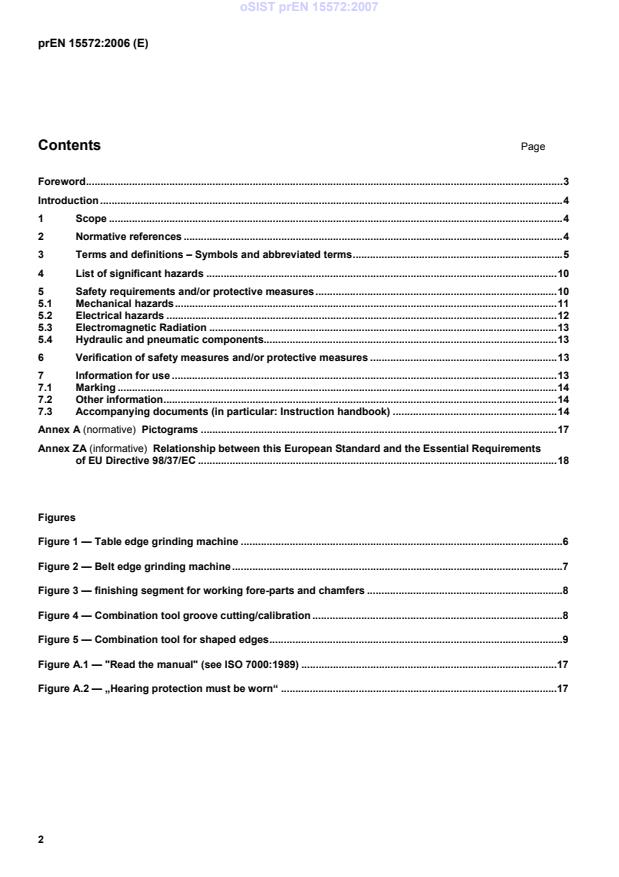
Contents Page
Foreword.3
Introduction .4
1 Scope.4
2 Normative references.4
3 Terms and definitions – Symbols and abbreviated terms.5
4 List of significant hazards .10
5 Safety requirements and/or protective measures.10
5.1 Mechanical hazards.11
5.2 Electrical hazards.12
5.3 Electromagnetic Radiation.13
5.4 Hydraulic and pneumatic components.13
6 Verification of safety measures and/or protective measures .13
7 Information for use .13
7.1 Marking.14
7.2 Other information.14
7.3 Accompanying documents (in particular: Instruction handbook) .14
Annex A (normative) Pictograms .17
Annex ZA (informative) Relationship between this European Standard and the Essential Requirements
of EU Directive 98/37/EC .18
Figures
Figure 1 — Table edge grinding machine .6
Figure 2 — Belt edge grinding machine.7
Figure 3 — finishing segment for working fore-parts and chamfers .8
Figure 4 — Combination tool groove cutting/calibration .8
Figure 5 — Combination tool for shaped edges.9
Figure A.1 — "Read the manual" (see ISO 7000:1989) .17
Figure A.2 — „Hearing protection must be worn“ .17
Foreword
This document (prEN 15572:2006) has been prepared by Technical Committee CEN/TC 151 “Construction
equipment and building material machines — Safety”, the secretariat of which is held by DIN.
This document is currently submitted to the CEN Enquiry.
This document has been prepared under a mandate given to CEN by the European Commission and the European
Free Trade Association, and supports essential requirements of EU Directive(s).
For relationship with EU Directive(s), see informative Annex ZA, which is an integral part of this document.
Annex A is normative and contains pictograms.
Introduction
This document is a type C standard as defined in EN ISO 12100.
The machinery concerned and the extent to which hazards, hazardous situations and events are covered are
indicated in the scope of this document.
When provisions of this type C standard are different from those which are stated in type A or B standards, the
provisions of this type C standard take precedence over the provisions of the other standards, for machines that
have been designed and built according to the provisions of this type C standard.
1 Scope
This standard applies for stationary edge and outline finishing machines for natural stone. Edge finishing machines
are processing the usually rough edges of the workpiece with one or more spindles fitted with grinding tools which
are aligned synchronously or asynchronously towards the edge of the workpiece. Edge finishing machines can be
of table or belt design.
This European Standard does not deal with significant hazards associated with noise.
This European Standard does not deal with:
metal grinding machines;
wood grinding machines;
hand-held grinding machines;
machines intended for operation in a potentially explosive atmosphere;
upstream and downstream conveying elements for transporting the workpieces.
This standard deals with all significant hazards, hazardous situations and events relevant to edge finishing
machines, when they are used as intended and under conditions of misuse which are reasonably foreseeable by
the manufacturer (see Clause 4). This standard specifies the appropriate technical measures to eliminate or reduce
risks arising from the significant hazards.
This document is not applicable to edge finishing machines which are manufactured before the date of publication
of this document by CEN.
2 Normative references
The following referenced documents are indispensable for the application of this document. For dated references,
only the edition cited applies. For undated references, the latest edition of the referenced document (including any
amendments) applies.
EN 294:1992, Safety of machinery — Safety distances to prevent danger zones from being reached by the upper
limbs
EN 349:1993, Safety of machinery — Minimum gaps to avoid crushing of parts of the human body
EN 418:1992, Safety of machinery — Emergency stop equipment, functional aspects; principles for design
EN 574:1996, Safety of machinery — Two-hand control devices — Functional aspects; principles for design
EN 894-1:1997, Safety of machinery — Ergonomic requirements for the design of displays and control actuators —
Part 1: General principles for human interactions with displays and control actuators
EN 953:1997, Safety of machinery — Guards — General requirements for the design and construction of fixed and
movable guards
EN 982:1996, Safety of machinery — Safety requirements for fluid power systems and their components —
Hydraulics
EN 983:1996, Safety of machinery — Safety requirements for fluid power systems and their components —
Pneumatics
EN 1037:1995, Safety of machinery — Prevention of unexpected start-up
EN 1050:1996, Safety of machinery — Principles for risk assessment
EN ISO 12100-1:2003, Safety of machinery — Basic concepts, general principles for design — Part 1: Basic
terminology, methodology
EN ISO 12100-2:2003, Safety of machinery — Basic concepts, general principles for design — Part 2: Technical
principles
prEN 60204-1:2006, Electrical Equipment of Machines — Part 1: General Requirements
EN 60529:1991, Systems of protection by cases (IP Code) (IEC 529: 1989)
EN 61000-6-2:2005, Electromagnetic compatibility (EMC) — Part 6-2: Generic standards: Immunity for industrial
environments
prEN 61000-6-3:2006, Electromagnetic compatibility (EMC) — Part 6-3: Generic standards; Emission standard for
residential, commercial and light-industrial environments
prEN 61000-6-4:2006, Electromagnetic compatibility (EMC) — Part 6-4: Generic standards; Emission standard for
industrial environments
prEN 61000-6-1:2006, Electromagnetic compatibility (EMC) — Part 6-1: Generic standards; Immunity for
residential, commercial and light- industrial environments
3 Terms and definitions – Symbols and abbreviated terms
For the purposes of this document, the definitions given in EN ISO 12100 apply. Additional definitions specifically
needed for this document are added below :
3.1
edge finishing machine
the edge finishing machine is a stationary machine for milling, grinding, polishing and cut-off grinding the edges of
workpieces of marble, granite or other stone-similar material. During the work process water is always used as a
cooling lubricant which also prevents the formation of dust caused by the process. The machines are intended for
the use of abrasives and cut-off wheels with diamond impregnation
3.2
table edge finishing machine
a stationary machine with a worktable on which the workpieces are fixed for processing. The work spindles are
guided along the workpiece on a rail-carriage combination. The worktable is fixed.
The particular work spindles will be generally switched on by the machine control when in working position relative
to the workpiece and switched off when leaving the workpiece.
Before the delivery the respective work spindle is put into rotation and the cooling lubricant supply is activated. This
process is repeated in reverse order when the carriage is turned off
Key
1 guide rail 8 control cabinet
2 stretching device 9 pneumatic control unit
3 worktable 10 table limit stop
4 workpiece 11 removable conveying elements (rolls)
5 control panel 12 edge detection
6 moving machine frame 13 work spindles for face finishing
7 finishing carriage 14 work spindles for chamfering
Figure 1 — Table edge grinding machine
3.3
belt edge finishing machine
a belt edge finishing machine is a stationary machine with a conveyer belt on which the workpieces are guided in-
line along the work spindles by horizontal and vertical guide rolls. These machines are designed for the intermittent
as well as for the continuous transport of the workpieces. The workpieces are guided on the conveyer belt by
means of non-driven top pressure rolls with pneumatic or elastic force.
The particular work spindles will be generally switched on by the machine control when in working position relative
to the workpiece and switched off when leaving the workpiece. Before the delivery the respective work spindle is
put into rotation and the cooling lubricant supply is activated. This process is repeated in reverse order when the
carriage is turned off
Key
1 control panel 8 edge detection
2 workpiece guidance device (rolls) 9 vertical guide rolls
3 conveyor belt 10 fore-part carriage
4 workpiece 11 finishing segment
5 pneumatic control unit 12 lower chamfer carriage
6 running direction 13 upper chamfer carriage
7 conveying belt drive 14 conveyor belt extension
Figure 2 — Belt edge grinding machine
3.4
typical processing tools
3.4.1
finishing segment for working fore-parts and chamfers
Key
1 abrasive wheel
2 coupler for plastic segment with worm-lock
3 finishing shaft
4 tool flange with worm-lock
Figure 3 — finishing segment for working fore-parts and chamfers
3.4.2
combination tool groove cutting/calibration
Key
1 cut-off wheel
2 milling cutter
3 fixing holes
4 diamond segment
Figure 4 — Combination tool groove cutting/calibration
...