


SIST ISO 16000-18:2013/Cor 1:2013
(Corrigendum)Indoor air - Part 18: Detection and enumeration of moulds - Sampling by impaction
Indoor air - Part 18: Detection and enumeration of moulds - Sampling by impaction
This part of ISO 16000 specifies requirements for short-term (1 min to 10 min) sampling of moulds in indoor air by impaction on solid agar media. Following the instructions given, a sample is obtained for subsequent detection of moulds by cultivation in accordance with ISO 16000-17.
Air intérieur - Partie 18: Détection et dénombrement des moisissures - Échantillonnage par impaction
Notranji zrak - 18. del: Ugotavljanje prisotnosti in števila gliv - Vzorčenje z impakcijo - Popravek
Ta del standarda ISO 16000 določa zahteve za kratkoročno (od 1 do 10 min) vzorčenje gliv v notranjem zraku z impakcijo na trdem agarju. Z upoštevanjem danih navodil se vzorec v skladu s standardom ISO 16000-17 pridobi za nadaljnje ugotavljanje prisotnosti gliv s kultivacijo.
General Information
Relations
Standards Content (Sample)
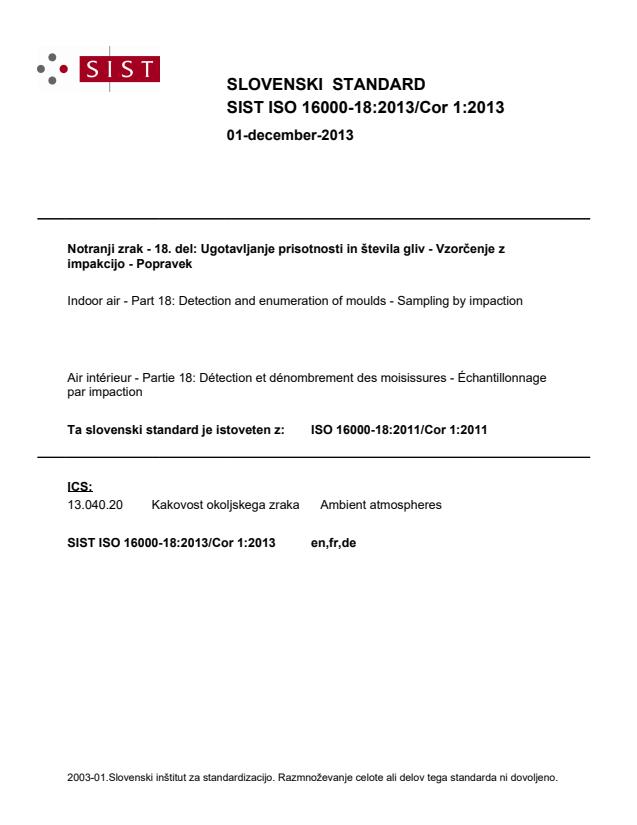
2003-01.Slovenski inštitut za standardizacijo. Razmnoževanje celote ali delov tega standarda ni dovoljeno.Air intérieur - Partie 18: Détection et dénombrement des moisissures - Échantillonnage par impactionIndoor air - Part 18: Detection and enumeration of moulds - Sampling by impaction13.040.20Kakovost okoljskega zrakaAmbient atmospheresICS:Ta slovenski standard je istoveten z:ISO 16000-18:2011/Cor 1:2011SIST ISO 16000-18:2013/Cor 1:2013en,fr,de01-december-2013SIST ISO 16000-18:2013/Cor 1:2013SLOVENSKI
STANDARD
INTERNATIONAL STANDARD ISO 16000-18:2011TECHNICAL CORRIGENDUM 1 Published 2011-12-01 INTERNATIONAL ORGANIZATION FOR STANDARDIZATION
ORGANISATION INTERNATIONALE DE NORMALISATION
Indoor air —
Part 18: Detection and enumeration of moulds — Sampling by impaction TECHNICAL CORRIGENDUM 1 Air intérieur— Partie 18: Détection et dénombrement des moisissures — Échantillonnage par impaction RECTIFICATIF TECHNIQUE 1 Technical Corrigendum 1 to ISO 16000-18:2011 was prepared by Technical Committee ISO/TC 146, Air quality, S
...
This May Also Interest You
- Standard2 pagesEnglish languagesale 15% off
- Standard2 pagesFrench languagesale 15% off
- Amendment5 pagesEnglish languagesale 10% offe-Library read for×1 day
- Standard1 pageEnglish languagesale 15% off
- Amendment4 pagesEnglish languagesale 10% offe-Library read for×1 day
This document specifies a method for the sampling of NO2 in ambient air using diffusive sampling followed by extraction and analysis by colourimetry or ion chromatography (IC). It can be used for the NO2 measurement in a concentration range of approximately 3 µg/m3 to 130 µg/m3 [12]. A sample is typically collected for a period of 1 to 4 weeks [14], with exposure periods depending on the design of the samplers and the concentration levels of NO2.
Several sorbents can be used for trapping NO2 in ambient air using a diffusive sampler [15]. This document specifies the application of triethanolamine as the reagent.
This document describes the application of a tube-type sampler (with either a cylindrical or a slightly conical tube), a badge-type sampler and a radial-type sampler.
The relative expanded uncertainty of NO2 measurements performed using these tube-type diffusive samplers can potentially be lower than 25 % for individual measurements. When aggregating results to form annual average values, the relative expanded uncertainty can be further reduced to levels below 15 % due to the reduction of random effects on uncertainty [9].
NOTE NO2 passive samplers are also employed to measure NOx with the addition of an oxidant to convert ambient NO into NO2. A second NO2 sampler is also deployed without the oxidant and the concentration of NO is determined from the difference of the two samplers [16].
- Standard54 pagesEnglish languagesale 10% offe-Library read for×1 day
- 01-Jan-2024
- 12-May-2025
- 13.040.20
- 2008/50/EC
- KAZ
This document specifies a continuous measurement method for the determination of the concentration of sulfur dioxide present in ambient air based on the ultraviolet fluorescence measuring principle. This document describes the performance characteristics and sets the relevant minimum criteria required to select an appropriate ultraviolet fluorescence analyser by means of type testing. It also includes the evaluation of the suitability of an analyser for use in a specific fixed site so as to meet the data quality requirements as specified in Annex I of Directive 2008/50/EC [1] and requirements during sampling, calibration and quality assurance for use.
The method is applicable to the determination of the mass concentration of sulphur dioxide present in ambient air up to 1000 µg/m3. This concentration range represents the certification range for sulfur dioxide for type testing.
NOTE 1 It is possible to use other ranges depending on the levels present in ambient air.
NOTE 2 When this document is used for purposes other than for measurements required by Directive 2008/50/EC, the ranges and uncertainty requirements possibly do not apply.
The method covers the determination of ambient air concentrations of sulfur dioxide in locations classified as rural areas, urban-background areas, and for sampling influenced by traffic or industrial sources.
The results are expressed in µg/m3 (at 20 °C and 101,3 kPa).
NOTE 3 1 000 µg/m3 of SO2 corresponds to 376 nmol/mol of SO2.
This document contains information for different groups of users.
Clause 5 to Clause 7 and Annex C and Annex D contain general information about the principles of sulfur dioxide measurement by ultraviolet fluorescence analyser and sampling equipment.
Clause 8 and Annex E are specifically directed towards test houses and laboratories that perform type testing of sulfur dioxide analysers. These sections contain information about:
— type testing conditions, test procedures and test requirements;
— analyser performance requirements;
— evaluation of the type testing results;
— evaluation of the uncertainty of the measurement results of the sulfur dioxide analyser based on the type testing results.
Clause 9 to Clause 11 and Annex F and Annex G are directed towards monitoring networks performing the practical measurements of sulfur dioxide in ambient air. These sections contain information about:
— initial installation of the analyser in the monitoring network and acceptance testing;
— ongoing quality assurance/quality control;
— calculation and reporting of measurement results;
— evaluation of the uncertainty of the measurement results under practical monitoring conditions.
This document represents an evolution of earlier editions (EN 14212:2005 and EN 14212:2012). It is advisable that when equipment is procured it complies fully with this document.
NOTE 4 Type testing performed prior to the publication of this document for the purpose of demonstrating equivalence are still valid.
NOTE 5 Analysers type tested prior to the publication of this document remain valid for use for regulated monitoring purposes.
- Standard124 pagesEnglish languagesale 10% offe-Library read for×1 day
- 02-Jan-2023
- 03-Mar-2025
- 13.040.20
- 2008/50/EC
- 2011-01-2525
- KAZ
This European Standard specifies a continuous measurement method for the determination of the concentrations of ozone present in ambient air based on the ultraviolet photometric measuring principle. This standard describes the performance characteristics and sets the relevant minimum criteria required to select an appropriate ultraviolet photometric analyser by means of type approval tests. It also includes the evaluation of the suitability of an analyser for use in a specific fixed site so as to meet the data quality requirements as specified in Annex I of Directive 2008/50/EC [1] and requirements during sampling, calibration and quality assurance for use.
The method is applicable to the determination of the concentration of ozone present in ambient air up to 500 μg/m3.
This concentration range represents the certification range for ozone for the type approval test.
NOTE 1 Other ranges may be used for measurement systems applied at rural locations monitoring ecosystems.
NOTE 2 When the standard is used for other purposes than Directive 2008/50/EC, the ranges and uncertainty requirements may not apply.
The method covers the determination of ambient air concentrations of ozone in zones classified as rural areas, urban and urban-background areas.
The results are expressed in μg/m3 (at 20 °C and 101,3 kPa).
NOTE 3 500 μg/m3 of O3 corresponds to 250 nmol/mol of O3 at 20 °C and 101,3 kPa.
This standard contains information for different groups of users.
Clauses 5 to 7 and Annexes B and C contain general information about the principles of ozone measurement by ultraviolet photometric analyser and sampling equipment.
Clause 8 and Annex E are specifically directed towards test houses and laboratories that perform type-approval testing of ozone analysers. These sections contain information about:
− type-approval test conditions, test procedures and test requirements;
− analyser performance requirements;
− evaluation of the type-approval test results;
− evaluation of the uncertainty of the measurement results of the ozone analyser based on the type-approval test results.
Clauses 9 to 11 and Annexes F and G are directed towards monitoring networks performing the practical
measurements of ozone in ambient air. These sections contain information about:
− initial installation of the analyser in the monitoring network and acceptance testing;
− ongoing quality assurance/quality control;
− calculation and reporting of measurement results;
− evaluation of the uncertainty of measurement results under practical monitoring conditions.
- Standard114 pagesEnglish languagesale 10% offe-Library read for×1 day
- 02-Jan-2023
- 03-Mar-2025
- 13.040.20
- 2008/50/EC
- 2011-01-2525
- KAZ
This document specifies the sampling and analysis of phthalates in indoor air and describes the sampling and analysis of phthalates in house dust and in solvent wipe samples of surfaces by means of gas chromatography-mass spectrometry (GC-MS).
Two alternative sampling, sample preparation and sample introduction methods, whose comparability has been proven in an interlaboratory test, are specified for indoor air[1]:
— sorbent tubes sampling with subsequent thermal desorption GC-MS, and
— sampling by adsorption and subsequent solvent extraction and injection to GC-MS.
Additional adsorbents that can be used are described in Annex B.
Depending on the sampling method, the compounds dimethyl phthalate to diisoundecylphthalate can be analysed in house dust as described in Annex D. The investigation of house dust samples is only appropriate as a screening method. This investigation only results in indicative values and is not acceptable for a final assessment of a potential need for action.
Dimethyl phthalate to diisoundecylphthalate can be analysed in solvent wipe samples as described in Annex C. Solvent wipe samples are suitable for non-quantitative source identification.
NOTE In principle, the method is also suitable for the analysis of other phthalates, adipates and cyclohexane dicarboxylic acid esters, but this is confirmed by determination of the performance characteristics in each case.
General information on phthalates are given in Annex A.
- Standard51 pagesEnglish languagesale 10% offe-Library read for×1 day
- Standard45 pagesEnglish languagesale 15% off
This European Standard specifies a continuous measurement method for the determination of the concentration of carbon monoxide present in ambient air based on the non-dispersive infrared spectroscopic measuring principle.
This standard describes the performance characteristics and sets the relevant minimum criteria required to select an appropriate non-dispersive infrared spectroscopic analyser by means of type approval tests. It also includes the evaluation of the suitability of an analyser for use in a specific fixed site so as to meet the data quality requirements as specified in Annex I of Directive 2008/50/EC [1] and requirements during sampling, calibration and quality assurance for use.
The method is applicable to the determination of the mass concentration of carbon monoxide present in ambient air up to 100 mg/m3 carbon monoxide. This concentration range represents the certification range for the type approval test.
NOTE 1 Other ranges may be used depending on the levels present in ambient air.
NOTE 2 When the standard is used for other purposes than for measurements required by Directive 2008/50/EC, the ranges and uncertainty requirements may not apply.
The method covers the determination of ambient air concentrations of carbon monoxide in zones classified as rural areas, urban-background areas and traffic-orientated locations and locations influenced by industrial sources.
The results are expressed in mg/m3 (at 20 °C and 101,3 kPa).
NOTE 3 100 mg/m3 of CO corresponds to 86 μmol/mol of CO.
This standard contains information for different groups of users.
Clauses 5 to 7 and Annexes B, C and D contain general information about the principles of carbon monoxide measurement by non-dispersive infrared spectroscopic analyser and sampling equipment.
Clause 8 and Annex E are specifically directed towards test houses and laboratories that perform type-approval testing of carbon monoxide analysers. These sections contain information about:
− type-approval test conditions, test procedures and test requirements;
− analyser performance requirements;
− evaluation of the type-approval test results;
− evaluation of the uncertainty of the measurement results of the carbon monoxide analyser based on the type approval test results.
Clauses 9 to 11 and Annex F are directed towards monitoring networks performing the practical measurements of carbon monoxide in ambient air. These sections contain information about:
− initial installation of the analyser in the monitoring network and acceptance testing;
− ongoing quality assurance/quality control;
− calculation and reporting of measurement results;
− evaluation of the uncertainty of measurement results under practical monitoring conditions.
- Standard105 pagesEnglish languagesale 10% offe-Library read for×1 day
- 02-Jan-2023
- 03-Mar-2025
- 13.040.20
- 2008/50/EC
- 2011-01-2525
- KAZ
- Standard1 pageEnglish languagesale 15% off
- Standard1 pageFrench languagesale 15% off
- Standard1 pageFrench languagesale 15% off
- Amendment4 pagesEnglish languagesale 10% offe-Library read for×1 day
- Amendment4 pagesEnglish languagesale 10% offe-Library read for×1 day
This document specifies a continuous measurement method for the determination of the concentrations of nitrogen dioxide and nitrogen monoxide present in ambient air based on the chemiluminescence measuring principle. This document describes the performance characteristics and sets the relevant minimum criteria required to select an appropriate chemiluminescence analyser by means of type testing. It also includes the evaluation of the suitability of an analyser for use in a specific fixed site so as to meet the data quality requirements as specified in Annex I of Directive 2008/50/EC [1] and requirements during sampling, calibration and quality assurance for use.
The method is applicable to the determination of the concentration of nitrogen dioxide present in ambient air up to 500 µg/m3. This concentration range represents the certification range for nitrogen dioxide for type testing.
The method is applicable to the determination of the concentration of nitrogen monoxide present in ambient air up to 1 200 µg/m3. This concentration range represents the certification range for nitrogen monoxide for the type testing.
NOTE 1 It is possible to use other ranges depending on the levels present in ambient air.
NOTE 2 When this document is used for purposes other than for measurements required by Directive2008/50/EC, the ranges and uncertainty requirements possibly do not apply.
The method covers the determination of ambient air concentrations of nitrogen dioxide and nitrogen monoxide in zones classified as rural areas, urban-background areas, traffic-orientated locations and locations influenced by industrial sources.
The results are expressed in µg/m3 (at 20 °C and 101,3 kPa).
NOTE 3 500 µg/m3 of nitrogen dioxide corresponds to 261 nmol/mol of nitrogen dioxide at 20 °C and 101,3 kPa. 1 200 µg/m3 of nitrogen monoxide corresponds to 962 nmol/mol of nitrogen monoxide at 20 °C and 101,3 kPa.
This document contains information for different groups of users.
Clause 5 to Clause 7 and Annex B and Annex C contain general information about the principles of NOx measurement by chemiluminescence analyser and sampling equipment.
Clause 8 and Annex E are specifically directed towards test houses and laboratories that perform type testing of NOx analysers. These sections contain information about:
— type testing conditions, test procedures and test requirements;
— analyser performance requirements;
— evaluation of the type testing results;
— evaluation of the uncertainty of the measurement results of the NOx analyser based on the type testing results.
Clause 9 to Clause 11 and Annex F and Annex G are directed towards monitoring networks performing the practical measurements of NOx in ambient air. These sections contain information about:
— initial installation of the analyser in the monitoring network and acceptance testing;
— ongoing quality assurance/quality control;
— calculation and reporting of measurement results;
— evaluation of the uncertainty of measurement results under practical monitoring conditions.
This document represents an evolution of earlier editions (EN 14211:2005 and EN 14211:2012). It is advisable that when equipment is procured it complies fully with this document.
NOTE 4 Type testing performed prior to the publication of this document for the purpose of demonstrating equivalence are still valid.
NOTE 5 Analysers type tested prior to the publication of this document remain valid for use for regulated monitoring purposes.
- Standard120 pagesEnglish languagesale 10% offe-Library read for×1 day
- 02-Jan-2023
- 03-Mar-2025
- 13.040.20
- 2008/50/EC
- 2011-01-2525
- KAZ
This document specifies a process for the electrical diffusion charging of aerosols with subsequent measurement of particle charge. With the aid of this method, it is possible to determine the lung-deposited surface area (LDSA) concentration of particles in ambient air. Depending on the design of the electrical diffusion charger, the LDSA of particles in the size range of approximately 20 nm to approximately 300 nm is measurable.
Furthermore, this document specifies design criteria for LDSA measuring aerosol monitors as well as performance criteria and the associated test procedures. The performance criteria depend on the application and they are more stringent when the instrument is operated in an air quality monitoring station.
In the determination of the LDSA concentration, the share of geometric particle surface area concentration is determined that can be deposited in the alveolar region of the human lung. Typical particle surface area concentrations with alveolar deposition measured in urban areas range from 5 µm2/cm3 to 50 µm2/cm3.
Instruments based on this measurement principle can be designed to be very compact with a low power consumption. This makes them ideally suited for handheld measurements, other forms of mobile application or to measure personal exposure. On the other hand, they can be easily adapted to serve as a stationary instrument in air quality monitoring stations.
- Technical specification32 pagesEnglish languagesale 10% offe-Library read for×1 day
- 01-Jul-2024
- 11-Dec-2024
- 13.040.20
- 2008/50/EC
- KAZ
Questions, Comments and Discussion
Ask us and Technical Secretary will try to provide an answer. You can facilitate discussion about the standard in here.
Loading comments...