

SIST EN IEC 60730-2-10:2026
(Main)Automatic electrical controls for household and similar use - Part 2-10: Particular requirements for motor-starting relays
- Abstract
This part of IEC 60730 applies to automatic electrical motor-starting relays
– intended to control the start windings of single phase motors;
– for use in, on, or in association with equipment for household appliance and similar use;
NOTE 1 Throughout this document, the word "equipment" means "appliance and equipment" and "control" means "motor-starting relays".
– intended for appliances within the scope of IEC 60335;
– for equipment that is used in building automation within the scope of ISO 16484 series and IEC 63044 series (HBES/BACS);
– for equipment that is used by the public, such as equipment intended to be used in shops, offices, hospitals, farms and commercial and industrial applications;
EXAMPLE 1 Controls for commercial catering, heating and air-conditioning equipment.
– used in, on, or in association with equipment that are smart enabled;
EXAMPLE 2 Smart grid control, remote interfaces/control of energy-consuming equipment.
– that are AC or DC powered with a rated voltage not exceeding 690 V AC or 600 V DC;
– used in, on, or in association with equipment that use electricity, gas, oil, solid fuel, solar thermal energy, etc., or a combination thereof;
– utilized as part of a control system or controls which are mechanically integral with multifunctional controls having non-electrical outputs;
– using NTC or PTC thermistors, requirements for which are contained in Annex J;
– that are mechanically or electrically operated, responsive to or controlling such characteristics as current and voltage, or combinations thereof;
EXAMPLE 3 Centrifugal motor-starting devices.
– as well as manual controls when such are electrically and/or mechanically integral with automatic controls.
NOTE 2 Requirements for manually actuated mechanical switches not forming part of an automatic control are contained in IEC 61058-1-1.
This document applies to
– the inherent safety of motor-starting control, and
– functional safety of motor-starting control and safety related systems (when required),
– controls where the performance (for example the effect of EMC phenomena) of the product can impair the overall safety and performance of the controlled system,
– the operating values, operating times, and operating sequences where such are associated with equipment safety,
– motor-starting controls incorporating electronic devices, thermistor elements, thermal elements or magnetic elements.
This document specifies the requirements for construction, operation and testing of automatic electrical motor-starting relays used in, on, or in association with an equipment.
This document does not
– apply to motor-starting relays designed exclusively for industrial process applications unless explicitly mentioned in the relevant equipment standard. However, this document can be applied to motor-start relays for equipment intended specifically for industrial applications in cases where no relevant safety standard exists;
– take into account the response value of an automatic action of a control, if such a response value is dependent upon the method of mounting the control in the equipment. Where a response value is of significant purpose for the protection of the user, or surroundings, the value defined in the appropriate equipment standard or as determined by the manufacturer will apply;
– apply to general purpose relays or to contactors and motor starters of the type covered by IEC 60947 series;
– apply to mechanically operated motor-starting devices.
- Status
- Published
- Public Enquiry End Date
- 31-Mar-2026
- Publication Date
- 27-Oct-2026
- Technical Committee
- ISS EIT.NZG - Household apliances
- Current Stage
- 6060 - National Implementation/Publication (Adopted Project)
- Start Date
- 15-Oct-2026
- Due Date
- 20-Dec-2026
- Completion Date
- 28-Oct-2026

SIST EN IEC 60730-2-10:2026 is the Slovenian standard for automatic electrical controls for household and similar use, published by SIST and aligned with IEC work. It gives particular requirements for motor-starting relays, meaning electrically operated controls that switch the auxiliary starting winding of single-phase motors in appliances and similar equipment.
What does SIST EN IEC 60730-2-10:2026 specify?
SIST EN IEC 60730-2-10:2026 specifies construction, operation and testing requirements for automatic electrical motor-starting relays used in, on, or in association with equipment for household and similar use. The standard is built to work with IEC 60730-1: it keeps the Part 1 framework and then adds, modifies, or replaces the clauses that are specific to motor-starting relays.
The scope covers relays for appliances, building automation and control systems, public-use equipment such as shops, offices, hospitals, farms, and commercial or industrial applications, and smart-enabled equipment. It also covers AC or DC powered equipment up to the stated voltage limits, equipment using different energy sources, and control systems where the relay is mechanically or electrically part of a larger control arrangement.
The document also points to a few clear exclusions. It is not for motor-starting relays designed exclusively for industrial process applications unless a relevant equipment standard explicitly calls for it, and it does not apply to general purpose relays, contactors and motor starters covered by IEC 60947, or mechanically operated motor-starting devices.
| Annex | What it covers |
|---|---|
| Annex H | Functional safety requirements, including endurance and EMC immunity details |
| Annex Q | Regional differences for CENELEC member countries |
| Annex R | National differences for the United States of America |
| Annex S | National differences for Japan |
| Annex T | National differences for Canada |
What are the key requirements of SIST EN IEC 60730-2-10:2026?
SIST EN IEC 60730-2-10:2026 keeps the core safety requirements of IEC 60730-1 and adds relay-specific test conditions, declarations, and functional-safety adjustments. In practice, manufacturers need to know how the relay is classified, what information must be declared, and how the relay is tested under normal, abnormal, and functional-safety conditions.
Scope and classification
Clause 3 adds the term motor-starting relay and ties the relay to the task of connecting the main and auxiliary starting windings of a single-phase motor. The note under the definition links electromechanical designs to type 1 action and electronic designs to class A control function, which matters because later tests and safety arguments depend on that control type.
Clause 5 and Table 1 require technical information to be given in a defined way. The table covers the relay purpose, control type, and related construction information such as insulation material properties. For a designer or buyer, this means the product data sheet and test file must match the relay’s actual intended use and construction.
Core safety and construction requirements
Clauses 6 to 15 retain the Part 1 safety structure for electric shock protection, protective earthing, terminals, construction, threaded parts, creepage and clearance distances, components, insulation, moisture and dust resistance, and electric strength. These are the baseline checks that show the relay can be installed safely and can survive foreseeable handling and environmental conditions.
Clause 16 modifies the heating test for motor-starting relays. The relay coil is loaded using the declared steady-state motor run current, while the contacts are not loaded. In practice, this tells the manufacturer to declare the current basis clearly and to prove that the coil temperature rise stays acceptable without relying on contact loading during the test.
Clause 19 keeps endurance testing as a key requirement for this product family. The document also links endurance to the abnormal operation burnout note, so endurance evidence is part of the overall safety case for electromechanical motor-starting relays.
EMC, abnormal operation, and functional safety
Clauses 23 and 25 apply the Part 1 EMC emission and immunity requirements. Annex H then adds functional-safety-specific EMC immunity rules, including a modified approach for type 1 action relays. This matters because electromagnetic disturbances can affect whether the relay starts the motor safely and consistently.
Clause 26 covers abnormal operation tests, including the abnormal temperature test. For the burnout test, the note says that electromechanical motor-start relays, relays and contactors show compliance by passing the endurance tests of Clause 19. The blocked mechanical output test is not applicable, which narrows the abnormal-condition test program to what is relevant for this relay type.
Annex H also modifies the thermal cycling endurance test duration and gives a specific evaluation approach for EMC immunity compliance. That helps laboratories and certification bodies decide which test path to use when the relay is part of a safety-related control function.
What terms does SIST EN IEC 60730-2-10:2026 define?
SIST EN IEC 60730-2-10:2026 defines several terms that are important for selecting the right relay and applying the test rules correctly.
- Motor-starting relay - An electrically operated control integrated into an appliance and used in a motor circuit to connect the main winding to the auxiliary starting winding so a single-phase motor can start.
- Steady state motor run current - The current used as the declared basis for the heating test and related information requirements when the motor is running steadily.
- Type 1 action - A control action category used for electromechanical motor-starting relays in the functional-safety context of the standard.
- Class A control function - The control-function category noted for electronic motor-starting relays in the definition note.
- HBES/BACS - Home and Building Electronic Systems and Building Automation and Control Systems, the application area covered in the scope.
- NTC thermistor - A negative temperature coefficient thermistor used in some motor-starting relay arrangements.
- PTC thermistor - A positive temperature coefficient thermistor used in some motor-starting relay arrangements.
Who uses SIST EN IEC 60730-2-10:2026?
SIST EN IEC 60730-2-10:2026 is used by relay manufacturers, appliance manufacturers, and control-system designers who need to build or select motor-starting relays for single-phase motors. It is also used by test laboratories, certification bodies, and quality managers who verify safety, EMC behaviour, endurance, and functional-safety performance.
Buyers and technical specifiers use it when they need to compare relay designs for household appliances, building automation equipment, or other similar-use equipment. It is especially relevant when a relay is part of a safety-related control function or when the product must fit the IEC 60730 family of appliance controls.
What changed in SIST EN IEC 60730-2-10:2026 from the previous edition?
SIST EN IEC 60730-2-10:2026 is the 3.0 edition and it cancels and replaces the 2.0 edition published in 2006. The document says this edition is a technical revision and that its main technical change is adoption of IEC 60730-1 Edition 6.0, including its significant changes.
Which standards are used with SIST EN IEC 60730-2-10:2026?
SIST EN IEC 60730-2-10:2026 is intended to be used with IEC 60730-1, which provides the general requirements that Part 2-10 modifies for motor-starting relays. It also names IEC 60947 (all parts) as a normative reference for low-voltage switchgear and controlgear.
The scope and annexes also refer to IEC 60335 (all parts) for household and similar appliances, ISO 16484 and IEC 63044 series for building automation and control systems, and regional companion editions such as EN 60730-2-10, UL 60730-2-10, JIS C 9730-2-10, and CAN/CSA-E60730-2-10 through the regional-differences annexes.
What does the SIST EN IEC 60730-2-10:2026 document contain?
SIST EN IEC 60730-2-10:2026 contains the Part 1-based clause structure, a product-specific scope, one added definition section, and a technical information table that tells users what must be declared and how. It also contains the main safety and performance clauses for electric shock protection, earthing, terminals, construction, insulation distances, components, heating, endurance, mechanical strength, EMC, and abnormal operation.
The document includes Figure references inherited from Part 1, so it is not only a rules text but also a test-and-application document. Annex H gives the functional-safety-specific rules, while Annexes Q, R, S, and T collect regional differences for CENELEC, the United States, Japan, and Canada. This makes the standard useful for design verification, testing, and conformity assessment across several markets.
Relations
- Effective Date
- 22-Sep-2026
- Effective Date
- 22-Sep-2026
- Effective Date
- 22-Sep-2026
- Effective Date
- 22-Sep-2026
- Effective Date
- 22-Sep-2026
- Effective Date
- 22-Sep-2026
- Effective Date
- 13-Oct-2026
- Effective Date
- 13-Oct-2026
- Effective Date
- 13-Oct-2026
- Effective Date
- 13-Oct-2026
- Effective Date
- 13-Oct-2026
- Effective Date
- 13-Oct-2026
- Effective Date
- 13-Oct-2026
- Effective Date
- 13-Oct-2026
- Effective Date
- 13-Oct-2026
Frequently Asked Questions
SIST EN IEC 60730-2-10:2026 is a standard published by the Slovenian Institute for Standardization (SIST). Its full title is "Automatic electrical controls for household and similar use - Part 2-10: Particular requirements for motor-starting relays". This standard covers: This part of IEC 60730 applies to automatic electrical motor-starting relays – intended to control the start windings of single phase motors; – for use in, on, or in association with equipment for household appliance and similar use; NOTE 1 Throughout this document, the word "equipment" means "appliance and equipment" and "control" means "motor-starting relays". – intended for appliances within the scope of IEC 60335; – for equipment that is used in building automation within the scope of ISO 16484 series and IEC 63044 series (HBES/BACS); – for equipment that is used by the public, such as equipment intended to be used in shops, offices, hospitals, farms and commercial and industrial applications; EXAMPLE 1 Controls for commercial catering, heating and air-conditioning equipment. – used in, on, or in association with equipment that are smart enabled; EXAMPLE 2 Smart grid control, remote interfaces/control of energy-consuming equipment. – that are AC or DC powered with a rated voltage not exceeding 690 V AC or 600 V DC; – used in, on, or in association with equipment that use electricity, gas, oil, solid fuel, solar thermal energy, etc., or a combination thereof; – utilized as part of a control system or controls which are mechanically integral with multifunctional controls having non-electrical outputs; – using NTC or PTC thermistors, requirements for which are contained in Annex J; – that are mechanically or electrically operated, responsive to or controlling such characteristics as current and voltage, or combinations thereof; EXAMPLE 3 Centrifugal motor-starting devices. – as well as manual controls when such are electrically and/or mechanically integral with automatic controls. NOTE 2 Requirements for manually actuated mechanical switches not forming part of an automatic control are contained in IEC 61058-1-1. This document applies to – the inherent safety of motor-starting control, and – functional safety of motor-starting control and safety related systems (when required), – controls where the performance (for example the effect of EMC phenomena) of the product can impair the overall safety and performance of the controlled system, – the operating values, operating times, and operating sequences where such are associated with equipment safety, – motor-starting controls incorporating electronic devices, thermistor elements, thermal elements or magnetic elements. This document specifies the requirements for construction, operation and testing of automatic electrical motor-starting relays used in, on, or in association with an equipment. This document does not – apply to motor-starting relays designed exclusively for industrial process applications unless explicitly mentioned in the relevant equipment standard. However, this document can be applied to motor-start relays for equipment intended specifically for industrial applications in cases where no relevant safety standard exists; – take into account the response value of an automatic action of a control, if such a response value is dependent upon the method of mounting the control in the equipment. Where a response value is of significant purpose for the protection of the user, or surroundings, the value defined in the appropriate equipment standard or as determined by the manufacturer will apply; – apply to general purpose relays or to contactors and motor starters of the type covered by IEC 60947 series; – apply to mechanically operated motor-starting devices.
This part of IEC 60730 applies to automatic electrical motor-starting relays – intended to control the start windings of single phase motors; – for use in, on, or in association with equipment for household appliance and similar use; NOTE 1 Throughout this document, the word "equipment" means "appliance and equipment" and "control" means "motor-starting relays". – intended for appliances within the scope of IEC 60335; – for equipment that is used in building automation within the scope of ISO 16484 series and IEC 63044 series (HBES/BACS); – for equipment that is used by the public, such as equipment intended to be used in shops, offices, hospitals, farms and commercial and industrial applications; EXAMPLE 1 Controls for commercial catering, heating and air-conditioning equipment. – used in, on, or in association with equipment that are smart enabled; EXAMPLE 2 Smart grid control, remote interfaces/control of energy-consuming equipment. – that are AC or DC powered with a rated voltage not exceeding 690 V AC or 600 V DC; – used in, on, or in association with equipment that use electricity, gas, oil, solid fuel, solar thermal energy, etc., or a combination thereof; – utilized as part of a control system or controls which are mechanically integral with multifunctional controls having non-electrical outputs; – using NTC or PTC thermistors, requirements for which are contained in Annex J; – that are mechanically or electrically operated, responsive to or controlling such characteristics as current and voltage, or combinations thereof; EXAMPLE 3 Centrifugal motor-starting devices. – as well as manual controls when such are electrically and/or mechanically integral with automatic controls. NOTE 2 Requirements for manually actuated mechanical switches not forming part of an automatic control are contained in IEC 61058-1-1. This document applies to – the inherent safety of motor-starting control, and – functional safety of motor-starting control and safety related systems (when required), – controls where the performance (for example the effect of EMC phenomena) of the product can impair the overall safety and performance of the controlled system, – the operating values, operating times, and operating sequences where such are associated with equipment safety, – motor-starting controls incorporating electronic devices, thermistor elements, thermal elements or magnetic elements. This document specifies the requirements for construction, operation and testing of automatic electrical motor-starting relays used in, on, or in association with an equipment. This document does not – apply to motor-starting relays designed exclusively for industrial process applications unless explicitly mentioned in the relevant equipment standard. However, this document can be applied to motor-start relays for equipment intended specifically for industrial applications in cases where no relevant safety standard exists; – take into account the response value of an automatic action of a control, if such a response value is dependent upon the method of mounting the control in the equipment. Where a response value is of significant purpose for the protection of the user, or surroundings, the value defined in the appropriate equipment standard or as determined by the manufacturer will apply; – apply to general purpose relays or to contactors and motor starters of the type covered by IEC 60947 series; – apply to mechanically operated motor-starting devices.
SIST EN IEC 60730-2-10:2026 is classified under the following ICS (International Classification for Standards) categories: 97.120 - Automatic controls for household use. The ICS classification helps identify the subject area and facilitates finding related standards.
SIST EN IEC 60730-2-10:2026 has the following relationships with other standards: It is inter standard links to SIST EN IEC 60947-1:2021, SIST EN IEC 60947-3:2021/A1:2025, SIST EN IEC 60947-2:2025, SIST EN IEC 60947-3:2021, SIST EN IEC 60947-10:2026, SIST EN IEC 60947-8:2023, SIST EN 12977-5:2012, SIST EN 12098-5:2018, SIST EN 14678-1:2013, SIST EN 15500:2008, SIST EN 15500-1:2018, SIST EN 60335-1:2012, SIST EN 12977-5:2018, SIST EN 13617-1:2012, SIST EN IEC 60335-1:2024. Understanding these relationships helps ensure you are using the most current and applicable version of the standard.
SIST EN IEC 60730-2-10:2026 is associated with the following European legislation: EU Directives/Regulations: 2014/35/EU; Standardization Mandates: M/511. When a standard is cited in the Official Journal of the European Union, products manufactured in conformity with it benefit from a presumption of conformity with the essential requirements of the corresponding EU directive or regulation.
SIST EN IEC 60730-2-10:2026 is available in PDF format for immediate download after purchase. The document can be added to your cart and obtained through the secure checkout process. Digital delivery ensures instant access to the complete standard document.
Standards Content (Sample)
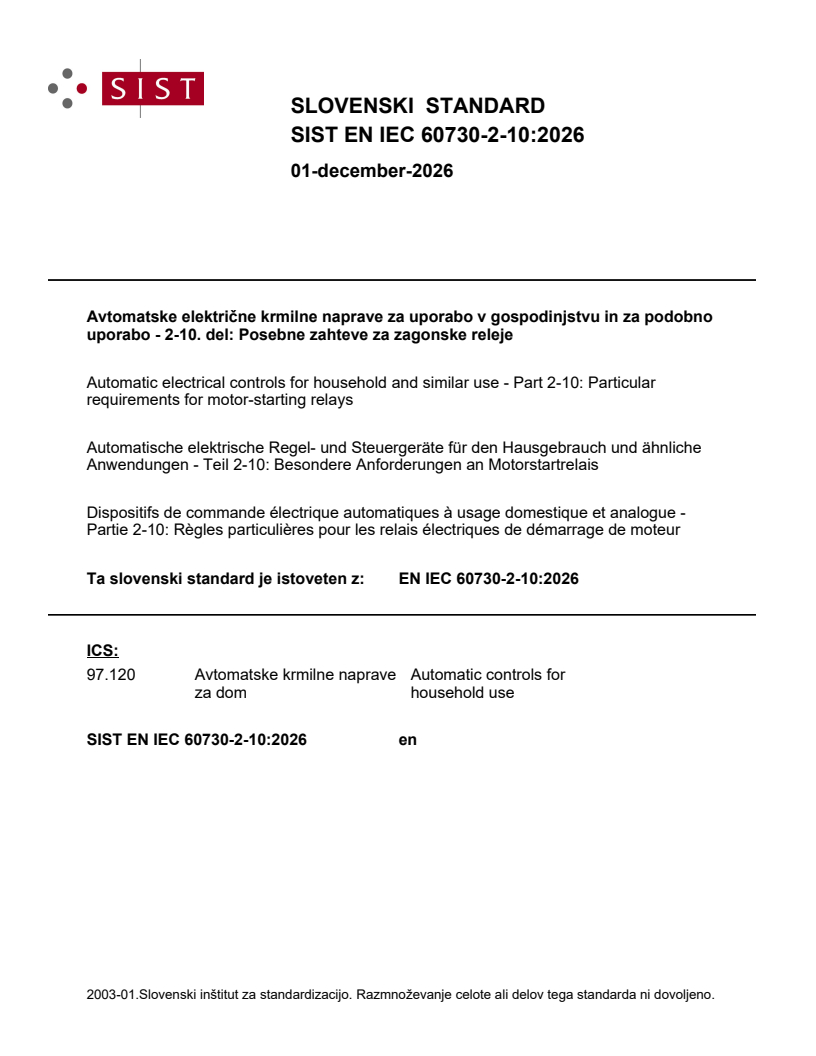
SLOVENSKI STANDARD
01-december-2026
Avtomatske električne krmilne naprave za uporabo v gospodinjstvu in za podobno
uporabo - 2-10. del: Posebne zahteve za zagonske releje
Automatic electrical controls for household and similar use - Part 2-10: Particular
requirements for motor-starting relays
Automatische elektrische Regel- und Steuergeräte für den Hausgebrauch und ähnliche
Anwendungen - Teil 2-10: Besondere Anforderungen an Motorstartrelais
Dispositifs de commande électrique automatiques à usage domestique et analogue -
Partie 2-10: Règles particulières pour les relais électriques de démarrage de moteur
Ta slovenski standard je istoveten z: EN IEC 60730-2-10:2026
ICS:
97.120 Avtomatske krmilne naprave Automatic controls for
za dom household use
2003-01.Slovenski inštitut za standardizacijo. Razmnoževanje celote ali delov tega standarda ni dovoljeno.
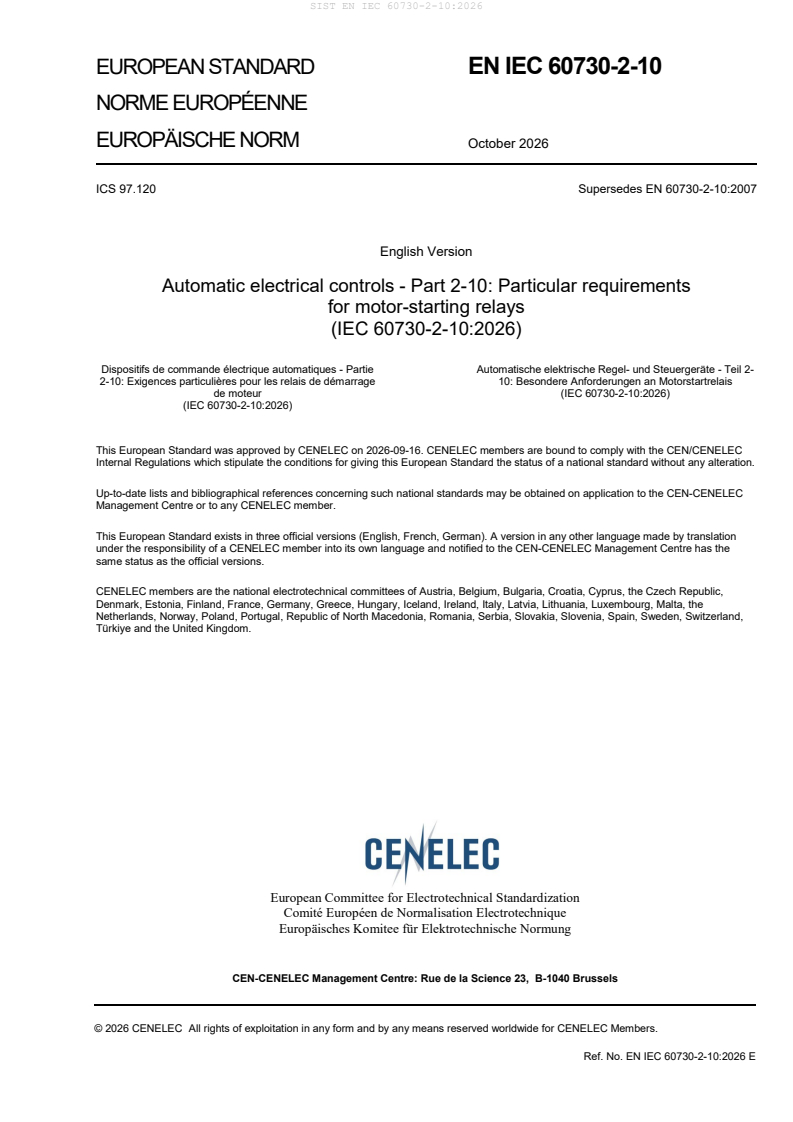
EUROPEAN STANDARD EN IEC 60730-2-10
NORME EUROPÉENNE
EUROPÄISCHE NORM October 2026
ICS 97.120 Supersedes EN 60730-2-10:2007
English Version
Automatic electrical controls - Part 2-10: Particular requirements
for motor-starting relays
(IEC 60730-2-10:2026)
Dispositifs de commande électrique automatiques - Partie Automatische elektrische Regel- und Steuergeräte - Teil 2-
2-10: Exigences particulières pour les relais de démarrage 10: Besondere Anforderungen an Motorstartrelais
de moteur (IEC 60730-2-10:2026)
(IEC 60730-2-10:2026)
This European Standard was approved by CENELEC on 2026-09-16. CENELEC members are bound to comply with the CEN/CENELEC
Internal Regulations which stipulate the conditions for giving this European Standard the status of a national standard without any alteration.
Up-to-date lists and bibliographical references concerning such national standards may be obtained on application to the CEN-CENELEC
Management Centre or to any CENELEC member.
This European Standard exists in three official versions (English, French, German). A version in any other language made by translation
under the responsibility of a CENELEC member into its own language and notified to the CEN-CENELEC Management Centre has the
same status as the official versions.
CENELEC members are the national electrotechnical committees of Austria, Belgium, Bulgaria, Croatia, Cyprus, the Czech Republic,
Denmark, Estonia, Finland, France, Germany, Greece, Hungary, Iceland, Ireland, Italy, Latvia, Lithuania, Luxembourg, Malta, the
Netherlands, Norway, Poland, Portugal, Republic of North Macedonia, Romania, Serbia, Slovakia, Slovenia, Spain, Sweden, Switzerland,
Türkiye and the United Kingdom.
European Committee for Electrotechnical Standardization
Comité Européen de Normalisation Electrotechnique
Europäisches Komitee für Elektrotechnische Normung
CEN-CENELEC Management Centre: Rue de la Science 23, B-1040 Brussels
© 2026 CENELEC All rights of exploitation in any form and by any means reserved worldwide for CENELEC Members.
Ref. No. EN IEC 60730-2-10:2026 E
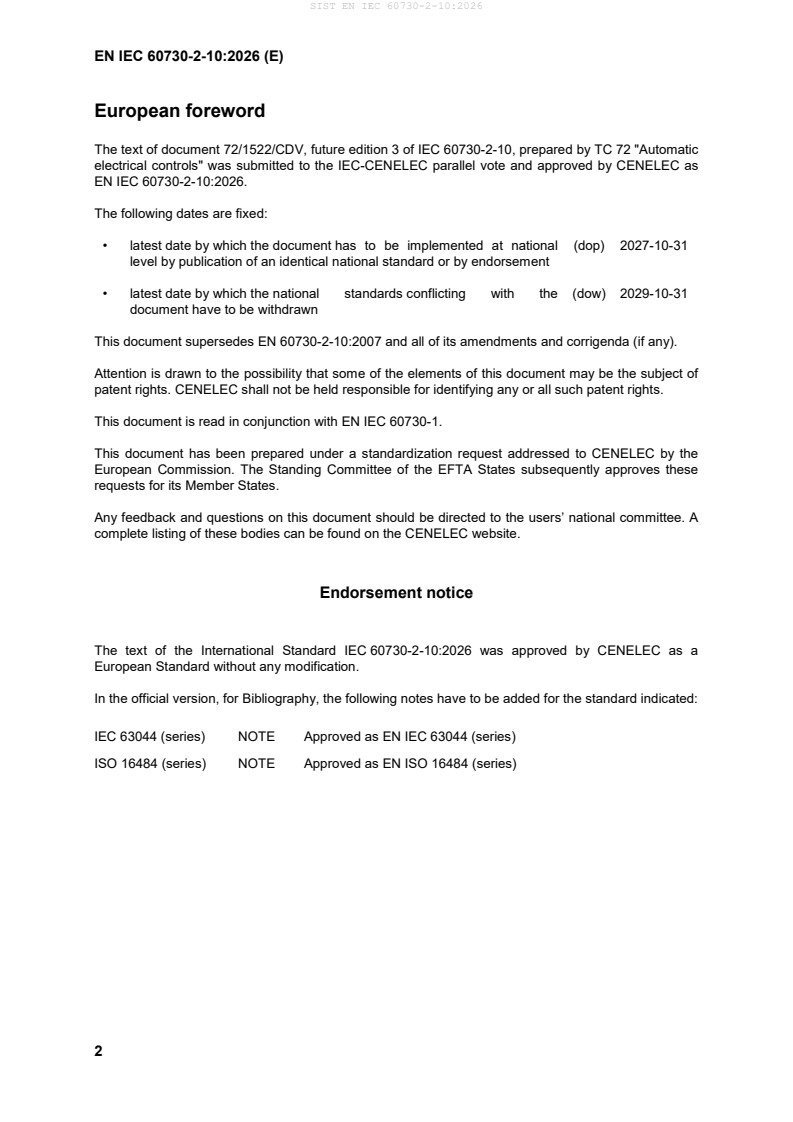
European foreword
The text of document 72/1522/CDV, future edition 3 of IEC 60730-2-10, prepared by TC 72 "Automatic
electrical controls" was submitted to the IEC-CENELEC parallel vote and approved by CENELEC as
The following dates are fixed:
• latest date by which the document has to be implemented at national (dop) 2027-10-31
level by publication of an identical national standard or by endorsement
• latest date by which the national standards conflicting with the (dow) 2029-10-31
document have to be withdrawn
This document supersedes EN 60730-2-10:2007 and all of its amendments and corrigenda (if any).
Attention is drawn to the possibility that some of the elements of this document may be the subject of
patent rights. CENELEC shall not be held responsible for identifying any or all such patent rights.
This document is read in conjunction with EN IEC 60730-1.
This document has been prepared under a standardization request addressed to CENELEC by the
European Commission. The Standing Committee of the EFTA States subsequently approves these
requests for its Member States.
Any feedback and questions on this document should be directed to the users’ national committee. A
complete listing of these bodies can be found on the CENELEC website.
Endorsement notice
The text of the International Standard IEC 60730-2-10:2026 was approved by CENELEC as a
European Standard without any modification.
In the official version, for Bibliography, the following notes have to be added for the standard indicated:
IEC 63044 (series) NOTE Approved as EN IEC 63044 (series)
ISO 16484 (series) NOTE Approved as EN ISO 16484 (series)
Annex ZA
(normative)
Normative references to international publications
with their corresponding European publications
The following documents are referred to in the text in such a way that some or all of their content
constitutes requirements of this document. For dated references, only the edition cited applies. For
undated references, the latest edition of the referenced document (including any amendments)
applies.
NOTE 1 Where an International Publication has been modified by common modifications, indicated by (mod),
the relevant EN/HD applies.
NOTE 2 Up-to-date information on the latest versions of the European Standards listed in this annex is available
here: www.cencenelec.eu.
Clause 2 of EN IEC 60730-1 is applicable, except as follows:
Addition:
Publication Year Title EN/HD Year
IEC 60947 series Low-voltage switchgear and controlgear EN IEC 60947 series
IEC 60730-2-10 ®
Edition 3.0 2026-08
INTERNATIONAL
STANDARD
Automatic electrical controls -
Part 2-10: Particular requirements for motor-starting relays
ICS 97.120 ISBN 978-2-8327-1408-9
IEC 60730-2-10:2026-08(en)
IEC 60730-2-10:2026 © IEC 2026
CONTENTS
FOREWORD . 2
1 Scope . 4
2 Normative references . 5
3 Terms and definitions . 5
4 General . 5
5 Required technical information . 6
6 Protection against electric shock . 6
7 Provision for protective earthing . 6
8 Terminals and terminations. 6
9 Constructional requirements . 6
10 Threaded parts and connections . 6
11 Creepage distances, clearances and distances through solid insulation . 7
12 Components . 7
13 Fault assessment on electronic circuits . 7
14 Moisture and dust resistance . 7
15 Electric strength and insulation resistance . 7
16 Heating . 7
17 Manufacturing deviation and drift . 7
18 Environmental stress . 8
19 Endurance . 8
20 Mechanical strength . 8
21 Resistance to heat, fire and tracking . 8
22 Resistance to corrosion . 8
23 Electromagnetic compatibility (EMC) requirements – Emission . 8
24 Normal operation . 8
25 Electromagnetic compatibility (EMC) requirements – Immunity . 8
26 Abnormal operation tests . 8
Annexes . 10
Annex H (normative) Requirements related to functional safety . 11
Annex Q (informative) Regional differences relevant for the member countries of
Cenelec . 12
Annex R (informative) National differences relevant in the United States of America . 13
Annex S (informative) National differences relevant in Japan . 14
Annex T (informative) National differences relevant in Canada . 15
Bibliography . 16
Table 1 – Required technical information and methods of providing these information . 6
IEC 60730-2-10:2026 © IEC 2026
INTERNATIONAL ELECTROTECHNICAL COMMISSION
____________
Automatic electrical controls -
Part 2-10 Particular requirements for motor-starting relays
FOREWORD
1) The International Electrotechnical Commission (IEC) is a worldwide organization for standardization comprising
all national electrotechnical committees (IEC National Committees). The object of IEC is to promote international
co-operation on all questions concerning standardization in the electrical and electronic fields. To this end and
in addition to other activities, IEC publishes International Standards, Technical Specifications, Technical Reports,
Publicly Available Specifications (PAS) and Guides (hereafter referred to as "IEC Publication(s)"). Their
preparation is entrusted to technical committees; any IEC National Committee interested in the subject dealt with
may participate in this preparatory work. International, governmental and non-governmental organizations liaising
with the IEC also participate in this preparation. IEC collaborates closely with the International Organization for
Standardization (ISO) in accordance with conditions determined by agreement between the two organizations.
2) The formal decisions or agreements of IEC on technical matters express, as nearly as possible, an international
consensus of opinion on the relevant subjects since each technical committee has representation from all
interested IEC National Committees.
3) IEC Publications have the form of recommendations for international use and are accepted by IEC National
Committees in that sense. While all reasonable efforts are made to ensure that the technical content of IEC
Publications is accurate, IEC cannot be held responsible for the way in which they are used or for any
misinterpretation by any end user.
4) In order to promote international uniformity, IEC National Committees undertake to apply IEC Publications
transparently to the maximum extent possible in their national and regional publications. Any divergence between
any IEC Publication and the corresponding national or regional publication shall be clearly indicated in the latter.
5) IEC itself does not provide any attestation of conformity. Independent certification bodies provide conformity
assessment services and, in some areas, access to IEC marks of conformity. IEC is not responsible for any
services carried out by independent certification bodies.
6) All users should ensure that they have the latest edition of this publication.
7) No liability shall attach to IEC or its directors, employees, servants or agents including individual experts and
members of its technical committees and IEC National Committees for any personal injury, property damage or
other damage of any nature whatsoever, whether direct or indirect, or for costs (including legal fees) and
expenses arising out of the publication, use of, or reliance upon, this IEC Publication or any other IEC
Publications.
8) Attention is drawn to the Normative references cited in this publication. Use of the referenced publications is
indispensable for the correct application of this publication.
9) IEC draws attention to the possibility that the implementation of this document may involve the use of (a)
patent(s). IEC takes no position concerning the evidence, validity or applicability of any claimed patent rights in
respect thereof. As of the date of publication of this document, IEC had not received notice of (a) patent(s), which
may be required to implement this document. However, implementers are cautioned that this may not represent
the latest information, which may be obtained from the patent database available at https://patents.iec.ch. IEC
shall not be held responsible for identifying any or all such patent rights.
IEC 60730-2-10 has been prepared by IEC technical committee 72: Automatic electrical
controls. It is an International Standard.
This third edition cancels and replaces the second edition published in 2006. This edition
constitutes a technical revision.
This edition includes the following significant technical changes with respect to the previous
edition:
a) adoption of IEC 60730-1:2022 with all of its significant changes.
IEC 60730-2-10:2026 © IEC 2026
The text of this International Standard is based on the following documents:
Draft Report on voting
72/1522/CDV 72/1543/RVC
Full information on the voting for its approval can be found in the report on voting indicated in
the above table.
The language used for the development of this International Standard is English.
This document was drafted in accordance with ISO/IEC Directives, Part 2, and developed in
accordance with ISO/IEC Directives, Part 1 and ISO/IEC Directives, IEC Supplement, available
at www.iec.ch/members_experts/refdocs. The main document types developed by IEC are
described in greater detail at www.ie
...