


SIST EN 397:2012
(Main)Industrial safety helmets
Industrial safety helmets
This European Standard specifies physical and performance requirements, methods of test and marking requirements for industrial safety helmets. The mandatory requirements apply to helmets for general use in industry. Additional optional performance requirements are included to apply only where specifically claimed by the helmet manufacturer. Industrial safety helmets are intended primarily to provide protection to the wearer against falling objects and consequential brain injury and skull fracture.
Industrieschutzhelme
Diese Europäische Norm legt physikalische Anforderungen und Leistungsanforderungen, Prüfverfahren sowie Anforderungen an die Kennzeichnung für Industrieschutzhelme fest. Die verbindlichen Anforderungen gelten für Helme zur allgemeinen Anwendung in der Industrie. Zusätzliche optionale Leistungsanforderungen sind für den Fall enthalten, dass diese ausdrücklich vom Hersteller in Anspruch genommen werden. Industrie-schutzhelme sind in erster Linie dazu bestimmt, dem Träger Schutz vor fallenden Gegenständen und deren Konsequenzen wie Gehirnverletzung und Schädelbruch zu bieten.
Casques de protection pour l'industrie
La présente Norme européenne précise les exigences physiques et de performance, les méthodes d’essai et
les exigences de marquage pour les casques de protection pour l’industrie. Les exigences obligatoires
s'appliquent aux casques d'utilisation générale dans l'industrie. D'autres exigences de performance
supplémentaires facultatives ne sont applicables que lorsqu'elles sont spécifiquement revendiquées par le
fabricant de casque. Les casques de protection pour l'industrie sont initialement destinés à protéger le porteur
contre les chutes d'objet et les blessures à la tête et traumatismes crâniens consécutifs.
Industrijske zaščitne čelade
Ta evropski standard določa fizikalne zahteve in zahteve glede zmogljivosti, preskusne metode ter zahteve glede označevanja za industrijske zaščitne čelade. Obvezne zahteve se uporabljajo za čelade za splošno uporabo v industriji. Dodatne izbirne zahteve glede zmogljivosti se uporabljajo le v primerih, ko jih proizvajalec čelad izrecno navede. Industrijske zaščitne čelade so narejene predvsem za zaščito uporabnika pred padajočimi predmeti ter posledičnimi poškodbami možganov in lobanje.
General Information
- Status
- Withdrawn
- Public Enquiry End Date
- 09-Oct-2011
- Publication Date
- 03-Jun-2012
- Withdrawal Date
- 14-Nov-2012
- Technical Committee
- OVP - Personal protecting equipment
- Current Stage
- 9900 - Withdrawal (Adopted Project)
- Start Date
- 07-Nov-2012
- Due Date
- 30-Nov-2012
- Completion Date
- 15-Nov-2012
- Ref Project
EN 397:2012 - Industrial safety helmets
Relations
- Effective Date
- 01-Jul-2012
- Effective Date
- 01-Jul-2012
- Consolidated By
SIST EN 397:2012+A1:2012 - Industrial safety helmets - Effective Date
- 01-Dec-2012

Frequently Asked Questions
SIST EN 397:2012 is a standard published by the Slovenian Institute for Standardization (SIST). Its full title is "Industrial safety helmets". This standard covers: This European Standard specifies physical and performance requirements, methods of test and marking requirements for industrial safety helmets. The mandatory requirements apply to helmets for general use in industry. Additional optional performance requirements are included to apply only where specifically claimed by the helmet manufacturer. Industrial safety helmets are intended primarily to provide protection to the wearer against falling objects and consequential brain injury and skull fracture.
This European Standard specifies physical and performance requirements, methods of test and marking requirements for industrial safety helmets. The mandatory requirements apply to helmets for general use in industry. Additional optional performance requirements are included to apply only where specifically claimed by the helmet manufacturer. Industrial safety helmets are intended primarily to provide protection to the wearer against falling objects and consequential brain injury and skull fracture.
SIST EN 397:2012 is classified under the following ICS (International Classification for Standards) categories: 13.340.20 - Head protective equipment. The ICS classification helps identify the subject area and facilitates finding related standards.
SIST EN 397:2012 has the following relationships with other standards: It is inter standard links to SIST EN 397:1996, SIST EN 397:1996/A1:2000, SIST EN 397:2012+A1:2012. Understanding these relationships helps ensure you are using the most current and applicable version of the standard.
SIST EN 397:2012 is associated with the following European legislation: EU Directives/Regulations: 89/686/EEC; Standardization Mandates: M/031. When a standard is cited in the Official Journal of the European Union, products manufactured in conformity with it benefit from a presumption of conformity with the essential requirements of the corresponding EU directive or regulation.
SIST EN 397:2012 is available in PDF format for immediate download after purchase. The document can be added to your cart and obtained through the secure checkout process. Digital delivery ensures instant access to the complete standard document.
Standards Content (Sample)
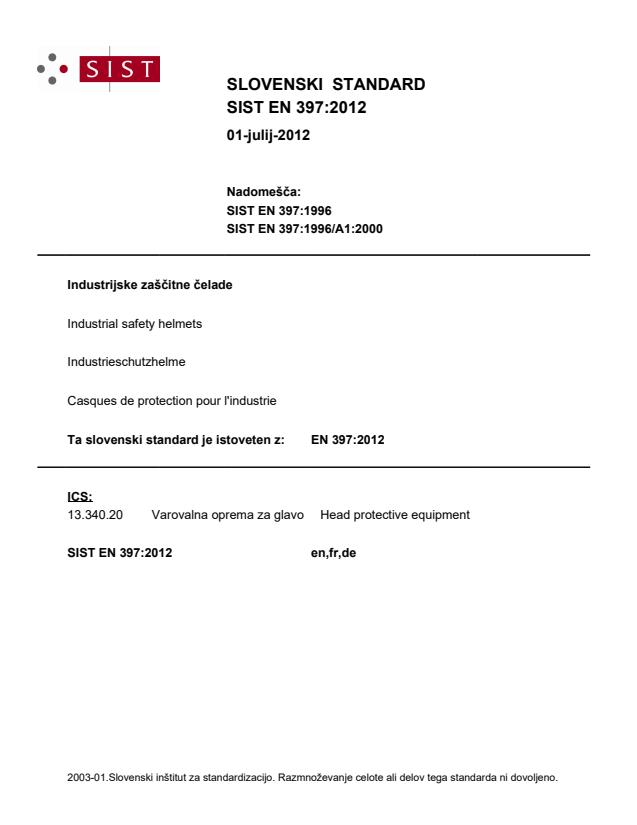
2003-01.Slovenski inštitut za standardizacijo. Razmnoževanje celote ali delov tega standarda ni dovoljeno.IndustrieschutzhelmeCasques de protection pour l'industrieIndustrial safety helmets13.340.20Varovalna oprema za glavoHead protective equipmentICS:Ta slovenski standard je istoveten z:EN 397:2012SIST EN 397:2012en,fr,de01-julij-2012SIST EN 397:2012SLOVENSKI
STANDARDSIST EN 397:1996/A1:2000SIST EN 397:19961DGRPHãþD
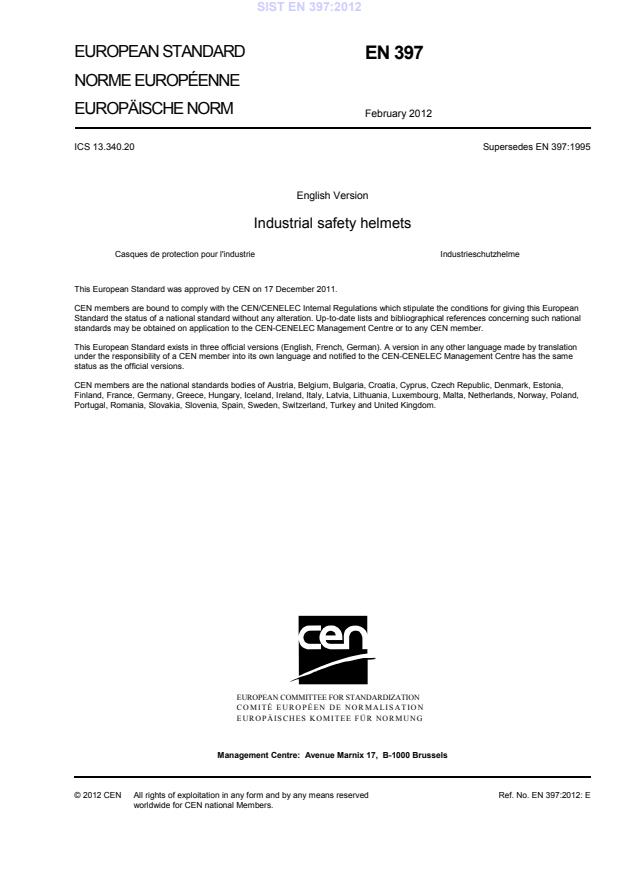
EUROPEAN STANDARD NORME EUROPÉENNE EUROPÄISCHE NORM
EN 397
February 2012 ICS 13.340.20 Supersedes EN 397:1995English Version
Industrial safety helmets
Casques de protection pour l'industrie
Industrieschutzhelme This European Standard was approved by CEN on 17 December 2011.
CEN members are bound to comply with the CEN/CENELEC Internal Regulations which stipulate the conditions for giving this European Standard the status of a national standard without any alteration. Up-to-date lists and bibliographical references concerning such national standards may be obtained on application to the CEN-CENELEC Management Centre or to any CEN member.
This European Standard exists in three official versions (English, French, German). A version in any other language made by translation under the responsibility of a CEN member into its own language and notified to the CEN-CENELEC Management Centre has the same status as the official versions.
CEN members are the national standards bodies of Austria, Belgium, Bulgaria, Croatia, Cyprus, Czech Republic, Denmark, Estonia, Finland, France, Germany, Greece, Hungary, Iceland, Ireland, Italy, Latvia, Lithuania, Luxembourg, Malta, Netherlands, Norway, Poland, Portugal, Romania, Slovakia, Slovenia, Spain, Sweden, Switzerland, Turkey and United Kingdom.
EUROPEAN COMMITTEE FOR STANDARDIZATION
COMITÉ EUROPÉEN DE NORMALISATION EUROPÄISCHES KOMITEE FÜR NORMUNG
Management Centre:
Avenue Marnix 17,
B-1000 Brussels © 2012 CEN All rights of exploitation in any form and by any means reserved worldwide for CEN national Members. Ref. No. EN 397:2012: ESIST EN 397:2012
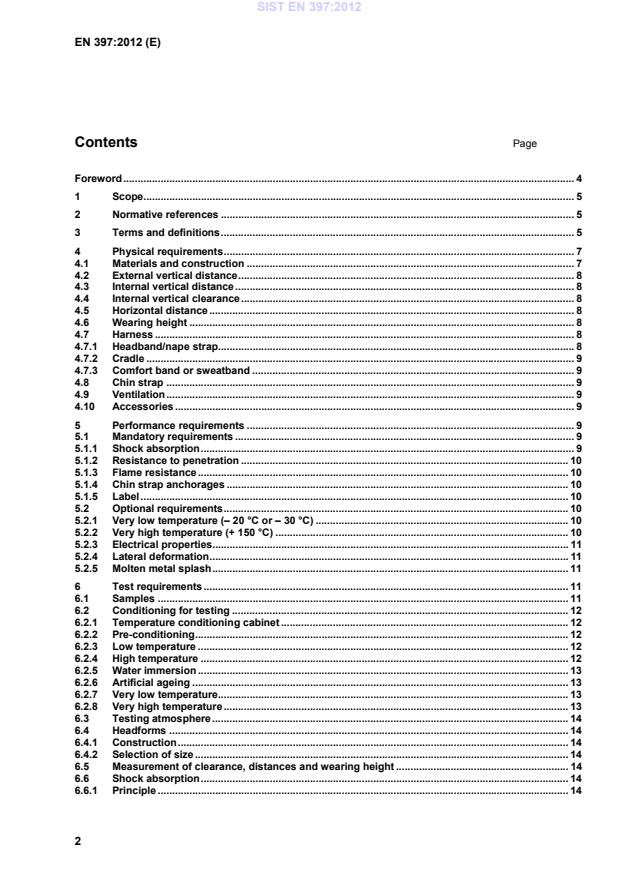
Recommendations for the materials and construction of
industrial safety helmets . 25Annex B (informative)
Alternative procedure for artificial ageing . 27Annex C (normative)
Test results — Uncertainty of measurement. 28Annex D (informative)
Significant technical changes between this European Standard and EN 397:1995 . 29Annex ZA (informative)
Relationship between this European Standard and the Essential Requirements of EU Directive 89/686/EEC Personal Protective Equipment . 30Bibliography . 31 SIST EN 397:2012
...
Questions, Comments and Discussion
Ask us and Technical Secretary will try to provide an answer. You can facilitate discussion about the standard in here.
Loading comments...