

SIST EN 2501:2001
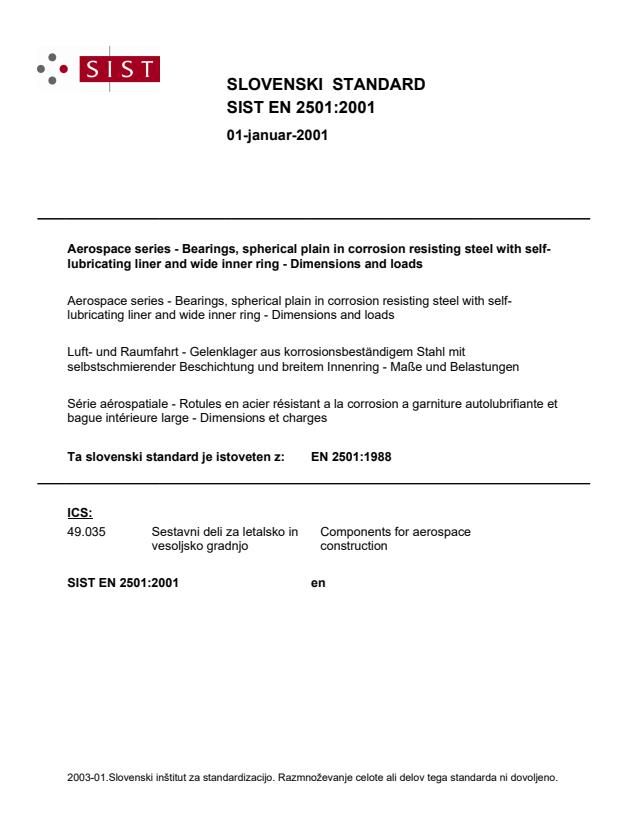
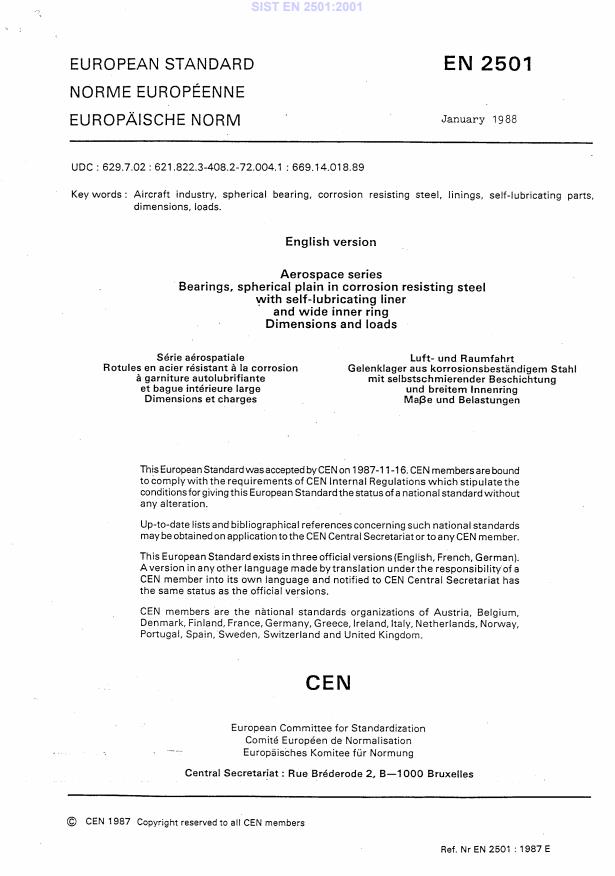
(Main)Aerospace series - Bearings, spherical plain in corrosion resisting steel with self-lubricating liner and wide inner ring - Dimensions and loads
General Information
- Abstract
This standard specifies the characteristics of bearings, spherical plain in corrosion resisting steel with self lubricating liner and wide inner ring.
They are intended, principally, for use in rod end fittings.
They shall be used in the temperature range -55 to +150 °C.
- Status
- Published
- Publication Date
- 31-Dec-2000
- Technical Committee
- SS SPL - Technical Board for the general field
- Current Stage
- 6060 - National Implementation/Publication (Adopted Project)
- Start Date
- 01-Jan-2001
- Due Date
- 01-Jan-2001
- Completion Date
- 01-Jan-2001


Overview
EN 2501:1988 (adopted as SIST EN 2501:2001) is a CEN aerospace-series standard that defines the characteristics, dimensions and load ratings for spherical plain bearings made from corrosion-resisting steel with a self-lubricating liner and a wide inner ring. The standard is intended principally for rod end fittings and specifies the usable temperature range: -55 °C to +150 °C.
Key Topics
- Bearing type and construction
- Spherical plain bearings in corrosion-resisting steel
- Integrated self-lubricating liner to reduce maintenance and improve service life
- Wide inner ring geometry for specific load and alignment requirements
- Dimensions and tolerances
- Standardised external and internal dimensions for interchangeability (as specified in the standard)
- Load characteristics
- Defined static and dynamic load capacities and relevant load conditions (bearing loads and limits)
- Operating conditions
- Specified temperature range -55 °C to +150 °C, ensuring suitability for typical aerospace environments
- Material and corrosion resistance
- Requirements for corrosion-resisting steel and compatibility with self-lubricating liners
- Application guidance
- Intended primary use in rod end fittings and other joint assemblies where spherical motion and corrosion resistance are required
Applications
EN 2501:1988 is directly applicable to aerospace designers, manufacturers and supply chains that need standardized spherical plain bearings for rod-end joints and articulating connections. Typical users include:
- Aerospace OEMs and component manufacturers specifying bearings for control linkages, actuator joints and structural rod ends
- Design and maintenance engineers who require standardised dimensions, load ratings and environmental performance
- Procurement and quality assurance teams ensuring purchased components meet aerospace interchangeability and performance requirements
- Certification bodies and inspectors verifying compliance with aerospace series bearing specifications
Related Standards
- Other aerospace-series bearing standards covering different bearing types and materials
- General bearing standards and material specifications (ISO/EN) for complementary guidance on testing, tolerances and quality control
EN 2501:1988 is a focused technical reference when selecting or specifying spherical plain bearings for corrosion-prone aerospace applications where self-lubrication, dimensional interchangeability and reliable performance across -55 °C to +150 °C are required.
Relations
- Effective Date
- 28-Jan-2026
- Effective Date
- 22-Dec-2008
Get Certified
Connect with accredited certification bodies for this standard

BUREAU VERITAS Certification Germany
Bureau Veritas certification in Germany.

Element Materials Technology
Materials testing and product certification.

AQMS Ltd.
AQMS provides ISO certification to SMEs across the UK.
Sponsored listings
Frequently Asked Questions
SIST EN 2501:2001 is a standard published by the Slovenian Institute for Standardization (SIST). Its full title is "Aerospace series - Bearings, spherical plain in corrosion resisting steel with self-lubricating liner and wide inner ring - Dimensions and loads". This standard covers: This standard specifies the characteristics of bearings, spherical plain in corrosion resisting steel with self lubricating liner and wide inner ring. They are intended, principally, for use in rod end fittings. They shall be used in the temperature range -55 to +150 °C.
This standard specifies the characteristics of bearings, spherical plain in corrosion resisting steel with self lubricating liner and wide inner ring. They are intended, principally, for use in rod end fittings. They shall be used in the temperature range -55 to +150 °C.
SIST EN 2501:2001 is classified under the following ICS (International Classification for Standards) categories: 49.035 - Components for aerospace construction. The ICS classification helps identify the subject area and facilitates finding related standards.
SIST EN 2501:2001 has the following relationships with other standards: It is inter standard links to SIST EN 4198:2009, SIST EN 2501:2001/AC1:2001. Understanding these relationships helps ensure you are using the most current and applicable version of the standard.
SIST EN 2501:2001 is available in PDF format for immediate download after purchase. The document can be added to your cart and obtained through the secure checkout process. Digital delivery ensures instant access to the complete standard document.
Standards Content (Sample)
2003-01.Slovenski inštitut za standardizacijo. Razmnoževanje celote ali delov tega standarda ni dovoljeno.Aerospace series - Bearings, spherical plain in corrosion resisting steel with self-lubricating liner and wide inner ring - Dimensions and loadsLuft- und Raumfahrt - Gelenklager aus korrosionsbeständigem Stahl mit selbstschmierender Beschichtung und breitem Innenring - Maße und BelastungenSérie aérospatiale - Rotules en acier résistant a la corrosion a garniture autolubrifiante et bague intérieure
...