

SIST EN 12965:2020+A1:2025
(Main + Amendment)Tractors and machinery for agriculture and forestry - Power take-off (PTO) drive shafts and their guards - Safety
General Information
- Abstract
This document specifies safety requirements and their verification for the design and construction of power take-off (PTO) drive shafts and their guards linking a tractor or self-propelled machinery to the first fixed bearing of recipient machinery. It describes methods for the elimination or reduction of risks which need specific requirements including such risks arising from misuse, reasonably foreseeable by the manufacturer. It is applicable only to those PTO drive shafts and guards mechanically linked to the shaft by at least two bearings.
In addition, it specifies the type of information on safe working practices to be provided by the manufacturer.
This document does not deal with:
- the guards totally covering, but not mechanically linked to, the PTO drive shaft;
- the mechanical characteristics of PTO drive shafts, overrun devices and torque limiters;
- general hazards which are dealt with in EN ISO 4254-1:2015 (see introduction).
Environmental aspects have not been considered in this document.
This document is not applicable to PTO drive shafts and their guards which are manufactured before the date of publication of this document by CEN.
- Status
- Published
- Publication Date
- 02-Apr-2025
- Technical Committee
- IMKG - Machinery for agriculture and forestry
- Current Stage
- 6060 - National Implementation/Publication (Adopted Project)
- Start Date
- 02-Apr-2025
- Due Date
- 07-Jun-2025
- Completion Date
- 03-Apr-2025
- Directive
- 2006/42/EC - Directive 2006/42/EC of the European Parliament and of the Council of 17 May 2006 on machinery, and amending Directive 95/16/EC (recast)OJ Ref: L02026/546, STANDARD TIPA C OJ Date: 13-Mar-2026

Overview
SIST EN 12965:2020+A1:2025 is a European standard specifying the safety requirements and verification methods for the design and construction of power take-off (PTO) drive shafts and their guards for use with tractors and machinery designed for agriculture and forestry. This standard aims to reduce the risk of injury by detailing safe design principles, guarding systems, and providing guidelines for the information manufacturers must supply to ensure safe operation. It is applicable specifically to PTO drive shafts and guard systems mechanically linked by at least two bearings, serving as a critical safety reference for both equipment designers and users in these industries.
Key Topics
The standard focuses on the following key areas:
- Safety Requirements: Specifies measures to reduce risks associated with the use of PTO drive shafts, including those arising from foreseeable misuse.
- Guard Design: Details the requirements for guard cones, wide-angle universal joint guards, and fully enclosed guard cones to prevent accidental contact with moving parts.
- Restraint and Locking Systems: Outlines the necessary features of restraining systems that stop guards from rotating and locking systems that prevent unintentional detachment or disengagement during operation.
- Verification Methods: Establishes test procedures and criteria for confirming compliance with the safety requirements, such as entanglement and durability tests.
- Information for Users: Mandates that manufacturers provide detailed instructions covering safe working practices, maintenance, assembly, and warnings as part of the operator’s manual and product marking.
Applications
SIST EN 12965:2020+A1:2025 applies to manufacturers, designers, and users involved with:
- Agricultural Tractors and Implements: Ensuring the safe transfer of rotational power via PTOs between tractors and recipient machines like mowers, balers, and tillers.
- Forestry Machinery: Protecting operators and bystanders from hazards associated with PTO-driven forestry equipment.
- Machinery Maintenance: Guiding service technicians and operators on proper practices for maintaining PTO drive shafts and guards, including lubrication and safe replacement procedures.
- Equipment Compliance and Safety Audits: Providing a benchmark for certifying machinery against recognized European Union safety regulations and supporting adherence to relevant directives.
By following this standard, organizations enhance operator safety, improve machinery reliability, and contribute to accident prevention in agricultural and forestry settings.
Related Standards
Consideration of related standards strengthens comprehensive equipment safety and regulatory compliance:
- EN ISO 4254-1:2015: General safety for agricultural machinery, addressing hazards not specifically covered by EN 12965.
- EN ISO 5674:2009: Requirements for the strength, durability, and wear resistance of PTO drive shaft guards.
- ISO 500-1 and ISO 500-2: Specifications for tractor PTO protection and compatibility with guard systems.
- EN ISO 12100:2010: General principles for risk assessment and risk reduction in machinery safety.
- EN 15811:2014: Fixed and interlocked guards for moving parts in agricultural machines.
- EN ISO 13857:2019: Safety distances to prevent human access to hazard zones.
Manufacturers and users are advised to refer to these standards alongside SIST EN 12965:2020+A1:2025 to ensure a holistic approach to PTO safety, legal compliance, and reducing workplace injuries.
Keywords: PTO safety, power take-off, drive shaft guards, agricultural machinery, forestry equipment, machinery safety standard, SIST EN 12965, guard systems, risk reduction, equipment compliance
Relations
- Effective Date
- 01-May-2025
- Effective Date
- 09-Feb-2026
- Effective Date
- 28-Jan-2026
- Effective Date
- 28-Jan-2026
- Effective Date
- 28-Jan-2026
- Effective Date
- 28-Jan-2026
- Effective Date
- 28-Jan-2026
- Effective Date
- 28-Jan-2026
- Effective Date
- 28-Jan-2026
- Refers
SIST EN ISO 1140:2021 - Fibre ropes - Polyamide - 3-, 4-, 8- and 12-strand ropes (ISO 1140:2021) - Effective Date
- 28-Jan-2026
- Effective Date
- 01-May-2025
Get Certified
Connect with accredited certification bodies for this standard

Control Union Certifications
Global certification for agriculture and sustainability.

ECOCERT
Organic and sustainability certification.

FSC International
Forest Stewardship Council certification.
Sponsored listings
Frequently Asked Questions
SIST EN 12965:2020+A1:2025 is a standard published by the Slovenian Institute for Standardization (SIST). Its full title is "Tractors and machinery for agriculture and forestry - Power take-off (PTO) drive shafts and their guards - Safety". This standard covers: This document specifies safety requirements and their verification for the design and construction of power take-off (PTO) drive shafts and their guards linking a tractor or self-propelled machinery to the first fixed bearing of recipient machinery. It describes methods for the elimination or reduction of risks which need specific requirements including such risks arising from misuse, reasonably foreseeable by the manufacturer. It is applicable only to those PTO drive shafts and guards mechanically linked to the shaft by at least two bearings. In addition, it specifies the type of information on safe working practices to be provided by the manufacturer. This document does not deal with: - the guards totally covering, but not mechanically linked to, the PTO drive shaft; - the mechanical characteristics of PTO drive shafts, overrun devices and torque limiters; - general hazards which are dealt with in EN ISO 4254-1:2015 (see introduction). Environmental aspects have not been considered in this document. This document is not applicable to PTO drive shafts and their guards which are manufactured before the date of publication of this document by CEN.
This document specifies safety requirements and their verification for the design and construction of power take-off (PTO) drive shafts and their guards linking a tractor or self-propelled machinery to the first fixed bearing of recipient machinery. It describes methods for the elimination or reduction of risks which need specific requirements including such risks arising from misuse, reasonably foreseeable by the manufacturer. It is applicable only to those PTO drive shafts and guards mechanically linked to the shaft by at least two bearings. In addition, it specifies the type of information on safe working practices to be provided by the manufacturer. This document does not deal with: - the guards totally covering, but not mechanically linked to, the PTO drive shaft; - the mechanical characteristics of PTO drive shafts, overrun devices and torque limiters; - general hazards which are dealt with in EN ISO 4254-1:2015 (see introduction). Environmental aspects have not been considered in this document. This document is not applicable to PTO drive shafts and their guards which are manufactured before the date of publication of this document by CEN.
SIST EN 12965:2020+A1:2025 is classified under the following ICS (International Classification for Standards) categories: 65.060.01 - Agricultural machines and equipment in general. The ICS classification helps identify the subject area and facilitates finding related standards.
SIST EN 12965:2020+A1:2025 has the following relationships with other standards: It is inter standard links to SIST EN 12965:2020, SIST ISO 500-3:2015, SIST EN ISO 4254-1:2016, SIST EN 15811:2015, SIST EN ISO 12100:2011, SIST EN ISO 9241-971:2022, SIST EN ISO 5674:2009, SIST EN ISO 4254-1:2016/A1:2022, SIST EN ISO 13857:2020, SIST EN ISO 1140:2021, SIST EN 12965:2020/kFprA1:2024. Understanding these relationships helps ensure you are using the most current and applicable version of the standard.
SIST EN 12965:2020+A1:2025 is associated with the following European legislation: EU Directives/Regulations: 2006/42/EC, EUR-PUB; Standardization Mandates: M/396. When a standard is cited in the Official Journal of the European Union, products manufactured in conformity with it benefit from a presumption of conformity with the essential requirements of the corresponding EU directive or regulation.
SIST EN 12965:2020+A1:2025 is available in PDF format for immediate download after purchase. The document can be added to your cart and obtained through the secure checkout process. Digital delivery ensures instant access to the complete standard document.
Standards Content (Sample)
SLOVENSKI STANDARD
01-maj-2025
Traktorji ter kmetijski in gozdarski stroji - Priključne gredi in njihova zaščita -
Varnost (vključno z dopolnilom A1)
Tractors and machinery for agriculture and forestry - Power take-off (PTO) drive shafts
and their guards - Safety
Traktoren und Maschinen für die Land- und Forstwirtschaft - Gelenkwellen und ihre
Schutzeinrichtungen - Sicherheit
Tracteurs et matériels agricoles et forestiers - Arbres de transmission à cardans de prise
de force et leurs protecteurs - Sécurité
Ta slovenski standard je istoveten z: EN 12965:2019+A1:2025
ICS:
65.060.01 Kmetijski stroji in oprema na Agricultural machines and
splošno equipment in general
2003-01.Slovenski inštitut za standardizacijo. Razmnoževanje celote ali delov tega standarda ni dovoljeno.
EN 12965:2019+A1
EUROPEAN STANDARD
NORME EUROPÉENNE
March 2025
EUROPÄISCHE NORM
ICS 65.060.01 Supersedes EN 12965:2019
English Version
Tractors and machinery for agriculture and forestry -
Power take-off (PTO) drive shafts and their guards - Safety
Tracteurs et matériels agricoles et forestiers - Arbres Traktoren und Maschinen für die Land- und
de transmission à cardans de prise de force et leurs Forstwirtschaft - Gelenkwellen und ihre
protecteurs - Sécurité Schutzeinrichtungen - Sicherheit
This European Standard was approved by CEN on 16 September 2019 and includes Amendment 1 approved by CEN on 29
December 2024.
CEN members are bound to comply with the CEN/CENELEC Internal Regulations which stipulate the conditions for giving this
European Standard the status of a national standard without any alteration. Up-to-date lists and bibliographical references
concerning such national standards may be obtained on application to the CEN-CENELEC Management Centre or to any CEN
member.
This European Standard exists in three official versions (English, French, German). A version in any other language made by
translation under the responsibility of a CEN member into its own language and notified to the CEN-CENELEC Management
Centre has the same status as the official versions.
CEN members are the national standards bodies of Austria, Belgium, Bulgaria, Croatia, Cyprus, Czech Republic, Denmark, Estonia,
Finland, France, Germany, Greece, Hungary, Iceland, Ireland, Italy, Latvia, Lithuania, Luxembourg, Malta, Netherlands, Norway,
Poland, Portugal, Republic of North Macedonia, Romania, Serbia, Slovakia, Slovenia, Spain, Sweden, Switzerland, Türkiye and
United Kingdom.
EUROPEAN COMMITTEE FOR STANDARDIZATION
COMITÉ EUROPÉEN DE NORMALISATION
EUROPÄISCHES KOMITEE FÜR NORMUNG
CEN-CENELEC Management Centre: Rue de la Science 23, B-1040 Brussels
© 2025 CEN All rights of exploitation in any form and by any means reserved Ref. No. EN 12965:2019+A1:2025 E
worldwide for CEN national Members.
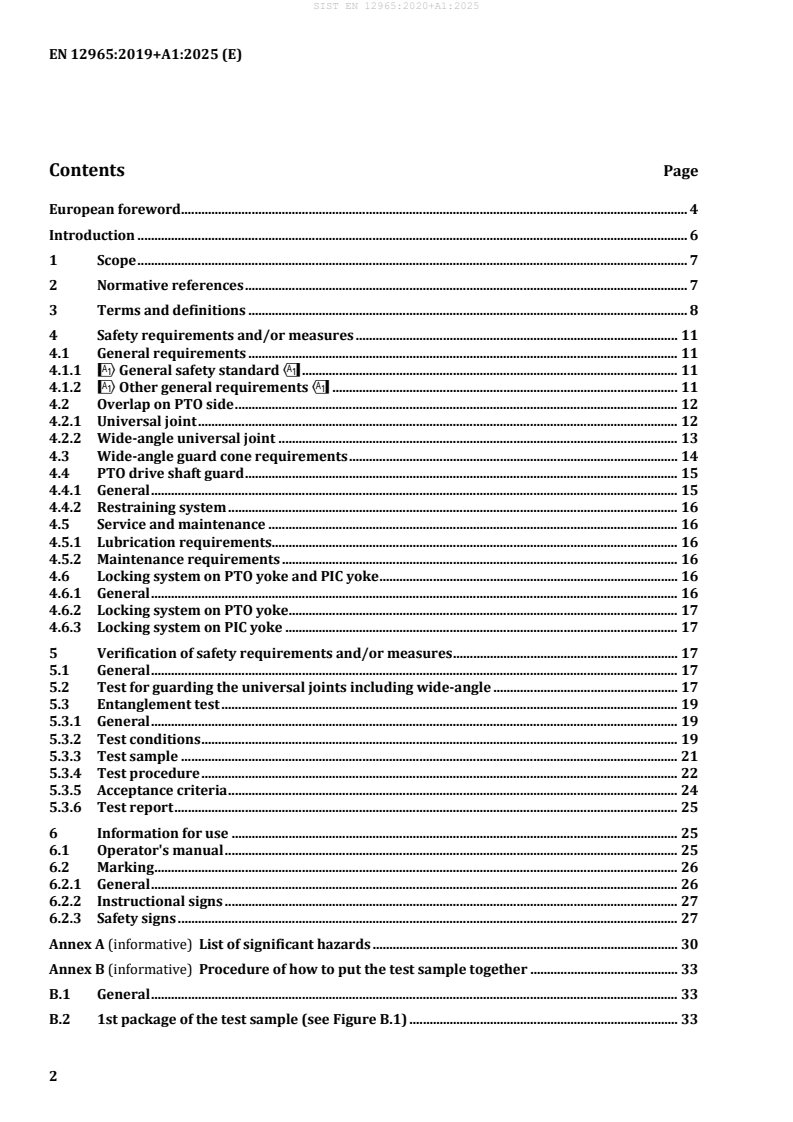
Contents Page
European foreword . 4
Introduction . 6
1 Scope . 7
2 Normative references . 7
3 Terms and definitions . 8
4 Safety requirements and/or measures . 11
4.1 General requirements . 11
4.1.1 !General safety standard" . 11
4.1.2 !Other general requirements" . 11
4.2 Overlap on PTO side . 12
4.2.1 Universal joint . 12
4.2.2 Wide-angle universal joint . 13
4.3 Wide-angle guard cone requirements . 14
4.4 PTO drive shaft guard . 15
4.4.1 General . 15
4.4.2 Restraining system . 16
4.5 Service and maintenance . 16
4.5.1 Lubrication requirements. 16
4.5.2 Maintenance requirements . 16
4.6 Locking system on PTO yoke and PIC yoke . 16
4.6.1 General . 16
4.6.2 Locking system on PTO yoke. 17
4.6.3 Locking system on PIC yoke . 17
5 Verification of safety requirements and/or measures . 17
5.1 General . 17
5.2 Test for guarding the universal joints including wide-angle . 17
5.3 Entanglement test . 19
5.3.1 General . 19
5.3.2 Test conditions . 19
5.3.3 Test sample . 21
5.3.4 Test procedure . 22
5.3.5 Acceptance criteria . 24
5.3.6 Test report . 25
6 Information for use . 25
6.1 Operator's manual . 25
6.2 Marking . 26
6.2.1 General . 26
6.2.2 Instructional signs . 27
6.2.3 Safety signs . 27
Annex A (informative) List of significant hazards . 30
Annex B (informative) Procedure of how to put the test sample together . 33
B.1 General . 33
B.2 1st package of the test sample (see Figure B.1) . 33
B.3 2nd package of the test sample (see Figure B.2) . 34
B.4 3rd package of the test sample (see Figure B.3) . 35
B.5 Putting together the three packages to a test sample . 35
Annex ZA (informative) Relationship between this European Standard and the Essential
Requirements of EU Directive 2006/42/EC aimed to be covered. 38
Bibliography . 41
European foreword
This document (EN 12965:2019+A1:2025) has been prepared by Technical Committee CEN/TC 144
“Tractors and machinery for agriculture and forestry”, the secretariat of which is held by AFNOR.
This European Standard shall be given the status of a national standard, either by publication of an
identical text or by endorsement, at the latest by September 2025, and conflicting national standards
shall be withdrawn at the latest by September 2025.
Attention is drawn to the possibility that some of the elements of this document may be the subject of
patent rights. CEN shall not be held responsible for identifying any or all such patent rights.
This document supersedes !EN 12965:2019"
The main changes [in EN 12965:2019] compared to the previous edition [EN 12965:2003+A2:2009] are
as follows:
— precision of the general requirements;
— addition of PTO type 4;
— precision of the requirements for the restraining system;
— addition and precision of the requirements for service and maintenance;
— addition of requirements for the locking system;
— addition of an entanglement test;
— addition of new pictogram required to highlight compatibility of guarding systems of PTO drive
shaft with tractor and machinery.
The following technical modifications have been made [in EN 12965:2019 for
— Modification to subclause 4.1;
— Modification to subclause 4.2.1;
— Modification to subclause 4.2.2.
These modifications require that also on PIC side, the guard covers the transmission to the ends of the
inner jaws in the case of simple universal joints and at least to the centre of the outer joint or joints in
the case of wide-angle universal joints.
This document includes Amendment 1 approved by CEN on 29 December 2024.
The start and finish of text introduced or altered by amendment is indicated in the text by tags !".
This document has been prepared under a standardization request addressed to CEN by the European
Commission. The Standing Committee of the EFTA States subsequently approves these requests for its
Member States.
For the relationship with EU Legislation, see informative Annex ZA, which is an integral part of this
document.
Any feedback and questions on this document should be directed to the users’ national standards body.
A complete listing of these bodies can be found on the CEN website.
According to the CEN-CENELEC Internal Regulations, the national standards organisations of the
following countries are bound to implement this European Standard: Austria, Belgium, Bulgaria,
Croatia, Cyprus, Czech Republic, Denmark, Estonia, Finland, France, Germany, Greece, Hungary, Iceland,
Ireland, Italy, Latvia, Lithuania, Luxembourg, Malta, Netherlands, Norway, Poland, Portugal, Republic of
North Macedonia, Romania, Serbia, Slovakia, Slovenia, Spain, Sweden, Switzerland, Türkiye and the
United Kingdom.
Introduction
This document is a type C standard as defined in EN ISO 12100:2010.
The machinery concerned and the extent to which hazards, hazardous situations and events are
covered are indicated in the scope of this document.
When provisions of this type C standard are different from those which are stated in type A or B
standards, the provisions of this type C standard take precedence over the provisions of the other
standards, for machines that have been designed and built according to the provisions of this type C
standard.
Hazards that are common to agricultural machines (self-propelled, mounted, semi-mounted and
trailed) are dealt with in EN ISO 4254-1:2015. EN 12965 provides requirements for power take-off
(PTO) drive shafts in addition to those of EN ISO 4254-1.
This document is of relevance, in particular, for the following stakeholder groups representing the
market players with regard to machinery safety:
— machine manufacturers (small, medium and large enterprises);
— health and safety bodies (regulators, accident prevention organizations, market surveillance, etc.).
Others can be affected by the level of machinery safety achieved with the means of the document by the
above-mentioned stakeholder groups:
— machine users/employers (small, medium and large enterprises);
— machine users/employees (e.g. trade unions, organizations for people with special needs);
— service providers, e.g. for maintenance (small, medium and large enterprises);
— consumers (in case of machinery intended for use by consumers).
The above-mentioned stakeholder groups have been given the possibility to participate at the drafting
process of this document.
1 Scope
This document specifies safety requirements and their verification for the design and construction of
power take-off (PTO) drive shafts and their guards linking a tractor or self-propelled machinery to the
first fixed bearing of recipient machinery. It describes methods for the elimination or reduction of risks
that need specific requirements including such risks arising from misuse, reasonably foreseeable by the
manufacturer. It is applicable only to those PTO drive shafts and guards mechanically linked to the shaft
by at least two bearings. When used with compatible guards for power take-off (PTO) of the tractor
(master shield) or self-propelled machine and the power input connection (PIC) of the power receiving
machine, the requirements for power take-off drive shafts are complete.
NOTE 1 Fully enclosing PIC guard cones alone provide full protection.
NOTE 2 ISO 500-1 and ISO 500-2 give requirements for the guarding of tractor power take-offs (PTO) and
ISO 4254-1 gives requirements for power input connections (PIC) of power receiving machinery that are
compatible with the guarding required by this document.
In addition, it specifies the type of information on safe working practices to be provided by the
manufacturer.
This document does not deal with:
— the guards totally covering, but not mechanically linked to, the PTO drive shaft;
— the mechanical characteristics of PTO drive shafts, overrun devices and torque limiters;
— general hazards which are dealt with in EN ISO 4254-1:2015 (see introduction).
Environmental aspects have not been considered in this document.
This document is not applicable to PTO drive shafts and their guards that are manufactured before the
date of publication of this document by CEN.
2 Normative references
The following documents are referred to in the text in such a way that some or all of their content
constitutes requirements of this document. For dated references, only the edition cited applies. For
undated references, the latest edition of the referenced document (including any amendments) applies.
EN 15811:2014, Agricultural machinery — Fixed guards and interlocked guards with or without guard
locking for moving transmission parts (ISO/TS 28923:2012 modified)
!EN ISO 1140:2021, Fibre ropes — Polyamide — 3-, 4-, 8- and 12-strand ropes (ISO 1140:2021)"
!EN ISO 4254-1:2015", Agricultural machinery — Safety — Part 1: General requirements
(ISO 4254-1:2013)
EN ISO 5674:2009, Tractors and machinery for agriculture and forestry — Guards for power take-off
(PTO) drive-shafts — Strength and wear tests and acceptance criteria (ISO 5674:2004, corrected version
2005-07-01)
EN ISO 12100:2010, Safety of machinery — General principles for design — Risk assessment and risk
reduction (ISO 12100:2010)
As impacted by EN ISO 4254-1:2015/A1:2021.
!EN ISO 13857:2019, Safety of machinery — Safety distances to prevent hazard zones being reached by
upper and lower limbs (ISO 13857:2019)"
ISO 500-3:2014, Agricultural tractors — Rear-mounted power take-off types 1, 2, 3 and 4 — Part 3: Main
PTO dimensions and spline dimensions, location of PTO
!ISO 11684:2023, Tractors, machinery for agriculture and forestry, powered lawn and garden
equipment — Safety labels — General principles"
3 Terms and definitions
For the purposes of this document, the following terms and definitions apply.
ISO and IEC maintain terminology databases for use in standardization at the following addresses:
— ISO Online browsing platform: available at httpss://www.iso.org/obp
— IEC Electropedia: available at https://www.electropedia.org/
3.1
power take-off (PTO) drive shaft
assembly consisting of two joints, telescopic members and a guard which is mechanically linked to the
shaft by at least two bearings used to transmit rotational power from the PTO of a tractor or self-
propelled machine to the PIC of an implement
Note 1 to entry: See Figure 1 - only shown as an example.
3.2
restraining system
part of the PTO drive shaft guard which prevents rotation of the guard when the PTO drive shaft rotates
Note 1 to entry: See Figure 1, key 28 - only shown as an example.
3.3
universal joint
mechanical device which can transmit torque and/or rotational motion
Note 1 to entry: See Figure 1, key 12 - only shown as an example.
3.4
wide-angle universal joint
mechanical device which can transmit torque and/or rotational motion at a constant velocity at fixed or
varying angles, generally equal or higher than 50°
Note 1 to entry: See Figure 1, key 16 - only shown as an example.
3.5
overrun device
device that permits the transmission of motion only in one direction (from the tractor towards the
recipient machinery)
Note 1 to entry: It is normally used with recipient machine having high value inertia.
3.6
torque limiter
device that cuts or limits the transmission of motion between tractor and recipient machinery, when
the torque reaches a prefixed value
Key
1 power take off shaft (PTO) 15 end of double yoke of outer joint
2 power-input connection (PIC) 16 wide-angle universal joint
3 PTO yoke bore 17 centre of articulation of wide-angle universal joint
4 PIC yoke bore 18 centre of outer joint
5 PTO yoke 19 guard cone
6 PIC yoke 20 wide angle guard cone
7 journal cross-assembly 21 guard bearing
8 inner yoke 22 guard tube
9 inner telescopic member 23 separate guard of wide angle universal joint
10 outer telescopic member 24 PTO drive shaft guard
11 end of inner yoke of universal joint 25 PTO drive shaft guard (in case of wide-angle PTO
drive shaft)
12 universal joint 26 PIC guard
13 PTO drive shaft, closed and extended length 27 locking system
14 double yoke 28 restraining system (as an example)
Figure 1 — Example of PTO drive shaft and guard
3.7
locking system
device on the PTO yoke and PIC yoke which allows locking of the PTO drive shaft mechanically to the
tractor’s PTO and to the PIC of the recipient machinery
Note 1 to entry: See Figure 1, key 27 - only shown as an example.
3.8
guard cone
guard of the inner yokes of the PTO drive shaft, integrally fixed to the guard tubes of the inner and outer
telescopic members of the PTO drive shaft
Note 1 to entry: See Figure 1, key 19 - only shown as an example.
3.9
wide-angle guard cone
guard of the wide-angle universal joint of the PTO drive shaft
Note 1 to entry: See Figure 1, key 20 – only shown as an example.
3.10
fully enclosed guard cone
guard on PIC side of the PTO drive shaft covering the universal or wide-angle universal joint, including
its locking system and the PIC of the recipient machinery, and which also includes other devices, if any
(e.g. torque limiter, overrun device)
Note 1 to entry: See Figure 2, key 4 – only shown as an example.
Key
1 implement 4 fully enclosed guard cone
2 PIC 5 clamping device on implement
3 universal joint
Figure 2 — Example of fully enclosed guard cone
3.11
PTO drive shaft guard
guard attached to the PTO drive shaft by bearings, designed to be able to be held stationary by a
restraining system while the shaft is rotating
Note 1 to entry: See Figure 1, keys 24 and 25 – only shown as an example.
4 Safety requirements and/or measures
4.1 General requirements
4.1.1 !General safety standard
The machine shall be designed according to the principles of EN ISO 12100:2010 for hazards relevant
but not significant which are not dealt with by this document."
4.1.2 !Other general requirements"
The PTO drive shafts and their guards shall comply with the safety requirements and/or protective
measures of this clause. !deleted text"
Concerning the guards between the outer ends of the guard cones, unless otherwise specified in this
!document", all the apertures and safety distances shall comply with the requirements given in
!EN ISO 13857:2019", Table 4.
The list of significant hazards dealt with in this standard is given in Annex A.
PTO drive shaft guards, together with PTO master shield (referred in ISO 500-1) and PIC guard, shall be
designed to prevent contact with the moving components of the PTO drive shaft when the PTO drive
shaft is operated in accordance with the operator's manual and the PTO drive shaft is connected in the
appropriate way between a tractor or self-propelled machine and a recipient machine.
The outside parts of the guard shall not turn with the PTO drive shaft.
If there is
— a torque limiter and/or an overrun device
or
— the use of a tool is required to lock the PIC yoke (e.g. flange yoke, clamp yoke)
on the PTO drive shaft it shall be positioned only on the PIC side of the PTO drive shaft. Relevant
marking shall be provided (see 6.2.2).
If PTO drive shaft guards have movable parts, they shall have a system to lock the parts of the PTO drive
shaft guard which can only be released by using a tool (in order to make opening an intentional action)
and which lock automatically without the use of a tool.
In the operator's manual (see 6.1), the manufacturer shall provide recommendations for proper
application and any information limiting the use of the PTO drive shaft and its guards (see 6.1, d),
including operating data and warnings against misuse. Information about requirements of the support
(e.g. form, type, position etc.) for the PTO drive shaft (see 6.1, g) and the restraining system (see 6.1, k),
shall also be provided. A safety sign illustrating the need to read the operator's manual shall be
provided on the PTO drive shaft guard (see 6.2.3).
Information on how to modify the PTO drive shaft length shall be included in the operator's manual (see
6.1 b).
!The PTO drive shaft guard cone shall cover the PTO drive shaft at least up to the end of the inner
yoke of the universal joint.
For wide-angle universal joints, the PTO drive shaft shall be guarded in the straight-line position at least
up to the end of the outer joint of the double yoke.
NOTE Owing to great joint angle requirements in combination with the use of torque limiters, overrun
devices or other similar devices on the PIC side of the PTO drive shaft, it is not always possible to cover the
primary PTO drive shaft at least up to the end of the inner yoke of the universal joint."
4.2 Overlap on PTO side
NOTE For overlap of the PTO drive shaft guard with the power input connection (PIC) guard see
EN ISO 4254-1:2015, 6.4.1.
4.2.1 Universal joint
!In order to ensure sufficient overlap between tractor master shield and PTO drive shaft guard
(Figure 1), the values for dimension c, distance between axis of locking system and end of guard cone as
shown in Figure 3, shall be as given in Table 1."
The dimension, c, shall be measured in straight line position of the PTO drive shaft.
Table 1 — Dimension c for PTO drive shaft
Dimensions in millimetres
PTO type c
according to !ISO 500-3:2014" max.
1 80
2 80
3 90
4 110
NOTE The overlap of minimum 50 mm of the PTO drive shaft guard with the PTO master shield results from
ISO 500-1 and ISO 500-3.
Key
1 master shield of tractor power take-off (PTO)
2 axis of locking system shield of tractor PTO
Figure 3 — Example of guarding of universal joints on PTO drive shafts on tractor side
4.2.2 Wide-angle universal joint
!In order to ensure sufficient overlap between tractor master shield and PTO drive shaft guard
(Figure 1), the values for dimension c, distance between axis of locking system and end of wide-angle
guard cone as shown in Figure 4, as given in Table 1 shall be met.
The dimension, c, shall be measured in straight line position of the PTO drive shaft."
Dimensions in millimetres
Key
1 master shield of tractor power take-off (PTO)
2 axis of the locking system of tractor PTO
Figure 4 — Example of guarding of wide-angle universal joints on PTO drive shafts on tractor
side
4.3 Wide-angle guard cone requirements
When a wide-angle universal joint is guarded by means of a separate guard independent of the guard of
the other parts of the PTO drive shaft (Figure 1), the guarding of this wide-angle joint shall be ensured
by taking all of the following measures.
— At the maximum angular position of the rotating PTO drive shaft, as specified by the manufacturer
in the operator’s manual, the opening resulting from the angular movement shall not be more than
30 mm (see Figure 5). This requirement shall be verified by the use of a rod: if the rod can be
inserted into the opening without being in contact with the guards on both sides then the opening
is too large to be acceptable.
— There shall be an overlap between the wide angle guard cone and the guard cone, viewed
perpendicular to the axis of the PTO drive shaft assembly when in the maximum angular position
measured perpendicularly to the plane passing through the end of the guard cone (see Figure 5).
— The overlap between the wide angle guard cone and the guard cone shall be at least 50 mm, with
the PTO drive shaft in the straight-line position (see Figure 4). Where the opening between the
guard cone and the wide angle guard cone does not exceed 4 mm at any angular position up to the
maximum, then this 50 mm overlap may be reduced to 10 mm in the straight-line position.
Dimensions in millimetres
Key
1 maximum joint angle
2 checking gauge ∅ 30
Figure 5 — Example of guarding of wide angle universal joint at maximum joint angle
4.4 PTO drive shaft guard
4.4.1 General
The PTO drive shaft guard shall comply with the acceptance criteria according to
!EN ISO 5674:2009".
The PTO drive shaft guard shall be designed so that it cannot be detached from the PTO drive shaft
without the use of a tool.
By design, it shall be possible for the user to replace the PTO drive shaft guard by following the
instructions given in the operator's manual (see 6.1, r).
The dimensions of the cone guarding the universal joints shall be such that the cone will not be
damaged by contact with the master shield of the power take-off of the tractor or self-propelled
machinery when the PTO drive shaft and its guard are at the maximum angular position given by the
manufacturer in the operator's manual. To verify this requirement a test shall be performed according
to 5.2.
A fully enclosed guard cone on the PIC side of the PTO drive shaft may replace the PIC guard.
The operator's manual shall include clear advice that the PTO drive shaft and its guards shall not be
used as a step (see 6.1, m).
4.4.2 Restraining system
A restraining system shall be provided (see Figure 1, key 28) to prevent all parts of the PTO drive shaft
guard rotating with the shaft. The member(s) of the restraining system shall be securely attached to the
guard and provided with a fitting that will enable them to be attached to a stationary part of the
mac
...