

SIST EN 12728:2001
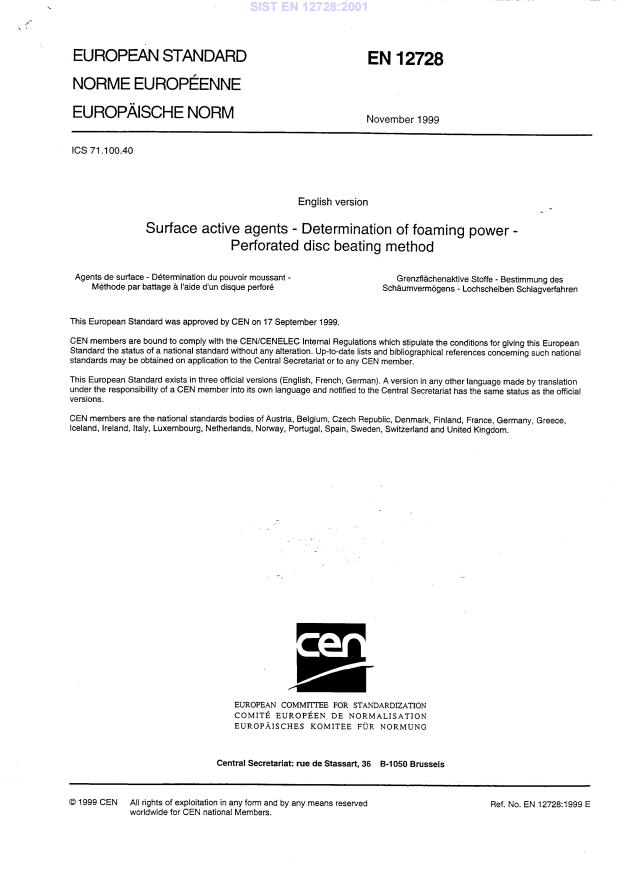
(Main)Surface active agents - Determination of foaming power - Perforated disc beating method
General Information
- Abstract
This European Standard specifies a test method for the determination of foaming power of surface active agents diluted in water with different degree of calcium hardness and a content of surface active agent less than or equal to 1 % (m/m).
- Status
- Published
- Publication Date
- 31-Dec-2000
- Technical Committee
- KDS - Cosmetics, chemical disinfectants and surface active agents
- Current Stage
- 6060 - National Implementation/Publication (Adopted Project)
- Start Date
- 01-Jan-2001
- Due Date
- 01-Jan-2001
- Completion Date
- 01-Jan-2001

Overview
EN 12728:1999 (CEN) defines a standardized laboratory test - the perforated disc beating method - for the determination of the foaming power of surface active agents (surfactants). The method applies to aqueous dilutions with varying degrees of calcium hardness and is intended for samples containing surface active agent ≤ 1 % (m/m). This European Standard provides a reproducible procedure to assess foam generation under controlled conditions so that surfactant foaming behaviour can be compared across products and laboratories.
Key Topics
- Scope and applicability: Test limited to surfactant solutions with concentrations up to 1% (m/m) and to water of different calcium hardness levels.
- Test principle: Use of a perforated disc beating device to generate foam; foaming power is assessed from the foam produced under the specified test conditions.
- Controlled variables: Emphasis on water hardness (calcium content) as a factor that affects foaming, and consistent sample concentration to ensure comparable results.
- Expected content of the standard: As with typical CEN test methods, the standard will specify apparatus, reagents, sample preparation, test procedure, and presentation of results to support reproducibility and comparability.
- Result expression: Foaming power is expressed in a standardized way so laboratories can report and compare outcomes (method details are in the standard text).
Applications
- Quality control: Routine QC testing of detergents, household cleaners, shampoos and other formulated products where foam performance is important.
- Product development and R&D: Comparing foaming characteristics of surfactant candidates and optimizing formulations with respect to water hardness.
- Comparative testing: Benchmarking competing surfactants or formulations under controlled hardness conditions.
- Regulatory and specification compliance: Providing standardized data to support product specifications, claims, or regulatory dossiers.
- Testing laboratories: Analytical and contract test labs use the method to produce comparable foaming data for clients.
Who should use EN 12728
- Surfactant and detergent manufacturers
- Personal-care formulators
- QC and analytical laboratories
- Research institutions studying foam behavior
- Standards bodies and procurement teams specifying foaming tests
Related Standards
- Other CEN/ISO test methods for surfactants and foam characterization (see CEN/ISO catalogs for specific references). EN 12728 complements broader surfactant testing standards by focusing specifically on foaming power using the perforated disc beating method.
Keywords: EN 12728, surface active agents, foaming power, perforated disc beating method, surfactant testing, calcium hardness, foaming test, CEN.
Relations
- Effective Date
- 25-Aug-2026
- Effective Date
- 28-Jan-2026
- Effective Date
- 28-Jan-2026
- Effective Date
- 28-Jan-2026
- Effective Date
- 28-Jan-2026
- Effective Date
- 28-Jan-2026
- Effective Date
- 09-Feb-2026
- Effective Date
- 28-Jan-2026
- Effective Date
- 28-Jan-2026
- Effective Date
- 28-Jan-2026
- Referred By
SIST EN ISO 7369:2004 - Pipework - Metal hoses and hose assemblies - Vocabulary (ISO 7369:2004) - Effective Date
- 28-Jan-2026
- Effective Date
- 28-Jan-2026
- Effective Date
- 28-Jan-2026
- Effective Date
- 28-Jan-2026
- Effective Date
- 28-Jan-2026
Get Certified
Connect with accredited certification bodies for this standard

ECOCERT
Organic and sustainability certification.

Eurofins Food Testing Global
Global leader in food, environment, and pharmaceutical product testing.

Intertek Bangladesh
Intertek certification and testing services in Bangladesh.
Sponsored listings
Frequently Asked Questions
SIST EN 12728:2001 is a standard published by the Slovenian Institute for Standardization (SIST). Its full title is "Surface active agents - Determination of foaming power - Perforated disc beating method". This standard covers: This European Standard specifies a test method for the determination of foaming power of surface active agents diluted in water with different degree of calcium hardness and a content of surface active agent less than or equal to 1 % (m/m).
This European Standard specifies a test method for the determination of foaming power of surface active agents diluted in water with different degree of calcium hardness and a content of surface active agent less than or equal to 1 % (m/m).
SIST EN 12728:2001 is classified under the following ICS (International Classification for Standards) categories: 71.100.40 - Surface active agents. The ICS classification helps identify the subject area and facilitates finding related standards.
SIST EN 12728:2001 has the following relationships with other standards: It is inter standard links to SIST ISO 607:1995, SIST EN 14960:2007, SIST EN 12829:2011, SIST-TS CEN ISO/TS 15877-7:2009, SIST EN ISO 862:1997, SIST EN ISO 3696:1998, SIST EN 60534-3-2:2002, SIST-TS CEN/TS 17035:2018, SIST EN ISO 10806:2004, SIST EN 215:2004, SIST EN ISO 7369:2004, SIST EN ISO 15749-2:2004, SIST EN 13942:2009, SIST EN 12178:2004, SIST EN 12284:2004. Understanding these relationships helps ensure you are using the most current and applicable version of the standard.
SIST EN 12728:2001 is available in PDF format for immediate download after purchase. The document can be added to your cart and obtained through the secure checkout process. Digital delivery ensures instant access to the complete standard document.
Standards Content (Sample)
2003-01.Slovenski inštitut za standardizacijo. Razmnoževanje celote ali delov tega standarda ni dovoljeno.UFHYGrenzflächenaktive Stoffe - Bestimmung des Schäumvermögens - Lochscheiben SchlagverfahrenAgents de surface - Détermination du pouvoir moussant - Méthode par battage a l'aide d'un disque perforéSurface active agents - Determination of foaming power - Perforated disc beating method71.100.40Površinsko aktivna sredstvaSurface active agentsIC
...