


kSIST FprEN ISO 1158:2025
(Main)Plastics - Vinyl chloride homopolymers and copolymers - Determination of chlorine content (ISO/FDIS 1158:2025)
Plastics - Vinyl chloride homopolymers and copolymers - Determination of chlorine content (ISO/FDIS 1158:2025)
This document specifies two methods for the determination of the chlorine content of homopolymers and copolymers of vinyl chloride, free from plasticizers or additives, namely:
method A (combustion in a bomb);
method B (combustion in a flask).
Kunststoffe - Vinylchloridhomopolymere und Copolymere - Bestimmung des Chlorgehalts (ISO/FDIS 1158:2025)
Plastiques - Homopolymères et copolymères de chlorure de vinyle - Dosage du chlore (ISO/FDIS 1158:2025)
Le présent document spécifie deux méthodes pour le dosage du chlore dans les homopolymères et les copolymères de chlorure de vinyle ne contenant ni plastifiants ni additifs, à savoir:
méthode A (combustion dans une bombe);
méthode B (combustion dans un ballon).
Polimerni materiali - Homo- in kopolimeri vinilklorida - Določevanje klora (ISO/FDIS 1158:2025)
General Information
- Status
- Not Published
- Public Enquiry End Date
- 30-Mar-2025
- Technical Committee
- IPMA - Polimer materials and products
- Current Stage
- 5020 - Formal vote (FV) (Adopted Project)
- Start Date
- 19-Dec-2025
- Due Date
- 06-Feb-2026
- Completion Date
- 23-Dec-2025
Relations
- Effective Date
- 08-Nov-2023
Overview
The kSIST FprEN ISO 1158:2025:2025 standard specifies standardized methods for the determination of chlorine content in vinyl chloride homopolymers and copolymers. These plastics, commonly used in various industrial applications, must be accurately characterized to ensure quality and compliance. This updated ISO draft provides two validated combustion-based analytical techniques-Method A (combustion in a bomb) and Method B (combustion in a flask)-to precisely measure chlorine levels in these polymers. The standard excludes plasticizers and additives to ensure consistent results.
Developed under the oversight of ISO/TC 61/SC 9, this standard also serves as a reference method for other chlorine-containing polymer materials such as chlorinated polyethylene and polyvinyl chloride. The latest revision enhances methodological accuracy and safety, reflecting decades of progress since the 1988 edition.
Key Topics
Scope and Application
Covers homopolymers and copolymers of vinyl chloride free from plasticizers and additives. Also applicable as a reference for related chlorine-containing polymers.Analytical Methods
- Method A: Combustion Bomb – Using sodium peroxide in a sealed steel bomb to oxidize the sample, followed by titration.
- Method B: Oxygen Flask – Combustion in an oxygen-flushed flask with a platinum wire ignition system, followed by titration.
Reagents and Apparatus
Use of analytical-grade reagents such as silver nitrate for titration, sodium peroxide, and nitric acid solutions. The apparatus includes combustion bombs, specialized flasks, potentiometric or Volhard titration equipment, drying ovens, and precision balances.Procedural Details
Includes sample preparation (drying and size reduction), controlled combustion, titration endpoint determination (via potentiometric or Volhard methods), and blank testing to ensure accuracy.Safety Precautions
Emphasizes operator protection during combustion processes due to the handling of reactive chemicals and high temperatures.Precision and Reporting
Defines accuracy requirements for weighing and titration, and mandates detailed documentation of test conditions and results in the test report.
Applications
The determination of chlorine content in vinyl chloride polymers is critical in:
- Quality control and assurance in manufacturing PVC and related thermoplastics
- Regulatory compliance and certification requiring chlorine content verification in plastics destined for electrical insulation, packaging, and construction materials
- Research and development for polymer formulation and stability studies
- Material specification and validation in industries such as automotive, electronics, and healthcare where precise chlorine levels influence performance and safety
- Reference testing in labs performing comparative analysis on chlorine-containing plastic compounds
Accurate chlorine determination helps optimize production processes, ensure product consistency, and mitigate environmental impacts by controlling chlorine-based emissions.
Related Standards
- ISO 3696: Water for Analytical Laboratory Use – Specifies the purity requirements for water used in chemical analysis.
- ISO 6353-1: Reagents for Chemical Analysis – Provides guidance on general test methods for analytical reagents.
- ISO 1158:1988 – The previous edition of this standard, now superseded by the 2025 revision.
- Other ISO/TC 61 Plastics Standards – Related thermoplastics and polymer testing methodologies developed by the same technical committee.
By aligning testing practices with ISO/DIS 1158:2025, laboratories and industries can ensure adherence to internationally accepted methods, enhancing interoperability and product reliability across global markets.
Keywords: vinyl chloride polymers, chlorine content determination, plastics testing, combustion methods, analytical chemistry, potentiometric titration, Volhard titration, thermoplastic polymers, ISO 1158, PVC quality control, chlorine analysis in polymers.

Get Certified
Connect with accredited certification bodies for this standard

Smithers Quality Assessments
US management systems and product certification.

DIN CERTCO
DIN Group product certification.
Sponsored listings
Frequently Asked Questions
kSIST FprEN ISO 1158:2025 is a draft published by the Slovenian Institute for Standardization (SIST). Its full title is "Plastics - Vinyl chloride homopolymers and copolymers - Determination of chlorine content (ISO/FDIS 1158:2025)". This standard covers: This document specifies two methods for the determination of the chlorine content of homopolymers and copolymers of vinyl chloride, free from plasticizers or additives, namely: method A (combustion in a bomb); method B (combustion in a flask).
This document specifies two methods for the determination of the chlorine content of homopolymers and copolymers of vinyl chloride, free from plasticizers or additives, namely: method A (combustion in a bomb); method B (combustion in a flask).
kSIST FprEN ISO 1158:2025 is classified under the following ICS (International Classification for Standards) categories: 83.080.20 - Thermoplastic materials. The ICS classification helps identify the subject area and facilitates finding related standards.
kSIST FprEN ISO 1158:2025 has the following relationships with other standards: It is inter standard links to SIST EN ISO 1158:2000. Understanding these relationships helps ensure you are using the most current and applicable version of the standard.
kSIST FprEN ISO 1158:2025 is available in PDF format for immediate download after purchase. The document can be added to your cart and obtained through the secure checkout process. Digital delivery ensures instant access to the complete standard document.
Standards Content (Sample)
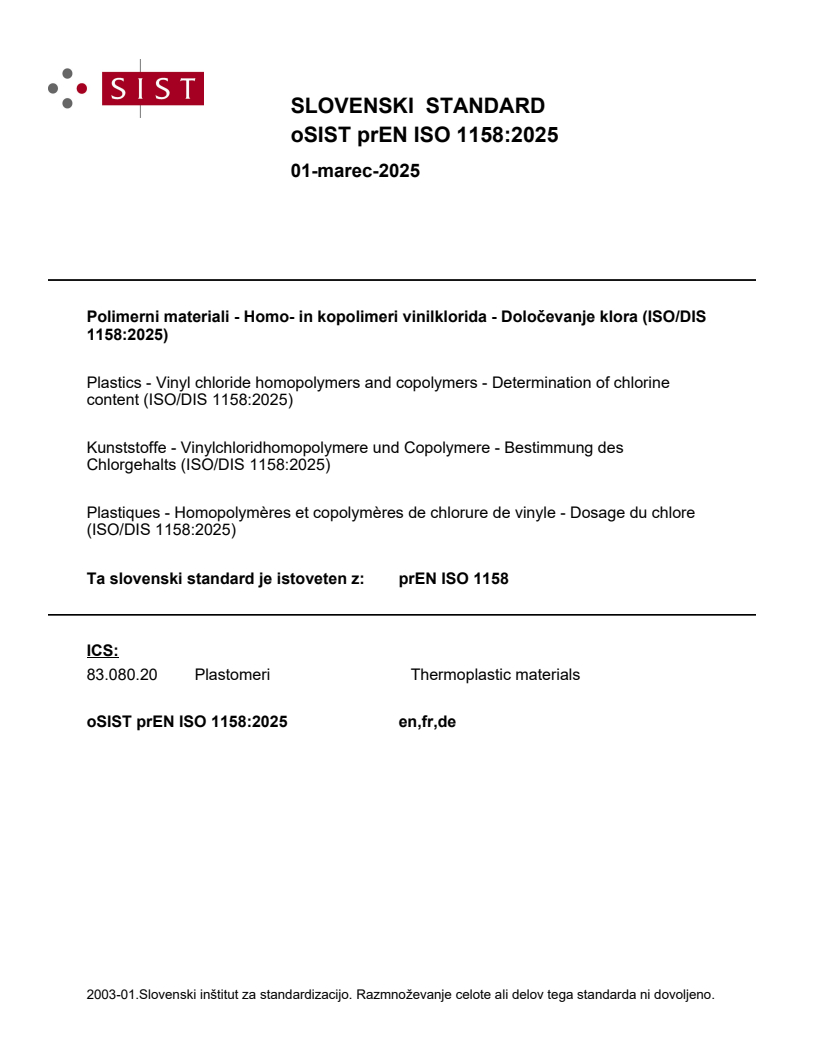
SLOVENSKI STANDARD
oSIST prEN ISO 1158:2025
01-marec-2025
Polimerni materiali - Homo- in kopolimeri vinilklorida - Določevanje klora (ISO/DIS
1158:2025)
Plastics - Vinyl chloride homopolymers and copolymers - Determination of chlorine
content (ISO/DIS 1158:2025)
Kunststoffe - Vinylchloridhomopolymere und Copolymere - Bestimmung des
Chlorgehalts (ISO/DIS 1158:2025)
Plastiques - Homopolymères et copolymères de chlorure de vinyle - Dosage du chlore
(ISO/DIS 1158:2025)
Ta slovenski standard je istoveten z: prEN ISO 1158
ICS:
83.080.20 Plastomeri Thermoplastic materials
oSIST prEN ISO 1158:2025 en,fr,de
2003-01.Slovenski inštitut za standardizacijo. Razmnoževanje celote ali delov tega standarda ni dovoljeno.
oSIST prEN ISO 1158:2025
oSIST prEN ISO 1158:2025
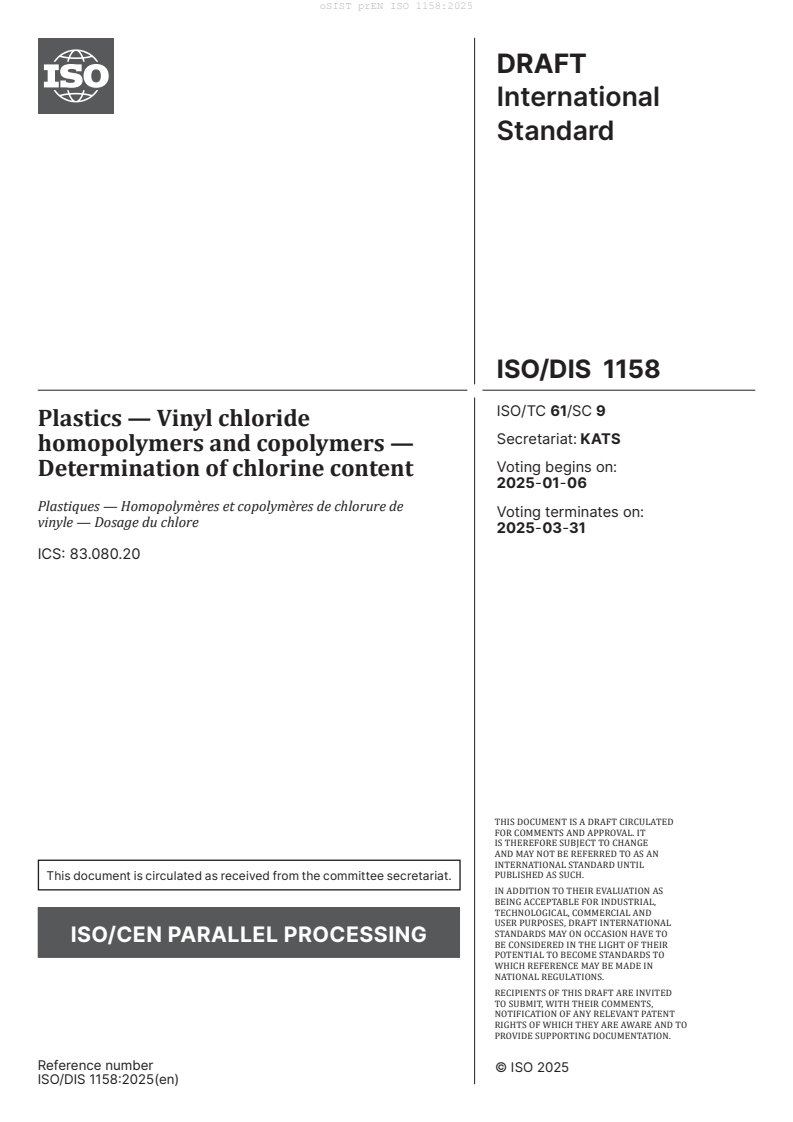
DRAFT
International
Standard
ISO/DIS 1158
ISO/TC 61/SC 9
Plastics — Vinyl chloride
Secretariat: KATS
homopolymers and copolymers —
Voting begins on:
Determination of chlorine content
2025-01-06
Plastiques — Homopolymères et copolymères de chlorure de
Voting terminates on:
vinyle — Dosage du chlore
2025-03-31
ICS: 83.080.20
THIS DOCUMENT IS A DRAFT CIRCULATED
FOR COMMENTS AND APPROVAL. IT
IS THEREFORE SUBJECT TO CHANGE
AND MAY NOT BE REFERRED TO AS AN
INTERNATIONAL STANDARD UNTIL
PUBLISHED AS SUCH.
This document is circulated as received from the committee secretariat.
IN ADDITION TO THEIR EVALUATION AS
BEING ACCEPTABLE FOR INDUSTRIAL,
TECHNOLOGICAL, COMMERCIAL AND
USER PURPOSES, DRAFT INTERNATIONAL
STANDARDS MAY ON OCCASION HAVE TO
ISO/CEN PARALLEL PROCESSING
BE CONSIDERED IN THE LIGHT OF THEIR
POTENTIAL TO BECOME STANDARDS TO
WHICH REFERENCE MAY BE MADE IN
NATIONAL REGULATIONS.
RECIPIENTS OF THIS DRAFT ARE INVITED
TO SUBMIT, WITH THEIR COMMENTS,
NOTIFICATION OF ANY RELEVANT PATENT
RIGHTS OF WHICH THEY ARE AWARE AND TO
PROVIDE SUPPORTING DOCUMENTATION.
Reference number
ISO/DIS 1158:2025(en)
oSIST prEN ISO 1158:2025
ISO/DIS 1158:2025(en)
© ISO 2025
All rights reserved. Unless otherwise specified, or required in the context of its implementation, no part of this publication may
be reproduced or utilized otherwise in any form or by any means, electronic or mechanical, including photocopying, or posting on
the internet or an intranet, without prior written permission. Permission can be requested from either ISO at the address below
or ISO’s member body in the country of the requester.
ISO copyright office
CP 401 • Ch. de Blandonnet 8
CH-1214 Vernier, Geneva
Phone: +41 22 749 01 11
Email: copyright@iso.org
Website: www.iso.org
Published in Switzerland
ii
oSIST prEN ISO 1158:2025
ISO/DIS 1158:2025(en)
Contents Page
Foreword .iv
1 Scope . 1
2 Normative references . 1
3 Terms and definitions . 1
4 Principle . 1
5 Reagents . 1
6 Apparatus . 2
7 Test sample . 4
8 Procedure . 4
9 Expression of results . 7
10 Precision . 7
11 Test report . 7
iii
oSIST prEN ISO 1158:2025
ISO/DIS 1158:2025(en)
Foreword
ISO (the International Organization for Standardization) is a worldwide federation of national standards
bodies (ISO member bodies). The work of preparing International Standards is normally carried out through
ISO technical committees. Each member body interested in a subject for which a technical committee
has been established has the right to be represented on that committee. International organizations,
governmental and non-governmental, in liaison with ISO, also take part in the work. ISO collaborates closely
with the International Electrotechnical Commission (IEC) on all matters of electrotechnical standardization.
The procedures used to develop this document and those intended for its further maintenance are described
in the ISO/IEC Directives, Part 1. In particular, the different approval criteria needed for the different types
of ISO documents should be noted. This document was drafted in accordance with the editorial rules of the
ISO/IEC Directives, Part 2 (see www.iso.org/directives).
ISO draws attention to the possibility that the implementation of this document may involve the use of (a)
patent(s). ISO takes no position concerning the evidence, validity or applicability of any claimed patent
rights in respect thereof. As of the date of publication of this document, ISO had not received notice of (a)
patent(s) which may be required to implement this document. However, implementers are cautioned that
this may not represent the latest information, which may be obtained from the patent database available at
www.iso.org/patents. ISO shall not be held responsible for identifying any or all such patent rights.
Any trade name used in this document is information given for the convenience of users and does not
constitute an endorsement.
For an explanation of the voluntary nature of standards, the meaning of ISO specific terms and expressions
related to conformity assessment, as well as information about ISO's adherence to the World Trade
Organization (WTO) principles in the Technical Barriers to Trade (TBT), see www.iso.org/iso/foreword.html.
This document was prepared by Technical Committee ISO/TC 61, Plastics, Subcommittee SC 9,
Thermoplastics Materials.
This fourth edition cancels and replaces the third edition (ISO 1158:1988), which has been technically
revised.
The main changes are as follows:
— Changed the scope of application of the document(see 1);
— Added the Normative references(see 2);
— Added the Terms and definitions(see 3)
— Changed the unit of concentration of nitric acid solution and added preparation method(see 5.3);
— Added a method for determining the endpoint of titration by potentiometric titration(see 8.1.6, 8.2.5);
— The preparation method of potassium hydroxide solution has been added (see 5.8);
— The regulations for Molotov cocktails have been changed (see 6.4);
— Changed the requirements of filter paper(see 6.8);
— Changed the test procedure for collecting the combustion-based liquid and the amount of liquid collected
in the incendiary bottle method (see 8.2.5);
— Changed the permissible margin of the method B (see 9.2);
A list of all parts in this document can be found on the ISO website.
Any feedback or questions on this document should be directed to the user’s national standards body. A
complete listing of these bodies can be found at www.iso.org/members.html
iv
oSIST prEN ISO 1158:2025
DRAFT International Standard ISO/DIS 1158:2025(en)
Plastics — Vinyl chloride homopolymers and copolymers —
Determination of chlorine content
WARNING — All precautions shall be taken, particularly those mentioned in the text of the present
International Standard, to protect operators from risks presented by both methods.
1 Scope
This document specifies two methods for the determination of the chlorine content of homopolymers and
copolymers of vinyl chloride, free from plasticizers or additives, namely:
— method A (combustion in a bomb);
— method B (combustion in a flask).
This document is also applicable as a reference method for the determination of chlorine content in other
chlorine-containing polymers(such as chlorinated polyvinyl chloride, polyvinyl chloride, chlorinated
polyethylene and Vinyl chloride-vinyl acetate) without plasticizers and additives.
2 Normative references
The following documents are referred to in the text in such a way that some or all of their content constitutes
requirements of this document. For dated references, only the edition cited applies. For undated references,
the latest edition of the referenced document (including any amendments) applies.
ISO 3696, Water for analytical laboratory use — Specification and test methods
ISO 6353-1, Reagents for chemical analysis — Part 1: General test methods
3 Terms and definitions
No terms and definitions are listed in this document.
ISO an
...
Questions, Comments and Discussion
Ask us and Technical Secretary will try to provide an answer. You can facilitate discussion about the standard in here.
Loading comments...