

SIST EN 16976:2024
(Main)Ambient air - Determination of the particle number concentration of atmospheric aerosol
General Information
- Abstract
This document specifies a standard method for determining the particle number concentration in ambient air in a range up to about 107 cm–3 for averaging times equal to or larger than 1 min. The standard method is based on a Condensation Particle Counter (CPC) operated in the counting mode and an appropriate dilution system for concentrations exceeding the counting mode range. It also defines the performance characteristics and the minimum requirements of the instruments to be used. The lower and upper sizes considered within this document are 10 nm and a few micrometres, respectively. This document gives guidance on sampling, operation, data processing and QA/QC procedures including calibration parameters.
- Status
- Published
- Public Enquiry End Date
- 02-Jul-2023
- Publication Date
- 18-Aug-2024
- Technical Committee
- KAZ - Air quality
- Current Stage
- 6060 - National Implementation/Publication (Adopted Project)
- Start Date
- 12-Aug-2024
- Due Date
- 17-Oct-2024
- Completion Date
- 19-Aug-2024

Overview
EN 16976:2024 - Ambient air: Determination of the particle number concentration of atmospheric aerosol - is a CEN standard that defines a harmonized method to measure particle number concentration in ambient air. The method is based on a Condensation Particle Counter (CPC) operated in counting mode, with provisions for an appropriate dilution system when concentrations exceed the CPC counting range. The standard covers measurements up to about 10^7 cm–3, with averaging times of ≥ 1 minute, and particle sizes from 10 nm up to a few micrometres. EN 16976:2024 updates and supersedes the previous CEN/TS version and aligns the lower size limit with Mobility Particle Size Spectrometers (MPSS).
Key topics and requirements
- Measurement principle: Use of CPC (Condensation Particle Counter) in counting mode; dilution systems for high concentrations.
- Size range: Lower limit set to 10 nm; upper limit is “a few micrometres” (practical upper detection defined per instrument).
- Concentration & averaging: Applicable up to ~10^7 cm–3 and for averaging times ≥ 1 min.
- Instrument performance: Defines minimum CPC performance characteristics, detection efficiency, plateau behaviour, linearity, calibration factor, and coincidence correction (coincedence correction is mandatory).
- Sampling & conditioning: Detailed guidance on sampling lines, dryers (silica-based diffusion dryers are excluded), dilution systems, and diffusion loss assessment.
- Environmental/test conditions: Key tests performed at a single temperature between 20 °C and 30 °C.
- QA/QC and uncertainty: Procedures for initial checks, routine maintenance, calibration (including calibration factor and linearity), zero and span checks, dilution-factor verification, calculation of measurement uncertainty, and Annexes with worked examples.
- Annexes: Normative and informative annexes cover diffusion loss determination, uncertainty examples, dilution-system design/operation, laminar flow, coincidence correction, and comparative CPC results.
Applications and users
EN 16976:2024 is designed for practical use in:
- Air quality monitoring networks and regulatory monitoring programmes.
- Environmental laboratories performing particle number concentration measurements.
- Instrument manufacturers for product performance specification and testing.
- Research institutions studying atmospheric aerosols, urban pollution, and ultrafine particles.
- QA/QC teams and calibration facilities validating CPCs and dilution systems.
Benefits include standardized, comparable particle number data for regulatory reporting, health-impact studies, and network interoperability.
Related standards
- CEN/TS 17434 (MPSS) - alignment of lower size limit (10 nm) is noted for QA comparisons between CPC and MPSS methods.
- EN 16976:2024 supersedes earlier CEN/TS 16976 editions and should be implemented by national bodies per CEN rules.
Keywords: EN 16976:2024, particle number concentration, ambient air, CPC, condensation particle counter, aerosol sampling, dilution system, QA/QC, measurement uncertainty, 10 nm.
Relations
- Effective Date
- 01-Sep-2024
Get Certified
Connect with accredited certification bodies for this standard

CIS Institut d.o.o.
Personal Protective Equipment (PPE) certification body. Notified Body NB-2890 for EU Regulation 2016/425 PPE.

Kiwa BDA Testing
Building and construction product certification.
Kmetijski inštitut Slovenije
Agricultural Institute of Slovenia. Soil testing, plant health, agricultural product analysis.
Sponsored listings
Frequently Asked Questions
SIST EN 16976:2024 is a standard published by the Slovenian Institute for Standardization (SIST). Its full title is "Ambient air - Determination of the particle number concentration of atmospheric aerosol". This standard covers: This document specifies a standard method for determining the particle number concentration in ambient air in a range up to about 107 cm–3 for averaging times equal to or larger than 1 min. The standard method is based on a Condensation Particle Counter (CPC) operated in the counting mode and an appropriate dilution system for concentrations exceeding the counting mode range. It also defines the performance characteristics and the minimum requirements of the instruments to be used. The lower and upper sizes considered within this document are 10 nm and a few micrometres, respectively. This document gives guidance on sampling, operation, data processing and QA/QC procedures including calibration parameters.
This document specifies a standard method for determining the particle number concentration in ambient air in a range up to about 107 cm–3 for averaging times equal to or larger than 1 min. The standard method is based on a Condensation Particle Counter (CPC) operated in the counting mode and an appropriate dilution system for concentrations exceeding the counting mode range. It also defines the performance characteristics and the minimum requirements of the instruments to be used. The lower and upper sizes considered within this document are 10 nm and a few micrometres, respectively. This document gives guidance on sampling, operation, data processing and QA/QC procedures including calibration parameters.
SIST EN 16976:2024 is classified under the following ICS (International Classification for Standards) categories: 13.040.20 - Ambient atmospheres. The ICS classification helps identify the subject area and facilitates finding related standards.
SIST EN 16976:2024 has the following relationships with other standards: It is inter standard links to SIST-TS CEN/TS 16976:2017. Understanding these relationships helps ensure you are using the most current and applicable version of the standard.
SIST EN 16976:2024 is associated with the following European legislation: EU Directives/Regulations: 2008/50/EC. When a standard is cited in the Official Journal of the European Union, products manufactured in conformity with it benefit from a presumption of conformity with the essential requirements of the corresponding EU directive or regulation.
SIST EN 16976:2024 is available in PDF format for immediate download after purchase. The document can be added to your cart and obtained through the secure checkout process. Digital delivery ensures instant access to the complete standard document.
Standards Content (Sample)
SLOVENSKI STANDARD
01-september-2024
Nadomešča:
SIST-TS CEN/TS 16976:2017
Zunanji zrak - Določevanje številčne koncentracije delcev atmosferskih aerosolov
Ambient air - Determination of the particle number concentration of atmospheric aerosol
Außenluft - Bestimmung der Partikelanzahlkonzentration des atmosphärischen Aerosols
Air ambiant Détermination de la concentration en nombre de particules de l'aérosol
atmosphérique
Ta slovenski standard je istoveten z: EN 16976:2024
ICS:
13.040.20 Kakovost okoljskega zraka Ambient atmospheres
2003-01.Slovenski inštitut za standardizacijo. Razmnoževanje celote ali delov tega standarda ni dovoljeno.
EN 16976
EUROPEAN STANDARD
NORME EUROPÉENNE
June 2024
EUROPÄISCHE NORM
ICS 13.040.20 Supersedes CEN/TS 16976:2016
English Version
Ambient air - Determination of the particle number
concentration of atmospheric aerosol
Air ambiant - Détermination de la concentration en Außenluft - Bestimmung der
nombre de particules de l'aérosol atmosphérique Partikelanzahlkonzentration des atmosphärischen
Aerosols
This European Standard was approved by CEN on 19 May 2024.
CEN members are bound to comply with the CEN/CENELEC Internal Regulations which stipulate the conditions for giving this
European Standard the status of a national standard without any alteration. Up-to-date lists and bibliographical references
concerning such national standards may be obtained on application to the CEN-CENELEC Management Centre or to any CEN
member.
This European Standard exists in three official versions (English, French, German). A version in any other language made by
translation under the responsibility of a CEN member into its own language and notified to the CEN-CENELEC Management
Centre has the same status as the official versions.
CEN members are the national standards bodies of Austria, Belgium, Bulgaria, Croatia, Cyprus, Czech Republic, Denmark, Estonia,
Finland, France, Germany, Greece, Hungary, Iceland, Ireland, Italy, Latvia, Lithuania, Luxembourg, Malta, Netherlands, Norway,
Poland, Portugal, Republic of North Macedonia, Romania, Serbia, Slovakia, Slovenia, Spain, Sweden, Switzerland, Türkiye and
United Kingdom.
EUROPEAN COMMITTEE FOR STANDARDIZATION
COMITÉ EUROPÉEN DE NORMALISATION
EUROPÄISCHES KOMITEE FÜR NORMUNG
CEN-CENELEC Management Centre: Rue de la Science 23, B-1040 Brussels
© 2024 CEN All rights of exploitation in any form and by any means reserved Ref. No. EN 16976:2024 E
worldwide for CEN national Members.
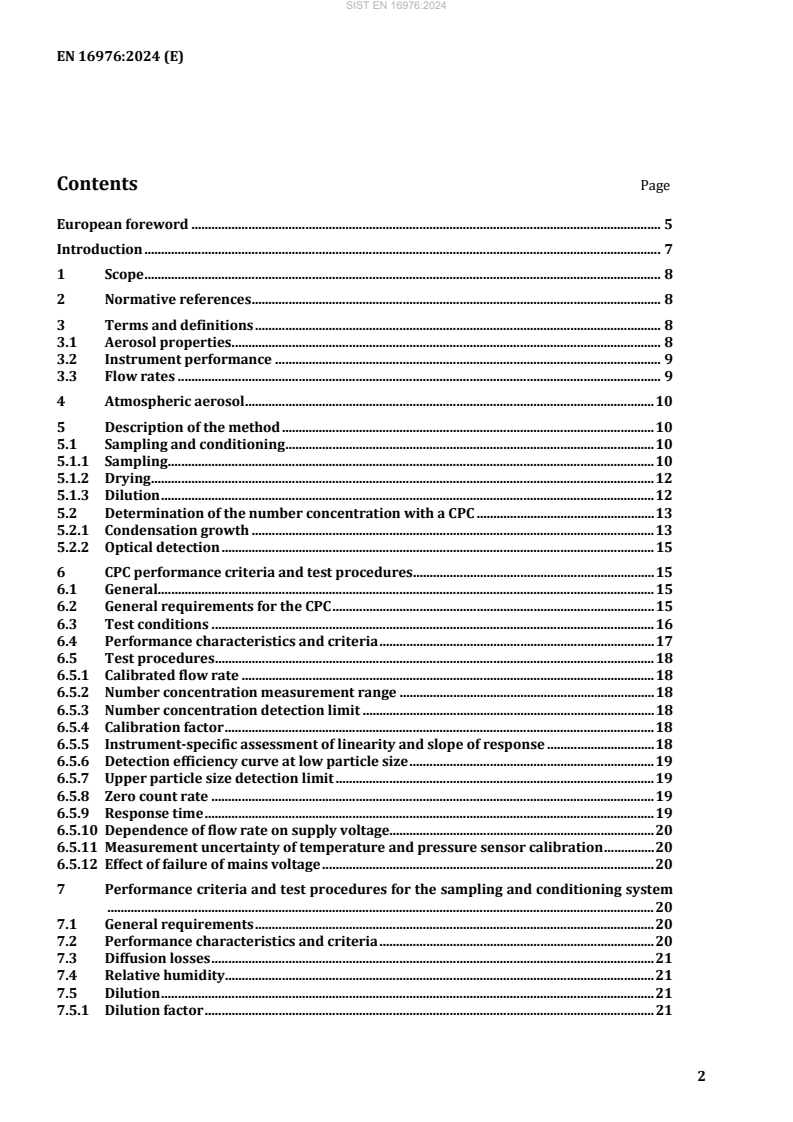
Contents Page
European foreword . 5
Introduction . 7
1 Scope . 8
2 Normative references . 8
3 Terms and definitions . 8
3.1 Aerosol properties. 8
3.2 Instrument performance . 9
3.3 Flow rates . 9
4 Atmospheric aerosol . 10
5 Description of the method . 10
5.1 Sampling and conditioning . 10
5.1.1 Sampling . 10
5.1.2 Drying . 12
5.1.3 Dilution . 12
5.2 Determination of the number concentration with a CPC . 13
5.2.1 Condensation growth . 13
5.2.2 Optical detection . 15
6 CPC performance criteria and test procedures . 15
6.1 General. 15
6.2 General requirements for the CPC . 15
6.3 Test conditions . 16
6.4 Performance characteristics and criteria . 17
6.5 Test procedures . 18
6.5.1 Calibrated flow rate . 18
6.5.2 Number concentration measurement range . 18
6.5.3 Number concentration detection limit . 18
6.5.4 Calibration factor . 18
6.5.5 Instrument-specific assessment of linearity and slope of response . 18
6.5.6 Detection efficiency curve at low particle size . 19
6.5.7 Upper particle size detection limit . 19
6.5.8 Zero count rate . 19
6.5.9 Response time . 19
6.5.10 Dependence of flow rate on supply voltage. 20
6.5.11 Measurement uncertainty of temperature and pressure sensor calibration . 20
6.5.12 Effect of failure of mains voltage . 20
7 Performance criteria and test procedures for the sampling and conditioning system
................................................................................................................................................................... 20
7.1 General requirements . 20
7.2 Performance characteristics and criteria . 20
7.3 Diffusion losses . 21
7.4 Relative humidity. 21
7.5 Dilution . 21
7.5.1 Dilution factor . 21
7.5.2 General criteria for dilution systems . 22
7.6 Primary sampling flow . 22
8 Measurement procedure . 22
8.1 Measurement planning . 22
8.2 Environmental operating conditions . 22
8.3 Initial installation . 23
8.4 Initial checks on site . 23
8.5 Data processing and reporting . 23
9 Quality control, quality assurance and measurement uncertainty . 24
9.1 General . 24
9.2 Frequency of calibrations, checks and maintenance . 24
9.2.1 General . 24
9.2.2 Full maintenance of CPC . 25
9.2.3 Calibration of linearity . 25
9.2.4 Zero check . 25
9.2.5 Number concentration check . 25
9.2.6 Actual flow rate check . 25
9.2.7 Temperature and pressure sensor calibration . 26
9.2.8 CPC internal diagnostics. 26
9.2.9 Sample system maintenance . 26
9.2.10 Relative humidity sensor . 26
9.2.11 Dilution factor (where applicable) . 26
9.2.12 Leak check . 26
9.3 Measurement uncertainty . 26
9.3.1 General . 26
9.3.2 CPC plateau detection efficiency . 27
9.3.3 CPC detection efficiency drift . 27
9.3.4 Flow determination . 28
9.3.5 Correction to standard temperature and pressure . 28
9.3.6 Diffusion losses in the sampling system . 28
9.3.7 Dilution factor (where applicable) . 28
9.3.8 Calculation of overall uncertainty . 29
Annex A (normative) Determination of diffusion losses in sampling lines . 30
Annex B (informative) Example of the calculation of diffusion losses in a sampling system 32
B.1 Description of the sampling system . 32
B.2 Air properties and diffusion coefficient . 33
B.3 Losses in the primary sampling tube . 33
B.4 Losses in the secondary sampling tube and the dryer . 34
B.5 Overall sampling losses . 34
Annex C (informative) Uncertainty calculation (example). 35
C.1 General . 35
C.2 CPC plateau detection efficiency . 35
C.3 CPC detection efficiency drift . 35
C.4 Flow determination . 35
C.5 Correction to standard temperature and pressure . 35
C.6 Sampling losses due to diffusion to walls . 35
C.7 Dilution factor (where applicable) . 36
C.8 Calculation of overall uncertainty . 36
Annex D (informative) Atmospheric aerosols . 37
D.1 General. 37
D.2 Examples of measurements . 37
Annex E (informative) Dilution systems . 40
E.1 Background . 40
E.2 Operation principles of dilution systems . 40
E.3 Design example of a dilution system for drying the primary sampling flow . 42
E.4 Operating parameters of a dilution system . 43
E.5 Example for the calculation of the uncertainty of the dilution factor . 46
Annex F (informative) Laminar flow . 48
Annex G (informative) Coincidence correction . 49
Annex H (informative) Results of an experimental comparison of different CPCs . 51
Bibliography . 56
European foreword
This document (EN 16976:2024) has been prepared by Technical Committee CEN/TC 264 “Air quality”,
the secretariat of which is held by DIN.
This European Standard shall be given the status of a national standard, either by publication of an
identical text or by endorsement, at the latest by December 2024, and conflicting national standards shall
be withdrawn at the latest by December 2024.
Attention is drawn to the possibility that some of the elements of this document may be the subject of
patent rights. CEN shall not be held responsible for identifying any or all such patent rights.
This document supersedes CEN/TS 16976:2016.
In comparison with the previous edition, the following technical modifications have been made:
— 1: The lower limit of the measured particle size range is set to be 10 nm and thus identical to MPSS
(Mobility Particle Size Spectrometers) measurements (see CEN/TS 17434). In air quality monitoring
networks where MPSS will be used for determining the particle size distribution a CPC may be used
for QA purposes for the MPSS data.
— 3: The parameter “calibration factor” has been introduced and defined. The terms and definitions for
the various flow rates have been revised and rearranged.
— 5.1.2: Aerosol diffusion dryer based on silica is excluded, because diffusion losses are too high with
this type of dryer.
— 6.2: Coincidence correction shall be applied. No other correction factors shall be applied unless a
correction for the analysed flow rate is necessary.
— 6.3: All tests are carried out only at one temperature (between 20 °C and 30 °C).
— 6.4: Table 1: Criteria for several performance characteristics have been changed, the performance
characteristic “calibration factor” has been included.
— 6.5: Some of the test procedures have been revised, a test procedure for the calibration factor has
been added.
— 7.2: Two dilution factors are necessary: one for reducing the concentration, an additional one for
drying.
— 7.5: The method of using tracer gas for the determination of the dilution factor of a dilution system
has been removed. General criteria for dilution systems have been added.
— 9.2: The test “Determination of low size cut-off” has been removed, the “Number concentration
check” has been substantially revised.
— The previous Annex C “Data reporting” has been removed.
— Annex D: The ambient particle number concentration values have been updated.
— Annex E: An example of the design of a dilution system and an example for the calculation of the
uncertainty of the dilution factor have been added.
— Annex G: The new Annex “Coincidence correction” has been added.
— Annex H: The new Annex “Results of an experimental comparison of different CPCs” has been added.
Any feedback and questions on this document should be directed to the users’ national standards body.
A complete listing of these bodies can be found on the CEN website.
According to the CEN-CENELEC Internal Regulations, the national standards organisations of the
following countries are bound to implement this European Standard: Austria, Belgium, Bulgaria, Croatia,
Cyprus, Czech Republic, Denmark, Estonia, Finland, France, Germany, Greece, Hungary, Iceland, Ireland,
Italy, Latvia, Lithuania, Luxembourg, Malta, Netherlands, Norway, Poland, Portugal, Republic of North
Macedonia, Romania, Serbia, Slovakia, Slovenia, Spain, Sweden, Switzerland, Türkiye and the United
Kingdom.
Introduction
There is a growing awareness of the significance of aerosol particles with diameters of D < 1 µm for
human health as well as for their climatic impact. To assess air quality, it appears necessary to
supplement gravimetrically determined mass concentrations such as PM and PM (see EN 12341)
2,5 10
with a measurement of the particle number concentration. Since ultrafine particles with diameters of
D < 0,1 µm make an almost insignificant contribution to the mass of atmospheric aerosol particles, they
can best be detected with counting measuring methods of sufficient sensitivity.
As particle measurement instrumentation allows determining either the particle number concentration
or the particle number size distribution two documents are established:
— one dealing with the determination of the single parameter number concentration (a measure of
“total” number concentration, this document)
— one dealing with the determination of number concentration within a limited number of size ranges
(CEN/TS 17434).
Clauses 4 and 5 contain general information about the method and the expected properties of the aerosol
to be measured.
Clause 6 sets out the performance criteria for CPCs. Specifically, these are the relevant performance
characteristics of CPC instruments (without any sampling system), the respective criteria that need to be
met, and a description of how the tests are to be carried out. In general, these tests are expected to be
carried out by test houses or CPC manufacturers rather than users and could form the basis for type
testing of CPCs in future.
Clause 7 sets out the performance criteria and test procedures for the sampling and conditioning system
(e.g. dilution). These may be applied by manufacturers of sampling systems, test houses or users
(network operators).
Clause 8 sets out requirements for the installation, initial checks and calibrations, and operation of a CPC
and sampling system at a monitoring site, including routine maintenance, data processing (including use
of QA/QC data) and reporting. In general, these will be the responsibility of users (network operators),
though calibrations requiring test aerosols are only to be carried out by suitably qualified laboratories.
Clause 9 sets out Quality Assurance and Quality Control procedures, i.e. the ongoing checks and
calibrations that are required on the CPC and sampling system during operation at a monitoring site. It is
expected that these will be the responsibility of users (network operators), though calibrations requiring
test aerosols are only to be carried out by suitably qualified laboratories. The main sources of
measurement uncertainty are described.
1 Scope
This document specifies a standard method for determining the particle number concentration in
7 –3
ambient air in a range up to about 10 cm for averaging times equal to or larger than 1 min. The
standard method is based on a Condensation Particle Counter (CPC) operated in the counting mode and
an appropriate dilution system for concentrations exceeding the counting mode range. It also defines the
performance characteristics and the minimum requirements of the instruments to be used. The lower
and upper sizes considered within this document are 10 nm and a few micrometres, respectively. This
document gives guidance on sampling, operation, data processing and QA/QC procedures including
calibration parameters.
2 Normative references
The following documents are referred to in the text in such a way that some or all of their content
constitutes requirements of this document. For dated references, only the edition cited applies. For
undated references, the latest edition of the referenced document (including any amendments) applies.
ISO 27891:2015, Aerosol particle number concentration — Calibration of condensation particle counters
3 Terms and definitions
For the purposes of this document, the following terms and definitions apply.
ISO and IEC maintain terminology databases for use in standardization at the following addresses:
— ISO Online browsing platform: available at https://www.iso.org/obp
— IEC Electropedia: available at https://www.electropedia.org
3.1 Aerosol properties
3.1.1
particle
small piece of matter with defined physical boundary
Note 1 to entry: The phase of a particle can be solid, liquid, or between solid and liquid and a mixture of any of the
phases.
[SOURCE: ISO 27891:2015, modified]
3.1.2
aerosol
multi-phase system of solid and/or liquid particles suspended in a gas, ranging in particle size from
0,001 µm to 100 µm
3.1.3
number size distribution
frequency distribution of the particle number concentration represented as a function of particle size
3.1.4
particle number concentration
number of particles related to the unit volume of the carrier gas
Note 1 to entry: For the exact particle number concentration indication, information on the gaseous condition
(temperature and pressure) or the reference to a standard volume indication is necessary.
[SOURCE: ISO 27891:2015]
3.1.5
Stokes diameter
diameter of a spherical particle which at the same velocity through a medium experiences the same drag
force as the particle to be described
3.1.6
Kelvin diameter
diameter of a pure vapour substance drop that would start to grow at the same supersaturation as the
particle in question
3.2 Instrument performance
3.2.1
coincidence error
error that occurs with counting measuring methods when two or more particles are counted
simultaneously as a single particle
Note 1 to entry: Coincidence error is related to particle number concentration, flow velocity through the sensing
zone and size of sensing zone.
3.2.2
detection efficiency
ratio of the particle number concentration determined by the measuring instrument to the reference
particle number concentration of the aerosol at the instrument's inlet
Note 1 to entry: The detection efficiency depends on particle size and may depend on particle number
concentration.
3.2.3
calibration factor
model- or instrument-specific ratio between the reference FCAE reading and the CPC count rate, both
converted to particle number concentration
3.3 Flow rates
3.3.1
actual flow rate
volumetric flow rate of an individual instrument, measured at its inlet under the actual air conditions
3.3.2
nominal flow rate
volumetric flow rate which a specific CPC model is designed for and which is indicated on the instrument
specification sheet by the manufacturer
Note 1 to entry: The actual flow rate of individual instruments may differ from the nominal flow due to
manufacturing tolerances.
3.3.3
calibrated flow rate
actual flow rate at the time of calibration documented on a calibration certificate
3.3.4
analysed flow rate
volumetric flow rate which is used for instrument internal calculation of the particle number
concentration
4 Atmospheric aerosol
Atmospheric aerosols are strongly dependent on their local and regional sources. Especially, the size
distribution in number and mass, as well as the size-resolved chemical composition are highly variable.
Aerosol particles are either emitted directly (primary aerosols) or formed by nucleation and
condensation from pre-cursor gases (secondary aerosol). Combustion processes lead to both primary
and secondary aerosols.
Mass-wise, the global direct emission of aerosol particles is dominated by sea salt, biological material as
well as by desert and volcanic dust. These particles are generally larger than 1 µm. Anthropogenic
emissions in this size range play a minor role on a global scale. Submicrometre natural aerosols consist
mainly of marine sulfate, biogenic organics, and wildfire carbonaceous particles. Submicrometre
anthropogenic aerosols are complex mixtures of primary and secondary particles, consisting mainly of
sulfate, nitrate, organics, and elemental carbon.
Particle number concentrations of atmospheric aerosols cover several orders of magnitude. While
remote marine or free tropospheric aerosols have number concentrations as low as tens or a few hundred
per cubic centimetre, anthropogenically influenced aerosols can contain a few thousand up to one million
particles per cubic centimetre. The number concentration of the anthropogenic aerosol over land,
especially in urban areas is dominated by particles in the size range smaller than 0,1 µm. Major sources
for high number concentrations in this size range are regional new particle formation and local
combustion processes. Average background concentrations in an urban area are several thousands of
particles per cubic centimetre.
For details see Annex D.
5 Description of the method
5.1 Sampling and conditioning
5.1.1 Sampling
The measurement of atmospheric aerosols will always necessitate sampling and the transport of the
sample to the measuring instrument. Moreover, in certain cases the sample has to be processed in terms
of temperature, relative humidity, and particle concentration in order to adapt the aerosol to the
measuring instrument's permissible operating conditions.
The information given on this issue in this document refers to stationary ambient monitoring sites. For
mobile applications (e.g. measurements from aircraft), additional considerations have to be taken into
account.
The measuring instruments shall be accommodated in a protected environment in controlled conditions
(temperature 20 °C to 30 °C, stable within ±2 °C during 1 day).
The sampling location depends on the measurement task. If the undisturbed atmospheric aerosol is to be
measured, air intake should take place 5 m to 10 m above the ground level. Buildings, vegetation, or the
topography of the terrain may make an even higher sampling point necessary. The measurement of
aerosols in a regulatory framework can require much lower sampling points (1,5 m to 4 m above the
ground) and at a minimum distance from the source (for example, at least 25 m from the boundary of
major intersections and not more than 10 m from the kerb for traffic-related measurements), see
Directive 2008/50/EC [1]).
The design of the inlet port should permit representative sampling regardless of the direction of the wind
for a broad range of wind velocities. However, this is not a critical condition for the small particles
measured by the CPC. Steps shall be taken to avoid soiling of the sampling lines by particles larger than
10 µm. For this purpose, a PM or PM inlet can be used (see Figure 1). An inlet that removes particles
10 2,5
in the measurement range of the CPC (e.g. a commercial PM inlet) shall be avoided.
Key
1 PM sampling inlet
2 Primary sampling tube
3 Secondary sampling tube
Figure 1 — Basic design of the aerosol inlet port
The sample should ideally be fed via a vertical primary sampling tube without bends to the measuring
instruments. Since gas measuring methods have fundamentally different requirements regarding
sampling, gas and aerosol sampling should be conducted independently of each other.
To reduce diffusion loss, it is necessary to intake aerosol with the aid of a pump at a primary flow rate
(Q ) much higher than the secondary flow rate (Q ). The CPC should sample isoaxially in the central
tot CPC
area from this volumetric flow via a secondary sampling tube that is as short as possible. Flow in the
primary sampling tube should be laminar in order to prevent additional particle loss due to turbulence.
Ideally, a Reynolds number close to Re = 2 000 should be aimed for (see 7.2).
The diffusion losses in the sampling system for the smallest relevant particle size of 10 nm shall be less
than 25 % (see 7.2).
The inlet port and lines shall be made of a conductive, corrosion-resistant material with a low surface
roughness (e.g. stainless steel) and electrically earthed. This prevents chemical changes to the aerosol
and particle losses due to electrostatic effects. Flexible tubing of electrically conductive material may also
be used for small connections or short distances. The length of flexible tubing should be below 50 cm.
The inlet and the flow-splitter of the sampling system shall be checked regularly to detect obstructions,
e.g. by insects, and cleaned, if necessary.
5.1.2 Drying
Aerosols with a high relative humidity (mist in extreme cases) should be dried, as the size of particles of
hygroscopic materials is strongly influenced by humidity. The requirement is to keep the relative
humidity of the secondary flow at the CPC inlet lower than 40 % (see 7.2). The relative humidity at the
inlet of the CPC shall be monitored.
According to 5.1.1, the CPC is operated in a protected environment with controlled temperature
conditions. This indoor temperature can differ substantially from the outdoor temperature. With respect
to the temperature conditions three cases are to be distinguished:
— In case the indoor temperature is higher than 22 °C no aerosol dryer is needed if the dew point
temperature of the aerosol to be sampled never exceeds 10 °C.
— If the aerosol dew point temperature is between 10 °C and the indoor temperature, the secondary
flow shall be dried.
— In case that the aerosol dew point temperature is above the indoor temperature, the primary flow
shall be dried in the outside section of the primary sampling tube. Additional drying of the secondary
flow may be necessary.
There are two recommended methods to dry the aerosol:
— Membrane dryer; preferably used to dry the secondary sampling flow.
–3
— Dilution (see 5.1.3) with dry clean air (particle number concentration less than 1 cm ); preferably
used to dry the primary sampling flow. In this case the exact dilution ratio shall be known in order to
calculate the correct concentrations.
5.1.3 Dilution
Dilution is applied either to reduce the number concentration of the ambient aerosol to the limits of the
CPC's measuring range or to reduce the humidity of the ambient aerosol. In both cases the dilution step
may introduce a high uncertainty which shall be estimated and specified in the report. Where dilution is
not required this step should be avoided. The minimum requirement with respect to uncertainty of the
dilution factor for both cases is given in 7.2.
Preferably the CPC selected to measure at any particular site will have a concentration range in counting
mode that covers the expected concentrations. When this is not possible the sample shall be diluted with
–3
clean air (particle number concentration less than 1 cm ). In this case the secondary sampling flow is
diluted. Operation principles of suitable dilution systems for this purpose are presented in Annex E.
If dilution is applied to dry the aerosol, then the dilution system shall be part of the primary sampling line
outside of the air-conditioned environment to avoid water condensation in that part of the sampling
system. A dilution system specially designed for that purpose is presented in E.4. Its operating
parameters are discussed in detail.
5.2 Determination of the number concentration with a CPC
5.2.1 Condensation growth
In a CPC, particles are enlarged by condensation growth and then subjected to optical detection by
scattered light.
To incite the condensation growth of particles of a given diameter, a certain minimum saturation ratio
with respect to a condensable vapour must be present in accordance with the Kelvin Formula (1):
4⋅⋅σ M
(1)
S= exp
ρ⋅ R⋅⋅Td
Where
S is the saturation ratio (ratio of current vapour pressure to saturation vapour pressure);
σ is the surface tension of the vapour substance in N/m;
M is the molar mass of the vapour substance (relative molecular mass) in kg/kmol;
ρ
is the density of the vapour substance in its condensed state in kg/m ;
R is the general gas constant (8314 J/(kmol·K);
T is the absolute temperature in K;
d is the Kelvin diameter in m.
Particle shape, surface structure and affinity of the particle material to the vapour phase are important
factors influencing the Kelvin diameter.
Figure 2 shows the principle of a continuous flow CPC. The aerosol enters a heated saturator (3) in which
it is saturated with the vapour substance at a constant temperature. Typical vapour substances used in
CPCs are alcohols, e.g. n-butanol. It then flows into a cooled condenser (6) where the vapour condenses
on the particles forming spherical droplets that consist mainly of the vapour substance and have a
diameter of typically a few micrometres. These droplets can be easily detected and counted optically.
The temperatures of the saturator and the condenser are important operating parameters that influence
the smallest detectable particle size.
Key
1 Aerosol inlet 8 Nozzle
2 Vapour substance reservoir 9 Light source
3 Heated saturator 10 Illumination optics
4 Nanoparticle (not true to scale) 11 Measuring volume
5 Thermoelectric cooling and heating device 12 Receiving optics
6 Condenser 13 Photodetector
7 Droplet (not true to scale) 14 Aerosol outlet
Figure 2 — Principle of a continuous flow CPC (cf. ISO 27891:2015)
5.2.2 Optical detection
The droplet aerosol produced by the condensation process is transported via a nozzle (8) through the
measuring volume of the instrument, where the droplets are illuminated by a light beam. The light
scattered by the droplets is collected by a receiving optics (12) under a defined solid angle (receiver
aperture) and guided onto a photodetector (13) (e.g. photodiode).
The measurement volume in most instruments is defined by the intersection of the aerosol stream and
the light beam (full flow instrument). In order to implement a very small measurement volume some
instruments do not count the droplets in the total cross-section of the aerosol flow. They instead confine
a smaller measurement volume within the aerosol stream using a special optical arrangement with
apertures in both the illumination optics and the receiving optics. The analysed flow rate for this type of
instrument is smaller than the actual flow rate at its inlet because the droplets are only counted in a
fraction of the actual flow. The analysed flow rate in this case shall be determined from the dimensions
of the measurement volume and the flow velocity of the aerosol stream inside the measuring volume.
If the particle number concentration is low enough, the droplets cross the light beam one after the other,
thus producing single electrical pulses at the detector output. From the count rate of these pulses and the
analysed flow rate and the sampling time the total number concentration of the droplets can be
determined. If there are no transport losses of droplets, this number concentration is equal to the number
concentration of the primary particles (condensation nuclei) with a size larger than the Kelvin diameter
determined by the supersaturation achieved in the instrument.
For higher particle number concentrations more than one particle may be present in the measuring
volume at the same time (coincidence). This results in the coincidence error, which leads to a measured
value lower than the actual concentration. The coincidence error can be described statistically and
corrected for within certain limits (see Annex G).
For even higher concentrations the detector cannot distinguish single pulses but measures the light
scattered by the whole population of particles in the sensing volume as an analogue signal (photometric
mode). Since in the ideal case droplet growth due to condensation yields the same size independently of
the size of the condensation nuclei and since the optical properties of the droplets are determined
essentially by the condensing material, there is in principle a linear relationship between this photometer
signal and the particle number concentration which can be determined by calibration. On the other hand,
very high particle number concentrations lead to a depletion of the vapour concentration by the
condensation process. This leads not only to nonlinearity of the calibration curve but also influences the
lower detection limit for particle size.
The use of the photometric mode is not allowed in the standard method.
6 CPC performance criteria and test procedures
6.1 General
This clause sets out the performance criteria for the CPC. In general, the tests described in 6.5 are
expected to be carried out by test houses or CPC manufacturers to validate an instrument design, and
could form the basis for type approval of CPCs in future.
6.2 General requirements for the CPC
1) The performance criteria all refer to the counting mode of the CPC.
2) Coincidence correction and the calibration factor shall be applied.
3) The calibration factor shall be accessible, and it shall be documented for the user.
4) The CPC shall have no internal flow splitting, which is not accessible to an external flow rate check,
or internal dilution to avoid unnecessary sources of measurement uncertainty.
5) The working fluid shall be n-butanol.
NOTE Adequate data from long-term studies in ambient air for other working fluids are currently not available.
6) The instrument shall produce concentration data averaged over a data reporting interval of 1 min.
7) The instrument's internal clock shall be externally synchronizable.
8) The instrument shall enable the following parameters to be recorded in 1 min time intervals:
— Date, start time and end time of each reported concentration;
— Analysed flow rate (equal to the actual flow rate except for instruments with an optically
confined measurement volume, see 5.2.2);
–3
— Raw concentration (count rate divided by the analysed flow rate), in cm ;
–3
— Concentration with internal coincidence correction (based on the analysed flow rate), in cm ;
— Saturator temperature, in K;
— Condenser temperature, in K;
— Temperature (in K) and absolute pressure (in hPa) at the point of flow rate measurement;
— Warning and error flags:
• Signal quality out of tolerance;
• Concentration exceeding maximum single count range;
• Flow problems;
• Saturator or condenser temperature out of range;
• Butanol liquid level too low;
• Light source malfunction.
6.3 Test conditions
Before operating the CPC, the operating instructions of the manufacturer shall be followed, particularly
...