


SIST EN 12057:2004
(Main)Natural stone products - Modular tiles - Requirements
Natural stone products - Modular tiles - Requirements
This document specifies requirements for flat modular tiles of natural stone which are made for use as flooring, stairs, cladding and ceiling finishes. It does not cover mineral aggregates and artificial agglomerated stone material and does not cover installation.
Natursteinprodukte - Fliesen - Anforderungen
Dieses Dokument legt Anforderungen an glatte Fliesen aus Naturstein fest, die als Belag für Fußböden und Treppenstufen sowie als Wandbekleidungen und für Deckenflächen eingesetzt werden. Nicht erfasst werden mineralische Gesteinskörnungen und künstlich hergestelltes Gesteinsmaterial sowie die Verlegung.
Produits en pierre naturelle - Plaquettes modulaires - Exigences
Le présent document définit les exigences relatives aux plaquettes modulaires planes en pierre naturelle destinées à être utilisées pour les sols, les escaliers, les revêtements muraux et les finitions de plafonds. Il ne couvre pas les agrégats minéraux ni les matériaux rocheux agglomérés artificiellement, et ne concerne pas la mise en �uvre.
Naravni kamen - Ploščice - Zahteve
Dokument specificira zahteve za ploščice iz naravnega kamna, ki so namenjene za oblaganje tal, stopnic, notranjih in zunanjih sten in stropov. Ta standard posebej ne opredeljuje mineralnih agregatov in umetnih kamnov ter tudi ne načina polaganja.
General Information
- Status
- Withdrawn
- Publication Date
- 30-Nov-2004
- Withdrawal Date
- 13-Apr-2015
- Technical Committee
- KAM - Natural stone
- Current Stage
- 9900 - Withdrawal (Adopted Project)
- Start Date
- 13-Apr-2015
- Due Date
- 06-May-2015
- Completion Date
- 14-Apr-2015
- Directive
- 89/106/EEC - Construction products
Relations
- Effective Date
- 01-May-2015

Frequently Asked Questions
SIST EN 12057:2004 is a standard published by the Slovenian Institute for Standardization (SIST). Its full title is "Natural stone products - Modular tiles - Requirements". This standard covers: This document specifies requirements for flat modular tiles of natural stone which are made for use as flooring, stairs, cladding and ceiling finishes. It does not cover mineral aggregates and artificial agglomerated stone material and does not cover installation.
This document specifies requirements for flat modular tiles of natural stone which are made for use as flooring, stairs, cladding and ceiling finishes. It does not cover mineral aggregates and artificial agglomerated stone material and does not cover installation.
SIST EN 12057:2004 is classified under the following ICS (International Classification for Standards) categories: 91.100.15 - Mineral materials and products. The ICS classification helps identify the subject area and facilitates finding related standards.
SIST EN 12057:2004 has the following relationships with other standards: It is inter standard links to SIST EN 12057:2015. Understanding these relationships helps ensure you are using the most current and applicable version of the standard.
SIST EN 12057:2004 is associated with the following European legislation: EU Directives/Regulations: 305/2011, 89/106/EEC; Standardization Mandates: M/119, M/121. When a standard is cited in the Official Journal of the European Union, products manufactured in conformity with it benefit from a presumption of conformity with the essential requirements of the corresponding EU directive or regulation.
SIST EN 12057:2004 is available in PDF format for immediate download after purchase. The document can be added to your cart and obtained through the secure checkout process. Digital delivery ensures instant access to the complete standard document.
Standards Content (Sample)
2003-01.Slovenski inštitut za standardizacijo. Razmnoževanje celote ali delov tega standarda ni dovoljeno.Natural stone products - Modular tiles - RequirementsProduits en pierre naturelle - Plaquettes modulaires - ExigencesNatursteinprodukte - Fliesen - AnforderungenTa slovenski standard je istoveten z:EN 12057:2004SIST EN 12057:2004en91.100.15ICS:SLOVENSKI
STANDARDSIST EN 12057:200401-december-2004
EUROPEAN STANDARDNORME EUROPÉENNEEUROPÄISCHE NORMEN 12057October 2004ICS 91.100.15English versionNatural stone products - Modular tiles - RequirementsProduits en pierre naturelle - Plaquettes modulaires -ExigencesNatursteinprodukte - Fliesen - AnforderungenThis European Standard was approved by CEN on 9 July 2004.CEN members are bound to comply with the CEN/CENELEC Internal Regulations which stipulate the conditions for giving this EuropeanStandard the status of a national standard without any alteration. Up-to-date lists and bibliographical references concerning such nationalstandards may be obtained on application to the Central Secretariat or to any CEN member.This European Standard exists in three official versions (English, French, German). A version in any other language made by translationunder the responsibility of a CEN member into its own language and notified to the Central Secretariat has the same status as the officialversions.CEN members are the national standards bodies of Austria, Belgium, Cyprus, Czech Republic, Denmark, Estonia, Finland, France,Germany, Greece, Hungary, Iceland, Ireland, Italy, Latvia, Lithuania, Luxembourg, Malta, Netherlands, Norway, Poland, Portugal, Slovakia,Slovenia, Spain, Sweden, Switzerland and United Kingdom.EUROPEAN COMMITTEE FOR STANDARDIZATIONCOMITÉ EUROPÉEN DE NORMALISATIONEUROPÄISCHES KOMITEE FÜR NORMUNGManagement Centre: rue de Stassart, 36
B-1050 Brussels© 2004 CENAll rights of exploitation in any form and by any means reservedworldwide for CEN national Members.Ref. No. EN 12057:2004: E
(normative)
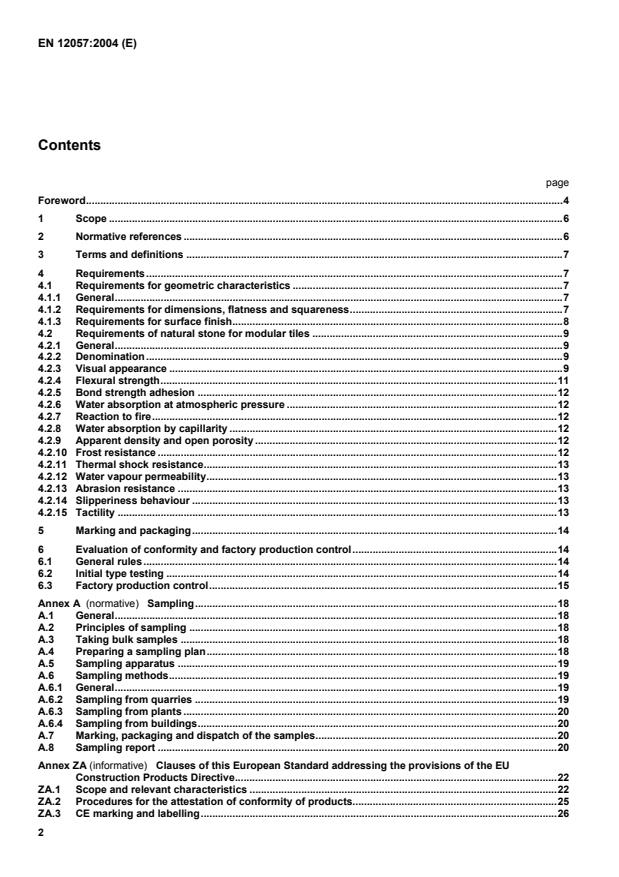
Sampling.18 A.1 General.18 A.2 Principles of sampling.18 A.3 Taking bulk samples.18 A.4 Preparing a sampling plan.18 A.5 Sampling apparatus.19 A.6 Sampling methods.19 A.6.1 General.19 A.6.2 Sampling from quarries.19 A.6.3 Sampling from plants.20 A.6.4 Sampling from buildings.20 A.7 Marking, packaging and dispatch of the samples.20 A.8 Sampling report.20 Annex ZA (informative)
Clauses of this European Standard addressing the provisions of the EU Construction Products Directive.22 ZA.1 Scope and relevant characteristics.22 ZA.2 Procedures for the attestation of conformity of products.25 ZA.3 CE marking and labelling.26
Clauses of this European Standard addressing the provisions of the EU Construction Products Directive.29 ZB.1 Scope and relevant characteristics.29 ZB.2 Procedures for the attestation of conformity of products.32 ZB.3 CE marking and labelling.33 ZB.3.1 CE marking.33 ZB.3.2 Reference model for marking and labelling.33 ZB.4 EC Declaration of conformity.35 Bibliography.36
EN 1925, Natural stone test methods - Determination of water absorption coefficient by capillarity EN 1936, Natural stone test method - Determination of real density and apparent density, and of total and open porosity EN 12371, Natural stone test methods - Determination of frost resistance EN 12372, Natural stone test methods - Determination of flexural strength under concentrated load EN 12407, Natural stone test methods - Petrographic examination EN 12440, Natural stone - Denomination criteria EN 12524, Building materials and products - Hygrothermal properties - Tabulated design values EN 12670:2001, Natural stone - Terminology EN 13161, Natural stone test methods - Determination of flexural strength under constant moment EN 13373, Natural stone test methods - Determination of geometric characteristics on units EN 13501-1, Fire classification of construction products and building elements - Part 1: Classification using test data from reaction to fire tests EN 13755, Natural stone test methods - Determination of water absorption at atmospheric pressure EN 14157, Natural stone test methods - Determination of the abrasion resistance EN 14066, Natural stone test methods - Determination of resistance to ageing by thermal shock EN 14231, Natural stone test methods - Determination of the slip resistance by means of the pendulum tester EN ISO 12572, Hygrothermal performance of building materials and products - Determination of water vapour transmission properties (ISO 12572:2001) NOTE Besides the documents for test methods mentioned in Clause 2 there exist further standards which can be used for scientific examinations, but which are not relevant for the application in practice according to this standard.
Figure 1 — Dimensions of a modular tile 4 Requirements 4.1 Requirements for geometric characteristics 4.1.1 General All measurements shall be carried out in accordance with EN 13373 and all measured values of individual units shall fall within the required tolerances. 4.1.2 Requirements for dimensions, flatness and squareness The tolerances for sizes, flatness and squareness shall be as given in Table 1. Table 1 is not valid for modular tiles having natural cleft/riven faces, for which tolerances on dimensions, flatness or squareness shall be declared by the manufacturer.
Not calibrated tiles Calibrated tilesa l, b ± 1 mm ± 0,5 mm
Dimensions d ± 1,5 mm ± 0,5 mm Flatness (for honed and polished surface only) 0,15 % 0,10 % Squareness 0,15 % 0,10 % a Calibrated tiles indicate a product submitted to specific mechanical finishing in order to obtain more precise dimensions; they are suitable to be fixed by thin mortar bed or adhesives
4.1.3 Requirements for surface finish 4.1.3.1 General Surface finishes shall extend uniformly to the edges of the modular tiles. The surface finishing of some types of stones may typically involve the use of patching, fillers or other similar products for natural holes, faults or cracks; this is to be considered as part of the normal processing. In such cases the type of treatment as well as the type and nature of additional materials shall be declared. 4.1.3.2 Requirements for surfaces after surface finishing Surfaces shall be worked to achieve the specified finish and shall have a regular appearance as a result of the finishing process (e.g. making reference to samples, see 4.2.3). NOTE 1 Surfaces obtained by grinding are, for example: - rough ground surfaces obtained, e.g. by means of a grinding disk of grain size F 60; - medium ground surfaces obtained, e.g. by means of a grinding disk of grain size F 120; - fine ground surfaces obtained, e.g. by means of a grinding disk of grain size F 220; - matt finished surfaces obtained, e.g. by means of a grinding disk with grain size F 400; - highly polished surfaces obtained, e.g. by means of a polishing disk or felt. NOTE 2 Surfaces obtained by means of percussion tools are, for example: – bush hammered surfaces (see EN 12670:2001, 2.3.8)*; – trimmed surfaces: finish obtained by using pointed chisel and mallet or a grooving machine; – striated surfaces: finish obtained by using a claw chisel (percussion tool for roughening a surface, with the cutting edge consisting of several teeth of various size) or a ruling machine.
Whenever stone processing is likely to change the characteristics of the raw material (e.g. as a consequence of the type of processing or because the use of patching, fillers or other similar products for natural holes, faults, cracks and similar), then this has to be considered when determining the characteristics requested by this document. The following characteristics shall be declared where requested by this document or with reference to the use conditions. 4.2.2 Denomination The denomination shall always be declared in accordance with EN 12440 (meaning traditional name, petrological family, typical colour and place of origin). The petrographic name shall be declared in accordance with EN 12407. 4.2.3 Visual appearance 4.2.3.1 General This characteristic shall always be declared. The colour, veining, texture, etc. of the stone shall be identified visually, typically by a reference sample of the same stone suitable for providing a general description of visual appearance. The reference sample shall be provided by the supplier.
Key 1
Reference sample 2
Production sample 3
Daylight Figure 2 — Comparison between production sample and reference sample 4.2.4 Flexural strength This characteristic shall always be declared. The flexural strength shall be determined using the test method in EN 12372 or EN 13161 and the mean value, lower expected value and standard deviation shall be declared. NOTE An identification test as defined in EN 12372 or EN 13161 is usually carried out for the purpose of CE marking. However, where the surface finish of the delivered product is known, the test may be carried out with this finish, in accordance with the technological tests defined in EN 12372 or EN 13161.
NOTE 1 The selection of the stone is subjected to climatic zone and/or to codes of practice. NOTE 2 When the mean value of flexural strength decreases by less than 20 %, this should not be considered as significant because of the variability of natural stone. NOTE 3 The frost damage which a stone may suffer when installed in a building will depend on the climatic conditions of the place of use, the relative position in the building (which determines the degree of saturation) and the predicted service life of the building. Consequently, each country may feel it appropriate to introduce in the document a national informative Annex that may be used to determine the number of the freeze-thaw cycles to be carried out in the laboratory for a technological test. This number of cycles will be appropriate to a specific project and will help to provide guidance for the interpretation of the test results. 4.2.11 Thermal shock resistance This characteristic shall be declared where subject to regulatory requirements. The resistance to thermal cycles shall be determined using the test method in EN 14066 and the changes both in mass and in dynamic modulus of elasticity expressed accordingly. When the tiles are to be used in areas not subjected to critical thermal cycles, the resistance shall be recorded as "No performance determined” (NPD). 4.2.12 Water vapour permeability This characteristic shall be declared upon request, when the tile is to be used in a location subject to vapour control requirements and fixed by means of mortar or adhesives. The permeability shall be given by making reference to tabulated values in EN 12524. 4.2.13 Abrasion resistance This characteristic shall be declared, for tiles for flooring and stairs only, when subject to regulatory requirements or upon request. The abrasion resistance shall be determined using the test method in EN 14157 and the results expressed accordingly. 4.2.14 Slip resistance This characteristic shall be declared, for tiles for flooring and stairs only, where subject to regulatory requirements or upon request and when the roughness of the surface is less than 1 mm measured following EN 13373. The slip resistance shall be determined using test methods in EN 14231 and the results expressed accordingly. Whenever results indicate an insufficient slip resistance of tiles for stairs, then adequate provisions shall be adopted in order to improve this parameter. This may be achieved by mechanical reworking of the surface, or by inserting anti-slip products e.g. rubber profiles, carborundum strips, metal bars or similar. 4.2.15 Tactility This characteristic shall be declared, for tiles for flooring and stairs only, where subject to regulatory requirements or upon request. The tactility is expressed by a description of surface corrugation obtained by mechanical finishes.
6.3 Factory production control 6.3.1 A factory production control system (FPC) shall be established and documente
...
Questions, Comments and Discussion
Ask us and Technical Secretary will try to provide an answer. You can facilitate discussion about the standard in here.
Loading comments...