

SIST ES 203 119-4 V1.5.1:2022
(Main)Methods for Testing and Specification (MTS) - The Test Description Language (TDL) - Part 4: Structured Test Objective Specification (Extension)
General Information
- Abstract
The present document specifies an extension of the Test Description Language (TDL) enabling the specification of
structured test objectives. The extension covers the necessary additional constructs in the abstract syntax, their
semantics, as well as the concrete graphical syntactic notation for the added constructs. In addition textual syntax
examples of the TDL Structured Test Objectives extensions as well as BNF rules for a textual syntax for TDL with the
Structured Test Objectives extensions are provided. The intended use of the present document is to serve both as a
foundation for TDL tools implementing support for the specification of structured test objectives, as well as a reference
for end users applying the standardized syntax for the specification of structured test objectives with TDL.
NOTE: OMG®, UML®, OCL™ and UTP™ are the trademarks of OMG (Object Management Group). This
information is given for the convenience of users of the present document and does not constitute an
endorsement by ETSI of the products named.
- Status
- Published
- Publication Date
- 15-Aug-2022
- Technical Committee
- SPN - Services and Protocols for Networks
- Current Stage
- 6060 - National Implementation/Publication (Adopted Project)
- Start Date
- 23-Jun-2022
- Due Date
- 28-Aug-2022
- Completion Date
- 16-Aug-2022
Buy Documents
ETSI ES 203 119-4 V1.5.1 (2022-03) - Methods for Testing and Specification (MTS); The Test Description Language (TDL); Part 4: Structured Test Objective Specification ( Extension)
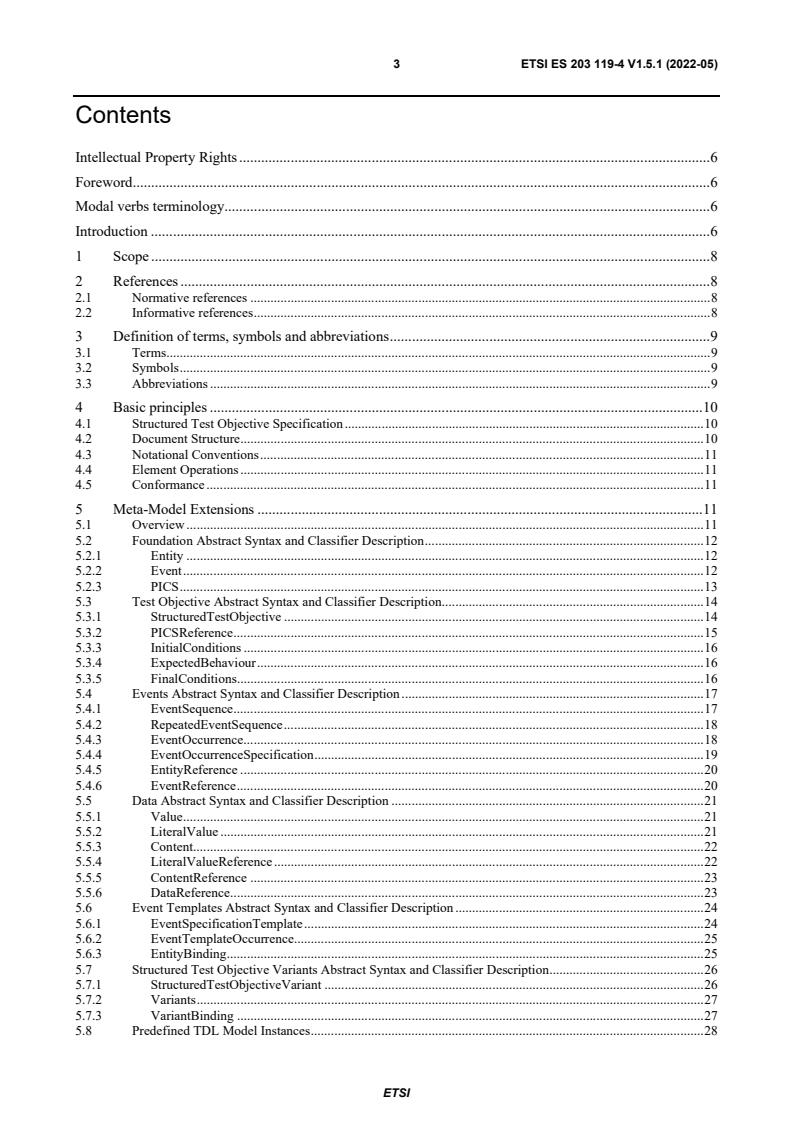
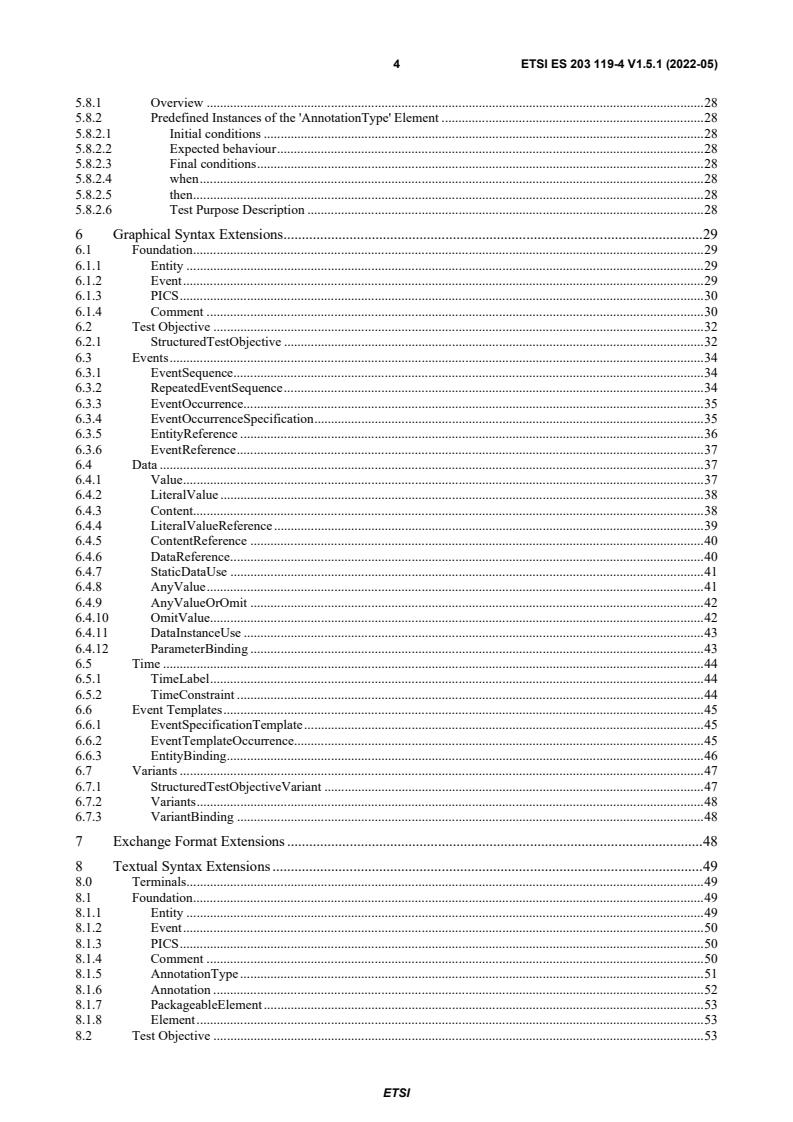
ETSI ES 203 119-4 V1.5.1 (2022-05) - Methods for Testing and Specification (MTS); The Test Description Language (TDL); Part 4: Structured Test Objective Specification ( Extension)

Overview
SIST ES 203 119-4 V1.5.1:2022, titled Methods for Testing and Specification (MTS) - The Test Description Language (TDL) - Part 4: Structured Test Objective Specification (Extension), is a key international standard published by the Slovenian Institute for Standardization (SIST), in alignment with ETSI ES 203 119-4. This document extends the Test Description Language (TDL) with capabilities for defining structured test objectives, moving beyond informal text-based objectives to formalized, meta-model-driven descriptions.
This standard addresses both the abstract syntax required for structured test objectives and their associated semantics, alongside graphical notation and textual syntax examples. It serves as both a foundation for tool development and a reference for practitioners specifying structured test objectives in model-based testing scenarios.
Key Topics
- Structured Test Objectives in TDL: The standard introduces constructs that formalize how test objectives are described, supporting improved clarity, validation, and interoperability in automated or model-based testing (MBT).
- Meta-Model Extensions: Additional elements are specified in the TDL meta-model to handle context, entities, events, initial and final conditions, expected behaviour, and variants within structured test scenarios.
- Graphical Syntax: Guidelines for the precise graphical representation of new constructs, aiding clarity in both tool development and user comprehension.
- Textual Syntax & BNF Rules: Examples and Backus-Naur Form (BNF) rules are provided for practitioners who prefer or require textual specification methods.
- Tool and User Reference: The document is designed for dual use: supporting development of TDL-compliant tools and providing clear guidance to end users working with the extended TDL syntax.
Applications
This extension to the TDL is vital for a range of industries and use-cases where rigorous, unambiguous test objectives are required:
- Model-Based Testing (MBT): Enables automated tools to interpret, visualize, and execute complex structured test objectives, enhancing efficiency and reducing ambiguity.
- Telecommunications Conformance Testing: Particularly relevant for conformance and interoperability scenarios, such as 3GPP, LTE, and IMS, where formal test purposes must be defined and validated (see also references to ETSI TS 136 523-1 and TS 186 011-2).
- Tool Development: Offers a clear reference for vendors and developers building MBT solutions or TDL-enabled test management suites, ensuring compatibility and conformance.
- Test Process Consistency: Supports standardized, formal communication of test intentions between diverse teams or organizations by grounding them in a shared, well-defined modeling language.
- Academic and Research: Facilitates formal analysis, verification, and validation of test objectives, supporting research in software engineering and testing methodologies.
Related Standards
For full effectiveness, usage of SIST ES 203 119-4 V1.5.1:2022 is supported by the following related standards:
- ETSI ES 203 119-1: Abstract Syntax and Associated Semantics for TDL
- ETSI ES 203 119-2: Graphical Syntax for TDL
- ETSI ES 203 119-3: Exchange Format enabling interoperability between tools
- ETSI ES 203 119-8: Textual Syntax for TDL
- ETSI ES 202 553: TPLan notation for expressing test purposes (provides conceptual background)
- ETSI TS 136 523-1, ETSI TS 186 011-2: Application in specific telecom conformance and interoperability scenarios
Practical Value
By formalizing test objectives within TDL, this standard significantly improves the quality, repeatability, and automation potential of test processes across information and communication technology domains. It enables standardized, machine-interpretable representations that ensure seamless integration, clearer documentation, and robust validation processes, fulfilling critical needs in advanced testing frameworks and toolchains.
Keywords: Test Description Language, TDL, structured test objectives, model-based testing, MBT, methodology, standardized syntax, conformance testing, graphical notation, software testing standard, ETSI, SIST.
Buy Documents
ETSI ES 203 119-4 V1.5.1 (2022-03) - Methods for Testing and Specification (MTS); The Test Description Language (TDL); Part 4: Structured Test Objective Specification ( Extension)
ETSI ES 203 119-4 V1.5.1 (2022-05) - Methods for Testing and Specification (MTS); The Test Description Language (TDL); Part 4: Structured Test Objective Specification ( Extension)
Get Certified
Connect with accredited certification bodies for this standard

BSI Group
BSI (British Standards Institution) is the business standards company that helps organizations make excellence a habit.

NYCE
Mexican standards and certification body.
Sponsored listings
Frequently Asked Questions
SIST ES 203 119-4 V1.5.1:2022 is a standard published by the Slovenian Institute for Standardization (SIST). Its full title is "Methods for Testing and Specification (MTS) - The Test Description Language (TDL) - Part 4: Structured Test Objective Specification (Extension)". This standard covers: The present document specifies an extension of the Test Description Language (TDL) enabling the specification of structured test objectives. The extension covers the necessary additional constructs in the abstract syntax, their semantics, as well as the concrete graphical syntactic notation for the added constructs. In addition textual syntax examples of the TDL Structured Test Objectives extensions as well as BNF rules for a textual syntax for TDL with the Structured Test Objectives extensions are provided. The intended use of the present document is to serve both as a foundation for TDL tools implementing support for the specification of structured test objectives, as well as a reference for end users applying the standardized syntax for the specification of structured test objectives with TDL. NOTE: OMG®, UML®, OCL™ and UTP™ are the trademarks of OMG (Object Management Group). This information is given for the convenience of users of the present document and does not constitute an endorsement by ETSI of the products named.
The present document specifies an extension of the Test Description Language (TDL) enabling the specification of structured test objectives. The extension covers the necessary additional constructs in the abstract syntax, their semantics, as well as the concrete graphical syntactic notation for the added constructs. In addition textual syntax examples of the TDL Structured Test Objectives extensions as well as BNF rules for a textual syntax for TDL with the Structured Test Objectives extensions are provided. The intended use of the present document is to serve both as a foundation for TDL tools implementing support for the specification of structured test objectives, as well as a reference for end users applying the standardized syntax for the specification of structured test objectives with TDL. NOTE: OMG®, UML®, OCL™ and UTP™ are the trademarks of OMG (Object Management Group). This information is given for the convenience of users of the present document and does not constitute an endorsement by ETSI of the products named.
SIST ES 203 119-4 V1.5.1:2022 is classified under the following ICS (International Classification for Standards) categories: 35.060 - Languages used in information technology. The ICS classification helps identify the subject area and facilitates finding related standards.
SIST ES 203 119-4 V1.5.1:2022 is available in PDF format for immediate download after purchase. The document can be added to your cart and obtained through the secure checkout process. Digital delivery ensures instant access to the complete standard document.
Standards Content (Sample)
Final draft ETSI ES 203 119-4 V1.5.1 (2022-03)
ETSI STANDARD
Methods for Testing and Specification (MTS);
The Test Description Language (TDL);
Part 4: Structured Test Objective Specification (Extension)
2 Final draft ETSI ES 203 119-4 V1.5.1 (2022-03)
Reference
RES/MTS-1194V151
Keywords
language, MBT, methodology, testing, TSS&TP,
TTCN-3, UML
ETSI
650 Route des Lucioles
F-06921 Sophia Antipolis Cedex - FRANCE
Tel.: +33 4 92 94 42 00 Fax: +33 4 93 65 47 16
Siret N° 348 623 562 00017 - APE 7112B
Association à but non lucratif enregistrée à la
Sous-Préfecture de Grasse (06) N° w061004871
Important notice
The present document can be downloaded from:
http://www.etsi.org/standards-search
The present document may be made available in electronic versions and/or in print. The content of any electronic and/or
print versions of the present document shall not be modified without the prior written authorization of ETSI. In case of any
existing or perceived difference in contents between such versions and/or in print, the prevailing version of an ETSI
deliverable is the one made publicly available in PDF format at www.etsi.org/deliver.
Users of the present document should be aware that the document may be subject to revision or change of status.
Information on the current status of this and other ETSI documents is available at
https://portal.etsi.org/TB/ETSIDeliverableStatus.aspx
If you find errors in the present document, please send your comment to one of the following services:
https://portal.etsi.org/People/CommiteeSupportStaff.aspx
If you find a security vulnerability in the present document, please report it through our
Coordinated Vulnerability Disclosure Program:
https://www.etsi.org/standards/coordinated-vulnerability-disclosure
Notice of disclaimer & limitation of liability
The information provided in the present deliverable is directed solely to professionals who have the appropriate degree of
experience to understand and interpret its content in accordance with generally accepted engineering or
other professional standard and applicable regulations.
No recommendation as to products and services or vendors is made or should be implied.
No representation or warranty is made that this deliverable is technically accurate or sufficient or conforms to any law
is made of merchantability or fitness
and/or governmental rule and/or regulation and further, no representation or warranty
for any particular purpose or against infringement of intellectual property rights.
In no event shall ETSI be held liable for loss of profits or any other incidental or consequential damages.
Any software contained in this deliverable is provided "AS IS" with no warranties, express or implied, including but not
limited to, the warranties of merchantability, fitness for a particular purpose and non-infringement of intellectual property
rights and ETSI shall not be held liable in any event for any damages whatsoever (including, without limitation, damages
for loss of profits, business interruption, loss of information, or any other pecuniary loss) arising out of or related to the use
of or inability to use the software.
Copyright Notification
No part may be reproduced or utilized in any form or by any means, electronic or mechanical, including photocopying and
microfilm except as authorized by written permission of ETSI.
The content of the PDF version shall not be modified without the written authorization of ETSI.
The copyright and the foregoing restriction extend to reproduction in all media.
© ETSI 2022.
All rights reserved.
ETSI
3 Final draft ETSI ES 203 119-4 V1.5.1 (2022-03)
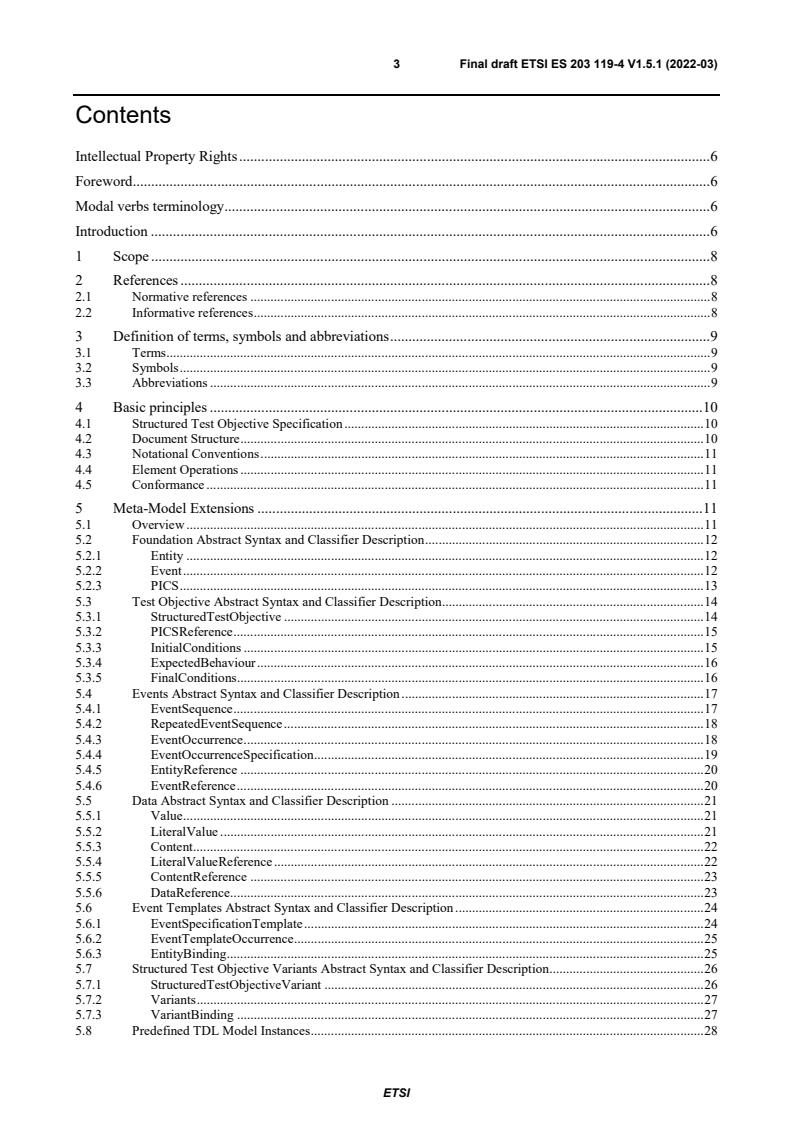
Contents
Intellectual Property Rights . 6
Foreword . 6
Modal verbs terminology . 6
Introduction . 6
1 Scope . 8
2 References . 8
2.1 Normative references . 8
2.2 Informative references . 8
3 Definition of terms, symbols and abbreviations . 9
3.1 Terms . 9
3.2 Symbols . 9
3.3 Abbreviations . 9
4 Basic principles . 10
4.1 Structured Test Objective Specification . 10
4.2 Document Structure . 10
4.3 Notational Conventions . 11
4.4 Element Operations . 11
4.5 Conformance . 11
5 Meta-Model Extensions . 11
5.1 Overview . 11
5.2 Foundation Abstract Syntax and Classifier Description . 12
5.2.1 Entity . 12
5.2.2 Event . 12
5.2.3 PICS . 13
5.3 Test Objective Abstract Syntax and Classifier Description . 14
5.3.1 StructuredTestObjective . 14
5.3.2 PICSReference . 15
5.3.3 InitialConditions . 15
5.3.4 ExpectedBehaviour . 16
5.3.5 FinalConditions . 16
5.4 Events Abstract Syntax and Classifier Description . 17
5.4.1 EventSequence . 17
5.4.2 RepeatedEventSequence . 18
5.4.3 EventOccurrence . 18
5.4.4 EventOccurrenceSpecification . 19
5.4.5 EntityReference . 20
5.4.6 EventReference . 20
5.5 Data Abstract Syntax and Classifier Description . 21
5.5.1 Value . 21
5.5.2 LiteralValue . 21
5.5.3 Content . 22
5.5.4 LiteralValueReference . 22
5.5.5 ContentReference . 23
5.5.6 DataReference . 23
5.6 Event Templates Abstract Syntax and Classifier Description . 24
5.6.1 EventSpecificationTemplate . 24
5.6.2 EventTemplateOccurrence . 25
5.6.3 EntityBinding . 25
5.7 Structured Test Objective Variants Abstract Syntax and Classifier Description . 26
5.7.1 StructuredTestObjectiveVariant . 26
5.7.2 Variants . 27
5.7.3 VariantBinding . 27
5.8 Predefined TDL Model Instances . 28
ETSI
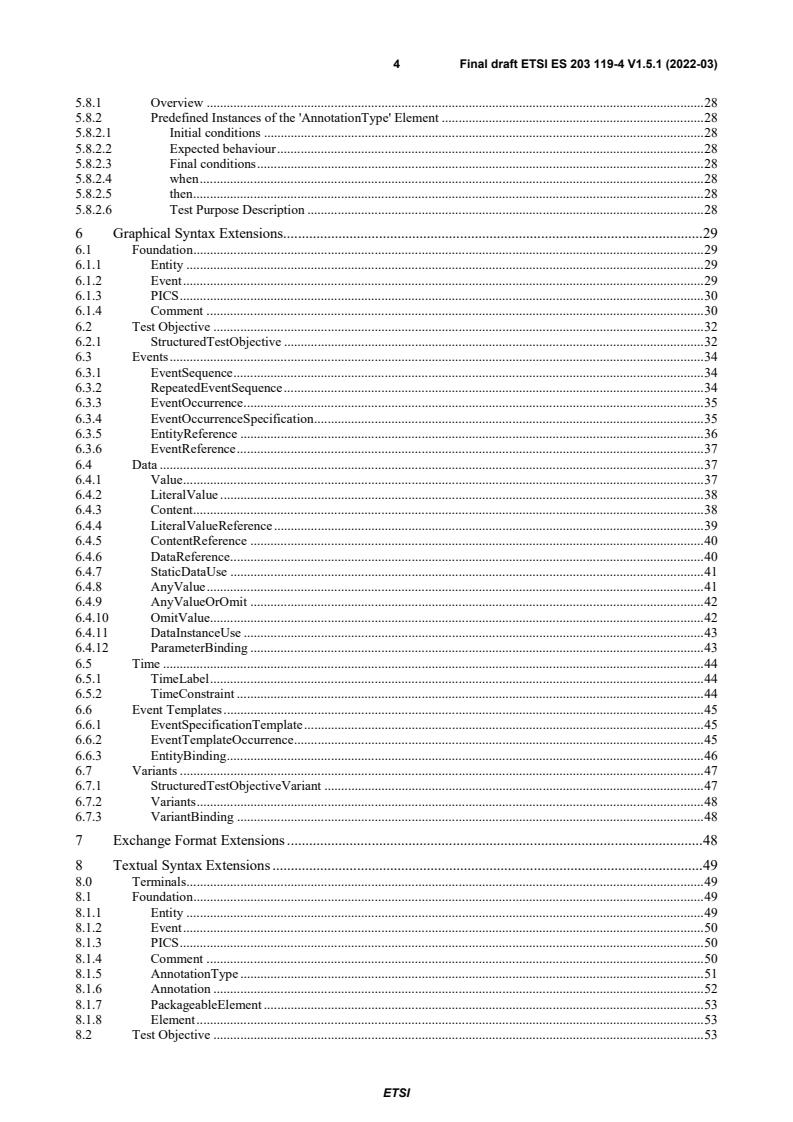
4 Final draft ETSI ES 203 119-4 V1.5.1 (2022-03)
5.8.1 Overview . 28
5.8.2 Predefined Instances of the 'AnnotationType' Element . 28
5.8.2.1 Initial conditions . 28
5.8.2.2 Expected behaviour . 28
5.8.2.3 Final conditions . 28
5.8.2.4 when . 28
5.8.2.5 then . 28
5.8.2.6 Test Purpose Description . 28
6 Graphical Syntax Extensions. 29
6.1 Foundation . 29
6.1.1 Entity . 29
6.1.2 Event . 29
6.1.3 PICS . 30
6.1.4 Comment . 30
6.2 Test Objective . 32
6.2.1 StructuredTestObjective . 32
6.3 Events . 34
6.3.1 EventSequence . 34
6.3.2 RepeatedEventSequence . 34
6.3.3 EventOccurrence . 35
6.3.4 EventOccurrenceSpecification . 35
6.3.5 EntityReference . 36
6.3.6 EventReference . 37
6.4 Data . 37
6.4.1 Value . 37
6.4.2 LiteralValue . 38
6.4.3 Content . 38
6.4.4 LiteralValueReference . 39
6.4.5 ContentReference . 40
6.4.6 DataReference . 40
6.4.7 StaticDataUse . 41
6.4.8 AnyValue . 41
6.4.9 AnyValueOrOmit . 42
6.4.10 OmitValue. 42
6.4.11 DataInstanceUse . 43
6.4.12 ParameterBinding . 43
6.5 Time . 44
6.5.1 TimeLabel . 44
6.5.2 TimeConstraint . 44
6.6 Event Templates . 45
6.6.1 EventSpecificationTemplate . 45
6.6.2 EventTemplateOccurrence . 45
6.6.3 EntityBinding . 46
6.7 Variants . 47
6.7.1 StructuredTestObjectiveVariant . 47
6.7.2 Variants . 48
6.7.3 VariantBinding . 48
7 Exchange Format Extensions . 48
8 Textual Syntax Extensions . 49
8.0 Terminals . 49
8.1 Foundation . 49
8.1.1 Entity . 49
8.1.2 Event . 50
8.1.3 PICS . 50
8.1.4 Comment . 50
8.1.5 AnnotationType . 51
8.1.6 Annotation . 52
8.1.7 PackageableElement . 53
8.1.8 Element . 53
8.2 Test Objective . 53
ETSI
5 Final draft ETSI ES 203 119-4 V1.5.1 (2022-03)
8.2.1 StructuredTestObjective . 53
8.2.2 PICSReference . 54
8.2.3 InitialConditions . 54
8.2.4 ExpectedBehaviour . 55
8.2.5 FinalConditions . 55
8.3 Events . 56
8.3.1 EventSequence . 56
8.3.2 RepeatedEventSequence . 56
8.3.3 EventOccurrence . 57
8.3.4 EventOccurrenceSpecification . 57
8.3.5 EntityReference . 58
8.3.6 EventReference . 58
8.4 Data . 59
8.4.1 Value . 59
8.4.2 LiteralValue . 59
8.4.3 Content . 60
8.4.4 LiteralValueReference . 60
8.4.5 ContentReference . 61
8.4.6 DataReference . 61
8.5 Time . 62
8.5.1 TimeLabel . 62
8.5.2 TimeConstraint . 62
8.6 Event Templates . 63
8.6.1 EventSpecificationTemplate . 63
8.6.2 EventTemplateOccurrence . 63
8.6.3 EntityBinding . 64
8.7 Variants . 64
8.7.1 StructuredTestObjectiveVariant . 64
8.7.2 Variants . 65
8.7.3 VariantBinding . 65
8.8 Behaviour . 66
8.8.1 TestDescription . 66
8.8.2 BehaviourDescription . 66
8.8.3 CompoundBehaviour . 67
8.8.4 Block . 67
Annex A (informative): Examples . 69
A.0 Overview . 69
A.1 A 3GPP Test Objective in Textual Syntax . 69
A.2 An IMS Test Objective in Textual Syntax . 70
Annex B (informative): Examples in Legacy Textual Syntax . 71
B.0 Overview . 71
B.1 A 3GPP Test Objective in Legacy Textual Syntax . 71
B.2 An IMS Test Objective in Legacy Textual Syntax . 72
Annex C (informative): Legacy Textual Syntax BNF Production Rules . 73
C.0 Overview . 73
C.1 Conventions . 73
C.2 Production Rules . 73
History . 78
ETSI
6 Final draft ETSI ES 203 119-4 V1.5.1 (2022-03)
Intellectual Property Rights
Essential patents
IPRs essential or potentially essential to normative deliverables may have been declared to ETSI. The declarations
pertaining to these essential IPRs, if any, are publicly available for ETSI members and non-members, and can be
found in ETSI SR 000 314: "Intellectual Property Rights (IPRs); Essential, or potentially Essential, IPRs notified to
ETSI in respect of ETSI standards", which is available from the ETSI Secretariat. Latest updates are available on the
ETSI Web server (https://ipr.etsi.org/).
Pursuant to the ETSI Directives including the ETSI IPR Policy, no investigation regarding the essentiality of IPRs,
including IPR searches, has been carried out by ETSI. No guarantee can be given as to the existence of other IPRs not
referenced in ETSI SR 000 314 (or the updates on the ETSI Web server) which are, or may be, or may become,
essential to the present document.
Trademarks
The present document may include trademarks and/or tradenames which are asserted and/or registered by their owners.
ETSI claims no ownership of these except for any which are indicated as being the property of ETSI, and conveys no
right to use or reproduce any trademark and/or tradename. Mention of those trademarks in the present document does
not constitute an endorsement by ETSI of products, services or organizations associated with those trademarks.
DECT™, PLUGTESTS™, UMTS™ and the ETSI logo are trademarks of ETSI registered for the benefit of its
Members. 3GPP™ and LTE™ are trademarks of ETSI registered for the benefit of its Members and of the 3GPP
Organizational Partners. oneM2M™ logo is a trademark of ETSI registered for the benefit of its Members and of the ®
oneM2M Partners. GSM and the GSM logo are trademarks registered and owned by the GSM Association.
Foreword
This final draft ETSI Standard (ES) has been produced by ETSI Technical Committee Methods for Testing and
Specification (MTS), and is now submitted for the ETSI standards Membership Approval Procedure.
The present document is part 4 of a multi-part deliverable. Full details of the entire series can be found in part 1 [1].
Modal verbs terminology
In the present document "shall", "shall not", "should", "should not", "may", "need not", "will", "will not", "can" and
"cannot" are to be interpreted as described in clause 3.2 of the ETSI Drafting Rules (Verbal forms for the expression of
provisions).
"must" and "must not" are NOT allowed in ETSI deliverables except when used in direct citation.
Introduction
Test purposes play an essential role in test specification processes at ETSI. Currently, TDL treats test purposes and test
objectives in general as informal text without any additional structural constraints. This extension package for TDL
refines and formalizes test objective specification within TDL by introducing relevant meta-model concepts and a
corresponding syntactical notation, both of which are related to TPLan ETSI ES 202 553 [i.1] and TPLan-like notations
already established at ETSI. This enables test purpose specification to enter the modelling world and paves the way for
improved tool support and better structured test objectives, as well as additional formal verification and validation
facilities down the road by integrating and unifying the means for the specification of test purposes and test
descriptions, while relying on the same underlying meta-model and benefiting from other related technologies built
around this meta-model.
ETSI
7 Final draft ETSI ES 203 119-4 V1.5.1 (2022-03)
The present document describes the relevant abstract syntax (meta-model) extensions as well as the corresponding
concrete syntactical notation.
NOTE: The use of underline (additional text) and strikethrough (deleted text) highlights the differences between
base document and extended documents.
ETSI
8 Final draft ETSI ES 203 119-4 V1.5.1 (2022-03)
1 Scope
The present document specifies an extension of the Test Description Language (TDL) enabling the specification of
structured test objectives. The extension covers the necessary additional constructs in the abstract syntax, their
semantics, as well as the concrete graphical syntactic notation for the added constructs. In addition textual syntax
examples of the TDL Structured Test Objectives extensions as well as BNF rules for a textual syntax for TDL with the
Structured Test Objectives extensions are provided. The intended use of the present document is to serve both as a
foundation for TDL tools implementing support for the specification of structured test objectives, as well as a reference
for end users applying the standardized syntax for the specification of structured test objectives with TDL.
® ®
NOTE: OMG , UML , OCL™ and UTP™ are the trademarks of OMG (Object Management Group). This
information is given for the convenience of users of the present document and does not constitute an
endorsement by ETSI of the products named.
2 References
2.1 Normative references
References are either specific (identified by date of publication and/or edition number or version number) or
non-specific. For specific references, only the cited version applies. For non-specific references, the latest version of the
referenced document (including any amendments) applies.
Referenced documents which are not found to be publicly available in the expected location might be found at
https://docbox.etsi.org/Reference/.
NOTE: While any hyperlinks included in this clause were valid at the time of publication, ETSI cannot guarantee
their long term validity.
The following referenced documents are necessary for the application of the present document.
[1] ETSI ES 203 119-1 (V1.6.1): "Methods for Testing and Specification (MTS); The Test
Description Language (TDL); Part 1: Abstract Syntax and Associated Semantics".
[2] ETSI ES 203 119-2 (V1.5.1): "Methods for Testing and Specification (MTS); The Test
Description Language (TDL); Part 2: Graphical Syntax".
[3] ETSI ES 203 119-3 (V1.5.1): "Methods for Testing and Specification (MTS); The Test
Description Language (TDL); Part 3: Exchange Format".
[4] ETSI ES 203 119-8 (V1.1.1): "Methods for Testing and Specification (MTS); The Test
Description Language (TDL); Part 8: Textual Syntax".
2.2 Informative references
References are either specific (identified by date of publication and/or edition number or version number) or
non-specific. For specific references, only the cited version applies. For non-specific references, the latest version of the
referenced document (including any amendments) applies.
NOTE: While any hyperlinks included in this clause were valid at the time of publication, ETSI cannot guarantee
their long term validity.
The following referenced documents are not necessary for the application of the present document but they assist the
user with regard to a particular subject area.
[i.1] ETSI ES 202 553 (V1.2.1): "Methods for Testing and Specification (MTS); TPLan: A notation for
expressing Test Purposes".
ETSI
9 Final draft ETSI ES 203 119-4 V1.5.1 (2022-03)
[i.2] ETSI TS 136 523-1 (V10.2.0): "LTE; Evolved Universal Terrestrial Radio Access (E-UTRA) and
Evolved Packet Core (EPC); User Equipment (UE) conformance specification; Part 1: Protocol
conformance specification (3GPP TS 36.523-1 version 10.2.0 Release 10)".
[i.3] ETSI TS 186 011-2: "Core Network and Interoperability Testing (INT); IMS NNI Interoperability
Test Specifications (3GPP Release 10); Part 2: Test descriptions for IMS NNI Interoperability".
[i.4] ETSI: The TDL Open Source Project Website.
NOTE: Available at https://tdl.etsi.org/index.php/open-source.
3 Definition of terms, symbols and abbreviations
3.1 Terms
For the purposes of the present document, the terms given in ETSI ES 203 119-1 [1], ETSI ES 203 119-2 [2], ETSI
ES 203 119-3 [3], ETSI ES 203 119-8 [4] and the following apply:
context: set of circumstances related to the occurrence of an event
entity: object that may be involved in the occurrence of an event as part of a specific context
entity type: alias for additional meta-information that may be used to describe one or more entities
event: observable phenomenon or state that may occur in a specific context
NOTE: Related to a term of the same name defined in ETSI ES 202 553 [i.1].
event occurrence: description of the occurrence of an event in a specific context
event type: alias for additional meta-information that may be used to describe one or more events
3.2 Symbols
Void.
3.3 Abbreviations
For the purposes of the present document, the following abbreviations apply:
BNF Backus-Naur Form
EBNF Extended Backus-Naur Form
IMS IP Multimedia Subsystem
IUT Implementation Under Test
OCL Object Constraint Language™
PICS Protocol Implementation Conformance Statement
SUT System Under Test
TDL Test Description Language
TPLan Test Purpose Notation
ETSI
10 Final draft ETSI ES 203 119-4 V1.5.1 (2022-03)
4 Basic principles
4.1 Structured Test Objective Specification
The present document defines an extension for TDL enabling the specification of structured test objectives. Rather than
rely on external documents or informal text provided by the default test objective specification facilities of TDL, this
extension enables users to describe test objectives in a more structured and formalized manner which may enable
subsequent generation of test description skeletons and consistency checking against test descriptions realizing a given
test objective. In addition, the structured approach to test objective specification also enables syntactical and semantical
consistency checking of the test objectives themselves.
The abstract concepts and the concrete syntax are based on TPLan ETSI ES 202 553 [i.1] to a large extent, as they also
reflect concepts and practices already established at ETSI. The fundamental concept in the specification of a structured
test objectives is the event occurrence which describes the occurrence of an abstract event in a specific context,
comprising one or more involved entities, an event argument, as well as a time label and/or a time constraint.
Events and entities referenced in an event occurrence shall be defined in advance as part of a domain description which
may then be reused across all structured test objective specifications in that domain. An entity is an abstract
representation of an object involved in an event occurrence that may be realized as a component instance or a gate
instance within a test description realizing the structured test objective.
An event argument may either refer to a data instance for data already defined with the facilities provided by TDL, or,
following a more light weight approach, describe data inline without the need to define all data types and instances in
advance. Pre-defined data and inline data may be integrated to a certain degree. Inline data may refer to pre-defined
data, but pre-defined data shall not refer to inline data.
Event occurrence specifications are organized in the different compartments of a structured test objective, including
initial conditions, expected behaviour, and final conditions. Multiple event occurrences are combined by means of an
'and' or 'or' operand indicating how subsequent event occurrences are related to each other (as a sequence or as
alternatives, respectively).
Structured test objectives may also include references to PICS which may be used as selection criteria for the concrete
realization of the test objectives. The PICS shall be defined in advance as part of the domain description. Multiple PICS
references within the same structured test objective are combined by means of an 'and' or 'or' operand indicating how
subsequent referenced PICS are related to each other.
Test objective variants may be included in a structured test objective to describe additional test objectives derived from
the structured test objective by specialising or overriding data elements and meta information.
4.2 Document Structure
The present document defines the structured test objective specification extension for TDL comprising:
• Meta-model extension describing additional concepts required for the specification of structured test objectives
(clause 5).
• Graphical concrete syntax extension describing corresponding shapes for the representation of the additional
concepts (clause 6).
• Exchange format extension describing corresponding representation of the additional concepts (clause 7).
• Textual concrete syntax extension describing corresponding derivations for the representation of the additional
concepts (clause 8).
• An informative annex with examples in a textual concrete syntax (annex A).
• An informative annex with production rules for the example textual syntax (annex B).
ETSI
11 Final draft ETSI ES 203 119-4 V1.5.1 (2022-03)
4.3 Notational Conventions
The present document inherits the notational conventions defined in ETSI ES 203 119-1 [1], ETSI ES 203 119-2 [2],
and ETSI ES 203 119-8 [4].
The abstract syntax specification and the classifier descriptions follow the notational conventions defined in clause 4.5
of Abstract Syntax and Associated Semantics [1]. The concrete syntax notation specification for the graphical syntax
extensions follows the notational conventions described in clause 4.5 of the Graphical Syntax [2]. The concrete syntax
notation specification for the textual syntax extensions follows the basic principles described in clause 4.3 of the
Textual Syntax [4] and the general rules described in clause 5 of the Textual Syntax [4].
4.4 Element Operations
The following operations shall be provided in an implementation of the TDL-TO extension to the TDL meta-model in
order to ensure the semantic integrity of TDL-TO models, in addition to the operations defined for the TDL meta-model
in ETSI ES 203 119-1 [1]. The operations are also used as reusable shortcuts for the specification of the formalized
constraints and are required for their interpretation, in addition to the operations provided by the standard library of
OCL:
• OclAny getTestObjective (): StructuredTestObjective - applicable on any TDL 'Element', returns the
'StructuredTestObjective' that contains the construct di
...
ETSI STANDARD
Methods for Testing and Specification (MTS);
The Test Description Language (TDL);
Part 4: Structured Test Objective Specification (Extension)
2 ETSI ES 203 119-4 V1.5.1 (2022-05)
Reference
RES/MTS-1194v151
Keywords
language, MBT, methodology, testing, TSS&TP,
TTCN-3, UML
ETSI
650 Route des Lucioles
F-06921 Sophia Antipolis Cedex - FRANCE
Tel.: +33 4 92 94 42 00 Fax: +33 4 93 65 47 16
Siret N° 348 623 562 00017 - APE 7112B
Association à but non lucratif enregistrée à la
Sous-Préfecture de Grasse (06) N° w061004871
Important notice
The present document can be downloaded from:
http://www.etsi.org/standards-search
The present document may be made available in electronic versions and/or in print. The content of any electronic and/or
print versions of the present document shall not be modified without the prior written authorization of ETSI. In case of any
existing or perceived difference in contents between such versions and/or in print, the prevailing version of an ETSI
deliverable is the one made publicly available in PDF format at www.etsi.org/deliver.
Users of the present document should be aware that the document may be subject to revision or change of status.
Information on the current status of this and other ETSI documents is available at
https://portal.etsi.org/TB/ETSIDeliverableStatus.aspx
If you find errors in the present document, please send your comment to one of the following services:
https://portal.etsi.org/People/CommiteeSupportStaff.aspx
If you find a security vulnerability in the present document, please report it through our
Coordinated Vulnerability Disclosure Program:
https://www.etsi.org/standards/coordinated-vulnerability-disclosure
Notice of disclaimer & limitation of liability
The information provided in the present deliverable is directed solely to professionals who have the appropriate degree of
experience to understand and interpret its content in accordance with generally accepted engineering or
other professional standard and applicable regulations.
No recommendation as to products and services or vendors is made or should be implied.
No representation or warranty is made that this deliverable is technically accurate or sufficient or conforms to any law
rule and/or regulation and further, no representation or warranty is made of merchantability or fitness
and/or governmental
for any particular purpose or against infringement of intellectual property rights.
In no event shall ETSI be held liable for loss of profits or any other incidental or consequential damages.
Any software contained in this deliverable is provided "AS IS" with no warranties, express or implied, including but not
limited to, the warranties of merchantability, fitness for a particular purpose and non-infringement of intellectual property
rights and ETSI shall not be held liable in any event for any damages whatsoever (including, without limitation, damages
for loss of profits, business interruption, loss of information, or any other pecuniary loss) arising out of or related to the use
of or inability to use the software.
Copyright Notification
No part may be reproduced or utilized in any form or by any means, electronic or mechanical, including photocopying and
microfilm except as authorized by written permission of ETSI.
The content of the PDF version shall not be modified without the written authorization of ETSI.
The copyright and the foregoing restriction extend to reproduction in all media.
© ETSI 2022.
All rights reserved.
ETSI
3 ETSI ES 203 119-4 V1.5.1 (2022-05)
Contents
Intellectual Property Rights . 6
Foreword . 6
Modal verbs terminology . 6
Introduction . 6
1 Scope . 8
2 References . 8
2.1 Normative references . 8
2.2 Informative references . 8
3 Definition of terms, symbols and abbreviations . 9
3.1 Terms . 9
3.2 Symbols . 9
3.3 Abbreviations . 9
4 Basic principles . 10
4.1 Structured Test Objective Specification . 10
4.2 Document Structure . 10
4.3 Notational Conventions . 11
4.4 Element Operations . 11
4.5 Conformance . 11
5 Meta-Model Extensions . 11
5.1 Overview . 11
5.2 Foundation Abstract Syntax and Classifier Description . 12
5.2.1 Entity . 12
5.2.2 Event . 12
5.2.3 PICS . 13
5.3 Test Objective Abstract Syntax and Classifier Description . 14
5.3.1 StructuredTestObjective . 14
5.3.2 PICSReference . 15
5.3.3 InitialConditions . 16
5.3.4 ExpectedBehaviour . 16
5.3.5 FinalConditions . 16
5.4 Events Abstract Syntax and Classifier Description . 17
5.4.1 EventSequence . 17
5.4.2 RepeatedEventSequence . 18
5.4.3 EventOccurrence . 18
5.4.4 EventOccurrenceSpecification . 19
5.4.5 EntityReference . 20
5.4.6 EventReference . 20
5.5 Data Abstract Syntax and Classifier Description . 21
5.5.1 Value . 21
5.5.2 LiteralValue . 21
5.5.3 Content . 22
5.5.4 LiteralValueReference . 22
5.5.5 ContentReference . 23
5.5.6 DataReference . 23
5.6 Event Templates Abstract Syntax and Classifier Description . 24
5.6.1 EventSpecificationTemplate . 24
5.6.2 EventTemplateOccurrence . 25
5.6.3 EntityBinding . 25
5.7 Structured Test Objective Variants Abstract Syntax and Classifier Description . 26
5.7.1 StructuredTestObjectiveVariant . 26
5.7.2 Variants . 27
5.7.3 VariantBinding . 27
5.8 Predefined TDL Model Instances . 28
ETSI
4 ETSI ES 203 119-4 V1.5.1 (2022-05)
5.8.1 Overview . 28
5.8.2 Predefined Instances of the 'AnnotationType' Element . 28
5.8.2.1 Initial conditions . 28
5.8.2.2 Expected behaviour . 28
5.8.2.3 Final conditions . 28
5.8.2.4 when . 28
5.8.2.5 then . 28
5.8.2.6 Test Purpose Description . 28
6 Graphical Syntax Extensions. 29
6.1 Foundation . 29
6.1.1 Entity . 29
6.1.2 Event . 29
6.1.3 PICS . 30
6.1.4 Comment . 30
6.2 Test Objective . 32
6.2.1 StructuredTestObjective . 32
6.3 Events . 34
6.3.1 EventSequence . 34
6.3.2 RepeatedEventSequence . 34
6.3.3 EventOccurrence . 35
6.3.4 EventOccurrenceSpecification . 35
6.3.5 EntityReference . 36
6.3.6 EventReference . 37
6.4 Data . 37
6.4.1 Value . 37
6.4.2 LiteralValue . 38
6.4.3 Content . 38
6.4.4 LiteralValueReference . 39
6.4.5 ContentReference . 40
6.4.6 DataReference . 40
6.4.7 StaticDataUse . 41
6.4.8 AnyValue . 41
6.4.9 AnyValueOrOmit . 42
6.4.10 OmitValue. 42
6.4.11 DataInstanceUse . 43
6.4.12 ParameterBinding . 43
6.5 Time . 44
6.5.1 TimeLabel . 44
6.5.2 TimeConstraint . 44
6.6 Event Templates . 45
6.6.1 EventSpecificationTemplate . 45
6.6.2 EventTemplateOccurrence . 45
6.6.3 EntityBinding . 46
6.7 Variants . 47
6.7.1 StructuredTestObjectiveVariant . 47
6.7.2 Variants . 48
6.7.3 VariantBinding . 48
7 Exchange Format Extensions . 48
8 Textual Syntax Extensions . 49
8.0 Terminals . 49
8.1 Foundation . 49
8.1.1 Entity . 49
8.1.2 Event . 50
8.1.3 PICS . 50
8.1.4 Comment . 50
8.1.5 AnnotationType . 51
8.1.6 Annotation . 52
8.1.7 PackageableElement . 53
8.1.8 Element . 53
8.2 Test Objective . 53
ETSI
5 ETSI ES 203 119-4 V1.5.1 (2022-05)
8.2.1 StructuredTestObjective . 53
8.2.2 PICSReference . 54
8.2.3 InitialConditions . 54
8.2.4 ExpectedBehaviour . 55
8.2.5 FinalConditions . 55
8.3 Events . 56
8.3.1 EventSequence . 56
8.3.2 RepeatedEventSequence . 56
8.3.3 EventOccurrence . 57
8.3.4 EventOccurrenceSpecification . 57
8.3.5 EntityReference . 58
8.3.6 EventReference . 58
8.4 Data . 59
8.4.1 Value . 59
8.4.2 LiteralValue . 59
8.4.3 Content . 60
8.4.4 LiteralValueReference . 60
8.4.5 ContentReference . 61
8.4.6 DataReference . 61
8.5 Time . 62
8.5.1 TimeLabel . 62
8.5.2 TimeConstraint . 62
8.6 Event Templates . 63
8.6.1 EventSpecificationTemplate . 63
8.6.2 EventTemplateOccurrence . 63
8.6.3 EntityBinding . 64
8.7 Variants . 64
8.7.1 StructuredTestObjectiveVariant . 64
8.7.2 Variants . 65
8.7.3 VariantBinding . 65
8.8 Behaviour . 66
8.8.1 TestDescription . 66
8.8.2 BehaviourDescription . 66
8.8.3 CompoundBehaviour . 67
8.8.4 Block . 67
Annex A (informative): Examples . 69
A.0 Overview . 69
A.1 A 3GPP Test Objective in Textual Syntax . 69
A.2 An IMS Test Objective in Textual Syntax . 70
Annex B (informative): Examples in Legacy Textual Syntax . 71
B.0 Overview . 71
B.1 A 3GPP Test Objective in Legacy Textual Syntax . 71
B.2 An IMS Test Objective in Legacy Textual Syntax . 72
Annex C (informative): Legacy Textual Syntax BNF Production Rules . 73
C.0 Overview . 73
C.1 Conventions . 73
C.2 Production Rules . 73
History . 78
ETSI
6 ETSI ES 203 119-4 V1.5.1 (2022-05)
Intellectual Property Rights
Essential patents
IPRs essential or potentially essential to normative deliverables may have been declared to ETSI. The declarations
pertaining to these essential IPRs, if any, are publicly available for ETSI members and non-members, and can be
found in ETSI SR 000 314: "Intellectual Property Rights (IPRs); Essential, or potentially Essential, IPRs notified to
ETSI in respect of ETSI standards", which is available from the ETSI Secretariat. Latest updates are available on the
ETSI Web server (https://ipr.etsi.org/).
Pursuant to the ETSI Directives including the ETSI IPR Policy, no investigation regarding the essentiality of IPRs,
including IPR searches, has been carried out by ETSI. No guarantee can be given as to the existence of other IPRs not
referenced in ETSI SR 000 314 (or the updates on the ETSI Web server) which are, or may be, or may become,
essential to the present document.
Trademarks
The present document may include trademarks and/or tradenames which are asserted and/or registered by their owners.
ETSI claims no ownership of these except for any which are indicated as being the property of ETSI, and conveys no
right to use or reproduce any trademark and/or tradename. Mention of those trademarks in the present document does
not constitute an endorsement by ETSI of products, services or organizations associated with those trademarks.
DECT™, PLUGTESTS™, UMTS™ and the ETSI logo are trademarks of ETSI registered for the benefit of its
Members. 3GPP™ and LTE™ are trademarks of ETSI registered for the benefit of its Members and of the 3GPP
Organizational Partners. oneM2M™ logo is a trademark of ETSI registered for the benefit of its Members and of the ®
oneM2M Partners. GSM and the GSM logo are trademarks registered and owned by the GSM Association.
Foreword
This ETSI Standard (ES) has been produced by ETSI Technical Committee Methods for Testing and Specification
(MTS).
The present document is part 4 of a multi-part deliverable. Full details of the entire series can be found in part 1 [1].
Modal verbs terminology
In the present document "shall", "shall not", "should", "should not", "may", "need not", "will", "will not", "can" and
"cannot" are to be interpreted as described in clause 3.2 of the ETSI Drafting Rules (Verbal forms for the expression of
provisions).
"must" and "must not" are NOT allowed in ETSI deliverables except when used in direct citation.
Introduction
Test purposes play an essential role in test specification processes at ETSI. Currently, TDL treats test purposes and test
objectives in general as informal text without any additional structural constraints. This extension package for TDL
refines and formalizes test objective specification within TDL by introducing relevant meta-model concepts and a
corresponding syntactical notation, both of which are related to TPLan ETSI ES 202 553 [i.1] and TPLan-like notations
already established at ETSI. This enables test purpose specification to enter the modelling world and paves the way for
improved tool support and better structured test objectives, as well as additional formal verification and validation
facilities down the road by integrating and unifying the means for the specification of test purposes and test
descriptions, while relying on the same underlying meta-model and benefiting from other related technologies built
around this meta-model.
ETSI
7 ETSI ES 203 119-4 V1.5.1 (2022-05)
The present document describes the relevant abstract syntax (meta-model) extensions as well as the corresponding
concrete syntactical notation.
NOTE: The use of underline (additional text) and strikethrough (deleted text) highlights the differences between
base document and extended documents.
ETSI
8 ETSI ES 203 119-4 V1.5.1 (2022-05)
1 Scope
The present document specifies an extension of the Test Description Language (TDL) enabling the specification of
structured test objectives. The extension covers the necessary additional constructs in the abstract syntax, their
semantics, as well as the concrete graphical syntactic notation for the added constructs. In addition textual syntax
examples of the TDL Structured Test Objectives extensions as well as BNF rules for a textual syntax for TDL with the
Structured Test Objectives extensions are provided. The intended use of the present document is to serve both as a
foundation for TDL tools implementing support for the specification of structured test objectives, as well as a reference
for end users applying the standardized syntax for the specification of structured test objectives with TDL.
® ®
NOTE: OMG , UML , OCL™ and UTP™ are the trademarks of OMG (Object Management Group). This
information is given for the convenience of users of the present document and does not constitute an
endorsement by ETSI of the products named.
2 References
2.1 Normative references
References are either specific (identified by date of publication and/or edition number or version number) or
non-specific. For specific references, only the cited version applies. For non-specific references, the latest version of the
referenced document (including any amendments) applies.
Referenced documents which are not found to be publicly available in the expected location might be found at
https://docbox.etsi.org/Reference/.
NOTE: While any hyperlinks included in this clause were valid at the time of publication, ETSI cannot guarantee
their long term validity.
The following referenced documents are necessary for the application of the present document.
[1] ETSI ES 203 119-1 (V1.6.1): "Methods for Testing and Specification (MTS); The Test
Description Language (TDL); Part 1: Abstract Syntax and Associated Semantics".
[2] ETSI ES 203 119-2 (V1.5.1): "Methods for Testing and Specification (MTS); The Test
Description Language (TDL); Part 2: Graphical Syntax".
[3] ETSI ES 203 119-3 (V1.5.1): "Methods for Testing and Specification (MTS); The Test
Description Language (TDL); Part 3: Exchange Format".
[4] ETSI ES 203 119-8 (V1.1.1): "Methods for Testing and Specification (MTS); The Test
Description Language (TDL); Part 8: Textual Syntax".
2.2 Informative references
References are either specific (identified by date of publication and/or edition number or version number) or
non-specific. For specific references, only the cited version applies. For non-specific references, the latest version of the
referenced document (including any amendments) applies.
NOTE: While any hyperlinks included in this clause were valid at the time of publication, ETSI cannot guarantee
their long term validity.
The following referenced documents are not necessary for the application of the present document but they assist the
user with regard to a particular subject area.
[i.1] ETSI ES 202 553 (V1.2.1): "Methods for Testing and Specification (MTS); TPLan: A notation for
expressing Test Purposes".
ETSI
9 ETSI ES 203 119-4 V1.5.1 (2022-05)
[i.2] ETSI TS 136 523-1 (V10.2.0): "LTE; Evolved Universal Terrestrial Radio Access (E-UTRA) and
Evolved Packet Core (EPC); User Equipment (UE) conformance specification; Part 1: Protocol
conformance specification (3GPP TS 36.523-1 version 10.2.0 Release 10)".
[i.3] ETSI TS 186 011-2: "Core Network and Interoperability Testing (INT); IMS NNI Interoperability
Test Specifications (3GPP Release 10); Part 2: Test descriptions for IMS NNI Interoperability".
[i.4] ETSI: The TDL Open Source Project Website.
NOTE: Available at https://tdl.etsi.org/index.php/open-source.
3 Definition of terms, symbols and abbreviations
3.1 Terms
For the purposes of the present document, the terms given in ETSI ES 203 119-1 [1], ETSI ES 203 119-2 [2], ETSI
ES 203 119-3 [3], ETSI ES 203 119-8 [4] and the following apply:
context: set of circumstances related to the occurrence of an event
entity: object that may be involved in the occurrence of an event as part of a specific context
entity type: alias for additional meta-information that may be used to describe one or more entities
event: observable phenomenon or state that may occur in a specific context
NOTE: Related to a term of the same name defined in ETSI ES 202 553 [i.1].
event occurrence: description of the occurrence of an event in a specific context
event type: alias for additional meta-information that may be used to describe one or more events
3.2 Symbols
Void.
3.3 Abbreviations
For the purposes of the present document, the following abbreviations apply:
BNF Backus-Naur Form
EBNF Extended Backus-Naur Form
IMS IP Multimedia Subsystem
IUT Implementation Under Test
OCL Object Constraint Language™
PICS Protocol Implementation Conformance Statement
SUT System Under Test
TDL Test Description Language
TPLan Test Purpose Notation
ETSI
10 ETSI ES 203 119-4 V1.5.1 (2022-05)
4 Basic principles
4.1 Structured Test Objective Specification
The present document defines an extension for TDL enabling the specification of structured test objectives. Rather than
rely on external documents or informal text provided by the default test objective specification facilities of TDL, this
extension enables users to describe test objectives in a more structured and formalized manner which may enable
subsequent generation of test description skeletons and consistency checking against test descriptions realizing a given
test objective. In addition, the structured approach to test objective specification also enables syntactical and semantical
consistency checking of the test objectives themselves.
The abstract concepts and the concrete syntax are based on TPLan ETSI ES 202 553 [i.1] to a large extent, as they also
reflect concepts and practices already established at ETSI. The fundamental concept in the specification of a structured
test objectives is the event occurrence which describes the occurrence of an abstract event in a specific context,
comprising one or more involved entities, an event argument, as well as a time label and/or a time constraint.
Events and entities referenced in an event occurrence shall be defined in advance as part of a domain description which
may then be reused across all structured test objective specifications in that domain. An entity is an abstract
representation of an object involved in an event occurrence that may be realized as a component instance or a gate
instance within a test description realizing the structured test objective.
An event argument may either refer to a data instance for data already defined with the facilities provided by TDL, or,
following a more light weight approach, describe data inline without the need to define all data types and instances in
advance. Pre-defined data and inline data may be integrated to a certain degree. Inline data may refer to pre-defined
data, but pre-defined data shall not refer to inline data.
Event occurrence specifications are organized in the different compartments of a structured test objective, including
initial conditions, expected behaviour, and final conditions. Multiple event occurrences are combined by means of an
'and' or 'or' operand indicating how subsequent event occurrences are related to each other (as a sequence or as
alternatives, respectively).
Structured test objectives may also include references to PICS which may be used as selection criteria for the concrete
realization of the test objectives. The PICS shall be defined in advance as part of the domain description. Multiple PICS
references within the same structured test objective are combined by means of an 'and' or 'or' operand indicating how
subsequent referenced PICS are related to each other.
Test objective variants may be included in a structured test objective to describe additional test objectives derived from
the structured test objective by specialising or overriding data elements and meta information.
4.2 Document Structure
The present document defines the structured test objective specification extension for TDL comprising:
• Meta-model extension describing additional concepts required for the specification of structured test objectives
(clause 5).
• Graphical concrete syntax extension describing corresponding shapes for the representation of the additional
concepts (clause 6).
• Exchange format extension describing corresponding representation of the additional concepts (clause 7).
• Textual concrete syntax extension describing corresponding derivations for the representation of the additional
concepts (clause 8).
• An informative annex with examples in a textual concrete syntax (annex A).
• An informative annex with production rules for the example textual syntax (annex B).
ETSI
11 ETSI ES 203 119-4 V1.5.1 (2022-05)
4.3 Notational Conventions
The present document inherits the notational conventions defined in ETSI ES 203 119-1 [1], ETSI ES 203 119-2 [2],
and ETSI ES 203 119-8 [4].
The abstract syntax specification and the classifier descriptions follow the notational conventions defined in clause 4.5
of Abstract Syntax and Associated Semantics [1]. The concrete syntax notation specification for the graphical syntax
extensions follows the notational conventions described in clause 4.5 of the Graphical Syntax [2]. The concrete syntax
notation specification for the textual syntax extensions follows the basic principles described in clause 4.3 of the
Textual Syntax [4] and the general rules described in clause 5 of the Textual Syntax [4].
4.4 Element Operations
The following operations shall be provided in an implementation of the TDL-TO extension to the TDL meta-model in
order to ensure the semantic integrity of TDL-TO models, in addition to the operations defined for the TDL meta-model
in ETSI ES 203 119-1 [1]. The operations are also used as reusable shortcuts for the specification of the formalized
constraints and are required for their interpretation, in addition to the operations provided by the standard library of
OCL:
• OclAny getTestObjective (): StructuredTestObjective - applicable on any TDL 'Element', returns the
'StructuredTestObjective' that contains the construct directly or indirectly.
• OclAny contains (object: OclAny): Boolean - applicable on any TDL 'Element', accepts a TDL 'Element' as
parameter 'object', returns 'true' if the 'Element' contains the 'object' and 'false' otherwise.
•
...
SLOVENSKI STANDARD
01-september-2022
Metode za preskušanje in specificiranje (MTS) - Jezik za opis preskusa (TDL) - 4.
del: Specifikacija cilja strukturiranega preskušanja (razširitev)
Methods for Testing and Specification (MTS) - The Test Description Language (TDL) -
Part 4: Structured Test Objective Specification (Extension)
Ta slovenski standard je istoveten z: ETSI ES 203 119-4 V1.5.1 (2022-05)
ICS:
35.060 Jeziki, ki se uporabljajo v Languages used in
informacijski tehniki in information technology
tehnologiji
2003-01.Slovenski inštitut za standardizacijo. Razmnoževanje celote ali delov tega standarda ni dovoljeno.
ETSI STANDARD
Methods for Testing and Specification (MTS);
The Test Description Language (TDL);
Part 4: Structured Test Objective Specification (Extension)
2 ETSI ES 203 119-4 V1.5.1 (2022-05)
Reference
RES/MTS-1194v151
Keywords
language, MBT, methodology, testing, TSS&TP,
TTCN-3, UML
ETSI
650 Route des Lucioles
F-06921 Sophia Antipolis Cedex - FRANCE
Tel.: +33 4 92 94 42 00 Fax: +33 4 93 65 47 16
Siret N° 348 623 562 00017 - APE 7112B
Association à but non lucratif enregistrée à la
Sous-Préfecture de Grasse (06) N° w061004871
Important notice
The present document can be downloaded from:
http://www.etsi.org/standards-search
The present document may be made available in electronic versions and/or in print. The content of any electronic and/or
print versions of the present document shall not be modified without the prior written authorization of ETSI. In case of any
existing or perceived difference in contents between such versions and/or in print, the prevailing version of an ETSI
deliverable is the one made publicly available in PDF format at www.etsi.org/deliver.
Users of the present document should be aware that the document may be subject to revision or change of status.
Information on the current status of this and other ETSI documents is available at
https://portal.etsi.org/TB/ETSIDeliverableStatus.aspx
If you find errors in the present document, please send your comment to one of the following services:
https://portal.etsi.org/People/CommiteeSupportStaff.aspx
If you find a security vulnerability in the present document, please report it through our
Coordinated Vulnerability Disclosure Program:
https://www.etsi.org/standards/coordinated-vulnerability-disclosure
Notice of disclaimer & limitation of liability
The information provided in the present deliverable is directed solely to professionals who have the appropriate degree of
experience to understand and interpret its content in accordance with generally accepted engineering or
other professional standard and applicable regulations.
No recommendation as to products and services or vendors is made or should be implied.
No representation or warranty is made that this deliverable is technically accurate or sufficient or conforms to any law
rule and/or regulation and further, no representation or warranty is made of merchantability or fitness
and/or governmental
for any particular purpose or against infringement of intellectual property rights.
In no event shall ETSI be held liable for loss of profits or any other incidental or consequential damages.
Any software contained in this deliverable is provided "AS IS" with no warranties, express or implied, including but not
limited to, the warranties of merchantability, fitness for a particular purpose and non-infringement of intellectual property
rights and ETSI shall not be held liable in any event for any damages whatsoever (including, without limitation, damages
for loss of profits, business interruption, loss of information, or any other pecuniary loss) arising out of or related to the use
of or inability to use the software.
Copyright Notification
No part may be reproduced or utilized in any form or by any means, electronic or mechanical, including photocopying and
microfilm except as authorized by written permission of ETSI.
The content of the PDF version shall not be modified without the written authorization of ETSI.
The copyright and the foregoing restriction extend to reproduction in all media.
© ETSI 2022.
All rights reserved.
ETSI
3 ETSI ES 203 119-4 V1.5.1 (2022-05)
Contents
Intellectual Property Rights . 6
Foreword . 6
Modal verbs terminology . 6
Introduction . 6
1 Scope . 8
2 References . 8
2.1 Normative references . 8
2.2 Informative references . 8
3 Definition of terms, symbols and abbreviations . 9
3.1 Terms . 9
3.2 Symbols . 9
3.3 Abbreviations . 9
4 Basic principles . 10
4.1 Structured Test Objective Specification . 10
4.2 Document Structure . 10
4.3 Notational Conventions . 11
4.4 Element Operations . 11
4.5 Conformance . 11
5 Meta-Model Extensions . 11
5.1 Overview . 11
5.2 Foundation Abstract Syntax and Classifier Description . 12
5.2.1 Entity . 12
5.2.2 Event . 12
5.2.3 PICS . 13
5.3 Test Objective Abstract Syntax and Classifier Description . 14
5.3.1 StructuredTestObjective . 14
5.3.2 PICSReference . 15
5.3.3 InitialConditions . 16
5.3.4 ExpectedBehaviour . 16
5.3.5 FinalConditions . 16
5.4 Events Abstract Syntax and Classifier Description . 17
5.4.1 EventSequence . 17
5.4.2 RepeatedEventSequence . 18
5.4.3 EventOccurrence . 18
5.4.4 EventOccurrenceSpecification . 19
5.4.5 EntityReference . 20
5.4.6 EventReference . 20
5.5 Data Abstract Syntax and Classifier Description . 21
5.5.1 Value . 21
5.5.2 LiteralValue . 21
5.5.3 Content . 22
5.5.4 LiteralValueReference . 22
5.5.5 ContentReference . 23
5.5.6 DataReference . 23
5.6 Event Templates Abstract Syntax and Classifier Description . 24
5.6.1 EventSpecificationTemplate . 24
5.6.2 EventTemplateOccurrence . 25
5.6.3 EntityBinding . 25
5.7 Structured Test Objective Variants Abstract Syntax and Classifier Description . 26
5.7.1 StructuredTestObjectiveVariant . 26
5.7.2 Variants . 27
5.7.3 VariantBinding . 27
5.8 Predefined TDL Model Instances . 28
ETSI
4 ETSI ES 203 119-4 V1.5.1 (2022-05)
5.8.1 Overview . 28
5.8.2 Predefined Instances of the 'AnnotationType' Element . 28
5.8.2.1 Initial conditions . 28
5.8.2.2 Expected behaviour . 28
5.8.2.3 Final conditions . 28
5.8.2.4 when . 28
5.8.2.5 then . 28
5.8.2.6 Test Purpose Description . 28
6 Graphical Syntax Extensions. 29
6.1 Foundation . 29
6.1.1 Entity . 29
6.1.2 Event . 29
6.1.3 PICS . 30
6.1.4 Comment . 30
6.2 Test Objective . 32
6.2.1 StructuredTestObjective . 32
6.3 Events . 34
6.3.1 EventSequence . 34
6.3.2 RepeatedEventSequence . 34
6.3.3 EventOccurrence . 35
6.3.4 EventOccurrenceSpecification . 35
6.3.5 EntityReference . 36
6.3.6 EventReference . 37
6.4 Data . 37
6.4.1 Value . 37
6.4.2 LiteralValue . 38
6.4.3 Content . 38
6.4.4 LiteralValueReference . 39
6.4.5 ContentReference . 40
6.4.6 DataReference . 40
6.4.7 StaticDataUse . 41
6.4.8 AnyValue . 41
6.4.9 AnyValueOrOmit . 42
6.4.10 OmitValue. 42
6.4.11 DataInstanceUse . 43
6.4.12 ParameterBinding . 43
6.5 Time . 44
6.5.1 TimeLabel . 44
6.5.2 TimeConstraint . 44
6.6 Event Templates . 45
6.6.1 EventSpecificationTemplate . 45
6.6.2 EventTemplateOccurrence . 45
6.6.3 EntityBinding . 46
6.7 Variants . 47
6.7.1 StructuredTestObjectiveVariant . 47
6.7.2 Variants . 48
6.7.3 VariantBinding . 48
7 Exchange Format Extensions . 48
8 Textual Syntax Extensions . 49
8.0 Terminals . 49
8.1 Foundation . 49
8.1.1 Entity . 49
8.1.2 Event . 50
8.1.3 PICS . 50
8.1.4 Comment . 50
8.1.5 AnnotationType . 51
8.1.6 Annotation . 52
8.1.7 PackageableElement . 53
8.1.8 Element . 53
8.2 Test Objective . 53
ETSI
5 ETSI ES 203 119-4 V1.5.1 (2022-05)
8.2.1 StructuredTestObjective . 53
8.2.2 PICSReference . 54
8.2.3 InitialConditions . 54
8.2.4 ExpectedBehaviour . 55
8.2.5 FinalConditions . 55
8.3 Events . 56
8.3.1 EventSequence . 56
8.3.2 RepeatedEventSequence . 56
8.3.3 EventOccurrence . 57
8.3.4 EventOccurrenceSpecification . 57
8.3.5 EntityReference . 58
8.3.6 EventReference . 58
8.4 Data . 59
8.4.1 Value . 59
8.4.2 LiteralValue . 59
8.4.3 Content . 60
8.4.4 LiteralValueReference . 60
8.4.5 ContentReference . 61
8.4.6 DataReference . 61
8.5 Time . 62
8.5.1 TimeLabel . 62
8.5.2 TimeConstraint . 62
8.6 Event Templates . 63
8.6.1 EventSpecificationTemplate . 63
8.6.2 EventTemplateOccurrence . 63
8.6.3 EntityBinding . 64
8.7 Variants . 64
8.7.1 StructuredTestObjectiveVariant . 64
8.7.2 Variants . 65
8.7.3 VariantBinding . 65
8.8 Behaviour . 66
8.8.1 TestDescription . 66
8.8.2 BehaviourDescription . 66
8.8.3 CompoundBehaviour . 67
8.8.4 Block . 67
Annex A (informative): Examples . 69
A.0 Overview . 69
A.1 A 3GPP Test Objective in Textual Syntax . 69
A.2 An IMS Test Objective in Textual Syntax . 70
Annex B (informative): Examples in Legacy Textual Syntax . 71
B.0 Overview . 71
B.1 A 3GPP Test Objective in Legacy Textual Syntax . 71
B.2 An IMS Test Objective in Legacy Textual Syntax . 72
Annex C (informative): Legacy Textual Syntax BNF Production Rules . 73
C.0 Overview . 73
C.1 Conventions . 73
C.2 Production Rules . 73
History . 78
ETSI
6 ETSI ES 203 119-4 V1.5.1 (2022-05)
Intellectual Property Rights
Essential patents
IPRs essential or potentially essential to normative deliverables may have been declared to ETSI. The declarations
pertaining to these essential IPRs, if any, are publicly available for ETSI members and non-members, and can be
found in ETSI SR 000 314: "Intellectual Property Rights (IPRs); Essential, or potentially Essential, IPRs notified to
ETSI in respect of ETSI standards", which is available from the ETSI Secretariat. Latest updates are available on the
ETSI Web server (https://ipr.etsi.org/).
Pursuant to the ETSI Directives including the ETSI IPR Policy, no investigation regarding the essentiality of IPRs,
including IPR searches, has been carried out by ETSI. No guarantee can be given as to the existence of other IPRs not
referenced in ETSI SR 000 314 (or the updates on the ETSI Web server) which are, or may be, or may become,
essential to the present document.
Trademarks
The present document may include trademarks and/or tradenames which are asserted and/or registered by their owners.
ETSI claims no ownership of these except for any which are indicated as being the property of ETSI, and conveys no
right to use or reproduce any trademark and/or tradename. Mention of those trademarks in the present document does
not constitute an endorsement by ETSI of products, services or organizations associated with those trademarks.
DECT™, PLUGTESTS™, UMTS™ and the ETSI logo are trademarks of ETSI registered for the benefit of its
Members. 3GPP™ and LTE™ are trademarks of ETSI registered for the benefit of its Members and of the 3GPP
Organizational Partners. oneM2M™ logo is a trademark of ETSI registered for the benefit of its Members and of the ®
oneM2M Partners. GSM and the GSM logo are trademarks registered and owned by the GSM Association.
Foreword
This ETSI Standard (ES) has been produced by ETSI Technical Committee Methods for Testing and Specification
(MTS).
The present document is part 4 of a multi-part deliverable. Full details of the entire series can be found in part 1 [1].
Modal verbs terminology
In the present document "shall", "shall not", "should", "should not", "may", "need not", "will", "will not", "can" and
"cannot" are to be interpreted as described in clause 3.2 of the ETSI Drafting Rules (Verbal forms for the expression of
provisions).
"must" and "must not" are NOT allowed in ETSI deliverables except when used in direct citation.
Introduction
Test purposes play an essential role in test specification processes at ETSI. Currently, TDL treats test purposes and test
objectives in general as informal text without any additional structural constraints. This extension package for TDL
refines and formalizes test objective specification within TDL by introducing relevant meta-model concepts and a
corresponding syntactical notation, both of which are related to TPLan ETSI ES 202 553 [i.1] and TPLan-like notations
already established at ETSI. This enables test purpose specification to enter the modelling world and paves the way for
improved tool support and better structured test objectives, as well as additional formal verification and validation
facilities down the road by integrating and unifying the means for the specification of test purposes and test
descriptions, while relying on the same underlying meta-model and benefiting from other related technologies built
around this meta-model.
ETSI
7 ETSI ES 203 119-4 V1.5.1 (2022-05)
The present document describes the relevant abstract syntax (meta-model) extensions as well as the corresponding
concrete syntactical notation.
NOTE: The use of underline (additional text) and strikethrough (deleted text) highlights the differences between
base document and extended documents.
ETSI
8 ETSI ES 203 119-4 V1.5.1 (2022-05)
1 Scope
The present document specifies an extension of the Test Description Language (TDL) enabling the specification of
structured test objectives. The extension covers the necessary additional constructs in the abstract syntax, their
semantics, as well as the concrete graphical syntactic notation for the added constructs. In addition textual syntax
examples of the TDL Structured Test Objectives extensions as well as BNF rules for a textual syntax for TDL with the
Structured Test Objectives extensions are provided. The intended use of the present document is to serve both as a
foundation for TDL tools implementing support for the specification of structured test objectives, as well as a reference
for end users applying the standardized syntax for the specification of structured test objectives with TDL.
® ®
NOTE: OMG , UML , OCL™ and UTP™ are the trademarks of OMG (Object Management Group). This
information is given for the convenience of users of the present document and does not constitute an
endorsement by ETSI of the products named.
2 References
2.1 Normative references
References are either specific (identified by date of publication and/or edition number or version number) or
non-specific. For specific references, only the cited version applies. For non-specific references, the latest version of the
referenced document (including any amendments) applies.
Referenced documents which are not found to be publicly available in the expected location might be found at
https://docbox.etsi.org/Reference/.
NOTE: While any hyperlinks included in this clause were valid at the time of publication, ETSI cannot guarantee
their long term validity.
The following referenced documents are necessary for the application of the present document.
[1] ETSI ES 203 119-1 (V1.6.1): "Methods for Testing and Specification (MTS); The Test
Description Language (TDL); Part 1: Abstract Syntax and Associated Semantics".
[2] ETSI ES 203 119-2 (V1.5.1): "Methods for Testing and Specification (MTS); The Test
Description Language (TDL); Part 2: Graphical Syntax".
[3] ETSI ES 203 119-3 (V1.5.1): "Methods for Testing and Specification (MTS); The Test
Description Language (TDL); Part 3: Exchange Format".
[4] ETSI ES 203 119-8 (V1.1.1): "Methods for Testing and Specification (MTS); The Test
Description Language (TDL); Part 8: Textual Syntax".
2.2 Informative references
References are either specific (identified by date of publication and/or edition number or version number) or
non-specific. For specific references, only the cited version applies. For non-specific references, the latest version of the
referenced document (including any amendments) applies.
NOTE: While any hyperlinks included in this clause were valid at the time of publication, ETSI cannot guarantee
their long term validity.
The following referenced documents are not necessary for the application of the present document but they assist the
user with regard to a particular subject area.
[i.1] ETSI ES 202 553 (V1.2.1): "Methods for Testing and Specification (MTS); TPLan: A notation for
expressing Test Purposes".
ETSI
9 ETSI ES 203 119-4 V1.5.1 (2022-05)
[i.2] ETSI TS 136 523-1 (V10.2.0): "LTE; Evolved Universal Terrestrial Radio Access (E-UTRA) and
Evolved Packet Core (EPC); User Equipment (UE) conformance specification; Part 1: Protocol
conformance specification (3GPP TS 36.523-1 version 10.2.0 Release 10)".
[i.3] ETSI TS 186 011-2: "Core Network and Interoperability Testing (INT); IMS NNI Interoperability
Test Specifications (3GPP Release 10); Part 2: Test descriptions for IMS NNI Interoperability".
[i.4] ETSI: The TDL Open Source Project Website.
NOTE: Available at https://tdl.etsi.org/index.php/open-source.
3 Definition of terms, symbols and abbreviations
3.1 Terms
For the purposes of the present document, the terms given in ETSI ES 203 119-1 [1], ETSI ES 203 119-2 [2], ETSI
ES 203 119-3 [3], ETSI ES 203 119-8 [4] and the following apply:
context: set of circumstances related to the occurrence of an event
entity: object that may be involved in the occurrence of an event as part of a specific context
entity type: alias for additional meta-information that may be used to describe one or more entities
event: observable phenomenon or state that may occur in a specific context
NOTE: Related to a term of the same name defined in ETSI ES 202 553 [i.1].
event occurrence: description of the occurrence of an event in a specific context
event type: alias for additional meta-information that may be used to describe one or more events
3.2 Symbols
Void.
3.3 Abbreviations
For the purposes of the present document, the following abbreviations apply:
BNF Backus-Naur Form
EBNF Extended Backus-Naur Form
IMS IP Multimedia Subsystem
IUT Implementation Under Test
OCL Object Constraint Language™
PICS Protocol Implementation Conformance Statement
SUT System Under Test
TDL Test Description Language
TPLan Test Purpose Notation
ETSI
10 ETSI ES 203 119-4 V1.5.1 (2022-05)
4 Basic principles
4.1 Structured Test Objective Specification
The present document defines an extension for TDL enabling the specification of structured test objectives. Rather than
rely on external documents or informal text provided by the default test objective specification facilities of TDL, this
extension enables users to describe test objectives in a more structured and formalized manner which may enable
subsequent generation of test description skeletons and consistency checking against test descriptions realizing a given
test objective. In addition, the structured approach to test objective specification also enables syntactical and semantical
consistency checking of the test objectives themselves.
The abstract concepts and the concrete syntax are based on TPLan ETSI ES 202 553 [i.1] to a large extent, as they also
reflect concepts and practices already established at ETSI. The fundamental concept in the specification of a structured
test objectives is the event occurrence which describes the occurrence of an abstract event in a specific context,
comprising one or more involved entities, an event argument, as well as a time label and/or a time constraint.
Events and entities referenced in an event occurrence shall be defined in advance as part of a domain description which
may then be reused across all structured test objective specifications in that domain. An entity is an abstract
representation of an object involved in an event occurrence that may be realized as a component instance or a gate
instance within a test description realizing the structured test objective.
An event argument may either refer to a data instance for data already defined with the facilities provided by TDL, or,
following a more light weight approach, describe data inline without the need to define all data types and instances in
advance. Pre-defined data and inline data may be integrated to a certain degree. Inline data may refer to pre-defined
data, but pre-defined data shall not refer to inline data.
Event occurrence specifications are organized in the different compartments of a structured test objective, including
initial conditions, expected behaviour, and final conditions. Multiple event occurrences are combined by means of an
'and' or 'or' operand indicating how subsequent event occurrences are related to each other (as a sequence or as
alternatives, respectively).
Structured test objectives may also include references to PICS which may be used as selection criteria for the concrete
realization of the test objectives. The PICS shall be defined in advance as part of the domain description. Multiple PICS
references within the same structured test objective are combined by means of an 'and' or 'or' operand indicating how
subsequent referenced PICS are related to each other.
Test objective variants may be included in a structured test objective to describe additional test objectives derived from
the structured test objective by specialising or overriding data elements and meta information.
4.2 Document Structure
The present document defines the structured test objective specification extension for TDL comprising:
• Meta-model extension describing additional concepts required for the specification of structured test objectives
(clause 5).
• Graphical concrete syntax extension describing corresponding shapes for the representation of the additional
concepts (clause 6).
• Exchange format extension describing corresponding representation of the additional concepts (clause 7).
• Textual concrete syntax extension describing corresponding derivations for the representation of the additional
concepts (clause 8).
• An informative annex with examples in a textual concrete syntax (annex A).
• An informative annex with production rules for the example textual syntax (annex B).
ETSI
11 ETSI ES 203 119-4 V1.5.1 (2022-05)
4.3 Notational Conventions
The present document inherits the notational conventions defined in ETSI ES 203 119-1 [1], ETSI ES 203 119-2 [2],
and ETSI ES 203 119-8 [4].
The abstract syntax specification and the classifier descriptions follow the notational conventions defined in clause 4.5
of Abstract Syntax and Associated Semantics [1]. The concrete syntax notation specification for the graphical syntax
extensions follow
...