

SIST EN 1156:2013
(Main)Wood-based panels - Determination of duration of load and creep factors
General Information
- Abstract
This European Standard specifies a method of determining in a constant climate both a duration of load factor and a creep factor for wood-based panels stressed in flatwise bending with and without a shear component. Details of an alternative but provisional method employing medium sized test pieces are given in Annex A; this method can also be used for test pieces loaded under varying climates.
NOTE The duration of load factor is necessary to modify the characteristic strength values obtained in short-term structural tests in order to derive long-term values. The creep factor obtained in the test is used to predict a long-term deflection from the initial elastic deflection.
- Status
- Published
- Public Enquiry End Date
- 30-Mar-2011
- Publication Date
- 22-Sep-2013
- Technical Committee
- LLZ - Les, lesni izdelki in zaščita lesa
- Current Stage
- 6060 - National Implementation/Publication (Adopted Project)
- Start Date
- 07-May-2013
- Due Date
- 12-Jul-2013
- Completion Date
- 23-Sep-2013


Overview
EN 1156:2013 (CEN) specifies a standardized laboratory method to determine the duration of load factor and the creep factor for wood‑based panels stressed in flatwise bending (with and without a shear component). The standard describes test rig geometry, sampling, conditioning, short‑term strength measurement and long‑term creep/load‑duration testing in a controlled climate. A provisional alternative for medium‑size test pieces and varying climates is given in Annex A.
Key topics and technical requirements
- Test principle: apply and sustain a constant bending moment over the central region of a rectangular test piece, record time to failure and deflection growth to quantify load‑duration and creep behaviour.
- Apparatus & measurement:
- Specified roller/support geometry and span related to panel thickness; deflection measurement accuracy of 0.01 mm or better.
- Two measurement methods: one to capture bending creep free of shear influence, and a second to measure bending with/without a shear component.
- Sampling & test pieces:
- Panels sampled per EN 1058; test pieces cut and side‑matched.
- Typical test set: large sample size (example: 70 pairs) to characterise long‑term behaviour and statistical variability.
- Test pieces free of visible strength‑reducing defects; Annex A covers larger/defective pieces.
- Conditioning: condition to constant mass for the applicable service class climate from EN 1995‑1‑1 (SC1, SC2, SC3), e.g. 20 °C/65 % RH for SC1, 20 °C/85 % RH for SC2, 20 °C/95 % RH for SC3 (tolerances per the standard).
- Test procedure:
- Determine short‑term bending strength (Fmax) under same climate.
- Duration‑of‑load tests: series at prescribed percentages of Fmax (recommended stress levels vary by climate).
- Creep tests: typically carried out at a lower single stress level (EN 1156 recommends a lower level such as 25 % Fmax when run concurrently).
- Results: compute the duration of load factor to convert short‑term characteristic strengths to long‑term strengths, and derive the creep factor to predict long‑term deflection from initial elastic deflection.
Applications and who uses it
- Product manufacturers of plywood, particleboard, OSB, MDF and other engineered wood panels - to generate long‑term strength and deflection data for datasheets and CE marking.
- Independent test laboratories - to perform standardized creep and load‑duration testing for certification and R&D.
- Structural engineers and specifiers - to convert short‑term test results into design values and predict long‑term deflection in service.
- Regulators and certification bodies - to verify compliance with design codes and service class conditions.
Related standards
- EN 310 (bending), EN 325 (sampling/cutting), EN 326‑1, EN 1058 (statistical values), EN 1995‑1‑1 (timber Eurocode service classes).
Keywords: EN 1156:2013, wood-based panels, duration of load factor, creep factor, creep testing, flatwise bending, CEN, test pieces, conditioning, short-term bending strength.
Relations
- Replaces
SIST ENV 1156:2000 - Wood-based panels - Determination of duration of load and creep factors - Effective Date
- 01-Mar-2015
- Effective Date
- 28-Jan-2026
- Effective Date
- 28-Jan-2026
- Effective Date
- 28-Jan-2026
- Effective Date
- 28-Jan-2026
- Effective Date
- 28-Jan-2026
- Effective Date
- 28-Jan-2026
- Effective Date
- 28-Jan-2026
- Effective Date
- 28-Jan-2026
- Effective Date
- 28-Jan-2026
- Effective Date
- 28-Jan-2026
- Effective Date
- 28-Jan-2026
- Effective Date
- 28-Jan-2026
- Effective Date
- 28-Jan-2026
- Effective Date
- 28-Jan-2026
Get Certified
Connect with accredited certification bodies for this standard

Gozdarski inštitut Slovenije
Slovenian Forestry Institute. Forest management certification support, timber testing.
Sponsored listings
Frequently Asked Questions
SIST EN 1156:2013 is a standard published by the Slovenian Institute for Standardization (SIST). Its full title is "Wood-based panels - Determination of duration of load and creep factors". This standard covers: This European Standard specifies a method of determining in a constant climate both a duration of load factor and a creep factor for wood-based panels stressed in flatwise bending with and without a shear component. Details of an alternative but provisional method employing medium sized test pieces are given in Annex A; this method can also be used for test pieces loaded under varying climates. NOTE The duration of load factor is necessary to modify the characteristic strength values obtained in short-term structural tests in order to derive long-term values. The creep factor obtained in the test is used to predict a long-term deflection from the initial elastic deflection.
This European Standard specifies a method of determining in a constant climate both a duration of load factor and a creep factor for wood-based panels stressed in flatwise bending with and without a shear component. Details of an alternative but provisional method employing medium sized test pieces are given in Annex A; this method can also be used for test pieces loaded under varying climates. NOTE The duration of load factor is necessary to modify the characteristic strength values obtained in short-term structural tests in order to derive long-term values. The creep factor obtained in the test is used to predict a long-term deflection from the initial elastic deflection.
SIST EN 1156:2013 is classified under the following ICS (International Classification for Standards) categories: 79.060.01 - Wood-based panels in general. The ICS classification helps identify the subject area and facilitates finding related standards.
SIST EN 1156:2013 has the following relationships with other standards: It is inter standard links to SIST ENV 1156:2000, SIST EN 1058:2025, SIST EN 326-1:1996, SIST EN 325:2026, SIST EN 310:1996, kSIST FprEN 1995-1-1:2025, SIST EN 12369-3:2022, SIST EN 13879:2004, SIST EN 636:2013+A1:2015, SIST EN 12871:2010, SIST-TS CEN/TS 15534-3:2007, SIST EN ISO 14631:2000, SIST EN 634-2:2007, SIST EN 13986:2005, SIST EN ISO 2897-2:2004. Understanding these relationships helps ensure you are using the most current and applicable version of the standard.
SIST EN 1156:2013 is associated with the following European legislation: EU Directives/Regulations: 305/2011, 89/106/EEC; Standardization Mandates: M/113. When a standard is cited in the Official Journal of the European Union, products manufactured in conformity with it benefit from a presumption of conformity with the essential requirements of the corresponding EU directive or regulation.
SIST EN 1156:2013 is available in PDF format for immediate download after purchase. The document can be added to your cart and obtained through the secure checkout process. Digital delivery ensures instant access to the complete standard document.
Standards Content (Sample)
2003-01.Slovenski inštitut za standardizacijo. Razmnoževanje celote ali delov tega standarda ni dovoljeno.HQMDHolzwerkstoffe - Bestimmung von Zeitstandfestigkeit und KriechzahlPanneaux à base de bois - Détermination des facteurs de durée de charge et de fluageWood-based panels - Determination of duration of load and creep factors79.060.01Wood-based panels in generalICS:Ta slovenski standard je istoveten z:EN 1156:2013SIST EN 1156:2013en,fr,de01-oktober-2013SIST EN 1156:2013SLOVENSKI
STANDARDSIST ENV 1156:20001DGRPHãþD
EUROPEAN STANDARD NORME EUROPÉENNE EUROPÄISCHE NORM
EN 1156
April 2013 ICS 79.060.01 Supersedes ENV 1156:1998English Version
Wood-based panels - Determination of duration of load and creep factors
Panneaux à base de bois - Détermination des facteurs de durée de charge et de fluage
Holzwerkstoffe - Bestimmung von Zeitstandfestigkeit und Kriechzahl This European Standard was approved by CEN on 1 March 2013.
CEN members are bound to comply with the CEN/CENELEC Internal Regulations which stipulate the conditions for giving this European Standard the status of a national standard without any alteration. Up-to-date lists and bibliographical references concerning such national standards may be obtained on application to the CEN-CENELEC Management Centre or to any CEN member.
This European Standard exists in three official versions (English, French, German). A version in any other language made by translation under the responsibility of a CEN member into its own language and notified to the CEN-CENELEC Management Centre has the same status as the official versions.
CEN members are the national standards bodies of Austria, Belgium, Bulgaria, Croatia, Cyprus, Czech Republic, Denmark, Estonia, Finland, Former Yugoslav Republic of Macedonia, France, Germany, Greece, Hungary, Iceland, Ireland, Italy, Latvia, Lithuania, Luxembourg, Malta, Netherlands, Norway, Poland, Portugal, Romania, Slovakia, Slovenia, Spain, Sweden, Switzerland, Turkey and United Kingdom.
EUROPEAN COMMITTEE FOR STANDARDIZATION
COMITÉ EUROPÉEN DE NORMALISATION EUROPÄISCHES KOMITEE FÜR NORMUNG
Management Centre:
Avenue Marnix 17,
B-1000 Brussels © 2013 CEN All rights of exploitation in any form and by any means reserved worldwide for CEN national Members. Ref. No. EN 1156:2013: ESIST EN 1156:2013
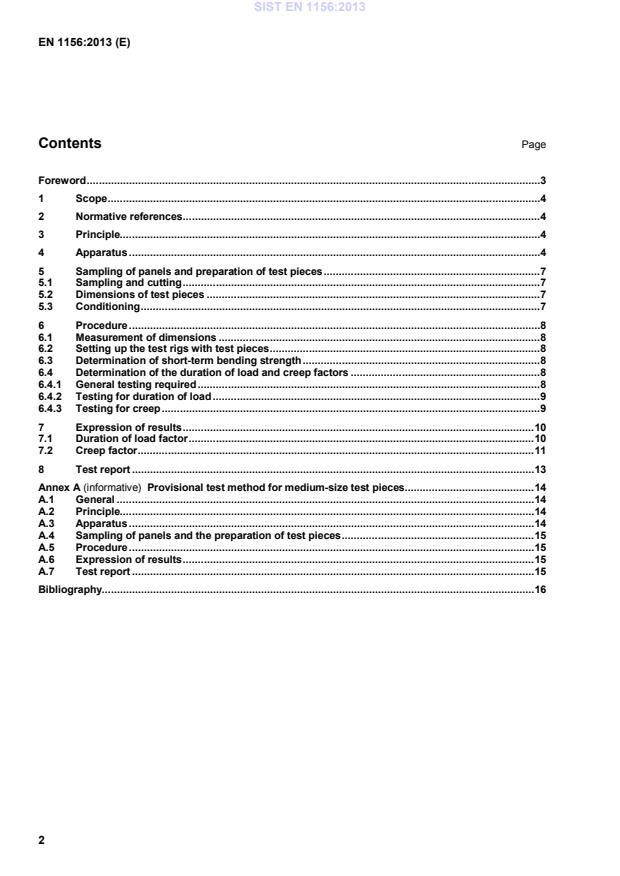
Provisional test method for medium-size test pieces . 14 A.1 General . 14 A.2 Principle. 14 A.3 Apparatus . 14 A.4 Sampling of panels and the preparation of test pieces . 15 A.5 Procedure . 15 A.6 Expression of results . 15 A.7 Test report . 15 Bibliography. 16
1-buildings 3 Principle Determination in a constant climate of the load duration factor (loss in strength with time under load) and the creep factor (ratio of increase in deflection with time to the initial elastic deflection) in bending by applying and sustaining a constant moment over the central region of a test piece; both the time to failure, and the increase in deflection with time are measured. 4 Apparatus 4.1 Measuring instruments as specified in EN 325. 4.2 A number of test rigs (see Figure 1), that have essentially the following components: 4.2.1 Two parallel cylindrical supports of a length exceeding the width of the test piece and of diameter d = (15 ± 0,5) mm.
The distance between the supports shall be adjustable, and each support shall be capable of rotating in its frame. Two cylindrical loading rollers of the same length and diameter as the supports. These shall lie parallel to the supports, be capable of rotating, and be linked together with cross-arms of fixed length. SIST EN 1156:2013
Key F dead-load l1 = 150 t thickness l2 = 5 t
L = l1+10 t+60
d = 15 ± 0,5 Figure 1 — Test arrangement for applying load for static bending and creep tests with test piece in position 4.2.2 A suitable instrument for measuring the deflection of the test piece in the middle of the span which is graduated to allow a reading to 0,01 mm or better and which enables readings of the displacement at the centre of the upper surface of the test piece to be taken in relation to two points on the upper surface of the test piece each 60 mm from the transverse centre line (see Figure 2).
This general method will measure creep in bending free of any influence of shear (method 1). SIST EN 1156:2013
Key F dead-load Figure 2 — Method 1 (general method) for the measurement of deflection Where it is desired to measure creep in bending both with and without a shear component a measuring system as illustrated in Figure 3 shall be used (method 2). Dimensions in millimetres
Key F dead-load Figure 3 — Method 2 for the measurement of deflection with and without a shear component 4.3 An arrangement for testing the short-term bending strength with the same loading configuration to the creep test arrangement. 4.4 Weights (= dead load) for applying different constant loads (forces) on the test pieces. 4.5 A controlled environment room capable of maintaining a fixed temperature to ±1 °C and a fixed relative humidity to ± 3 %. 4.6 Equipment for recording temperature and relative humidity. SIST EN 1156:2013
...