

SIST EN 301 843-1 V2.1.1:2016
(Main)ElectroMagnetic Compatibility (EMC) standard for marine radio equipment and services - Harmonised Standard covering the essential requirements of article 3.1b of the Directive 2014/53/EU - Part 1: Common technical requirements
General Information
- Abstract
The present document contains the common requirements for marine radio communications equipment and associated
ancillary equipment, in respect of ElectroMagnetic Compatibility (EMC).
The provisions of the present document apply to marine radio equipment not covered in the scope of the Council
Directive on marine equipment (the "Marine Equipment Directive" 96/98/EC [i.5]).
Product dependent arrangements necessary to perform the EMC tests on dedicated types of marine radio
communications equipment, and the assessment of test results, are detailed in the appropriate product related parts of
the present document.
The present document, together with the product related part, specifies the applicable EMC tests, the methods of
measurement, the limits and the performance criteria for marine radio equipment and associated ancillary equipment.
In case of differences (for instance concerning special conditions, definitions, abbreviations) between the present
document and the relevant product related part of the present document, the product related part takes precedence.
For the further content of the present document, the expression "radio equipment" is taken to mean marine radio
communications equipment, in each individual case.
Technical specifications related to the antenna port of radio equipment and emissions from the enclosure port of radio
equipment and combinations of radio and associated ancillary equipment are not included in the present document.
Such technical specifications are normally found in the relevant product standards for the effective use of the radio
spectrum.
The environment classification used in the present document is maritime, as defined in CENELEC EN 60945 [1].
Marine radio communications equipment meeting the EMC requirements set out in CENELEC EN 60945 [1] is deemed
to meet also the EMC requirements for the residential, commercial and light industrial environment as defined in
CENELEC EN 61000-6-3 [i.1] and CENELEC EN 61000-6-1 [i.2].
The EMC requirements have been selected to ensure an adequate level of compatibility for apparatus intended to be
used in the maritime environment. The levels, however, do not cover extreme cases which may occur in any location
but with low probability of occurrence.
Compliance of radio equipment to the requirements of the present document does not signify compliance to any
requirements related to spectrum management or to the use of the equipment (licensing requirements).
Compliance to the requirements of the present document does not signify compliance to any safety requirements.
However, it is the responsibility of the assessor of the equipment to record in the test report any observations regarding
the test sample becoming dangerous or unsafe as a result of the application of the tests called for in the present
document.
The present document contains requirements to demonstrate an adequate level of electromagnetic compatibility as set
out in Directive 2014/30/EU.
In addition to the present document, other ENs that specify technical requirements in respect of essential requirements
under other parts of article 3 of the Radio Equipment Directive [i.4] may apply to equipment within the scope of the
present document.
- Status
- Published
- Public Enquiry End Date
- 20-Mar-2016
- Publication Date
- 13-Apr-2016
- Technical Committee
- MOC - Mobile Communications
- Current Stage
- 6060 - National Implementation/Publication (Adopted Project)
- Start Date
- 08-Apr-2016
- Due Date
- 13-Jun-2016
- Completion Date
- 14-Apr-2016
Buy Documents

ETSI EN 301 843-1 V2.1.1 (2016-03) - ElectroMagnetic Compatibility (EMC) standard for marine radio equipment and services; Harmonised Standard covering the essential requirements of article 3.1b of the Directive 2014/53/EU; Part 1: Common technical requirements



Overview
SIST EN 301 843-1 V2.1.1:2016 specifies the common technical requirements for electromagnetic compatibility (EMC) in marine radio communications equipment and associated ancillary equipment. Developed by the Slovenian Institute for Standardization (SIST), this harmonised European standard supports compliance with the essential EMC requirements of Article 3.1b of Directive 2014/53/EU (Radio Equipment Directive). The standard covers a wide range of marine radio equipment, except those included under the Marine Equipment Directive 96/98/EC, and establishes the foundation for EMC testing methods, performance assessment, and criteria in maritime environments.
The focus is to ensure marine radio and ancillary systems operate reliably in the presence of electromagnetic disturbances typical of maritime settings, contributing to effective and safe communications at sea.
Key Topics
Scope of EMC Requirements
- Applies to marine radio communications equipment and related ancillary devices not regulated by Directive 96/98/EC.
- Defines how to assess and ensure electromagnetic compatibility for these products.
EMC Testing and Measurement
- Establishes generic EMC tests, limits, and measurement procedures.
- Addresses emission and immunity requirements necessary for safe and reliable vessel operation.
- Specific technical details and additional EMC tests may be covered in product-specific parts of the standard.
Environmental Considerations
- The requirements are selected for maritime environments as defined in CENELEC EN 60945, ensuring compatibility even in the challenging conditions found at sea.
- Equipment compliant with this standard is also considered suitable for residential, commercial, and light industrial environments according to CENELEC EN 61000-6-3 and EN 61000-6-1.
Assessment and Performance Criteria
- Outlines the process for assessing the performance of equipment under EMC tests, including continuous and transient interference phenomena.
- Specifies conditions for deemed compliance, test arrangements, and documentation for conformity assessment.
Regulatory Alignment
- Provides a basis for presumption of conformity with EMC requirements of the Radio Equipment Directive (RED) 2014/53/EU.
- Ensures alignment with Directive 2014/30/EU on electromagnetic compatibility.
Applications
This standard is practically applied wherever marine radio equipment is developed, manufactured, tested, or installed, including:
- Commercial Shipping: Ensures communications and navigational radio systems maintain reliable operation without interference, supporting maritime safety.
- Pleasure Craft and Yachts: Applicable to radio equipment not covered by other marine equipment directives, maintaining communication integrity in leisure marine vessels.
- Maritime Equipment Manufacturing: Provides manufacturers with harmonised EMC requirements to streamline product development, testing, and CE marking.
- Certification and Compliance Testing: Used by testing laboratories and certification bodies to verify EMC compliance of marine radio devices, simplifying market access in the European Union.
It is important to note that compliance with SIST EN 301 843-1:2016 relates only to electromagnetic compatibility and does not automatically imply compliance with safety or spectrum management regulations.
Related Standards
For comprehensive EMC testing and regulatory alignment, products may also reference or incorporate the following standards:
- CENELEC EN 60945: Maritime navigation and radiocommunication equipment - General requirements for EMC in marine settings.
- CENELEC EN 61000-6-3 and EN 61000-6-1: Generic EMC emission and immunity standards applicable to general environments.
- Directive 2014/53/EU: EU Radio Equipment Directive defining essential requirements.
- SIST EN 301 843-2, -4, -5, -6: Parts of the same series addressing specific EMC requirements for VHF, MF/HF, NAVTEX, and Earth Stations on vessels.
- CISPR 16-1-1: Specifications for radio disturbance and immunity measuring apparatus.
Keywords: electromagnetic compatibility (EMC), marine radio equipment, EMC testing, maritime communications, EMC standard, Directive 2014/53/EU, radio equipment, certification, maritime safety.
Buy Documents
ETSI EN 301 843-1 V2.1.1 (2016-03) - ElectroMagnetic Compatibility (EMC) standard for marine radio equipment and services; Harmonised Standard covering the essential requirements of article 3.1b of the Directive 2014/53/EU; Part 1: Common technical requirements
Get Certified
Connect with accredited certification bodies for this standard

DNV
DNV is an independent assurance and risk management provider.

Lloyd's Register
Lloyd's Register is a global professional services organisation specialising in engineering and technology.

FSC International
Forest Stewardship Council certification.
Sponsored listings
Frequently Asked Questions
SIST EN 301 843-1 V2.1.1:2016 is a standard published by the Slovenian Institute for Standardization (SIST). Its full title is "ElectroMagnetic Compatibility (EMC) standard for marine radio equipment and services - Harmonised Standard covering the essential requirements of article 3.1b of the Directive 2014/53/EU - Part 1: Common technical requirements". This standard covers: The present document contains the common requirements for marine radio communications equipment and associated ancillary equipment, in respect of ElectroMagnetic Compatibility (EMC). The provisions of the present document apply to marine radio equipment not covered in the scope of the Council Directive on marine equipment (the "Marine Equipment Directive" 96/98/EC [i.5]). Product dependent arrangements necessary to perform the EMC tests on dedicated types of marine radio communications equipment, and the assessment of test results, are detailed in the appropriate product related parts of the present document. The present document, together with the product related part, specifies the applicable EMC tests, the methods of measurement, the limits and the performance criteria for marine radio equipment and associated ancillary equipment. In case of differences (for instance concerning special conditions, definitions, abbreviations) between the present document and the relevant product related part of the present document, the product related part takes precedence. For the further content of the present document, the expression "radio equipment" is taken to mean marine radio communications equipment, in each individual case. Technical specifications related to the antenna port of radio equipment and emissions from the enclosure port of radio equipment and combinations of radio and associated ancillary equipment are not included in the present document. Such technical specifications are normally found in the relevant product standards for the effective use of the radio spectrum. The environment classification used in the present document is maritime, as defined in CENELEC EN 60945 [1]. Marine radio communications equipment meeting the EMC requirements set out in CENELEC EN 60945 [1] is deemed to meet also the EMC requirements for the residential, commercial and light industrial environment as defined in CENELEC EN 61000-6-3 [i.1] and CENELEC EN 61000-6-1 [i.2]. The EMC requirements have been selected to ensure an adequate level of compatibility for apparatus intended to be used in the maritime environment. The levels, however, do not cover extreme cases which may occur in any location but with low probability of occurrence. Compliance of radio equipment to the requirements of the present document does not signify compliance to any requirements related to spectrum management or to the use of the equipment (licensing requirements). Compliance to the requirements of the present document does not signify compliance to any safety requirements. However, it is the responsibility of the assessor of the equipment to record in the test report any observations regarding the test sample becoming dangerous or unsafe as a result of the application of the tests called for in the present document. The present document contains requirements to demonstrate an adequate level of electromagnetic compatibility as set out in Directive 2014/30/EU. In addition to the present document, other ENs that specify technical requirements in respect of essential requirements under other parts of article 3 of the Radio Equipment Directive [i.4] may apply to equipment within the scope of the present document.
The present document contains the common requirements for marine radio communications equipment and associated ancillary equipment, in respect of ElectroMagnetic Compatibility (EMC). The provisions of the present document apply to marine radio equipment not covered in the scope of the Council Directive on marine equipment (the "Marine Equipment Directive" 96/98/EC [i.5]). Product dependent arrangements necessary to perform the EMC tests on dedicated types of marine radio communications equipment, and the assessment of test results, are detailed in the appropriate product related parts of the present document. The present document, together with the product related part, specifies the applicable EMC tests, the methods of measurement, the limits and the performance criteria for marine radio equipment and associated ancillary equipment. In case of differences (for instance concerning special conditions, definitions, abbreviations) between the present document and the relevant product related part of the present document, the product related part takes precedence. For the further content of the present document, the expression "radio equipment" is taken to mean marine radio communications equipment, in each individual case. Technical specifications related to the antenna port of radio equipment and emissions from the enclosure port of radio equipment and combinations of radio and associated ancillary equipment are not included in the present document. Such technical specifications are normally found in the relevant product standards for the effective use of the radio spectrum. The environment classification used in the present document is maritime, as defined in CENELEC EN 60945 [1]. Marine radio communications equipment meeting the EMC requirements set out in CENELEC EN 60945 [1] is deemed to meet also the EMC requirements for the residential, commercial and light industrial environment as defined in CENELEC EN 61000-6-3 [i.1] and CENELEC EN 61000-6-1 [i.2]. The EMC requirements have been selected to ensure an adequate level of compatibility for apparatus intended to be used in the maritime environment. The levels, however, do not cover extreme cases which may occur in any location but with low probability of occurrence. Compliance of radio equipment to the requirements of the present document does not signify compliance to any requirements related to spectrum management or to the use of the equipment (licensing requirements). Compliance to the requirements of the present document does not signify compliance to any safety requirements. However, it is the responsibility of the assessor of the equipment to record in the test report any observations regarding the test sample becoming dangerous or unsafe as a result of the application of the tests called for in the present document. The present document contains requirements to demonstrate an adequate level of electromagnetic compatibility as set out in Directive 2014/30/EU. In addition to the present document, other ENs that specify technical requirements in respect of essential requirements under other parts of article 3 of the Radio Equipment Directive [i.4] may apply to equipment within the scope of the present document.
SIST EN 301 843-1 V2.1.1:2016 is classified under the following ICS (International Classification for Standards) categories: 33.060.20 - Receiving and transmitting equipment; 33.100.01 - Electromagnetic compatibility in general; 47.020.70 - Navigation and control equipment. The ICS classification helps identify the subject area and facilitates finding related standards.
SIST EN 301 843-1 V2.1.1:2016 is available in PDF format for immediate download after purchase. The document can be added to your cart and obtained through the secure checkout process. Digital delivery ensures instant access to the complete standard document.
Standards Content (Sample)
HARMONISED EUROPEAN STANDARD
ElectroMagnetic Compatibility (EMC) standard
for marine radio equipment and services;
Harmonised Standard covering the essential requirements
of article 3.1b of the Directive 2014/53/EU;
Part 1: Common technical requirements
2 ETSI EN 301 843-1 V2.1.1 (2016-03)
Reference
REN/ERM-EMC-347
Keywords
EMC, harmonised standard, maritime, radio
ETSI
650 Route des Lucioles
F-06921 Sophia Antipolis Cedex - FRANCE
Tel.: +33 4 92 94 42 00 Fax: +33 4 93 65 47 16
Siret N° 348 623 562 00017 - NAF 742 C
Association à but non lucratif enregistrée à la
Sous-Préfecture de Grasse (06) N° 7803/88
Important notice
The present document can be downloaded from:
http://www.etsi.org/standards-search
The present document may be made available in electronic versions and/or in print. The content of any electronic and/or
print versions of the present document shall not be modified without the prior written authorization of ETSI. In case of any
existing or perceived difference in contents between such versions and/or in print, the only prevailing document is the
print of the Portable Document Format (PDF) version kept on a specific network drive within ETSI Secretariat.
Users of the present document should be aware that the document may be subject to revision or change of status.
Information on the current status of this and other ETSI documents is available at
https://portal.etsi.org/TB/ETSIDeliverableStatus.aspx
If you find errors in the present document, please send your comment to one of the following services:
https://portal.etsi.org/People/CommiteeSupportStaff.aspx
Copyright Notification
No part may be reproduced or utilized in any form or by any means, electronic or mechanical, including photocopying
and microfilm except as authorized by written permission of ETSI.
The content of the PDF version shall not be modified without the written authorization of ETSI.
The copyright and the foregoing restriction extend to reproduction in all media.
© European Telecommunications Standards Institute 2016.
All rights reserved.
TM TM TM
DECT , PLUGTESTS , UMTS and the ETSI logo are Trade Marks of ETSI registered for the benefit of its Members.
TM
3GPP and LTE™ are Trade Marks of ETSI registered for the benefit of its Members and
of the 3GPP Organizational Partners.
GSM® and the GSM logo are Trade Marks registered and owned by the GSM Association.
ETSI
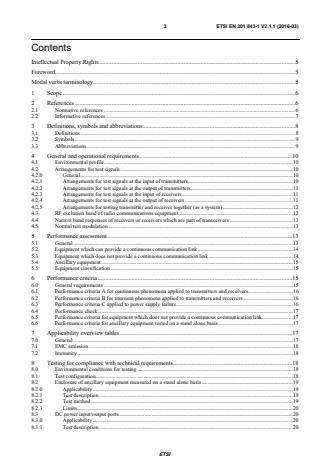
3 ETSI EN 301 843-1 V2.1.1 (2016-03)
Contents
Intellectual Property Rights . 5
Foreword . 5
Modal verbs terminology . 5
1 Scope . 6
2 References . 6
2.1 Normative references . 6
2.2 Informative references . 7
3 Definitions, symbols and abbreviations . 8
3.1 Definitions . 8
3.2 Symbols . 9
3.3 Abbreviations . 9
4 General and operational requirements . 10
4.1 Environmental profile . 10
4.2 Arrangements for test signals . 10
4.2.0 General . 10
4.2.1 Arrangements for test signals at the input of transmitters . 10
4.2.2 Arrangements for test signals at the output of transmitters . 11
4.2.3 Arrangements for test signals at the input of receivers . 11
4.2.4 Arrangements for test signals at the output of receivers . 11
4.2.5 Arrangements for testing transmitter and receiver together (as a system) . 12
4.3 RF exclusion band of radio communications equipment. 12
4.4 Narrow band responses of receivers or receivers which are part of transceivers . 13
4.5 Normal test modulation . 13
5 Performance assessment . 13
5.1 General . 13
5.2 Equipment which can provide a continuous communication link . 14
5.3 Equipment which does not provide a continuous communication link . 14
5.4 Ancillary equipment . 15
5.5 Equipment classification . 15
6 Performance criteria . 15
6.0 General requirements . 15
6.1 Performance criteria A for continuous phenomena applied to transmitters and receivers. 16
6.2 Performance criteria B for transient phenomena applied to transmitters and receivers . 16
6.3 Performance criteria C applied to power supply failure . 16
6.4 Performance check . 17
6.5 Performance criteria for equipment which does not provide a continuous communication link . 17
6.6 Performance criteria for ancillary equipment tested on a stand alone basis . 17
7 Applicability overview tables . 17
7.0 General . 17
7.1 EMC emission . 18
7.2 Immunity . 18
8 Testing for compliance with technical requirements . 18
8.0 Environmental conditions for testing . 18
8.1 Test configuration. 18
8.2 Enclosure of ancillary equipment measured on a stand alone basis . 19
8.2.0 Applicability . 19
8.2.1 Test description . 19
8.2.2 Test method . 19
8.2.3 Limits . 20
8.3 DC power input/output ports . 20
8.3.0 Applicability . 20
8.3.1 Test description . 20
ETSI
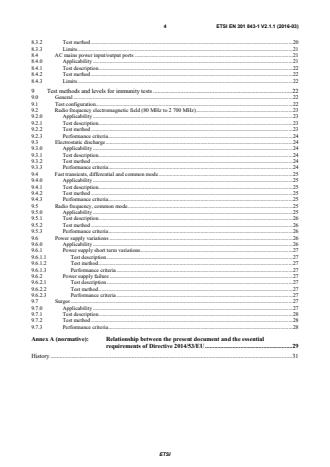
4 ETSI EN 301 843-1 V2.1.1 (2016-03)
8.3.2 Test method . 20
8.3.3 Limits . 21
8.4 AC mains power input/output ports . 21
8.4.0 Applicability . 21
8.4.1 Test description . 22
8.4.2 Test method . 22
8.4.3 Limits . 22
9 Test methods and levels for immunity tests . 22
9.0 General . 22
9.1 Test configuration. 22
9.2 Radio frequency electromagnetic field (80 MHz to 2 700 MHz) . 23
9.2.0 Applicability . 23
9.2.1 Test description . 23
9.2.2 Test method . 23
9.2.3 Performance criteria . 24
9.3 Electrostatic discharge . 24
9.3.0 Applicability . 24
9.3.1 Test description . 24
9.3.2 Test method . 24
9.3.3 Performance criteria . 24
9.4 Fast transients, differential and common mode . 25
9.4.0 Applicability . 25
9.4.1 Test description . 25
9.4.2 Test method . 25
9.4.3 Performance criteria . 25
9.5 Radio frequency, common mode . 25
9.5.0 Applicability . 25
9.5.1 Test description . 26
9.5.2 Test method . 26
9.5.3 Performance criteria . 26
9.6 Power supply variations . 26
9.6.0 Applicability . 26
9.6.1 Power supply short term variations . 27
9.6.1.1 Test description . 27
9.6.1.2 Test method . 27
9.6.1.3 Performance criteria . 27
9.6.2 Power supply failure . 27
9.6.2.1 Test description . 27
9.6.2.2 Test method . 27
9.6.2.3 Performance criteria . 27
9.7 Surges . 27
9.7.0 Applicability . 27
9.7.1 Test description . 28
9.7.2 Test method . 28
9.7.3 Performance criteria . 28
Annex A (normative): Relationship between the present document and the essential
requirements of Directive 2014/53/EU . 29
History . 31
ETSI
5 ETSI EN 301 843-1 V2.1.1 (2016-03)
Intellectual Property Rights
IPRs essential or potentially essential to the present document may have been declared to ETSI. The information
pertaining to these essential IPRs, if any, is publicly available for ETSI members and non-members, and can be found
in ETSI SR 000 314: "Intellectual Property Rights (IPRs); Essential, or potentially Essential, IPRs notified to ETSI in
respect of ETSI standards", which is available from the ETSI Secretariat. Latest updates are available on the ETSI Web
server (https://ipr.etsi.org/).
Pursuant to the ETSI IPR Policy, no investigation, including IPR searches, has been carried out by ETSI. No guarantee
can be given as to the existence of other IPRs not referenced in ETSI SR 000 314 (or the updates on the ETSI Web
server) which are, or may be, or may become, essential to the present document.
Foreword
This Harmonised European Standard (EN) has been produced by ETSI Technical Committee Electromagnetic
compatibility and Radio spectrum Matters (ERM).
The present document has been prepared under the Commission's standardisation request C(2015) 5376 final [i.10] to
provide one voluntary means of conforming to the essential requirements of Directive 2014/53/EU on the harmonisation
of the laws of the Member States relating to the making available on the market of radio equipment and repealing
Directive 1999/5/EC [i.4].
Once the present document is cited in the Official Journal of the European Union under that Directive, compliance with
the normative clauses of the present document given in table A.1 confers, within the limits of the scope of the present
document, a presumption of conformity with the corresponding essential requirements of that Directive, and associated
EFTA regulations.
The present document is part 1 of a multi-part deliverable covering the ElectroMagnetic Compatibility (EMC) standard
for marine radio equipment and services, as identified below:
Part 1: "Common technical requirements";
Part 2: "Specific conditions for VHF radiotelephone transmitters and receivers";
Part 4: "Specific conditions for Narrow-Band Direct-Printing (NBDP) NAVTEX receivers";
Part 5: "Specific conditions for MF/HF radiotelephone transmitters and receivers";
Part 6: "Specific conditions for Earth Stations on board Vessels operating in frequency bands above 3 GHz".
National transposition dates
Date of adoption of this EN: 21 March 2016
Date of latest announcement of this EN (doa): 30 June 2016
Date of latest publication of new National Standard
or endorsement of this EN (dop/e): 31 December 2016
Date of withdrawal of any conflicting National Standard (dow): 31 December 2017
Modal verbs terminology
In the present document "shall", "shall not", "should", "should not", "may", "need not", "will", "will not", "can" and
"cannot" are to be interpreted as described in clause 3.2 of the ETSI Drafting Rules (Verbal forms for the expression of
provisions).
"must" and "must not" are NOT allowed in ETSI deliverables except when used in direct citation.
ETSI
6 ETSI EN 301 843-1 V2.1.1 (2016-03)
1 Scope
The present document contains the common requirements for marine radio communications equipment and associated
ancillary equipment, in respect of ElectroMagnetic Compatibility (EMC).
The provisions of the present document apply to marine radio equipment not covered in the scope of the Council
Directive on marine equipment (the "Marine Equipment Directive" 96/98/EC [i.5]).
Product dependent arrangements necessary to perform the EMC tests on dedicated types of marine radio
communications equipment, and the assessment of test results, are detailed in the appropriate product related parts of
the present document.
The present document, together with the product related part, specifies the applicable EMC tests, the methods of
measurement, the limits and the performance criteria for marine radio equipment and associated ancillary equipment.
In case of differences (for instance concerning special conditions, definitions, abbreviations) between the present
document and the relevant product related part of the present document, the product related part takes precedence.
For the further content of the present document, the expression "radio equipment" is taken to mean marine radio
communications equipment, in each individual case.
Technical specifications related to the antenna port of radio equipment and emissions from the enclosure port of radio
equipment and combinations of radio and associated ancillary equipment are not included in the present document.
Such technical specifications are normally found in the relevant product standards for the effective use of the radio
spectrum.
The environment classification used in the present document is maritime, as defined in CENELEC EN 60945 [1].
Marine radio communications equipment meeting the EMC requirements set out in CENELEC EN 60945 [1] is deemed
to meet also the EMC requirements for the residential, commercial and light industrial environment as defined in
CENELEC EN 61000-6-3 [i.1] and CENELEC EN 61000-6-1 [i.2].
The EMC requirements have been selected to ensure an adequate level of compatibility for apparatus intended to be
used in the maritime environment. The levels, however, do not cover extreme cases which may occur in any location
but with low probability of occurrence.
Compliance of radio equipment to the requirements of the present document does not signify compliance to any
requirements related to spectrum management or to the use of the equipment (licensing requirements).
Compliance to the requirements of the present document does not signify compliance to any safety requirements.
However, it is the responsibility of the assessor of the equipment to record in the test report any observations regarding
the test sample becoming dangerous or unsafe as a result of the application of the tests called for in the present
document.
The present document contains requirements to demonstrate an adequate level of electromagnetic compatibility as set
out in Directive 2014/30/EU.
In addition to the present document, other ENs that specify technical requirements in respect of essential requirements
under other parts of article 3 of the Radio Equipment Directive [i.4] may apply to equipment within the scope of the
present document.
2 References
2.1 Normative references
References are either specific (identified by date of publication and/or edition number or version number) or
non-specific. For specific references, only the cited version applies. For non-specific references, the latest version of the
referenced document (including any amendments) applies.
Referenced documents which are not found to be publicly available in the expected location might be found at
http://docbox.etsi.org/Reference.
ETSI
7 ETSI EN 301 843-1 V2.1.1 (2016-03)
NOTE: While any hyperlinks included in this clause were valid at the time of publication, ETSI cannot guarantee
their long term validity.
The following referenced documents are necessary for the application of the present document.
[1] CENELEC EN 60945:2002 + Corrigendum 1 (2008): "Maritime navigation and
radiocommunication equipment and systems - General requirements - Methods of testing and
required test results".
[2] CISPR 16-1-1 (2015): "Specification for radio disturbance and immunity measuring apparatus and
methods - Part 1-1: Radio disturbance and immunity measuring apparatus - Measuring apparatus".
[3] CENELEC EN 61000-4-2 (2003): "Electromagnetic compatibility (EMC) - Part 4-2: Testing and
measurement techniques - Electrostatic discharge immunity test".
[4] CENELEC EN 61000-4-3 (2006 + Amendment 1:2008 +Amendment 2:2010): "Electromagnetic
compatibility (EMC) - Part 4-3: Testing and measurement techniques - Radiated, radio-frequency,
electromagnetic field immunity test".
[5] CENELEC EN 61000-4-4 (2012): "Electromagnetic compatibility (EMC) - Part 4-4: Testing and
measurement techniques - Electrical fast transient/burst immunity test".
[6] CENELEC EN 61000-4-5 (2014): "Electromagnetic compatibility (EMC) - Part 4-5: Testing and
measurement techniques - Surge immunity test".
[7] CENELEC EN 61000-4-6 (2014): "Electromagnetic compatibility (EMC) - Part 4-6: Testing and
measurement techniques - Immunity to conducted disturbances, induced by radio-frequency
fields".
[8] ETSI EN 301 843-2 (V2.1.1) (03-2016): "ElectroMagnetic Compatibility (EMC) standard for
marine radio equipment and services; Harmonised Standard covering the essential requirements of
article 3.1b of the Directive 2014/53/EU; Part 2: Specific conditions for VHF radiotelephone
transmitters and receivers".
[9] ETSI EN 301 843-4 (V2.1.1) (03-2016): "ElectroMagnetic Compatibility (EMC) standard for
marine radio equipment and services; Harmonised Standard covering the essential requirements of
article 3.1b of the Directive 2014/53/EU; Part 4: Specific conditions for Narrow-Band Direct-
Printing (NBDP) NAVTEX receivers".
[10] ETSI EN 301 843-5 (V2.1.1) (03-2016): "ElectroMagnetic Compatibility (EMC) standard for
marine radio equipment and services; Harmonised Standard covering the essential requirements of
article 3.1b of the Directive 2014/53/EU; Part 5: Specific conditions for MF/HF radiotelephone
transmitters and receivers".
[11] ETSI EN 301 843-6 (V2.1.1) (03-2016): "ElectroMagnetic Compatibility (EMC) standard for
marine radio equipment and services; Harmonised Standard covering the essential requirements of
article 3.1b of the Directive 2014/53/EU; Part 6: Specific conditions for Earth Stations on board
Vessels operating in frequency bands above 3 GHz".
2.2 Informative references
References are either specific (identified by date of publication and/or edition number or version number) or
non-specific. For specific references, only the cited version applies. For non-specific references, the latest version of the
referenced document (including any amendments) applies.
NOTE: While any hyperlinks included in this clause were valid at the time of publication, ETSI cannot guarantee
their long term validity.
The following referenced documents are not necessary for the application of the present document but they assist the
user with regard to a particular subject area.
[i.1] CENELEC EN 61000-6-3 (2007) + A1 (2011): "Electromagnetic compatibility (EMC) -
Part 6-3: Generic standards - Emission standard for residential, commercial and light-industrial
environments".
ETSI
8 ETSI EN 301 843-1 V2.1.1 (2016-03)
[i.2] CENELEC EN 61000-6-1 (2007): "Electromagnetic compatibility (EMC) - Part 6-1: Generic
standards - Immunity for residential, commercial and light-industrial environments".
[i.3] Directive 2014/30/EU of the European Parliament and of the Council of 26 February 2014 on the
harmonisation of the laws of the Member States relating to electromagnetic compatibility.
[i.4] Directive 2014/53/EU of the European Parliament and of the Council of 16 April 2014 on the
harmonisation of the laws of the Member States relating to the making available on the market of
radio equipment and repealing Directive 1999/5/EC.
[i.5] Council Directive 96/98/EC of 20 December 1996 on marine equipment.
[i.6] CENELEC EN 60050-161 (1990): "International Electrotechnical Vocabulary. Chapter 161:
Electromagnetic compatibility".
[i.7] CEPT/ERC Recommendation 74-01 (2011): "Unwanted emissions in the spurious domain".
[i.8] Void.
[i.9] Void.
[i.10] Commission Implementing Decision C(2015) 5376 final of 4.8.2015 on a standardisation request
to the European Committee for Electrotechnical Standardisation and to the European
Telecommunications Standards Institute as regards radio equipment in support of Directive
2014/53/EU of the European Parliament and of the Council.
3 Definitions, symbols and abbreviations
3.1 Definitions
For the purposes of the present document, the following terms and definitions apply:
ancillary equipment: Equipment (apparatus), used in connection with a receiver, transmitter or transceiver is
considered as an ancillary equipment (apparatus) if:
- the equipment is intended for use in conjunction with a receiver or transmitter to provide additional operational
and/or control features to the radio equipment, (e.g. to extend control to another position or location); and
- the equipment cannot be used on a stand alone basis to provide user functions independently of a receiver or
transmitter; and
- the receiver or transmitter to which it is connected, is capable of providing some intended operation such as
transmitting and/or receiving without the ancillary equipment (i.e. it is not a sub-unit of the main equipment
essential to the main equipment basic functions).
artificial antenna: non-reactive, non-radiating dummy load equal to the nominal impedance of the antenna port
NOTE: For the purpose of EMC tests, the antenna port(s) of the Equipment Under Test (EUT) are terminated
with a non-radiating 50 Ω termination (artificial antenna) unless there is a requirement to apply a Radio
Frequency (RF) input signal to the receiver antenna port.
continuous phenomena (continuous disturbance): electromagnetic disturbance, the effects of which on a particular
device or equipment cannot be resolved into a succession of distinct effects
NOTE: See CENELEC EN 60050-161 [i.6].
enclosure port: physical boundary of the apparatus through which electromagnetic fields may radiate or impinge
NOTE: In the case of integral antenna equipment, this port is inseparable from the antenna port.
integral antenna: antenna designed to be connected directly to the equipment with or without the use of an external
connector and considered to be part of the equipment
NOTE: An integral antenna may be fitted internally or externally to the equipment. An antenna which may not be
removed during the tests, according to the manufacturer's statement.
ETSI
9 ETSI EN 301 843-1 V2.1.1 (2016-03)
manufacturer: manufacturer of the equipment, or his authorized representative, or an equipment supplier to the
European market
mobile equipment: marine receiver, transmitter or transmitter/receiver (transceiver) intended for installation and use
onboard ships
operating frequency range: range(s) of radio frequencies covered by the Equipment Under Test (EUT) without any
change of units
port: particular interface, of the specified equipment (apparatus), with the electromagnetic environment
NOTE: For example, any connection point on an equipment intended for connection of cables to or from that
equipment is considered as a port (see figure 1).
Enclosure port
Antenna port
AC power port
Signal/control port
DC power port
APPARATUS
Earth port Telecommunication port
Figure 1: Examples of ports
portable equipment: marine radio and/or ancillary equipment intended for portable (e.g. handheld) operation onboard
ships, and powered by its own integral battery
radio communications equipment: marine communications equipment which includes one or more radio transmitters
and/or receivers and/or parts thereof for use in a mobile or portable application onboard ships
NOTE: It can be operated with ancillary equipment but if so, is not dependent on it for basic functionality.
removable antenna: antenna which may be removed for the test according to the manufacturer statement
spurious emission: emission on a frequency, or frequencies, which are outside the necessary bandwidth and the level of
which may be reduced without affecting the corresponding transmission of information
NOTE: Spurious emissions include harmonic emissions, parasitic emissions, intermodulation products and
frequency conversion products but exclude out of band emissions (CEPT/ERC Recommendation
74-01 [i.7]).
transient phenomena (transient disturbance): pertaining to or designating a phenomena or a quantity which varies
between two consecutive steady states during a time interval short compared with the time-scale of interest
NOTE: See CENELEC EN 60050-161 [i.6].
3.2 Symbols
For the purposes of the present document, the following symbols apply:
Bn Necessary bandwidth of an emission
PX Maximum PEP
3.3 Abbreviations
For the purposes of the present document, the following abbreviations apply:
AC Alternating Current
AM Amplitude Modulation
AMN Artificial Mains Network
B measurement Bandwidth
DC Direct Current
EFTA European Free Trade Association
EM ElectroMagnetic
EMC ElectroMagnetic Compatibility
ETSI
10 ETSI EN 301 843-1 V2.1.1 (2016-03)
ESD Electro Static Discharge
EUT Equipment Under Test
IEC International Electrotechnical Commission
IMO International Maritime Organization
MF/FH Medium Frequency/High Frequency
NAVTEX Navigational Telex
NBDP Narrow Band Direct Printing
RF Radio Frequency
rms root mean square
VHF Very High Frequency
4 General and operational requirements
4.1 Environmental profile
The environmental profile for operation of the equipment shall be declared by the supplier. The equipment shall comply
with all the technical requirements of the present document at all times when operating within the boundary limits of the
required operational environmental profile.
The equipment shall be tested under normal test conditions according to the relevant product and basic standards or to
the information accompanying the equipment.
The test shall be carried out at a point within the specified normal operating environmental range of temperature and
humidity with the equipment connected to the normal power supply voltage. The normal temperature and humidity
conditions shall be a combination of temperature and humidity within the following ranges:
- temperature: +15 °C to +35 °C
- relative humidity: 25 % to 75 %
The normal test voltage for equipment to be connected to the AC mains, shall be the nominal (rated) mains voltage. The
frequency of the test voltage shall be 50 Hz ± 1 Hz.
The normal test voltage for equipment to be connected to a battery, shall be the nominal voltage of the battery (12 V,
24 V, etc.). For operation from other power sources, the normal test voltage shall be declared by the manufacturer.
The test conditions, configuration, and mode of operation shall represent the intended use and shall be recorded in the
test report.
For emission and immunity tests, specific product type related information on the test modulation, test conditions and
tests arrangements, etc., are found in the part of the present document dealing with the particular type of radio
equipment.
4.2 Arrangements for test signals
4.2.0 General
Adequate measures shall be taken to avoid the effect of immunity test signals on both the measuring equipment and the
signal sources for the wanted signals (the "test system") located outside the test environment.
4.2.1 Arrangements for test signals at the input of transmitters
The signal source providing the transmitter under test with the modulation signal for the normal test modulation shall be
located outside the test environment, unless the transmitter is modulated by its own internal source, see the relevant part
of the present document dealing with the particular type of radio equipment.
The transmitter shall be modulated with normal test modulation, by an internal or external signal source capable of
delivering the normal test modulation as specified in the relevant part of the present document dealing with the
particular type of radio equipment.
ETSI
11 ETSI EN 301 843-1 V2.1.1 (2016-03)
4.2.2 Arrangements for test signals at the output of transmitters
The measuring equipment for the wanted RF output signal from the transmitter under test shall be located outside the
test environment.
For transmitters with an integral antenna, the wanted RF output signal to establish a communication link shall be
delivered from the EUT to an antenna located within the test environment. This antenna shall be connected to the
external measuring equipment by a coaxial cable.
For transmitters with a removable antenna, the wanted RF output signal to establish a communication link shall be
delivered from the antenna connector to the external measuring equipment by a shielded transmission line, such as a
coaxial cable. Adequate measures shall be taken to minimize the effect of unwanted common mode currents on the
external conductor of the transmission line at the point of entry to the transmitter.
Unless otherwise specified in the part of the present document relevant for each type of radio equipment, the level of the
wanted RF output signal in transmit mode of operation shall be set to the maximum rated RF power for the EUT,
modulated with the normal test modulation.
4.2.3 Arrangements for test signals at the input of receivers
The signal source providing the receiver under test with the wanted RF input signal shall be located outside the test
environment.
The signal source shall be modulated with normal test modulation as specified in the relevant part of the present
document for the particular type of radio equipment.
For receivers with an integral antenna, the wanted RF input signal to establish a communication link shall be presented
to the EUT from an antenna located within the test environment. This antenna shall be connected to the external RF
signal source by a coaxial cable.
For receivers with a removable antenna, the wanted RF input signal to establish a communication link shall be
presented to the antenna connector of the EUT by a shielded transmission line, such as e.g. a coaxial cable. The
transmission line shall be connected to the external RF signal source. Adequate measures shall be taken to minimize the
effect of unwanted common mode currents on the external conductor of the shielded transmission line at the point of
entry to the receiver.
Adequate measures shall be taken to minimize the effect of unwanted common mode currents on the external conductor
of the shielded transmission line at the point of entry to the receiver.
Unless otherwise specified in the part of the present document relevant for the particular type of radio equipment, the
level of the wanted RF input signal shall be set to be approximately 40 dB above the minimum level necessary to
achieve a receiver performance which meets the relevant specified performance criteria, measured while the power
amplifiers generating the EM disturbance are switched on, but without excitation. This increased level of the wanted RF
input signal is expected to represent a normal operation signal level and should be sufficient to avoid the broadband
noise from the power amplifiers generating the EM disturbance from influencing the measurement.
4.2.4 Arrangements for test signals at the output of receivers
The measuring equipment for the output signal from the receiver under test shall be located outside the test
environment.
For receivers with an analogue speech output the audio output from the acoustic transducer should be coupled via an
electrically non-conductive acoustic tube to an external audio distortion meter or other appropriate measuring
equipment outside of the test environment. Where it is not practical to use an electrically non-conductive acoustic tube,
then other means of connecting the receiver output signal to the external audio distortion meter or other measuring
equipment shall be provided and recorded in the test report.
For receivers with a non-speech output the output signal shall be coupled via an electrically non-conductive means to
the external measuring equipment outside the test environment (e.g. a camera to read a display). If the receiver has an
output connector or port providing the wanted output signal, then this port shall be used via a cable, consistent with the
standard cable used in normal operation, connected to the external measuring equipment outside the test environment.
The measuring equipment may be supplied by the manufacturer.
Precautions shall be taken to ensure that any effect on the test due to the coupling means is minimized.
ETSI
12 ETSI EN 301 843-1 V2.1.1 (2016-03)
4.2.5 Arrangements for testing transmitter and receiver together
(as a system)
Transmitters and receivers may be tested for immunity as a system when combined as a transceiver or the combined
equipment is of a size which allows simultaneous testing. In this case the transceiver or transmitter and receiver shall be
located inside the test environment and shall be exposed simultaneously to the immunity test signals.
The normal test modulation shall be transmitted by the test system and looped back in the EUT. Further, the output of
the EUT shall be monitored by the test system.
For combined testing of transceivers or transmitters and receivers operating at the same frequency, two samples of the
EUT are required. The wanted RF output signal of the transmitter (sample A) may be used via a suitable attenuator and
applied to the input of the receiver (sample B) as the wanted RF input signal.
For transceivers or transmitters and receivers operating at different frequencies e.g. in duplex mode the arrangements
are defined in the product related part of the present document for the particular type of radio equipment.
4.3 RF exclusion band of radio communications equipment
For the purpose of EMC tests set up in the present document, the radio communications equipment is subject to an
exclusion band. This exclusion band is always product dependent and defined in the relevant part of the present
document dealing with the particular type of radio equipment.
The RF exclusion band applies to radio communications equipment intended for operation at designated frequencies up
to 2 GHz.
For equipment intended for operation at frequencies around 2 GHz the product r
...
2003-01.Slovenski inštitut za standardizacijo. Razmnoževanje celote ali delov tega standarda ni dovoljeno.ElectroMagnetic Compatibility (EMC) standard for marine radio equipment and services - Harmonised Standard covering the essential requirements of article 3.1b of the Directive 2014/53/EU - Part 1: Common technical requirements47.020.70Navigacijska in krmilna opremaNavigation and control equipment33.100.01Elektromagnetna združljivost na splošnoElectromagnetic compatibility in general33.060.20Sprejemna in oddajna opremaReceiving and transmitting equipmentICS:Ta slovenski standard je istoveten z:ETSI EN 301 843-1 V2.1.1 (2016-03)SIST EN 301 843-1 V2.1.1:2016en01-junij-2016SIST EN 301 843-1 V2.1.1:2016SLOVENSKI
STANDARD
HARMONISED EUROPEAN STANDARD SIST EN 301 843-1 V2.1.1:2016
ETSI ETSI EN 301 843-1 V2.1.1 (2016-03) 2
Reference REN/ERM-EMC-347 Keywords EMC, harmonised standard, maritime, radio ETSI 650 Route des Lucioles F-06921 Sophia Antipolis Cedex - FRANCE
Tel.: +33 4 92 94 42 00
Fax: +33 4 93 65 47 16
Siret N° 348 623 562 00017 - NAF 742 C Association à but non lucratif enregistrée à la Sous-Préfecture de Grasse (06) N° 7803/88
Important notice The present document can be downloaded from: http://www.etsi.org/standards-search The present document may be made available in electronic versions and/or in print. The content of any electronic and/or print versions of the present document shall not be modified without the prior written authorization of ETSI. In case of any existing or perceived difference in contents between such versions and/or in print, the only prevailing document is the print of the Portable Document Format (PDF) version kept on a specific network drive within ETSI Secretariat. Users of the present document should be aware that the document may be subject to revision or change of status. Information on the current status of this and other ETSI documents is available at https://portal.etsi.org/TB/ETSIDeliverableStatus.aspx If you find errors in the present document, please send your comment to one of the following services: https://portal.etsi.org/People/CommiteeSupportStaff.aspx Copyright Notification No part may be reproduced or utilized in any form or by any means, electronic or mechanical, including photocopying and microfilm except as authorized by written permission of ETSI. The content of the PDF version shall not be modified without the written authorization of ETSI. The copyright and the foregoing restriction extend to reproduction in all media.
© European Telecommunications Standards Institute 2016. All rights reserved.
DECTTM, PLUGTESTSTM, UMTSTM and the ETSI logo are Trade Marks of ETSI registered for the benefit of its Members. 3GPPTM and LTE™ are Trade Marks of ETSI registered for the benefit of its Members and of the 3GPP Organizational Partners. GSM® and the GSM logo are Trade Marks registered and owned by the GSM Association. SIST EN 301 843-1 V2.1.1:2016
ETSI ETSI EN 301 843-1 V2.1.1 (2016-03) 3 Contents Intellectual Property Rights . 5 Foreword . 5 Modal verbs terminology . 5 1 Scope . 6 2 References . 6 2.1 Normative references . 6 2.2 Informative references . 7 3 Definitions, symbols and abbreviations . 8 3.1 Definitions . 8 3.2 Symbols . 9 3.3 Abbreviations . 9 4 General and operational requirements . 10 4.1 Environmental profile . 10 4.2 Arrangements for test signals . 10 4.2.0 General . 10 4.2.1 Arrangements for test signals at the input of transmitters . 10 4.2.2 Arrangements for test signals at the output of transmitters . 11 4.2.3 Arrangements for test signals at the input of receivers . 11 4.2.4 Arrangements for test signals at the output of receivers . 11 4.2.5 Arrangements for testing transmitter and receiver together (as a system) . 12 4.3 RF exclusion band of radio communications equipment. 12 4.4 Narrow band responses of receivers or receivers which are part of transceivers . 13 4.5 Normal test modulation . 13 5 Performance assessment . 13 5.1 General . 13 5.2 Equipment which can provide a continuous communication link . 14 5.3 Equipment which does not provide a continuous communication link . 14 5.4 Ancillary equipment . 15 5.5 Equipment classification . 15 6 Performance criteria . 15 6.0 General requirements . 15 6.1 Performance criteria A for continuous phenomena applied to transmitters and receivers. 16 6.2 Performance criteria B for transient phenomena applied to transmitters and receivers . 16 6.3 Performance criteria C applied to power supply failure . 16 6.4 Performance check . 17 6.5 Performance criteria for equipment which does not provide a continuous communication link . 17 6.6 Performance criteria for ancillary equipment tested on a stand alone basis . 17 7 Applicability overview tables . 17 7.0 General . 17 7.1 EMC emission . 18 7.2 Immunity . 18 8 Testing for compliance with technical requirements . 18 8.0 Environmental conditions for testing . 18 8.1 Test configuration. 18 8.2 Enclosure of ancillary equipment measured on a stand alone basis . 19 8.2.0 Applicability . 19 8.2.1 Test description . 19 8.2.2 Test method . 19 8.2.3 Limits . 20 8.3 DC power input/output ports . 20 8.3.0 Applicability . 20 8.3.1 Test description . 20 SIST EN 301 843-1 V2.1.1:2016
ETSI ETSI EN 301 843-1 V2.1.1 (2016-03) 4 8.3.2 Test method . 20 8.3.3 Limits . 21 8.4 AC mains power input/output ports . 21 8.4.0 Applicability . 21 8.4.1 Test description . 22 8.4.2 Test method . 22 8.4.3 Limits . 22 9 Test methods and levels for immunity tests . 22 9.0 General . 22 9.1 Test configuration. 22 9.2 Radio frequency electromagnetic field (80 MHz to 2 700 MHz) . 23 9.2.0 Applicability . 23 9.2.1 Test description . 23 9.2.2 Test method . 23 9.2.3 Performance criteria . 24 9.3 Electrostatic discharge . 24 9.3.0 Applicability . 24 9.3.1 Test description . 24 9.3.2 Test method . 24 9.3.3 Performance criteria . 24 9.4 Fast transients, differential and common mode . 25 9.4.0 Applicability . 25 9.4.1 Test description . 25 9.4.2 Test method . 25 9.4.3 Performance criteria . 25 9.5 Radio frequency, common mode . 25 9.5.0 Applicability . 25 9.5.1 Test description . 26 9.5.2 Test method . 26 9.5.3 Performance criteria . 26 9.6 Power supply variations . 26 9.6.0 Applicability . 26 9.6.1 Power supply short term variations . 27 9.6.1.1 Test description . 27 9.6.1.2 Test method . 27 9.6.1.3 Performance criteria . 27 9.6.2 Power supply failure . 27 9.6.2.1 Test description . 27 9.6.2.2 Test method . 27 9.6.2.3 Performance criteria . 27 9.7 Surges . 27 9.7.0 Applicability . 27 9.7.1 Test description . 28 9.7.2 Test method . 28 9.7.3 Performance criteria . 28 Annex A (normative): Relationship between the present document and the essential requirements of Directive 2014/53/EU . 29 History . 31
ETSI ETSI EN 301 843-1 V2.1.1 (2016-03) 5 Intellectual Property Rights IPRs essential or potentially essential to the present document may have been declared to ETSI. The information pertaining to these essential IPRs, if any, is publicly available for ETSI members and non-members, and can be found in ETSI SR 000 314: "Intellectual Property Rights (IPRs); Essential, or potentially Essential, IPRs notified to ETSI in respect of ETSI standards", which is available from the ETSI Secretariat. Latest updates are available on the ETSI Web server (https://ipr.etsi.org/). Pursuant to the ETSI IPR Policy, no investigation, including IPR searches, has been carried out by ETSI. No guarantee can be given as to the existence of other IPRs not referenced in ETSI SR 000 314 (or the updates on the ETSI Web server) which are, or may be, or may become, essential to the present document. Foreword This Harmonised European Standard (EN) has been produced by ETSI Technical Committee Electromagnetic compatibility and Radio spectrum Matters (ERM). The present document has been prepared under the Commission's standardisation request C(2015) 5376 final [i.10] to provide one voluntary means of conforming to the essential requirements of Directive 2014/53/EU on the harmonisation of the laws of the Member States relating to the making available on the market of radio equipment and repealing Directive 1999/5/EC [i.4]. Once the present document is cited in the Official Journal of the European Union under that Directive, compliance with the normative clauses of the present document given in table A.1 confers, within the limits of the scope of the present document, a presumption of conformity with the corresponding essential requirements of that Directive, and associated EFTA regulations. The present document is part 1 of a multi-part deliverable covering the ElectroMagnetic Compatibility (EMC) standard for marine radio equipment and services, as identified below: Part 1: "Common technical requirements"; Part 2: "Specific conditions for VHF radiotelephone transmitters and receivers"; Part 4: "Specific conditions for Narrow-Band Direct-Printing (NBDP) NAVTEX receivers"; Part 5: "Specific conditions for MF/HF radiotelephone transmitters and receivers"; Part 6: "Specific conditions for Earth Stations on board Vessels operating in frequency bands above 3 GHz".
National transposition dates Date of adoption of this EN: 21 March 2016 Date of latest announcement of this EN (doa): 30 June 2016 Date of latest publication of new National Standard or endorsement of this EN (dop/e):
31 December 2016 Date of withdrawal of any conflicting National Standard (dow): 31 December 2017
Modal verbs terminology In the present document "shall", "shall not", "should", "should not", "may", "need not", "will", "will not", "can" and "cannot" are to be interpreted as described in clause 3.2 of the ETSI Drafting Rules (Verbal forms for the expression of provisions). "must" and "must not" are NOT allowed in ETSI deliverables except when used in direct citation. SIST EN 301 843-1 V2.1.1:2016
ETSI ETSI EN 301 843-1 V2.1.1 (2016-03) 6 1 Scope The present document contains the common requirements for marine radio communications equipment and associated ancillary equipment, in respect of ElectroMagnetic Compatibility (EMC). The provisions of the present document apply to marine radio equipment not covered in the scope of the Council Directive on marine equipment (the "Marine Equipment Directive" 96/98/EC [i.5]). Product dependent arrangements necessary to perform the EMC tests on dedicated types of marine radio communications equipment, and the assessment of test results, are detailed in the appropriate product related parts of the present document. The present document, together with the product related part, specifies the applicable EMC tests, the methods of measurement, the limits and the performance criteria for marine radio equipment and associated ancillary equipment. In case of differences (for instance concerning special conditions, definitions, abbreviations) between the present document and the relevant product related part of the present document, the product related part takes precedence. For the further content of the present document, the expression "radio equipment" is taken to mean marine radio communications equipment, in each individual case. Technical specifications related to the antenna port of radio equipment and emissions from the enclosure port of radio equipment and combinations of radio and associated ancillary equipment are not included in the present document. Such technical specifications are normally found in the relevant product standards for the effective use of the radio spectrum. The environment classification used in the present document is maritime, as defined in CENELEC EN 60945 [1].
Marine radio communications equipment meeting the EMC requirements set out in CENELEC EN 60945 [1] is deemed to meet also the EMC requirements for the residential, commercial and light industrial environment as defined in CENELEC EN 61000-6-3 [i.1] and CENELEC EN 61000-6-1 [i.2]. The EMC requirements have been selected to ensure an adequate level of compatibility for apparatus intended to be used in the maritime environment. The levels, however, do not cover extreme cases which may occur in any location but with low probability of occurrence. Compliance of radio equipment to the requirements of the present document does not signify compliance to any requirements related to spectrum management or to the use of the equipment (licensing requirements). Compliance to the requirements of the present document does not signify compliance to any safety requirements. However, it is the responsibility of the assessor of the equipment to record in the test report any observations regarding the test sample becoming dangerous or unsafe as a result of the application of the tests called for in the present document. The present document contains requirements to demonstrate an adequate level of electromagnetic compatibility as set out in Directive 2014/30/EU. In addition to the present document, other ENs that specify technical requirements in respect of essential requirements under other parts of article 3 of the Radio Equipment Directive [i.4] may apply to equipment within the scope of the present document. 2 References
2.1 Normative references References are either specific (identified by date of publication and/or edition number or version number) or non-specific. For specific references, only the cited version applies. For non-specific references, the latest version of the referenced document (including any amendments) applies. Referenced documents which are not found to be publicly available in the expected location might be found at http://docbox.etsi.org/Reference. SIST EN 301 843-1 V2.1.1:2016
ETSI ETSI EN 301 843-1 V2.1.1 (2016-03) 7 NOTE: While any hyperlinks included in this clause were valid at the time of publication, ETSI cannot guarantee their long term validity. The following referenced documents are necessary for the application of the present document. [1] CENELEC EN 60945:2002 + Corrigendum 1 (2008): "Maritime navigation and radiocommunication equipment and systems - General requirements - Methods of testing and required test results". [2] CISPR 16-1-1 (2015): "Specification for radio disturbance and immunity measuring apparatus and methods - Part 1-1: Radio disturbance and immunity measuring apparatus - Measuring apparatus". [3] CENELEC EN 61000-4-2 (2003): "Electromagnetic compatibility (EMC) - Part 4-2: Testing and measurement techniques - Electrostatic discharge immunity test". [4] CENELEC EN 61000-4-3 (2006 + Amendment 1:2008 +Amendment 2:2010): "Electromagnetic compatibility (EMC) - Part 4-3: Testing and measurement techniques - Radiated, radio-frequency, electromagnetic field immunity test". [5] CENELEC EN 61000-4-4 (2012): "Electromagnetic compatibility (EMC) - Part 4-4: Testing and measurement techniques - Electrical fast transient/burst immunity test". [6] CENELEC EN 61000-4-5 (2014): "Electromagnetic compatibility (EMC) - Part 4-5: Testing and measurement techniques - Surge immunity test". [7] CENELEC EN 61000-4-6 (2014): "Electromagnetic compatibility (EMC) - Part 4-6: Testing and measurement techniques - Immunity to conducted disturbances, induced by radio-frequency fields". [8] ETSI EN 301 843-2 (V2.1.1) (03-2016): "ElectroMagnetic Compatibility (EMC) standard for marine radio equipment and services; Harmonised Standard covering the essential requirements of article 3.1b of the Directive 2014/53/EU; Part 2: Specific conditions for VHF radiotelephone transmitters and receivers". [9] ETSI EN 301 843-4 (V2.1.1) (03-2016): "ElectroMagnetic Compatibility (EMC) standard for marine radio equipment and services; Harmonised Standard covering the essential requirements of article 3.1b of the Directive 2014/53/EU; Part 4: Specific conditions for Narrow-Band Direct-Printing (NBDP) NAVTEX receivers". [10] ETSI EN 301 843-5 (V2.1.1) (03-2016): "ElectroMagnetic Compatibility (EMC) standard for marine radio equipment and services; Harmonised Standard covering the essential requirements of article 3.1b of the Directive 2014/53/EU; Part 5: Specific conditions for MF/HF radiotelephone transmitters and receivers". [11] ETSI EN 301 843-6 (V2.1.1) (03-2016): "ElectroMagnetic Compatibility (EMC) standard for marine radio equipment and services; Harmonised Standard covering the essential requirements of article 3.1b of the Directive 2014/53/EU; Part 6: Specific conditions for Earth Stations on board Vessels operating in frequency bands above 3 GHz". 2.2 Informative references References are either specific (identified by date of publication and/or edition number or version number) or non-specific. For specific references, only the cited version applies. For non-specific references, the latest version of the referenced document (including any amendments) applies. NOTE: While any hyperlinks included in this clause were valid at the time of publication, ETSI cannot guarantee their long term validity. The following referenced documents are not necessary for the application of the present document but they assist the user with regard to a particular subject area. [i.1] CENELEC EN 61000-6-3 (2007) + A1 (2011): "Electromagnetic compatibility (EMC) -
Part 6-3: Generic standards - Emission standard for residential, commercial and light-industrial environments". SIST EN 301 843-1 V2.1.1:2016
ETSI ETSI EN 301 843-1 V2.1.1 (2016-03) 8 [i.2] CENELEC EN 61000-6-1 (2007): "Electromagnetic compatibility (EMC) - Part 6-1: Generic standards - Immunity for residential, commercial and light-industrial environments". [i.3] Directive 2014/30/EU of the European Parliament and of the Council of 26 February 2014 on the harmonisation of the laws of the Member States relating to electromagnetic compatibility. [i.4] Directive 2014/53/EU of the European Parliament and of the Council of 16 April 2014 on the harmonisation of the laws of the Member States relating to the making available on the market of radio equipment and repealing Directive 1999/5/EC. [i.5] Council Directive 96/98/EC of 20 December 1996 on marine equipment. [i.6] CENELEC EN 60050-161 (1990): "International Electrotechnical Vocabulary. Chapter 161: Electromagnetic compatibility". [i.7] CEPT/ERC Recommendation 74-01 (2011): "Unwanted emissions in the spurious domain". [i.8] Void. [i.9] Void. [i.10] Commission Implementing Decision C(2015) 5376 final of 4.8.2015 on a standardisation request to the European Committee for Electrotechnical Standardisation and to the European Telecommunications Standards Institute as regards radio equipment in support of Directive 2014/53/EU of the European Parliament and of the Council. 3 Definitions, symbols and abbreviations 3.1 Definitions For the purposes of the present document, the following terms and definitions apply: ancillary equipment: Equipment (apparatus), used in connection with a receiver, transmitter or transceiver is considered as an ancillary equipment (apparatus) if: - the equipment is intended for use in conjunction with a receiver or transmitter to provide additional operational and/or control features to the radio equipment, (e.g. to extend control to another position or location); and - the equipment cannot be used on a stand alone basis to provide user functions independently of a receiver or transmitter; and - the receiver or transmitter to which it is connected, is capable of providing some intended operation such as transmitting and/or receiving without the ancillary equipment (i.e. it is not a sub-unit of the main equipment essential to the main equipment basic functions). artificial antenna: non-reactive, non-radiating dummy load equal to the nominal impedance of the antenna port NOTE: For the purpose of EMC tests, the antenna port(s) of the Equipment Under Test (EUT) are terminated with a non-radiating 50 Ω termination (artificial antenna) unless there is a requirement to apply a Radio Frequency (RF) input signal to the receiver antenna port. continuous phenomena (continuous disturbance): electromagnetic disturbance, the effects of which on a particular device or equipment cannot be resolved into a succession of distinct effects NOTE: See CENELEC EN 60050-161 [i.6]. enclosure port: physical boundary of the apparatus through which electromagnetic fields may radiate or impinge NOTE: In the case of integral antenna equipment, this port is inseparable from the antenna port. integral antenna: antenna designed to be connected directly to the equipment with or without the use of an external connector and considered to be part of the equipment NOTE: An integral antenna may be fitted internally or externally to the equipment. An antenna which may not be removed during the tests, according to the manufacturer's statement. SIST EN 301 843-1 V2.1.1:2016
ETSI ETSI EN 301 843-1 V2.1.1 (2016-03) 9 manufacturer: manufacturer of the equipment, or his authorized representative, or an equipment supplier to the European market mobile equipment: marine receiver, transmitter or transmitter/receiver (transceiver) intended for installation and use onboard ships operating frequency range: range(s) of radio frequencies covered by the Equipment Under Test (EUT) without any change of units port: particular interface, of the specified equipment (apparatus), with the electromagnetic environment NOTE: For example, any connection point on an equipment intended for connection of cables to or from that equipment is considered as a port (see figure 1).
DC power port AC power port Enclosure port Antenna port Signal/control port APPARATUS Telecommunication port Earth port
Figure 1: Examples of ports portable equipment: marine radio and/or ancillary equipment intended for portable (e.g. handheld) operation onboard ships, and powered by its own integral battery radio communications equipment: marine communications equipment which includes one or more radio transmitters and/or receivers and/or parts thereof for use in a mobile or portable application onboard ships NOTE: It can be operated with ancillary equipment but if so, is not dependent on it for basic functionality. removable antenna: antenna which may be removed for the test according to the manufacturer statement spurious emission: emission on a frequency, or frequencies, which are outside the necessary bandwidth and the level of which may be reduced without affecting the corresponding transmission of information NOTE: Spurious emissions include harmonic emissions, parasitic emissions, intermodulation products and frequency conversion products but exclude out of band emissions (CEPT/ERC Recommendation 74-01 [i.7]). transient phenomena (transient disturbance): pertaining to or designating a phenomena or a quantity which varies between two consecutive steady states during a time interval short compared with the time-scale of interest NOTE: See CENELEC EN 60050-161 [i.6]. 3.2 Symbols For the purposes of the present document, the following symbols apply: Bn Necessary bandwidth of an emission PX Maximum PEP 3.3 Abbreviations For the purposes of the present document, the following abbreviations apply: AC Alternating Current AM Amplitude Modulation AMN Artificial Mains Network B measurement Bandwidth DC Direct Current EFTA European Free Trade Association EM ElectroMagnetic EMC ElectroMagnetic Compatibility SIST EN 301 843-1 V2.1.1:2016
ETSI ETSI EN 301 843-1 V2.1.1 (2016-03) 10 ESD Electro Static Discharge EUT Equipment Under Test IEC International Electrotechnical Commission IMO International Maritime Organization MF/FH Medium Frequency/High Frequency NAVTEX Navigational Telex NBDP Narrow Band Direct Printing RF Radio Frequency rms root mean square VHF Very High Frequency 4 General and operational requirements 4.1 Environmental profile The environmental profile for operation of the equipment shall be declared by the supplier. The equipment shall comply with all the technical requirements of the present document at all times when operating within the boundary limits of the required operational environmental profile. The equipment shall be tested under normal test conditions according to the relevant product and basic standards or to the information accompanying the equipment. The test shall be carried out at a point within the specified normal operating environmental range of temperature and humidity with the equipment connected to the normal power supply voltage. The normal temperature and humidity conditions shall be a combination of temperature and humidity within the following ranges: - temperature: +15 °C to +35 °C - relative humidity: 25 % to 75 % The normal test voltage for equipment to be connected to the AC mains, shall be the nominal (rated) mains voltage. The frequency of the test voltage shall be 50 Hz ± 1 Hz. The normal test voltage for equipment to be connected to a battery, shall be the nominal voltage of the battery (12 V, 24 V, etc.). For operation from other power sources, the normal test voltage shall be declared by the manufacturer. The test conditions, configuration, and mode of operation shall represent the intended use and shall be recorded in the test report. For emission and immunity tests, specific product type related information on the test modulation, test conditions and tests arrangements, etc., are found in the part of the present document dealing with the particular type of radio equipment. 4.2 Arrangements for test signals 4.2.0 General Adequate measures shall be taken to avoid the effect of immunity test signals on both the measuring equipment and the signal sources for the wanted signals (the "test system") located outside the test environment. 4.2.1 Arrangements for test signals at the input of transmitters The signal source providing the transmitter under test with the modulation signal for the normal test modulation shall be located outside the test environment, unless the transmitter is modulated by its own internal source, see the relevant part of the present document dealing with the particular type of radio equipment. The transmitter shall be modulated with normal test modulation, by an internal or external signal source capable of delivering the normal test modulation as specified in the relevant part of the present document dealing with the particular type of radio equipment. SIST EN 301 843-1 V2.1.1:2016
ETSI ETSI EN 301 843-1 V2.1.1 (2016-03) 11 4.2.2 Arrangements for test signals at the output of transmitters The measuring equipment for the wanted RF output signal from the transmitter under test shall be located outside the test environment. For transmitters with an integral antenna, the wanted RF output signal to establish a communication link shall be delivered from the EUT to an antenna located within the test environment. This antenna shall be connected to the external measuring equipment by a coaxial cable. For transmitters with a removable antenna, the wanted RF output signal to establish a communication link shall be delivered from the antenna connector to the external measuring equipment by a shielded transmission line, such as a coaxial cable. Adequate measures shall be taken to minimize the effect of unwanted common mode currents on the external conductor of the transmission line at the point of entry to the transmitter. Unless otherwise specified in the part of the present document relevant for each type of radio equipment, the level of the wanted RF output signal in transmit mode of operation shall be set to the maximum rated RF power for the EUT, modulated with the normal test modulation. 4.2.3 Arrangements for test signals at the input of receivers The signal source providing the receiver under test with the wanted RF input signal shall be located outside the test environment. The signal source shall be modulated with normal test modulation as specified in the relevant part of the present document for the particular type of radio equipment. For receivers with an integral antenna, the wanted RF input signal to establish a communication link shall be presented to the EUT from an antenna located within the test environment. This antenna shall be connected to the external RF signal source by a coaxial cable. For receivers with a removable antenna, the wanted RF input signal to establish a communication link shall be presented to the antenna connector of the EUT by a shielded transmission line, such as e.g. a coaxial cable. The transmission line shall be connected to the external RF signal source. Adequate measures shall be taken to minimize the effect of unwanted common mode currents on the external conductor of the shielded transmission line at the point of entry to the receiver. Adequate measures shall be taken to minimize the effect of unwanted common mode currents on the external conductor of the shielded transmission line at the point of entry to the receiver. Unless otherwise specified in the part of the present document relevant for the particular type of radio equipment, the level of the wanted RF input signal shall be set to be approximately 40 dB above the minimum level necessary to achieve a receiver performance which meets the relevant specified performance criteria, measured while the power amplifiers generating the EM disturbance are switched on, but without excitation. This increased level of the wanted RF input signal is expected to represent a normal operation signal level and should be sufficient to avoid the broadband noise from the power amplifiers generating the EM disturbance from influencing the measurement. 4.2.4 Arrangements for test signals at the output of receivers The measuring equipment for the output signal from the receiver under test shall be located outside the test environment. For receivers with an analogue speech output the audio output from the acoustic transducer should be coupled via an electrically non-conductive acoustic tube to an external audio distortion meter or other appropriate measuring equipment outside of the test environment. Where it is not practical to use an electrically non-conductive acoustic tube, then other means of connecting the receiver output signal to the external audio distortion meter or other measuring equipment shall be provided and recorded in the test report. For receivers with a non-speech output the output signal shall be coupled via an electrically non-conductive means to the external measuring equipment outside the test environment (e.g. a camera to read a display). If the receiver has an output connector or port providing the wanted output signal, then this port shall be used via a cable, consistent with the standard cable used in normal operation, connected to the external measuring equipment outside the test environment. The measuring equipment may be supplied by the manufacturer. Precautions shall be taken to ensure that any effect on the test due to the coupling means is minimized. SIST EN 301 843-1 V2.1.1:2016
ETSI ETSI EN 301 843-1 V2.1.1 (2016-03) 12 4.2.5 Arrangements for testing transmitter and receiver together (as a system) Transmitters and receivers may be tested for immunity as a system when combined as a transceiver or the combined equipment is of a size which allows simultaneous testing. In this case the transceiver or transmitter and receiver shall be located inside the test environment and shall be exposed simultaneously to the immunity test signals. The normal test modulation shall be transmitted by the test system and looped back in the EUT. Further, the output of the EUT shall be monitored by the test system. For combined testing of transceivers or transmitters and receivers operating at the same frequency, two samples of the EUT are required. The wanted RF output signal of the transmitter (sample A) may be used via a suitable attenuator and applied to the input of the receiver (sample B) as the wanted RF input signal. For transceivers or transmitters and receivers operating at different frequencies e.g. in duplex mode the arrangements are defined in the product related part of the present document for the particular type of radio equipment. 4.3 RF exclusion band of radio communications equipment For the purpose of EMC tests set up in the present document, the radio communications equipment is subject to an exclusion band. This exclusion band is always product dependent and defined in the relevant part of the present document dealing with the particular type of radio equipment. The RF exclusion band applies to radio communications equipment intended for operation at designated frequencies up to 2 GHz.
For equipment intended for operation at frequencies around 2 GHz the product related conditions for the exclusion band
...