

SIST EN 50724:2024
(Main)Fixed Ultrasonic Gas Leak Detectors (UGLD) - General requirements and test methods
General Information
- Abstract
This document refers to UGLDs (ultrasonic gas leak detectors) that work in a frequency beyond the audible range. This document is applicable to fixed ultrasonic gas leak detection equipment intended to provide an indication, alarm or other output function for the purpose of initiating automatic or manual protective action(s).
This document specifies general requirements for design, testing and performance, and describes test methods that apply to UGLD. The following items are considered in this document:
- Leak rates to be used to verify the detection range of UGLD,
- Test gas to be used (nitrogen or compressed air),
- Nozzle shape and size used at all tests leak rate tests,
- Gas pressure used at all leak rate tests,
- Time duration of each leak rate test,
- Test leak nozzle height from solid ground,
- Test leak nozzle angling relative to test UGLD,
- UGLD angle relative to the leak (field of coverage of the UGLD),
- Wind speed and direction, air temperature and humidity at day of test,
- Minimum distance to solid structures (walls, etc.) at test site,
- Installation height relative to the ground,
- Texture of solid ground between leak and UGLD,
- Background noise sources, known to interfere with UGLDs,
- Specification of detection radius in 3 dimensions,
- Operational requirements such as temperature, vibration, etc.
This document is also applicable when an equipment manufacturer makes any claims regarding any special features of construction or superior performance that exceed the minimum requirements of this document. This document prescribes that all such claims are verified, and that the test procedures are extended or supplemented, where necessary, to verify the claimed performance. The additional tests are agreed between the manufacturer and test laboratory and identified and described in the test report.
This document does not apply to portable gas detectors using ultrasonic measurements nor to gas detectors using non-ultrasonic measurements to detect a gas leak.
- Status
- Published
- Public Enquiry End Date
- 28-Sep-2022
- Publication Date
- 07-Jan-2024
- Technical Committee
- EXP - Product for explosive atmospheres
- Current Stage
- 6060 - National Implementation/Publication (Adopted Project)
- Start Date
- 03-Oct-2023
- Due Date
- 08-Dec-2023
- Completion Date
- 08-Jan-2024

Overview
EN 50724:2023 - Fixed Ultrasonic Gas Leak Detectors (UGLD) - General requirements and test methods (CLC/CENELEC) defines design, performance and test methods for fixed ultrasonic gas leak detectors (UGLDs) that operate above the audible range (>16 kHz). The standard covers UGLD equipment intended to provide indication, alarm or output signals for initiating automatic or manual protective action. It applies to fixed installations (not portable devices) and requires verification of any manufacturer claims that exceed the document’s minimum requirements.
Key topics and technical requirements
EN 50724:2023 specifies general requirements and prescribes reproducible test methods. Key technical topics include:
- Detection principle: ultrasonic acoustic emission monitoring of pressurised leaks (useful for systems typically >2 bar). UGLDs detect ultrasound generated by gas escaping a pressurized system - not gas type or ppm/LFL concentration.
- Detection range verification: specified leak rates, nozzle shapes/sizes, gas pressure, test gas (nitrogen or compressed air), and test durations to validate detection performance.
- Test geometry and environment: nozzle height/angle, UGLD mounting angle, three‑dimensional detection radius, minimum distance to solid structures, ground texture, and installation height.
- Environmental and operational conditions: wind speed/direction, ambient temperature and humidity, background ultrasonic noise sources, rain, vibration and EMC considerations.
- Performance and reliability: alarm set points, time-to-alarm, stability, calibration, repeatability, battery capacity and power-supply variation tests.
- Software/digital components: verification procedures for equipment using software or digital technologies.
- Claims verification: where manufacturers claim superior performance, additional agreed tests between manufacturer and test laboratory must be included and reported.
- Exclusions: portable ultrasonic detectors and non-ultrasonic gas detectors are outside scope.
Practical applications and users
EN 50724:2023 is intended for stakeholders involved in stationary gas-leak detection and safety management in industries with pressurised gas systems, including:
- Oil & gas production, refining and storage
- Chemical and petrochemical plants
- Pipeline and tank farm operators
- Industrial safety engineers and facility managers
- UGLD manufacturers and R&D teams
- Test laboratories, certification bodies and conformity assessors
- EPC contractors and asset owners implementing leak-detection strategies
UGLDs complement point or concentration-based detectors by providing rapid, range-based detection of pressurised leaks even when the gas cloud has not reached the sensor.
Related standards
Normative and related references cited in EN 50724 include:
- EN IEC 61326-1 - EMC requirements for measurement and control equipment
- EN 50271:2018 - Requirements and tests for gas-detection apparatus using software/digital technologies
- IEC 60068-2-6 - Environmental testing - vibration (Test Fc)
Keywords: EN 50724:2023, ultrasonic gas leak detectors, UGLD, fixed UGLD, test methods, leak detection, CLC, CENELEC, detection range, performance requirements.
Get Certified
Connect with accredited certification bodies for this standard

IMQ S.p.A. (Certification)
Italian electrical product certification.

SLG Prüf- und Zertifizierungs GmbH
German testing and certification body.

UL Solutions
Global safety science company with testing, inspection and certification.
Sponsored listings
Frequently Asked Questions
SIST EN 50724:2024 is a standard published by the Slovenian Institute for Standardization (SIST). Its full title is "Fixed Ultrasonic Gas Leak Detectors (UGLD) - General requirements and test methods". This standard covers: This document refers to UGLDs (ultrasonic gas leak detectors) that work in a frequency beyond the audible range. This document is applicable to fixed ultrasonic gas leak detection equipment intended to provide an indication, alarm or other output function for the purpose of initiating automatic or manual protective action(s). This document specifies general requirements for design, testing and performance, and describes test methods that apply to UGLD. The following items are considered in this document: - Leak rates to be used to verify the detection range of UGLD, - Test gas to be used (nitrogen or compressed air), - Nozzle shape and size used at all tests leak rate tests, - Gas pressure used at all leak rate tests, - Time duration of each leak rate test, - Test leak nozzle height from solid ground, - Test leak nozzle angling relative to test UGLD, - UGLD angle relative to the leak (field of coverage of the UGLD), - Wind speed and direction, air temperature and humidity at day of test, - Minimum distance to solid structures (walls, etc.) at test site, - Installation height relative to the ground, - Texture of solid ground between leak and UGLD, - Background noise sources, known to interfere with UGLDs, - Specification of detection radius in 3 dimensions, - Operational requirements such as temperature, vibration, etc. This document is also applicable when an equipment manufacturer makes any claims regarding any special features of construction or superior performance that exceed the minimum requirements of this document. This document prescribes that all such claims are verified, and that the test procedures are extended or supplemented, where necessary, to verify the claimed performance. The additional tests are agreed between the manufacturer and test laboratory and identified and described in the test report. This document does not apply to portable gas detectors using ultrasonic measurements nor to gas detectors using non-ultrasonic measurements to detect a gas leak.
This document refers to UGLDs (ultrasonic gas leak detectors) that work in a frequency beyond the audible range. This document is applicable to fixed ultrasonic gas leak detection equipment intended to provide an indication, alarm or other output function for the purpose of initiating automatic or manual protective action(s). This document specifies general requirements for design, testing and performance, and describes test methods that apply to UGLD. The following items are considered in this document: - Leak rates to be used to verify the detection range of UGLD, - Test gas to be used (nitrogen or compressed air), - Nozzle shape and size used at all tests leak rate tests, - Gas pressure used at all leak rate tests, - Time duration of each leak rate test, - Test leak nozzle height from solid ground, - Test leak nozzle angling relative to test UGLD, - UGLD angle relative to the leak (field of coverage of the UGLD), - Wind speed and direction, air temperature and humidity at day of test, - Minimum distance to solid structures (walls, etc.) at test site, - Installation height relative to the ground, - Texture of solid ground between leak and UGLD, - Background noise sources, known to interfere with UGLDs, - Specification of detection radius in 3 dimensions, - Operational requirements such as temperature, vibration, etc. This document is also applicable when an equipment manufacturer makes any claims regarding any special features of construction or superior performance that exceed the minimum requirements of this document. This document prescribes that all such claims are verified, and that the test procedures are extended or supplemented, where necessary, to verify the claimed performance. The additional tests are agreed between the manufacturer and test laboratory and identified and described in the test report. This document does not apply to portable gas detectors using ultrasonic measurements nor to gas detectors using non-ultrasonic measurements to detect a gas leak.
SIST EN 50724:2024 is classified under the following ICS (International Classification for Standards) categories: 13.320 - Alarm and warning systems; 29.260.20 - Electrical apparatus for explosive atmospheres. The ICS classification helps identify the subject area and facilitates finding related standards.
SIST EN 50724:2024 is available in PDF format for immediate download after purchase. The document can be added to your cart and obtained through the secure checkout process. Digital delivery ensures instant access to the complete standard document.
Standards Content (Sample)
SLOVENSKI STANDARD
01-februar-2024
Stacionarni ultrazvočni detektorji uhajanja plina (UGLD) - Splošne zahteve in
preskusne metode
Fixed Ultrasonic Gas Leak Detectors (UGLD) - General requirements and test methods
Ortsfeste Ultraschall-Gasleckage-Detektoren (UGLD) - Allgemeine Anforderungen und
Prüfverfahren
Détecteurs ultrasoniques fixes - Règles de performance et méthodes d'essai
Ta slovenski standard je istoveten z: EN 50724:2023
ICS:
13.320 Alarmni in opozorilni sistemi Alarm and warning systems
29.260.20 Električni aparati za Electrical apparatus for
eksplozivna ozračja explosive atmospheres
2003-01.Slovenski inštitut za standardizacijo. Razmnoževanje celote ali delov tega standarda ni dovoljeno.
EUROPEAN STANDARD EN 50724
NORME EUROPÉENNE
EUROPÄISCHE NORM September 2023
ICS 13.320
English Version
Fixed Ultrasonic Gas Leak Detectors (UGLD) - General
requirements and test methods
Détecteurs de fuites de gaz à ultrasons (DFGU) fixes - Ortsfeste Ultraschall-Gasleckage-Detektoren (UGLD) -
Exigences générales et méthodes d'essai Allgemeine Anforderungen und Prüfverfahren
This European Standard was approved by CENELEC on 2023-08-07. CENELEC members are bound to comply with the CEN/CENELEC
Internal Regulations which stipulate the conditions for giving this European Standard the status of a national standard without any alteration.
Up-to-date lists and bibliographical references concerning such national standards may be obtained on application to the CEN-CENELEC
Management Centre or to any CENELEC member.
This European Standard exists in three official versions (English, French, German). A version in any other language made by translation
under the responsibility of a CENELEC member into its own language and notified to the CEN-CENELEC Management Centre has the
same status as the official versions.
CENELEC members are the national electrotechnical committees of Austria, Belgium, Bulgaria, Croatia, Cyprus, the Czech Republic,
Denmark, Estonia, Finland, France, Germany, Greece, Hungary, Iceland, Ireland, Italy, Latvia, Lithuania, Luxembourg, Malta, the
Netherlands, Norway, Poland, Portugal, Republic of North Macedonia, Romania, Serbia, Slovakia, Slovenia, Spain, Sweden, Switzerland,
Türkiye and the United Kingdom.
European Committee for Electrotechnical Standardization
Comité Européen de Normalisation Electrotechnique
Europäisches Komitee für Elektrotechnische Normung
CEN-CENELEC Management Centre: Rue de la Science 23, B-1040 Brussels
© 2023 CENELEC All rights of exploitation in any form and by any means reserved worldwide for CENELEC Members.
Ref. No. EN 50724:2023 E
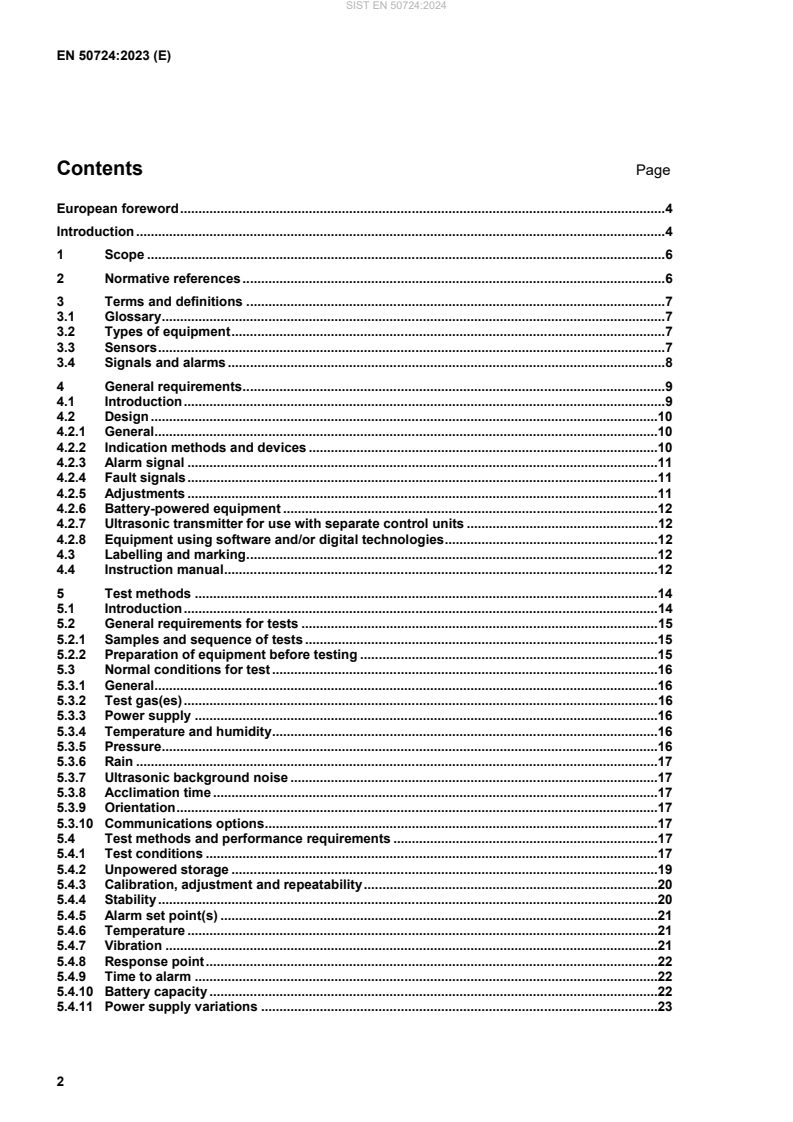
Contents Page
European foreword . 4
Introduction . 4
1 Scope . 6
2 Normative references . 6
3 Terms and definitions . 7
3.1 Glossary. 7
3.2 Types of equipment . 7
3.3 Sensors . 7
3.4 Signals and alarms . 8
4 General requirements . 9
4.1 Introduction . 9
4.2 Design .10
4.2.1 General .10
4.2.2 Indication methods and devices .10
4.2.3 Alarm signal .11
4.2.4 Fault signals .11
4.2.5 Adjustments .11
4.2.6 Battery-powered equipment .12
4.2.7 Ultrasonic transmitter for use with separate control units .12
4.2.8 Equipment using software and/or digital technologies .12
4.3 Labelling and marking .12
4.4 Instruction manual .12
5 Test methods .14
5.1 Introduction .14
5.2 General requirements for tests .15
5.2.1 Samples and sequence of tests .15
5.2.2 Preparation of equipment before testing .15
5.3 Normal conditions for test .16
5.3.1 General .16
5.3.2 Test gas(es) .16
5.3.3 Power supply .16
5.3.4 Temperature and humidity .16
5.3.5 Pressure.16
5.3.6 Rain .17
5.3.7 Ultrasonic background noise .17
5.3.8 Acclimation time .17
5.3.9 Orientation .17
5.3.10 Communications options .17
5.4 Test methods and performance requirements .17
5.4.1 Test conditions .17
5.4.2 Unpowered storage .19
5.4.3 Calibration, adjustment and repeatability .20
5.4.4 Stability .20
5.4.5 Alarm set point(s) .21
5.4.6 Temperature .21
5.4.7 Vibration .21
5.4.8 Response point .22
5.4.9 Time to alarm .22
5.4.10 Battery capacity .22
5.4.11 Power supply variations .23
5.4.12 Electromagnetic compatibility . 23
5.4.13 Verification of software and digital components . 23
5.4.14 False alarm sources . 23
Annex A (informative) Mass flow rate . 24
Annex B (informative) Test sheet . 25
Annex C (informative) Temperature and humidity dB corrections . 26
Annex D (normative) Hole typical drawings . 27
Annex E (informative) Calibration . 29
Annex F (informative) Background noise generation . 31
European foreword
This document (EN 50724:2023) has been prepared by CLC/TC 31 “Electrical apparatus for potentially
explosive atmospheres”.
The following dates are fixed:
• latest date by which this document has (dop) 2024–08–07
to be implemented at national level by
publication of an identical national
standard or by endorsement
• latest date by which the national (dow) 2026–08–07
standards conflicting with this document
have to be withdrawn
Attention is drawn to the possibility that some of the elements of this document may be the subject of patent
rights. CENELEC shall not be held responsible for identifying any or all such patent rights.
Any feedback and questions on this document should be directed to the users’ national committee. A complete
listing of these bodies can be found on the CENELEC website.
Introduction
Ultrasonic Gas Leak Detectors (UGLDs) are being increasingly appointed to quickly detect gas leaks from
pressurized systems to complement the use of point or line of sight detectors. The UGLD detects the acoustic
emission generated by the leak, which propagates omni-directionally at the speed of sound. The leak can be
detected at some distance without the gas itself needing to reach the position of the sensor. The main reason
for implementing UGLDs is to improve the response time to detect dangerous gas leaks and to improve the gas
leak detection coverage with the addition of a complementary detection method that is not affected by air flow.
In general terms, an UGLD functions by detecting the ultrasonic noise generated by gas escapes from a high-
pressure area to a low-pressure area through a small aperture (leak). In practice the technique is of value for
detecting leaks from tank/pipelines, etc running at pressures greater than 2 bar. The intensity of this airborne
ultrasound generated by a gas leak is due to a number of factors including but not limited to gas type, gas
pressure, leak size and gas temperature.
An UGLD does not detect specific gas types, measure percentage LFL or ppm concentration level, but instead
responds to the specific ultrasonic sound generated by a pressurized gas leak. The reliable range coverage of
an UGLD is mainly determined by the leak rate of the gas leak, the atmospheric transmission of the ultrasound,
and the potential acoustic background noise that can interfere with the UGLD. The leak rate is mainly determined
by gas pressure and leak size, but molecular weight and gas temperature also plays a role. The leak rate
determines how fast a potentially dangerous gas cloud will be generated. In addition, physical obstructions
between the location of the leak, and the UGLD will also have an influence on the detection range of the detector.
1 Scope
This document refers to UGLDs (ultrasonic gas leak detectors) that work in a frequency beyond the audible
range. This document is applicable to fixed ultrasonic gas leak detection equipment intended to provide an
indication, alarm or other output function for the purpose of initiating automatic or manual protective action(s).
This document specifies general requirements for design, testing and performance, and describes test methods
that apply to UGLD. The following items are considered in this document:
— Leak rates to be used to verify the detection range of UGLD,
— Test gas to be used (nitrogen or compressed air),
— Nozzle shape and size used at all tests leak rate tests,
— Gas pressure used at all leak rate tests,
— Time duration of each leak rate test,
— Test leak nozzle height from solid ground,
— Test leak nozzle angling relative to test UGLD,
— UGLD angle relative to the leak (field of coverage of the UGLD),
— Wind speed and direction, air temperature and humidity at day of test,
— Minimum distance to solid structures (walls, etc.) at test site,
— Installation height relative to the ground,
— Texture of solid ground between leak and UGLD,
— Background noise sources, known to interfere with UGLDs,
— Specification of detection radius in 3 dimensions,
— Operational requirements such as temperature, vibration, etc.
This document is also applicable when an equipment manufacturer makes any claims regarding any special
features of construction or superior performance that exceed the minimum requirements of this document. This
document prescribes that all such claims are verified, and that the test procedures are extended or
supplemented, where necessary, to verify the claimed performance. The additional tests are agreed between
the manufacturer and test laboratory and identified and described in the test report.
This document does not apply to portable gas detectors using ultrasonic measurements nor to gas detectors
using non-ultrasonic measurements to detect a gas leak.
2 Normative references
The following documents are referred to in the text in such a way that some or all of their content constitutes
requirements of this document. For dated references, only the edition cited applies. For undated references, the
latest edition of the referenced document (including any amendments) applies.
EN IEC 61326-1, Electrical equipment for measurement, control and laboratory use - EMC requirements - Part
1: General requirements
EN 50271:2018, Electrical apparatus for the detection and measurement of combustible gases, toxic gases or
oxygen - Requirements and tests for apparatus using software and/or digital technologies
IEC 60068-2-6, Environmental testing - Part 2-6: Tests - Test Fc: Vibration (sinusoidal)
3 Terms and definitions
For the purposes of this document, the following terms and definitions apply.
ISO and IEC maintain terminology databases for use in standardization at the following addresses:
— ISO Online browsing platform: available at https://www.iso.org/obp
— IEC Electropedia: available at https://www.electropedia.org/
3.1 Glossary
3.1.1
UGLD
Ultrasonic Gas Leak Detector
equipment that work normally in a frequency beyond the audible range (> 16 kHz)
3.1.2
leak rate
mass flow rate from the gas leak
3.2 Types of equipment
3.2.1
alarm-only equipment
equipment having an alarm but not having a proportional indication of sound pressure level
3.2.2
continuous duty equipment
equipment that is powered for long periods of time, but may have either continuous or intermittent sensing
3.2.3
fixed equipment
equipment that is intended to have all parts permanently installed
3.2.4
stand-alone leak detection equipment
fixed leak detection equipment that provides a conditioned electronic signal or output indication to a generally
accepted industry standard (such as 4-20 mA), intended to be utilized with stand-alone control units, or signal
processing data acquisition, central monitoring and similar systems which typically process information from
various locations and sources including, but not limited to, leak detection equipment
3.2.5
stand-alone control unit
fixed leak detection control units intended to provide meter indication, alarm functions, output contacts and/or
alarm signal outputs when utilized with stand-alone leak detection equipment
3.3 Sensors
3.3.1
integral sensor
sensor which is integral to the main body of the equipment
3.3.2
remote sensor
sensor which is not integral to the main body of the equipment
3.3.3
sensor
assembly in which the sensing element is housed and which may also contain associated circuit components
3.3.4
sensing element
part of the sensor which is sensitive to the noise to be measured
3.4 Signals and alarms
3.4.1
sound pressure level
SPL
level measured in dB defined as:
POW P
SIG SIG
SPL=10⋅=log 20⋅ log
10 10
POW P
ref ref
with the sound pressure P , the reference sound pressure P = 20µPa, the reference signal power
SIG ref
POW , and the signal power POW calculated from a time domain signal of N digits:
ref SIG
N2
POW = abs FFT N ~ P ²
( ( ))
SIG i SIG
∑
i=1
Note 1 to entry: FFT represents the signal within the i frequency bin generated by a Fast Fourier Transformation. No
i th
weighting filter is applied (like A, C or Z). The FFT window shall be chosen in a way that best represents the power of the
ultrasonic signal.
Note 2 to entry: The reference signal power , necessary to fixate the dB-scale to an absolute reference, is
POW
ref
extremely difficult to measure, especially since the ultrasonic bandwidth ranges of UGLDs differ among each other.
Therefore, the absolute calibration is traced back to the existing calibration in the audible range, the hearing threshold. A
practical method and calibration set up is described in Annex E.
To generate a consistent dB-scale between the vendor devices, the calibration bandwidth is fixed from 16kHz to 64kHz,
representing two full octave frequency bands.
3.4.2
reference noise
small leak of air close to the UGLD – typically round nozzle, 300 µm, mass flow 0,06 g/s, 25 cm from the sensor,
used for some specific small-scale tests
Note 1 to entry: The nozzle drawing is provided in Annex D.
3.4.3
reference leak
25 g/s leak of test gas generated though a 2 mm nozzle using e.g. a mass flow controller
Note 1 to entry: An upstream pressure of 38-bar at 20°C may be necessary.
Note 2 to entry: The nozzle drawing is provided in Annex D.
3.4.4
low noise condition
no external stimulus beyond 50 dB, measured with an external dedicated measurement equipment in the
frequency range defined
3.4.5
measuring range
measuring range that represents the interval between the lowest measured value (in dB) and the highest
measured value
3.4.6
alarm set point
fixed or adjustable setting of the equipment that is intended to pre-set the level of ultrasonic sound pressure
level at which the equipment will automatically initiate an indication, alarm or other output function
3.4.7
fault signal
audible, visible or other type of output, different from the alarm signal, permitting, directly or indirectly, a warning
or indication that the equipment is not working faultless
3.4.8
latching alarm
alarm that, once activated, requires deliberate action to be deactivated
3.4.9
repeatability
level of agreement between the results of measurements of the same ultrasound noise level, carried out by the
same method and conditions, on the same UGLD instrument type
3.4.10
drift
variation in the equipment indication with time, at any fixed ultrasound noise level under constant ambient
conditions
3.4.11
final indication
indication given by the equipment after stabilisation
3.4.12
stabilisation
state when three successive readings of an equipment, taken at 5 s intervals, indicate no changes greater than
± 1 dB
3.4.13
time to alarm
time interval, with the equipment in a warmed-up condition, between the time when an instantaneous release is
produced in the equipment surrounding and the time when the alarm is triggered
4 General requirements
4.1 Introduction
The equipment shall comply with the requirements of this document.
Electrical assemblies and components shall comply with the construction and test requirements of 4.2, where
applicable. In addition, parts of the UGLD intended for use in potentially explosive atmospheres are expected
to employ materials and comply with the construction and explosion protection as specified in the appropriate
regulations for explosion protection.
4.2 Design
4.2.1 General
The equipment shall be constructed in such a manner that regular functional checks can be easily undertaken
by the user and that it can be equipped with suitable devices for application of a sound source (field test kit).
Any malfunction of outputs from the detection equipment not relevant to safety or health shall never adversely
affect the functions of the equipment related to safety.
EXAMPLE Equipment with 4-20 mA and Highway Addressable Remote Transducer (HART) Protocol communication
where only the 4-20 mA communication is defined in the instruction manual as related to safety. The loss of HART
communication is not related to safety.
4.2.2 Indication methods and devices
4.2.2.1 General
Readily distinguishable indications shall be provided to show the instrument status, e.g. that the equipment is
energised, operational, in alarm or in a special state (e.g. fault or warning or inhibited).
It is permitted for the equipment output signals to indicate instrument status (e.g. energised, in alarm and special
state conditions) on the receiving control unit.
If the equipment has more than one leak detection scale, the range selected shall be clearly identified.
4.2.2.2 Display and other devices for indication of measured values
For equipment with a display to indicate the ultrasound measurement level, all methods of indication of the
measured ultrasound pressure level value shall present the same value within the resolution of each indicator.
Any over-range measurements shall be clearly indicated.
For alarm-only equipment or equipment where the resolution of the read-out device is inadequate to
demonstrate compliance with this document, the manufacturer shall identify suitable methods for connecting
indicating or recording devices for the purpose of testing the compliance of the equipment with this document.
The indication on the read-out device of the equipment shall not contradict the results obtained by the indicating
or recording devices.
4.2.2.3 Indicator light
If only one indicator light is provided for signalling alarms, special states and other indications, it shall be
coloured red. If separate indicator lights are used or if a multi-coloured indicator light is provided, the colours
shall be used in the following order of priority ((a) being highest priority):
a) alarms indicating the presence of ultrasonic noise level beyond an alarm set point shall be coloured RED;
b) equipment fault or warning special state indicators shall be coloured YELLOW;
c) power supply indicators shall be coloured GREEN.
If a multi-coloured indicator light is provided, the equipment shall provide an additional indication by means other
than colour.
If there is more than one indicator light of the same colour with different functions, the lights shall be labelled to
show their functions. Text, marks, and icons on a screen display describing the indicator lights are permissible
in place of printed labels.
4.2.3 Alarm signal
4.2.3.1 Alarm settings
If audible and visual alarms are provided, they shall be clearly distinguished from other indications. If the
equipment has more than one measuring range, the equipment shall not automatically change any existing
alarm setting when changing the measuring range.
4.2.3.2 Alarm output functions
Alarm devices shall not be adjustable to operate outside the measuring range.
If alarm devices, output contacts or alarm signal outputs are provided as part of continuous leak detection
equipment and are intended to operate when a potentially hazardous leak is detected, they shall be of a latching
type requiring a deliberate manual action to reset. If two or more alarm set points are provided, the lower may
be non-latching - based on user preference. Alarms shall remain in operation while the alarm condition is still
present, although audible alarms may be silenced if this audible alarm is not the only alarm signalling means.
If it is possible to deactivate alarm devices, output contacts or alarm signal outputs, e.g. for calibration purposes,
this deactivation shall be indicated by a signal. For fixed equipment, this shall include a contact or other
transmittable output signal. However, the output signal or contacts are not required if the alarms are
automatically re-enabled within 15 min.
EXAMPLE It might be necessary to de-activate alarm devices for calibration purposes.
4.2.3.3 Alarm delay
An alarm delay may be provided as part of continuous leak detection equipment.
4.2.4 Fault signals
Externally powered equipment shall provide a fault signal in the event of failure of power to the equipment.
Externally powered equipment shall provide a fault signal when the supply voltage falls below the minimum
supply voltage fault limit.
A short circuit or open circuit in connections to any remote sensor or transmitter shall be indicated by a fault
signal.
Under the above conditions the equipment may also indicate alarm.
Equipment where the sensor can be replaced without opening the housing with a tool shall provide a fault signal
in the event of a disconnection of the sensor.
The failure of an ultrasound sensor shall be indicated as a fault. If an UGLD Detector has multiple ultrasound
sensors, then the failure of any sensor shall be indicated.
4.2.5 Adjustments
All adjustment functions shall be designed so as to discourage unauthorised or inadvertent interference with the
equipment.
EXAMPLE Procedural devices, in the case of a special keyboard instrument, and/or mechanical devices such as a
cover requiring the use of a special tool.
Fixed explosion-protected equipment housed in explosion-protected enclosures shall be designed so that, if any
facilities for adjustments are necessary for routine recalibration and for resetting or functions of the like, these
facilities shall be externally accessible and shall not degrade the explosion protection of the equipment. The
instrument manual shall provide the instructions for these tasks.
The adjustments of the low noise reference and sensitivity shall be designed so that:
a) adjustment of one will not affect the other;
or
b) it shall not be possible to adjust only one and the sequence of adjustments shall ensure that the affected
one is adjusted second.
4.2.6 Battery-powered equipment
Equipment powered with integral batteries shall be provided with an indication of low battery condition, and the
nature and purpose of this indication shall be explained in the manual (see 4.4 c10).
4.2.7 Ultrasonic transmitter for use with separate control units
The UGLD may provide a deterministic discrete output of an alarm (gas leak) based on set thresholds and it
may provide an output as a measurement, proportional to the ultrasound pressure level, to a separate control
unit along with the special states.
The manufacturer shall provide a guidance to interpret the output signal or indication, which will enable the
accuracy of the transfer function to be verified.
4.2.8 Equipment using software and/or digital technologies
The equipment shall fulfil the requirements of EN 50271:2018.
4.3 Labelling and marking
The equipment shall be marked legibly and indelibly. The following minimum requirements apply:
a) name and address of the manufacturer;
b) certification marking;
c) designation of series or type;
d) serial number;
e) year of manufacture (may be encoded within the serial number);
f) “EN 50724” (to represent conformance with this performance standard). If due to size constraints this
information cannot be put onto the equipment, it shall be included in the instruction manual.
4.4 Instruction manual
Each equipment shall be provided with an instruction manual that includes the following information:
a) complete instructions, drawings and diagrams for safe and proper installation, commissioning, operation,
maintenance and decommissioning of the equipment;
b) details for calibration/adjustment and/or maintenance which shall include the following:
1) calibration/adjustment procedures where necessary;
2) recommendations and requirements for initial and regular checking and calibration (where necessary)
of the equipment on a routine basis, including the maximum time intervals between testing and
calibrations (where necessary);
3) if applicable, instructions for the replacement of the sensor or sensing element;
c) details of operational limitations, performance claimed by the manufacturer and special features including,
where applicable, the following:
1) intended use;
2) whether the equipment is intended to be used in potentially explosive atmospheres and the hazardous
location certifications;
3) measuring principles including bandwidth, detection frequency range;
4) operational temperature limits (performance and if applicable, explosion protection);
5) humidity limits and transient effects from humidity changes, if any;
6) pressure limits (performance and if applicable, explosion protection) and, if appropriate, correction
factors for pressure dependence;
7) supply voltage limits and supply voltage fault limit;
8) maximum power consumption;
9) relevant characteristics and construction details of required interconnecting cables;
10) for battery operated equipment, battery type(s) and operating time(s) until low battery condition under
normal operating conditions;
11) nominal orientation and orientation limits
12) warm-up time;
13) test signal application time for test and calibration (if necessary);
14) electromagnetic compatibility (e.g. shielded cable, transient suppression, special enclosure);
15) description of any suppression of indication(s) including default setting(s) and the method for its
enablement/disablement;
16) equipment drift with time due to sensor stability or other factors;
17) performance under operating conditions outside the specification of this document, if applicable (see
5.1);
18) the interface specification, cabling characteristics and maximum polling rate for each communication
port;
19) the largest and most complex system configuration;
20) the instrument field of coverage as a 3-dimensional plot of ultrasound pressure level. Include multiple
plots if the field of coverage is adjustable;
d) details of storage life and limitations for the equipment, replacement parts and accessories, including,
where applicable, the following limits:
1) temperature;
2) humidity;
3) pressure;
4) time;
e) specification and significance of all alarms and fault signals, the default setting of alarms, the duration of
such alarms and signals (if time-limited or non-latching), and any provisions that may be made for silencing
or resetting such alarms and signals, as applicable;
f) Description of Special states, Alarm or other status messages that could be shown on the display or other
devices for indication;
g) details of any method for the determination of the possible sources of a malfunction and any corrective
procedures (i.e. trouble-shooting procedures);
h) a statement that alarm devices, outputs or contacts are of the non-latching types, where applicable; and
the requirement that the alarm with the highest set point shall be configured latching, if applicable (see
4.2.3.2);
i) for battery-operated equipment, installation and maintenance instructions for the batteries;
j) a recommended replacement parts list;
k) where optional accessories (e.g. weather-protecting devices) are supplied, a list of such accessories and
their effects on the equipment characteristics (including sensitivity), and means for their identification (e.g.
part numbers). In addition, it shall be clearly described for each accessory whether it is included in the
performance certificate;
l) details of performance certification, if any (e.g. issuing organization, date, ranges, accessories, etc.), and
marking, and any special conditions of use;
m) if an ingress protection (IP) is claimed, such as IEC 60529, the following statement shall be included:
1) IP ratings do not imply that the equipment will detect ultrasonic noise during and after exposure to
those conditions.
2) recommendations for determining appropriate calibration interval and maintenance requirements if
exposed to those conditions representative of the IP rating; State which conditions this would apply to
and what checks have to be made to ensure that the equipment has not been damaged. If a
microphone filter is used identify when it will need replacement.
3) recommended accessories to those conditions representative of the IP rating
n) for transmitter or separate control units (see 4.2.7 and 4.2.8), specification of the transfer function, full scale
input/output and all status signals (e.g. fault, inhibit);
o) any necessary instructions or information, where the special nature of the equipment (such as nonlinear
responses) requires additional instructions or special information that are alternative to, or in addition to,
the requirements of 4.3 and 4.4 a) to o);
p) configuration, operation and default setting of any alarm delay.
5 Test methods
5.1 Introduction
The test methods and procedures described in 5.2 to 5.4 are intended as a basis for establishing whether the
equipment conforms with the performance requirements given in this document.
Where a manufacturer makes any claims in the instruction manual regarding any special features of construction
or extended performance that exceed the minimum requirements of this document, all such claims shall be
verified and the test procedures shall be carried out as stated in each clause and shall be extended or
supplemented, where necessary, to verify the claimed special features of construction or extended performance.
Any extended or supplemented tests shall be agreed between the manufacturer and test laboratory and
described in the test report. When verifying an extended performance or special feature the minimum
requirements of this document shall be met and the claimed extended performance shall be verified.
5.2 General requirements for tests
5.2.1 Samples and sequence of tests
5.2.1.1 Test samples
For the purpose of type testing, the tests shall be carried out on one sample of equipment. The EMC test (5.4.14)
may be performed on a separate equipment sample.
One additional sample of the equipment may be used for the tests according to 5.4.4 and 5.4.11.
If a test sample ceases to function during the test sequence, then mutual agreement shall be reached between
the test laboratory and the manufacturer as to which tests have to be repeated with a replacement sample. The
decision and its justification shall be described in the test report.
5.2.1.2 Test sequence
The unpowered storage test (5.4.2) shall be conducted first for all test samples. Pre-conditioning by the
unpowered storage test (5.4.2) is not required for a separate test sample which is used for the EMC test (5.4.14).
All remaining tests shall be performed to a schedule agreed upon between the manufacturer and the test
laboratory.
If equipment, which has been tested previously to this document, is modified then the test laboratory shall agree
with the manufacturer which tests have to be repeated with the modified equipment. The decision and its
justification shall be described in the test report. In the case of modifications to the software or of electronic
components which are part of the basic leak detection functionality (signal chain from sensor to output(s)) the
following tests shall be re-performed as a minimum: calibration curve, alarm set point(s).
For transmitters the following tests shall be performed: 5.4.2 through 5.4.6.
For control units the following tests shall be performed: 5.4.2, 5.4.3, 5.4.5, 5.4.6, 5.4.8, 5.4.8 through 5.4.14.
5.2.2 Preparation of equipment before testing
The equipment shall be prepared and mounted in accordance with the instruction manual, including all
necessary interconnections, initial adjustments and initial calibrations. Adjustments may be made, at the
beginning of each test. Once a particular test has begun, further adjustments shall not be made except where
specifically permitted by the particular test procedure.
Suppression of indications and any alarm delay of the equipment under test shall be disabled. For each test,
the alarm set point shall be set as agreed between the testing laboratory and the manufacturer. The setting
shall be indicated in the test report.
In particular, the following points shall be noted:
a) Equipment having remote sensors.
For the purpose of the tests in 5.4, where reference is made to exposure of the sensor to the test conditions,
the entire remote sensor (including any or all normally attached protective mechanical parts) shall be exposed.
For equipment having connection facilities for more than one remote sensor, only one remote sensor needs to
be subjected to the tests. The replacement of all but one sensor by “dummy” impedances yielding the worst-
case load conditions for the test in question is permitted. The worst-case load conditions shall be determined
by the testing laboratory within the limits specified in the instruction manual.
For equipment having remote sensor(s), all tests shall be performed in the worst-case conditions. The worst-
case load conditions shall be determined by the testing laboratory within the limits specified in the instruction
manual.
b) Separate leak detection control units.
The replacement of all transmitters by appropriate signal sources and worst-case loads for the test in
question shall be permitted. The worst-case loads shall be determined by the test laboratory within the
limits specified in the instruction manual (see 4.4 c12)). The chosen loads shall be documented in the test
report.
c) Equipment having integral sensors.
The entire apparatus shall be exposed to the test conditions without removal of any normally attached parts,
including any sampling probe for tests 5.4.10 and 5.4.14.
d) For alarm-only apparatus, readings shall be taken using an external indicating or recording device connected
to test points described in 4.2.2.
Optional accessories to be included in the performance test shall be either attached or removed according to
which condition will give the most unfavourable result for the test being conducted unless otherwise specified.
The exact configuration of the equipment, including use of or removal of the optional accessories, shall be
documented in the test report.
5.3 Normal conditions for test
5.3.1 General
The test conditions specified in 5.3.2 to 5.3.10 shall be used for all tests, unless otherwise stated.
Conditions and observations made during the test should be reported in the test sheet. An example is provided
in Annex B.
5.3.2 Test gas(es)
The gasses to be used for the test shall be Nitrogen, > 99,5 % v/v, or compressed dry air simulating the target
gas. Alternatively, tests may use a typical reference gas considering the use case, non- dangerous gas shall be
used, while representing the gas type.
5.3.3 Power supply
a) Fixed AC or DC powered equipment shall be operated within ± 2 % of the rated supply voltage and
frequency as specified in the instruction manual.
b) Battery-powered equipment shall, for short-term tests, be equipped with new or fully charged batteries at
the commencement of each series of tests. For long-term testing, it is permissible to energize the unit from
a stabilized power supply. The temperature test (5.4.6) shall be carried out with any batteries specified in
the instruction manual.
5.3.4 Temperature and humidity
The ambient air shall be held at a temperature constant to ± 4 °C within the range of 10 °C to 30 °C, throughout
the duration of each test, unless otherwise specified for the particular test. Humidity shall remain in the
corresponding range to ensure a deviation lower than ± 2dB, see for example graphs in Annex C.
When the above conditions cannot be maintained during the testing, correction of the measured value shall be
applied using the table in Annex C.
This requirement is not applicable to tests 5.4.12 and 5.4.13.
5.3.5 Pressure
The tests shall be performed at the prevailing ambient pressure provided that it lies between 86 kPa and
108 kPa. If a deviation greater than ± 1 kPa occurs during a test, the pressure changes shall be recorded and
taken into account.
5.3.6 Rain
When tests are carried out outside, they shall be undertaken in dry conditions.
5.3.7 Ultrasonic background no
...