

SIST EN 15483:2009
Ambient air quality - Atmospheric measurements near ground with FTIR spectroscopy
General Information
- Abstract
This European Standard is applicable to open-path absorption measurements of 'concentration path length' product using the Fourier transform infrared (FTIR) technique with an artificial radiation source. It is applicable to the continuous measurement of infrared active organic and inorganic compounds in the gaseous state in ambient air using fixed tropospheric open paths up to approximately 1 km in length and provides a spatial average.
- Status
- Published
- Publication Date
- 17-Feb-2009
- Technical Committee
- KAZ - Air quality
- Current Stage
- 6060 - National Implementation/Publication (Adopted Project)
- Start Date
- 28-Jan-2009
- Due Date
- 04-Apr-2009
- Completion Date
- 18-Feb-2009

Overview
EN 15483:2008 (CEN) - "Ambient air quality - Atmospheric measurements near ground with FTIR spectroscopy" defines requirements and good practice for open-path Fourier transform infrared (FTIR) measurements of path-integrated gas concentrations in the troposphere. The standard covers continuous, non‑contact monitoring of infrared‑active organic and inorganic gases using an artificial IR source and fixed open paths up to approximately 1 km, providing a spatially averaged “concentration × path length” result suitable for environmental assessment and emission surveillance.
Key topics and technical requirements
- Measurement principle: Use of FTIR interferometry (interferogram → Fourier transform) to obtain spectral absorbance and quantify species via the Beer–Lambert law and instrument modelling.
- Measurement configurations: Bistatic (separate transmitter and receiver) and monostatic (transmitter/receiver with retroreflector) optical set‑ups are described, including advantages such as source modulation.
- Instrument performance: Requirements and descriptions for spectral resolution, instrument line shape (ILS), apodisation, signal‑to‑noise ratio, scan speed and spectral acquisition time.
- Measurement planning: Defining target species, likely interferences, monitoring path geometry, temporal resolution and site constraints before deployment.
- Procedure & data processing: Guidance on background/reference spectra, spectral fitting, calibration transfer, handling interfering variables and generation of path‑integrated concentrations.
- Calibration & quality assurance: Traceable calibration methods, performance characterisation, and routine QA/servicing to ensure reproducible and valid results.
- Uncertainty & reporting: Identification and quantification of major uncertainty sources and recommended reporting items (measurement records, sample forms).
- Annexed guidance: Informative annexes cover spectrometer types, monitoring configurations, equipment lists, emission flux conditions, fog effects on spectra, performance characteristics and example applications.
Practical applications and users
EN 15483 is designed for practitioners and organizations performing field atmospheric FTIR monitoring, including:
- Environmental agencies and air‑quality monitoring networks
- Field measurement teams and consultants assessing diffuse emissions
- Industrial environmental monitoring (leak detection, process emission screening)
- Research institutions studying near‑ground atmospheric composition
- FTIR system manufacturers and integrators implementing field systems
Typical use cases include monitoring emissions from landfills, road corridors, sewage or industrial/agricultural areas, tracing leaks in plant piping, and remote monitoring where in‑situ point measurements are impractical or hazardous. The standard also notes potential applicability for compliance monitoring of certain pollutants under EU legislation in specific circumstances (e.g., CO).
Related standards
Relevant normative references cited in EN 15483 include:
- EN ISO 6142 / EN ISO 6144 (calibration gas preparation)
- EN ISO 9169 (performance characteristics of automatic measuring systems)
- ISO 6145 series (dynamic volumetric gas mixture methods)
Keywords: FTIR spectroscopy, open‑path FTIR, ambient air quality, open‑path absorption, Fourier transform infrared, path‑integrated concentration, atmospheric measurements near ground, real‑time monitoring.
Relations
- Effective Date
- 25-Aug-2026
- Effective Date
- 25-Aug-2026
- Effective Date
- 28-Jan-2026
- Effective Date
- 28-Jan-2026
- Effective Date
- 28-Jan-2026
- Effective Date
- 28-Jan-2026
- Effective Date
- 28-Jan-2026
- Effective Date
- 28-Jan-2026
- Effective Date
- 28-Jan-2026
- Effective Date
- 28-Jan-2026
- Effective Date
- 28-Jan-2026
- Effective Date
- 28-Jan-2026
- Effective Date
- 28-Jan-2026
Get Certified
Connect with accredited certification bodies for this standard

CIS Institut d.o.o.
Personal Protective Equipment (PPE) certification body. Notified Body NB-2890 for EU Regulation 2016/425 PPE.

Kiwa BDA Testing
Building and construction product certification.
Kmetijski inštitut Slovenije
Agricultural Institute of Slovenia. Soil testing, plant health, agricultural product analysis.
Sponsored listings
Frequently Asked Questions
SIST EN 15483:2009 is a standard published by the Slovenian Institute for Standardization (SIST). Its full title is "Ambient air quality - Atmospheric measurements near ground with FTIR spectroscopy". This standard covers: This European Standard is applicable to open-path absorption measurements of 'concentration path length' product using the Fourier transform infrared (FTIR) technique with an artificial radiation source. It is applicable to the continuous measurement of infrared active organic and inorganic compounds in the gaseous state in ambient air using fixed tropospheric open paths up to approximately 1 km in length and provides a spatial average.
This European Standard is applicable to open-path absorption measurements of 'concentration path length' product using the Fourier transform infrared (FTIR) technique with an artificial radiation source. It is applicable to the continuous measurement of infrared active organic and inorganic compounds in the gaseous state in ambient air using fixed tropospheric open paths up to approximately 1 km in length and provides a spatial average.
SIST EN 15483:2009 is classified under the following ICS (International Classification for Standards) categories: 13.040.20 - Ambient atmospheres. The ICS classification helps identify the subject area and facilitates finding related standards.
SIST EN 15483:2009 has the following relationships with other standards: It is inter standard links to SIST ISO 6145-1:2004, SIST ISO 6145-6:2004, SIST EN 2436-002:2009, SIST EN ISO 9169:2007, SIST EN 16116-2:2014, SIST EN 16116-1:2014, SIST EN ISO 6144:2006, SIST EN 809:2000/kprA1:2009, SIST EN ISO 7625:2014, SIST EN 12790:2009, SIST EN ISO 22435:2009/A1:2013, SIST EN ISO 6142-1:2015, SIST EN 933-8:2012. Understanding these relationships helps ensure you are using the most current and applicable version of the standard.
SIST EN 15483:2009 is available in PDF format for immediate download after purchase. The document can be added to your cart and obtained through the secure checkout process. Digital delivery ensures instant access to the complete standard document.
Standards Content (Sample)
2003-01.Slovenski inštitut za standardizacijo. Razmnoževanje celote ali delov tega standarda ni dovoljeno.Kakovost zunanjega zraka - Prizemne meritve zunanjega zraka s FTIR spektroskopijoLuftqualität - Messungen in der bodennahen Atmosphäre mit FTIR-SpektroskopieQualité de l'air ambiant - Mesurages de l'air ambiant à proximité du sol par spectrométrie à transformée Fourier (FTIR)Ambient air quality - Atmospheric measurements near ground with FTIR spectroscopy13.040.20Kakovost okoljskega zrakaAmbient atmospheresICS:Ta slovenski standard je istoveten z:EN 15483:2008SIST EN 15483:2009en,fr,de01-marec-2009SIST EN 15483:2009SLOVENSKI
STANDARD
EUROPEAN STANDARDNORME EUROPÉENNEEUROPÄISCHE NORMEN 15483November 2008ICS 13.040.20 English VersionAmbient air quality - Atmospheric measurements near groundwith FTIR spectroscopyQualité de l'air ambiant - Mesurages de l'air ambiant àproximité du sol par spectroscopie à transformée deFourier (FTIR)Luftqualität - Messungen in der bodennahen Atmosphäremit FTIR-SpektroskopieThis European Standard was approved by CEN on 11 October 2008.CEN members are bound to comply with the CEN/CENELEC Internal Regulations which stipulate the conditions for giving this EuropeanStandard the status of a national standard without any alteration. Up-to-date lists and bibliographical references concerning such nationalstandards may be obtained on application to the CEN Management Centre or to any CEN member.This European Standard exists in three official versions (English, French, German). A version in any other language made by translationunder the responsibility of a CEN member into its own language and notified to the CEN Management Centre has the same status as theofficial versions.CEN members are the national standards bodies of Austria, Belgium, Bulgaria, Cyprus, Czech Republic, Denmark, Estonia, Finland,France, Germany, Greece, Hungary, Iceland, Ireland, Italy, Latvia, Lithuania, Luxembourg, Malta, Netherlands, Norway, Poland, Portugal,Romania, Slovakia, Slovenia, Spain, Sweden, Switzerland and United Kingdom.EUROPEAN COMMITTEE FOR STANDARDIZATIONCOMITÉ EUROPÉEN DE NORMALISATIONEUROPÄISCHES KOMITEE FÜR NORMUNGManagement Centre: rue de Stassart, 36
B-1050 Brussels© 2008 CENAll rights of exploitation in any form and by any means reservedworldwide for CEN national Members.Ref. No. EN 15483:2008: ESIST EN 15483:2009
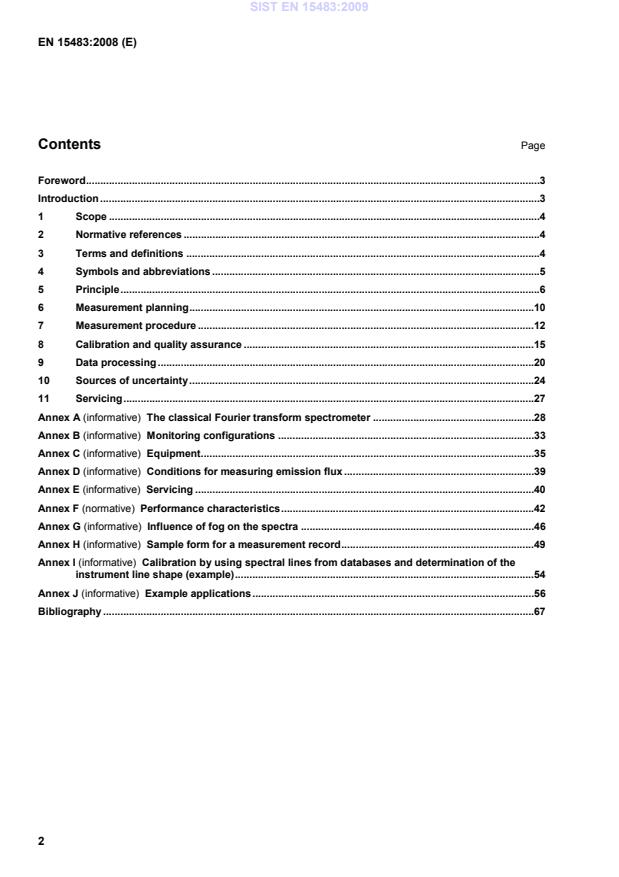
The classical Fourier transform spectrometer.28 Annex B (informative)
Monitoring configurations.33 Annex C (informative)
Equipment.35 Annex D (informative)
Conditions for measuring emission flux.39 Annex E (informative)
Servicing.40 Annex F (normative)
Performance characteristics.42 Annex G (informative)
Influence of fog on the spectra.46 Annex H (informative)
Sample form for a measurement record.49 Annex I (informative)
Calibration by using spectral lines from databases and determination of the instrument line shape (example).54 Annex J (informative)
Example applications.56 Bibliography.67
specific absorption coefficient of the measured variable; a'(ν~) specific (natural) absorption coefficient (=a(ν~)/lg(e)); c concentration; ci concentration of the ith compound; SIST EN 15483:2009
Key 1 FTIR spectrometer 2 telescope for radiation collection 3 ambient air 4 monitoring path 5 IR radiation source with collimating optics Figure 1 – Bistatic arrangement for FTIR remote sensing
Key 1 FTIR spectrometer 2 telescope for radiation collection 3 ambient air 4 monitoring path 5 IR radiation source with collimating optics 6 FTIR spectrometer including radiation source
7 telescope for transmission and collection of IR radiation 8 retroreflector Figure 2 – Monostatic arrangement for FTIR remote sensing In the bistatic measurement set-up, the IR radiation source (5) and the FTIR spectrometer (1) are spatially separated from one another. The two instrumental parts are oriented in such a way that the radiation emitted from the IR source and collimated by a parabolic mirror is collected by the FTIR spectrometer telescope (2). The monitoring path length is defined by the distance between collimating and receiving optics. For a monostatic measurement set-up, transmitting and receiving optics are an integral part of the FTIR spectrometer (6), which also includes the IR radiation source and a beam splitter serving to separate the received and transmitted beams. By means of a retroreflector (8) the IR beam passes twice through the SIST EN 15483:2009
(1) With the relationship )~(a)e()~(aνν′⋅=lg the following applies ))~((010)~()~()~(lcaIIT⋅⋅−==νννν
(2) where T)~(ν transmittance; I0(ν~) intensity of radiation emitted by the transmitter (also abbreviated to I0 below); I(ν~) intensity incident on the receiver (also termed I below); a'(ν~) specific (natural) absorption coefficient of the gas, based on Equation (1); a(ν~) specific (decadic) absorption coefficient of the gas, based on Equation (2), for example in (mg/m3)–1·m–1 or converted into ppm–1·m–1; c gas concentration, e. g. in mg/m3, or converted from concentration into mixing ratio in ppm or ppb; l length of the monitoring path, in m. NOTE 1 The Beer-Lambert law is commonly used in the form of Equation (2). NOTE 2 The Beer-Lambert law is valid for monochromatic radiation. It is an excellent approximation of the measured transmittance if high spectral resolution is applied. For low spectral resolutions, an apparent deviation from the law is observed (see 8.1.2). However, this deviation is caused by the instrument line shape, which is well characterized in the case of a Fourier transform spectrometer. Thus the apparent deviation can be modelled and the effect of the deviation on the quantification can be removed (see 8.1.3). The transmittance is a direct measure of the attenuation of I0 caused by the gas. SIST EN 15483:2009
Non-zero intensities below the detector cut-off wavelength indicate detector non-linearity. Detector saturation or ADC overflow will result in deformed single-beam spectra when compared to routine measurements. In such cases corrective actions may be e. g. • a smaller aperture • use of a mesh • application of a detector nonlinearity correction method [7] • reduce the source intensity SIST EN 15483:2009
show spectroscopic overlap with water vapour spectral features; • a spectrum of the ambient black body emission radiation three times per day if the evaluation of spectral data is carried out in a range from detector cut-off to approx. 1500 cm–1 (FTIR spectrometer with non-modulated IR radiation as found for bistatic FTIR spectrometer systems; see 10.3.6); • a spectrum of the internal stray radiation once after turning on the instrument, once per week during continuous operation (FTIR spectrometer with modulated IR radiation as found for monostatic FTIR spectrometer systems; see 10.3.6). In addition the following information shall be available: • reference spectra for the compounds to be measured including compounds which have cross-sensitivities (see 10.3.2); The user shall ensure that either the components to be measured are free from cross-sensitivities to interfering gases or that interfering compounds are known and properly taken into account within the evaluation procedure. For every measurement with a non-modulated signal, at least at the beginning and the end of a series of measurements a background radiation spectrum shall be recorded. For relatively long series of measurements the background radiation spectrum may vary greatly. Changes in the background radiation spectrum will affect measurement uncertainty. The frequency of measurements of the background shall be chosen to meet the required measurement uncertainty. The measured spectra shall then be corrected using the recorded spectra of the natural background radiation. This applies particularly with meteorological conditions which change rapidly. 7.4 Information to be recorded Documentation of the measurements variables shall include: scan speed; spectral acquisition time and number of co-added interferograms; path length; spectral range; SIST EN 15483:2009
Key X calibration gas mixing ratio × optical path length in ppm·m Y measurement values in ppm·m Figure 3a – Plot of a linear calibration function composed of the results of univariate evaluation of absorption bands with different absorption coefficients
Key X calibration gas mixing ratio × optical path length in ppm·m Y measurement values in ppm·m Figure 3b – Plot of a calibration function from multivariate evaluation (uncorrected, no linearization of evaluation results obtained) The calibration function is used in all following measurements as a basis for correcting values calculated as specified in Clause 9, since otherwise systematic errors, in particular due to apparent nonlinearities (nonlinear relationship between absorbance and concentration) at high concentrations that are caused by the application of a spectral resolution that is significantly lower (width of the instrument line shape significantly larger) than SIST EN 15483:2009
Key 1 methane 2 carbon monoxide 3 dinitrogen monoxide 4 ammonia X date Y mean mixing ratio in ppm Figure 4 – Measurement of atmospheric trace gases by FTIR spectrometer over a relatively long period SIST EN 15483:2009
Key X time Y water vapour mixing ratio in ppm Figure 5 – Comparison between FTIR spectrometer (continuous line) and standard humidity meter (hair hygrometer; dotted line) 8.3 Control measurements For continued operation of the system at a fixed site and line of sight, control measurements shall be recorded at a fixed concentration using a gas cell which is representative for the concentration of the pollutant. The gas cell should be installed in the measurement beam, internal or external to the measurement system. At a fixed installation a control measurement in a weekly period should be performed. The time period of this measurement should be based on the experience of the behaviour of the system and this procedure should be carried after maintenance, modification of the system or change of position. If there are significant changes compared to the pri
...