

SIST EN 1149-1:2006
(Main)Protective clothing - Electrostatic properties - Part 1: Test method for measurement of surface resistivity
General Information
- Abstract
This European Standard specifies a test method for materials intended to be used in the manufacturing of electrostatic dissipative protective clothing (or gloves) to avoid incendiary discharge. This test method is not applicable for materials to be used in the manufacturing of protection clothing or gloves against mains voltages.
- Status
- Published
- Publication Date
- 30-Nov-2006
- Technical Committee
- OVP - Personal protecting equipment
- Current Stage
- 6060 - National Implementation/Publication (Adopted Project)
- Start Date
- 01-Dec-2006
- Due Date
- 01-Dec-2006
- Completion Date
- 01-Dec-2006
89/686/EEC - Personal protective equipment (PPE)OJ Ref: C 205 OJ Date: 09-Jul-2011 Conflicting Date: 31-Dec-2006

Overview
EN 1149-1:2006 - "Protective clothing - Electrostatic properties - Part 1: Test method for measurement of surface resistivity" is a CEN European Standard that specifies a laboratory test method to measure surface resistivity / surface resistance of materials intended for electrostatic dissipative protective clothing or gloves. The method is intended to assess materials that rely on surface conductivity to avoid incendiary discharges; it is explicitly not applicable to garments designed to protect against mains voltages.
Key topics and requirements
- Test principle: specimen placed on an insulating base plate; a concentric electrode assembly (inner cylindrical and outer annular electrodes) rests on the specimen; DC potential applied and resistance measured.
- Apparatus: concentric stainless-steel electrodes, insulating flat base plate (surface resistivity ≥ 10^14 Ω), ohmmeter (range 10^5 to 10^14 Ω), cleaning agent (e.g., propan‑2‑ol or ethanol).
- Specimens and conditioning:
- Five specimens (or five locations on an uncut garment) without seams; pre‑treatment per manufacturer or five cleaning cycles (EN 340:2003).
- Conditioning and test atmosphere: (23 ± 1) °C and (25 ± 5) % relative humidity (surface resistance is humidity‑sensitive).
- Procedure:
- Clean electrodes and base plate, perform blank insulation test, apply (100 ± 5) V and measure resistance after (15 ± 1) s.
- If R < 10^5 Ω, note use of lower voltage or measure current and calculate resistance.
- Calculation:
- Surface resistivity ρ = k × R, where k is the electrode geometrical factor (for the specified electrode k = 19.8).
- Report the geometric mean of five measurements.
- Reporting: include reference to EN 1149-1, date, test atmosphere, sample details, individual and geometric mean values, and any deviations.
Practical applications
- Material manufacturers assessing electrostatic dissipative performance of fabrics, coatings and laminates.
- PPE manufacturers verifying materials used in electrostatic-dissipative garments or gloves.
- Independent test laboratories performing standardized surface resistivity testing for compliance and quality control.
- Safety and process engineers in industries with flammable atmospheres (petrochemical, pharmaceuticals, electronics assembly) using electrostatic-dissipative PPE to reduce ignition risk.
Who should use this standard
- PPE designers, manufacturers and quality managers
- Accredited testing laboratories and conformity assessment bodies
- Safety professionals specifying electrostatic-dissipative clothing for hazardous workplaces
Related standards
- EN 1149 series (other parts cover vertical resistance, charge decay and performance requirements)
- EN 340:2003 (protective clothing - general requirements)
- Annex ZA of EN 1149-1 links the method to EU Directive 89/686/EEC for Personal Protective Equipment (as noted in the standard)
This standard is essential when evaluating surface conductivity properties of materials intended for electrostatic dissipative protective clothing and helps ensure consistent, documented test results for safety-critical applications.
Relations
- Effective Date
- 01-Dec-2006
- Effective Date
- 28-Jan-2026
- Effective Date
- 28-Jan-2026
- Effective Date
- 28-Jan-2026
- Effective Date
- 28-Jan-2026
- Referred By
SIST EN ISO 15465:2004 - Pipework - Stripwound metal hoses and hose assemblies (ISO 15465:2004) - Effective Date
- 28-Jan-2026
- Effective Date
- 28-Jan-2026
- Effective Date
- 28-Jan-2026
- Effective Date
- 28-Jan-2026
- Effective Date
- 28-Jan-2026
Get Certified
Connect with accredited certification bodies for this standard

CIS Institut d.o.o.
Personal Protective Equipment (PPE) certification body. Notified Body NB-2890 for EU Regulation 2016/425 PPE.

Kiwa BDA Testing
Building and construction product certification.
Kmetijski inštitut Slovenije
Agricultural Institute of Slovenia. Soil testing, plant health, agricultural product analysis.
Sponsored listings
Frequently Asked Questions
SIST EN 1149-1:2006 is a standard published by the Slovenian Institute for Standardization (SIST). Its full title is "Protective clothing - Electrostatic properties - Part 1: Test method for measurement of surface resistivity". This standard covers: This European Standard specifies a test method for materials intended to be used in the manufacturing of electrostatic dissipative protective clothing (or gloves) to avoid incendiary discharge. This test method is not applicable for materials to be used in the manufacturing of protection clothing or gloves against mains voltages.
This European Standard specifies a test method for materials intended to be used in the manufacturing of electrostatic dissipative protective clothing (or gloves) to avoid incendiary discharge. This test method is not applicable for materials to be used in the manufacturing of protection clothing or gloves against mains voltages.
SIST EN 1149-1:2006 is classified under the following ICS (International Classification for Standards) categories: 13.340.10 - Protective clothing. The ICS classification helps identify the subject area and facilitates finding related standards.
SIST EN 1149-1:2006 has the following relationships with other standards: It is inter standard links to SIST EN 1149-1:1998, SIST EN 340:2004, SIST EN 12434:2001, SIST EN 17348:2022, SIST-TP CEN/CLC/TR 16832:2015, SIST EN ISO 15465:2004, SIST EN 1149-5:2008, SIST EN 420:2003+A1:2010, SIST EN 1149-5:2018, SIST EN ISO 10806:2004. Understanding these relationships helps ensure you are using the most current and applicable version of the standard.
SIST EN 1149-1:2006 is associated with the following European legislation: EU Directives/Regulations: 2016/425, 89/686/EEC, 93/68/EEC, 93/95/EEC, 96/58/EC; Standardization Mandates: M/031. When a standard is cited in the Official Journal of the European Union, products manufactured in conformity with it benefit from a presumption of conformity with the essential requirements of the corresponding EU directive or regulation.
SIST EN 1149-1:2006 is available in PDF format for immediate download after purchase. The document can be added to your cart and obtained through the secure checkout process. Digital delivery ensures instant access to the complete standard document.
Standards Content (Sample)
2003-01.Slovenski inštitut za standardizacijo. Razmnoževanje celote ali delov tega standarda ni dovoljeno.Schutzkleidung - Elektrostatische Eigenschaften - Teil 1: Prüfverfahren für die Messung des OberflächenwiderstandesVetements de protection - Propriétés électrostatiques - Partie 1: Méthode d'essai pour la résistivité de surfaceProtective clothing - Electrostatic properties - Part 1: Test method for measurement of surface resistivity13.340.10Varovalna oblekaProtective clothingICS:Ta slovenski standard je istoveten z:EN 1149-1:2006SIST EN 1149-1:2006en01-december-2006SIST EN 1149-1:2006SLOVENSKI
STANDARDSIST EN 1149-1:19981DGRPHãþD
EUROPEAN STANDARDNORME EUROPÉENNEEUROPÄISCHE NORMEN 1149-1June 2006ICS 13.340.01Supersedes EN 1149-1:1995
English VersionProtective clothing - Electrostatic properties - Part 1: Testmethod for measurement of surface resistivityVêtements de protection - Propriétés électrostatiques -Partie 1: Méthode d'essai pour la résistivité de surfaceSchutzkleidung - Elektrostatische Eigenschaften - Teil 1:Prüfverfahren für die Messung desOberflächenwiderstandesThis European Standard was approved by CEN on 24 May 2006.CEN members are bound to comply with the CEN/CENELEC Internal Regulations which stipulate the conditions for giving this EuropeanStandard the status of a national standard without any alteration. Up-to-date lists and bibliographical references concerning such nationalstandards may be obtained on application to the Central Secretariat or to any CEN member.This European Standard exists in three official versions (English, French, German). A version in any other language made by translationunder the responsibility of a CEN member into its own language and notified to the Central Secretariat has the same status as the officialversions.CEN members are the national standards bodies of Austria, Belgium, Cyprus, Czech Republic, Denmark, Estonia, Finland, France,Germany, Greece, Hungary, Iceland, Ireland, Italy, Latvia, Lithuania, Luxembourg, Malta, Netherlands, Norway, Poland, Portugal, Romania,Slovakia, Slovenia, Spain, Sweden, Switzerland and United Kingdom.EUROPEAN COMMITTEE FOR STANDARDIZATIONCOMITÉ EUROPÉEN DE NORMALISATIONEUROPÄISCHES KOMITEE FÜR NORMUNGManagement Centre: rue de Stassart, 36
B-1050 Brussels© 2006 CENAll rights of exploitation in any form and by any means reservedworldwide for CEN national Members.Ref. No. EN 1149-1:2006: ESIST EN 1149-1:2006
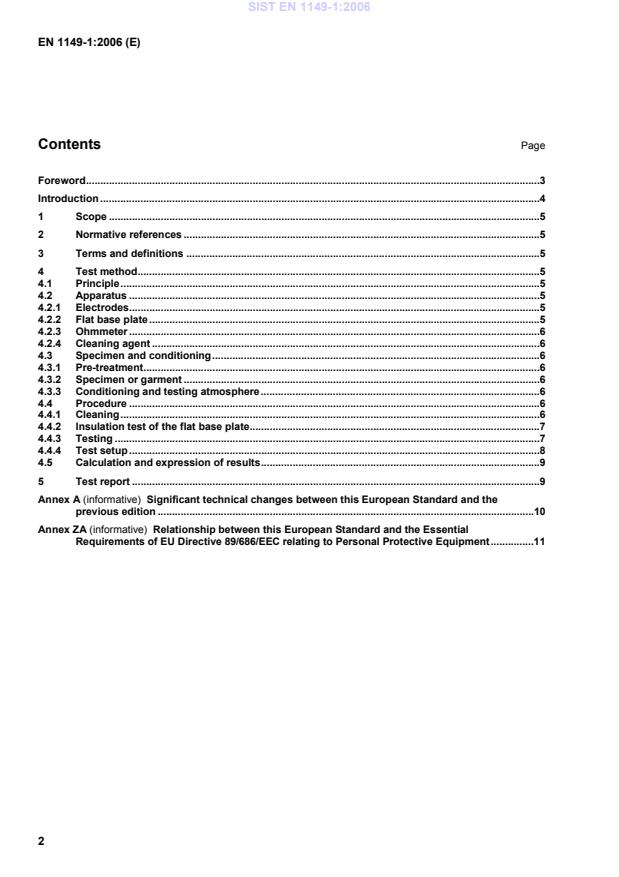
Significant technical changes between this European Standard and the previous edition.10 Annex ZA (informative)
Relationship between this European Standard and the Essential Requirements of EU Directive 89/686/EEC relating to Personal Protective Equipment.11
According to the CEN/CENELEC Internal Regulations, the national standards organizations of the following countries are bound to implement this European Standard: Austria, Belgium, Cyprus, Czech Republic, Denmark, Estonia, Finland, France, Germany, Greece, Hungary, Iceland, Ireland, Italy, Latvia, Lithuania, Luxembourg, Malta, Netherlands, Norway, Poland, Portugal, Romania, Slovakia, Slovenia, Spain, Sweden, Switzerland and United Kingdom.
1 This document is under development. SIST EN 1149-1:2006
...