

SIST EN 1400:2013+A2:2018
(Main)Child use and care articles - Soothers for babies and young children - Safety requirements and test methods
General Information
- Abstract
This European Standard specifies safety requirements relating to the materials, construction, performance, packaging and product information for soothers.
This European Standard is applicable to products that resemble or function as a soother. Some soothers may be marketed with other functions. This standard is applicable to these products (some examples are given in Annex C).
This European Standard does not apply to products designed for specialist clinical medical applications, e.g. those relating to Pierre-Robin Syndrome or premature babies (see Annex C).
The standard is not applicable to feeding teats. Safety requirements and test methods for feeding teats are included in all parts of EN 14350 [2], [3].
- Status
- Published
- Publication Date
- 19-Sep-2018
- Technical Committee
- OTR - Child use and care article
- Current Stage
- 6060 - National Implementation/Publication (Adopted Project)
- Start Date
- 05-Sep-2018
- Due Date
- 10-Nov-2018
- Completion Date
- 20-Sep-2018
- Directive
- 2001/95/EC - General product safetyOJ Ref: L 213 OJ Date: 13-Aug-2022

Overview
SIST EN 1400:2013+A2:2018 (also published as EN 1400:2013+A2:2018) is the European safety standard for soothers (pacifiers, babies’ dummies). It defines minimum safety requirements and test methods for materials, construction, performance, consumer packaging and product information for products that resemble or function as soothers. The standard harmonises test procedures used across CEN member countries and includes Amendments A1 and A2 (2014, 2018).
Key topics and technical requirements
- Scope and applicability: applies to consumer soothers and similar products; excludes specialist clinical devices (e.g. for Pierre‑Robin syndrome or premature babies) and feeding teats (see EN 14350).
- Materials and chemical safety: sets requirements and test methods for migration of elements and selected organic compounds. Amendment A2 updated migration considerations (e.g. arsenic, barium, nickel) and includes requirements for substances such as Bisphenol A (BPA); phthalates are controlled separately under REACH.
- Construction and mechanical safety: addresses shield design, teat attachment (plug/cover), ring/knob integrity, ventilation holes, and resistance to stresses. The standard includes specific test equipment and fixtures (for example a Polyoxymethylene (POM) shield template, and stainless‑steel test spheres of defined diameters).
- Performance tests: mechanical properties (tensile, puncture resistance, ageing) and specific tests for teat protectors and detachable parts to reduce choking and inhalation hazards.
- Labelling and product information: mandatory warnings, user instructions and packaging requirements to ensure safe use by caregivers (Annex A contains multi‑language warning phrases).
- Test methods and annexes: normative and informative annexes provide sampling plans (Annex E), rationale, examples of products resembling soothers (Annex C), HPLC method references for certain chemical analyses (Annex F), and guidance on puncture resistance (Annex G).
Practical applications - who uses this standard
- Manufacturers and product designers - to design compliant soothers and select suitable materials and components.
- Test laboratories and quality managers - to perform required mechanical and chemical tests and to implement sampling plans (ISO/IEC 17025 recommended).
- Regulatory bodies and conformity assessors - to evaluate product safety and harmonise national regulations.
- Retailers and procurement teams - to specify safe products for sale and ensure correct labelling.
- Consumer safety organisations and importers - to verify claims and inform caregivers.
Related standards (selection)
- EN 14350 - Feeding teats (all parts)
- EN 71 series - Safety of toys (mechanical/physical and migration tests)
- EN 12868 - Release of N‑nitrosamines from rubber teats and soothers
- ISO 9001, ISO/IEC 17025 - Quality management and testing competence
Using SIST EN 1400:2013+A2:2018 helps reduce risk of accidents, ensures consistent testing across Europe, and supports regulatory compliance and consumer confidence in soothers and similar child care articles.
Relations
- Effective Date
- 01-Oct-2018
- Effective Date
- 04-Feb-2026
- Effective Date
- 28-Jan-2026
- Effective Date
- 28-Jan-2026
- Refers
SIST EN 71-11:2006 - Safety of toys - Part 11: Organic chemical compounds - Methods of analysis - Effective Date
- 28-Jan-2026
- Effective Date
- 28-Jan-2026
- Effective Date
- 28-Jan-2026
- Effective Date
- 28-Jan-2026
- Effective Date
- 28-Jan-2026
- Effective Date
- 28-Jan-2026
- Effective Date
- 28-Jan-2026
- Effective Date
- 01-Oct-2018
Frequently Asked Questions
SIST EN 1400:2013+A2:2018 is a standard published by the Slovenian Institute for Standardization (SIST). Its full title is "Child use and care articles - Soothers for babies and young children - Safety requirements and test methods". This standard covers: This European Standard specifies safety requirements relating to the materials, construction, performance, packaging and product information for soothers. This European Standard is applicable to products that resemble or function as a soother. Some soothers may be marketed with other functions. This standard is applicable to these products (some examples are given in Annex C). This European Standard does not apply to products designed for specialist clinical medical applications, e.g. those relating to Pierre-Robin Syndrome or premature babies (see Annex C). The standard is not applicable to feeding teats. Safety requirements and test methods for feeding teats are included in all parts of EN 14350 [2], [3].
This European Standard specifies safety requirements relating to the materials, construction, performance, packaging and product information for soothers. This European Standard is applicable to products that resemble or function as a soother. Some soothers may be marketed with other functions. This standard is applicable to these products (some examples are given in Annex C). This European Standard does not apply to products designed for specialist clinical medical applications, e.g. those relating to Pierre-Robin Syndrome or premature babies (see Annex C). The standard is not applicable to feeding teats. Safety requirements and test methods for feeding teats are included in all parts of EN 14350 [2], [3].
SIST EN 1400:2013+A2:2018 is classified under the following ICS (International Classification for Standards) categories: 97.190 - Equipment for children. The ICS classification helps identify the subject area and facilitates finding related standards.
SIST EN 1400:2013+A2:2018 has the following relationships with other standards: It is inter standard links to SIST EN 1400:2013+A1:2014, SIST EN 71-1:2026, SIST EN 71-1:2015+A1:2018, SIST EN 71-3:2019+A2:2025, SIST EN 71-11:2006, SIST EN 12868:2017, SIST EN ISO 3696:1998, SIST EN ISO 21920-1:2022, SIST EN ISO 105-A03:2019, SIST EN 1400-2:2003, SIST EN 1400-1:2003, SIST EN 1400:2013+A1:2014/kFprA2:2018. Understanding these relationships helps ensure you are using the most current and applicable version of the standard.
SIST EN 1400:2013+A2:2018 is associated with the following European legislation: EU Directives/Regulations: 2001/95/EC, EUR-PUB; Standardization Mandates: M/264. When a standard is cited in the Official Journal of the European Union, products manufactured in conformity with it benefit from a presumption of conformity with the essential requirements of the corresponding EU directive or regulation.
SIST EN 1400:2013+A2:2018 is available in PDF format for immediate download after purchase. The document can be added to your cart and obtained through the secure checkout process. Digital delivery ensures instant access to the complete standard document.
Standards Content (Sample)
SLOVENSKI STANDARD
01-oktober-2018
Nadomešča:
SIST EN 1400:2013+A1:2014
Izdelki za otroke - Dude za dojenčke in mlajše otroke - Varnostne zahteve in
preskusne metode (z dopolnili do vključno A2)
Child use and care articles - Soothers for babies and young children - Safety
requirements and test methods
Artikel für Säuglinge und Kleinkinder - Schnuller für Säuglinge und Kleinkinder -
Sicherheitstechnische Anforderungen und Prüfverfahren
Articles de puériculture - Sucettes pour nourrissons et jeunes enfants - Exigences de
sécurité et méthodes d'essai
Ta slovenski standard je istoveten z: EN 1400:2013+A2:2018
ICS:
97.190 Otroška oprema Equipment for children
2003-01.Slovenski inštitut za standardizacijo. Razmnoževanje celote ali delov tega standarda ni dovoljeno.
EN 1400:2013+A2
EUROPEAN STANDARD
NORME EUROPÉENNE
September 2018
EUROPÄISCHE NORM
ICS 97.190 Supersedes EN 1400:2013+A1:2014
English Version
Child use and care articles - Soothers for babies and young
children - Safety requirements and test methods
Articles de puériculture - Sucettes pour nourrissons et Artikel für Säuglinge und Kleinkinder - Schnuller für
jeunes enfants - Exigences de sécurité et méthodes Säuglinge und Kleinkinder - Sicherheitstechnische
d'essai Anforderungen und Prüfverfahren
This European Standard was approved by CEN on 25 February 2014 and includes Amendment 2 approved by CEN on 23 April
2018.
This European Standard was corrected and reissued by the CEN-CENELEC Management Centre on 9 January 2019.
CEN members are bound to comply with the CEN/CENELEC Internal Regulations which stipulate the conditions for giving this
European Standard the status of a national standard without any alteration. Up-to-date lists and bibliographical references
concerning such national standards may be obtained on application to the CEN-CENELEC Management Centre or to any CEN
member.
This European Standard exists in three official versions (English, French, German). A version in any other language made by
translation under the responsibility of a CEN member into its own language and notified to the CEN-CENELEC Management
Centre has the same status as the official versions.
CEN members are the national standards bodies of Austria, Belgium, Bulgaria, Croatia, Cyprus, Czech Republic, Denmark, Estonia,
Finland, Former Yugoslav Republic of Macedonia, France, Germany, Greece, Hungary, Iceland, Ireland, Italy, Latvia, Lithuania,
Luxembourg, Malta, Netherlands, Norway, Poland, Portugal, Romania, Serbia, Slovakia, Slovenia, Spain, Sweden, Switzerland,
Turkey and United Kingdom.
EUROPEAN COMMITTEE FOR STANDARDIZATION
COMITÉ EUROPÉEN DE NORMALISA T IO N
EUROPÄISCHES KOMITEE FÜR NORMUN G
CEN-CENELEC Management Centre: Rue de la Science 23, B-1040 Brussels
© 2018 CEN All rights of exploitation in any form and by any means reserved Ref. No. EN 1400:2013+A2:2018 E
worldwide for CEN national Members.
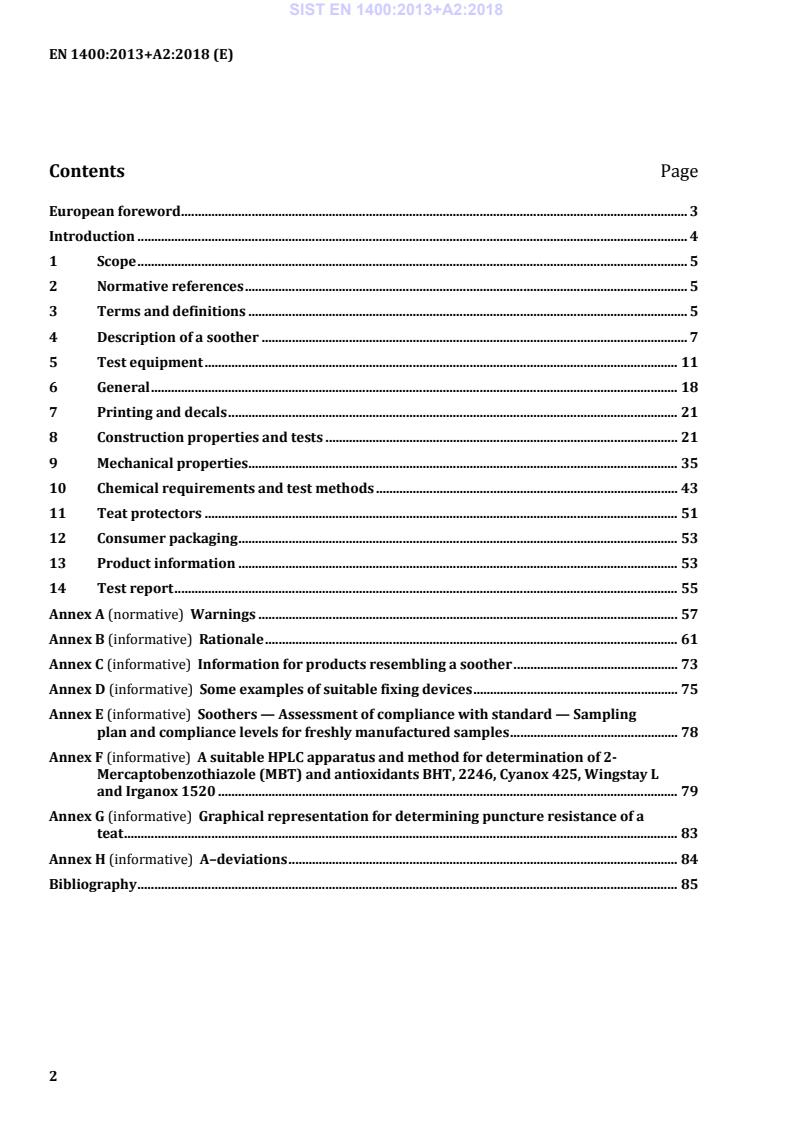
Contents Page
European foreword . 3
Introduction . 4
1 Scope . 5
2 Normative references . 5
3 Terms and definitions . 5
4 Description of a soother . 7
5 Test equipment . 11
6 General . 18
7 Printing and decals . 21
8 Construction properties and tests . 21
9 Mechanical properties . 35
10 Chemical requirements and test methods . 43
11 Teat protectors . 51
12 Consumer packaging . 53
13 Product information . 53
14 Test report . 55
Annex A (normative) Warnings . 57
Annex B (informative) Rationale . 61
Annex C (informative) Information for products resembling a soother . 73
Annex D (informative) Some examples of suitable fixing devices . 75
Annex E (informative) Soothers — Assessment of compliance with standard — Sampling
plan and compliance levels for freshly manufactured samples . 78
Annex F (informative) A suitable HPLC apparatus and method for determination of 2-
Mercaptobenzothiazole (MBT) and antioxidants BHT, 2246, Cyanox 425, Wingstay L
and Irganox 1520 . 79
Annex G (informative) Graphical representation for determining puncture resistance of a
teat . 83
Annex H (informative) A–deviations . 84
Bibliography . 85
European foreword
This document (EN 1400:2013+A2:2018) has been prepared by Technical Committee CEN/TC 252
“Child care articles”, the secretariat of which is held by AFNOR.
This European Standard shall be given the status of a national standard, either by publication of an
identical text or by endorsement, at the latest by March 2019, and conflicting national standards shall
be withdrawn at the latest by March 2019.
Attention is drawn to the possibility that some of the elements of this document may be the subject of
patent rights. CEN shall not be held responsible for identifying any or all such patent rights.
This document includes Amendment 1, approved by CEN on 2014-02-25 and Amendment 2, approved
by CEN on 2018-04-23.
This document supersedes #EN 1400:2013+A1:2014$.
The start and finish of text introduced or altered by amendment is indicated in the text by tags !"
and #$.
This document has been prepared under a mandate (M/264) given to CEN by the European
Commission and the European Free Trade Association.
This standard is linked to the General Product Safety Directive (GPSD) but no Annex ZA is needed
because GPSD is not a New Approach Directive and does not include Essential Requirements to which
such an annex should refer.
According to the CEN-CENELEC Internal Regulations, the national standards organisations of the
following countries are bound to implement this European Standard: Austria, Belgium, Bulgaria,
Croatia, Cyprus, Czech Republic, Denmark, Estonia, Finland, Former Yugoslav Republic of Macedonia,
France, Germany, Greece, Hungary, Iceland, Ireland, Italy, Latvia, Lithuania, Luxembourg, Malta,
Netherlands, Norway, Poland, Portugal, Romania, Serbia, Slovakia, Slovenia, Spain, Sweden, Switzerland,
Turkey and the United Kingdom.
Introduction
Soothers are widely used throughout Europe to satisfy non-nutritive sucking needs and to pacify
children.
They are designed to be in the mouths of babies and young children for long periods. Accidents, some of
which have been fatal, have occurred in the past and a prime purpose of this standard is to reduce the
risk of accidents occurring in the future. It is stressed that this European Standard cannot eliminate all
possible risks to babies and young children using such a product and that parental or guardian control
is of paramount importance. It is essential that all warnings and instructions specified in this standard
are given clearly by the manufacturer, to allow the consumer to ensure that the soother is used
correctly and safely.
This European Standard harmonises minimum safety requirements and test methods for soothers. Most
of the provisions have been taken from other existing national and European Standards.
It is recommended that manufacturers and suppliers operate to EN ISO 9001, the standard for quality
management systems [1]. It is also recommended that laboratories operate to ISO/IEC 17025, General
requirements for the competence of testing and calibration laboratories [4].
In addition, it is recognised that some organisations require reference testing. A suggested sampling
plan and compliance levels for freshly manufactured soothers are provided in Annex E (informative).
This procedure can be used as a voluntary type approval procedure.
Latex protein allergy risk has not been included in this standard. Nevertheless, provision for packaging
information for soothers containing natural rubber has been made in this standard. There is no
published information that sensitisation is caused by soother teats. In addition, there is an extremely
low incidence of latex protein allergy among young children and babies. However, the issue of
subsequent allergic reaction from rubber teats will be reconsidered when further information becomes
available.
Phthalates have not been included in this standard because the use of phthalates in childcare articles is
restricted by Annex XVII of REACH Regulation [5].
A normative annex has been included which contains translations of warning phrases into the main
European languages.
# Since the publication of EN 1400:2013+A1:2014 it has come to the attention of the Technical
Committee that some of the TDI's used to calculate the limits of a certain number of element migration
from soothers are out of date. During the drafting of this amendment the Technical committee reviewed
all the previous sources of TDI's to ascertain the current state of knowledge.
The migration limits for Arsenic, Barium, and Nickel have been changed to reflect the latest information.
In addition migration limits for Chromium VI and Organic Tin have been added.
The Technical Committee has also included a requirement for Bisphenol A (BPA) in soothers based on
the most recent TDI from the 2015 EFSA Opinion and an A-Deviation from France.$
1 Scope
This European Standard specifies safety requirements relating to the materials, construction,
performance, packaging and product information for soothers.
This European Standard is applicable to products that resemble or function as a soother. Some soothers
may be marketed with other functions. This standard is applicable to these products (some examples
are given in Annex C).
This European Standard does not apply to products designed for specialist clinical medical applications,
e.g. those relating to Pierre-Robin Syndrome or premature babies (see Annex C).
The standard is not applicable to feeding teats. Safety requirements and test methods for feeding teats
are included in all parts of EN 14350 [2], [3].
2 Normative references
The following documents, in whole or in part, are normatively referenced in this document and are
indispensable for its application. For dated references, only the edition cited applies. For undated
references, the latest edition of the referenced document (including any amendments) applies.
DIN 53160-1, Determination of the colourfastness of articles for common use — Part 1: Test with artificial
saliva
EN 71-1, Safety of toys — Part 1: Mechanical and physical properties
EN 71-3, Safety of toys — Part 3: Migration of certain elements
EN 71-11:2005, Safety of toys — Part 11: Organic chemical compounds — Methods of analysis
EN 12868, Child use and care articles — Methods for determining the release of N-Nitrosamines and N-
Nitrosatable substances from elastomer or rubber teats and soothers
EN 20105-A03, Textiles — Tests for colour fastness — Part A03: Grey scale for assessing staining
(ISO 105-A03)
EN ISO 1302, Geometrical Product Specifications (GPS) — Indication of surface texture in technical
product documentation (ISO 1302)
EN ISO 3696, Water for analytical laboratory use — Specification and test methods (ISO 3696)
ISO 188, Rubber, vulcanized or thermoplastic — Accelerated ageing or heat resistance tests
3 Terms and definitions
For the purposes of this document, the following terms and definitions apply.
3.1
soother
article which includes a teat and which is intended to satisfy the non-nutritive sucking need of children
Note 1 to entry: Soothers are also known as pacifiers or babies' dummies.
3.2
teat
part of the soother designed to be placed in the mouth
3.3
shield
structure positioned at the rear of the teat to reduce the likelihood of the soother being drawn entirely
into the child's mouth
3.4
ring
structure positioned adjacent to or on the shield to facilitate handling of the soother
Note 1 to entry: The ring, knob or cover can be integral with the shield or plug or it can be a separate component
that is attached to the shield or plug
Note 2 to entry: See Figure 1.
3.5
knob
structure positioned adjacent to or on the shield to facilitate gripping of the soother
Note 1 to entry: The ring, knob or cover can be integral with the shield or plug or it can be a separate component
that is attached to the shield or plug.
Note 2 to entry: See Figure 2.
3.6
plug
device located within the neck of the teat that secures the teat to the shield
Note 1 to entry: See Figure 3.
3.7
cover
device that prevents open access to the plug
Note 1 to entry: The ring, knob or cover can be integral with the shield or plug or it can be a separate component
that is attached to the shield or plug.
Note 2 to entry: See Figure 3.
3.8
ventilation hole (see B.7)
any shape of hole in the shield or teat protector that is large enough to allow sufficient passage of air to
sustain life
Note 1 to entry: See also 8.4.1 and 11.3.1.
3.9
teat protector
device that can be attached to and detached from the soother to cover the teat
3.10
outer packaging
any packaging used for storage of the product by a retailer, not including the packaging intended for the
consumer
3.11
major axis of the soother
major axis of the soother goes at right angles to the shield and through the centre of the teat, where the
teat enters the shield
Note 1 to entry: See Figure 14.
3.12
major axis of the shield
major axis of the shield is parallel to the longest dimension of the shield and in the middle of the width
Note 1 to entry: See Figure 15.
4 Description of a soother
A soother, as shown in Figures 1, 2, 3 and 4, normally consists of:
— a teat,
— a shield, and
— either a ring or knob,
and can include:
— a plug, and
— a cover.
NOTE 1 Similar components are marked with the same number in Figures 1 to 4.
NOTE 2 Some or all of the components may be manufactured from the same material which may result in the
components not being separately distinguishable.
NOTE 3 The ring, knob or cover can be integral with the shield or plug or it can be a separate component that is
attached to the shield or plug.
Key
1 teat
2 shield
3 ring
5 cover
7 sucking face of shield
8 rear face of shield
Figure 1 — Example of a soother with ring
Key
1 teat
2 shield
4 plug
6 knob
Figure 2 — Example of a soother with knob
Key
1 teat
2 shield
4 plug
5 cover
6 knob
7 sucking face of shield
8 rear face of shield
Figure 3 — Example of a soother with plug and cover
Key
1 teat
2 shield
4 plug
6 knob
Figure 4 — Example of a soother with a combined plug and knob
5 Test equipment
5.1 Shield template
The shield template shall be made from Polyoxymethylene (POM), standard (natural, non pigmented,
unfilled), E-modulus: 3000 MPa to 3300 MPa, hardness: 80 to 90 Shore D, Surface roughness: lower
than Ra 2,2.
NOTE Extruded sheets of POM normally meet the surface roughness requirement.
The dimensions shall be as shown in Figure 5.
Dimensions in millimetres
Key
1 enlarged part section A – A
2 permanent marks for major and minor axes
Figure 5 — Shield template
5.2 Test spheres
Test spheres A, B, C and D, shall be made from stainless steel of diameters given in Table 1.
Table 1 — Test sphere diameters
Test sphere Diameter
mm
+0,1
A
4,0
−0
+0
B
5,5
−0,1
+0,1
C
−0
+0,1
D
−0
5.3 Indentor
The indentor is made from H13 high chrome tool steel or equivalent and hardened to a minimum of
50 Rockwell C and shall have dimensions as shown in Figure 6. All dimensions with a tolerance are
Ra 0,4
machined as in EN ISO 1302 to .The larger diameter of the indentor has not been specified, as it
should be of a size to fit into the equipment for applying the necessary force specified in the test
methods.
Dimensions in millimetres
Key
a This face is flat and has dimensions of (3,0 x 0,20) mm.
Figure 6 — Indentor
5.4 Cutting board
The cutting board is made from a polymeric material of (70 ± 5) Shore D hardness with a stop made
from any suitable material to the dimensions as shown in Figure 7. All dimensions shall have a tolerance
of ± 2 mm except where indicated. A centre line and point of puncture is to be marked onto the surface
as shown in Figure 7.
Dimensions in millimetres
Key
1 stop for cut edge of teat
2 position of teat
3 point of puncture
Figure 7 — Cutting board
5.5 Bite endurance jaws
The jaws are made from H13 high chrome tool steel or equivalent and hardened to (45 to 50) Rockwell
C and shall have dimensions as shown in Figure 8.
Ra 0,4
All dimensions with a tolerance are machined as in EN ISO 1302 to . All dimensions for the top
and bottom jaws are identical.
Dimensions in millimetres
Figure 8 — Bite endurance jaws
5.6 Impact mass
A flat stainless steel weight with radiused edges (2 ± 0,5) mm and a mass of (1 ± 0,02) kg, distributed
over an area of diameter (80 ± 2) mm, see Figure 9.
Dimensions in millimetres
Key
a radius (2 ± 0,5) mm
Figure 9 — Impact mass
5.7 Guides
Guides 1, 2 and 3 with dimensions as shown in Figures 10, 11 and 12.
Dimensions in millimetres
Figure 10 — Guide 1
Dimensions in millimetres
Figure 11 — Guide 2
Dimensions in millimetres
Figure 12 — Guide 3
6 General
6.1 Tolerances for construction and mechanical properties
Unless otherwise stated, the following tolerances apply:
— forces: ± 5 % of the nominal force;
— masses: ± 0,5 % of the nominal mass;
— dimensions: ±1,0 mm of the nominal
dimension;
— angles: ± 2º of the nominal angle;
— duration of forces for durability tests: ± 1 s;
— duration of forces for static load tests: ± 2 s.
The tests are described in terms of the application of forces. Masses can however be used. 1 kg mass
may be used for 10 N force.
Unless otherwise specified, the test forces may be applied by any suitable device which does not
adversely affect the results.
6.2 Order of tests for construction and mechanical properties
The tests shall be carried out in the order given in Table 2.
Table 2 — Order of testing for construction and mechanical properties
Order of Test Samples taken direct from All Other samples
Testing manufacturer prior to being
Clause
placed on the market
6.3.1 Pre-treatment No pre-treatment
6.3.2 Boiling
6.3.3 Conditioning
6.3.4 A sample used in any of the tests below shall not be used in any
further tests
1 8.1 - 8.9 Construction properties and tests
2 9.1.2 Impact resistance
9.7.2.2 followed by
Tensile test along the major axis
(see Annex D, Figure D.1)
3 9.2.2.1 Puncture resistance of teat
4 9.3.2.1 Tear resistance of teat
9.7.2.2 followed by
Tensile test
at right angles to the major axis
(see Annex D, Figure D.2)
5 9.4.2 Knob, plug and/or cover retention
6 9.5.2 Bite endurance of elastomeric components
9.7.2.2 followed by
Tensile test
at right angles to the major axis
(see Annex D, Figure D.2)
7 9.7.2.3 Tensile tests for single components and pairs of components
8 9.7.2 Integrity
Additional requirements for soothers with knobs made of
flexible materials
9 9.2.2.2 Puncture resistance of knob made of flexible materials
Order of Test Samples taken direct from All Other samples
Testing manufacturer prior to being
Clause
placed on the market
10 9.3.2.2 Tear resistance of knob made of flexible materials
9.7.2.2 followed by
Tensile test
at right angles to the major axis
(see Annex D, Figure D.2)
11 9.5.2 Bite endurance of elastomeric components
9.7.2.2 followed by
Tensile test
at right angles to the major axis
(see Annex D, Figure D.2)
Additional tests for soothers where a part rotates inside the teat
(See 9.6)
12 9.6.2 Rotation endurance
9.7.2.2 followed by
Tensile test
along the major axis
(see Annex D, Figure D.1)
6.3 Preparation of samples for construction and mechanical tests
6.3.1 Pre-treatment
Only samples taken directly from the manufacturer (see B.4.1) prior to being placed on the market shall
be artificially aged for (7 days) ± 2 h in a cabinet oven with forced air circulation by means of a fan and a
ventilation of three to ten changes per hour (as described as Method B in ISO 188) at a temperature of
(70 ± 2) °C and conditioned as described in 6.3.3.
6.3.2 Boiling
All samples shall be immersed in boiling water, to the requirements of EN ISO 3696, Grade 3, for (10 ±
1) min without touching the walls of the container and removed (see B.4.2). Afterwards, allow the
samples to cool to room temperature.
6.3.3 Conditioning
All samples shall be conditioned before the tests. The conditioning of the samples shall be performed
for at least 40 h in a temperature (23 ± 2) °C, and relative humidity (50 ± 5) %. Samples shall remain in
the conditioning atmosphere until the test is carried out. The tests may be carried out in a non-
conditioned room.
6.3.4 New samples
New samples, preferably from the same batch, shall be used for each test (i.e. samples used in one test
shall not be used in another test) or for each testing orientation, unless otherwise stated.
6.4 Preparation of samples for chemical tests
6.4.1 General
The sample preparation (6.4.2) applies to all tests except N-Nitrosamines and N-Nitrosatable
substances release; see 10.4.
Samples and test portions shall only be handled with suitable (for example, non-rubber) gloves and
shall only be stored in securely fastened, migration free containers and protected from the light.
6.4.2 Boiling
All samples shall be immersed in boiling water, to the requirements of EN ISO 3696, Grade 3, for (10 ±
1) min without touching the walls of the container and removed. Store in a closed container; a
desiccator for example is ideal for this purpose. This is to reduce the risk of contamination.
6.4.3 New samples
New samples, preferably from the same batch, shall be used for each test, i.e. samples used in one test
shall not be used in another test unless otherwise stated.
7 Printing and decals
There shall be no printing on the sucking face of the shield.
Adhesive decals and labels shall not be attached to any part of the soother. No decorations shall be
attached to any part of the soother by glue.
A soother may be decorated, including moulded in, imprinting and printing. Imprinting may include
techniques such as stamping and laser etching. No form of decoration shall be removed during the
boiling stage (see 6.3.2).
8 Construction properties and tests
8.1 General
The soother shall be free from any sharp points or edges and free of flash and burrs.
The soother shall have no removable parts other than a teat protector (see Clause 11).
Soothers have been known to become lodged in a child's mouth. Attention should therefore be made to
the design of all soother components to allow the assembled soother to be gripped as easily as possible,
thereby facilitating removal of the soother from the child's mouth.
Attention should also be made to the design of the soother to ensure that it may be cleaned as easily and
as efficiently as possible (see B.3).
8.2 Teat (see B.5)
8.2.1 Requirements
When tested in accordance with 8.2.2, the effective penetration of the teat shall not be greater than 35
mm.
The teat shall not include any hole in front of the sucking face side of the shield.
Any hollow section of the teat shall not contain solid, fluid or gaseous substances (except air) nor shall it
contain any inserts except for the plug.
8.2.2 Test method for effective penetration
The effective penetration is the distance from the tip of the teat to where the teat enters the shield along
the major axis, see Figure 13, and shall be measured using a suitable measuring device with an accuracy
of 0,1 mm.
Dimensions in millimetres
Figure 13 — Measurement of teat penetration
8.3 Shield (see B.6)
8.3.1 Requirements
The soother shall incorporate a shield.
When tested in accordance with 8.3.2, the shield shall not pass through the shield template.
8.3.2 Test method
The shield template, see 5.1, shall be supported horizontally so that it remains firm and horizontal
throughout the test and there is no lateral movement of the shield template.
NOTE It will assist the test if the shield is marked with its major and minor axes on both the sucking face and
the rear face. These marked axes can then be lined up with the permanent marks on the shield template (see
Figure 5).
Immerse the soother for at least 10 s in an aqueous solution of a wetting agent. A 2 % (V/V) solution of
polyoxyethylene (20) sorbitan mono-oleate is suitable.
Position the wet soother with the sucking face of the shield against the opening in the template; such
that the major axis of the soother goes through the intersection of the axes marked on the template (see
Figure 14). Orientate the soother, until the major axis of the shield (see Figure 15) is parallel to the
major axis of the template.
At a crosshead speed of (100 ± 5) mm per min, apply a tensile force of (10 ± 0,5) N to the teat along the
direction of the major axis of the soother, ensuring that there is no lateral movement causing a
pendulum effect. That is, the major axis of the soother shall always be aligned with the centre of the
template throughout the test. Maintain the load for (10 ± 0,5) s (see Figure 16 a)).
Reverse the soother and repeat the test by pulling on the ring or the knob, using a suitable device
(see Figure 16 b)).
If the design or position of the soother ring or knob makes this impossible, or if the shield slides
sideways through the template during the test then cut off the teat and repeat the test with the soother
reversed over the template. The force is applied from above through a rod centred in the hole left by the
teat and along the major axis (see Figure 16 c)). The rod shall be a little larger in diameter than the size
of the hole left by the teat.
With some soothers (e.g. full rubber or full silicone soothers) using this rod may not be possible. In
these instances a tube with an internal diameter of (15 ± 0/1) mm and a wall thickness of (1 ± 0,1) mm
shall be used (see Figure 16d)). The teat shall be cut off as far as necessary to accommodate the tube.
Key
a major axis of soother
b intersection of major and minor axes of shield template
c shield template (side view)
d shield template (top view)
Figure 14 — Major axis of soother in relation to the intersection of the axes marked on the shield
template
Key
w half of shield width
a-a major axis of shield
Figure 15 — Example of the major axis of a shield
Key
a) force applied to the teat
b) force applied to the ring or knob
c) force applied from above through a rod centred in the hole left by the teat
d) force applied from above through a tube
Figure 16 — Examples of positions of a soother on the shield template
8.4 Shield ventilation (see B.7)
8.4.1 Requirements
The shield shall be provided with at least two ventilation holes (see 3.8) each of which shall include a
circular area of at least 4 mm diameter and a minimum area of 20 mm .
When tested in accordance with 8.4.2.1, each ventilation hole shall allow the unhindered passage of test
sphere A, see 5.2, even when the ring, if present, is in contact with the shield. In this respect,
"unhindered" means that the test sphere falls through the hole under its own weight, even if it touches
the edges of the hole or other parts of the soother, such as the ring.
When tested in accordance with 8.4.2.2, each ventilation hole shall have a minimum area of 20 mm .
If any part of the soother, in any position, is equal to or more than 1,3 mm from the entrance to the hole
then the hole shall be considered to be unobstructed and area measurement shall be made on the
complete hole (see Figures 17 a) and Figure 17 b)).
An obstructed hole is when any part of the soother, for example the ring, covers part of the hole in at
least one position and when the obstruction is less than 1,3 mm at its closest point to the surface of the
hole (see Figures 17 c) and Figure 17 d)).
If a ring or other part of the soother obstructs a ventilation hole it shall be the unobstructed part of this
ventilation hole that is tested.
Additional holes in any position, even if smaller than ventilation holes, may be provided and shall
comply with the requirements of 8.9.
The centres of two of the ventilation holes shall be at least 15 mm apart and located either side of the
minor axis of the shield, see Figure 18.
The edges of two ventilation holes shall be at least 5 mm from the edge of the shield.
The minimum diameter of a ventilation hole is 4mm, however it is recommended that ventilation holes
are as large as possible, but consistent with the requirement for openings (see 8.9).
Certain types of ventilation holes have given rise to finger injuries. Non-circular holes should avoid
acute V-shaped angles or inward facing angles that are not well rounded, as both these features can lead
to fingers becoming caught and injured. See also 8.9.
NOTE The shape of the edge of the shield and the size, shape and position of ventilation holes affect the ease
with which the shield can be gripped in the event of the soother becoming lodged in a child’s mouth.
Dimensions in millimetres
Key
O obstructing part
S soother shield
H ventilation hole
L lateral view
T top view showing examples of permissible measurement areas (shaded)
Figure 17 — Examples of obstructed and unobstructed holes in the shield
Dimensions in millimetres
Key
A minor axis
B major axis
C shaded area – no mandatory holes
Figure 18 — Examples of permissible positions for mandatory ventilation holes
8.4.2 Test Methods
8.4.2.1 Minimum diameter
The ventilation hole to be tested shall be orientated so that the entry to the hole shall be horizontal. Any
part of the soother whether it obstructs or does not obstruct the hole (see 8.4.1) shall be in its most
onerous position.
Place test sphere A, see 5.2, on the hole so that its mass allows it to pass through the ventilation hole.
Check whether the sphere passes completely through the hole.
8.4.2.2 Minimum area
Measurement of the area of the hole may be made by any suitable method including graph paper,
shadow technology etc. Any part of the soother whether it obstructs or does not obstruct the hole (see
8.4.1) shall be in its most onerous position.
If the hole is unobstructed (any part of the soother, in any position, is equal to or more than 1,3 mm
from the entrance to the hole) then the area measurement shall be made on the complete hole (see
Figure 17 a) and Figure 17 b)).
If the hole is obstructed then the measurement of area shall be made by including the area occupied by
the Test Sphere A (12,57mm ) plus the area immediately surrounding Test Sphere A (see Figure 17 c)
and Figure 17 d)).
8.5 Ring (see B.8)
8.5.1 Requirements
A flow chart for ring requirements is shown in Table 3.
Table 3 — Flow chart for ring requirements
Rings made of non- Rings made of flexible
flexible materials materials
8.5.1 8.8.1
If rings made of non-
flexible materials fail any
of the requirements then
treat as if it is a knob made
from non-flexible
materials; see 8.7.1
Rings made of flexible materials shall comply with the requirements of 8.8.1.
Rings made of non-flexible materials shall comply with the following requirements.
— When tested in accordance with 8.5.2, the effective penetration, dimension A, which is the distance
from the tip of the ring to the rear face of the shield, shall not be greater than 35 mm (see Figure
19).
— Dimension A shall not be greater than 1,4 times dimension B, the widest width of the ring, see
Figure 19, 8.5.2.2 and B.8.
— When tested in accordance with 8.5.2.3 the opening in the ring shall allow test sphere D, see 5.2, to
pass through, see Figure 19.
— When tested in accordance with 8.5.2.4 the ring shall collapse to 16 mm or less above the shield
(see B.9).
Soothers fitted with rings that do not meet all the above requirements shall be treated as if they are
fitted with a knob made from non-flexible materials, see 8.7.
Dimensions in millimetres
Key
A effective penetration of ring = Dimension ‘A’
B widest width of ring = Dimension ‘B’
1 test sphere D
Figure 19 — Ring dimension nomenclature
8.5.2 Test methods
8.5.2.1 Effective penetration of ring
The dimension A from the tip of the ring to the rear face of the shield, see Figure 19, along the major
axis shall be measured using a suitable measuring device with an accuracy of 0,1 mm.
8.5.2.2 Width of ring
The dimension B, the maximum width of the ring, see Figure 19, shall be measured using a suitable
measuring device with an accuracy of 0,1 mm.
8.5.2.3 Size of opening in the ring
Position the ring 90° to the shield, see Figure 19, and check that test sphere D passes through the
opening in the ring.
8.5.2.4 Collapse of ring
Support the soother so that the movement of the ring is not restricted.
Apply a (10 ± 0,5) N force along the major axis of the ring through a test plate as shown in Figure 20.
Measure the distance between the rear face of the shield and the face of the test plate along the major
axis of the soother, as shown in Figure 20, using a suitable measuring device with an accuracy of 0,1
mm.
If necessary, the ring shall be offset slightly from the 90° position, before applying the force, to ensure it
does not lock in the 90° position.
Dimensions in millimetres
Key
1 position of ring following application of the 10 N force
2 test plate
3 rear face of shield along the major axis
Figure 20 — Collapse of ring measurement
8.6 Plug (see B.10)
8.6.1 Requirement
A plug shall not project more than 3 mm beyond the sucking face of the shield, see Figure 21.
Dimensions in millimetres
Key
a sucking face of shield with teat removed
b exposed plug
Figure 21 — Section through soother showing measurement of the projection of the plug
8.6.2 Test Method
Carefully cut off the teat. If the plug projects beyond the sucking face of the shield, measure from the
end of the plug to the sucking face of the shield using a suitable device with an accuracy of 0,1 mm .
8.7 Knobs, plugs and/or covers made from non-flexible materials (see B.11)
8.7.1 Requirements
A knob, plug or cover made from non-flexible materials, whichever projects furthest beyond the rear
face of the shield, shall not be less than 10 mm and not more than 16 mm, see Figure 22, unless the
soother is fitted with a ring that meets requirement 8.5.1.
Requirement 8.7.1 shall also apply to a ring made of non-flexible materials that does not meet
requirement 8.5.1.
8.7.2 Test Method
The distance from the tip of the knob, plug or cover to the shield template (see 5.1), down the central
axis, see Figure 21, shall be measured using a suitable measuring device with an accuracy of 0,1 mm.
The thickness of the shield template shall be added to the length measured to give the effective
projection. The knob, plug and/or cover shall be tested in all orientations about the major axis of the
soother relative to the intersection of the major and minor axes of the shield template.
Key
b knob
c cover
d shield template
e dimension to be measured
f effective penetration
g thickness of shield template
M major axis of soother
Figure 22 — Measurement of effective penetration of knob, plug and/or cover made from non-
flexible materials using the shield template
8.8 Rings, knobs, plugs and/or covers made of flexible materials (see B.12)
8.8.1 Requirement
If made of flexible materials, the effective penetration of the ring knob, plug and/or cover shall not be
less than 10 mm and not more than 35 mm when tested in accordance with 8.8.2.
8.8.2 Test method
The distance from the tip of the ring, knob, plug and/or cover to the shield template (see 5.1), down the
central axis, see Figure 23, shall be measured using a suitable measuring device with an accuracy of 0,1
mm. The thickness of the shield template shall be added to the length measured to give the overall
effective penetration length. The ring, knob, plug and/or cover shall be tested in all orientations about
the major axis of the soother relative to the intersection of the major and minor axes of the shield
template.
Key
a ring
b knob
c cover
d shield template
e dimension to be measured
f effective penetration
g thickness of shield template
M major axis of the soother
Figure 23 — Measurement of effective penetration of ring, knob, plug and/or cover made of
flexible materials using the shield template
8.9 Openings (see B.13)
8.9.1 Requirement
When tested in accordance with 8.9.2, there shall be no openings that allow test sphere B, see 5.2, to
enter and penetrate at least the complete size of test sphere B (5,5 mm), unless test sphere C, see 5.2,
enters the opening at least the same depth that test sphere B penetrated.
This requirement only applies to components made of materials with a Shore A hardness of more than
60.
Circular holes not meeting this requirement present a risk of restricting circulation. Non-circular holes
with acute V-shaped angles or inward facing angles that are not well rounded are to be avoided.
8.9.2 Test method
The opening to be tested shall be orientated so that the entry to the opening is horizontal. Place test
sphere C, see 5.2, on the hole so that its mass allows it to pass through the opening. If test sphere C does
not pass through any opening, check whether test sphere B, see 5.2, enters 5,5 mm into the opening.
This test shall be repeated from the other side of the opening.
9 Mechanical properties
9.1 Impact resistance
9.1.1 Requirements
When tested in accordance with 9.1.2 no part of the soother shall break, tear or separate. Subsequently
when tested in accordance with 9.7.2.2, tensile test, no part of the same soother shall break, tear or
separate.
9.1.2 Test method
Place the soother to be tested unsupported on a flat, horizontal steel surface. Drop the
...