


SIST EN 1069-2:2010
(Main)Water slides - Part 2: Instructions
Water slides - Part 2: Instructions
This European Standard is applicable to water slides as defined in EN 1069 1:2010, 3.3.
This European Standard establishes the instructions for use, operation and maintenance as well as the documentation and commissioning of water slides.
Wasserutschen - Teil 2: Hinweise
Diese Norm gilt für alle nach EN 1069 1:2010, 3.3 festgelegten Wasserrutschen.
Diese Norm legt Anweisungen für die Benutzung, den Betrieb und die Wartung von Wasserrutschen fest sowie deren Dokumentation und Abnahmeprüfung.
Toboggans aquatiques - Partie 2: Instructions
La présente Norme européenne s'applique aux toboggans aquatiques tels que définis dans l'EN 1069 1:2010, 3.3.
La présente Norme européenne spécifie les instructions d'utilisation, d'exploitation et d'entretien, ainsi que les documents et la réception des toboggans aquatiques.
Vodni tobogani - 2. del: Navodila
Ta evropski standard velja za vodne tobogane, kot je opredeljeno v EN 1069-1:2010, 3.3. Ta evropski standard vzpostavlja navodila za uporabo, obratovanje in vzdrževanje ter za dokumentacijo in začetek obratovanja vodnih toboganov.
General Information
- Status
- Withdrawn
- Public Enquiry End Date
- 14-Oct-2008
- Publication Date
- 14-Nov-2010
- Withdrawal Date
- 11-Sep-2017
- Technical Committee
- SPO - Sports
- Current Stage
- 9900 - Withdrawal (Adopted Project)
- Start Date
- 12-Sep-2017
- Due Date
- 05-Oct-2017
- Completion Date
- 12-Sep-2017
Relations
- Effective Date
- 01-Dec-2010
- Effective Date
- 01-Oct-2017

Frequently Asked Questions
SIST EN 1069-2:2010 is a standard published by the Slovenian Institute for Standardization (SIST). Its full title is "Water slides - Part 2: Instructions". This standard covers: This European Standard is applicable to water slides as defined in EN 1069 1:2010, 3.3. This European Standard establishes the instructions for use, operation and maintenance as well as the documentation and commissioning of water slides.
This European Standard is applicable to water slides as defined in EN 1069 1:2010, 3.3. This European Standard establishes the instructions for use, operation and maintenance as well as the documentation and commissioning of water slides.
SIST EN 1069-2:2010 is classified under the following ICS (International Classification for Standards) categories: 97.220.40 - Outdoor and water sports equipment. The ICS classification helps identify the subject area and facilitates finding related standards.
SIST EN 1069-2:2010 has the following relationships with other standards: It is inter standard links to SIST EN 1069-2:2002, SIST EN 1069-2:2017. Understanding these relationships helps ensure you are using the most current and applicable version of the standard.
SIST EN 1069-2:2010 is available in PDF format for immediate download after purchase. The document can be added to your cart and obtained through the secure checkout process. Digital delivery ensures instant access to the complete standard document.
Standards Content (Sample)
2003-01.Slovenski inštitut za standardizacijo. Razmnoževanje celote ali delov tega standarda ni dovoljeno.Vodni tobogani - 2. del: NavodilaWasserutschen - Teil 2: HinweiseWater slides - Part 2: Instructions97.220.40Oprema za športe na prostem in vodne športeOutdoor and water sports equipmentICS:Ta slovenski standard je istoveten z:EN 1069-2:2010SIST EN 1069-2:2010en,fr,de01-december-2010SIST EN 1069-2:2010SLOVENSKI
STANDARDSIST EN 1069-2:20021DGRPHãþD
EUROPEAN STANDARD NORME EUROPÉENNE EUROPÄISCHE NORM
EN 1069-2
August 2010 ICS 97.220.40 Supersedes EN 1069-2:1999English Version
Water slides - Part 2: Instructions
Toboggans aquatiques - Partie 2: Instructions
Wasserutschen - Teil 2: Hinweise This European Standard was approved by CEN on 16 July 2010.
CEN members are bound to comply with the CEN/CENELEC Internal Regulations which stipulate the conditions for giving this European Standard the status of a national standard without any alteration. Up-to-date lists and bibliographical references concerning such national standards may be obtained on application to the CEN Management Centre or to any CEN member.
This European Standard exists in three official versions (English, French, German). A version in any other language made by translation under the responsibility of a CEN member into its own language and notified to the CEN Management Centre has the same status as the official versions.
CEN members are the national standards bodies of Austria, Belgium, Bulgaria, Croatia, Cyprus, Czech Republic, Denmark, Estonia, Finland, France, Germany, Greece, Hungary, Iceland, Ireland, Italy, Latvia, Lithuania, Luxembourg, Malta, Netherlands, Norway, Poland, Portugal, Romania, Slovakia, Slovenia, Spain, Sweden, Switzerland and United Kingdom.
EUROPEAN COMMITTEE FOR STANDARDIZATION
COMITÉ EUROPÉEN DE NORMALISATION EUROPÄISCHES KOMITEE FÜR NORMUNG
Management Centre:
Avenue Marnix 17,
B-1000 Brussels © 2010 CEN All rights of exploitation in any form and by any means reserved worldwide for CEN national Members. Ref. No. EN 1069-2:2010: ESIST EN 1069-2:2010
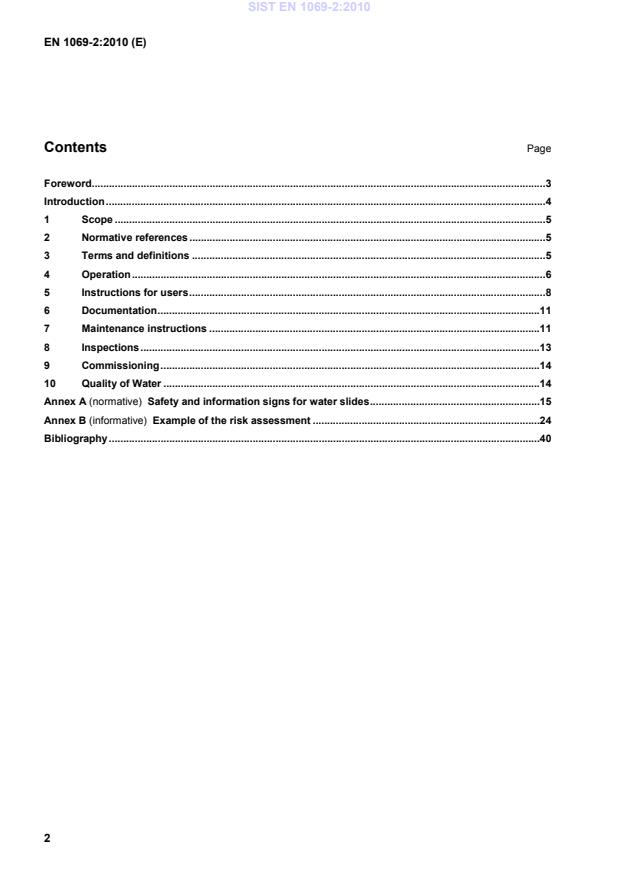
Safety and information signs for water slides . 15Annex B (informative)
Example of the risk assessment . 24Bibliography . 40 SIST EN 1069-2:2010
According to the CEN/CENELEC Internal Regulations, the national standards organizations of the following countries are bound to implement this European Standard: Austria, Belgium, Bulgaria, Croatia, Cyprus, Czech Republic, Denmark, Estonia, Finland, France, Germany, Greece, Hungary, Iceland, Ireland, Italy, Latvia, Lithuania, Luxembourg, Malta, Netherlands, Norway, Poland, Portugal, Romania, Slovakia, Slovenia, Spain, Sweden, Switzerland and the United Kingdom.
EN 15288-2:2008, Swimming pools — Part 2: Safety requirements for operation EN ISO 3834 (all parts), Quality requirements for fusion welding of metallic materials (ISO 3834:2005) EN ISO 13849-1, Safety of machinery — Safety-related parts of control systems — Part 1: General principles for design (ISO 13849-1:2006) EN ISO 15607, Specification and qualification of welding procedures for metallic materials — General rules
(ISO 15607:2003) ISO 3864-1, Graphical symbols — Safety colours and safety signs — Part 1: Design principles for safety signs in workplaces and public areas ISO 3864-3, Graphical symbols — Safety colours and safety signs — Part 3: Design principles for graphical symbols for use in safety signs ISO 7001, Graphical symbols — Public information symbols ISO 7010:2003, Graphical symbols — Safety colours and safety signs — Safety signs used in workplaces and public areas ISO 20712-1, Water safety signs and beach safety flags — Part 1: Specifications for water safety signs used in workplaces and public areas ISO 20712-3:2008, Water safety signs and beach safety flags — Part 3: Guidance for use ISO 22727, Graphical symbols — Creation and design of public information symbols — Requirements 3 Terms and definitions For the purposes of this document, the terms and definitions given in EN 1069-1:2010 and the following apply. 3.1 operator company, organization, authority or person with overall control and responsibility for the water slide facility
4.2 Guidelines to the operational risk assessment An operational risk assessment shall be performed by the slide operator, based on the results of the design risk assessment, as a basis for the identification of the proper supervision, following the requirements of EN 15288-2. In addition, and referring to the fact that impact between the users proved to be a critical issue, also the following risks shall be taken into consideration: a) inappropriate spacing at the start between users; b) sliding position (e.g. sitting) can bring the user to an involuntary stop; c) significant differences in speed can cause collisions of users; d) significant differences in speed caused by: 1) different sliding positions; 2) different bathing costume respectively wearing hardly any bathing costume (e.g. G-string type); 3) different fitness, size, weight and age of user; 4) changing water flow rate (malfunction of water supply); e) reasonably foreseeable risky behaviours by the users: 1) higher risk of collision between users at a splashdown area in contrast to a catch unit; f) suitability for children; g) foreseeable users categories (e.g. adults, children, both) and number of users (e.g. chain sliding allowed); h) allowed use of ride enhancement devices (e.g. mattresses, rafts). Examples of general and specific risk assessments are given in Annex B.
4.3 Risk reduction The operator shall take measures to reduce possible risks to a minimum bearing in mind the risky behaviours of users by choosing an appropriate level of distance control and supervision and shall identify a risk reduction strategy from the following options: SIST EN 1069-2:2010
c) a proper level of supervision/technical measures as a result of the risk assessment. Additional safety equipments which may be used: d) For the user: The installation of a monitor at the start section that transmits the situation at the end of the slide and at the catch unit/splashdown area for the person who is starting to see whether the catch unit or the splashdown area of the pool is free. e) For the supervisory staff: The installation of a monitor at the staff terminal that transmits the situation at the start and the end of the slide and at the catch unit/splashdown area. The quality of technical distance control equipment depends on the risk assessment and should be carried out in accordance with EN ISO 13849-2. 4.4 Basic elements for the identification of proper supervision
The operator, by performing the part of the risk assessment concerning proper supervision, shall take into account at least the following: a) kind of landing: 1) catch unit; 2) sofa unit; 3) special pool and its water depth at landing; 4) general purpose pool and its water depth at landing; b) speed at the final part; c) presence and kind of distance control: 1) full technical distance control; 2) traffic lights; 3) other types; d) visibility for the user: 1) slide fully visible from the start; 2) catch unit visible from the start; 3) pool visible from the start. The use of mandatory and prohibition signs and public information symbols should also be considered when determining the proper supervision to enforce them.
5.2 Signage at the entrance of a slide The graphical symbols required to be included in the signage system shall include all those determined as a result of the risk assessment.
From slide Type 1.2 onwards minimum signage shall be clearly displayed at the entrance of the means of access and on the platform, complying with the template given in Figure 1. In addition, where more than one slide starts from the same platform, specific information for each slide shall be displayed before entering its start section. The following minimum required safety signs and public information symbols shall be displayed on the multiple sign: a) the severity of the ride, by using the designated information sign and using the following colour code: 1) blue for easy (Types 2, 3, 6.1 where relevant); 2) red for medium (Types 4, 6.2, 7, 8, 9 and 10 where relevant); 3) black for severe (Types 5 and 10 where relevant); b) minimum height/age of the user and additionally for Types 1 and 2 maximum height/age of the user; c) height of fall landing, if > 200 mm; d) water depth in the splashdown area; e) instructions to clear quickly the landing area after the ride; f) the only mandatory sliding position or, if more that one position is allowed, the relevant information signs; g) the mandatory use of ride enhancement devices (e.g. single or multiple rafts, mattresses). It is the responsibility of the manufacturer to define the above mentioned information and requirements to display them at the time of commissioning.
If a special feature has been incorporated in the design, e.g. the possibility of becoming involuntary airborne, special water/light/sound effects, then the user shall be warned at least prior to use the slide. The information shall be given that young children up to the age of eight years should always be supervised by parents or responsible carers, see EN 15288-2:2008, 6.1.1.3. Conforming to the result of the operational risk assessment (see EN 15288-2) the operator may add, under his responsibility, more information/warnings/prohibitions/mandatory signs or alter those given by the manufacturer, except a), paying attention to the possibility to reach all users categories in the specific environment. Figure 1 gives the template about how to combine the information that needs to be displayed, using the defined graphical symbols. SIST EN 1069-2:2010
Key 1 either Figure A.13 or Figure A.14 shall be inserted. 2 the relevant figures of the sliding position shall be inserted (see Annex A).
Figure 1 — Template of minimum signage to be displayed at the entrance of a slide If more than one sliding position may be allowed at one water slide, change the heading into "Allowed sliding positions" and insert those signs which describe the positions in form of an information sign according to ISO 7001 (see Figure A.6 to Figure A.11). More than one mandatory action sign in this case is not allowed. NOTE It is advisable to show allowed and recommended behaviours instead of prohibited ones.
5.3 Additional user information The instructions for use shall address possible additional hazards in accordance with the risk assessment, including e.g.: medical conditions of the users; jewellery and spectacles worn by the users; locker keys/bracelets worn by the users; voluntary stopping along the slide; possible misunderstanding of the displayed signs.
For information to be effectively imparted to user's signs inside the changing areas or inside lockers may be used e.g. about removing jewellery and spectacles. Complex safety messages and vital information concerning the severity/difficulty of the water slide may also be given through video clips shown on screens at the point of payment and in the changing room. This would help the user make an informed decision about his willingness to use a specific slide. SIST EN 1069-2:2010
Each manufacturer/supplier/importer/installer shall provide for the following information, at the time of commissioning: a) manufacturer's/supplier's complete address, web address, telephone number, and a manual to enable the operator to request instructions or assistance. Special advice or details of special qualifications for personnel shall be given where appropriate; b) all safety relevant design documents as built drawings and calculations of the complete water slide installation and parts list; documentation of foundation, durability, design analysis and inspection, certificates of manufacturing, materials, components, test reports, electric circuit diagrams. The results of the various inspections shall also become an integral part of the logbook; c) technical data and other important technical characteristics; d) detailed maintenance and technical operational program relating to the water slide as installed; e) if delivered in the area of application of EN 1069-1 and EN 1069-2 this manual shall be written in the language of the user and shall provide, as a minimum, the instructions specified in Clause 7; f) the results of the design risk assessment and every other requirement/information relating to 4.2 and concerning manner of use (e.g. position, use of raft, numbers, etc.). 7 Maintenance instructions 7.1 General Maintenance instructions for slides and accessories as given by the manufacturer/supplier shall be followed under the responsibility of the operator. Frequency of maintenance if not regulated by statutory requirements or manufacturers instructions shall be at least once a year. Maintenance, repair and modification shall be recorded, in a maintenance logbook, and monitored by the operator. These instructions shall comprise: lifespan; a list of those components (e.g. joints, surfaces) which require regular inspection, the recommended frequency of inspection (preferably expressed in service hours), and the method of inspection, e.g. visual; a list of any specific tests to be carried out; recommendations regarding electrical maintenance; requirements for cleaning and maintenance particular of stressed stainless steel and GRP (glass-reinforced plastics); recommendations regarding removing deposits from the slide itself, e.g. calcium, body fats. Whether contracted or not, all maintenance work on a water slide shall be carried out by, or under the direct supervision of persons trained or experienced in the maintenance procedures. SIST EN 1069-2:2010
7.2 Servicing The servicing intervals recommended by the manufacturer shall not be exceeded, unless any extension in the period has been agreed and approved either with the manufacturer in writing or with the approval of the independent inspection body. The frequencies at which servicing is carried out shall be in compliance with manufacturer's recommendations. Servicing recommendations shall deal with all components that have to be checked, tested, adjusted or replaced at specified intervals. 7.3 Repair The repair of damaged parts shall be carried out with caution, as this could lead to an alteration of the approved original design. For example, the stiffening or strengthening of one component can produce higher stresses in adjacent components which, in turn, fail. Welding shall follow the provisions in standards EN ISO 15607, EN ISO 3834 (all parts), etc. Welding may be a safety-critical modification, requiring approval by the manufacturer and inspection body. A welder shall follow the appropriate European Standards and shall be qualified to EN 1418:1997, Clause 6 and shall use the correct materials and techniques. Changes of this kind shall be regarded as modifications and dealt with in the manner specified below. 7.4 Modifications Any modification to: structures and mechanical parts; safety critical components; emergency equipment; performances shall only be carried out after consultation with the manufacturer and/or the independent inspection body.
Following any such modification, those parts involved, shall be subjected to further thorough inspection by an independent inspection body and update of the risk assessment before the water slide is taken back into use. The approved documentation shall be included in the logbook.
Even apparently insignificant modifications may lead to the accelerated failure of the components of a device, and using a device outside the manufacturer’s specification or the specific environment for which it was designed, is a safety-critical modification. The inspection report concerning a repair or modification shall be included in the logbook. SIST EN 1069-2:2010
check of the slide surface (from inside the slide); check of the junctions in order to detect possible breaks or cracks;
detection of possible oxidations;
check of the stability of the structure during its use; inspect for wear. Adequate reasonable access should be possible to all parts of the slide for the purposes of inspection, maintenance and repair. 8.2 Independent periodic thorough inspection 8.2.1 General Water slides Types 3 to 10, together with all its ancillary parts, shall be periodically inspected, at least once a year, by an independent third party expert with the necessary technical and operational knowledge and experience in the field of water slides. In the particular case of water slides which are used on a seasonal basis, this thorough inspection should be carried out where practicable before the beginning of each season, but in any case before the expiry of the inspection report as documented in the logbook. 8.2.2 Inspection procedure As a minimum, the following steps shall be carried out: consult the logbook especially the reports from the last inspection(s); perform a visual inspection, which may need to be supplemented by non-destructive testing; check if the water slide appears to be complete and unmodified; check all components (disassembling when needed) for signs of wear, internal or external corrosion or cracking; SIST EN 1069-2:2010
The test shall be carried by a slider approved by the third party expert. 9 Commissioning To ensure that the water slide as built complies with all requirements, it shall be commissioned in cooperation with the appropriate authorities before public use. 10 Quality of Water The quality of the water used: a) for water slides installed in a pool, shall comply with the specific requirements for swimming pool water; b) for water slides installed in a lake or on the sea-shore, shall comply with the specification of the statutory requirements for bathing in natural water. A catch unit shall be self-emptying due to hygiene requirements. SIST EN 1069-2:2010
Safety and information signs for water slides
Figure A.1 — Severity of ride
Figure A.2 — Falling height x, indicated in cm
Figure A.3 — Water depth y in metres
Figure A.4 — Black Hole
Figure A.5 — Minimum / Maximum height or age of the user
Figure A.6 — Lie on your back, feet forward
Figure A.7 — Lie on your stomach, facing forward Figure A.8 — Sitting, facing forwards SIST EN 1069-2:2010
...
Questions, Comments and Discussion
Ask us and Technical Secretary will try to provide an answer. You can facilitate discussion about the standard in here.
Loading comments...