

SIST EN 301 444 V1.2.2:2013
(Main)Satellite Earth Stations and Systems (SES) - Harmonized EN for Land Mobile Earth Stations (LMES) operating in the 1,5 GHz and 1,6 GHz bands providing voice and/or data communications covering essential requirements of article 3.2 of the R&TTE directive
- Abstract
The present document applies to Land Mobile Earth Stations (LMESs) radio equipment with an EIRP less than or equal to 33 dBW and which have the following characteristics:
- the LMES could be either vehicle mounted or portable equipment;
- these LMESs are controlled and monitored by a Network Control Facility (NCF). The NCF is outside the scope of the present document;
- the LMES operate through geostationary satellites as part of a network providing voice and/or data communications;
- the LMES is capable of operating in any combination of all or any part of the frequency ranges sub-band 1 and sub-band 2 defined in table 1a.
The present document is intended to cover the provisions of Directive 1999/5/EC [1] (R&TTE Directive) Article 3.2 which states that "… radio equipment shall be so constructed that it effectively uses the spectrum allocated to terrestrial/space radio communications and orbital resources so as to avoid harmful interference". In addition to the present document, other ENs that specify technical requirements in respect of essential requirements under other parts of Article 3 of the R&TTE Directive [1] may apply to equipment within the scope of the present document.
- Status
- Published
- Publication Date
- 23-Sep-2013
- Technical Committee
- MOC - Mobile Communications
- Current Stage
- 6060 - National Implementation/Publication (Adopted Project)
- Start Date
- 16-Sep-2013
- Due Date
- 21-Nov-2013
- Completion Date
- 24-Sep-2013
- Mandate
- M/284
Buy Documents


ETSI EN 301 444 V1.2.2 (2013-06) - Satellite Earth Stations and Systems (SES); Harmonized EN for Land Mobile Earth Stations (LMES) operating in the 1,5 GHz and 1,6 GHz bands providing voice and/or data communications covering essential requirements of article 3.2 of the R&TTE directive



SIST EN 301 444 V1.2.2:2013 is the Slovenian adoption of the ETSI Harmonized European Standard for Land Mobile Earth Stations (LMES) operating in the 1.5 GHz and 1.6 GHz bands. It specifies technical requirements and test methods for LMES equipment with EIRP up to 33 dBW that use geostationary satellites for voice and/or data communications, so manufacturers, applicants and test laboratories can assess spectrum use and interference performance under Article 3.2 of the R&TTE Directive.
What does SIST EN 301 444 V1.2.2:2013 specify?
SIST EN 301 444 V1.2.2:2013 applies to vehicle-mounted or portable LMES controlled by a Network Control Facility (NCF), with the NCF outside the scope of the document. The standard focuses on how these terminals use the allotted spectrum and how they avoid harmful interference.
It is organized into scope, references, definitions and abbreviations, technical requirement specifications, test methods, and two annexes.
| Annex | What it covers |
|---|---|
| Annex A | HS Requirements and conformance Test specifications Table (HS-RTT) for presumption of conformity |
| Annex B | Bibliography |
What are the key requirements of SIST EN 301 444 V1.2.2:2013?
The standard combines emission limits with control functions that force the LMES into a safe non-transmitting state when control is lost or a fault occurs. In practice, this means the terminal must not just meet radio limits in normal use, but also stop transmitting quickly when the network or the hardware tells it to.
- Environmental profile, clause 4.1 - The applicant declares the operating humidity, temperature and supply voltage range, and the equipment must meet the technical requirements across that profile. This matters because compliance is tied to declared real-world conditions, not only ideal bench conditions.
- Maximum EIRP, clause 4.2.0 - The LMES maximum EIRP shall not exceed 33 dBW. The applicant declares the value, so product configuration and transmitter power settings must stay within this ceiling.
- Unwanted emissions outside the operating bands, clause 4.2.1 - The LMES must meet radiated unwanted-emission limits outside the designated transmit bands, with separate treatment for carrier-on and carrier-off states. This protects terrestrial and satellite services in adjacent spectrum and drives the radiated emission test plan in clause 5.2.2.
- Unwanted emissions inside the protected satellite bands, clause 4.2.2 - Emissions in the protected bands are limited differently depending on whether the LMES transmits in sub-band 1 only, sub-band 2 only, or both. The applicant chooses the applicable limit set where allowed, so compliance evidence must match the declared operating mode.
- Control and Monitoring Functions (CMF), clause 4.2.3 - The LMES needs processor monitoring, transmit subsystem monitoring, power-on/reset behavior, Control Channel (CC) reception, network control command handling and, where relevant, initial burst transmission control. These functions keep the terminal from transmitting without authorization and reduce the risk of harmful interference.
- Radio astronomy protection, clause 4.2.4 - The LMES must be able to disable transmissions in the protected radio astronomy bands near recorded RA stations. For operators, this means the network must support site-based transmission control where radio astronomy protection is required.
- Timing and state control, clauses 4.2.3.2 to 4.2.3.7 - The document sets fast reaction expectations for faults, loss of CC, disable commands and initial bursts. In practice, designers have to implement logic that moves the terminal into carrier-off state without delay when required.
What terms does SIST EN 301 444 V1.2.2:2013 define?
- Land Mobile Earth Station (LMES) - A land-based satellite terminal that may be vehicle mounted or portable.
- Network Control Facility (NCF) - The network-side controller that authorizes transmission and sends control information to the LMES.
- Equivalent Isotropically Radiated Power (EIRP) - A measure of transmitted power referenced to an isotropic radiator, used here to limit LMES output.
- Control Channel (CC) - The channel or channels by which the LMES receives control information from the NCF.
- Control and Monitoring Functions (CMF) - The functions that supervise the LMES and suppress transmission when faults or loss of control occur.
- Externally Mounted Equipment (EME) - Modules intended to be mounted externally to a vehicle.
- Installable Equipment (IE) - Vehicle-fitted equipment that may consist of one or several interconnected modules.
Who uses SIST EN 301 444 V1.2.2:2013?
Manufacturers and their authorized representatives use this standard when designing LMES hardware and declaring operating limits. Test laboratories use it to set up radiated emissions and control-function tests. Satellite network operators and compliance teams use it to confirm that terminals can be authorized, disabled and monitored in a way that protects other radio services, including radio astronomy. Buyers and quality managers use it to check whether a terminal is intended for the 1.5 GHz and 1.6 GHz LMES environment and whether the required control functions are part of the design.
What changed in SIST EN 301 444 V1.2.2:2013 from the previous edition?
SIST EN 301 444 V1.2.2:2013 replaces EN 301 444 V1.1.1. The document states that table 2a was removed, table 2b remains for existing and legacy LMES on the original L-band allocation, and table 2c was added for LMES that can transmit in sub-band 1 and/or sub-band 2. It also introduces the extended emission requirements associated with the 1 668 MHz to 1 675 MHz transmit band and recommends table 2c for new LMES.
Which standards are used with SIST EN 301 444 V1.2.2:2013?
- Directive 1999/5/EC - Provides the Article 3.2 essential requirement that this standard addresses.
- CISPR 16-1-4 - Defines antennas and test sites for radiated disturbance measurements used in the unwanted-emission tests.
- ETSI TBR 044 - The earlier technical basis whose legacy limits are retained for compatibility.
- ETSI EN 301 444 (V1.1.1) - The immediately preceding version of the same harmonized standard.
What does the SIST EN 301 444 V1.2.2:2013 document contain?
The body of the document gives each technical requirement with a justification, a specification and a conformance test reference. Clause 5 then turns those requirements into laboratory procedures, including test environments, uncertainty limits, special test equipment notes, and step-by-step arrangements for emissions and CMF tests. Figures 2 to 6 show the test layouts, and table 4 gives the measurement uncertainties that apply to the test suite. Annex A maps the requirements to the essential radio test suite, which is the part used for presumption of conformity.
Buy Documents
ETSI EN 301 444 V1.2.2 (2013-06) - Satellite Earth Stations and Systems (SES); Harmonized EN for Land Mobile Earth Stations (LMES) operating in the 1,5 GHz and 1,6 GHz bands providing voice and/or data communications covering essential requirements of article 3.2 of the R&TTE directive
Get Certified
Connect with accredited certification bodies for this standard

ANCE
Mexican certification and testing association.

Intertek Slovenia
Intertek testing, inspection, and certification services in Slovenia.

LNE (Laboratoire National de Métrologie et d'Essais)
French national laboratory for metrology and testing.
Sponsored listings
Frequently Asked Questions
SIST EN 301 444 V1.2.2:2013 is a standard published by the Slovenian Institute for Standardization (SIST). Its full title is "Satellite Earth Stations and Systems (SES) - Harmonized EN for Land Mobile Earth Stations (LMES) operating in the 1,5 GHz and 1,6 GHz bands providing voice and/or data communications covering essential requirements of article 3.2 of the R&TTE directive". This standard covers: The present document applies to Land Mobile Earth Stations (LMESs) radio equipment with an EIRP less than or equal to 33 dBW and which have the following characteristics: - the LMES could be either vehicle mounted or portable equipment; - these LMESs are controlled and monitored by a Network Control Facility (NCF). The NCF is outside the scope of the present document; - the LMES operate through geostationary satellites as part of a network providing voice and/or data communications; - the LMES is capable of operating in any combination of all or any part of the frequency ranges sub-band 1 and sub-band 2 defined in table 1a. The present document is intended to cover the provisions of Directive 1999/5/EC [1] (R&TTE Directive) Article 3.2 which states that "… radio equipment shall be so constructed that it effectively uses the spectrum allocated to terrestrial/space radio communications and orbital resources so as to avoid harmful interference". In addition to the present document, other ENs that specify technical requirements in respect of essential requirements under other parts of Article 3 of the R&TTE Directive [1] may apply to equipment within the scope of the present document.
The present document applies to Land Mobile Earth Stations (LMESs) radio equipment with an EIRP less than or equal to 33 dBW and which have the following characteristics: - the LMES could be either vehicle mounted or portable equipment; - these LMESs are controlled and monitored by a Network Control Facility (NCF). The NCF is outside the scope of the present document; - the LMES operate through geostationary satellites as part of a network providing voice and/or data communications; - the LMES is capable of operating in any combination of all or any part of the frequency ranges sub-band 1 and sub-band 2 defined in table 1a. The present document is intended to cover the provisions of Directive 1999/5/EC [1] (R&TTE Directive) Article 3.2 which states that "… radio equipment shall be so constructed that it effectively uses the spectrum allocated to terrestrial/space radio communications and orbital resources so as to avoid harmful interference". In addition to the present document, other ENs that specify technical requirements in respect of essential requirements under other parts of Article 3 of the R&TTE Directive [1] may apply to equipment within the scope of the present document.
SIST EN 301 444 V1.2.2:2013 is classified under the following ICS (International Classification for Standards) categories: 33.070.40 - Satellite. The ICS classification helps identify the subject area and facilitates finding related standards.
SIST EN 301 444 V1.2.2:2013 is associated with the following European legislation: EU Directives/Regulations: 1999/5/EC; Standardization Mandates: M/284. When a standard is cited in the Official Journal of the European Union, products manufactured in conformity with it benefit from a presumption of conformity with the essential requirements of the corresponding EU directive or regulation.
SIST EN 301 444 V1.2.2:2013 is available in PDF format for immediate download after purchase. The document can be added to your cart and obtained through the secure checkout process. Digital delivery ensures instant access to the complete standard document.
Standards Content (Sample)
Contents
- Introduction
- 6 ETSI EN 301 444 V1.2.2 (2013-06)
- 7 ETSI EN 301 444 V1.2.2 (2013-06)
- 1 Scope
- 1 Transmit 1 (Earth to space) 1 626,5 MHz to 1 660,5 MHz
- 2 Transmit 2 (Earth to space) 1 668,0 MHz to 1 675,0 MHz
- 2 References
- 2.1 Normative references
- 8 ETSI EN 301 444 V1.2.2 (2013-06)
- 2.2 Informative references
- 3 Definitions and abbreviations
- 3.1 Definitions
- 9 ETSI EN 301 444 V1.2.2 (2013-06)
- 3.2 Abbreviations
- 4 Technical requirement specifications
- 4.1 Environmental profile
- 10 ETSI EN 301 444 V1.2.2 (2013-06)
- 4.2 Conformance requirements
- 11 ETSI EN 301 444 V1.2.2 (2013-06)
- 12 ETSI EN 301 444 V1.2.2 (2013-06)
- 13 ETSI EN 301 444 V1.2.2 (2013-06)
- 14 ETSI EN 301 444 V1.2.2 (2013-06)
- 15 ETSI EN 301 444 V1.2.2 (2013-06)
- 16 ETSI EN 301 444 V1.2.2 (2013-06)
- 5 Testing for compliance with technical requirements
- 5.1 Environmental conditions for testing
- 5.2 Essential radio test suites
- 17 ETSI EN 301 444 V1.2.2 (2013-06)
- 18 ETSI EN 301 444 V1.2.2 (2013-06)
- 19 ETSI EN 301 444 V1.2.2 (2013-06)
- 20 ETSI EN 301 444 V1.2.2 (2013-06)
- 21 ETSI EN 301 444 V1.2.2 (2013-06)
- 22 ETSI EN 301 444 V1.2.2 (2013-06)
- 23 ETSI EN 301 444 V1.2.2 (2013-06)
- 24 ETSI EN 301 444 V1.2.2 (2013-06)
- 25 ETSI EN 301 444 V1.2.2 (2013-06)
- 26 ETSI EN 301 444 V1.2.2 (2013-06)
- 27 ETSI EN 301 444 V1.2.2 (2013-06)
- 28 ETSI EN 301 444 V1.2.2 (2013-06)
- Bibliography
- 29 ETSI EN 301 444 V1.2.2 (2013-06)
Introduction
The requirements defined in the present document have been selected to ensure an adequate level of compatibility with other radio services. The levels, however, do not cover extreme cases, which may occur in any location but with a low probability of occurrence.
The present document may not cover those cases where a potential source of interference which is producing individually repeated transient phenomena or a continuous phenomenon is present, e.g. a radar or broadcast site in the near vicinity. In such a case it may be necessary to use special protection applied to either the source of interference, or the interfered part or both.
The present document does not contain any requirement, recommendation or information about the installation of the LMES.
ETSI
6 ETSI EN 301 444 V1.2.2 (2013-06)
The previous version [6] of this harmonized standard contained two sets of limits to provide a transition from TBR 044 [4]. One set of limits (table 2a) was applicable up to 1 June 2002 and a more stringent set (table 2b) was applicable after this date. The first set of limits (table 2a) has been removed in the present document since it is no longer required. The second set of limits (table 2b) is retained for existing and legacy LMES and may continue to be used for LMES that only operate in the original L-band allocation (sub-band 1 as defined in table 1a). The determination of the parameters of the user earth stations using a given geo-stationary satellite for the protection of the spectrum allocated to that satellite, is considered to be under the responsibility of the satellite operator or the satellite network operators. Applicants for LMESs operating in satellite networks which provide radio navigation service and/or other safety services should note that such satellite network operators may require testing in addition to the present document to prove correct interworking in order to avoid the LMES causing harmful interference which endangers the functioning of these services. References to these requirements will be listed in the Bibliography of the present document as they become known.
The present document specifies a new set of emission requirements for LMESs that are capable of transmitting in the frequency band from 1 668,0 MHz to 1 675,0 MHz. Following the WRC-03 decision to allocate to MSS the bands 1 518 MHz to 1 525 MHz (space to Earth) and 1 668 MHz to 1 675 MHz (Earth to space) and the conclusions of WRC-07, the present document specifies the necessary requirements to harmonise the use of these extended frequency bands by LMESs.
The present document treats the two parts of the L-band frequency allocation (as extended) as two sub-bands which may be used separately or in any combination. The original L-band allocation is referenced in the present document as "sub-band 1" and the extended L-band is referenced as "sub-band 2". A new table 2c is added to the present document for LMESs that are capable of transmitting in any combination of either or both of these sub-bands. The new table 2c is recommended for all new LMESs including LMES that can only operate in sub-band 1.
The applicant may choose between tables 2b and 2c for new LMESs that are capable of transmitting in only the sub-band 1. The applicant has to declare which alternative is used. Figure 1: Void ETSI
7 ETSI EN 301 444 V1.2.2 (2013-06)
1 Scope
The present document applies to Land Mobile Earth Stations (LMESs) radio equipment with an EIRP less than or equal to 33 dBW and which have the following characteristics:
- the LMES could be either vehicle mounted or portable equipment;
- these LMESs are controlled and monitored by a Network Control Facility (NCF). The NCF is outside the scope of the present document;
- the LMES operate through geostationary satellites as part of a network providing voice and/or data communications;
- the LMES is capable of operating in any combination of all or any part of the frequency ranges sub-band 1 and sub-band 2 defined in table 1a.
Table 1a: Land Mobile Satellite Service frequency bands Sub-Band Direction of transmission LMSS frequency bands
1 Transmit 1 (Earth to space) 1 626,5 MHz to 1 660,5 MHz
Receive 1 (space to Earth) 1 525,0 MHz to 1 559,0 MHz
2 Transmit 2 (Earth to space) 1 668,0 MHz to 1 675,0 MHz
Receive 2 (space to Earth) 1 518,0 MHz to 1 525,0 MHz
The present document is intended to cover the provisions of Directive 1999/5/EC [1] (R&TTE Directive) Article 3.2 which states that "… radio equipment shall be so constructed that it effectively uses the spectrum allocated to terrestrial/space radio communications and orbital resources so as to avoid harmful interference". In addition to the present document, other ENs that specify technical requirements in respect of essential requirements under other parts of Article 3 of the R&TTE Directive [1] may apply to equipment within the scope of the present document.
NOTE: A list of such ENs is included on the web site http://www.newapproach.org.
2 References
References are either specific (identified by date of publication and/or edition number or version number) or non-specific. For specific references, only the cited version applies. For non-specific references, the latest version of the reference document (including any amendments) applies.
Referenced documents which are not found to be publicly available in the expected location might be found at http://docbox.etsi.org/Reference.
NOTE: While any hyperlinks included in this clause were valid at the time of publication ETSI cannot guarantee their long term validity.
2.1 Normative references
The following referenced documents are necessary for the application of the present document. [1] Directive 1999/5/EC of the European Parliament and of the Council of 9 March 1999 on radio equipment and telecommunications equipment and the mutual recognition of their conformity (R&TTE Directive).
[2] CISPR 16-1-4 (2010-04-27): "Specification for radio disturbance and immunity measuring apparatus and methods - Part 1-4: Radio disturbance and immunity measuring apparatus- Antennas and test sites for radiated disturbance measurements".
[3] Void.
ETSI
8 ETSI EN 301 444 V1.2.2 (2013-06)
[4] ETSI TBR 044 (edition 1) (May 1998): "Satellite Earth Stations and Systems (SES); Land Mobile Earth Stations (LMES) operating in the 1,5 GHz and 1,6 GHz bands providing voice and/or data communications".
[5] Void.
[6] ETSI EN 301 444 (V1.1.1) (May 2000): "Satellite Earth Stations and Systems (SES); Harmonized EN for Land Mobile Earth Stations (LMES) operating in the 1,5 GHz and 1,6 GHz bands providing voice and/or data communications covering essential requirements under Article 3.2 of the R&TTE directive".
NOTE: This is a specific reference to the previous version of the present document.
2.2 Informative references
The following referenced documents are not necessary for the application of the present document but they assist the user with regard to a particular subject area.
[i.1] Directive 98/34/EC of the European Parliament and of the Council of 22 June 1998 laying down a procedure for the provision of information in the field of technical standards and regulations and of rules on Information Society services.
[i.2] Directive 98/48/EC of the European Parliament and of the Council of 20 July 1998 amending Directive 98/34/EC laying down a procedure for the provision of information in the field of technical standards and regulations.
3 Definitions and abbreviations
3.1 Definitions
For the purposes of the present document, the terms and definitions given in the R&TTE Directive [1] and the following apply:
applicant: manufacturer or his authorized representative within the European Community or the person responsible for placing the apparatus on the market antenna transmit gain: ratio, expressed in decibels, of the power that would have to be supplied to an isotropic radiator to the power supplied to the antenna being considered, so that they produce the same field strength at the same distance in the same direction carrier-off state: LMES is in this state when either it is authorized by the Network Control Facility (NCF) to transmit but when it does not transmit any signal, or when it is not authorized by the NCF to transmit. carrier-on state: LMES is in this state when it is authorized by the NCF to transmit and when it transmits a signal. Control Channel (CC): channel or channels by which LMES receive control information from the NCF for their network environmental profile: range of environmental conditions under which equipment within the scope of the present document is required to comply with the provisions of the present document Externally Mounted Equipment (EME): EME consists of those of the modules of the IE which are intended to be mounted externally to the vehicle as stated by the applicant.
Installable Equipment (IE): equipment which is intended to be fitted to a vehicle. An IE may consist of one or several interconnected modules Internally Mounted Equipment (IME): those of the modules of the IE which are not declared by the applicant as EME are defined as Internally Mounted Equipment (IME) ETSI
9 ETSI EN 301 444 V1.2.2 (2013-06)
nominated bandwidth: bandwidth of the LMES radio frequency transmission nominated by the applicant and that is wide enough to encompass all spectral elements of the transmission necessary for communication and which have a level greater than the specified unwanted emissions limits and is within the LMSS transmit frequency band within which the LMES operates NOTE: The nominated bandwidth is wide enough to take account of the transmit carrier frequency stability. Portable Equipment (PE): portable equipment is generally intended to be self-contained, free standing and portable NOTE: A PE would normally consist of a single module, but may consist of several interconnected modules. unwanted emissions: unwanted emissions are those falling outside the nominated bandwidth sub-band: contiguous portion of the operating band NOTE: Two sub-bands are defined (see table 1a).
3.2 Abbreviations
For the purposes of the present document, the following abbreviations apply:
CC Control Channel CMF Control and Monitoring Functions EIRP Equivalent Isotropically Radiated Power EMC ElectroMagnetic Compatibility EME Externally Mounted Equipment ETS European Telecommunication Standard EUT Equipment Under Test IE Installable Equipment IME Internally Mounted Equipment LMES Land Mobile Earth Station MES Mobile Earth Station MSS Mobile Satellite Service NCF Network Control Facility PE Portable Equipment RA Radio Astronomy R&TTE Radio and Telecommunications Terminal Equipment RF Radio Frequency STE Special Test Equipment TBR Technical Basis for Regulation
4 Technical requirement specifications
4.1 Environmental profile
The technical requirements of the present document apply under the environmental profile for operation of the equipment, which shall be declared by the applicant. The equipment shall comply with all the technical requirements of the present document at all times when operating within the boundary limits of the declared operational environmental profile. The environmental profile for operation of the equipment shall include the ranges of humidity, temperature and supply voltage.
ETSI
10 ETSI EN 301 444 V1.2.2 (2013-06)
4.2 Conformance requirements
4.2.0 Maximum EIRP
4.2.0.1 Justification
Not needed.
4.2.0.2 Specification
The maximum eirp of the LMES shall not exceed 33 dBW.
4.2.0.3 Conformance test
Declaration of maximum eirp by the applicant.
NOTE: No conformance test is defined for this requirement.
4.2.1 Unwanted emissions outside the band 1 625,8 MHz to 1 661,2 MHz
and outside the band 1 667,3 MHz to 1 675,7 MHz
4.2.1.1 Justification
The technical requirements presented in this clause shall apply to all LMESs that are capable of transmitting either in sub-band 1 or sub-band 2, or in both sub-bands as defined in table 1a for the purpose of:
- protection of terrestrial and satellite services from emissions caused by LMES outside the band 1 625,8 MHz to 1 661,2 MHz; and
- protection of terrestrial and satellite services from emissions caused by LMES outside the band 1 667,3 MHz to 1 675,7 MHz.
4.2.1.2 Specification
Unwanted emissions from Land Mobile Earth Stations (LMESs) outside the band 1 625,8 MHz to 1 661,2 MHz and outside the band 1 667,3 MHz to 1 675,7 MHz shall be below the following limits. Unless otherwise stated the specification in this clause shall apply to all types of LMESs notwithstanding their transmitting capabilities within the frequency bands as defined in table 1a. 1) The unwanted emissions over the frequency range 30 MHz to 1 000 MHz shall not exceed the limits in table 1. Table 1: Limits of unwanted emissions up to 1 000 MHz at a measuring distance of 10 m Frequency (MHz) Quasi-peak limits (dB(µV/m)) 30 to 230 30 230 to 1 000 37
The lower limit shall apply at the transition frequency.
2) For LMES that are capable of transmitting within only the sub-band 1 frequency band as defined in table 1a , the unwanted emissions Equivalent Isotropically Radiated Power (EIRP) above 1 000 MHz in the measurement bandwidth and in all directions shall not exceed limits of either tables 2b or 2c. The applicant shall declare which alternative shall be used.
ETSI
11 ETSI EN 301 444 V1.2.2 (2013-06)
3) For LMES that are capable of transmitting within only the sub-band 2 frequency band or within both sub-band 1 and sub-band 2 frequency bands as defined in table 1a, the unwanted emissions Equivalent Isotropically Radiated Power (EIRP) above 1 000 MHz in the measurement bandwidth and in all directions shall not exceed the limits in table 2c.
Table 2a: Void Table 2b: Limits of unwanted emissions above 1 000 MHz and outside the band 1 625,8 MHz to 1 661,2 MHz, applicable from 1 June 2002 Frequency range Carrier-on Carrier-off (MHz) EIRP limit (dBpW) Measurement EIRP limit (dBpW) Measurement bandwidth (kHz) bandwidth (kHz) 1 000,0 to 1 525,0 49 100 48 100 1 525,0 to 1 559,0 49 100 17 3 1 559,0 to 1 580,42 50 1 000 50 1 000 1 580,42 to 1 605,0 50 1 000 50 1 000 1 605,0 to 1 610,0 (note 5) 100 (note 6) 100 1 610,0 to 1 625,8 74 100 48 100 1 625,8 to 1 661,2 (note 1) (note 1) (note 1) (note 1) 1 661,2 to 1 690,0 74 100 48 100 1 690,0 to 3 400,0 49 (note 2) 100 48 100 3 400 to 10 700 55 100 48 100 (notes 3 & 4) 10 700 to 21 200 61 100 54 100 21 200 to 40 000 67 100 60 100 NOTE 1: The unwanted emissions in the band 1 625,8 MHz to 1 661,2 MHz are limited by clause 4.2.2. NOTE 2: In the band 3 263,0 MHz to 3 321,0 MHz the maximum EIRP in one, and only one, 100 kHz measurement bandwidth shall not exceed 82 dBpW. Elsewhere in this band the power limit in table 2b shall be applied. NOTE 3: In each of the bands 4 894,5 MHz to 4 981,5 MHz, 6 526,0 MHz to 6 642,0 MHz and 8 175,5 MHz to 8 302,5 MHz the maximum EIRP in one, and only one, 100 kHz measurement bandwidth shall not exceed 72 dBpW. Elsewhere in this band the power limit in table 2b shall be applied. NOTE 4: In the band 9 789,0 MHz to 9 963,0 MHz the maximum EIRP in one, and only one, 100 kHz measurement bandwidth shall not exceed 61 dBpW. Elsewhere in this band the power limit in table 2b shall be applied. NOTE 5: Linearly interpolated from 40 dBpW in 100 kHz at 1 605,0 MHz to 74 dBpW in 100 kHz at 1 610,0 MHz. NOTE 6: Linearly interpolated from 40 dBpW in 100 kHz at 1 605,0 MHz to 48 dBpW in 100 kHz at 1 610,0 MHz.
Table 2c: Limits of unwanted emissions above 1 000 MHz and outside the band 1 625,8 MHz to 1 661,2 MHz and the band 1 667,3 MHz to 1 675,7 MHz Frequency range Carrier-on Carrier-off (MHz) EIRP limit (dBpW) Measurement EIRP limit (dBpW) Measurement bandwidth (kHz) bandwidth (kHz) 1 000,0 to 1 518 60 1 000 48 (note 7) 100 1 518,0 to 1 525,0 60 1 000 17 3 1 525,0 to 1 559,0 49 100 17 3 1 559,0 to 1 580,42 50 1 000 50 1 000 1 580,42 to 1 605,0 50 1 000 50 1 000 1 605,0 to 1 610,0 (note 5) 100 (note 6) 100 1 610,0 to 1 625,8 74 100 48 100 1 625,8 to 1 661,2 (note 1) (note 1) (note 1) (note 1) 1 661,2 to 1 661,7 (note 8) 100 48 100 1 661,7 to 1 666,8 74 100 48 100 1 666,8 to 1 667,3 (note 9) 100 48 100 1 667,3 to 1 675,7 (note 2) (note 2) (note 2) (note 2) 1 675,7 to 1 676,2 (note 10) 100 48 100 1 676,2 to 1 704,5 74 100 48 100 1 704,5 to 2 250,0 49 100 43 (note 7) 100 2 250,0 to 3 400,0 60 (note 3) 1 000 43 (note 7) 1 000 3 400 to 10 700 60 (notes 4) 1 000 43 (note 7) 1 000 ETSI
12 ETSI EN 301 444 V1.2.2 (2013-06)
Frequency range Carrier-on Carrier-off (MHz) EIRP limit (dBpW) Measurement EIRP limit (dBpW) Measurement bandwidth (kHz) bandwidth (kHz) 10 700 to 21 200 60 1 000 43 (note 7) 1 000 21 200 to 40 000 60 1 000 43 (note 7) 1 000 NOTE 1: The unwanted emissions in the band 1 625,8 MHz to 1 661,2 MHz are limited by clause 4.2.2. NOTE 2: The unwanted emissions in the band 1 667,3 MHz to 1 675,7 MHz are limited by clause 4.2.2. NOTE 3: In the band 3 263,0 MHz to 3 321,0 MHz and 3 336,0 MHz to 3 350,0 MHz the maximum EIRP in one, and only one, 3 MHz measurement bandwidth shall not exceed 82 dBpW. Elsewhere in this band the power limit in table 2c shall be applied.
NOTE 4: In the bands 4 894,5 MHz to 4 981,5 MHz and 5 004,0 MHz to 5 025,0 MHz the maximum EIRP in one, and only one, 3 MHz measurement bandwidth shall not exceed 72 dBpW. Elsewhere in this band the power limit in table 2c shall be applied.
In the bands 6 526,0 MHz to 6 642,0 MHz and 6 672,0 MHz to 6 700,0 MHz the maximum EIRP in one, and only one, 3 MHz measurement bandwidth shall not exceed 72 dBpW. Elsewhere in this band the power limit in table 2c shall be applied.
In the bands 8 157,5 MHz to 8 302,5 MHz and 8 340,0 MHz to 8 375,0 MHz the maximum EIRP in one, and only one, 3 MHz measurement bandwidth shall not exceed 72 dBpW. Elsewhere in this band the power limit in table 2c shall be applied.
NOTE 5: Linearly interpolated from 40 dBpW in 100 kHz at 1 605,0 MHz to 74 dBpW in 100 kHz at 1 610,0 MHz. NOTE 6: Linearly interpolated from 40 dBpW in 100 kHz at 1 605,0 MHz to 48 dBpW in 100 kHz at 1 610,0 MHz. NOTE 7: Peak-hold measurement methods shall be used for carrier-off limits in the band 1 000,0 MHz to 1 518,0 MHz and in all the bands from 1 704,5 MHz to 40 000 MHz. Otherwise average measurement methods should be used.
NOTE 8: For an LMES transmitting in sub-band 1 (as defined in table 1a) the limit shall be linearly interpolated from 80 dBpW in 100 kHz at 1 661,2 MHz to 74 dBpW in 100 kHz at 1 661,7 MHz. For an LMES transmitting in sub-band 2 (as defined in table 1a) a limit of 74 dBpW in 100 kHz shall apply. NOTE 9: For an LMES transmitting in sub-band 2 (as defined in table 1a) the limit shall be linearly interpolated from 74 dBpW in 100 kHz at 1 666,8 MHz to 80 dBpW in 100 kHz at 1 667,3 MHz. For an LMES transmitting in sub-band 1 (as defined in table 1a) a limit of 74 dBpW in 100 kHz shall apply. NOTE 10: For an LMES transmitting in sub-band 2 (as defined in table 1a) the limit shall be linearly interpolated from 80 dBpW in 100 kHz at 1 675,7 MHz to 74 dBpW in 100 kHz at 1 676,2 MHz. For an LMES transmitting in sub-band 1 (as defined in table 1a) a limit of 74 dBpW in 100 kHz shall apply.
4.2.1.3 Conformance test
Conformance test shall be carried out in accordance with clause 5.2.2.
...
2003-01.Slovenski inštitut za standardizacijo. Razmnoževanje celote ali delov tega standarda ni dovoljeno.Satellite Earth Stations and Systems (SES) - Harmonized EN for Land Mobile Earth Stations (LMES) operating in the 1,5 GHz and 1,6 GHz bands providing voice and/or data communications covering essential requirements of article 3.2 of the R&TTE directive33.070.40SatelitSatelliteICS:Ta slovenski standard je istoveten z:EN 301 444
Version1.2.2SIST EN 301 444 V1.2.2:2013en01-oktober-2013SIST EN 301 444 V1.2.2:2013SLOVENSKI
STANDARD
Harmonized European Standard SIST EN 301 444 V1.2.2:2013
ETSI ETSI EN 301 444 V1.2.2 (2013-06) 2
Reference REN/SES-00359 Keywords earth station, LMES, regulation, satellite ETSI 650 Route des Lucioles F-06921 Sophia Antipolis Cedex - FRANCE
Tel.: +33 4 92 94 42 00
Fax: +33 4 93 65 47 16
Siret N° 348 623 562 00017 - NAF 742 C Association à but non lucratif enregistrée à la Sous-Préfecture de Grasse (06) N° 7803/88
Important notice Individual copies of the present document can be downloaded from: http://www.etsi.org The present document may be made available in more than one electronic version or in print. In any case of existing or perceived difference in contents between such versions, the reference version is the Portable Document Format (PDF). In case of dispute, the reference shall be the printing on ETSI printers of the PDF version kept on a specific network drive within ETSI Secretariat. Users of the present document should be aware that the document may be subject to revision or change of status. Information on the current status of this and other ETSI documents is available at http://portal.etsi.org/tb/status/status.asp If you find errors in the present document, please send your comment to one of the following services: http://portal.etsi.org/chaircor/ETSI_support.asp Copyright Notification No part may be reproduced except as authorized by written permission. The copyright and the foregoing restriction extend to reproduction in all media.
© European Telecommunications Standards Institute 2013. All rights reserved.
DECTTM, PLUGTESTSTM, UMTSTM and the ETSI logo are Trade Marks of ETSI registered for the benefit of its Members. 3GPPTM and LTE™ are Trade Marks of ETSI registered for the benefit of its Members and of the 3GPP Organizational Partners. GSM® and the GSM logo are Trade Marks registered and owned by the GSM Association. SIST EN 301 444 V1.2.2:2013
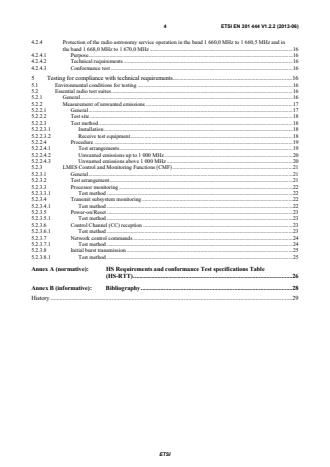
ETSI ETSI EN 301 444 V1.2.2 (2013-06) 3 Contents Intellectual Property Rights . 5 Foreword . 5 Introduction . 5 1 Scope . 7 2 References . 7 2.1 Normative references . 7 2.2 Informative references . 8 3 Definitions and abbreviations . 8 3.1 Definitions . 8 3.2 Abbreviations . 9 4 Technical requirement specifications . 9 4.1 Environmental profile . 9 4.2 Conformance requirements . 10 4.2.0 Maximum EIRP . 10 4.2.0.1 Justification . 10 4.2.0.2 Specification. 10 4.2.0.3 Conformance test . 10 4.2.1 Unwanted emissions outside the band 1 625,8 MHz to 1 661,2 MHz and outside the band 1 667,3 MHz to 1 675,7 MHz . 10 4.2.1.1 Justification . 10 4.2.1.2 Specification. 10 4.2.1.3 Conformance test . 12 4.2.2 Maximum unwanted emissions within the 1 625,8 MHz to1 661,2 MHz band and within the 1 667,3 MHz to 1 675,7 MHz band . 12 4.2.2.1 Justification . 12 4.2.2.2 Specifications . 13 4.2.2.3 Conformance test . 13 4.2.3 Control and Monitoring Functions (CMF) . 14 4.2.3.1 General . 14 4.2.3.2 Processor monitoring . 14 4.2.3.2.1 Justification . 14 4.2.3.2.2 Specification . 14 4.2.3.2.3 Conformance test . 14 4.2.3.3 Transmit subsystem monitoring . 14 4.2.3.3.1 Justification . 14 4.2.3.3.2 Specification . 14 4.2.3.3.3 Conformance test . 14 4.2.3.4 Power-on/reset . 14 4.2.3.4.1 Justification . 14 4.2.3.4.2 Specification . 14 4.2.3.4.3 Conformance test . 15 4.2.3.5 Control Channel (CC) reception . 15 4.2.3.5.1 Justification . 15 4.2.3.5.2 Specification . 15 4.2.3.5.3 Conformance test . 15 4.2.3.6 Network control commands . 15 4.2.3.6.1 Justification . 15 4.2.3.6.2 Specification . 15 4.2.3.6.3 Conformance test . 15 4.2.3.7 Initial burst transmission . 16 4.2.3.7.1 Justification . 16 4.2.3.7.2 Specification . 16 4.2.3.7.3 Conformance test . 16 SIST EN 301 444 V1.2.2:2013
ETSI ETSI EN 301 444 V1.2.2 (2013-06) 4 4.2.4 Protection of the radio astronomy service operation in the band 1 660,0 MHz to 1 660,5 MHz and in the band 1 668,0 MHz to 1 670,0 MHz . 16 4.2.4.1 Purpose . 16 4.2.4.2 Technical requirements . 16 4.2.4.3 Conformance test . 16 5 Testing for compliance with technical requirements . 16 5.1 Environmental conditions for testing . 16 5.2 Essential radio test suites . 16 5.2.1 General . 16 5.2.2 Measurement of unwanted emissions . 17 5.2.2.1 General . 17 5.2.2.2 Test site . 18 5.2.2.3 Test method . 18 5.2.2.3.1 Installation . 18 5.2.2.3.2 Receive test equipment . 18 5.2.2.4 Procedure . 19 5.2.2.4.1 Test arrangements . 19 5.2.2.4.2 Unwanted emissions up to 1 000 MHz . 20 5.2.2.4.3 Unwanted emissions above 1 000 MHz . 20 5.2.3 LMES Control and Monitoring Functions (CMF) . 21 5.2.3.1 General . 21 5.2.3.2 Test arrangement . 21 5.2.3.3 Processor monitoring . 22 5.2.3.3.1 Test method . 22 5.2.3.4 Transmit subsystem monitoring . 22 5.2.3.4.1 Test method . 22 5.2.3.5 Power-on/Reset . 23 5.2.3.5.1 Test method . 23 5.2.3.6 Control Channel (CC) reception . 23 5.2.3.6.1 Test method . 23 5.2.3.7 Network control commands . 24 5.2.3.7.1 Test method . 24 5.2.3.8 Initial burst transmission . 25 5.2.3.8.1 Test method . 25 Annex A (normative): HS Requirements and conformance Test specifications Table (HS-RTT) . 26 Annex B (informative): Bibliography . 28 History . 29
ETSI ETSI EN 301 444 V1.2.2 (2013-06) 5 Intellectual Property Rights IPRs essential or potentially essential to the present document may have been declared to ETSI. The information pertaining to these essential IPRs, if any, is publicly available for ETSI members and non-members, and can be found in ETSI SR 000 314: "Intellectual Property Rights (IPRs); Essential, or potentially Essential, IPRs notified to ETSI in respect of ETSI standards", which is available from the ETSI Secretariat. Latest updates are available on the ETSI Web server (http://ipr.etsi.org). Pursuant to the ETSI IPR Policy, no investigation, including IPR searches, has been carried out by ETSI. No guarantee can be given as to the existence of other IPRs not referenced in ETSI SR 000 314 (or the updates on the ETSI Web server) which are, or may be, or may become, essential to the present document. Foreword This Harmonized European Standard (EN) has been produced by ETSI Technical Committee Satellite Earth Stations and Systems (SES). The present document has been produced by ETSI in response to a mandate from the European Commission issued under Directive 98/34/EC [i.1] as amended by Directive 98/48/EC [i.2]. The title and reference to the present document are intended to be included in the publication in the Official Journal of the European Union of titles and references of Harmonized Standard under the Directive 1999/5/EC [1]. See article 5.1 of Directive 1999/5/EC [1] for information on presumption of conformity and Harmonised Standards or parts thereof the references of which have been published in the Official Journal of the European Union. The requirements relevant to Directive 1999/5/EC [1] are summarised in annex A.
National transposition dates Date of latest announcement of this EN (doa): 30 September 2013 Date of latest publication of new National Standard or endorsement of this EN (dop/e):
31 March 2014 Date of withdrawal of any conflicting National Standard (dow): 30 September 2016
Introduction The requirements defined in the present document have been selected to ensure an adequate level of compatibility with other radio services. The levels, however, do not cover extreme cases, which may occur in any location but with a low probability of occurrence. The present document may not cover those cases where a potential source of interference which is producing individually repeated transient phenomena or a continuous phenomenon is present, e.g. a radar or broadcast site in the near vicinity. In such a case it may be necessary to use special protection applied to either the source of interference, or the interfered part or both. The present document does not contain any requirement, recommendation or information about the installation of the LMES. SIST EN 301 444 V1.2.2:2013
ETSI ETSI EN 301 444 V1.2.2 (2013-06) 6 The previous version [6] of this harmonized standard contained two sets of limits to provide a transition from
...